Key Differences for Product Development
Introduction: Why Brands Confuse These Technologies
Walk any supplement trade show floor and you’ll hear the same claims: “liposomal absorption,” “micellar technology,” “advanced bioavailability.” For procurement managers evaluating contract manufacturing partners, the distinction matters profoundly—yet most marketing materials treat these delivery systems as interchangeable buzzwords.
The confusion stems from a genuine overlap: both technologies use amphiphilic molecules to enhance absorption of poorly soluble compounds. Both create nano-scale carriers. Both command premium pricing. But from a manufacturing, regulatory, and commercial standpoint, liposomes and micelles represent fundamentally different engineering decisions with divergent cost structures, stability profiles, and ingredient compatibility.
This guide examines both systems through the lens of B2B product development: technical architecture, commercial viability, formulation constraints, manufacturing scalability, and the specific audit criteria procurement teams should apply when vetting OEM partners.
What Are Micelles?
Structure
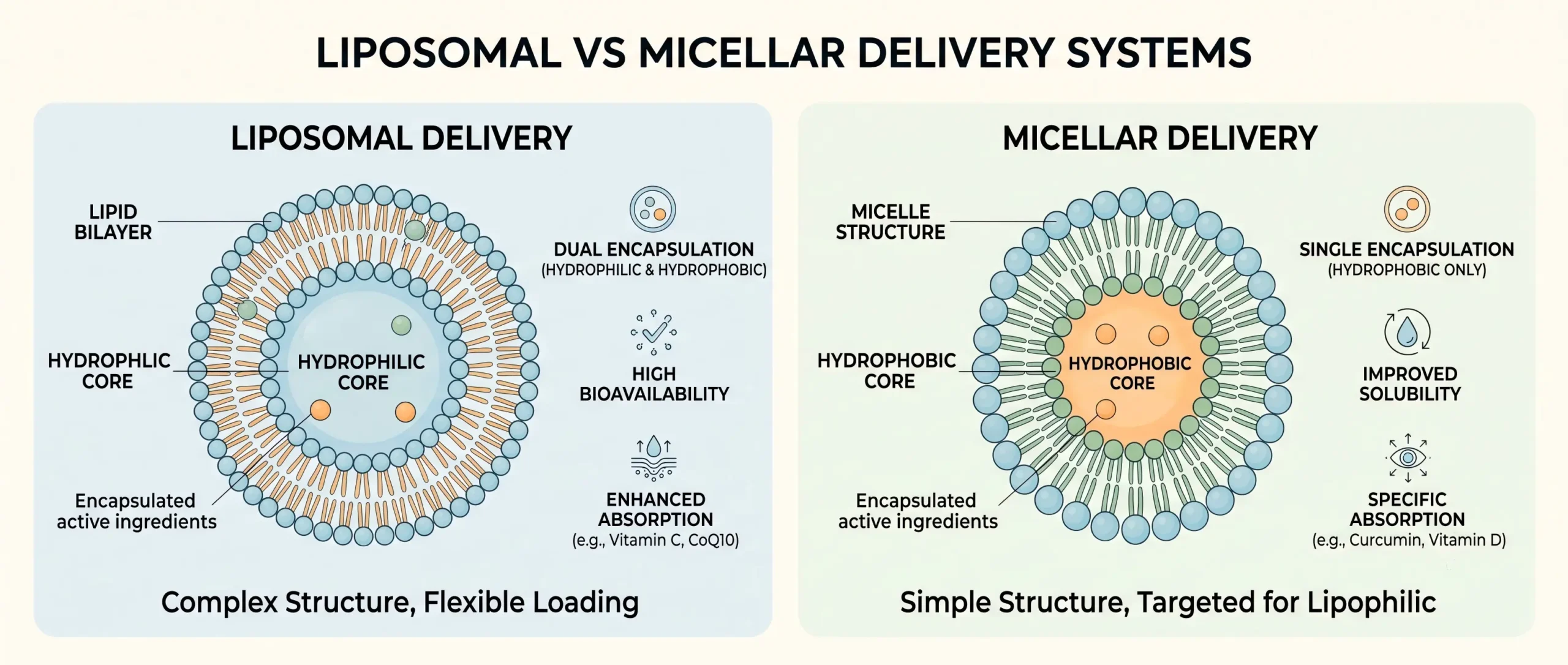
Micelles are self-assembled spherical structures composed of surfactant molecules arranged in a single monolayer. Each molecule orients with its hydrophilic (water-attracting) head facing the aqueous exterior and its hydrophobic (water-repelling) tail pointing inward, creating a lipophilic core. This configuration resembles a bicycle wheel: hydrophilic heads form the rim, hydrophobic tails act as spokes converging toward the center where active compounds reside.
Typical micelle diameters range from 2–20 nm, making them among the smallest functional delivery vehicles in nutraceutical formulation. Their diminutive size enables penetration through biological barriers that larger carriers cannot access.
Formation
Micelle assembly occurs spontaneously when surfactant concentration exceeds the critical micelle concentration (CMC)—a threshold specific to each surfactant type and dependent on environmental conditions including temperature, pH, and ionic strength. Below the CMC, surfactant molecules exist as individual entities; above it, they aggregate into functional micellar structures.
The thermodynamics driving micelle formation follow the equation: ΔG = ΔH − TΔS. The process is entropy-driven: as hydrophobic tails aggregate, structured water molecules surrounding them are released, increasing system entropy and making micellization energetically favorable.
In biological systems, bile salts naturally form micelles to emulsify and transport dietary lipids and fat-soluble vitamins. This endogenous mechanism validates micellar delivery as physiologically compatible.
Absorption Mechanism
Micelles enhance absorption through several pathways:
Solubilization: They increase the apparent aqueous solubility of lipophilic compounds beyond their intrinsic limits
Mucosal penetration: Their small size facilitates diffusion across intestinal epithelium
Lymphatic transport: Some micellar formulations access lymphatic circulation, bypassing hepatic first-pass metabolism
Research on micelle characteristics and intestinal absorption demonstrates that micelle shape, size, and zeta potential directly influence uptake efficiency through Niemann-Pick C1-like 1 (NPC1L1) protein interactions—a selective binding mechanism that regulates cholesterol and phytosterol absorption.
What Are Liposomes?
Liposomes are vesicular structures composed of one or more phospholipid bilayers surrounding an aqueous core. Unlike micelles, liposomes feature a true membrane architecture: hydrophilic heads face both the external environment and the internal aqueous compartment, while hydrophobic tails are sandwiched between these layers.
This bilayer construction gives liposomes unique dual-encapsulation capability:
Hydrophilic compounds (vitamin C, certain peptides, minerals) reside in the aqueous core
Lipophilic compounds (CoQ10, curcuminoids, vitamin D) embed within the bilayer itself
Liposome sizes for medical and nutraceutical applications typically range from 50–450 nm, though most functional formulations target the 100–200 nm range for optimal balance between encapsulation capacity and absorption efficiency.
The phospholipid composition—commonly phosphatidylcholine from soy or sunflower lecithin—determines membrane fluidity, charge characteristics, and biocompatibility. Cholesterol is frequently incorporated (up to ~50 mol% in optimized formulations) to modulate membrane rigidity and reduce permeability, enhancing stability during storage and gastrointestinal transit.
Liposomes vs Micelles: Technical Comparison
| Feature | Liposome | Micelle |
| Bilayer Structure | Yes—phospholipid bilayer(s) with aqueous core | No—single surfactant monolayer |
| Size Range | 50–450 nm (typical: 100–200 nm) | 2–20 nm |
| Encapsulation Capacity | Hydrophilic & lipophilic simultaneously | Primarily lipophilic |
| Encapsulation Efficiency | 60–85% (ingredient-dependent) | Variable; generally lower for complex actives |
| Stability | Higher—bilayer resists dissociation | Lower—disassembles below CMC |
| Shelf Life | 18–36 months (properly formulated) | 12–24 months (typically) |
| Manufacturing Complexity | High—requires specialized equipment | Low—simple mixing processes |
| Cost per Unit Dose | Higher (3–8× conventional formulations) | Lower (1.5–3× conventional formulations) |
| Scalability | Moderate—batch-to-batch consistency challenges | High—easily scaled |
| Regulatory Precedent | Extensive (pharmaceutical liposomes since 1990s) | Growing (food-grade surfactants well-established) |
Key Structural Distinctions
The bilayer versus monolayer difference is not academic—it determines every downstream performance characteristic. Liposomes’ phospholipid bilayers resemble cell membrane architecture, enabling fusion with enterocyte membranes or uptake via endocytosis. This biomimetic quality supports targeted delivery and sustained release. Micelles lack this structural complexity; their function is primarily solubilization and transport rather than membrane-mediated delivery.
Ingredient Suitability: Matching Actives to Delivery Systems
Vitamins
Vitamin C (Ascorbic Acid): Liposomal delivery demonstrates clinically validated superiority. A randomized, double-blind, placebo-controlled crossover trial (n=27) showed that 500 mg liposomal vitamin C achieved 27% higher plasma Cmax and 21% greater AUC₀₋₂₄ compared to standard vitamin C, with leukocyte concentrations increasing by 20%.
A separate open-label pharmacokinetic study confirmed 1.77× greater bioavailability for liposomal versus non-liposomal vitamin C, with encapsulation efficiency of 65.85% and particle size below 100 nm.
Fat-Soluble Vitamins (A, D, E, K): Both systems are viable. Micelles offer cost-effective solubilization for standard potency products. Liposomes provide additional protection against oxidative degradation for premium positioning—particularly relevant for vitamin E tocopherols and vitamin D3, which are susceptible to environmental stressors.
Polyphenols
Curcumin: This poorly bioavailable polyphenol illustrates the dramatic impact of delivery technology. Liquid micellar curcumin formulations have demonstrated 185-fold increases in oral bioavailability compared to unformulated curcumin in pharmacokinetic studies.
Liposomal curcumin (e.g., Meriva® phytosome complex) has shown 19–32× absorption increases. The choice depends on target market: micellar for maximum bioavailability at moderate cost; liposomal for dual-ingredient formulations or sustained-release positioning.
Quercetin: Self-emulsifying micellar-hydrogel systems have achieved 18.61-fold improvement in free quercetin bioavailability and 62.08-fold for total quercetin (including metabolites) versus unformulated quercetin in human trials.
Antioxidants
Coenzyme Q10 (Ubiquinone): Both delivery systems have demonstrated efficacy. Liposomal CoQ10 encapsulates ubiquinone within phospholipid bilayers that resemble human cell membranes, protecting against degradation and facilitating efficient intestinal uptake. Micellar (self-emulsifying) systems increase CoQ10 solubility in gastrointestinal fluids, improving bioaccessibility and reducing dependence on high-fat meals for absorption.
Comparative data indicate that lipid-based delivery systems produce higher and more predictable plasma CoQ10 exposure than conventional formulations, with clinical benefits typically emerging after 8–12 weeks of consistent supplementation.
Glutathione: As a tripeptide with poor oral stability, liposomal encapsulation is strongly preferred. The aqueous core protects reduced glutathione from gastric degradation, while the bilayer facilitates absorption via enterocyte membrane interaction.
Peptides
Small peptides (2–10 amino acids) generally favor liposomal delivery due to:
Aqueous core compatibility
Protection from proteolytic degradation
Controlled release kinetics
Micelles are generally unsuitable for hydrophilic peptides unless chemically modified with lipophilic moieties—a transformation that adds regulatory complexity.
Manufacturing Complexity: What OEM Partners Must Demonstrate
Liposome Manufacturing Challenges
Formulation Development
Liposome production requires precise control over multiple variables:
Phospholipid selection: Source (soy vs. sunflower), fatty acid profile (saturated vs. unsaturated), and purification grade affect membrane properties
Cholesterol ratio: Optimal concentrations (~50 mol% in some formulations) must balance fluidity with rigidity
Hydration methodology: Thin-film hydration, reverse-phase evaporation, ethanol injection, or microfluidic channel methods each produce different vesicle characteristics
Size control: Extrusion through polycarbonate membranes or high-pressure homogenization to achieve target particle distribution
Quality Control Requirements
| Parameter | Method | Acceptance Criteria |
| Particle size | Dynamic Light Scattering (DLS) | 100–200 nm (typical target) |
| Polydispersity Index (PDI) | DLS | <0.2 (monodisperse preferred) |
| Zeta potential | Electrophoretic light scattering | ±30 mV (colloidal stability) |
| Encapsulation efficiency | Ultracentrifugation + HPLC | ≥60% (ingredient-specific) |
| Lamellarity | Cryo-TEM / NMR | Unilamellar preferred for oral delivery |
| Sterility | Membrane filtration | Per pharmacopeial standards |
Scale-Up Considerations
Liposome manufacturing presents well-documented scale-up challenges. Batch-to-batch consistency in particle size distribution and encapsulation efficiency requires validated processes. Microfluidic methods offer improved reproducibility compared to traditional thin-film hydration but require significant capital investment.
Micelle Manufacturing Challenges
Formulation Simplicity
Micelle production is comparatively straightforward: surfactant and active compound are combined above the CMC, typically through simple mixing, heating, or homogenization. This simplicity enables faster development timelines and lower technical barriers to entry.
Quality Control Requirements
| Parameter | Method | Acceptance Criteria |
| Particle size | DLS | 2–20 nm |
| CMC determination | Surface tension / conductivity | Documented for surfactant system |
| Zeta potential | Electrophoretic light scattering | Stable across pH range |
| Surfactant residue | HPLC / GC | Within regulatory limits |
| Thermal stability | Accelerated aging studies | No phase separation at 40°C/75% RH |
Stability Vulnerabilities
Micelles’ primary manufacturing risk is CMC-dependent dissociation. Dilution below the critical concentration—whether during gastrointestinal transit, in aqueous finished products, or through consumer misuse—causes structural collapse and payload release. Formulation must include sufficient surfactant excess or polymeric stabilization to maintain integrity under stress conditions.
Which Technology Should Brands Choose?
Premium Positioning Strategy
Choose Liposomes When:
Target retail price exceeds $0.50 per serving
Clinical substantiation is central to marketing claims
Formula includes both hydrophilic and lipophilic actives
Brand positioning emphasizes “pharmaceutical-grade” or “clinically validated”
Sustained-release or targeted delivery is a differentiator
Clinical Evidence Value: The liposomal vitamin C studies demonstrate how rigorous trial design (randomized, double-blind, placebo-controlled, crossover) generates defensible marketing claims. The 27% plasma Cmax increase and 20% leukocyte improvement provide specific, quantified benefits that resonate with healthcare practitioners and educated consumers.
Cost Optimization Strategy
Choose Micelles When:
Target retail price is $0.20–0.40 per serving
Single lipophilic active is primary ingredient
Rapid market entry is prioritized over clinical differentiation
Formula stability requirements are moderate
Volume SKUs (bulk powders, large-format liquids) dominate portfolio
Functional Performance Matrix
| Ingredient Category | Liposomal Advantage | Micellar Advantage |
| Hydrophilic vitamins (C, B-complex) | Strong | None |
| Lipophilic vitamins (A, D, E, K) | Moderate | Cost |
| Polyphenols (curcumin, quercetin, resveratrol) | Dual-loading | Maximum bioavailability/cost ratio |
| Peptides (<10 amino acids) | Strong | Limited applicability |
| Peptides (>10 amino acids) | Moderate | Not suitable |
| Minerals (ionic) | Aqueous core loading | Not suitable |
| Botanical extracts (lipophilic) | Protection from oxidation | Cost-effective solubilization |
OEM Considerations: Audit Criteria for Contract Manufacturing Partners
When evaluating supplement contract manufacturers for liposomal or micellar production, procurement teams should verify the following capabilities:
Facility & Equipment
Dedicated cleanroom space: Liposome production requires ISO 7 or better environment to prevent particulate contamination
High-shear homogenization or microfluidic systems: Essential for consistent liposome size distribution
Extrusion capability: For size reduction and unilamellar vesicle production
Cryo-TEM access: Either in-house or contracted—required for definitive lamellarity verification
Accelerated stability chambers: ICH Q1A-compliant for shelf-life projection
Analytical Validation
Method validation documentation: DLS, HPLC for encapsulation efficiency, and relevant compendial methods
Reference standard traceability: USP, EP, or in-house validated standards
Batch release criteria: Documented specifications with statistical process control
Regulatory Documentation
GRAS status verification: For novel surfactants or phospholipid sources
New Dietary Ingredient (NDI) assessment: If applicable for innovative delivery formats
International compliance: EU Novel Food, TGA, Health Canada requirements for export markets
Commercial Indicators
Minimum Order Quantities (MOQs): Liposomal production typically requires higher volume commitments due to equipment changeover complexity
Lead times: 8–16 weeks typical for liposomal development; 4–8 weeks for micellar
Pricing structure: Raw material costs (pharmaceutical-grade phospholipids vs. food-grade surfactants) drive significant COGS differences
Frequently Asked Questions
Q: Can liposomes and micelles be combined in a single formula? A: Yes—hybrid systems exist where micelles are incorporated within liposomal structures or where both carriers coexist in a single matrix. However, compatibility testing is essential as surfactants can disrupt phospholipid bilayers at concentrations above their CMC. Such formulations require sophisticated stability validation.
Q: Which system has stronger regulatory precedent? A: Liposomes. The pharmaceutical industry has used liposomal drug delivery since the 1990s (Doxil® was FDA-approved in 1995), creating extensive toxicological and clinical databases. Micellar systems leverage food-grade surfactant approvals but lack equivalent pharmaceutical validation for novel applications.
Q: How should brands communicate delivery system benefits without overstating? A: Reference specific clinical endpoints (Cmax, AUC, cellular uptake) rather than generic “better absorption” claims. The 27% plasma increase and 21% AUC improvement for liposomal vitamin C are quantified, defensible statements. Avoid “4× better” claims unless supported by peer-reviewed pharmacokinetic studies with appropriate study design.
Q: What is the typical shelf-life differential? A: Properly formulated liposomes achieve 24–36 months at controlled room temperature. Micellar systems typically achieve 12–24 months, though polymeric micelles and concentrated liquid formats can extend this range.
Q: Are there ingredient loading capacity differences? A: Yes. Liposomes can achieve 60–85% encapsulation efficiency for compatible actives, with total payload limited by bilayer capacity and aqueous core volume. Micelles generally have lower encapsulation efficiency for complex actives but can achieve high surfactant-to-drug ratios with simple lipophiles.
Conclusion: Making the Manufacturing Decision
The liposomal versus micellar decision is not a technology beauty contest—it is a strategic alignment of delivery science with brand positioning, target pricing, ingredient portfolio, and manufacturing partnership capabilities.
For brands targeting premium clinical nutrition markets, investing in liposomal technology provides stronger differentiation, more robust clinical substantiation, and broader ingredient compatibility. The trade-off is higher COGS, longer development timelines, and greater manufacturing complexity requiring specialized OEM partners.
For brands prioritizing market penetration and cost-competitive positioning, micellar technology delivers meaningful bioavailability enhancement at accessible price points, with faster development cycles and simpler manufacturing scale-up.
The critical success factor in either case is OEM partner selection. A contract manufacturer with validated liposomal processes, documented analytical capabilities, and transparent quality systems transforms delivery technology from marketing claim to reproducible product performance. Request batch records, stability data, and third-party analytical verification before committing production volumes.
Ready to develop your next-generation delivery system product? Contact our formulation team to discuss liposomal and micellar feasibility assessments, pilot batch production, and clinical batch manufacturing capabilities.
This technical guide is intended for B2B product development professionals and procurement teams evaluating supplement contract manufacturing partnerships. All clinical data referenced originates from peer-reviewed publications and publicly available trial registries.
References
Purpura M, Jäger R, Godavarthi A, et al. Liposomal delivery enhances absorption of vitamin C into plasma and leukocytes: a double-blind, placebo-controlled, randomized trial. Eur J Nutr. 2024;63(8):3037-3046. https://pmc.ncbi.nlm.nih.gov/articles/PMC11519160/
Gopi S, Balakrishnan P. Evaluation and clinical comparison studies on liposomal and non-liposomal ascorbic acid (vitamin C) and their enhanced bioavailability. J Liposome Res. 2021;31(4):356-364. https://pubmed.ncbi.nlm.nih.gov/32901526/
Aizawa H. Impact of micelle characteristics on cholesterol absorption and ezetimibe inhibition: Insights from Niemann-Pick C1-like 1 binding and molecular structure. J Liposome Res. 2024. https://pubmed.ncbi.nlm.nih.gov/37905576/
Akbarzadeh A, et al. Liposome: classification, preparation, and applications. Nanoscale Res Lett. 2013;8:102. (Referenced in NRFHH 2026 Lipomac trial)
Thimmannagari S, et al. A clinical evaluation of liposomal (Lipomac™) versus nonliposomal vitamin C: A randomized, open-label, cross-over trial in healthy subjects. NRFHH. 2026;6(1):249-256. https://www.nrfhh.com/A-clinical-evaluation-of-liposomal-Lipomac-versus-nonliposomal-vitamin-C-A-randomized,211489,0,2.html
Stahl W, et al. (Referenced in curcumin bioavailability data). In: Enhancing the Bioavailability and Bioactivity of Curcumin for Disease Prevention and Treatment. PMC10967568. https://pmc.ncbi.nlm.nih.gov/articles/PMC10967568/
Joseph A, Shanmughan P, Balakrishnan A, Maliakel B. Enhanced Bioavailability and Pharmacokinetics of a Natural Self-Emulsifying Reversible Hybrid-Hydrogel System of Quercetin: A Randomized Double-Blinded Comparative Crossover Study. ACS Omega. 2026. https://pubs.acs.org/doi/10.1021/acsomega.2c05929
Bozzuto G, Molinari A. Liposomes as nanomedical devices. Int J Nanomedicine. 2015;10:975-999. https://pmc.ncbi.nlm.nih.gov/articles/PMC9118483/
Kaddah S, et al. Cholesterol content effects on liposome membrane permeability and fluidity. In: Liposomes: structure, composition, types, and clinical applications. PMC9118483.
Bedu-Addo FK, Tang P, Xu Y, Huang L. Interaction of polyethyleneglycol-phospholipid conjugates with cholesterol-phosphatidylcholine mixtures: sterically stabilized liposome formulations. Pharm Res. 1996;13(5):710-717. https://pubmed.ncbi.nlm.nih.gov/8860426/
Interaction of Phospholipid, Cholesterol, Beta-Carotene, and Vitamin C Molecules in Liposome-Based Drug Delivery Systems: An In Silico Study. PMC. https://pmc.ncbi.nlm.nih.gov/articles/PMC9833918/
Comparative Analysis of Liposomal and Surfactant-Based Drug Delivery Systems. Preprints. 2025. https://www.preprints.org/manuscript/202511.0347