For supplement brands and procurement teams: A black cohosh dose is a formulation decision, not just a number on a label. Whether evaluating a 40 mg specification or a 540 mg label claim, the milligram amount alone cannot determine whether the extract will fit a capsule, what it will cost to manufacture, or whether the finished product will be commercially viable.
This guide explains how to interpret black cohosh dose figures from a procurement and manufacturing perspective, what extract specifications actually mean, and how to move from an observed label amount to a black cohosh supplement decision.
1. What Does a Black Cohosh Dose Actually Mean?
A label that reads “40 mg black cohosh” and another that reads “540 mg black cohosh” are not directly comparable until the number’s meaning is understood. The same milligram amount can describe:
- Raw botanical powder (ground Actaea racemosa root or rhizome)
- A concentrated extract with no defined marker compound level
- A standardized extract with verified content of specific constituents
- A proprietary blend where black cohosh is only one component
- A botanical-equivalent amount derived from an extract ratio
For procurement, the critical first step is to determine which category applies. Without this clarification, comparing supplier quotes, calculating formulation feasibility, or estimating finished-product cost is not possible.
Why This Matters for Brands
When requesting a quote for “black cohosh 40 mg” or “black cohosh 540 mg,” suppliers may interpret the request differently. One may quote a raw powder. Another may quote a 10:1 extract. A third may quote a standardized extract with defined triterpene glycoside content. The price, physical properties, and regulatory documentation for these three materials will differ substantially.
Decision point: Before comparing suppliers, define whether the target dose refers to raw botanical weight, extract weight, or standardized extract weight.
2. Extract Weight vs Extract Potency vs Standardization
This section addresses the core technical question that determines every downstream manufacturing decision.
2.1 Botanical Identity
The correct botanical source is Actaea racemosa L. (syn. Cimicifuga racemosa). The part used in herbal preparations is the root or rhizome [1]. However, commercial products have been found to contain the wrong herb or mixtures of black cohosh with other herbs not listed on the label [1]. NCCIH specifically notes that it is possible, though not proven, that these contaminants might be responsible for cases of liver damage linked to black cohosh products [1].
Procurement implication: Identity verification through appropriate analytical methods (HPLC, DNA fingerprinting) is a baseline requirement, not an optional add-on.
2.2 Extract Ratio
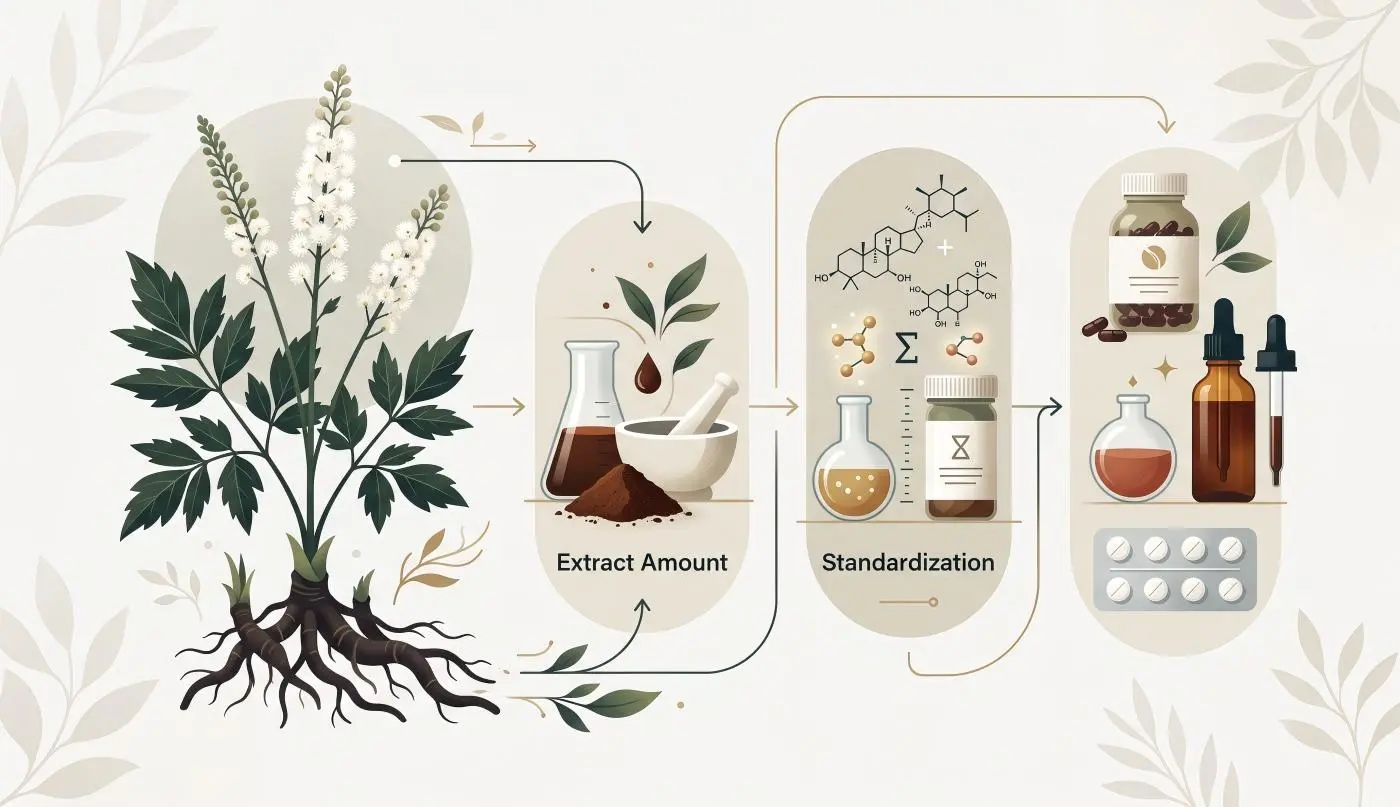
An extract ratio (e.g., 10:1) indicates that a certain amount of raw botanical was used to produce one part of extract. This describes concentration efficiency but does not, by itself, define the finished product’s active compound profile.
Extract ratio alone does not tell you:
- The solvent system used (ethanol, isopropanol, water)
- Which marker compounds were retained
- The physical properties of the extract (density, flowability, hygroscopicity)
- Whether the extract is standardized
2.3 Standardization
Standardization means the extract is manufactured and tested to contain a defined level of marker compounds. Depending on the extract, specifications may identify marker compounds such as triterpene glycosides or other defined constituents.
According to the NTP Technical Report, black cohosh products are generally standardized to the content of triterpene glycosides, such as 23-epi-26-deoxyactein (27-deoxyactein), actein, or cimicifugosides. Standardizing to attain a triterpene content of 2.5%, or approximately 1 mg of a given triterpene, is common [2]. However, one analytical study of 11 commercial black cohosh products found that actual triterpene glycoside content ranged from 0.36% to 7.55%, even though 8 of the 11 products carried a label claim of 2.5% [2].
Procurement implication: A label claim of “2.5% triterpene glycosides” should be supported by a Certificate of Analysis (COA) using a validated analytical method. Do not assume that all suppliers’ “2.5%” specifications are equivalent.
2.4 Why Standardization Matters More Than the Headline Milligram
When comparing suppliers, compare the complete extract specification—not only “mg per capsule.”
| Factor | Standardized Extract | Non-Standardized Extract |
| Batch-to-batch consistency | Higher | Variable |
| Label claim defensibility | Stronger | Weaker |
| Formulation predictability | Higher | Lower |
| Raw material cost | Typically higher | Typically lower |
3. How to Read 40 mg, 540 mg and Other Black Cohosh Label Amounts
This section directly addresses the search intent behind “black cohosh 40 mg” and “540 mg black cohosh.” These numbers appear on commercial labels, but they cannot be interpreted in isolation.
3.1 The 40 mg Figure
Forty milligrams appears in some studied and commercial extract preparations. The Spanish Menopause Society’s 2022 position statement notes that most well-designed studies in recent years have been conducted with isopropanolic extracts, and the most common dose studied is 40 mg/day [3].
However, this should not be treated as a universal black cohosh dosage. A 2023 NCCIH review of 22 studies found that products containing black cohosh extracts were potentially beneficial for overall menopause symptoms, with improvements in hot flashes, but data on anxiety or depressive symptoms were limited [1].
Furthermore, not all clinical trials have shown benefit. One randomized controlled trial in 54 women found that 40 mg daily of a specific extract for 12 weeks improved symptoms to a similar extent as placebo, with no serious adverse events [4]. Another study in Thai women found that a 40 mg/day compound was not more successful in decreasing menopause symptoms versus placebo [5].
For procurement: 40 mg may represent a specific studied preparation, but the extract identity and specification matter more than the number itself.
3.2 The 540 mg Figure
A 540 mg label claim cannot be interpreted from the number alone. It may represent:
- Raw botanical powder
- An extract with a specific ratio
- Extract plus carrier or excipient
- A proprietary blend where black cohosh is only one ingredient
- A per-serving amount rather than per-capsule amount
There is no authoritative clinical or regulatory source that defines 540 mg as a standard black cohosh dose. For a B2B buyer, seeing “540 mg” on a competitor’s label or a supplier’s spec sheet should trigger a verification process, not an assumption.
3.3 Buyer Verification Checklist
| Label Statement | Buyer Should Verify |
| “40 mg Black Cohosh” | Is this powder, extract, or standardized extract? |
| “40 mg Extract” | What is the extract ratio? What solvent was used? |
| “40 mg Standardized Extract” | What is the standardization target and method? |
| “540 mg Black Cohosh” | Is this raw material, extract, or a blend? |
| “540 mg Extract” | What is the extract ratio? Is a carrier included? |
| “Proprietary Blend” | What is the actual black cohosh amount? |
These are formulation and procurement considerations, not clinical dosage recommendations.
3.4 Clinical Dose Context
According to the NTP Technical Report, black cohosh doses in clinical trials evaluating efficacy have ranged from 6.5 to 160 mg/day for 1–12 months [2]. The German Commission E recommends 40 mg/day of alcohol extracts, not to exceed 6 months of use [2]. StatPearls notes that there is no standardized dose for black cohosh, and doses of various commercially available supplements vary greatly [6].
4. Dose → Extract Load → Dosage Form
This is the core manufacturing decision chain. The extract mass, total active load, and physical properties of the material determine which dosage forms are practical.
4.1 How Extract Load Influences Dosage Form Selection
If extract load is low (concentrated standardized extract):
- Capsule and tablet are both feasible
- Smaller unit size
- Lower excipient requirement
- More formulation space for combination ingredients
If extract load increases:
- Capsule fill capacity becomes a constraint
- Tablet may provide more formulation flexibility for higher mass
- Multiple capsules per serving may be required
If total formula load is high (multi-ingredient formula):
- Tablet often offers more physical space for multiple actives
- Total active load must be calculated before dose is locked
- Powder format may be considered for very high serving masses
If taste or odor is a concern:
- Film-coated tablets offer better sensory masking than uncoated tablets
- Capsules provide inherent taste/odor barrier
- Powder formats may require flavor masking systems
4.2 Dosage Form Decision Table
| Formulation Condition | More Practical Options | Why |
| Low extract load | Capsule / tablet | Both offer sufficient dose capacity |
| High extract load | Tablet / multiple capsules | Single capsule fill capacity becomes limiting |
| Strong botanical taste | Film-coated tablet / capsule | Better sensory masking |
| Multi-ingredient formula | Tablet / larger capsule | Total active load becomes critical |
| Very high serving mass | Powder | Avoids excessive unit count per serving |
4.3 Softgel Consideration
Softgels are generally not the default dosage form for conventional dry black cohosh extracts unless the formulation uses a compatible oil-based delivery system. For most standard black cohosh extracts, capsules or tablets remain the practical choices.
5. Dose → Product Cost
For B2B buyers, the relevant comparison is not raw material price per kilogram. It is cost per finished serving and cost per 30-day supply.
5.1 Why Cost per Kilogram Is Misleading
Supplier A at $X/kg and Supplier B at $Y/kg is the wrong comparison if:
- The extracts have different concentrations
- The recommended serving sizes differ
- One requires more excipients, larger capsules, or more complex manufacturing
5.2 Total Product Cost Components
Finished-product cost includes:
- Raw material (extract cost × dose per serving)
- Excipients (binders, fillers, flow agents, lubricants)
- Manufacturing (compression, encapsulation, coating)
- Packaging (bottle size, desiccant, label, carton)
- Testing (identity, potency, microbiology, stability)
- Logistics (shipping weight, pallet volume)
5.3 Cost Comparison Example
Consider two theoretical approaches:
| Parameter | Scenario A | Scenario B |
| Extract type | Concentrated standardized | Higher mass loading |
| Dose per serving | 40 mg | 270 mg × 2 capsules |
| Raw material cost | Higher per kg | Lower per kg |
| Excipient load | Lower | Higher |
| Capsule/tablet size | Smaller | Larger or multiple units |
| Packaging volume | Smaller | Larger |
| Shipping cost | Lower | Higher |
| Cost per 30-day supply | Depends on full calculation | Depends on full calculation |
The cheapest raw material does not always yield the lowest-cost finished product.
6. Dose → Tablet Size, Capsule Count & Consumer Experience
This section addresses product-market fit from a physical-product perspective—not efficacy claims, but the consumer’s interaction with the finished unit.
6.1 Tablet Size Considerations
As extract mass per serving increases, tablet size increases. Larger tablets can create a practical swallowability consideration, particularly when a formula requires multiple units per serving. For procurement, this means:
- Tablet diameter and thickness must be confirmed during formulation development
- Scoring may be considered for larger tablets
- Tablet architecture (standard, bilayer, core) affects size and manufacturing complexity
6.2 Capsule Size Considerations
Capsule size selection depends on:
- Powder density of the extract
- Tapped density of the formulated blend
- Excipient system
- Filling equipment capability
- Target fill weight
Approximate fill capacity varies substantially with powder density and formulation. Capsule size alone should not be used to determine whether a specific black cohosh formula will fit.
Common capsule sizes for reference (not fixed capacities):
- Size #1: Used for low-to-moderate fill weights
- Size #0: Moderate fill weight applications
- Size #00: Higher fill weight, but larger physical size
6.3 Number of Units Per Serving
| Units per Serving | Implications |
| 1 tablet/capsule | Maximum convenience; simpler packaging communication |
| 2 capsules | Common for botanicals; acceptable to most consumers |
| 3+ units | Compliance consideration; packaging and cost increase |
6.4 Taste and Odor
Black cohosh has distinct botanical characteristics. For finished products, this influences:
- Tablet coating selection
- Capsule versus tablet choice
- Consumer acceptance and repeat purchase potential
7. Dose → Stability → Packaging
Packaging selection should be confirmed through finished-product stability assessment rather than selected solely from the ingredient name.
7.1 Extract Characteristics That Affect Stability
- Moisture sensitivity
- Hygroscopicity
- Carrier system composition
- Excipient compatibility
7.2 Dosage Form Stability Considerations
| Dosage Form | Stability Consideration |
| Tablet | Compressed form offers some protection; coating adds barrier |
| Capsule | Two-piece capsules offer less moisture protection than coated tablets; gelatin vs. HPMC choice matters |
| Powder | Highest surface area exposure; most vulnerable to moisture uptake and clumping |
7.3 Packaging Decision Framework
| Product Design | Main Consideration |
| Low-dose concentrated extract | Extract stability + blend uniformity |
| High-load tablet | Moisture + compression integrity + packaging barrier |
| Powder | Moisture uptake + clumping prevention |
| Multi-ingredient formula | Ingredient compatibility + stability interactions |
| High-humidity target market | Moisture barrier + packaging selection critical |
A study cited in the literature indicates that black cohosh is stable for at least 3 years when stored in a sealed container at room temperature (20°C to 25°C) and protected from light [7]. However, this refers to specific extract preparations, and finished-product stability should be confirmed through your own stability program.
8. What Buyers Should Ask a Black Cohosh Supplier
This is the core procurement module. Do not ask only “How many mg?” Request the complete specification.
8.1 Botanical Identity
- Species: Actaea racemosa L.
- Plant part: Root/rhizome
- Verification method: HPLC fingerprint, DNA analysis, or other validated method
8.2 Extract Specification
- Extract ratio (if applicable)
- Solvent system (ethanol, isopropanol, water, or combination)
- Standardization target (if any) with validated analytical method
- Marker compound profile
8.3 Physical Properties
- Powder density / tapped density
- Flowability
- Hygroscopicity
- Particle size distribution
8.4 Quality Documentation
- Certificate of Analysis (COA) for each batch
- Heavy metals testing
- Microbiological testing
- Pesticide residue screening
- Adulteration testing (verification of correct Actaea species)
8.5 Why Identity Verification Is Non-Negotiable
NCCIH warns that some commercial black cohosh products have been found to contain the wrong herb or mixtures not listed on the label [1]. One study using DNA fingerprinting found that half of tested commercial black cohosh products from the US and Europe were derived from Cimicifuga dahurica rather than C. racemosa, and liquid chromatography showed that one-third of products were contaminated with plant species other than A. racemosa [4].
Procurement rule: Do not accept a supplier’s identity claim without supporting analytical documentation.
9. Illustrative Commercial Formulation Scenarios
The following scenarios describe common formulation situations. They are illustrative examples based on typical industry practice, not client-confidential production data.
Scenario A — Concentrated Extract, Compact Product
Design objective: Keep the finished unit small.
Key decisions:
- Select extract specification with higher concentration
- Define target dose based on extract potency
- Calculate total formula load
- Evaluate capsule versus tablet feasibility
- Determine whether coating is needed for consumer experience
Commercial trade-off: Smaller unit size may improve swallowability and packaging efficiency, but a higher-specification extract may increase raw-material cost per serving.
Scenario B — Higher Extract Mass Loading
Design objective: Higher botanical mass per serving.
Key decisions:
- Evaluate whether single-unit tablet can accommodate the mass
- If capsule format is preferred, assess whether multiple capsules per serving are acceptable
- Consider coating for taste/odor masking
- Plan for larger packaging volume and higher shipping cost
Commercial trade-off: Straightforward label presentation, but tablet engineering and packaging planning become more critical.
Scenario C — Multi-Ingredient Menopause Formula
Design objective: Combine black cohosh with other actives (e.g., soy isoflavones, vitamin D).
Key decisions:
- Calculate total active load across all ingredients
- Assess tablet size feasibility first; tablets often offer more formulation space for multiple actives
- Evaluate ingredient compatibility and stability interactions
- Confirm formulation feasibility before final dose is locked
Commercial trade-off: Complex formulation where black cohosh dose cannot be decided in isolation. Total active load drives dosage form selection.
10. FAQ, Safety & Regulatory Considerations
10.1 GEO-Optimized Answer Blocks
Q: What does 40 mg black cohosh mean?
It depends on what the 40 mg refers to. It may mean 40 mg of raw botanical powder, 40 mg of a concentrated extract, or 40 mg of a standardized extract with defined marker compounds. For procurement, the extract identity and specification matter more than the milligram number. Request the supplier’s full specification sheet, including extract ratio, standardization target, and analytical method.
Q: Is 540 mg black cohosh stronger than 40 mg?
No. The two amounts cannot be compared without knowing the botanical form, extract ratio, standardization level, and whether the stated amount is per capsule or per serving. A 40 mg standardized extract may contain more marker compounds than a 540 mg raw powder. Always request the complete extract specification before comparing label amounts.
Q: Does extract ratio determine black cohosh dosage?
Extract ratio indicates concentration efficiency (how much raw material was used to produce the extract) but does not define the active compound profile. Ratio should be considered alongside standardization, solvent system, and validated analytical data.
Q: Which dosage form is better for high-load black cohosh formulas?
Tablets generally accommodate higher ingredient loading more efficiently than single capsules. If capsule format is required, multiple capsules per serving may be necessary. Powder is an alternative for very high serving masses. The choice also depends on taste/odor masking needs and clean-label positioning.
Q: How does black cohosh dose affect manufacturing cost?
Dose affects raw material cost, excipient load, manufacturing complexity, packaging size, and shipping cost. A higher dose often increases total product cost beyond the raw material price difference. Compare cost per finished serving, not cost per kilogram of extract.
Q: What should a buyer request from a black cohosh extract supplier?
Botanical identity verification, extract ratio and solvent system, standardization target with validated method, physical properties (density, flowability, hygroscopicity), heavy metals and microbiological testing, and adulteration screening. Do not rely on milligram amount alone.
10.2 Safety & Regulatory Considerations Buyers Should Not Ignore
Liver Safety Signal
While black cohosh has been used safely in research studies lasting as long as a year and is generally well tolerated, concerns have been raised that it may cause liver damage in some people [1]. Cases of liver damage—some very serious—have been reported in people taking products labeled as black cohosh. These problems are rare, and it is uncertain whether black cohosh was responsible for them [1].
The LiverTox database (National Institute of Diabetes and Digestive and Kidney Diseases) assigns a likelihood score of A, meaning “products sold as black cohosh are well established causes of clinically apparent liver injury, but the specific ingredient or component that accounts for the injury is unclear” [4]. In several retrieved cases, the implicated product was found to contain Chinese Actaea species rather than authentic black cohosh, raising the possibility that misidentification or adulteration—not A. racemosa itself—may explain some adverse events [4].
Regulatory and Labeling Considerations
- The FDA does not directly regulate black cohosh as a drug; dietary supplement regulations apply [6].
- The US Pharmacopeia has determined that black cohosh may be responsible for more than 30 cases of liver damage; worldwide, there have been 83 reports. No causal relationship has been established [6].
- The US Pharmacopeia recommended that products contain the following label: “Discontinue use and consult a healthcare practitioner if you have a liver disorder or develop symptoms of liver trouble, such as abdominal pain, dark urine, or jaundice.” [6]
- Black cohosh may not be safe for use during pregnancy or while breastfeeding [1].
Procurement Implication: Quality documentation, identity verification, and appropriate labeling are not optional—they are baseline requirements for a commercially viable and legally defensible product.
10.3 How to Choose the Right Black Cohosh Dose: A 10-Step Framework
- Step 1: Define target market and consumer demographics
- Step 2: Define desired botanical positioning (premium, mass-market, clean-label)
- Step 3: Select extract specification (botanical identity, ratio, standardization)
- Step 4: Determine target extract amount per serving
- Step 5: Calculate total active load (all ingredients)
- Step 6: Choose dosage form (capsule, tablet, powder)
- Step 7: Evaluate tablet/capsule feasibility and swallowability
- Step 8: Evaluate manufacturing cost per unit and total product cost
- Step 9: Evaluate packaging requirements and stability needs
- Step 10: Lock finished-product specification with full documentation
The complete decision chain: Extract specification → Dose → Serving size → Dosage form → Tablet/capsule architecture → Cost → Packaging → Commercial viability
References
[1] National Center for Complementary and Integrative Health (NCCIH). Black Cohosh: Usefulness and Safety. https://www.nccih.nih.gov/health/black-cohosh
[2] National Toxicology Program (NTP). Technical Report on the Toxicology and Carcinogenesis Studies of Black Cohosh Root Extract. https://ntp.niehs.nih.gov/sites/default/files/2023-12/tr603_508.pdf
[3] Castelo-Branco C, et al. Black cohosh efficacy and safety for menopausal symptoms. The Spanish Menopause Society statement. Gynecol Endocrinol. 2022;38(5):379-384. https://pubmed.ncbi.nlm.nih.gov/35403534/
[4] LiverTox: Clinical and Research Information on Drug-Induced Liver Injury. Black Cohosh. National Institute of Diabetes and Digestive and Kidney Diseases. https://www.ncbi.nlm.nih.gov/books/NBK547990/
[5] Tanmahasamut P, et al. Cimicifuga racemosa extract for relieving menopausal symptoms: a randomized controlled trial. Climacteric. 2015;18(1):79-85. https://pubmed.ncbi.nlm.nih.gov/24941138/
[6] StatPearls. Black Cohosh. NCBI Bookshelf. https://www.ncbi.nlm.nih.gov/books/NBK470187/
[7] Drugs.com. Black Cohosh. https://www.drugs.com/npp/black-cohosh.html