About This Guide and How the Evidence Was Verified
This guide is written for supplement brand owners, private-label buyers, and formulators evaluating lutein, zeaxanthin, and astaxanthin for eye health products. It is a commercial formulation resource, not medical advice, and it is not a substitute for consulting a qualified regulatory affairs professional in your target market before finalizing labels or claims.
Every specific figure in this guide — clinical trial doses, hazard ratios, market sizes, and regulatory limits — carries a bracketed citation, e.g. [2], that points to the numbered source list in Section 15. Wherever possible we cite the primary source directly (the peer-reviewed journal article, the government regulation, or the original market research report) rather than a secondary summary of it. Where a figure originates from a single manufacturer-funded or single-arm study, or from a source we could not independently verify against the primary publication, that limitation is stated in the text rather than left implicit. This guide was last checked against its cited sources in July 2026; regulatory limits in particular change over time, and readers should confirm current requirements directly with the regulator before submitting a product for market.
Table of Contents
- Market Opportunity: Why Eye Health Is a Growing Category
2. Understanding the Three Key Carotenoids
3. Why Formulas Often Combine All Three
4. Clinical Evidence: What the Research Actually Shows
4.1 Lutein and Zeaxanthin: The AREDS and AREDS2 Trials
4.2 Astaxanthin: A Smaller but Growing Evidence Base
5. Ingredient Specification & Sourcing Criteria
6. Stability Challenges and Solutions
7. Dosage Forms: Choosing the Right Format
8. Bioavailability Considerations
9. Example Formulations
10. Quality Control & Testing Recommendations
11. Packaging & Shelf-Life Guidance
12. Regulatory Snapshot by Market
13. Choosing an OEM / Contract Manufacturing Partner
14. Frequently Asked Questions
15. References
Medical and Regulatory Disclaimer
Contact KS Nutripharma
1. Market Opportunity: Why Eye Health Is a Growing Category
Eye strain and age-related vision decline are two of the fastest-growing wellness concerns worldwide, driven by two converging forces: an aging global population and a dramatic increase in daily screen time.
- The global eye health supplements market was valued at approximately USD 1.42 billion in 2023 and is projected to grow at a compound annual growth rate (CAGR) of roughly 6% through 2030 [4]. Independent estimates vary by scope and methodology — a separate industry report sizes the global market at USD 1.87 billion in 2024, growing at a CAGR near 8.9% to 2033 [5] — but all major reports agree the category is expanding faster than the broader supplement market.
- The global lutein ingredient market alone was estimated at roughly USD 350–400 million as of the early 2020s, with North America and Asia-Pacific as the largest regional demand centers [6].
- The World Health Organization estimates that at least 2 billion people globally live with a vision impairment, and that a large share of cases are avoidable or linked to conditions, such as age-related macular degeneration (AMD), that carotenoid nutrition research has focused on [7].
- Digital device use is a distinct and separate driver from age-related eye disease: surveys of screen-heavy populations report a high prevalence of self-reported digital eye strain symptoms, which has created consumer demand for “screen fatigue” and “blue light” formulas aimed at a much younger demographic than traditional AMD-focused products [9].
For supplement brands, this means two distinct sub-categories worth formulating for separately: (1) long-term macular health/healthy aging formulas aimed at consumers 50+, generally following the AREDS2 nutrient profile, and (2) digital eye strain/screen fatigue formulas aimed at a working-age, screen-heavy demographic, where the evidence base is smaller and dose ranges are less standardized.
2. Understanding the Three Key Carotenoids
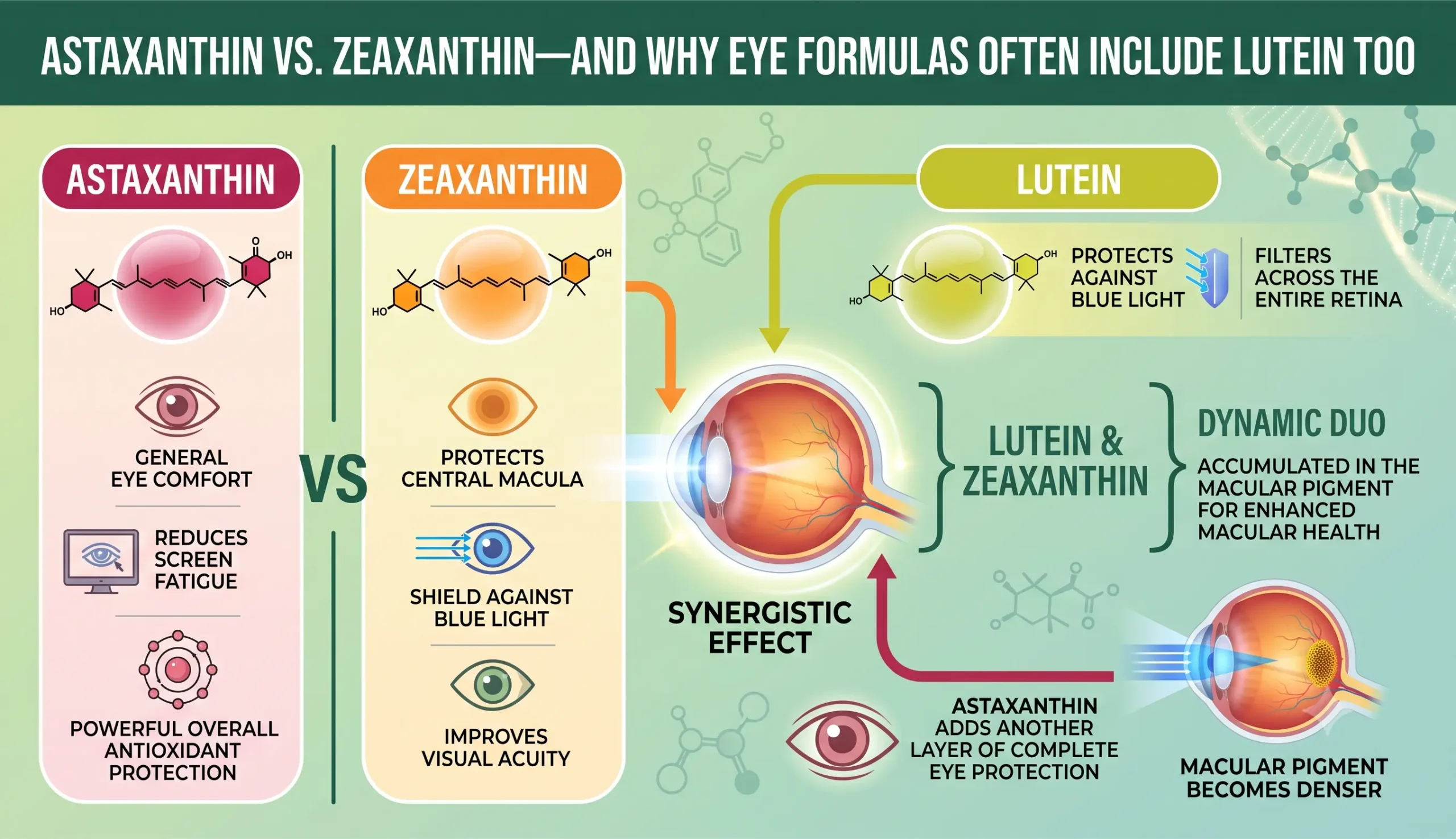
Lutein, zeaxanthin, and astaxanthin are all xanthophyll carotenoids, but they differ meaningfully in where they concentrate in the body, how they behave in a formulation, and what the clinical evidence supports.
| Property | Lutein | Zeaxanthin | Astaxanthin |
| Primary source | Marigold flower (Tagetes erecta) extract | Marigold extract (minor component) or synthetic; also from paprika | Haematococcus pluvialis microalgae (natural) or synthetic |
| Where it concentrates | Macula (peripheral ring) and retina | Macula (central, highest concentration point) | Not retina-specific; crosses blood-retina barrier; broad antioxidant distribution |
| Typical research dose | 10 mg/day (AREDS2 dose) [1][2]; some trials up to 20 mg/day | 2 mg/day (AREDS2 dose) [1][2] | 4–12 mg/day across published trials [10][11][12] |
| Best-established evidence | AMD progression risk (AREDS2, 10-year follow-up) [1][2] | AMD progression risk (as co-nutrient with lutein in AREDS2) [1][2] | Accommodation/eye-focusing fatigue and digital eye strain endpoints [10][11][13]; smaller evidence base than AREDS2 |
| Regulatory status (novel food / new ingredient) | Established food and supplement ingredient in US, EU, China | Established in US and EU; synthetic form has an EFSA-derived ADI [14] | Novel food in EU (authorized, with maximum levels by age group) [16]; GRAS-notified in US [17]; new food ingredient approval in China [18] |
| Formulation notes | Fat-soluble; oleoresin form is viscous and heat-sensitive; beadlet forms improve powder handling | Fat-soluble; often supplied pre-blended with lutein from the same marigold extract | Highly oxygen- and light-sensitive; typically stabilized as an oil suspension or microencapsulated beadlet |
3. Why Formulas Often Combine All Three
Lutein and zeaxanthin are the only two carotenoids that the human macula selectively accumulates, where they act as a natural blue-light filter and localized antioxidant [8]. Meso-zeaxanthin, a third macular carotenoid formed partly by conversion from lutein at the retina, is present in some premium formulas but was not itself part of the AREDS2 intervention and has a smaller independent clinical evidence base [8].
Astaxanthin is not concentrated in the retina the way lutein and zeaxanthin are, but it is one of the most potent lipid-soluble antioxidants identified, crosses the blood-retina barrier, and has been studied specifically for ciliary-muscle and eye-focusing fatigue — a different mechanism and a different symptom set (asthenopia, digital eye strain) than the AMD-progression endpoint that lutein and zeaxanthin are best known for [10][11]. Combination formulas are therefore marketed on the premise of covering both mechanisms — long-term macular pigment support plus short-term visual fatigue relief — rather than because a single trial has tested the exact combined dose used in most commercial products. Brands should describe this rationale as a formulation strategy, not as a proven combined clinical effect, unless they can point to a trial of that specific combination.
4. Clinical Evidence: What the Research Actually Shows
4.1 Lutein and Zeaxanthin: The AREDS and AREDS2 Trials
Two separate, sequential NIH-funded trials are often conflated in marketing copy, so it is worth separating them clearly:
- AREDS (1996–2001)tested a formula of vitamin C, vitamin E, beta-carotene, and zinc (with or without copper) against placebo in participants with intermediate or advanced AMD in one eye. This original formula reduced the risk of progression to advanced AMD by about 25% relative to placebo over five years. That 25% figure describes the original antioxidant-vitamin-and-zinc formula as a whole — it does not isolate an effect of lutein or zeaxanthin, because neither ingredient was part of AREDS [1].
- AREDS2 (2006–2012)enrolled 4,203 participants aged 50–85 at 82 U.S. clinical centers specifically to test whether adding lutein (10 mg) and zeaxanthin (2 mg), and/or omega-3 fatty acids, to the original AREDS formula improved outcomes further, and whether lutein/zeaxanthin could safely replace beta-carotene [1][3]. The 10-year follow-up analysis (AREDS2 Report 28, 2022) found that participants randomized to lutein/zeaxanthin had a hazard ratio of 91 for progression to late AMD compared with those not randomized to lutein/zeaxanthin, and a hazard ratio of 0.85 when compared directly with the beta-carotene arm [2].
- The same follow-up found that beta-carotene was associated with a higher odds of lung cancer (odds ratio 82), an effect concentrated in former smokers, while lutein/zeaxanthin showed no statistically significant increase (odds ratio 1.15) [2]. This safety difference is the main reason lutein/zeaxanthin has since replaced beta-carotene in most AREDS2-style commercial formulas, independent of the modest efficacy difference.
For formulators: “AREDS2 formula” is a specific, defined nutrient profile (vitamin C 500 mg, vitamin E 400 IU, zinc 80 mg, copper 2 mg, lutein 10 mg, zeaxanthin 2 mg, with or without omega-3s). Using the term on a label or in marketing for a product that does not match this profile is a common compliance risk worth flagging to your regulatory reviewer.
4.2 Astaxanthin: A Smaller but Growing Evidence Base
Astaxanthin’s eye-health evidence base is smaller, more heterogeneous in dose and endpoint, and generally not government-funded, so it should be presented with more caveats than the AREDS2 data:
| Study focus | Design | Dose | Key reported finding |
| Accommodation / focusing fatigue in VDT workers | Randomized, double-blind, placebo-controlled | 6 mg/day astaxanthin | Improved accommodation amplitude versus placebo [10]. Note: this trial is most accessibly documented via a manufacturer-hosted compilation of the original Japanese-language paper; brands should request the original journal article for verification rather than citing the compilation directly. |
| Visual function in VDT workers | Randomized, double-blind, placebo-controlled | 9 mg/day astaxanthin | Improvements in visual-function measures in the astaxanthin group versus placebo over the study period [11]. |
| Eye-hand coordination and macular pigment optical density | Randomized, double-blind, placebo-controlled | Astaxanthin, lutein and zeaxanthin combined (approx. 6:10:2 mg ratio) | Improvements in a subset of visual-performance and macular-pigment measures versus placebo [13]. This is one of the few trials to test a combined dose similar to commercial triple-carotenoid products, though it used a single specific ratio. |
| AMD-related visual function (CARMIS study) | Randomized, double-blind, placebo-controlled, 12 months | Astaxanthin 4 mg + lutein 10 mg + zeaxanthin 1 mg, plus other antioxidants, versus lutein/zeaxanthin alone | Contrast sensitivity improvements reported in early AMD; authors disclosed a funding relationship with the ingredient supplier [15]. |
| Screen-use-related visual fatigue and sleep | Randomized, double-blind, placebo-controlled | Lutein 20 mg + zeaxanthin 4 mg (no astaxanthin) | Reported improvements in visual fatigue and sleep-quality measures in adults with high screen exposure [9]. Included for context on the digital-eye-strain sub-category; note this trial used lutein/zeaxanthin only. |
| Dry eye symptoms in VDT users | Randomized, double-blind, placebo-controlled | Astaxanthin 6 mg/day | Improvements in tear film stability and dry-eye symptom scores versus placebo [12]. |
What the evidence does not yet show: No large, long-term, government-funded trial equivalent to AREDS2 exists for astaxanthin in eye health. Most astaxanthin eye-health trials are smaller (dozens to low hundreds of participants), shorter in duration, and several are funded or co-authored by ingredient suppliers — a disclosed conflict of interest that does not invalidate the findings but should temper how strongly a brand claims efficacy. Astaxanthin also has no FDA-authorized or EFSA-authorized eye-health claim in any market as of this guide’s last verification date; any eye-health language on a label should be checked against your target market’s specific claim rules (see Section 12).
5. Ingredient Specification & Sourcing Criteria
Formulation quality starts with the raw material specification. Key parameters to request from any supplier’s Certificate of Analysis (CoA):
5.1 Lutein/Zeaxanthin (from marigold extract)
- Potency: commonly supplied at 5%, 10%, 20%, or 80% (crystalline/USP-grade) total carotenoid content by HPLC.
- Lutein: zeaxanthin ratio: natural marigold extract typically yields a ratio around 20:1 to 40:1 lutein-to-zeaxanthin; brands wanting an AREDS2-matched 5:1 ratio (10 mg lutein / 2 mg zeaxanthin) generally need a supplier that blends in additional purified zeaxanthin.
- Form: free lutein (oil suspension, more bioavailable, more heat/oxygen sensitive) versus lutein esters (more stable, requires enzymatic cleavage for absorption) versus microencapsulated beadlets (best flowability and stability for tablets).
- Residual solvent and heavy metals: should meet USP <467> residual solvent limits and USP <232>/<233> elemental impurity limits if selling into the US market.
5.2 Astaxanthin (from Haematococcus pluvialis)
- Natural vs. synthetic: natural astaxanthin from pluvialis is almost entirely the 3S,3’S stereoisomer bound as esters; synthetic astaxanthin is a mixture of stereoisomers (typically ~25% each of 3S,3’S and 3R,3’R, ~50% 3R,3’S) in free (unesterified) form. Most eye-health clinical trials used the natural, algae-derived form.
- Potency: oil extracts commonly supplied at 5%–10% astaxanthin; beadlet/powder forms typically 1.5%–10%.
- Regulatory pathway match: confirm the specific supplier’s product matches the exact production strain/process referenced in your target market’s novel food or GRAS authorization (see Section 12) — authorizations are frequently tied to a specific manufacturing process, not to astaxanthin generically.
- Oxidative stability data: request accelerated stability data (e.g., 40°C/75% RH) specific to the finished oil or beadlet, not only the raw pigment, since astaxanthin degrades primarily through oxidation of its conjugated double-bond system.
6. Stability Challenges and Solutions
All three carotenoids are fat-soluble pigments with conjugated double-bond systems, making them inherently susceptible to oxidative degradation from light, heat, and oxygen exposure. This is the single most common formulation failure point reported by brands reformulating a failed batch.
| Challenge | Mechanism | Common Solutions |
| Oxidative degradation | Conjugated polyene chain reacts with atmospheric oxygen, accelerated by heat, light, and trace metal catalysts | Microencapsulation (spray-dried beadlets); addition of antioxidants (mixed tocopherols, ascorbyl palmitate); nitrogen-flushed packaging; opaque or amber primary packaging |
| Photodegradation | UV and visible light drive isomerization and oxidative cleavage | Amber glass or opaque HDPE bottles; foil blister packaging; light-protective outer cartons |
| Processing heat exposure | Tableting compression heat and encapsulation drying temperatures can degrade unprotected oleoresins | Use of pre-stabilized beadlet forms rated for tableting; softgel encapsulation (lower processing temperature than tablets) as an alternative format |
| Isomer stability (astaxanthin) | Ester bonds and stereoisomer configuration can shift during storage, altering potency labeling accuracy | Use suppliers with validated shelf-life stability data specific to the finished dosage form, not only the raw ingredient |
Recommended minimum testing: real-time stability data covering the full intended shelf life (typically 24 months) plus accelerated stability data, both tested in the actual finished packaging configuration you intend to sell, not only in the raw material’s original packaging.
7. Dosage Forms: Choosing the Right Format
| Format | Advantages | Considerations for These Carotenoids |
| Softgel | Naturally suited to oil-based actives; good oxygen barrier; masks taste/color | Most common format for this category; works well with oleoresin or oil-suspended astaxanthin |
| Tablet | Lower cost per unit; long shelf life if formulated correctly; easy to combine with other actives | Requires beadlet/microencapsulated carotenoid forms rather than raw oleoresin to survive compression and storage |
| Capsule (powder-filled) | Flexible for multi-ingredient blends; moderate cost | Beadlet forms recommended for flow and stability; less oxygen barrier than softgel unless overencapsulated |
| Gummy | High consumer appeal, especially with younger/digital-eye-strain demographic | Carotenoid color and stability in a high-moisture, often acidic matrix is challenging; requires supplier-validated gummy-specific stabilized forms and typically shorter validated shelf life |
| Liquid/shot | Fast-growing format for “on-the-go” and beauty-from-within positioning | Emulsification and light protection (opaque bottle) are essential; flavor-masking astaxanthin’s inherent taste is a common challenge |
8. Bioavailability Considerations
Because all three carotenoids are fat-soluble, absorption is highly dependent on co-administration with dietary fat and on the delivery form:
- A pharmacokinetic comparison of astaxanthin delivery forms found that an emulsified/oil-suspension formulation produced substantially higher plasma astaxanthin levels than a comparable dry powder/tablet form taken under the same conditions, underscoring that raw ingredient potency on a CoA does not guarantee equivalent in-body absorption between finished products [19].
- Co-formulating with a meal or with added lipids (e.g., a softgel oil carrier) is a standard recommendation to improve absorption of all three carotenoids, consistent with general fat-soluble-nutrient absorption principles.
- Brands making comparative bioavailability claims (“2x more absorbable”) should hold finished-product pharmacokinetic data for their specific formulation; extrapolating a raw-ingredient bioavailability study to a different finished dosage form is a common and avoidable overclaim.
9. Example Formulations
These example formulas are formulation starting points based on published research doses for the individual ingredients, not clinically tested finished products, unless otherwise noted. Doses shown are not established as safe or effective for pregnant or breastfeeding women, children, or people taking anticoagulant/antiplatelet medication (astaxanthin and high-dose antioxidants can interact with some medications) — confirm target-market labeling, upper-limit, and drug-interaction cautions with a qualified regulatory reviewer before finalizing any label.
Formula A — “AREDS2-Aligned” Macular Health (50+ demographic)
| Ingredients | Dose | Rationale |
| Lutein | 10 mg | Matches AREDS2 intervention dose [1][2] |
| Zeaxanthin | 2 mg | Matches AREDS2 intervention dose [1][2] |
| Vitamin C | 500 mg | Matches original AREDS2 formula component |
| Vitamin E | 400 IU | Matches original AREDS2 formula component |
| Zinc | 80 mg (as zinc oxide) | Matches original AREDS2 formula component; note this exceeds typical adult RDA/UL and should be reviewed against target-market upper limits |
| Copper | 2 mg | Included to offset zinc-induced copper depletion, per original AREDS design |
This formula intentionally mirrors the published AREDS2 nutrient profile rather than a proprietary blend, since that profile is the one with 10-year outcome data behind it [2]. Brands should avoid adding beta-carotene to this formula given the lung-cancer signal noted in Section 4.1.
Formula B — Digital Eye Strain/Screen Fatigue (working-age demographic)
| Ingredients | Dose | Rationale |
| Lutein | 10 mg | Within studied range for screen-fatigue-related trials [9][13] |
| Zeaxanthin | 2 mg | Co-nutrient with lutein, consistent with cited trial ratios [13] |
| Astaxanthin | 6 mg | Within the dose range studied for accommodation and dry-eye endpoints in VDT users [10][12] |
| Bilberry extract (optional) | Per supplier-validated anthocyanin content | Commonly co-marketed antioxidant for this sub-category; evidence base is separate from the carotenoids in this guide and not covered here |
No single published trial has tested this exact three-carotenoid combination and dose together; this formula is assembled from separate trials of its individual components at similar doses [9][10][12][13], not from one combined-product trial. Marketing copy should reflect that the combination itself is a formulation hypothesis, not a directly tested claim.
Formula C — Premium Broad-Spectrum Macular Support
| Ingredients | Dose | Rationale |
| Lutein | 10 mg | AREDS2-aligned dose [1][2] |
| Zeaxanthin | 2 mg | AREDS2-aligned dose [1][2] |
| Meso-zeaxanthin | Supplier-dependent, commonly 0.5–10 mg | Third macular pigment carotenoid; not part of AREDS2 and has a smaller independent evidence base than lutein/zeaxanthin [8] — include only with clear evidence-level disclosure |
| Astaxanthin | 4 mg | Dose used in the CARMIS trial’s combination arm [15] |
| Omega-3 (DHA/EPA) | Per supplier-validated dose | Tested as an optional add-on arm in AREDS2 itself, with no significant additional benefit found over lutein/zeaxanthin alone [1] |
This is a formulation concept extrapolated from several separate evidence sources rather than a single trial of this exact seven-nutrient combination; the meso-zeaxanthin and omega-3 additions in particular should be positioned as “may support” formulation choices, not as independently proven to add efficacy on top of the AREDS2-established base.
10. Quality Control & Testing Recommendations
- Identity testing: HPLC with UV/Vis detection to confirm and quantify individual carotenoid isomers (not just “total carotenoids”).
- Potency verification at release and at end-of-shelf-life: carotenoids commonly show potency decline over shelf life; testing only at release without an end-of-shelf-life check is a common cause of later label-claim compliance failures.
- Heavy metals and microbial testing: particularly relevant for algae-derived astaxanthin, given cultivation in open or closed pond/bioreactor systems.
- Stereoisomer confirmation for astaxanthin: chiral HPLC to confirm natural (3S,3’S-dominant) versus synthetic sourcing, important both for regulatory pathway matching and for marketing claims distinguishing “natural” astaxanthin.
11. Packaging & Shelf-Life Guidance
- Amber glass, opaque HDPE, or foil-laminate blister packaging is strongly preferred over clear packaging for all three carotenoids.
- Desiccant inclusion is recommended for powder-filled capsule and tablet formats to control moisture-driven degradation.
- Typical validated shelf life for well-formulated softgel or tablet products in this category is 18–24 months; gummies typically carry shorter validated shelf life (12–18 months) due to the moisture/acid matrix.
- Always validate shelf life in the actual finished packaging you will sell, at the actual dose and matrix you will sell — raw-ingredient shelf-life data from a supplier does not automatically transfer to your finished product’s shelf life.
12. Regulatory Snapshot by Market
This section summarizes ingredient legality and general claim posture; it is not a substitute for market-specific legal review, and rules change over time. Confirm current requirements directly with the regulator or a local regulatory counsel before submission.
12.1 United States
- Lutein and zeaxanthin are broadly marketed as dietary ingredients under DSHEA; astaxanthin from Haematococcus pluvialishas been the subject of GRAS notices to FDA for use in conventional foods and beverages (e.g., GRN 294, GRN 580) [17], and is also marketed as a dietary ingredient.
- No FDA-authorized health claim or qualified health claim currently covers lutein, zeaxanthin, or astaxanthin for eye health; a 2004 petition seeking a qualified health claim for lutein/zeaxanthin and cataracts/AMD was denied by FDA, meaning only general structure/function claims (“supports eye health,” appropriately substantiated) are permitted, not disease-risk-reduction language [15b].
12.2 European Union
- Lutein is an established food ingredient; EFSA’s Panel on Dietetic Products, Nutrition and Allergies concluded in 2012 that a cause-and-effect relationship had not been established between lutein intake and maintenance of normal vision, given the evidence available at that time — meaning lutein does not currently carry an authorized “maintenance of vision” Article 13.1 health claim in the EU [14b].
- Synthetic zeaxanthin has an EFSA-derived Acceptable Daily Intake; brands using synthetic (as opposed to marigold-extract) zeaxanthin in the EU should confirm current ADI-based maximum use levels [14].
- Astaxanthin is regulated as a Novel Food in the EU. Authorized synthetic and Haematococcus pluvialis-derived astaxanthin uses carry specific maximum daily intake levels that differ by age group and by source (synthetic vs. natural), set out in the relevant EU novel food implementing regulations and supporting EFSA safety opinions [16]. Brands must confirm their specific product and intended dose fall within the authorized novel food conditions before selling in the EU.
12.3 China
- Haematococcus pluvialis-sourced astaxanthin was approved as a “new food ingredient” (新食品原料) by China’s former Ministry of Health in 2010, subject to specified conditions of use [18].
- Lutein is permitted as a food/health-food ingredient in China; products making specific health function claims generally require registration or notification as a “Blue Hat” (蓝帽子) health food (保健食品) under the National Medical Products Administration / State Administration for Market Regulation framework, a process distinct from ordinary food registration and generally requiring additional safety and efficacy documentation [18].
- Regulatory conditions in China change relatively frequently; brands should confirm current new-food-ingredient and health-food approval status directly with NMPA/SAMR guidance or qualified local regulatory counsel before finalizing a China-market formula.
13. Choosing an OEM / Contract Manufacturing Partner
Recommended due-diligence criteria when evaluating a contract manufacturer for this category:
- Carotenoid-specific manufacturing experience: ask for finished-product stability data (not just raw-material data) for a comparable carotenoid formula they have previously produced.
- Certifications: NSF/cGMP (21 CFR Part 111) certification at minimum for US-bound product; look for additional certifications (e.g., ISO 22000, HACCP) relevant to your target markets.
- Analytical capability: in-house or contracted HPLC capability to verify carotenoid identity and potency at release and at stability checkpoints, rather than relying solely on supplier CoAs.
- Regulatory documentation support: ability to provide the documentation package (specifications, stability data, manufacturing process description) needed to support novel food, GRAS, or new-food-ingredient submissions in your target markets.
- Packaging capability matched to stability needs: confirm the manufacturer can supply or source the amber/opaque/nitrogen-flush packaging options this category typically requires (Section 11).
- Minimum order quantities and formulation flexibility: particularly relevant for brands wanting a custom ratio (e.g., a non-AREDS2 dose) rather than a manufacturer’s existing stock formula.
14. Frequently Asked Questions
What is the difference between the AREDS and AREDS2 formulas?
AREDS (1996–2001) is the original formula (vitamin C, vitamin E, beta-carotene, zinc, with or without copper) that produced the well-known ~25% relative risk reduction for AMD progression. AREDS2 (2006–2012) is a follow-up trial that replaced beta-carotene with lutein (10 mg) and zeaxanthin (2 mg) and tested adding omega-3s; its 10-year data show lutein/zeaxanthin performs at least as well as beta-carotene, without beta-carotene’s lung-cancer signal in former smokers [1][2]. See Section 4.1 for the exact figures.
Can I put “AREDS2 formula” on my label?
Only if your finished formula matches the actual AREDS2 nutrient profile and doses; using the term for a materially different formula is a labeling-accuracy risk in most markets. Confirm exact wording with regulatory counsel.
Is natural astaxanthin better than synthetic for eye-health formulas?
Nearly all of the eye-health clinical trials cited in this guide used natural, Haematococcus pluvialis-derived astaxanthin, not synthetic. If a brand wants to rely on those studies as substantiation, using the natural form is the more defensible choice; synthetic astaxanthin has a different stereoisomer profile that has not been tested in the same eye-health trials.
Do these ingredients help with dry eye, not just macular degeneration?
There is a smaller, separate evidence base specifically on astaxanthin and dry-eye/tear-film measures in screen-heavy populations [12], distinct from the AREDS2 AMD-progression evidence. Brands targeting dry eye specifically should cite that literature rather than AREDS2, since AREDS2 did not measure dry-eye outcomes.
What is a reasonable minimum order quantity for a custom formula?
This varies widely by manufacturer and dosage form; softgel and tablet MOQs are generally lower than gummy MOQs given gummies’ more complex stabilization requirements (Section 7). Request MOQ and formulation-flexibility terms early in OEM discussions (Section 13).
How long does it take to bring a new formula to market?
Typical timelines range from a few months for a manufacturer’s existing stock formula to 9–12+ months for a fully custom formula requiring new stability studies and market-specific regulatory documentation (e.g., a novel food dossier in the EU or a new-food-ingredient filing in China).
15. References
Where a source could not be independently verified against its original primary publication, that limitation is noted directly in the entry.
- National Eye Institute. Age-Related Eye Disease Studies (AREDS/AREDS2)— study background and design summary. National Institutes of Health. nih.gov; trial design also published as: The Age-Related Eye Disease Study 2 (AREDS2) Research Group. Am J Ophthalmol. 2012. pmc.ncbi.nlm.nih.gov/articles/PMC3485447.
- Chew EY, Clemons TE, Agrón E, et al. Long-term Outcomes of Adding Lutein/Zeaxanthin and ω-3 Fatty Acids to the AREDS Supplements on Age-Related Macular Degeneration Progression: AREDS2 Report 28. JAMA Ophthalmol.2022;140(7):692–698. ncbi.nlm.nih.gov/articles/PMC9164119.
- gov. Age-Related Eye Disease Study 2 (AREDS2), NCT00345176. clinicaltrials.gov/study/NCT00345176.
- Grand View Research. Eye Health Supplements Market Size, Share & Trends Analysis Report.com.
- Research and Markets / GII Research industry compilation. Eye Health Supplements Market Size, Share and Trends.com.
- Market Research Future. Lutein Market Report.com.
- World Health Organization. Blindness and Vision Impairmentfact sheet / World Report on Vision. int.
- Arunkumar R, Gorusupudi A, Bernstein PS. The macular carotenoids: A biochemical overview. Biochim Biophys Acta Mol Cell Biol Lipids.2020;1865(11):158617. org/10.1016/j.bbalip.2020.158617.
- Lopresti AL, Smith SJ. Effects of a lutein and zeaxanthin supplement on visual fatigue and sleep in adults with high screen exposure: a randomized, double-blind, placebo-controlled trial. Front Nutr. preprints.org (preprint).
- Nagaki Y, Mihara M, Tsukahara H, Ono S. The supplementation effect of astaxanthin on accommodation and asthenopia. J Clin Ther Med.2006;22(1):41–54. Most accessibly available via a manufacturer-hosted compilation: com — request the original journal article for independent verification.
- Effects of astaxanthin supplementation on visual function in visual display terminal (VDT) workers. J Clin Biochem Nutr. PMID 36777084.
- Huang JY, Yeh PT, Hou YC. A randomized, double-blind, placebo-controlled study of oral antioxidant supplement therapy in patients with dry eye syndrome. Clin Ophthalmol.2016;10:813–820. org/10.2147/OPTH.S106455.
- Effects of astaxanthin, lutein, and zeaxanthin on eye-hand coordination and macular pigment optical density. 2023. PMID 36986186.
- EFSA Panel on Dietetic Products, Nutrition and Allergies (NDA). Scientific Opinion on the substantiation of a health claim related to lutein and maintenance of normal vision. EFSA Journal.2012;10(6):2716. org/10.2903/j.efsa.2012.2716. Related opinion: EFSA Journal. 2010;8(2):1492. doi.org/10.2903/j.efsa.2010.1492. Zeaxanthin ADI opinion: EFSA Panel on Food Additives and Nutrient Sources (ANS). Scientific Opinion on the safety of synthetic zeaxanthin. EFSA Journal. 2012;10(10):2891. Referenced via BfR compilation: bfr.bund.de.
- Piermarocchi S, Saviano S, Parisi V, et al. Carotenoids in Age-related Maculopathy Italian Study (CARMIS): two-year results of a randomized study. Eur J Ophthalmol.2012;22(2):216–225. org/10.5301/ejo.5000069. Note: study authors disclosed a funding/consulting relationship with the ingredient supplier. [15b] U.S. FDA. Letter Responding to Health Claim Petition dated November 25, 2003 (Lutein and Zeaxanthin and Reduced Risk of Age-Related Macular Degeneration and Cataracts): Denial Letter, Docket No. 2004Q-0180. fda.gov.
- European Commission / EFSA. Novel food authorization and safety opinions for astaxanthin-rich Haematococcus pluvialisextract and synthetic astaxanthin, including maximum use levels by population group. EFSA Journal. 2023;21(4):8338 org/10.2903/j.efsa.2023.8338; EFSA Journal. 2025. doi.org/10.2903/j.efsa.2025.9737.
- S. FDA. GRAS Notices GRN 294 and GRN 580 for astaxanthin-rich extract from Haematococcus pluvialismicroalgae. FDA GRAS Notice Inventory.
- Former Ministry of Health of the People’s Republic of China. Notice on New Food Ingredients (Announcement No. 17, 2010) approving Haematococcus pluvialis-derived astaxanthin; general regulatory framework summarized via industry compliance guides, e.g. comand shanghaijungle.com. Confirm current status directly with NMPA/SAMR.
- Odeberg JM, Lignell Å, Pettersson A, Höglund P. Oral bioavailability of the antioxidant astaxanthin in humans is enhanced by incorporation of lipid based formulations. Eur J Pharm Sci.2003;19(4):299–304. available via cyanotech.com.
Medical and Regulatory Disclaimer
This guide is provided for general commercial and formulation information purposes only and does not constitute medical, legal, or regulatory advice. Statements about ingredient research have not been evaluated by the U.S. Food and Drug Administration, the European Food Safety Authority, or China’s National Medical Products Administration unless explicitly cited as an authorized claim. Products formulated using the information in this guide are not intended to diagnose, treat, cure, or prevent any disease. Brands are solely responsible for ensuring their specific formulation, labeling, and marketing claims comply with the laws of every market in which they sell, and should consult qualified regulatory and legal counsel in each target market before commercialization. KS Nutripharma has made reasonable efforts to cite primary sources accurately as of the last verification date on the cover page, but regulations and scientific understanding evolve, and readers should independently confirm current requirements.
Develop a Multi-Carotenoid Eye Formula With KS Nutripharma®
KS Nutripharma develops custom eye health supplements using lutein, zeaxanthin, astaxanthin, vitamins, minerals, botanical extracts, and compatible oil-based ingredients.
For astaxanthin-centered concepts, explore our astaxanthin supplement manufacturing services. Astaxanthin can also support broader antioxidant supplement formulations beyond the eye-health category.
Available product formats include oil softgels, vegan softgels, hard capsules, tablets, gummies, powder sachets, custom daily packs, and private-label bottles, blisters, pouches, and cartons.
Send KS Nutripharma your target audience, intended positioning, active quantities, dosage form, target market, certifications, packaging, and estimated order volume. Our formulation team can assess oil-phase compatibility, capsule size, blend uniformity, stability, testing, and regulatory documentation, and can discuss minimum order quantities and timelines (see Section 13).