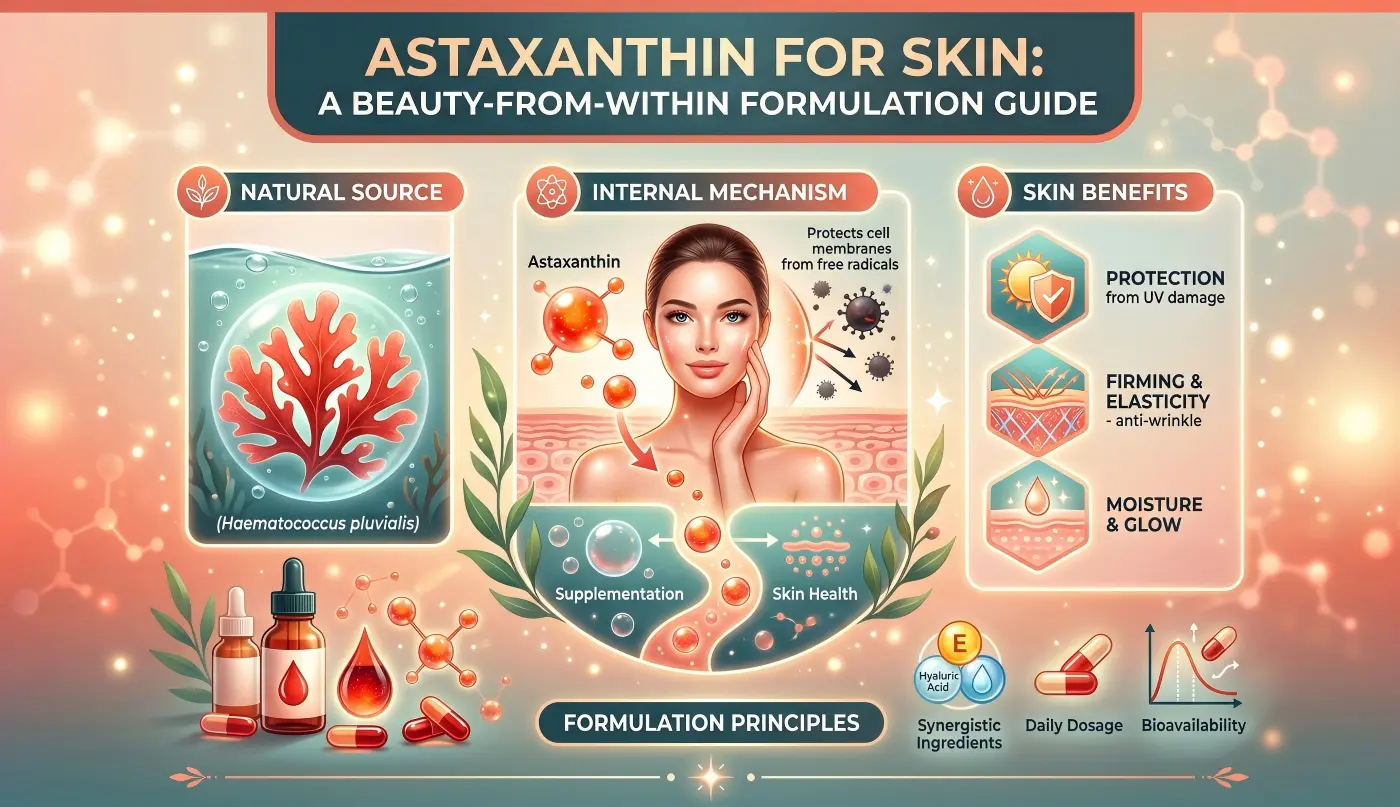
Astaxanthin is increasingly used in beauty-from-within supplements positioned around skin hydration, elasticity, barrier function, healthy aging, and protection from everyday oxidative stress.
The commercial opportunity is substantial, but the evidence requires careful interpretation. Human trials have investigated oral astaxanthin at approximately 2 to 12 mg per day for 6 to 16 weeks. A 2021 meta-analysis found statistically significant improvements in skin moisture and elasticity, but not in wrinkle depth, compared with placebo.[1]
This distinction matters. Current evidence can support a responsibly formulated skin supplement, but it does not justify claims that astaxanthin:
- Reverses skin aging
- Removes wrinkles
- Rebuilds collagen
- Treats a dermatological condition
- Replaces sunscreen
- Prevents UV damage
- Whitens or tans the skin
- Produces guaranteed before-and-after results
For supplement brands, the strongest strategy is to connect a substantiated serving of natural astaxanthin with a coherent delivery format, complementary ingredients, realistic consumer expectations, and finished-product stability data.
Medical and Regulatory Notice: This article is intended for supplement brands, formulators, and procurement teams. It does not provide individual medical advice. Human-study doses are included for product-development context and are not universal consumer recommendations. Claims, serving sizes, warnings, and ingredient authorization require market-specific review.
Quick Answer: Does Astaxanthin Help Support Skin Appearance?
Human evidence suggests that oral astaxanthin may support selected skin parameters, particularly moisture and elasticity.
A 2021 systematic review and meta-analysis found:
- Skin moisture: SMD 0.53; 95% CI 0.05 to 1.01; p=0.03
- Skin elasticity: SMD 0.77; 95% CI 0.19 to 1.35; p=0.009
- Wrinkle depth: SMD -0.26; 95% CI -0.58 to 0.06; p=0.11
The wrinkle-depth result was not statistically significant.[1]
The evidence is promising but not definitive because many studies were small, used different formulations and methods, and were conducted in relatively narrow populations. Several studies also had commercial funding or manufacturer involvement.
For B2B product development, the most defensible conclusion is:
Astaxanthin is a clinically studied carotenoid that may support skin moisture, elasticity, and resilience to environmental stress, but it should not be marketed as a proven wrinkle treatment or substitute for sun protection.
Why Is Astaxanthin Used in Beauty Supplements?
Astaxanthin is a red-orange xanthophyll carotenoid. Natural astaxanthin used in human supplements is commonly derived from the microalga Haematococcus pluvialis.
Its molecular structure contains a long conjugated chain and polar end groups. This gives astaxanthin lipid compatibility and antioxidant activity in laboratory systems, but it also makes the ingredient:
- Poorly soluble in water
- Sensitive to light
- Sensitive to oxygen
- Vulnerable to prolonged heat
- Dependent on formulation for effective delivery
Beauty brands use astaxanthin because it creates several commercially relevant formulation opportunities:
- A small active amount can support a premium product.
- Its natural red color reinforces antioxidant positioning.
- It fits softgels, capsules, gummies, and beauty powders.
- It can complement collagen, vitamin C, ceramides, hyaluronic acid, vitamin E, or glutathione.
- Human skin studies exist, although the evidence has limitations.
- Microalgae sourcing supports natural and beauty-from-within narratives.
The scientific rationale is stronger when astaxanthin is presented as part of a complete skin-support formula rather than a miracle anti-aging ingredient.
How Could Astaxanthin Affect Skin Biology?
Three evidence levels must be separated.
Mechanistic Evidence
Cell and animal studies suggest that astaxanthin may influence pathways associated with:
- Reactive oxygen species
- Lipid oxidation
- UV-induced inflammatory signaling
- Matrix metalloproteinases
- Epidermal-dermal communication
- Endogenous antioxidant defenses
For example, laboratory experiments have found that astaxanthin can affect UVB-induced inflammatory cytokine secretion in keratinocytes and matrix metalloproteinase-1 secretion from fibroblasts under experimental conditions.[2]
These findings provide biological plausibility. They do not prove that an oral supplement produces the same effect in human facial skin.
Biomarker Evidence
Human studies have measured outcomes such as:
- Interleukin-1α in the stratum corneum
- Transepidermal water loss
- Minimal erythema dose
- Skin moisture
- Skin elasticity
- Procollagen type I expression
- MMP-1 and MMP-12 expression
Biomarker changes can help explain how an intervention might work, but they do not automatically establish a visible consumer benefit.
Consumer-Relevant Clinical Evidence
The most relevant outcomes for a beauty supplement include:
- Instrument-measured moisture
- Instrument-measured elasticity
- Transepidermal water loss
- Standardized wrinkle measurements
- Dermatologist grading
- Validated participant questionnaires
- Standardized photography
A credible marketing claim should match the actual human outcome. A study measuring moisture should not be used to claim wrinkle removal.
What Do Human Studies Say About Astaxanthin for Skin?
Evidence Summary
| Study | Participants | Intervention | Duration | Main findings | Important limitations |
| Ito et al., 2018 [3] | 23 healthy Japanese adults | 4 mg astaxanthin or placebo | 9 weeks of supplementation within a 10-week study | Increased minimal erythema dose and reduced moisture loss in a UV-irradiated area; subjective texture findings | Small study; specific Japanese population; not a sunscreen study |
| Tominaga et al., 2017 [2] | 65 healthy women aged 35-60 | 6 mg, 12 mg, or placebo | 16 weeks | Selected wrinkle and moisture parameters worsened in placebo but were maintained in astaxanthin groups; IL-1α maintained only in the 12 mg group | Seasonal design; largely maintenance rather than reversal; ingredient-related commercial involvement |
| Yoon et al., 2014 [4] | 44 healthy women | 2 mg astaxanthin plus 3 g collagen hydrolysate or placebo | 12 weeks | Improvements in elasticity and TEWL; changes in procollagen I, MMP-1, and MMP-12 | Combination product cannot isolate astaxanthin’s effect |
| Tominaga et al., 2012 [14] | 36 healthy men in a controlled trial | 6 mg astaxanthin or placebo | 6 weeks | Reported changes in selected wrinkle, elasticity, moisture, TEWL, and sebum measurements | Small sample; short duration |
| Astaxanthin skin meta-analysis, 2021 [1] | 11 studies identified | Different oral or topical interventions | 4-16 weeks in included RCTs | Significant pooled moisture and elasticity effects; wrinkle-depth effect not significant | Heterogeneity, small studies, funding concerns and possible bias |
The 4 mg UV-Exposure Study
A randomized, double-blind, placebo-controlled study recruited 23 healthy Japanese participants. One group received 4 mg of astaxanthin per day, while the other received placebo.
After nine weeks, researchers evaluated minimal erythema dose and changes in moisture and transepidermal water loss following controlled UV exposure.
The astaxanthin group showed:
- An increase in minimal erythema dose compared with placebo
- Less moisture loss in an irradiated skin area
- Improvements in selected subjective assessments of texture and roughness
The study does not show that astaxanthin prevents skin cancer, treats sunburn, or replaces topical sunscreen. The sample was small, and the intervention must be understood within its specific experimental design.[3]
The 6 mg and 12 mg Study
A 16-week randomized, double-blind, placebo-controlled trial included 65 healthy women aged 35-60. Participants received:
- 6 mg astaxanthin per day
- 12 mg astaxanthin per day
- Placebo
The active material was a 5% H. pluvialis oil extract in canola-oil softgels.
Researchers observed that selected wrinkle and moisture parameters significantly worsened in the placebo group during the study but did not significantly worsen in the astaxanthin groups. Interleukin-1α increased in the placebo and 6 mg groups but not in the 12 mg group.[2]
This is better described as maintenance under seasonal environmental stress than as reversal of existing skin aging.
The study does not demonstrate that 12 mg is universally better than 6 mg. Not every outcome showed a clear dose-response relationship.
The Astaxanthin-and-Collagen Study
A randomized, double-blind, placebo-controlled study included 44 healthy women with moderately photoaged skin. Participants received:
- 2 mg astaxanthin per day
- 3 g collagen hydrolysate per day
- Or matched placebos
After 12 weeks, the active group showed improvements in selected facial elasticity and transepidermal water-loss measurements. Researchers also reported increased procollagen type I mRNA and decreased MMP-1 and MMP-12 expression compared with placebo. There was no significant difference in UV-induced DNA damage between groups.[4]
This study directly supports the commercial logic of combining astaxanthin and collagen. However, because both actives were administered together, it cannot determine:
- How much of the result came from astaxanthin
- How much came from collagen
- Whether the combination was synergistic
- Whether a higher astaxanthin dose would improve the outcome
- Whether another collagen source would perform identically
Brands using a materially different formula should avoid presenting it as clinically proven by this study.
How Strong Is the Overall Evidence?
The 2021 meta-analysis identified 11 studies: nine randomized controlled human studies of oral astaxanthin and two open-label studies involving topical or combined oral-topical use.[1]
The pooled results favored astaxanthin for moisture and elasticity, but interpretation requires caution.
Skin Moisture
Five studies were included in the moisture analysis. The pooled standardized mean difference was 0.53, with a 95% confidence interval of 0.05 to 1.01.
The I² value was 52%, indicating moderate heterogeneity. The studies did not all estimate an identical treatment effect.
Skin Elasticity
Six trials were included in the elasticity analysis. The pooled standardized mean difference was 0.77, with a 95% confidence interval of 0.19 to 1.35.
The I² value was 75%, indicating substantial heterogeneity. Differences in participants, formulations, duration, measurement instruments, and study design may explain part of this variability.
Wrinkle Depth
The pooled wrinkle-depth result did not reach statistical significance:
- SMD -0.26
- 95% CI -0.58 to 0.06
- p=0.11
A product should therefore not claim that the body of evidence proves astaxanthin reduces wrinkle depth.
Evidence Limitations
The evidence base contains recurring weaknesses:
- Small sample sizes
- Short study durations
- Limited geographic and ethnic diversity
- Heavy representation of healthy middle-aged women
- Different astaxanthin sources and delivery systems
- Different measurement locations
- Different seasons and environmental conditions
- Combination products that prevent ingredient-level conclusions
- Commercial funding or supplier involvement
- Limited replication by independent research groups
- Few direct dose-comparison studies
E-E-A-T-compliant content should state these limitations rather than presenting only positive endpoints.
What Is an Evidence-Based Astaxanthin Dosage for Skin Products?
Human skin studies have used approximately 2 to 12 mg per day.
That range does not establish an optimal dose. Product developers should select the serving according to the closest relevant evidence, target market, dosage form, safety review, and formula architecture.
2 mg Position
Two milligrams was used with 3 g of collagen hydrolysate in the 12-week combination trial.[4]
This position can work for:
- Astaxanthin-and-collagen powders
- Multi-active beauty formulas
- Entry-level combination products
- Products where astaxanthin is supportive rather than the hero ingredient
It should not be presented as proving that 2 mg astaxanthin alone provides the combination study’s results.
4 mg Position
Four milligrams was used in the controlled UV-exposure study.[3]
It can support:
- Daily beauty softgels
- Skin hydration and antioxidant positioning
- Smaller capsules
- Lower-cost premium products
- Combination formulas with ceramides or hyaluronic acid
6 mg Position
Six milligrams has been used in several skin studies and offers a strong evidence-to-commercial-positioning balance.
It can support:
- Premium beauty-from-within softgels
- Once-daily capsule concepts
- Astaxanthin plus vitamin E
- Astaxanthin plus plant ceramides
- Skin and healthy-aging positioning
12 mg Position
Twelve milligrams has been studied, but a higher label number should not be selected solely to appear stronger.
A 12 mg product requires closer review of:
- Target-market authorization
- Population and warnings
- Ingredient cost
- Single-unit feasibility
- Stability overage
- Whether the intended claims require this amount
- Whether evidence shows an advantage over 6 mg
In the 16-week trial, not every measurement demonstrated a clear 12 mg superiority.[2]
See the detailed astaxanthin dosage guide for serving-strength and ingredient-concentration calculations.
How Much Raw Material Is Required?
The label amount refers to active astaxanthin, not the total weight of the astaxanthin preparation.
The theoretical formula is:
Required preparation weight = target active amount ÷ active concentration
| Active target | 2% preparation | 5% preparation | 10% preparation |
| 2 mg | 100 mg | 40 mg | 20 mg |
| 4 mg | 200 mg | 80 mg | 40 mg |
| 6 mg | 300 mg | 120 mg | 60 mg |
| 12 mg | 600 mg | 240 mg | 120 mg |
These values do not include:
- Carrier oil
- Encapsulation matrix
- Antioxidants
- Processing aids
- Manufacturing overage
- Assay adjustment
- Other active ingredients
A 2% powder may be practical in a sachet but consume excessive space in a multi-active capsule. A 10% oil may be more appropriate for a compact softgel.
Astaxanthin and Collagen: How Should the Formula Be Designed?
Astaxanthin and collagen have complementary commercial roles:
- Astaxanthin supports antioxidant and skin-resilience positioning.
- Collagen peptides provide a structural-protein and elasticity narrative.
- The combination has direct human-study precedent at 2 mg astaxanthin plus 3 g collagen hydrolysate.[4]
The Main Formulation Constraint
Three grams of collagen cannot fit into a normal one-capsule serving.
A typical size 00 capsule may hold substantially less than 1 g, depending on bulk density. Delivering 3 g would usually require multiple capsules.
More practical designs include:
Powder Stick
A daily sachet can contain:
- 3 to 5 g collagen peptides
- Protected astaxanthin beadlets
- Vitamin C
- Hyaluronic acid
- Flavor and sweetener system
Advantages:
- Clinically relevant collagen quantity
- Convenient once-daily ritual
- Strong beauty branding
- Flexible flavor options
Challenges:
- Astaxanthin dispersion
- Red-orange color
- Flavor masking
- Moisture protection
- Oxidation
- Sediment or ring formation
- Sachet barrier performance
Two-Part Daily Pack
The pack may contain:
- One astaxanthin softgel
- One collagen powder stick
This separates the lipid-soluble astaxanthin from a high-mass water-soluble collagen format.
It also enables:
- Better astaxanthin delivery
- Higher collagen loading
- Fewer compatibility problems
- Premium regimen positioning
Its disadvantages include higher packaging cost and more complex consumer instructions.
Multi-Capsule Serving
A capsule system is possible but may require four to eight capsules, depending on collagen dose and density. This can reduce adherence and create negative reviews about serving count.
Collagen Source Selection
Collagen may be:
- Bovine
- Marine
- Porcine
- Chicken-derived
- Single-species or blended
Brands should confirm:
- Species identity
- Molecular-weight distribution
- Peptide profile
- Heavy metals
- Microbiology
- Protein content
- Hydroxyproline
- Allergen status
- BSE/TSE documentation where applicable
- Country of origin
- Halal or kosher status
- Sustainability claims
Marine collagen can support premium beauty positioning but requires fish-allergen labeling and careful sensory control.
A 2023 meta-analysis of 26 randomized controlled trials involving 1,721 participants found pooled improvements in hydration and elasticity with hydrolyzed collagen. The authors also identified bias and called for larger trials.[5] Evidence from one branded collagen peptide cannot automatically substantiate every hydrolyzed collagen material.
Astaxanthin and Vitamin C: What Is the Formulation Logic?
Vitamin C is a water-soluble antioxidant and a cofactor for enzymes involved in collagen biosynthesis. It participates in the hydroxylation of proline and lysine residues needed for stable collagen structure.[6]
This creates a clear consumer narrative:
- Astaxanthin: lipid-phase antioxidant positioning
- Vitamin C: water-soluble nutrient and collagen-formation role
However, a valid biological role does not prove that adding vitamin C to astaxanthin produces synergistic visible results.
Technical Considerations
Vitamin C can introduce:
- Acidic flavor
- Moisture sensitivity
- Oxidation
- Browning reactions
- Gummy pH changes
- Instability in aqueous liquids
- Interactions with minerals
Form options include:
- Ascorbic acid
- Sodium ascorbate
- Calcium ascorbate
- Coated vitamin C
- Acerola-derived preparations
Natural vitamin C ingredients may contain a relatively small amount of active vitamin C and a much larger amount of fruit carrier. Formulators should calculate the declared nutrient from the tested vitamin C assay.
A beauty powder can carry meaningful vitamin C amounts more easily than a small softgel. A two-unit system may therefore be preferable when the formula includes both oil-based astaxanthin and a substantial vitamin C declaration.
Astaxanthin and Ceramides: When Does the Combination Make Sense?
Ceramides are lipid components associated with the skin barrier. Oral beauty supplements commonly use wheat-, rice-, or konjac-derived ceramide preparations.
A randomized, double-blind, placebo-controlled study evaluated wheat polar lipid complexes in oil and powder forms. Daily quantities were approximately:
- 70 mg oil preparation
- 30 mg powder preparation
These supplied approximately 1.6 to 1.7 mg of wheat glucosylceramides and 11 to 12 mg of digalactosyl diglycerides. Researchers reported changes in hydration, elasticity, and transepidermal water loss.[7]
Commercial Advantages
- Strong skin-barrier positioning
- Low ingredient mass
- Compatibility with capsules and softgels
- Complementary hydration narrative
- Potential for once-daily dosing
Formulation and Label Risks
A wheat-derived ceramide ingredient requires careful review of:
- Wheat allergen status
- Gluten testing
- Residual protein
- Gluten-free substantiation
- Active ceramide or glucosylceramide amount
- Oil versus powder concentration
- Target-market nomenclature
A 30 mg branded wheat lipid complex is not equivalent to 30 mg of pure ceramides. Labels and marketing copy must distinguish total ingredient weight from active lipid content.
Astaxanthin and Hyaluronic Acid: A Hydration-Focused Concept
Oral hyaluronic acid is used in beauty products positioned around moisture, elasticity, and skin-barrier appearance.
A 12-week randomized, double-blind, placebo-controlled trial included 40 healthy adults aged 35-64. Participants consumed 120 mg of hyaluronic acid per day or placebo. The study reported differences in wrinkle assessment, stratum corneum water content, TEWL, and elasticity.[8]
A newer randomized trial involving 150 healthy adults evaluated 60 mg and 120 mg of high-molecular-weight sodium hyaluronate for 12 weeks. The 120 mg group showed more consistent changes across multiple measured skin parameters, although the authors stated that a statistically confirmed dose-response relationship would require a larger study.[9]
Formulation Advantages
- Low-to-moderate ingredient mass
- Compatible with capsules
- Strong hydration positioning
- Suitable for vegan products if fermentation-derived
- Easy combination with astaxanthin powder or beadlets
Variables Brands Must Specify
- Hyaluronic acid or sodium hyaluronate
- Fermentation or animal origin
- Molecular weight
- Purity
- Active amount
- Moisture
- Microbiology
- Particle size
- Dissolution behavior
A study on one molecular weight and branded material cannot automatically support a different hyaluronic acid specification.
Additional Combination Options
Astaxanthin and Vitamin E
Both are lipid-compatible, making the combination suitable for softgels. Vitamin E may also help protect the oil phase, depending on its form and concentration.
The formulation should distinguish between:
- Vitamin E as a declared dietary ingredient
- Mixed tocopherols used primarily to stabilize the oil
- Total tocopherol content
- Alpha-tocopherol equivalents for label purposes
Astaxanthin and Glutathione
This combination supports antioxidant and beauty positioning, but reduced glutathione is sensitive to moisture and oxidation and may create sulfur-related odor.
A dry capsule or protected powder is usually more practical than a conventional oil softgel. Direct combination evidence should be reviewed before making synergy claims.
Astaxanthin and CoQ10
Both are lipid-soluble and compatible with premium softgel concepts. This combination is better suited to healthy-aging or cellular-energy positioning than a narrowly defined skin-hydration product.
Astaxanthin and Omega-3
A shared oil phase makes formulation possible, but omega-3 oils create greater oxidation risk and require substantially more fill volume.
Testing should include:
- Peroxide value
- p-Anisidine value
- TOTOX where appropriate
- Astaxanthin assay
- Odor
- Softgel leakage
- Headspace oxygen
- End-of-shelf-life rancidity
Which Dosage Form Is Best for an Astaxanthin Skin Supplement?
Format Decision Matrix
| Format | Best use | Main strengths | Main constraints |
| Oil softgel | Astaxanthin alone or with vitamin E, CoQ10, ceramide oil, or omega-3 | Compact, lipid-compatible, premium presentation | Gelatin or vegan-shell choice, leakage, oxidation, heat sensitivity |
| Hard capsule | Astaxanthin powder with HA, ceramides, vitamins, or glutathione | Vegan options, flexible dry blends, low MOQ potential | Powder concentration, fill space, blend uniformity |
| Gummy | Consumer-friendly beauty concept | High engagement, flavor and lifestyle positioning | Heat, oxygen, color, moisture, lower dose density, sugar |
| Beauty powder | Astaxanthin with collagen and vitamin C | Supports gram-level collagen and one daily ritual | Dispersion, flavor, sediment, sachet-barrier requirements |
| Two-part day pack | Softgel plus powder stick | Optimizes both lipid- and water-phase ingredients | Higher cost, packaging complexity |
| Liquid shot | Premium ready-to-drink concept | Convenience and strong shelf presence | Astaxanthin dispersibility, oxygen, light, sediment and microbial control |
For a more detailed technical comparison, see Astaxanthin Powder, Oil, Softgels, Capsules, or Gummies.
Softgel Development Considerations
Softgels are often the simplest format for a 4 to 12 mg astaxanthin product because the ingredient is lipid-soluble.
A softgel development brief should specify:
- Natural astaxanthin source
- Active concentration
- Carrier oil
- Target active amount
- Antioxidant system
- Other oil-soluble ingredients
- Shell type
- Capsule size
- Color
- Bottle count
- Packaging
- Target shelf life
Process Controls
The manufacturer should verify:
- Oil-peroxide value before production
- Astaxanthin assay
- Fill homogeneity
- Mixing time
- Oxygen exposure
- Fill viscosity
- Shell compatibility
- Seam integrity
- Unit-weight variation
- Leakage
- Disintegration
- Final assay
If the ingredient is a suspension, mixing must maintain uniformity from the first unit to the last unit filled.
Hard-Capsule Development Considerations
Hard capsules are useful when astaxanthin is combined with dry ingredients such as:
- Hyaluronic acid
- Ceramide powder
- Vitamin C
- Glutathione
- Biotin
- Zinc
- Botanical extracts
The selected astaxanthin powder may be:
- Standardized biomass powder
- Oil adsorbed onto a carrier
- Spray-dried powder
- Microencapsulated powder
- Beadlets
- Cold-water-dispersible powder
Blend-Uniformity Risk
Astaxanthin may account for only a small fraction of the total formula. Its intense color makes visible streaking possible, but visual uniformity does not prove analytical content uniformity.
A robust process may require:
- Geometric dilution
- Controlled particle-size matching
- Validated blending time
- In-process sampling
- Content-uniformity testing
- Segregation assessment
- Transfer-loss assessment
Astaxanthin’s red pigment also requires validated equipment cleaning to prevent cross-contamination into later products.
Astaxanthin Gummy Development Considerations
Gummies are attractive for beauty brands but expose astaxanthin to several stressors:
- Warm gummy mass
- Acidic pH
- Water
- Open-air mixing
- Depositing delays
- Curing airflow
- Packaging headspace
- Distribution heat
A 2024 study reported significant astaxanthin degradation under prolonged exposure above 60°C and extended ultraviolet exposure.[10] A protected commercial ingredient may behave differently, so the study should guide risk assessment rather than serve as a universal temperature limit.
Controls for Gummy Manufacturing
- Use an ingredient designed for aqueous or gummy applications.
- Confirm thermal stability for the actual process.
- Add the ingredient at a validated stage.
- Set maximum warm-hold time.
- Minimize air incorporation.
- Monitor deposit uniformity.
- Test potency after cooking, depositing, and curing.
- Evaluate texture and water activity.
- Use light- and oxygen-protective packaging.
- Conduct real-time stability in the final package.
Astaxanthin naturally creates a red-orange color. It can reduce the need for separate coloring, but batch-to-batch color should not be used as a substitute for assay testing.
Beauty-Powder Development Considerations
A beauty powder is often the most credible format for astaxanthin and collagen because it can deliver gram-level protein quantities.
Technical Challenges
Astaxanthin does not naturally dissolve in water. An ordinary oil or non-dispersible powder may:
- Float
- Form a red ring
- Settle
- Clump
- Stain the container
- Create uneven color
- Produce an oily mouthfeel
A cold-water-dispersible or microencapsulated ingredient can improve performance. However, water-soluble claims should be tested because many systems create dispersions rather than true solutions.
Application testing should evaluate:
- Water temperature
- Mixing method
- Dispersion time
- Sedimentation after 5, 15, and 30 minutes
- Turbidity
- Flavor
- Aroma
- Container staining
- pH
- Color stability
- Vitamin C interaction
- Sachet storage
- Post-reconstitution instructions
How Should Astaxanthin Skin Products Be Stability-Tested?
Astaxanthin is sensitive to light, oxygen, and heat. The surrounding carrier can also oxidize.
A finished-product stability program should evaluate the formula in the final commercial package.
Chemical Tests
- Astaxanthin assay
- Relevant degradation products where methods exist
- Vitamin C assay
- Vitamin E assay
- Hyaluronic acid identity or content
- Ceramide marker compounds
- Oil peroxide value
- p-Anisidine or TOTOX where relevant
- Moisture
- Water activity
- pH for gummies or liquids
Physical Tests
- Softgel leakage
- Seam strength
- Shell brittleness or tackiness
- Capsule disintegration
- Powder caking
- Gummy hardness
- Gummy stickiness
- Color
- Odor
- Sedimentation
- Reconstitution
- Package integrity
Microbiological Tests
The exact panel depends on dosage form and market, but may include:
- Total aerobic microbial count
- Yeast and mold
- Specified objectionable organisms
- Water-activity-related risk assessment
Stability Packaging
Possible options include:
- Opaque HDPE or PET bottles
- Amber containers
- Induction seals
- Foil-laminate sachets
- High-barrier blister packs
- Secondary cartons
- Desiccants where compatible
- Oxygen absorbers where validated
An oxygen absorber or desiccant should not be added automatically. Compatibility, ingestion risk, headspace, moisture equilibrium, and label requirements must be evaluated.
What Should Finished-Product Quality Testing Include?
At minimum, the quality specification should address:
- Identity of each dietary ingredient
- Active astaxanthin amount
- Unit-weight variation
- Content uniformity where appropriate
- Heavy metals
- Microbiology
- Residual solvents where relevant
- Pesticides where relevant
- Oxidation markers
- Disintegration
- Physical appearance
- Packaging integrity
For collagen products, additional testing can include:
- Protein
- Hydroxyproline
- Species verification
- Peptide molecular-weight distribution
- Allergens
For plant-ceramide products:
- Glucosylceramide markers
- Allergen status
- Residual protein
- Gluten testing where claimed
For hyaluronic acid:
- Identity
- Molecular weight
- Purity
- Microbiology
- Fermentation-source documentation
What Can Before-and-After Content Actually Prove?
Searches for astaxanthin skin before and after reflect strong consumer interest, but uncontrolled photographs provide weak evidence.
Skin appearance in a photograph changes with:
- Lighting
- Camera exposure
- Lens
- Distance
- Facial expression
- Makeup
- Moisturizer
- Time of day
- Menstrual cycle
- Hydration
- Weather
- Image editing
A compliant before-and-after program needs:
- Written protocol
- Consistent camera and lens
- Fixed distance and angle
- Controlled lighting
- No makeup or standardized makeup
- Standardized cleansing
- Defined acclimation period
- Fixed facial expression
- Unedited images
- Representative participants
- Disclosure of typicality
- Documentation of adverse events
- Objective instrumental measurements
A dramatic testimonial cannot replace competent and reliable scientific evidence.
The FTC states that health-related advertising generally requires competent and reliable scientific evidence and emphasizes high-quality randomized controlled human trials for many health-benefit claims.[11]
Which Skin Claims Should Brands Avoid?
High-risk claims include:
- Reverses skin aging
- Eliminates wrinkles
- Rebuilds damaged skin
- Stimulates collagen production
- Prevents UV damage
- Protects against sunburn
- Replaces sunscreen
- Treats acne
- Treats eczema
- Treats rosacea
- Repairs DNA damage
- Prevents skin cancer
- Whitens skin
- Tans skin without sunlight
- Works in seven days
- Clinically proven for everyone
Claims about collagen production or wrinkle removal may imply alteration of skin structure and create regulatory risk, particularly for oral supplements.
More conservative language may include:
- Supports healthy skin
- Supports skin moisture
- Supports skin elasticity
- Helps maintain skin condition during environmental stress
- Provides antioxidant support
- Supports a healthy skin-aging routine
- Formulated with clinically studied ingredients
Even conservative wording requires substantiation for the exact message communicated.
In the United States, structure/function claims must be truthful and nonmisleading, use the required disclaimer, and be notified to FDA within 30 days after first marketing when applicable.[12]
How Should a Brand Build Its Substantiation File?
A claim dossier should contain:
- Exact proposed claim language
- Express and implied claim analysis
- Target consumer
- Ingredient identity
- Finished-product formula
- Serving size
- Human studies
- Systematic reviews
- Relevant negative or null studies
- Source and delivery-system comparison
- Safety review
- Regulatory assessment
- Supplier specifications
- Certificates of analysis
- Finished-product testing
- Stability data
- Label and advertising review
- Testimonial and influencer controls
A supplier brochure should not be the only substantiation document.
The marketed product should match the research in relevant respects:
- Ingredient source
- Active amount
- Delivery system
- Population
- Duration
- Outcome
- Use instructions
If the marketed formula differs materially, claims should be qualified accordingly.
Practical Product Concepts
Concept 1: Daily Skin Softgel
Possible architecture:
- Natural astaxanthin: 4 to 6 mg
- Vitamin E
- Olive oil or MCT carrier
- One softgel daily
Positioning:
- Healthy skin
- Skin moisture and elasticity support
- Antioxidant beauty support
Advantages:
- Simple formula
- Compact unit
- Strong astaxanthin identity
- Relatively straightforward stability program
Concept 2: Astaxanthin and Collagen Beauty Powder
Possible architecture:
- Natural astaxanthin: 2 to 4 mg
- Hydrolyzed collagen: 3 to 5 g
- Vitamin C
- Hyaluronic acid
- Fruit flavor
Positioning:
- Multi-pathway beauty-from-within support
- Moisture and elasticity
- Daily beauty ritual
Main challenge:
- Astaxanthin dispersion and oxidation in a high-mass powder.
Concept 3: Vegan Skin-Hydration Capsules
Possible architecture:
- Microalgae astaxanthin: 4 mg
- Fermentation-derived sodium hyaluronate
- Rice- or wheat-derived ceramides
- Vitamin C
- HPMC capsule
Positioning:
- Vegan skin-hydration support
- Barrier and moisture concept
Main challenge:
- Confirm that every carrier, processing aid, and ceramide source meets the vegan claim.
Concept 4: Premium Two-Part Beauty Pack
Possible architecture:
- Astaxanthin oil softgel
- Collagen-vitamin C powder sachet
Positioning:
- Premium daily regimen
- Optimized oil and water phases
- Strong subscription potential
Main challenge:
- Higher cost, secondary packaging, and more complex use instructions.
Concept 5: Astaxanthin Beauty Gummies
Possible architecture:
- Protected astaxanthin powder
- Vitamin C
- Hyaluronic acid
- Pectin gummy
Positioning:
- Convenient beauty support
- Vegan-friendly potential
- Natural red-orange appearance
Main challenge:
- Thermal stability, active loading, oxygen exposure, and end-of-shelf-life potency.
Frequently Asked Questions
What are the main astaxanthin benefits for skin?
Human research suggests potential support for moisture and elasticity. Evidence for wrinkle-depth reduction is less conclusive.
How much astaxanthin has been studied for skin?
Human skin studies have used approximately 2 to 12 mg per day for 6 to 16 weeks. Two milligrams was studied with collagen, while 4 mg, 6 mg, and 12 mg have been studied in other skin protocols.
What is the best astaxanthin dosage for skin?
No universally optimal dosage has been established. The serving should match the intended positioning, relevant study, delivery format, target market, and safety review.
Is 4 mg astaxanthin enough for a skin supplement?
Four milligrams was used in a randomized controlled study that measured UV-induced skin responses and moisture-related outcomes. It is a defensible commercial strength when matched to appropriate positioning.
Is 12 mg better than 6 mg?
Not necessarily. The available dose-comparison evidence does not establish that 12 mg consistently produces superior skin outcomes.
Can astaxanthin reduce wrinkles?
A meta-analysis did not find a statistically significant pooled reduction in wrinkle depth compared with placebo. Brands should avoid claiming proven wrinkle removal.
Does astaxanthin protect skin from the sun?
A small human trial measured selected responses to controlled UV exposure, but astaxanthin is not a substitute for sunscreen, protective clothing, shade, or professional skin care.
Can astaxanthin change skin color?
Astaxanthin is a pigment, but online anecdotes about tanning, whitening, or skin-color change do not constitute reliable evidence. Products should not be marketed as tanning or skin-whitening supplements without appropriate authorization and evidence.
Can astaxanthin be combined with collagen?
Yes. A 12-week human trial evaluated 2 mg astaxanthin with 3 g collagen hydrolysate. A powder stick or two-part pack is generally more practical than trying to fit gram-level collagen into one capsule.
Is astaxanthin better in a softgel?
An oil softgel is efficient for astaxanthin because the ingredient is lipid-soluble. Human pharmacokinetic research found 1.7 to 3.7 times higher bioavailability from certain lipid formulations than the reference formulation tested.[13] This does not prove that every softgel is superior to every powder.
How long should a brand tell consumers to expect results?
Many studies lasted 8 to 16 weeks. Brands should not promise that every consumer will notice a visible result within a fixed time. Expectations should reflect the actual evidence and product-specific substantiation.
Developing an Astaxanthin Beauty Supplement with KS Nutripharma®
KS Nutripharma provides custom astaxanthin supplement manufacturing for beauty-from-within brands.
Development options include:
- Astaxanthin oil softgels
- Vegan hard capsules
- Astaxanthin gummies
- Collagen beauty powders
- Powder sachets
- Two-part daily packs
- Hyaluronic acid and ceramide formulas
- Custom antioxidant combinations
- Bottle, blister, pouch, sachet, and carton packaging
Astaxanthin can also be incorporated into broader antioxidant supplement formulations or custom combination concepts.
Send KS Nutripharma your target market, desired claims, active amounts, dosage form, packaging, certifications, and order quantity. Our team can assess ingredient selection, formula space, flavor, stability, analytical testing, and private-label manufacturing feasibility.
References
- Zhou X, Cao Q, Orfila C, Zhao J, Zhang L. “Systematic Review and Meta-Analysis on the Effects of Astaxanthin on Human Skin Ageing.” Nutrients. 2021;13(9):2917. https://doi.org/10.3390/nu13092917
- Tominaga K, et al. “Protective Effects of Astaxanthin on Skin Deterioration.” Journal of Clinical Biochemistry and Nutrition. 2017;61(1):33-39. https://pmc.ncbi.nlm.nih.gov/articles/PMC5525019/
- Ito N, Seki S, Ueda F. “The Protective Role of Astaxanthin for UV-Induced Skin Deterioration in Healthy People: A Randomized, Double-Blind, Placebo-Controlled Trial.” Nutrients. 2018;10(7):817. https://doi.org/10.3390/nu10070817
- Yoon HS, Cho HH, Cho S, Lee SR, Shin MH, Chung JH. “Supplementing With Dietary Astaxanthin Combined With Collagen Hydrolysate Improves Facial Elasticity and Decreases Matrix Metalloproteinase-1 and -12 Expression: A Comparative Study With Placebo.” Journal of Medicinal Food. 2014;17(7):810-816. https://pubmed.ncbi.nlm.nih.gov/24955642/
- Pu SY, et al. “Effects of Oral Collagen for Skin Anti-Aging: A Systematic Review and Meta-Analysis.” Nutrients. 2023;15(9):2080. https://pmc.ncbi.nlm.nih.gov/articles/PMC10180699/
- National Academies of Sciences, Engineering, and Medicine. “Dietary Reference Intakes for Vitamin C, Vitamin E, Selenium, and Carotenoids.” National Academies Press; 2000. https://www.ncbi.nlm.nih.gov/books/NBK225480/
- Bizot V, Cestone E, Michelotti A, Nobile V. “Improving Skin Hydration and Age-Related Symptoms by Oral Administration of Wheat Glucosylceramides and Digalactosyl Diglycerides: A Human Clinical Study.” Cosmetics. 2017;4(4):37. https://doi.org/10.3390/cosmetics4040037
- Oe M, et al. “Oral Hyaluronan Relieves Wrinkles and Improves Dry Skin: A 12-Week Double-Blinded, Placebo-Controlled Study.” Nutrients. 2021;13(7):2220. https://pmc.ncbi.nlm.nih.gov/articles/PMC8308347/
- “Oral Sodium Hyaluronate Improves Skin Hydration, Barrier Function and Signs of Aging: A Randomized, Double-Blind, Placebo-Controlled Trial in 150 Healthy Adults.” Scientific Reports. 2025. https://doi.org/10.1038/s41598-025-32758-5
- “Evaluation of Astaxanthin Stability Under Varying Temperatures and Ultraviolet Irradiation Durations Based on Raman Spectroscopy.” Food Chemistry: X. 2024;24:101947. https://pmc.ncbi.nlm.nih.gov/articles/PMC11582459/
- U.S. Federal Trade Commission. “Health Products Compliance Guidance.” Washington, DC: Federal Trade Commission; 2022. https://www.ftc.gov/system/files/ftc_gov/pdf/Health-Products-Compliance-Guidance.pdf
- U.S. Food and Drug Administration. “Notifications for Structure/Function and Related Claims in Dietary Supplement Labeling.” Silver Spring, MD: U.S. Food and Drug Administration. https://www.fda.gov/food/information-industry-dietary-supplements/notifications-structurefunction-and-related-claims-dietary-supplement-labeling
- Odeberg JM, Lignell Å, Pettersson A, Höglund P. “Oral Bioavailability of the Antioxidant Astaxanthin in Humans Is Enhanced by Incorporation of Lipid-Based Formulations.” European Journal of Pharmaceutical Sciences. 2003;19(4):299-304. https://pubmed.ncbi.nlm.nih.gov/12885395/
- Tominaga K, Hongo N, Karato M, Yamashita E. “Cosmetic Benefits of Astaxanthin on Human Subjects.” Acta Biochimica Polonica. 2012;59(1):43-47.https://pubmed.ncbi.nlm.nih.gov/22428137/