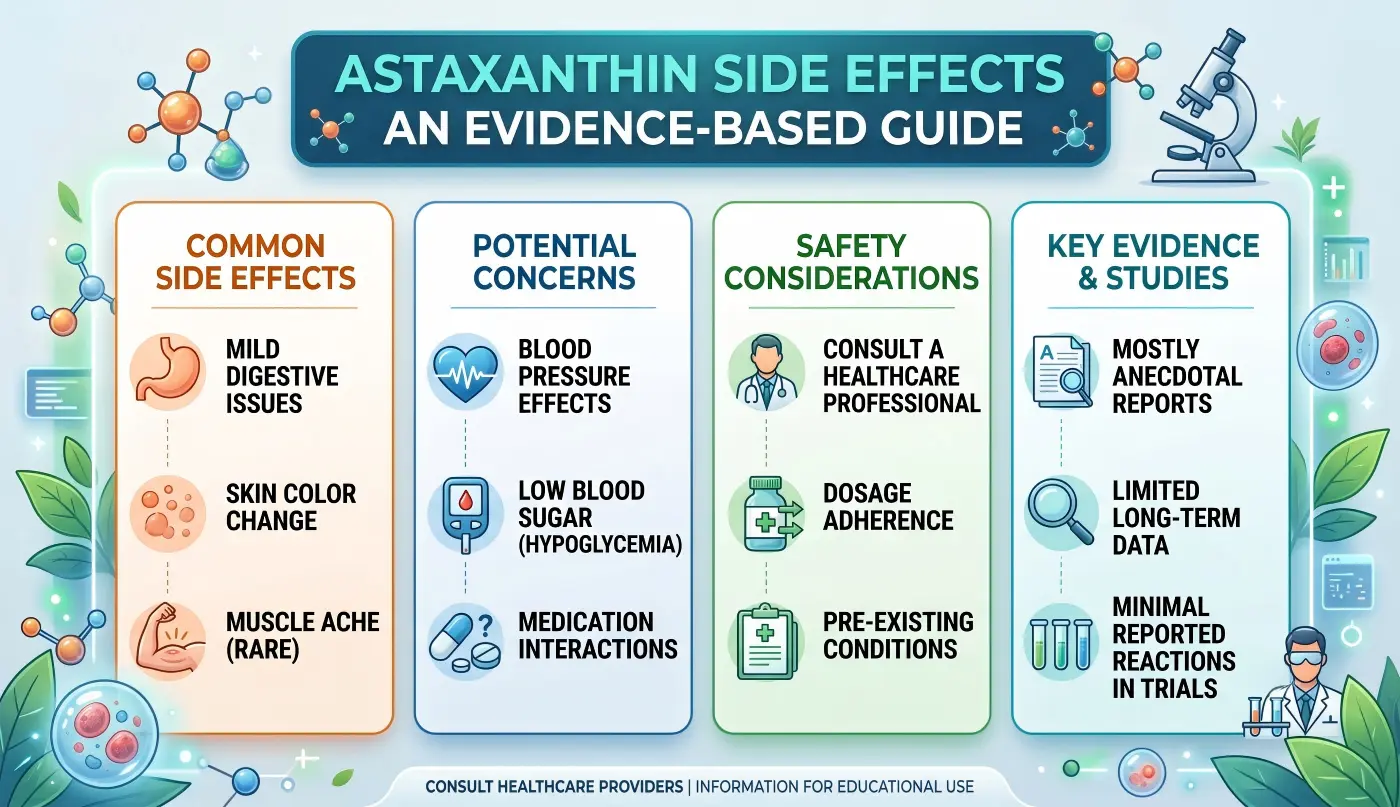
Medical disclaimer: This article is for educational and product-development purposes only. It does not replace advice from a qualified healthcare professional. Dietary supplements are not intended to diagnose, treat, cure, or prevent disease. This article is written for two audiences: consumers researching astaxanthin safety, and supplement brands developing astaxanthin-containing products. Sections are labeled accordingly.
Quick Answer
Natural astaxanthin has generally been well tolerated in the human studies conducted to date, at the doses and durations studied. That is not the same as saying every astaxanthin product, dose, or formulation is safe for every person. Safety depends on the ingredient source, concentration, daily intake, other formula ingredients, manufacturing quality, the consumer’s health status and medications, and the regulations of the target market. People who are pregnant or breastfeeding, are under 18, take anticoagulant/antiplatelet medication, or have liver, kidney, or endocrine conditions should consult a healthcare professional before use.
Table of Contents
- Is Astaxanthin Safe?
- What Do Regulatory Authorities Say?
- What Are the Known Astaxanthin Side Effects?
- Are There Astaxanthin Dangers at Higher Doses?
- Is 12 mg of Astaxanthin Too Much?
- Can Astaxanthin Affect Hormones?
- Can Astaxanthin Cause Liver Side Effects?
- Is Astaxanthin Safe for the Kidneys?
- Can Astaxanthin Interact With Medications?
- Who Should Not Take Astaxanthin?
- Natural vs. Synthetic Astaxanthin Safety
- Why Finished-Product Quality Matters
- Safety Checklist for Supplement Brands
- What Should Consumers Do If They Experience a Reaction?
- Frequently Asked Questions
- References
Astaxanthin is a lipid-soluble carotenoid used in eye health, beauty-from-within, antioxidant, healthy-aging, and active-lifestyle supplements. It occurs naturally in aquatic foods and can be produced commercially from sources such as Haematococcus pluvialis microalgae.
As consumer interest grows, so do searches for astaxanthin side effects, astaxanthin dangers, and potential long-term risks. Available human studies generally report good tolerability under the conditions evaluated, but this does not mean every astaxanthin product, dose, or use is appropriate for every person. Safety depends on more than the name of the active ingredient — source, concentration, daily intake, dosage form, other formula ingredients, manufacturing quality, target population, medications, and regional regulations all matter.
Is Astaxanthin Safe?
Key takeaway: Natural astaxanthin has been well tolerated in the healthy adult populations and dose ranges studied to date, but the evidence has real limits — mainly short durations, small sample sizes, and a narrow demographic profile.
A published safety review evaluated 87 human studies of natural astaxanthin. The authors reported that the reviewed studies did not identify safety concerns, including 35 studies using at least 12 mg per day.[1] This was a literature review, not proof that every dose is safe for all populations or for indefinite use.
A randomized, double-blind, placebo-controlled trial evaluated 6 mg of astaxanthin per day from Haematococcus pluvialis extract in 35 healthy adults (ages 35–69) for eight weeks. Researchers monitored blood pressure, a comprehensive metabolic panel, and blood counts, and found no clinically important safety differences between the astaxanthin and placebo groups.[2]
Another clinical evaluation administered 4 mg, 8 mg, or 20 mg of astaxanthin per day to 127 healthy adults for four weeks. The investigators reported no clinically abnormal findings in the measured biochemical and hematological parameters.[3]
These studies are reassuring, but they share common limitations:
- Trials were relatively small (dozens, not thousands, of participants).
- Durations were measured in weeks, not years.
- Participants were predominantly healthy adults.
- Ingredient sources and formulations differed between studies.
- Some studies were commercially funded.
- Evidence is limited for children, pregnancy, breastfeeding, and people with complex medical conditions.
The most accurate conclusion: natural astaxanthin has generally been well tolerated in studied adult populations — not that it is risk-free under all conditions.
What Do Regulatory Authorities Say About Astaxanthin Safety?
Key takeaway: Regulatory conclusions apply to a specific ingredient, intake level, and population — not to every astaxanthin product on the market.
In 2020, the European Food Safety Authority (EFSA) evaluated an intake of 8 mg astaxanthin per day from food supplements, combined with estimated dietary exposure from foods such as fish and crustaceans. EFSA concluded that this combined exposure was safe for adults under the conditions assessed. It also concluded that:
- Adolescents aged 14 to under 18 could reach the acceptable daily intake (ADI).
- Children aged 10 to under 14 could exceed the ADI by approximately 28%.
- Infants aged 4–6 months could exceed the ADI by up to 524%.[4]
This population-specific conclusion matters: a serving assessed as safe for adults should not automatically be used in a children’s supplement. EFSA’s 8 mg assessment should also not be described as a global recommended dosage or a universal upper limit — requirements differ by country, ingredient specification, consumer group, and product category.
In the United States, dietary supplements generally do not receive FDA premarket approval. Companies are responsible for establishing that their products comply with applicable safety, manufacturing, and labeling requirements. For a new dietary ingredient not already present in the food supply in unaltered form, the manufacturer or distributor must generally submit a New Dietary Ingredient Notification (NDIN) at least 75 days before market introduction, containing the basis for concluding that the ingredient is reasonably expected to be safe.[7]
What Are the Known Astaxanthin Side Effects?
Key takeaway: Published human trials do not establish a single, consistent pattern of common astaxanthin-specific side effects — but that does not rule out individual reactions.
Any dietary supplement may cause an unwanted reaction because of:
- The active ingredient itself
- Dose or frequency of use
- Other active ingredients in the formula
- Carrier oils, capsule materials, flavors, colors, sweeteners, or excipients
- Allergens or cross-contact
- Contamination or adulteration
- Interactions with medications or other supplements
- An individual’s underlying medical condition
General symptoms such as nausea, abdominal discomfort, diarrhea, headache, rash, or itching should not automatically be attributed to astaxanthin — they may be associated with another formula component or an unrelated condition.
A note on skin color changes (carotenoderma)
Carotenoderma is a well-documented, benign, reversible yellow-orange skin discoloration caused by carotenoid buildup in the skin, most often reported with high intakes of beta-carotene or lycopene from foods, juices, or supplements.[8][9] Astaxanthin belongs to the same carotenoid family, and consumers occasionally search for “astaxanthin skin color” for this reason. However, published case literature on carotenoderma is dominated by beta-carotene and lycopene; documented cases specifically attributed to astaxanthin supplementation are rare in the literature reviewed. Brands should not claim astaxanthin “cannot” cause skin-color changes, but should also avoid implying this is a common, expected effect without supporting evidence.
If a consumer experiences a significant reaction after using an astaxanthin supplement, the appropriate response is to stop using the product and seek advice from a healthcare professional. Serious reactions should be reported through the relevant national adverse-event reporting system; the U.S. FDA provides an online process for reporting problems associated with dietary supplements.[9]
Are There Astaxanthin Dangers at Higher Doses?
Key takeaway: A dose used safely in a short clinical study is not automatically appropriate for long-term, unsupervised, real-world consumer use.
Human studies have evaluated doses ranging from approximately 2 mg to 24 mg per day, with some studies using even higher experimental levels.[1] The table below summarizes the primary human safety data referenced in this article:
A dose evaluated in a short clinical study is not automatically suitable for long-term daily consumption, every adult, children or adolescents, pregnant or breastfeeding consumers, people taking prescription medications, people with liver/kidney/endocrine/immune/cardiovascular conditions, or every national market. Brands should not select a dose simply because it appears on a competitor’s label; serving levels should be justified by target-market regulations, ingredient-specific safety documentation, intended population, relevant human research, total daily exposure, and label directions. A higher number on the label is not automatically a better product.
Is 12 mg of Astaxanthin Too Much?
There is no universal answer. The safety review that examined 87 human studies included trials using 12 mg per day or more without identifying safety concerns in the reviewed research.[1] However, EFSA’s adult assessment concerned 8 mg per day from supplements together with background dietary exposure.[4] That regulatory conclusion cannot be replaced by citing a higher-dose clinical study.
A 12 mg serving may be commercially available or scientifically studied, but its suitability still depends on the country of sale, ingredient source and composition, intended consumer, use duration, formula combination, and product-specific safety evidence. Brands developing high-strength astaxanthin supplements should obtain a market-specific regulatory assessment before finalizing the formula.
Can Astaxanthin Affect Hormones?
Searches for “astaxanthin side effects hormones” reflect a common consumer concern, but current human evidence does not establish a recognized pattern of hormone-related adverse effects. Some laboratory and animal studies have investigated astaxanthin in relation to cell-signaling, reproductive, metabolic, or inflammatory pathways; those findings cannot be directly translated into evidence about human hormone levels.
The available human safety trials were not designed to exclude every possible endocrine effect. The responsible conclusion is that no well-established hormone-related adverse effect has been confirmed in mainstream human safety research, but evidence is not sufficient to guarantee the absence of endocrine effects in every population or at every dose. Astaxanthin should not be marketed as a testosterone booster, estrogen regulator, fertility treatment, or hormone-balancing supplement without adequate evidence and regulatory authorization. People with hormone-sensitive conditions or those receiving endocrine treatment should consult their healthcare professional before using a new supplement.
Can Astaxanthin Cause Liver Side Effects?
In the eight-week randomized trial of 6 mg per day, researchers monitored a comprehensive metabolic panel and did not report clinically meaningful liver-safety concerns attributable to the astaxanthin-rich algal extract.[2] Other short-term studies using different serving levels similarly reported no clinically abnormal changes in the biochemical parameters assessed.[3]
These findings do not prove that astaxanthin can treat liver disease, that every astaxanthin product is safe for people with liver impairment, that very high doses are safe long-term, or that a contaminated or adulterated supplement cannot cause liver injury. For manufacturers, liver-safety risk is not limited to astaxanthin itself — raw-material identity, residual solvents, undeclared ingredients, microbial contamination, and excessive levels of other actives can all affect the safety profile of the finished product. People with liver disease or medication requiring liver monitoring should seek medical advice before use.
Is Astaxanthin Safe for the Kidneys?
Available clinical studies do not establish astaxanthin as a common cause of kidney injury in healthy adults under the studied conditions, but evidence specifically designed to evaluate long-term kidney safety remains limited. Cell and animal studies suggesting protective kidney mechanisms should not be used as proof that astaxanthin treats kidney disease or is appropriate for people with impaired renal function.
Consumers with kidney disease may need to control specific nutrients, fluids, medications, or supplement ingredients, and a multi-ingredient astaxanthin product may also contain minerals, botanicals, or other actives that are unsuitable for them. Anyone with chronic kidney disease, reduced kidney function, or medically supervised dietary restrictions should consult a healthcare professional before use.
Can Astaxanthin Interact With Medications?
Key takeaway: Reliable interaction data for astaxanthin are limited, but at least one well-documented case links high-dose astaxanthin to a dangerous rise in warfarin’s anticoagulant effect.
A published case report described a 69-year-old woman on stable warfarin therapy (INR 1.4) who began taking astaxanthin at 16 mg per day (above the product’s labeled maximum). Within 48 hours, her INR rose to 10.38 and she developed significant bruising (ecchymosis). Astaxanthin and warfarin were withheld and vitamin K was administered; her INR returned to 1.43 as symptoms improved. The causality assessment indicated a probable relationship between astaxanthin supplementation and the bleeding event.[5] Separately, laboratory research has reported that astaxanthin can influence coagulation, fibrinolysis, and platelet aggregation in animal models — mechanistic evidence that is consistent with, but does not independently confirm, the human case report.[6]
This does not establish that astaxanthin is unsafe for all consumers taking anticoagulant or antiplatelet medication, but it does mean:
- A lack of documented interactions in general does not prove that no interaction is possible.
- People taking warfarin, aspirin, or other anticoagulant/antiplatelet medications should discuss astaxanthin with their prescriber or pharmacist before starting it, and should not exceed labeled serving amounts.
- Consumers with a narrow therapeutic range medication, multiple medications, planned surgery, or medically monitored blood clotting should seek professional advice first.
Brands should avoid publishing broad “no known interactions” claims for astaxanthin unless they have established an adequate evidence basis, and should consider a caution statement for anticoagulant/antiplatelet users on labeling or in consumer-facing materials.
Who Should Not Take Astaxanthin?
There is not enough evidence to create a universal list of people who must never take astaxanthin. Nevertheless, some groups require additional caution.
Children and adolescents. Adult safety findings should not be applied directly to children. EFSA concluded that a combined exposure scenario involving 8 mg per day from supplements could exceed the ADI in children under 14, and that adolescents aged 14 to under 18 could reach the ADI.[4] Children’s products require age-specific exposure calculations, serving instructions, safety evidence, and regulatory review.
Pregnant or breastfeeding consumers. There is insufficient high-quality human evidence to establish routine astaxanthin supplementation as safe during pregnancy or breastfeeding. The National Center for Complementary and Integrative Health (NCCIH) notes that many dietary supplements have not been adequately tested in pregnant women, nursing mothers, or children.[11] Pregnant or breastfeeding consumers should consult their healthcare provider before taking astaxanthin unless it has been specifically recommended as part of their care.
People taking medication. Reliable clinical interaction data for astaxanthin are limited, and at least one documented case links high-dose astaxanthin to a dangerous interaction with warfarin.[5] Consumers taking prescription or over-the-counter medication should discuss new supplements with their healthcare provider or pharmacist, particularly when the medication has a narrow therapeutic range, multiple medications are being used, blood clotting or other parameters are medically monitored, or surgery is planned.
People with medical conditions. Consumers being treated for liver, kidney, cardiovascular, immune, endocrine, bleeding, or metabolic conditions should seek professional advice before use. This precaution does not mean astaxanthin is known to worsen these conditions — it reflects limited evidence in medically complex populations.
People with ingredient allergies. Microalgae-derived astaxanthin is not the same as shellfish-derived astaxanthin, but a finished supplement may contain fish oil, krill oil, gelatin, soy-derived carriers, or other potential allergens. Consumers should not assume every astaxanthin supplement is vegan, fish-free, shellfish-free, soy-free, or allergen-free.
Anyone who previously experienced a reaction. The original reaction may have been caused by astaxanthin, another ingredient, contamination, or an unrelated factor. Professional assessment is necessary when the cause is uncertain.
Natural vs. Synthetic Astaxanthin Safety
Natural and synthetic astaxanthin should not be treated as identical materials. Natural astaxanthin for human supplements is commonly obtained from Haematococcus pluvialis; synthetic astaxanthin is produced through chemical synthesis and is widely associated with aquaculture applications. The materials may differ in stereoisomer distribution, esterification profile, source organism or manufacturing route, carrier system, impurity profile, regulatory status, intended use, and supporting safety data.
A review may conclude that one natural astaxanthin preparation was well tolerated, but that conclusion should not automatically be transferred to a materially different source or specification. Brands should verify that supplier safety data correspond to the exact commercial ingredient being purchased.
KSNutripharma’s natural astaxanthin supplement manufacturing service supports source selection, specification review, dosage-form development, quality testing, and finished-product manufacturing.
Why Finished-Product Quality Matters
(Section for supplement brands and formulators)
Astaxanthin safety cannot be assessed from the active amount alone. A poorly designed product may create risks even when the astaxanthin ingredient itself has an acceptable safety profile.
Ingredient identity. Confirm the biological or synthetic source and verify that incoming material matches the approved specification. Identity testing helps prevent substitution, dilution, and use of an incorrect carotenoid-rich material.
Active-ingredient assay. Astaxanthin concentration should be verified using a suitable analytical method (e.g., HPLC), distinguishing between total astaxanthin-containing material, astaxanthin concentration in the input, active astaxanthin per finished serving, label claim, and manufacturing overage. A capsule containing 100 mg of a 5% astaxanthin preparation does not provide 100 mg of astaxanthin.
Contaminant testing. A finished-product quality program may include testing for heavy metals, microbiological contamination, residual solvents, pesticide residues, undeclared allergens, oxidation products, and other market-specific contaminants, reflecting the source, extraction process, carrier, dosage form, and target country.
Oxidation and stability control. Astaxanthin is sensitive to oxygen, heat, and light. Degradation may reduce active content and change product color, odor, or appearance. Relevant controls include nitrogen protection, low-oxygen processing, controlled production temperatures, light-protective handling, antioxidant carrier systems, oxygen-barrier packaging, desiccants where appropriate, and accelerated/real-time stability testing.
Dosage-form compatibility. Astaxanthin oil suspension is commonly used in softgels; standardized powders, beadlets, and microencapsulated systems can support capsules, tablets, gummies, and powders. The correct format depends on target serving level, processing temperature, moisture exposure, water dispersibility, capsule fill weight, blend uniformity, color impact, and target shelf life. Multi-carotenoid eye health formulations require additional compatibility assessment because astaxanthin, lutein, zeaxanthin, oils, minerals, and botanical extracts may have different stability requirements.
Safety Checklist for Supplement Brands
Before commercializing an astaxanthin product, brand owners should request and review:
- Complete ingredient specifications
- Source and manufacturing-process information
- Astaxanthin concentration and assay method
- Certificate of analysis for each batch
- Heavy-metal and microbiological limits
- Residual-solvent and pesticide information where relevant
- Allergen and genetically modified organism statements
- Carrier oil and excipient composition
- Stability and storage data
- Regulatory status in the target market
- Evidence supporting the proposed daily serving
- Suitability for the intended age group
- Finished-product testing specifications
- Packaging compatibility data
- Adverse-event handling and traceability procedures
The product’s safety file should be reviewed whenever the source, concentration, dosage form, packaging, serving level, supplier, or target market changes.
What Should Consumers Do If They Experience a Reaction?
- Stop taking the product.
- Seek medical assistance if symptoms are serious or persistent.
- Keep the bottle, label, lot number, and purchase information.
- Record the serving used and when symptoms began.
- Inform the manufacturer or distributor.
- Report serious events to the appropriate national authority.
The FDA advises consumers to stop using a dietary supplement and submit a safety report when they believe it caused a serious reaction or illness.[9] In the United States, reports can be submitted through the FDA Safety Reporting Portal.[10]
Frequently Asked Questions
What are the most common astaxanthin side effects? Human studies have not established a consistent pattern of common astaxanthin-specific side effects. Individual reactions remain possible and may relate to the active ingredient, dose, carrier, allergens, other formula ingredients, or product quality.
Is astaxanthin dangerous? Natural astaxanthin has generally been well tolerated by healthy adults in published studies. However, “natural” does not mean risk-free. Risks depend on dose, source, target population, other ingredients, medications, manufacturing quality, and duration of use.
Can astaxanthin damage the liver? Short-term human safety studies have not identified a consistent signal of liver injury under the conditions studied.[2][3] Evidence is insufficient to guarantee safety for every person, high dose, or duration. People with liver disease should consult a healthcare professional.
Can astaxanthin damage the kidneys? Kidney injury has not been established as a common adverse effect in available healthy-adult studies. People with kidney disease or renal dietary restrictions should obtain medical advice before use, because targeted long-term evidence is limited.
Does astaxanthin affect hormones? Current human safety research does not establish a recognized hormone-related adverse effect, but studies have not ruled out every possible endocrine effect. Consumers with hormone-sensitive conditions should consult their healthcare provider.
Can astaxanthin interact with blood thinners like warfarin? Yes, potentially. A published case report documented a dangerous rise in INR (from 1.4 to 10.38) after a patient on warfarin began taking 16 mg of astaxanthin per day, resulting in bleeding.[5] Anyone taking warfarin, aspirin, or other anticoagulant/antiplatelet medication should consult their healthcare provider or pharmacist before using astaxanthin.
Does astaxanthin change skin color? High intakes of carotenoids in general — most commonly beta-carotene and lycopene — can cause a benign, reversible yellow-orange skin discoloration called carotenoderma.[8] Documented cases specifically linked to astaxanthin are rare in the published literature, but consumers using very high or combined carotenoid intakes should be aware this is a possible class effect.
Is 12 mg of astaxanthin safe? Clinical studies and reviews have included 12 mg daily without identifying significant safety concerns in the populations studied.[1] That does not establish 12 mg as appropriate in every country or for every consumer. EFSA’s adult safety assessment evaluated 8 mg per day from supplements combined with dietary exposure.[4]
Can children take astaxanthin? Adult supplements should not be given to children without age-specific assessment and professional guidance. EFSA found that an exposure scenario involving 8 mg per day from supplements could exceed the ADI in children under 14.[4]
Can astaxanthin be taken during pregnancy? There is insufficient evidence to establish routine use as safe during pregnancy or breastfeeding. Consumers should consult their healthcare provider before use.[11]
Does a higher astaxanthin dose provide better results? Not necessarily. A higher serving may increase cost or exposure without producing a clinically meaningful additional benefit. Dose selection should follow the product objective, human evidence, safety assessment, and target-market requirements.
Developing a Safety-Focused Astaxanthin Supplement
A responsible astaxanthin product requires more than selecting a marketable serving level. Brands must evaluate ingredient identity, source, purity, target population, evidence, dosage-form compatibility, manufacturing controls, stability, packaging, labeling, and post-market procedures.
KSNutripharma® supports natural astaxanthin softgels, capsules, tablets, gummies, powders, and custom combination formulas. Services include raw-material qualification, formulation development, pilot production, analytical testing, stability planning, packaging, and OEM/ODM manufacturing.
Contact KSNutripharma about your astaxanthin supplement project and provide your target country, intended consumer, daily serving, dosage form, formula, packaging, and forecast volume.
References and Authoritative Resources
- Brendler T, Williamson EM. Astaxanthin: How much is too much? A safety review. National Library of Medicine, PubMed. https://pubmed.ncbi.nlm.nih.gov/31788888/
- Spiller GA, Dewell A. Safety of an astaxanthin-rich Haematococcus pluvialis algal extract: a randomized clinical trial. National Library of Medicine, PubMed. https://pubmed.ncbi.nlm.nih.gov/12804020/
- Satoh A, et al. Preliminary clinical evaluation of toxicity and efficacy of a new astaxanthin-rich Haematococcus pluvialis extract. National Library of Medicine, PubMed. https://pubmed.ncbi.nlm.nih.gov/19430618/
- EFSA Panel on Nutrition, Novel Foods and Food Allergens (NDA). Safety of astaxanthin for its use as a novel food in food supplements. EFSA Journal, 2020. National Library of Medicine, PubMed. https://pubmed.ncbi.nlm.nih.gov/32874213/
- Sittiwet A, et al. Interaction between warfarin and astaxanthin: A case report. Journal of Cardiology Cases, 2019. National Library of Medicine, PubMed. https://pubmed.ncbi.nlm.nih.gov/31073352/
- Effects of astaxanthin on blood coagulation, fibrinolysis and platelet aggregation in hyperlipidemic rats (animal study; mechanistic evidence only). National Library of Medicine, PubMed Central. https://pmc.ncbi.nlm.nih.gov/articles/PMC6130668/
- U.S. Food and Drug Administration. New Dietary Ingredients in Dietary Supplements — Background for Industry. https://www.fda.gov/food/new-dietary-ingredient-ndi-notification-process/new-dietary-ingredients-dietary-supplements-background-industry
- Diet-induced carotenodermia: a literature review (general carotenoid class effect; not astaxanthin-specific). ResearchGate / peer-reviewed dermatology literature. https://www.researchgate.net/publication/375227333_Diet-induced_carotenodermia_a_literature_review
- U.S. Food and Drug Administration. How to Report a Problem With Dietary Supplements. https://www.fda.gov/food/dietary-supplements/how-report-problem-dietary-supplements
- U.S. Food and Drug Administration. Safety Reporting Portal. https://www.safetyreporting.fda.gov/
- National Center for Complementary and Integrative Health. Using Dietary Supplements Wisely. https://www.nccih.nih.gov/health/using-dietary-supplements-wisely
- National Center for Complementary and Integrative Health. Dietary and Herbal Supplements. https://www.nccih.nih.gov/health/dietary-and-herbal-supplements