This article is written from a nutraceutical formulation and contract-manufacturing perspective and is not intended as medical advice. Conversion percentages reported in human studies apply to the specific tested preparations and should not be interpreted as guaranteed results for other commercial supplements.
Introduction: Why Sulforaphane and Glucoraphanin Are Often Confused
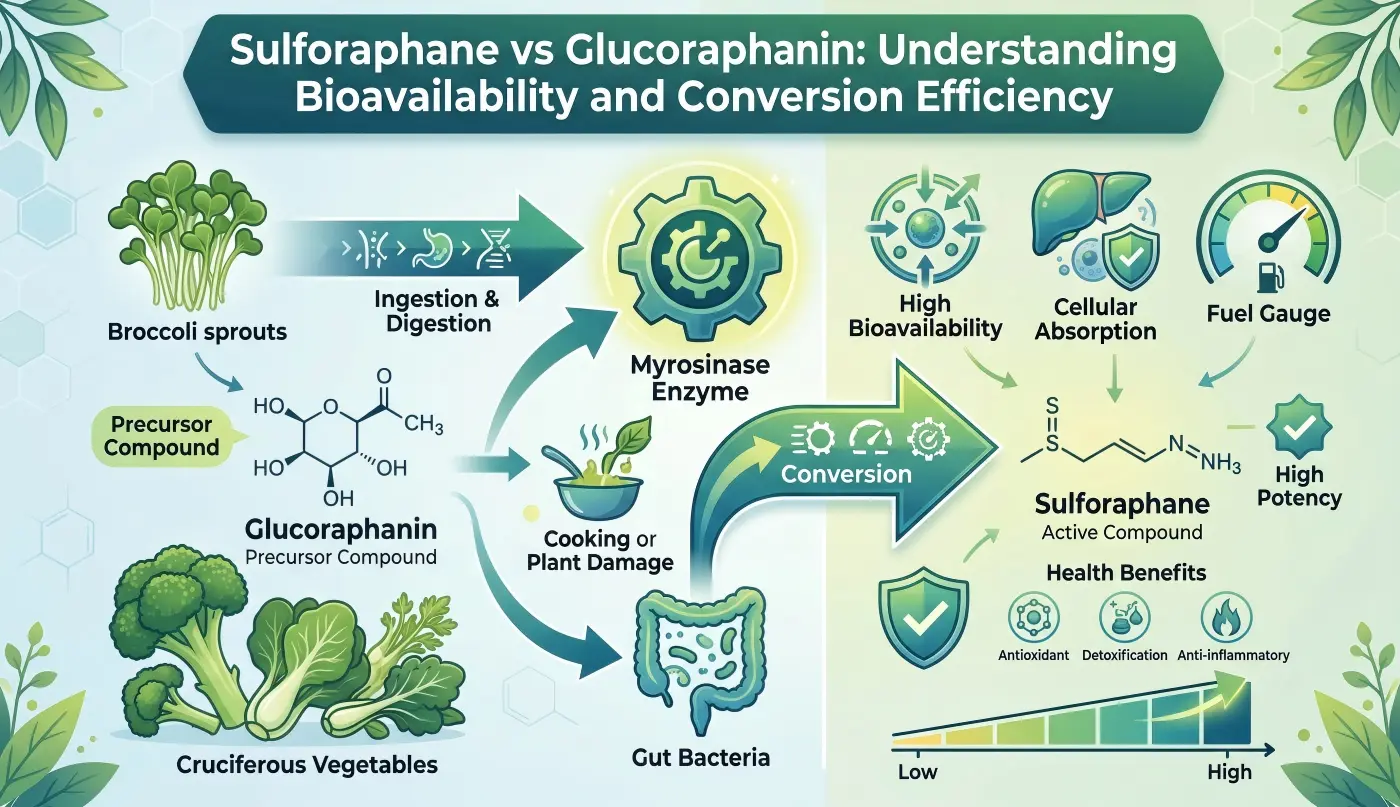
Sulforaphane and glucoraphanin are two names that frequently appear together on broccoli sprout supplement labels, often without clear differentiation. Glucoraphanin (GR) is a glucosinolate precursor. Sulforaphane (SFN) is the isothiocyanate formed from GR through enzymatic hydrolysis.
Products labeled as “sulforaphane supplements” do not always contain stabilized, preformed sulforaphane. Many products actually provide glucoraphanin from broccoli seed extract or broccoli sprout extract, relying on either endogenous myrosinase or gut microbial conversion to produce sulforaphane after consumption.
To accurately compare two products, buyers must determine whether the label reports preformed sulforaphane, glucoraphanin content, or only a theoretical sulforaphane yield.
What Is Glucoraphanin?
Glucoraphanin is a glucosinolate, a class of sulfur-containing compounds found primarily in cruciferous vegetables including broccoli, broccoli seeds, and broccoli sprouts. In intact plant tissue, glucoraphanin and myrosinase are typically stored in separate cellular compartments. When plant tissue is disrupted through chewing, crushing, or processing, the two come into contact and hydrolysis occurs.
Glucoraphanin should be viewed as sulforaphane potential, not as guaranteed sulforaphane delivery. The amount of sulforaphane ultimately produced depends on multiple conversion factors.
What Is Sulforaphane?
Sulforaphane is an isothiocyanate formed from glucoraphanin. It is the primary bioactive compound of interest in human absorption and metabolism studies. After absorption, sulforaphane undergoes metabolism through the mercapturic acid pathway, producing metabolites including SFN-glutathione, SFN-cysteine, and SFN-N-acetylcysteine.
Sulforaphane is relatively reactive, which makes direct incorporation into supplements a formulation challenge requiring appropriate stability engineering.
Sulforaphane and Nrf2
Sulforaphane has been widely studied for its interaction with the Nrf2 signaling pathway. Nrf2 regulates genes associated with normal cellular antioxidant and xenobiotic response systems. Mechanistic evidence does not mean that a specific finished product has been proven to prevent or treat any disease condition.
How Is Glucoraphanin Converted Into Sulforaphane?
The conversion pathway can be summarized as follows:
Glucoraphanin -> [Active Myrosinase] -> Unstable Intermediate -> [Rearrangement] -> Sulforaphane
Importantly, glucoraphanin hydrolysis does not automatically produce 100% sulforaphane. Alternative products, including sulforaphane nitrile, can form depending on conditions.
The Role of Myrosinase
Myrosinase is the enzyme that catalyzes glucoraphanin conversion to sulforaphane. It can be sourced from broccoli sprouts, seeds, mustard seed, and other plant sources. Heating, extraction, and storage can reduce enzyme activity. The mere presence of “myrosinase” on a label does not guarantee effective conversion; enzyme activity in the finished product must be verified.
Conversion Is Not Automatically 100%
Factors affecting conversion efficiency include myrosinase activity and dose, glucoraphanin-to-enzyme contact conditions, moisture content, temperature, pH, gastrointestinal release location, formulation matrix, competing reaction pathways, and gut microbial composition.
Theoretical sulforaphane yield is not the same as analytically measured or clinically delivered sulforaphane.
What Does “Bioavailability” Mean in Sulforaphane Research?
Three distinct concepts are frequently conflated in discussions of sulforaphane bioavailability:
Ingredient Content: The amount of GR or preformed SFN present in the capsule or raw material, typically measured by analytical chemistry.
Conversion Efficiency: The proportion of GR that is converted into SFN and its metabolites, often expressed on a molar basis.
Internal Dose: The amount of SFN and its metabolites actually absorbed, distributed, and detectable in blood or urine.
Many studies estimate bioavailability using 24-hour urinary metabolite recovery. While urinary recovery is a commonly used proxy, it does not represent absolute absorption across all tissues. A reported “70% urinary recovery” should not be marketed as “70% human absorption rate.”
Sulforaphane vs. Glucoraphanin: What Do Human Studies Show?
Preformed Sulforaphane Usually Produces Higher and Faster Recovery
Human studies indicate that directly administered sulforaphane is generally absorbed and excreted more rapidly than glucoraphanin. Some studies report that approximately 70-90% of an oral SFN dose is recovered as SFN metabolites in urine. This range reflects specific study formulations and should not be extrapolated to all commercial products.
In the Qidong cross-study analysis, SFN-rich beverage showed average urinary metabolite recovery of approximately 70%, while GR-rich beverage showed approximately 5%. These figures reflect the specific beverage formulations tested and should not be treated as a fixed ratio applicable to all SFN and GR products.
Glucoraphanin Without Active Myrosinase Is More Variable
When plant myrosinase is absent or inactivated, glucoraphanin relies primarily on intestinal bacterial conversion. The Linus Pauling Institute summarizes a study of 45 participants in which average conversion was approximately 12%, with individual ranges from about 1.1% to 40.7%. These figures demonstrate substantial individual variation and should not be presented as predictions for any specific consumer.
Active Myrosinase Can Improve Glucoraphanin Conversion
A 2015 human study demonstrated that glucoraphanin preparations containing active plant myrosinase generally achieved higher sulforaphane bioavailability than glucoraphanin without myrosinase. The observed difference was approximately 3-4 fold, though actual results depend on formulation, dose, and study design.
Recent Evidence: Glucoraphanin Plus Mustard-Seed Myrosinase
A 2026 randomized, double-blind, crossover study of 16 healthy participants evaluated glucoraphanin with mustard-seed myrosinase. The glucoraphanin-plus-myrosinase group showed average recovery of approximately 39.8%, compared with approximately 18.6% for glucoraphanin alone. First 8-hour conversion rates were approximately 25.4% and 8.0%, respectively.
This study had important limitations: small sample size, single-dose design, and use of a specific broccoli seed extract, mustard seed powder, and vitamin C formulation. Results should not be directly extrapolated to all myrosinase-containing products.
Why Does Conversion Efficiency Vary Between People?
Gut Microbiome Differences
Certain intestinal bacteria possess myrosinase-like activity. The composition and metabolic activity of these bacteria vary among individuals. Glucoraphanin may be converted to sulforaphane or to alternative products such as sulforaphane nitrile. Currently, single microbiome assessments cannot accurately predict individual supplement response.
Food and Formulation Matrix
Capsule versus tablet versus powder or beverage format; disintegration time; whether glucoraphanin and myrosinase are in physical contact; product water activity; processing effects on enzyme activity; and gastrointestinal release location all influence conversion.
Processing and Storage
Sulforaphane may degrade during production or storage. Glucoraphanin is relatively more stable, but its myrosinase counterpart may lose activity. Both technical routes present distinct quality control challenges.
Does More Glucoraphanin Mean More Sulforaphane?
Not necessarily. Glucoraphanin content indicates only the theoretical upper limit for conversion. If myrosinase is insufficient or inactive, actual sulforaphane formation may be low. Increasing glucoraphanin input does not linearly increase internal sulforaphane dose without corresponding conversion efficiency.
A product containing 50 mg of glucoraphanin does not contain 50 mg of sulforaphane.
Why Milligrams of GR and SFN Cannot Be Compared Directly
Sulforaphane and glucoraphanin have different molecular weights. Research studies typically compare molar doses in micromoles (umol). Approximate conversions:
- 100 umol SFN is approximately 17.7 mg SFN
- 100 umol GR is approximately 43.6-43.7 mg GR
- 100 umol GR theoretically yields up to 100 umol SFN, but actual yield depends on conversion efficiency
Theoretical SFN amount = GR molar dose x conversion efficiency x SFN molecular weight. This is an estimation method and cannot replace finished-product testing or human pharmacokinetic studies. Labels must clearly state whether they report GR, SFN, or theoretical SFN yield.
Stability Trade-Offs in Supplement Manufacturing
Glucoraphanin Formulations
Advantages: the precursor is relatively stable; suitable for capsules and tablets; compatible with plant-sourced positioning; straightforward raw material standardization. Challenges: conversion efficiency must be addressed; myrosinase activity must be verified; theoretical yield should not replace actual testing; individual variation may be substantial.
Preformed Sulforaphane Formulations
Advantages: bypasses the glucoraphanin conversion step; more direct active dosing; absorption and metabolism typically faster; easier to match specific sulforaphane studies. Challenges: sensitive to heat, moisture, and storage conditions; requires stabilization technology; needs end-of-shelf-life content verification; higher-dose formulations may present gastrointestinal tolerance considerations.
Which Ingredient Is Better for Different Product Strategies?
Choose Stabilized Sulforaphane When:
- Defined preformed SFN dose is required
- More direct and faster active delivery is emphasized
- Adequate raw material stability data is available
- Finished product can verify end-of-shelf-life SFN content
Choose Glucoraphanin Plus Active Myrosinase When:
- Broccoli-derived or clean-label positioning is desired
- A relatively stable precursor is preferred
- Supplier can provide GR content and enzyme activity specifications
- Finished-product myrosinase activity can be verified
Be Cautious With Glucoraphanin Alone When:
- The product relies entirely on gut microbial conversion
- Fixed SFN production is claimed without supporting data
- Glucoraphanin weight is presented as sulforaphanin weight
Formulation Recommendations From KS Nutripharma
Strategy 1: Stabilized Direct-SFN Capsule
Stabilized sulforaphane raw material, low-moisture production environment, moisture-protective packaging, with initial and end-of-shelf-life SFN testing. Suitable for premium positioning, standardized active-dose products, and science-led formulations.
Strategy 2: GR Plus Verified Myrosinase System
Standardized glucoraphanin extract with plant myrosinase verified for activity, controlled processing temperature, finished-product testing for GR and enzyme activity, with in-vitro SFN yield validation where appropriate. Suitable for botanical formulations, clean-label products, and broccoli-derived ingredient positioning.
Strategy 3: Dual-Delivery Formulation
May combine a small amount of preformed sulforaphane with glucoraphanin precursor and active myrosinase. The theoretical goal is to provide both rapid delivery and sustained conversion. However, a dual-delivery concept should not be described as superior unless the finished formulation has appropriate stability, bioavailability, and claim-substantiation data.
Quality-Control Checklist for Supplement Brands
Before selecting a sulforaphane-related ingredient, brands should confirm:
- Does the specification state SFN or GR content?
- Are values expressed in mg, umol, or potential yield?
- Is SFN directly measured or theoretically calculated?
- Does the ingredient contain active myrosinase with defined activity units?
- Is enzyme activity tested in the raw material, the finished product, or both?
- What analytical method is used for GR and SFN quantification?
- Are degradation products monitored?
- Are real-time and accelerated stability data available?
- What is the minimum active content specification at end of shelf life?
- Are microbial, heavy metal, pesticide, and residual solvent tests conducted?
- Do human studies match the intended raw material and dose?
A high-quality specification should describe what is present, what can be converted, how conversion is measured, and what remains at the end of shelf life.
Regulatory and Claim Considerations
“Higher bioavailability” is an objective, verifiable comparative claim only when supported by evidence specific to the product, dose, and conditions of use. Mechanism studies cannot automatically support disease prevention or treatment claims. Even “activates Nrf2” should be reviewed against product-specific evidence and target market regulations.
Brands should consult FDA and FTC guidance on dietary supplement claims substantiation:
Frequently Asked Questions
Is glucoraphanin the same as sulforaphane?
No. Glucoraphanin is the glucosinolate precursor; sulforaphane is an isothiocyanate formed after enzymatic hydrolysis.
Does the body convert all glucoraphanin into sulforaphane?
No. Conversion is incomplete and varies according to myrosinase activity, formulation, and individual gut microbial metabolism.
Is sulforaphane more bioavailable than glucoraphanin?
Preformed SFN generally produces higher and faster urinary recovery than GR alone. However, SFN must remain stable in the finished product, while GR combined with active myrosinase may substantially improve conversion.
Why do supplements combine glucoraphanin with myrosinase?
Because active myrosinase can increase and accelerate the conversion of GR into SFN compared with reliance on gut microbial conversion alone.
Can a label claim “10 mg sulforaphane from glucoraphanin”?
Only if the wording accurately distinguishes measured SFN from theoretical or validated yield and complies with the target market’s labeling rules. Glucoraphanin content alone does not prove a fixed delivered sulforaphane dose.
Is more myrosinase always better?
Not necessarily. Enzyme activity, substrate ratio, processing stability, and release conditions matter more than simply adding more myrosinase powder.
Which is more stable: sulforaphane or glucoraphanin?
Glucoraphanin is generally the more stable precursor. Preformed sulforaphane usually requires stabilization and appropriate packaging.
Conclusion:
Sulforaphane and glucoraphanin are not interchangeable ingredients. Sulforaphane provides the active isothiocyanate directly but creates greater stability challenges. Glucoraphanin is a relatively stable precursor, but its value depends on how efficiently it is converted by active myrosinase or the gut microbiome. For supplement brands, the best formulation is the one that demonstrates verified content, controlled conversion, finished-product stability, and evidence-aligned claims.
KS Nutripharma® helps supplement brands evaluate sulforaphane and glucoraphanin ingredients, develop conversion-focused formulations, verify active content, select suitable dosage forms, and scale products for commercial manufacturing.
Contact us to discuss your sulforaphane supplement formulation needs:→
References
[1] National Cancer Institute. Sulforaphane Definition. https://www.cancer.gov/publications/dictionaries/cancer-drug/def/sulforaphane
[2] Linus Pauling Institute. Isothiocyanates. https://lpi.oregonstate.edu/mic/dietary-factors/phytochemicals/isothiocyanates
[3] Linus Pauling Institute. Cruciferous Vegetables. https://lpi.oregonstate.edu/mic/food-beverages/cruciferous-vegetables
[4] Fahey JW, Zhang Y, Talalay P. Broccoli sprouts: an exceptionally rich source of inducers of enzymes that protect against chemical carcinogens. Proc Natl Acad Sci USA. 1997;94(19):10367-10372. https://doi.org/10.1073/pnas.94.19.10367
[5] Okonkwo A, et al. Comparison of isothiocyanate yield from glucoraphanin in raw vs. cooked broccoli. PLOS ONE. 2015;10(11):e0140963. https://journals.plos.org/plosone/article?id=10.1371/journal.pone.0140963
[6] Vermeulen M, et al. Bioavailability and metabolism of sulforaphane: the role of the gut microbiome. Mol Nutr Food Res. 2024. https://pmc.ncbi.nlm.nih.gov/articles/PMC10922398/
[7] Yagishita Y, Fahey JW, Dinkova-Kostova AT, Kensler TW. Broccoli or sulforaphane: is it the source or dose that matters? Front Nutr. 2021;8:648788. https://www.frontiersin.org/journals/nutrition/articles/10.3389/fnut.2021.648788/full
[8] Clarke JD, et al. Bioavailability and metabolism of sulforaphane. Food Funct. 2012;3(3):298-303. https://pubmed.ncbi.nlm.nih.gov/22318753/
[9] Egner PA, et al. Rapid and sustainable detoxication of airborne pollutants by broccoli sprout beverage. Cancer Prev Res. 2011;4(3):396-403. https://pmc.ncbi.nlm.nih.gov/articles/PMC3076202/
[10] Sivakumaran S, et al. Urinary excretion of sulforaphane metabolites as a measure of bioavailability. Molecules. 2019;24(19):3593. https://doi.org/10.3390/molecules24193593
[11] Wang Y, et al. Enhanced sulforaphane bioavailability from glucoraphanin by myrosinase. Sci Rep. 2026;16:39389. https://www.nature.com/articles/s41598-026-39389-4
[12] Bommareddy A, et al. Stability and bioavailability of sulforaphane. Mol Nutr Food Res. 2017;61(2):1600766. https://doi.org/10.1002/mnfr.201600766
[13] ClinicalTrials.gov. NCT02656420. https://clinicaltrials.gov/study/NCT02656420
[14] FDA. Draft Guidance: Standards for Growing, Harvesting, Packing, and Holding Sprouts. https://www.fda.gov/regulatory-information/search-fda-guidance-documents/draft-guidance-industry-standards-growing-harvesting-packing-and-holding-sprouts-human-consumption
[15] FDA. Selecting and Serving Produce Safely. https://www.fda.gov/food/buy-store-serve-safe-food/selecting-and-serving-produce-safely
[16] FDA. Small Entity Compliance Guide: Current Good Manufacturing Practice. https://www.fda.gov/regulatory-information/search-fda-guidance-documents/small-entity-compliance-guide-current-good-manufacturing-practice-manufacturing-packaging-labeling
[17] FDA. Small Entity Compliance Guide: Structure/Function Claims. https://www.fda.gov/regulatory-information/search-fda-guidance-documents/small-entity-compliance-guide-structurefunction-claims
[18] FDA. Guidance for Industry: Substantiation for Dietary Supplement Claims. https://www.fda.gov/regulatory-information/search-fda-guidance-documents/guidance-industry-substantiation-dietary-supplement-claims-made-under-section-403r-6-federal-food
[19] FTC. Health Products Compliance Guidance. https://www.ftc.gov/business-guidance/resources/health-products-compliance-guidance