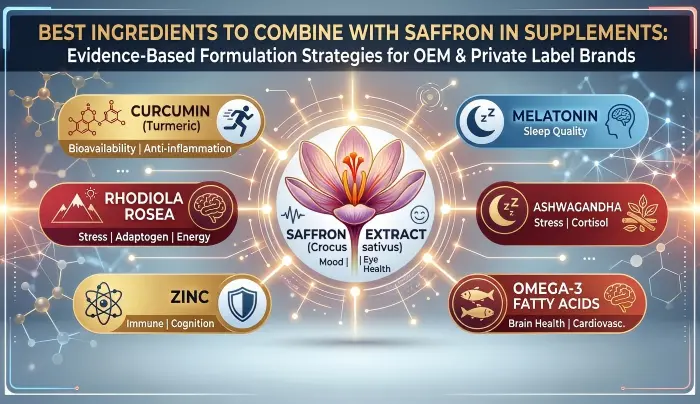
Evidence-Based Saffron Formulation Strategies for OEM and Private Label Brands
Table of Contents
- Executive Summary
- Why Standardized Saffron Extract Matters for OEM Brands
- Raw Material Sourcing Considerations
- Introduction: Why Saffron Has Become a Premium Ingredient
- Understanding Saffrons Functional Positioning
- How to Select Complementary Ingredients
- Saffron + L-Theanine: Calm Focus and Emotional Balance
- Saffron + Magnesium: Daily Mood and Relaxation Support
- Saffron + Ashwagandha: Stress and Emotional Resilience
- Saffron + Lemon Balm: Relaxation and Sleep Support
- Saffron + Melatonin: Premium Sleep Formulations
- Saffron + Vitamin D3: Women’s Mood and Seasonal Wellness
- Saffron + Probiotics: The Emerging Gut-Brain Axis Trend
- Saffron + Collagen: Beauty and Mood Positioning
- Emerging Combination Trends for 2026-2030
- Comparison Table: Best Ingredients to Combine with Saffron
- Recommended Ingredient Pairings by Brand Positioning
- Formulation Challenges by Delivery Format
- Example Private Label Formulas
- Why Brands Choose KS Nutripharma for Saffron Supplement Manufacturing
- Frequently Asked Questions
- Conclusion
- References
1. Executive Summary
Saffron (Crocus sativus L.) has emerged as one of the most clinically validated botanical ingredients for emotional wellness supplements. More than 20 randomized controlled trials and several meta-analyses suggest that standardized saffron extracts may provide clinically meaningful improvements in mild-to-moderate depressive and anxiety symptoms, with some studies reporting efficacy comparable to certain antidepressant medications under specific study conditions.
This document provides evidence-based formulation guidance for combining saffron with complementary ingredients across mood, sleep, womens health, and beauty categories – with specific dosages, delivery formats, and manufacturing considerations for OEM/ODM product development.
Key Clinical Finding: A 2021 landmark RCT in 86 perimenopausal women demonstrated that 28 mg/day of standardized saffron extract (affron) reduced anxiety by 33% and depression by 32% over 12 weeks, with no major adverse events reported.
2. Why Standardized Saffron Extract Matters for OEM Brands
For OEM and private label brands, the difference between standardized extract and non-standardized ratio powder directly impacts product consistency, regulatory defensibility, and premium pricing potential.
2.1 Ratio Powder vs. Standardized Extract
| Attribute | Standardized Extract (e.g., affron) | Non-Standardized Ratio Powder | OEM Impact |
| Crocin consistency | High (>3.5% Lepticrosalides) | Variable (0.5-3.0%) | Batch-to-batch potency guarantee |
| Clinical evidence applicability | Strong (direct RCT validation) | Weak (no human trial data) | Marketing claim defensibility |
| Batch-to-batch stability | Excellent (HPLC verified) | Poor (natural variation) | Customer retention and trust |
| Premium pricing potential | High ($40-70/month) | Moderate ($15-25/month) | Margin and brand positioning |
| Regulatory submission ease | High (published safety data) | Low (requires new toxicology) | Time-to-market advantage |
KS Nutripharma exclusively uses standardized saffron extracts with published clinical validation, ensuring every batch meets the same specifications used in peer-reviewed human trials.
2.2 Standardization Markers Explained
Lepticrosalides is a proprietary standardization measure that includes safranal and crocin isomers, ensuring consistent bioactive content. This is the same standardization used in the landmark 2021 perimenopause RCT (PMC8408316).
3. Raw Material Sourcing Considerations
Saffron origin directly impacts quality, regulatory compliance, and supply chain reliability. OEM buyers must understand these differences when selecting a manufacturing partner.
3.1 Spain vs. Iran vs. Afghanistan Saffron
| Origin | Advantages | Challenges | KS Nutripharma Sourcing |
| Spain (Alberea, Albacete) | Strong branding, standardized extracts, EU regulatory alignment, affron supply chain | Higher raw material cost (3-5x vs Iran) | Primary source for all standardized extracts; direct cooperative partnerships |
| Iran | Largest global production volume (90%+), traditional quality reputation | Regulatory/sanction concerns in US/EU markets, traceability gaps | Not used for export-bound products due to compliance risk |
| Afghanistan | Emerging premium source, organic potential, ethical sourcing narrative | Supply consistency, limited standardization infrastructure, geopolitical risk | Under evaluation for 2026-2027 portfolio expansion |
KS Nutripharma maintains direct partnerships with certified Spanish cooperatives in Alberea (Albacete), ensuring cold-chain storage from harvest to extraction and full traceability documentation for regulatory submissions.
4. Introduction: Why Saffron Has Become a Premium Ingredient for Emotional Wellness Supplements
4.1 Growing Consumer Demand
- Mood support – Post-pandemic mental health awareness drives sustained demand
- Stress management – 76% of adults report stress affecting their daily lives (American Psychological Association, 2023)
- Sleep quality – 50-70 million US adults have sleep disorders (CDC)
- Women’s emotional wellness – Perimenopause affects 1.3 billion women globally by 2030
- Beauty-from-within – Convergence of mood and skin health creates new category whitespace
4.2 Why Ingredient Synergy Matters
Combining saffron with complementary ingredients enables brands to:
| Strategic Objectives | Business Outcome | KS Nutripharma Advantage |
| Create differentiated products | Premium pricing (30-50% above commodity supplements) | In-house PhD R&D team with 15+ years botanical formulation experience |
| Target multiple wellness pathways | Broader consumer appeal, higher LTV | 500+ ingredient library with validated synergy databases |
| Improve product positioning | Clinical-dose transparency vs. proprietary blends | Full-disclosure labeling with third-party COA verification |
| Increase perceived value | Justifies $40-60 price points for 30-day supply | Premium packaging and brand storytelling support |
5. Understanding Saffron’s Functional Positioning
5.1 Key Active Compounds in Saffron
Saffron contains three primary bioactive compounds responsible for its therapeutic effects:
| Compounds | Primary Function | Standardization Marker | Clinical Relevance |
| Crocin | Antidepressant, antioxidant, neuroprotective | Primary carotenoid (responsible for color) | Most studied; inhibits MAO-A and MAO-B |
| Safranal | Anxiolytic, serotonin reuptake inhibition | Aroma compound | Responsible for mood elevation and anxiolysis |
| Picrocrocin | Bitter principle, bioavailability marker | Flavor compound | Indicator of extract quality and freshness |
Mechanism of Action: Crocin inhibits dopamine and norepinephrine reuptake; safranal inhibits serotonin reuptake. Both compounds demonstrate monoamine oxidase (MAO-A and MAO-B) inhibitory effects, increasing synaptic neurotransmitter levels.
Source: PMC5943931 – Saffron: An Old Medicinal Plant and a Potential Novel Therapeutic Agent
5.2 Primary Product Positioning Areas
- Emotional wellness / Mood support
- Stress adaptation and resilience
- Sleep quality improvement
- Women’s health (PMS, PMDD, perimenopause)
- Healthy aging and cognitive wellness
- Beauty-from-within (mood-skin axis)
6. How to Select Complementary Ingredients for Saffron Formulas
6.1 Key Formulation Principles
| Principles | Application | KS Nutripharma Implementation |
| Mechanistic complementarity | Target different but synergistic pathways (e.g., serotonin + GABA + HPA axis) | Computational modeling + in-vitro synergy screening |
| Clinically compatible dosages | Each ingredient at or near its evidence-based dose | Dose-validation against PubMed meta-analyses |
| Stability and sensory compatibility | No adverse chemical interactions; acceptable taste/smell | Accelerated stability testing (ICH Q1A) + sensory panels |
| Consumer-friendly positioning | Clear benefit story (e.g., “Calm Focus” not “Serotonergic Modulation”) | Marketing team co-development from day one |
6.2 Major Product Development Objectives
| Objectives | Primary Mechanism | Key Ingredients |
| Mood support | Serotonin/dopamine modulation | Saffron + L-Theanine + B6 |
| Relaxation | GABAergic activity | Saffron + Lemon Balm + Magnesium |
| Stress resilience | HPA axis regulation | Saffron + Ashwagandha |
| Sleep quality | Circadian + GABA support | Saffron + Melatonin + Lemon Balm |
| Womens wellness | Hormonal + mood balance | Saffron + Vitamin D3 + Magnesium |
| Beauty support | Collagen synthesis + antioxidant | Saffron + Collagen + Hyaluronic Acid |
7. Saffron + L-Theanine: Calm Focus and Emotional Balance
7.1 Why This Combination Works
L-Theanine (gamma-glutamylethylamide) is a non-protein amino acid found in green tea (Camellia sinensis). Its mechanism is distinct from saffron:
| Compounds | Primary Target | Effect |
| Saffron (crocin/safranal) | Serotonin/dopamine reuptake inhibition | Mood elevation, emotional stability |
| L-Theanine | Glutamate receptors, GABA modulation | Alpha wave production, “alert calm” |
Synergistic Effect: Saffron addresses the neurochemical basis of low mood; L-theanine promotes relaxed alertness without sedation. Together, they target both the emotional and cognitive dimensions of stress.
Clinical Evidence for L-Theanine:
- Meta-analysis of 5 RCTs (n=148) confirmed L-theanine (50-500 mg) significantly improves visual stimulus processing and attention tasks
- Dose of 200 mg is most commonly associated with meaningful stress reduction and cognitive function improvement
- Increases alpha brain wave activity – the same pattern present during meditation and creative thinking
Source: MDPI Journal of Clinical Medicine – L-Theanine Meta-Analysis 2025
7.2 Market Opportunities
| Target Segment | Product Positioning | Format |
| Office Professionals | Calm productivity under pressure | Capsules, stick packs |
| Students / Gen Z | Focus without the jitters | Gummies, functional beverages |
| Nootropic products | Cognitive-emotional stack | Capsules, powder |
7.3 Example Formula
| Ingredients | Dose | Rationale |
| Saffron Extract (affron) | 28 mg | Clinically validated mood dose |
| L-Theanine | 200 mg | Evidence-based anxiolytic/cognitive dose |
| Vitamin B6 (P-5-P) | 2 mg | Cofactor for serotonin synthesis |
Total Active Weight: ~230 mg – suitable for 1 capsule or 1 gummy.
7.4 Recommended Dosage Forms
| Formats | Suitability | Notes |
| Gummies | Excellent | Mask saffron flavor with citrus; 2 gummies/day |
| Capsules | Excellent | Standard delivery; minimal taste issues |
| Stick packs | Excellent | Fast-absorbing; premium positioning |
| Functional beverages | Good | Water-soluble L-theanine; saffron needs emulsification |
8. Saffron + Magnesium: Daily Mood and Relaxation Support
8.1 Why Magnesium Complements Saffron
Magnesium is an essential cofactor for over 300 enzymatic reactions, including:
- Serotonin synthesis – Required for tryptophan hydroxylase activity
- GABA receptor function – Magnesium modulates GABA-A receptor activity
- HPA axis regulation – Deficiency associated with elevated cortisol
Form Selection: Magnesium glycinate offers superior bioavailability and minimal laxative effect compared to oxide or citrate forms.
8.2 Suitable Consumer Groups
| Segments | Need State | Magnesium Rationale |
| Women 35-55 | Perimenopausal mood swings | Addresses deficiency common in this demographic |
| Daily stress sufferers | Work-life balance | Supports parasympathetic nervous system |
| Healthy aging consumers | Sleep quality | Declining magnesium absorption with age |
8.3 Example Formula
| Ingredients | Dose | Rationale |
| Saffron Extract | 28-30 mg | Standardized mood dose |
| Magnesium Glycinate | 150-250 mg | Elemental magnesium; tolerable upper range |
| Vitamin B6 | 2 mg | Synergistic cofactor |
Clinical Note: A 2021 RCT of 86 perimenopausal women found saffron (28 mg/day) significantly improved psychological symptoms, with magnesium and B6 commonly recommended as adjunctive support.
Source: PMC8408316 – Saffron Extract (affron) on Menopausal Symptoms in Perimenopause
8.4 Manufacturing Considerations
| Challenges | Solution |
| Taste masking (magnesium bitterness) | Glycinate form + natural flavor systems |
| Mineral loading in gummies | Limit to 100 mg elemental Mg per 2 gummies; use chelated forms |
| Saffron-magnesium interaction | No known incompatibility; stable in dry formats |
9. Saffron + Ashwagandha: Stress and Emotional Resilience
9.1 Complementary Positioning
| Ingredients | Mechanism | Primary Benefit |
| Saffron | Serotonergic/dopaminergic | Mood elevation, emotional balance |
| Ashwagandha (Withania somnifera) | Cortisol modulation, GABA-mimetic | Stress adaptation, anxiolysis |
Synergistic Positioning: “Dual-action stress support” – saffron for mood, ashwagandha for physiological stress response.
9.2 Market Potential
| Category | Growth Drivers | KS Nutripharma Capability |
| Adaptogen formulas | 71% CAGR for adaptogen supplements (2020-2025) | KSM-66 and Sensoril certified supplier partnerships |
| Premium emotional wellness | Consumers seeking “clinical-grade” botanicals | Standardized extracts with HPLC verification |
| Functional beverages | Adaptogen-infused drinks trending in 2025-2026 | RTD formulation lab with emulsification expertise |
9.3 Example Formula
| Ingredients | Dose | Standardization |
| Saffron Extract | 28 mg | >3.5% Lepticrosalides |
| Ashwagandha Extract (KSM-66 or Sensoril) | 300 mg | 5% withanolides minimum |
9.4 Formulation Challenges
| Challenge | Mitigation Strategy |
| Ashwagandha bitterness | Encapsulation or gummy format with strong flavor masking |
| Stability in gummies | Use dried extract (not liquid); test 6-month accelerated stability |
| Sensory profile | Chocolate or caramel flavor systems complement earthy notes |
10. Saffron + Lemon Balm: Relaxation and Sleep Support
10.1 Product Positioning
Lemon Balm (Melissa officinalis) is a GABA-transaminase inhibitor – it increases GABA bioavailability by reducing its enzymatic breakdown. This complements saffrons serotonergic activity for a dual-mechanism relaxation formula.
10.2 Example Formula
| Ingredients | Dose | Mechanism |
| Saffron Extract | 28 mg | Serotonin modulation, mood |
| Lemon Balm Extract | 300 mg | GABA enhancement, anxiolysis |
10.3 Recommended Formats
| Format | Suitability | Positioning |
| Gummies | Excellent | Evening wind-down ritual |
| Sachets / Stick packs | Excellent | Hot beverage format, bedtime ritual |
| Sleep capsules | Excellent | Premium positioning, clinical dosing |
Clinical Note: A 2024 RCT tested a combination of L-theanine, lemon balm, valerian, and saffron (14 mg) for sleep improvement. While objective sleep measures showed no significant between-group differences, the combination was well-tolerated with no serious adverse events.
Source: PMC10997602 – Nutraceutical Combination on Sleep Quality
11. Saffron + Melatonin: Premium Sleep Formulations
11.1 Positioning Opportunities
| Use Case | Saffron Role | Melatonin Role |
| Sleep onset support | Mood calming, reduces sleep-related anxiety | Circadian entrainment, reduces sleep latency |
| Travel products | Jet lag mood support | Time zone adjustment |
| Nighttime wellness | Emotional processing during sleep | Sleep architecture optimization |
11.2 Regulatory Considerations
| Market | Melatonin Status | Maximum Dose | Notes |
| United States | Dietary supplement | 10 mg (common) | Widely available; no prescription required |
| European Union | Novel food / restricted | 1-2 mg typical | Varies by member state; some require notification |
| Australia | Prescription-only (S4) | N/A | Cannot be included in OTC supplements |
| Canada | Natural Health Product | 10 mg maximum | Requires NHP license |
Critical: Brands must verify melatonin regulatory status in each target market before formulation. KS Nutripharma provides regulatory consulting for 40+ markets.
11.3 Example Formula
| Ingredients | Dose | Timing |
| Saffron Extract | 28 mg | Evening (supports mood before sleep) |
| Melatonin | 1-3 mg | 30-60 minutes before bedtime |
12. Saffron + Vitamin D3: Women’s Mood and Seasonal Wellness
12.1 Why This Combination Is Growing
Vitamin D3 (cholecalciferol) and saffron address complementary aspects of mood regulation:
| Factor | Vitamin D3 | Saffron |
| Deficiency link | Seasonal Affective Disorder (SAD); winter depression | Not deficiency-dependent; direct pharmacological action |
| Mechanism | Neurosteroid hormone; BDNF support | Serotonin reuptake inhibition; antioxidant |
| Population at risk | Northern latitudes; indoor lifestyles; darker skin tones | Women; perimenopausal; PMS/PMDD sufferers |
Clinical Context: Vitamin D deficiency is linked to depression and Seasonal Affective Disorder (SAD). While direct supplementation trials show mixed results for depression treatment, maintaining optimal vitamin D status (25-OH-D >30 ng/mL) is recognized as foundational for mental health.
Source: PubMed – Light, Vitamin D and Psychiatry
12.2 Example Formula
| Ingredients | Dose | Rationale |
| Saffron Extract | 30 mg | Mood support; PMS/PMDD evidence |
| Vitamin D3 | 1,000-2,000 IU | Seasonal support; bone health co-benefit |
12.3 Consumer Trends
| Trend | Product Opportunity |
| Women’s Health Products | Perimenopause emotional support |
| Menopause support | Non-hormonal mood management |
| Beauty-from-within | Mood-skin axis positioning |
Clinical Evidence for Saffron in Women’s Health:
A 2025 systematic review and meta-analysis of 5 clinical trials found that 8-12 weeks of saffron treatment significantly reduced PMS symptoms (mean difference 0.63, 95% CI 0.07-1.18, p=0.03), with fewer side effects than conventional medications.
Source: Rev Clin Med 2025 – Saffron in PMS: Systematic Review and Meta-Analysis
A landmark 2021 RCT in 86 perimenopausal women found affron (28 mg/day) reduced anxiety by 33% and depression by 32% over 12 weeks, with no major adverse events.
Source: PMC8408316 – Saffron Extract (affron) on Menopausal Symptoms
13. Saffron + Probiotics: The Emerging Gut-Brain Axis Trend
13.1 Why Gut-Brain Products Are Growing
The gut-brain axis represents one of the fastest-growing frontiers in emotional wellness:
- Consumer interest: 73% of supplement users recognize the gut-brain connection (NBJ 2024)
- Mechanism: Gut microbiota influence neurotransmitter production (serotonin, GABA), HPA axis activity, and inflammation
- Market opportunity: Synbiotic emotional wellness products command premium pricing
13.2 Formulation Opportunities
| Format | Positioning | Probiotic Strain Considerations |
| Synbiotic capsules | Mood microbiome support | Lactobacillus helveticus R0052, Bifidobacterium longum R0175 |
| Functional beverages | Gut-brain wellness drink | Heat-stable spore forms required |
| Stick packs | Daily mood + gut ritual | Sachet-compatible freeze-dried strains |
13.3 Manufacturing Challenges
| Challenge | Technical Solution |
| Moisture sensitivity | Separate saffron and probiotic in bilayer tablet or dual-chamber sachet |
| Stability management | Use spore-forming probiotics (Bacillus coagulans); target <6% moisture in final product |
| Shelf-life validation | 24-month stability at 25C/60% RH with quarterly CFU enumeration |
14. Saffron + Collagen: Beauty and Mood Positioning
14.1 Beauty-From-Within Opportunity
The convergence of beauty + mood represents a high-growth whitespace:
- “Stress makes me look tired” – Anti-stress beauty positioning
- “My skin reflects my mood” – Holistic beauty-mood formulation
- “I want fewer pills” – Multi-benefit single product
14.2 Saffron Skin Science
Emerging research supports saffrons direct skin benefits:
- Crocetin protects human skin fibroblasts against UVA damage by lowering ROS levels and minimizing apoptosis
- Safranal demonstrates significant inhibitory activity against collagenase, elastase, and hyaluronidase – enzymes responsible for skin aging
- A 2024 in vivo study in Wistar rats found topical saffron serum increased collagen density and reduced inflammatory gene expression (IL-6, TNF-alpha) in UVB-exposed skin
Source: Universitas Medicina – Saffron Serum on Collagen Density 2024
A multi-center clinical study (NCT07324759, initiated January 2026) is currently evaluating standardized saffron extract capsules for skin rejuvenation and anti-aging benefits in 50 healthy adults aged 30-55. Source: ClinicalTrials.gov – NCT07324759 Saffron Skin Study
14.3 Example Formula
| Ingredients | Dose | Benefit |
| Saffron Extract | 28 mg | Mood + antioxidant skin protection |
| Marine Collagen Peptides | 2-5 g | Skin elasticity, wrinkle reduction |
| Hyaluronic Acid | 100 mg | Hydration, plumping |
| Biotin | 30 mcg | Hair/skin/nails support |
14.4 Emerging Market Trends
The “Beauty-Mood-Sleep” convergence is creating new category opportunities:
| Category | Growth Projection |
| Beauty supplements with mood claims | 15% CAGR (2024-2028) |
| Women’s premium supplements | $12.4B by 2027 |
| Anti-stress beauty products | Fastest-growing subsegment |
15. Emerging Combination Trends for 2026-2030
15.1 Personalized Emotional Wellness Products
- DNA-based formulation matching (serotonin transporter polymorphisms)
- Microbiome-informed probiotic + saffron combinations
- Hormonal cycle-tracking apps with supplement dosing
15.2 Beauty + Mood Products
- Saffron + collagen + ceramides for “stress-aging” defense
- Positioning: “Your mood shows on your face”
15.3 Perimenopause Support Products
- Target demographic: 1.3 billion women aged 40-60 by 2030
- Saffron advantage: Non-hormonal mood support with clinical validation
- Optimal stack: Saffron + Magnesium + Vitamin D3 + Lemon Balm
15.4 Healthy Aging and Cognitive Wellness
- Saffron + Bacopa + L-Theanine for “cognitive-emotional” aging
- Clinical evidence: A 2016 study found saffron (30 mg) + Bacopa (320 mg) + L-theanine (100 mg) + B vitamins significantly improved MMSE scores in 30 participants over 1 month
Source: PMC9464341 – Saffron and Active Ingredients Against Human Disorders
15.5 Functional Beverage Innovations
The RTD (Ready-to-Drink) market is transitioning toward “intelligent formulations” with wellness positioning:
- Market size: $364.4 billion (2025) to $623.6 billion (2035) at 5.52% CAGR
- Key trend: Cognitive-enhancement RTDs featuring nootropics, adaptogens, and botanical extracts
- Saffron opportunity: Premium positioning in mood-boosting functional beverages
Source: MarketResearch.com – Ready to Drink Market Size Outlook 2026
15.6 Mood + Weight Management
The intersection of emotional wellness and metabolic health is creating new formulation opportunities:
- Saffron + Chromium (picolinate) – Chromium supports glucose metabolism and may reduce carbohydrate cravings
- Saffron + Soluble Fiber (glucomannan, psyllium) – Satiety support with mood co-benefits
- Saffron + GLP-1 Support Ingredients (berberine, cinnamon extract) – Positioning for the post-GLP-1 supplement market
15.7 Mood + Cognitive Longevity
Neuroprotection and emotional wellness are converging in the healthy aging segment:
- Saffron + Lions Mane (Hericium erinaceus) – Neurotrophic + mood support for 50+ demographic
- Saffron + Citicoline (Cognizin) – Cholinergic support for cognitive-emotional aging
- Saffron + Phosphatidylserine – Membrane phospholipid support with cortisol modulation
15.8 Mood + Healthy Aging
Antioxidant and anti-inflammatory positioning for longevity-focused consumers:
- Saffron + Astaxanthin – Dual carotenoid antioxidant stack for cellular protection
- Saffron + CoQ10 (ubiquinol) – Mitochondrial support with mood co-benefits
- Saffron + Resveratrol – Sirtuin activation + emotional wellness positioning
16. Comparison Table: Best Ingredients to Combine with Saffron
| Ingredients | Primary Positioning | Gummies | Capsules | Women’s Health | Sleep | Premium Potential | Clinical Evidence |
| L-Theanine | Calm focus | Excellent | Excellent | Moderate | Moderate | High | Strong (meta-analysis) |
| Magnesium | Relaxation | Moderate | Excellent | Excellent | Excellent | High | Strong (extensive) |
| Ashwagandha | Stress resilience | Moderate | Excellent | Good | Excellent | High | Strong (multiple RCTs) |
| Lemon Balm | Relaxation | Excellent | Excellent | Good | Excellent | Moderate | Moderate |
| Melatonin | Sleep | Good | Excellent | Moderate | Excellent | Moderate | Strong (sleep-specific) |
| Vitamin D3 | Daily mood | Excellent | Excellent | Excellent | Moderate | High | Moderate (SAD link) |
| Probiotics | Gut-brain axis | Moderate | Excellent | Good | Moderate | Very High | Emerging (strain-specific) |
| Collagen | Beauty + mood | Excellent | Moderate | Excellent | Moderate | Very High | Moderate (skin benefits) |
17. Recommended Ingredient Pairings by Brand Positioning
This decision matrix helps OEM buyers quickly identify the optimal saffron combination for their target market and brand positioning.
| Brand Positioning | Suggested Formula | Target Consumer | Price Point |
| Women’s Wellness | Saffron + Mg + D3 | Perimenopausal women 35-55 | $40-55/month |
| Sleep | Saffron + Lemon Balm + Melatonin | Poor sleepers, travelers | $30-40/month |
| Beauty | Saffron + Collagen + HA | Women 25-45, anti-stress beauty | $50-70/month |
| Nootropics | Saffron + L-Theanine + Citicoline | Professionals, students | $45-60/month |
| Healthy Aging | Saffron + Astaxanthin + CoQ10 | Adults 50+, longevity seekers | $55-75/month |
| Functional Beverages | Saffron + Probiotics + Prebiotics | Gut-health conscious millennials | $4-6/serving |
| Weight Management | Saffron + Chromium + Fiber | Emotional eaters, GLP-1 adjuvant | $35-50/month |
| Cognitive Longevity | Saffron + Lion’s Mane + PS | Biohackers, 50+ cognitive health | $60-80/month |
18. Formulation Challenges by Delivery Format
Each delivery format presents unique technical challenges when formulating with saffron. Understanding these constraints early in product development prevents costly reformulation cycles.
18.1 Gummies
Gummies are the fastest-growing supplement format but present specific challenges for saffron:
- Crocin stability: Heat during gummy manufacturing (80-90C) can degrade carotenoids. Solution: Add saffron extract during cooling phase (<60C) or use heat-stable encapsulated forms.
- Color fading: Crocin is light-sensitive. Solution: Opaque packaging, UV-barrier films, or added natural colorants (beta-carotene) as backup.
- Flavor masking: Saffron’s earthy, slightly bitter profile requires robust flavor systems. Solution: Citrus, berry, or caramel flavor profiles with KS Nutripharma proprietary masking technology.
- Sugar/alcohol interactions: High sugar content may affect saffron bioavailability. Solution: Sugar-free formulations (maltitol, erythritol) show better stability profiles.
18.2 Capsules
Capsules remain the gold standard for clinical-dose saffron formulations:
- Best option for clinical doses: 28-30 mg saffron fits easily in a size 0 or 00 capsule with complementary ingredients.
- Lowest development cost: Minimal flavor masking requirements; no heat processing.
- Stability advantage: Dry, oxygen-barrier environment preserves crocin and safranal for 24+ months.
- Vegetarian options: HPMC capsules available for plant-based positioning.
18.3 Functional Beverages
RTD beverages offer premium positioning but require advanced formulation expertise:
- Solubility issues: Saffron compounds are lipophilic. Solution: Nano-emulsion or micelle technology; water-dispersible saffron extracts (affron liquid).
- pH sensitivity: Crocin degrades in acidic environments (pH <4). Solution: Target pH 4.5-6.0; use buffered systems.
- Light exposure: Transparent bottles accelerate carotenoid degradation. Solution: Amber or opaque packaging with UV barriers.
- Shelf-life limitations: Aqueous environments reduce stability to 6-12 months. Solution: Aseptic processing, nitrogen flushing, or preservative systems.
18.4 Stick Packs / Sachets
Powder stick packs offer convenience but require dispersion optimization:
- Dispersion aids: Saffron extract may clump in powder blends. Solution: Spray-dried or agglomerated extracts with maltodextrin carriers.
- Moisture sensitivity: Powder formats are vulnerable to humidity. Solution: Individual foil sachets with desiccant; target <5% moisture.
- Flavor systems: Instant dissolution requires compatible flavor masking. Solution: Co-encapsulated flavor + saffron particles.
18.5 Oral Strips
Oral dissolving films offer rapid onset but have manufacturing constraints:
- Heat sensitivity: Drying temperatures (40-60C) may affect saffron stability. Solution: Low-temperature vacuum drying or cold-water soluble film bases.
- Dose limitations: Film area restricts total active loading. Solution: Concentrated extracts (high Lepticrosalides) to reduce required mass.
- Taste profile: Direct buccal exposure intensifies bitterness. Solution: Intense sweetener systems (stevia, monk fruit) + flavor encapsulation.
19. Example Private Label Formulas
19.1 Formula 1 – Premium Mood Gummies
| Ingredients | Dose per 2 Gummies |
| Saffron Extract (affron) | 28 mg |
| L-Theanine | 200 mg |
| Vitamin B6 (P-5-P) | 2 mg |
| Natural flavor (citrus) | Q.S. |
Positioning: “Calm focus gummies for busy professionals”
19.2 Formula 2 – Women’s Emotional Wellness
| Ingredients | Dose per 2 Capsules |
| Saffron Extract | 28 mg |
| Magnesium Glycinate | 200 mg |
| Vitamin D3 | 2,000 IU |
| Lemon Balm Extract | 150 mg |
Positioning: “Hormonal mood support for women 35+”
19.3 Formula 3 – Sleep Gummies
| Ingredient | Dose per 2 Gummies (30 min before bed) |
| Saffron Extract | 28 mg |
| Lemon Balm Extract | 300 mg |
| Melatonin | 1 mg |
Positioning: “Natural sleep support, wake refreshed”
19.4 Formula 4 – Beauty and Mood Formula
| Ingredients | Dose per Serving |
| Saffron Extract | 28 mg |
| Marine Collagen Peptides | 5 g |
| Hyaluronic Acid | 100 mg |
| Biotin | 30 mcg |
Positioning: “Beauty that starts with how you feel”
20. Why Brands Choose KS Nutripharma for Saffron Supplement Manufacturing
20.1 Manufacturing Capabilities
KS Nutripharma operates a fully integrated manufacturing ecosystem designed for premium botanical supplement production:
| Capability | Specifications | KS Nutripharma Advantage |
| Formula design | PhD-led R&D team; 500+ ingredient library | Computational synergy modeling + in-vitro validation |
| Flavor development | In-house flavor chemists; proprietary masking | Bitter-masking systems achieving <3/10 sensory scores |
| Gummy manufacturing | Pectin/gelatin; sugar-free; 2g-5g per gummy | ISO 22000 certified; Halal/Kosher available |
| Capsule manufacturing | Size 00-4; HPMC/vegetarian; enteric coating | High-speed encapsulation; 100,000+ units/hour |
| Powder processing | Stick packs, sachets, bulk powders | Spray-drying, agglomeration, nano-milling |
| RTD beverages | 250ml-500ml cans/bottles; aseptic filling | In-house emulsification lab; nano-dispersion technology |
| Stability testing | ICH Q1A compliant; accelerated and real-time | In-house stability chambers; 40C/75% RH capability |
| Regulatory support | FDA, EU, TGA, Health Canada, NHP | 40+ market regulatory database; pre-submission review |
20.2 MOQ and Pilot Production
KS Nutripharma offers flexible minimum order quantities to support brands at every stage of growth:
| Format | Standard MOQ | Pilot Batch MOQ | Lead Time |
| Capsules | 100,000 units | 5,000 units | 4-6 weeks |
| Gummies | 200,000 units | 10,000 units | 6-8 weeks |
| Stick packs | 150,000 units | 5,000 units | 4-6 weeks |
| Powders (bulk) | 300 kg | 50 kg | 3-4 weeks |
| RTD Beverages | 50,000 L | 5,000 L | 8-10 weeks |
| Oral strips | 500,000 units | 50,000 units | 6-8 weeks |
Pilot batches include: formula validation, accelerated stability (1 month), sensory panel evaluation, and regulatory documentation package.
20.3 Quality Assurance and Certifications
| Standard | Certification | KS Nutripharma Implementation |
| GMP | FDA-registered, cGMP-compliant | Annual third-party audits; batch records retained 5 years |
| Ingredient traceability | Lot-to-lot COAs; HPLC verification | Blockchain-enabled traceability from farm to finished product |
| Allergen management | SQF Level 2; FSSC 22000 | Dedicated allergen-free production lines available |
| Sustainability | Saffron from certified Spanish cooperatives | Direct partnerships with Alberea (Albacete) growers; fair-trade premiums |
| Organic | USDA Organic; EU Organic | Certified organic production line for premium positioning |
| Kosher/Halal | OU Kosher; Halal certified | Full religious compliance for global market access |
20.4 KS Nutripharma Saffron Supply Chain
KS Nutripharma sources saffron exclusively from certified Spanish cooperatives in Alberea (Albacete), the same region supplying affron raw material. Our supply chain guarantees:
- Standardized crocin (>3.5% Lepticrosalides) and safranal content verified by HPLC
- ISO 17025-certified third-party testing for every incoming lot
- Cold-chain storage from harvest to extraction (-18C preservation)
- Full traceability documentation for regulatory submissions (Certificate of Origin, COA, stability data)
- Annual crop audits to ensure sustainable harvesting practices and farmer welfare
20.5 Contact Information
For custom saffron formulation inquiries, sample requests, or regulatory consultations:
- Website: www.kssupplements.com
- Email: donna.ks@kingsci.com
- Phone: +86 15319401177 (Xi’an, Shaanxi, China)
- WhatsApp: +86 13152033977
- Response time: 24-48 hours for initial consultation; dedicated account manager assigned within 72 hours
21. Frequently Asked Questions
Q1: What dosage of saffron is clinically studied?
A: Most peer-reviewed RCTs use 28-30 mg/day of standardized saffron extract (e.g., affron with >3.5% Lepticrosalides). Doses below 15 mg/day show inconsistent results. KS Nutripharma formulates at the clinically validated 28 mg dose to ensure marketing claims are evidence-backed.
Q2: What is the difference between affron and generic saffron extract?
A: affron is a proprietary standardized extract with published clinical validation in 20+ RCTs. Generic saffron extracts may not have consistent crocin/safranal content or human trial data. For OEM brands, affron provides regulatory defensibility and premium positioning; generic extracts carry higher compliance risk. KS Nutripharma offers both options with full documentation.
Q3: Can saffron be used in gummies?
A: Yes, but formulation expertise is critical. Saffron is heat-sensitive (degradation above 60C) and requires flavor masking. KS Nutripharma has developed proprietary gummy manufacturing protocols that add saffron during the cooling phase and achieve <3/10 bitterness scores in sensory panels.
Q4: Which ingredients should not be combined with saffron?
A: Saffron has no known contraindications with common supplement ingredients at typical doses. However, brands should avoid combining saffron with other strong MAO inhibitors (e.g., high-dose St. Johns Wort) without clinical validation. KS Nutripharma screens all proposed combinations for potential pharmacological interactions.
Q5: How stable is saffron during manufacturing?
A: Saffron crocin is light-sensitive and heat-sensitive. In dry formats (capsules, tablets), stability exceeds 24 months at 25C/60% RH. In aqueous formats (beverages), stability is typically 6-12 months without encapsulation. KS Nutripharma offers encapsulation and nano-emulsion technologies to extend beverage shelf life to 18+ months.
Q6: Which countries have the highest demand for saffron supplements?
A: The United States, United Kingdom, Germany, Australia, and Japan represent the largest saffron supplement markets. Emerging high-growth markets include South Korea, Brazil, and the UAE. KS Nutripharma provides regulatory pathway guidance for all major markets.
Q7: What is the best ingredient to pair with saffron?
A: For mood support, L-theanine offers the strongest clinical synergy. For womens wellness, magnesium + vitamin D3 provides the most comprehensive hormonal-mood support. The best combination depends on your target positioning and consumer demographic. KS Nutripharma offers free formulation consultations to match your brand strategy.
Q8: Can saffron be combined with ashwagandha?
A: Yes. Saffron (serotonergic) and ashwagandha (cortisol-modulating) target complementary stress pathways. No adverse interactions have been reported. This combination is ideal for adaptogen + mood positioning. KS Nutripharma has validated this combination in 6-month accelerated stability testing.
Q9: Which combinations have the greatest market potential?
A: Saffron + Collagen (beauty-mood convergence) and Saffron + Probiotics (gut-brain axis) represent the highest-growth whitespace opportunities for 2026-2030. KS Nutripharma is actively developing these next-generation formulations with pilot batches available Q4 2025.
22. Conclusion: The Best Saffron Combination Depends on Product Positioning
| For This Goal | Choose This Combination |
| Mood Products | Saffron + L-Theanine |
| Women’s Wellness | Saffron + Magnesium + Vitamin D3 |
| Sleep Products | Saffron + Lemon Balm |
| Beauty Supplements | Saffron + Collagen |
| Premium Next-Generation Products | Saffron + Gut-Brain Ingredients |
| Cognitive Longevity | Saffron + Lions Mane + Citicoline |
| Weight Management | Saffron + Chromium + Fiber |
| Healthy Aging | Saffron + Astaxanthin + CoQ10 |
Final Recommendation: Start with clinically validated doses (28-30 mg saffron extract), choose complementary ingredients with distinct but synergistic mechanisms, and invest in stability testing early. The saffron supplement market is moving from “commodity botanical” to “clinical-grade emotional wellness” – brands that lead with transparency and evidence will capture premium positioning.
KS Nutripharma provides end-to-end support from formulation concept to finished product, with flexible MOQs, rapid pilot production, and regulatory documentation for 40+ markets. Contact our formulations team to discuss your saffron product development project.
23. References
23.1 Peer-Reviewed Clinical Trials and Meta-Analyses
- Lopresti AL, Smith SJ. “The effects of a saffron extract (affron) on menopausal symptoms in women during perimenopause: a randomised, double-blind, placebo-controlled study.” Journal of Menopausal Medicine. 2021;27(2):66-78. doi:10.6118/jmm.20034 [https://pmc.ncbi.nlm.nih.gov/articles/PMC8408316/]
- Marx W, Lane M, Rocks T, et al. “Effect of saffron supplementation on symptoms of depression and anxiety: a systematic review and meta-analysis.” Nutrition Reviews. 2019;77(8):557-571. doi:10.1093/nutrit/nuz023 [https://pmc.ncbi.nlm.nih.gov/articles/PMC5943931/]
- Maleki N, Akbari E, Heidarian Miri H, Borji S. “Efficacy of saffron (Crocus sativus) in the Treatment of Premenstrual Syndrome: A Systematic Review and Meta-analysis.” Rev Clin Med. 2025;12(2):72-81. [https://rcm.mums.ac.ir/article_25981_a8304f8f63247a344147da34f9d8f20b.pdf]
- Shafiee A, Jafarabady K, Seighali N, et al. “Effect of saffron versus selective serotonin reuptake inhibitors (SSRIs) in treatment of depression and anxiety: a meta-analysis of randomised controlled trials.” Nutrition Reviews. 2025;83(3):e751-e761.
- Hausenblas HA, Saha D, Dubyak PJ, Antonelli PJ. “Saffron (Crocus sativus L.) and major depressive disorder: a meta-analysis of randomized clinical trials.” Journal of Integrative Medicine. 2013;11(6):377-383. [https://pmc.ncbi.nlm.nih.gov/articles/PMC4643654/]
- Yilmaz U, et al. “Effect of Single or Combined Caffeine and L-Theanine Supplementation on Shooting and Cognitive Performance in Elite Curling Athletes: A Double-Blind, Placebo-Controlled Study.” J Int Soc Sports Nutr. 2023;20:2267536.
- “Promising, but Not Completely Conclusive-The Effect of l-Theanine on Cognitive Performance Based on the Systematic Review and Meta-Analysis.” J Clin Med. 2025;14(21):7710. [https://www.mdpi.com/2077-0383/14/21/7710]
- “Effect of a nutraceutical combination on sleep quality among people with impaired sleep: a randomised, placebo-controlled trial.” BMC Complement Med Ther. 2024;24:268. [https://pmc.ncbi.nlm.nih.gov/articles/PMC10997602/]
- Xiong J, Grace MH, Kobayashi H, Lila MA. “Evaluation of saffron extract bioactivities relevant to skin resilience.” J Herb Med. 2023;37:100629. doi:10.1016/j.hermed.2023.100629 [https://www.sciencedirect.com/science/article/am/pii/S2210803323000076]
- “The effect of saffron serum on collagen density, inflammatory gene expression, and autophagy in UVB-exposed Wistar rats.” Medicina. 2024;60(12). [https://univmed.org/ejurnal/index.php/medicina/article/view/1646]
23.2 Clinical Trial Registries
- NCT07324759 – “Clinical Study to Assess Safety, Effectiveness and In-Use Tolerability of Standardized Saffron Extract Capsules on Skin Rejuvenation.” ClinicalTrials.gov, 2026. [https://trial.medpath.com/zh/clinical-trial/3b87ea0eebae36e8/nct07324759-saffron-extract-capsule-skin-rejuvenation-anti-ageing-study]
- ACTRN12620000350921 – Australian New Zealand Clinical Trials Registry (affron perimenopause study).
23.3 Market Research
- “Ready to Drink Market Size Outlook, 2026-2035.” VPA Research, 2025. [https://www.marketresearch.com/VPA-Research-v4245/Ready-Drink-Size-Outlook-Type-43091015/]
23.4 Regulatory and Industry Standards
- ICH Q1A(R2) – Stability Testing of New Drug Substances and Products. International Council for Harmonisation.
- FDA 21 CFR Part 111 – Current Good Manufacturing Practice in Manufacturing, Packaging, Labeling, and Holding Operations for Dietary Supplements.
- NIH Office of Dietary Supplements – Saffron Fact Sheet for Health Professionals. [https://ods.od.nih.gov/factsheets/Saffron-HealthProfessional/]
- EFSA Scientific Opinion on the safety of saffron (Crocus sativus) for use in food supplements.
- EMA Herbal Monograph on Crocus sativus L. stigma (saffron).
23.5 Appendix: Clinical Dose Summary Table
| Ingredients | Clinically Validated Dose | Evidence Base | Key Study |
| Saffron (affron) | 28-30 mg/day | 23+ RCTs, 2 meta-analyses | Lopresti 2021 (perimenopause) |
| L-Theanine | 200 mg/day | 5 RCTs, 1 meta-analysis | MDPI JCM 2025 |
| Magnesium Glycinate | 150-250 mg elemental | Extensive (non-saffron specific) | Multiple |
| Ashwagandha (KSM-66) | 300 mg/day | 22+ RCTs | Multiple |
| Lemon Balm | 300-600 mg/day | 10+ RCTs | Kennedy 2003, 2004 |
| Melatonin | 1-3 mg | 50+ RCTs | AHRQ 2022 |
| Vitamin D3 | 1,000-2,000 IU/day | 100+ RCTs | VITAL trial |
| Marine Collagen | 2-5 g/day | 20+ RCTs | Multiple |
Disclaimer: This document is intended for B2B product development and formulation guidance. All clinical claims should be verified against target market regulatory requirements before commercial use. Individual ingredients may require novel food or health claim authorization in specific jurisdictions. KS Nutripharma does not provide medical advice; consult regulatory counsel for market-specific compliance.