A Complete Guide to Liposomal Delivery Technology, Manufacturing, and OEM Development
Introduction
If you are considering adding a liposomal glutathione product to your supplement line, you are entering one of the fastest-growing segments of the premium wellness market. But before committing to OEM development, you need clear answers to three fundamental questions:
- What exactly is liposomal glutathione?
- Why are leading brands investing in this delivery technology?
- And how do you evaluate suppliers and products to ensure commercial success?
This guide is written specifically for supplement brand owners, product developers, and procurement professionals. Rather than offering generic product descriptions, we provide the technical knowledge, manufacturing insights, and decision-making frameworks you need to evaluate liposomal glutathione as a business opportunity and select the right manufacturing partner.
Why Is Liposomal Glutathione Becoming a Premium Supplement Category?
Understanding the market forces behind liposomal glutathione’s growth is essential for making informed product development decisions. Several converging trends have created strong commercial momentum for this category:
Consumer Willingness to Pay Premium Prices
Market data consistently shows that consumers in the wellness space are willing to pay significantly more for products featuring advanced delivery technologies. Liposomal positioning supports price points that are typically 40-100% higher than conventional glutathione formulations, creating attractive margin opportunities for brands.
Antioxidant Category Growth
The global antioxidant supplement market continues to expand as consumer awareness of oxidative stress and cellular wellness increases. Glutathione, often referred to as the body’s “master antioxidant,” occupies a central position in this category and benefits from the overall market growth trajectory.
Beauty-from-Within Trend
The intersection of nutrition and skincare has created a massive opportunity for glutathione products. Consumers increasingly recognize that skin wellness starts from within, and glutathione’s role in supporting the body’s natural antioxidant defenses has made it a sought-after ingredient in beauty supplements.
Healthy Aging Demographics
As populations age globally, consumers aged 40 and above represent a growing segment actively seeking products that support vitality and wellness. This demographic typically has higher purchasing power and prioritizes quality over price, aligning perfectly with premium liposomal positioning.
Delivery Technology as a Value Driver
Modern supplement consumers are more educated than ever. They actively research delivery technologies and understand that formulation science matters. Liposomal delivery provides a credible, science-based differentiation that resonates with discerning buyers and supports premium positioning.
Functional Nutrition Market Expansion
The broader shift from basic supplementation to targeted functional nutrition has created demand for products with specific technological advantages. Liposomal glutathione fits squarely within this trend, offering brands a product with both compelling science and strong consumer appeal.
1. What Is Glutathione?
Glutathione is a tripeptide molecule composed of three amino acids: glutamine, cysteine, and glycine. It exists as one of the body’s most abundant endogenous compounds and plays a central role in maintaining cellular redox balance.
For supplement formulation purposes, it is important to understand the two primary forms:
- Reduced Glutathione (GSH): The biologically active form that participates directly in antioxidant processes. GSH contains a free sulfhydryl (-SH) group that enables it to neutralize reactive oxygen species. This is the form used in virtually all quality supplement formulations.
- Oxidized Glutathione (GSSG): The form that results after GSH has participated in redox reactions. The GSH-to-GSSG ratio serves as an important indicator of cellular oxidative stress status in research contexts.
Supplement-grade glutathione is typically manufactured through fermentation using specific microbial strains, followed by multi-step purification to achieve purity levels of 98% or higher. The source, purity, and physical characteristics of the glutathione raw material significantly impact the quality of the final liposomal product.
2. What Is a Liposomal Glutathione Supplement?
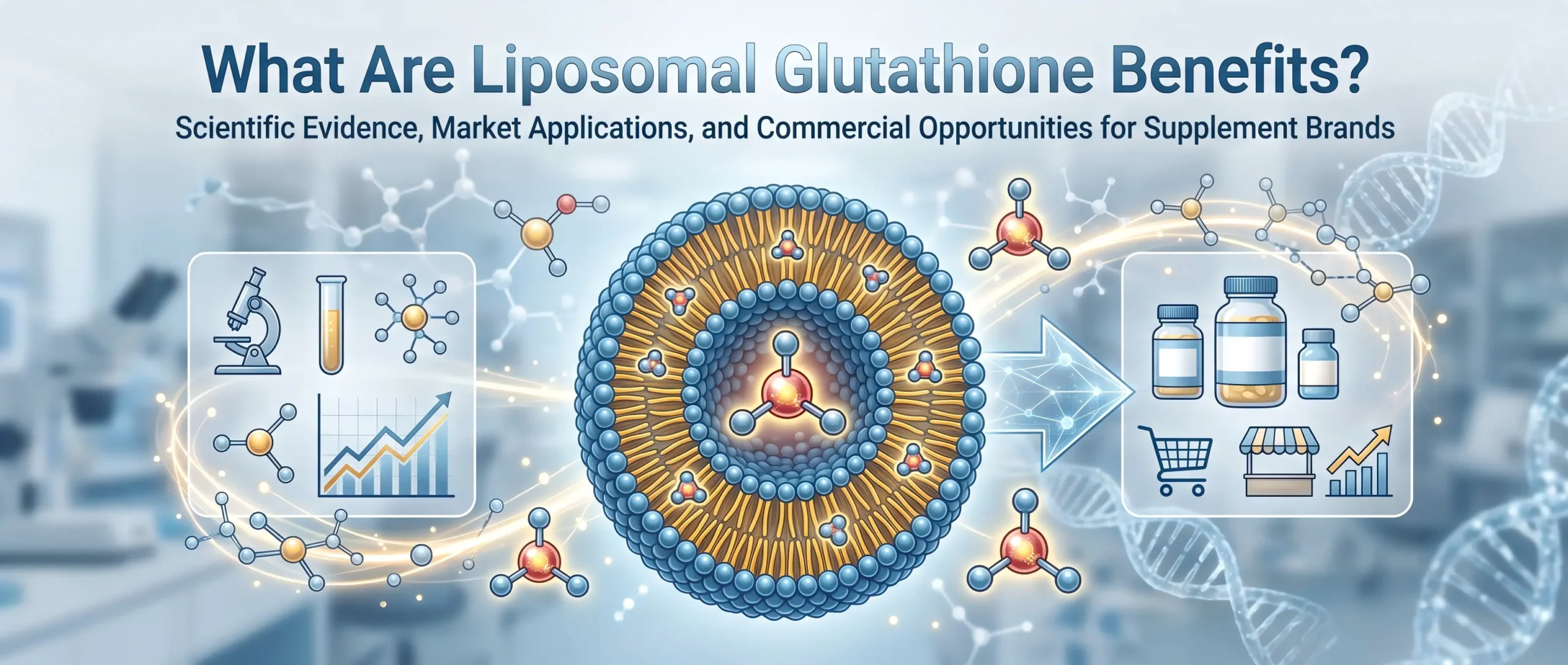
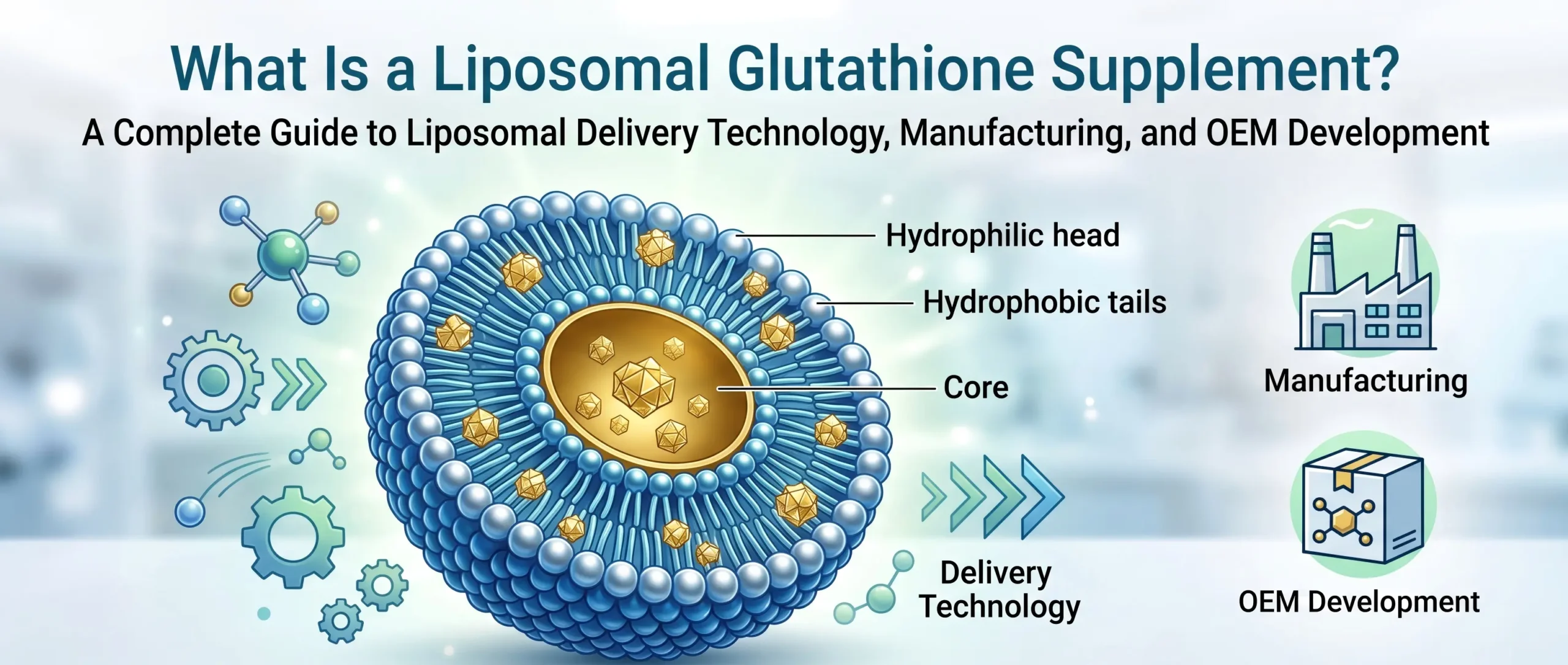
A liposomal glutathione supplement is a specialized delivery system that encapsulates glutathione molecules within microscopic vesicles called liposomes. These vesicles consist of one or more phospholipid bilayers that structurally resemble the cell membranes found throughout the human body.
It is critical to understand that liposomal glutathione is not simply a mixture of glutathione powder and phospholipids. True liposomal formulation requires specific manufacturing processes that create stable vesicular structures with defined physical properties. The quality and performance of the final product depend entirely on the manufacturing methodology employed.
Key Structural Components
- Phospholipid Bilayer: Typically formed using phosphatidylcholine (PC) derived from sunflower or soy lecithin. This bilayer creates a protective shell around the encapsulated glutathione. PC content of 90% or higher is generally associated with superior liposome formation and stability.
- Encapsulation: The process of incorporating glutathione molecules into the aqueous core or lipid layers of the liposome. The percentage of glutathione successfully encapsulated (encapsulation efficiency) is a key quality parameter.
- Nano-Scale Size: Quality liposomal formulations typically exhibit particle sizes between 100 and 300 nanometers with a narrow distribution. This size range optimizes stability, dispersion, and manufacturing consistency.
- Protective Function: The phospholipid shell provides a physical barrier that helps protect glutathione from oxidation, moisture, and pH variations during storage and distribution.
3. How Does Liposomal Delivery Work?
Liposomal delivery can be understood as a multi-stage process designed to protect and transport active compounds. The following stages outline how a well-manufactured liposomal glutathione product functions:
- Glutathione Preparation —High-purity reduced glutathione (GSH) is selected and prepared according to precise specifications for purity, particle size, and moisture content.
- Phospholipid Hydration —The phospholipid component is hydrated under controlled conditions to form the initial bilayer structures. Temperature, hydration time, and solvent selection all influence final liposome quality.
- Encapsulation Processing —Through controlled high-shear mixing or microfluidic processing, glutathione molecules become incorporated within the forming liposomal vesicles. This is the most critical manufacturing step.
- Particle Size Optimization —The liposome dispersion is processed through homogenization or extrusion to achieve the target particle size distribution. This step directly impacts stability and appearance.
- Quality Verification —The finished dispersion undergoes testing for particle size, encapsulation efficiency, and physical stability before proceeding to filling and packaging.
- Product Integration —When consumed, the liposomal structures interact with the gastrointestinal environment. The phospholipid composition influences behavior under digestive conditions, potentially offering protection advantages compared to unencapsulated forms.
It is important to maintain realistic expectations. Liposomal delivery should be understood as a technology that offers potential formulation and stability advantages, not as a guarantee of specific absorption outcomes. Individual physiological responses vary significantly.
4. Liposomal Glutathione vs. Conventional Glutathione
For procurement professionals evaluating product options, the following comparison provides a clear framework for understanding the differences between liposomal and conventional glutathione formulations:
| Comparison Factor | Conventional Glutathione | Liposomal Glutathione |
| Delivery System | Powder or basic capsule | Phospholipid vesicle encapsulation |
| Stability Profile | Moderate; susceptible to oxidation and moisture | Higher; phospholipid shell provides protective barrier |
| Market Positioning | Commodity/basic supplement | Premium/advanced delivery technology |
| Price Point (ASP) | Lower; competitive pricing pressure | Higher; supports premium pricing strategy |
| Manufacturing Complexity | Lower; standard blending and encapsulation | Higher; requires specialized liposome processing equipment |
| Product Differentiation | Limited; minimal technological story | Strong; delivery technology provides compelling narrative |
| Consumer Perception | Standard/generic supplement | Advanced, science-driven wellness product |
| Brand Storytelling | Minimal technology angle | Rich scientific narrative supports marketing |
| Shelf Life Requirements | Standard; may require additional stabilizers | Enhanced; liposomal structure provides natural protection |
| OEM Investment | Lower MOQ, faster turnaround | Higher MOQ, longer development timeline |
This comparison highlights why liposomal glutathione has become the preferred choice for brands targeting premium market segments. The combination of technological sophistication, enhanced stability potential, and strong consumer appeal creates a compelling commercial proposition that justifies the higher investment in product development.
5. Why Do Premium Supplement Brands Choose Liposomal Glutathione?
Leading supplement brands invest in liposomal glutathione for reasons that span both technical formulation advantages and commercial market considerations. Understanding both dimensions is essential for making informed product development decisions.
Technical Reasons
- Enhanced Stability:The phospholipid encapsulation creates a protective microenvironment that may help maintain glutathione in its reduced (GSH) form throughout the product lifecycle. This stability advantage can translate to longer shelf life and more flexible storage conditions.
- Oxidation Protection:Both glutathione and phospholipids are susceptible to oxidation, but the liposomal structure provides a degree of mutual protection. When combined with appropriate antioxidant stabilizers and packaging, liposomal formulations can demonstrate superior oxidative stability.
- Improved Dispersion:Liposomal dispersions achieve excellent homogeneity in liquid systems, enabling the development of premium liquid supplements, emulsions, and softgel formulations with consistent quality from batch to batch.
- Digestive Environment Interaction:The phospholipid bilayer structure is naturally recognized by the body due to its similarity to cellular membranes. This may offer interaction advantages within the gastrointestinal environment compared to unencapsulated powder forms.
Commercial Reasons
- Premium Positioning:Liposomal delivery technology provides an immediate and credible basis for premium product positioning. Consumers associate advanced delivery systems with higher quality, supporting price points that deliver superior margins.
- Higher Average Selling Price (ASP):Brands consistently report that liposomal glutathione products command ASPs 40-100% higher than conventional alternatives. This margin improvement directly impacts profitability and brand positioning.
- Stronger Product Differentiation:In a crowded glutathione market, liposomal technology provides genuine differentiation that is difficult for competitors to replicate without significant manufacturing investment.
- Innovation Storytelling:The science behind liposomal delivery provides rich content for marketing narratives. Brands can leverage the technology story across product pages, educational content, and consumer communications to build trust and credibility.
- Consumer Education Opportunity:Liposomal technology creates opportunities for brands to educate consumers about delivery science, building deeper engagement and brand loyalty among quality-conscious buyers.
6. Core Formulation Design of Liposomal Glutathione Supplements
From an OEM development perspective, understanding formulation design is critical for creating products that meet quality standards and market expectations. A well-designed liposomal glutathione formula integrates multiple functional layers, each serving a specific purpose:
Primary Active: Reduced Glutathione (GSH)
The foundation of the formulation. Key specifications include purity (typically 98% or higher), source (fermentation-derived), particle characteristics, and microbial/ heavy metal compliance. The glutathione content directly impacts the product’s potency claims and cost structure.
Liposomal Carrier System
The phospholipid carrier is the defining feature of the product. Critical parameters include:
- Phosphatidylcholine Content: Higher PC content (90%+) generally produces more stable and uniform liposomes. Low-PC lecithin may result in inconsistent encapsulation.
- Source Origin: Non-GMO sunflower lecithin is increasingly preferred for clean-label positioning, though soy-derived options remain common and cost-effective.
- Phospholipid-to-Glutathione Ratio: This ratio influences encapsulation efficiency and product viscosity. Ratios typically range from 2:1 to 5:1 depending on the target specifications and dosage form.
Supporting Antioxidants
Many premium formulations include complementary antioxidants to enhance oxidative stability:
- Vitamin C: Commonly added both as a stability enhancer and as a complementary wellness ingredient with established consumer recognition.
- Natural Tocopherols: Vitamin E compounds can provide lipid-phase antioxidant protection for the phospholipid component.
- Rosemary Extract: A natural antioxidant option that aligns with clean-label positioning requirements.
Stabilization System
Beyond the liposomal structure itself, additional stabilizers may be incorporated to ensure shelf-life stability:
- Chelating Agents: EDTA or natural alternatives may be included to sequester metal ions that could catalyze oxidation.
- pH Buffers: Appropriate buffering systems maintain optimal pH for both glutathione stability and liposome integrity.
- Preservation System: For liquid formulations, appropriate preservation (natural or conventional) is essential to prevent microbial growth after opening.
Flavor and Sensory System
For liquid and powder dosage forms, sensory optimization is critical for consumer acceptance:
- Natural Flavor Systems:Citrus, berry, and tropical flavors are popular choices that can mask the natural taste of phospholipids.
- Natural Sweeteners:Stevia, monk fruit, and erythritol are commonly used to achieve pleasant taste profiles without sugar.
- Texture Modifiers:Ingredients that improve mouthfeel and visual appeal, particularly important for emulsion-based products.
Delivery Optimization
The final formulation must be optimized for the intended dosage form. Liquid formulations require different viscosity and dispersion characteristics than softgel-compatible emulsions. Working with manufacturers who understand these dosage-form-specific requirements is essential for successful product development.
7. Available Dosage Forms and Manufacturing Suitability
Liposomal glutathione can be formulated into multiple dosage forms, each suited to different brand positioning, distribution channels, and target demographics. The following analysis helps identify which format aligns with your specific business strategy:
| Dosage Form | Best Suited For | Key Considerations |
| Liquid | Premium wellness brands, clinical nutrition lines, beauty-focused brands, practitioner channels, subscription models | Highest perceived value, flexible dosing, excellent for flavor innovation, requires refrigeration after opening, higher shipping weight |
| Softgel | Mass retail, Amazon/e-commerce, Costco/warehouse clubs, travel-friendly lines | Convenient, portable, excellent stability, masks taste completely, precise dosing, familiar format for consumers |
| Capsule | Private label brands, entry-level premium lines, cost-conscious segments | Lower cost than liquid/softgel, familiar format, may have some liposomal integrity trade-offs versus liquid forms |
| Stick Pack | Travel wellness, sampling programs, subscription boxes, on-the-go consumers | Single-serve convenience trend, lightweight shipping, requires formulation expertise for stability, strong unboxing experience |
| Powder | Sports nutrition, functional food crossover, DIY wellness consumers | Versatile (mix with beverages), flexible dosing, appeals to ingredient-minimalist consumers, requires robust flavor system |
| Sachet | International markets, promotional campaigns, pharmacy channels | Pre-measured, hygienic single-use, cost-effective for sampling, multiple format options (liquid emulsion or powder) |
| Tablets | Budget-friendly mass market, emerging market entry | Limited true liposomal application due to compression challenges, may use liposomal powder as an ingredient story, lowest cost positioning |
Liquid and softgel formats currently dominate the premium liposomal glutathione market. However, stick packs represent the fastest-growing segment due to their alignment with convenience and portability trends. The optimal choice depends on your target retail channel, consumer demographics, and brand positioning strategy.
8. Manufacturing Process and Quality Parameters
Understanding the manufacturing workflow helps procurement professionals evaluate supplier capabilities and ask the right questions during supplier qualification. A typical liposomal glutathione manufacturing process follows these stages:
Typical Manufacturing Workflow
- Raw Material Selection & Verification —All incoming materials (glutathione, phospholipids, excipients) undergo identity testing, purity verification, and certificate of analysis review before release to production.
- Phospholipid Hydration —Phospholipids are hydrated under controlled temperature and time parameters. The hydration phase is critical for forming the lamellar structures that will become liposomes.
- High-Shear Mixing —Glutathione is introduced to the hydrated phospholipid dispersion under controlled mixing conditions. Shear rate, duration, and temperature are carefully monitored to optimize encapsulation.
- Homogenization —The crude dispersion is processed through high-pressure homogenization or microfluidization to achieve uniform particle size distribution. Multiple passes may be required to reach target specifications.
- Particle Size Reduction & Optimization —Additional processing steps fine-tune the particle size distribution to meet specification targets. This step directly impacts product stability and appearance.
- In-Process Quality Control —Samples are tested for particle size, polydispersity index (PDI), encapsulation efficiency, and physical appearance before proceeding to filling.
- Filling & Packaging —The qualified dispersion is filled into the designated packaging format (bottles, softgel shells, stick packs, etc.) under appropriate environmental controls.
- Finished Product Testing —The final product undergoes comprehensive testing including assay, stability indicators, microbial limits, and heavy metals before release.
Critical Quality Parameters
The following parameters are essential for evaluating liposomal glutathione product quality:
| Parameter | Typical Target | Significance |
| Average Particle Size | 100-300 nm | Impacts stability, appearance, and dispersion characteristics |
| Polydispersity Index (PDI) | <0.30 | Lower values indicate a more uniform particle distribution and better manufacturing consistency. |
| Encapsulation Efficiency (EE) | >60% (higher preferred) | Percentage of glutathione successfully incorporated into liposomes; higher EE correlates with better stability |
| Phosphatidylcholine Content | >90% | Higher PC content supports better liposome formation and structural integrity |
| Oxidation Stability | Pass accelerated testing | Indicates product resistance to degradation during shelf life |
| Zeta Potential | Appropriate range for stability | Indicates surface charge that influences aggregation tendency and dispersion stability |
| Assay (GSH Content) | 95-105% of label claim | Confirms the product contains the stated amount of active glutathione |
| Shelf Life (Stable) | 18-24 months typical | Real-time and accelerated stability data should support claimed shelf life |
When evaluating manufacturers, request documentation demonstrating process validation and historical batch data for these parameters. Reputable suppliers will readily provide this information.
9. OEM Supplier Evaluation Checklist
Selecting the right manufacturing partner is one of the most critical decisions in product development. Use this comprehensive checklist when evaluating liposomal glutathione OEM suppliers:
Facility & Regulatory
- GMP Certification: Facility operates under current Good Manufacturing Practice standards recognized in target markets (FDA, EU, NSF, etc.)
- Quality Management System: ISO 9001 or equivalent quality management certification in place
- Facility Audit: Willing to accommodate third-party facility audits or virtual inspections
- Regulatory Support: Capability to provide regulatory documentation for product registration in target countries
Technical Capabilities
- Liposomal Manufacturing Equipment: Access to high-shear mixers, homogenizers, or microfluidic processing equipment suitable for liposome production
- Analytical Testing: In-house capability for particle size analysis (DLS), encapsulation efficiency testing, and stability studies
- Formulation Development: R&D team with demonstrated experience in liposomal formulation optimization
- Scale-Up Experience: Proven track record scaling from pilot batches to commercial production volumes
Quality Documentation
- Certificate of Analysis (COA): Comprehensive per-batch COA including all critical quality parameters
- Stability Reports: Available accelerated and real-time stability data for the specific formulation
- Heavy Metal Testing: Testing for lead, arsenic, cadmium, and mercury with documented specifications
- Microbiological Testing: Total plate count, yeast, mold, and pathogen screening per relevant standards
- Particle Size Report: Detailed particle size distribution data including average size and PDI
- Phospholipid Specifications: Complete documentation of phospholipid source, PC content, and origin certification
Commercial Considerations
- MOQ Flexibility: Minimum order quantities aligned with your market testing and launch plans
- Lead Time: Clear production timelines from order to delivery, including stability hold periods
- Packaging Support: Capability to support various packaging formats or work with specified packaging suppliers
- Customization Options: Flexibility for formula adjustments, flavor customization, and dosage form modifications
- Pilot Batch Program: Willingness to produce pilot batches for market testing before full commercial commitment
10. How to Identify a High-Quality Liposomal Glutathione Product
For brands sourcing finished products or evaluating white-label options, the following criteria help distinguish premium liposomal glutathione from inferior alternatives:
- Phospholipid Source Transparency: High-quality products specify the phospholipid source (sunflower or soy), PC content, and non-GMO status. Generic “lecithin” listings without specifications may indicate lower-grade materials.
- Particle Size Documentation: Reputable products provide particle size data as part of their quality documentation. Claims of “nano” or “liposomal” without supporting data should be viewed critically.
- Encapsulation Efficiency Data: Quality manufacturers test and report encapsulation efficiency. Products with verified EE above 60% generally demonstrate superior manufacturing sophistication.
- Stability Report Availability: Manufacturers should provide stability data supporting claimed shelf life under specified storage conditions. Request both accelerated and real-time data when available.
- Oxidation Protection Measures: Premium products incorporate antioxidant stabilizers and appropriate packaging (amber bottles, nitrogen flushing) to protect against oxidative degradation.
- Third-Party Testing: Independent laboratory verification of identity, purity, and potency adds a layer of credibility that supports premium positioning and consumer trust.
- Manufacturing Certifications: Look for GMP certification, NSF registration, or other relevant quality certifications that demonstrate adherence to recognized manufacturing standards.
11. When Should Brands Choose Liposomal Glutathione?
Liposomal glutathione is an excellent product choice for certain market segments but may not be the optimal fit for every brand. Consider the following guidance:
Well-Suited For
- Premium Beauty & Skin Wellness Brands: The beauty-from-within category values advanced delivery technology and supports premium pricing. Liposomal glutathione fits naturally into skin wellness product lines.
- Healthy Aging Product Lines: Consumers aged 40+ seeking healthy aging support are receptive to premium formulations backed by delivery science.
- Cellular Wellness & Functional Nutrition: Brands positioned around cellular health, mitochondrial support, or functional nutrition benefit from the scientific credibility of liposomal delivery.
- Practitioner & Professional Channels: Healthcare practitioners and wellness professionals prefer products with documented quality parameters and advanced formulation technology.
- High-End Wellness Subscription Services: Curated wellness boxes and premium subscription services value products with strong differentiation and educational storytelling potential.
Less Suitable For
- Budget/Value Market Segments: The higher manufacturing cost and MOQ requirements of liposomal glutathione make it difficult to compete in price-sensitive market segments where conventional glutathione dominates.
- Commodity Supplement Positioning: If your brand strategy relies on competing primarily on price, liposomal glutathione’s higher cost structure and premium positioning may create strategic misalignment.
- Mass Market Entry-Level Lines: First-time supplement users and price-sensitive consumers may not appreciate the technology value proposition enough to justify the premium price point.
12. Frequently Asked Questions
What phospholipid content is recommended for liposomal glutathione?
For optimal liposome formation and stability, phosphatidylcholine (PC) content of 90% or higher is generally recommended. Lower PC content may result in inconsistent encapsulation, larger particle sizes, and reduced stability. When evaluating suppliers, request the PC specification for their phospholipid material and confirm it meets this threshold.
What encapsulation efficiency is considered acceptable?
Encapsulation efficiency (EE) above 60% is generally considered acceptable for commercial liposomal glutathione products. Premium formulations may achieve EE values of 70-85%. Higher EE correlates with better stability and product consistency. Always request EE data as part of the Certificate of Analysis.
What shelf life can manufacturers typically achieve?
With proper formulation and packaging, liposomal glutathione products typically achieve shelf lives of 18-24 months under recommended storage conditions. Liquid formulations generally require refrigeration after opening. Request both accelerated (typically 40C/75% RH for 6 months) and real-time stability data from prospective manufacturers.
Can liposomal glutathione be manufactured as a powder?
Yes, powder forms are available through spray-drying or freeze-drying (lyophilization) of liposomal dispersions. These powders can be used in capsules, stick packs, and functional food applications. However, the drying process may affect liposome integrity to some degree, so powder forms may represent a compromise between liposomal benefits and processing convenience.
What certifications should an OEM supplier provide?
At minimum, suppliers should provide GMP certification relevant to your target market (FDA-registered facility for US, appropriate EU certification for Europe), comprehensive Certificates of Analysis, and stability reports. Additional valuable certifications include NSF registration, ISO 9001, NSF/ANSI 173 (for dietary supplements), and third-party quality certifications.
Can glutathione be combined with NAD+, CoQ10, or NMN?
Yes, glutathione is frequently combined with these ingredients in premium wellness formulations. However, each combination requires specific compatibility and stability validation. Liposomal systems can accommodate certain complementary ingredients, but the formulation must be optimized for chemical compatibility, pH stability, and shelf-life performance. Work with experienced formulators to develop combination products.
What is the difference between sunflower and soy phospholipids?
Both sources can produce quality liposomal formulations. Sunflower-derived phospholipids are preferred for clean-label positioning due to non-GMO and allergen-free attributes. Soy-derived options are generally more cost-effective and widely available. The choice depends on brand positioning, target market preferences, and regulatory considerations in your distribution countries.
How do I verify that a product is truly liposomal and not just a mixture?
Request particle size analysis data (Dynamic Light Scattering report) and encapsulation efficiency testing from the manufacturer. True liposomal products will demonstrate defined particle size distributions in the 100-300 nm range with acceptable PDI values. Products that cannot provide this documentation may be simple mixtures rather than true liposomal formulations.
Conclusion
Liposomal glutathione represents a strategically valuable product category for supplement brands targeting premium market segments. Success in this category requires a systematic approach that moves from technology understanding through supplier evaluation to commercial launch.
The recommended development pathway follows these stages:
- Understand the Technology —Develop a solid grasp of liposomal delivery principles, quality parameters, and manufacturing considerations.
- Evaluate the Formula —Assess formulation options including phospholipid source, supporting ingredients, and target dosage forms aligned with your brand strategy.
- Assess Manufacturing Capability —Use a supplier evaluation checklist to qualify potential OEM partners against technical, quality, and commercial criteria.
- Review Quality Documentation —Verify all quality parameters, stability data, and regulatory documentation before committing to production.
- Request Samples —Evaluate pilot batches for product quality, sensory characteristics, and packaging compatibility.
- Launch Your Brand —Develop compelling marketing narratives leveraging the liposomal technology story to support premium positioning.
For brands ready to explore liposomal glutathione development, experienced OEM manufacturers offer comprehensive services including formulation development, regulatory support, private labeling, and custom product creation. The key to success lies in partnering with suppliers who combine technical expertise with transparent quality systems and a genuine understanding of your commercial objectives.
At KSNutripharma®, we specialize in liposomal glutathione OEM development backed by validated manufacturing processes, transparent quality documentation, and end-to-end formulation support. Whether you are developing your first liposomal product or scaling an existing line, our technical team can guide you through particle size optimization, encapsulation efficiency validation, and regulatory-compliant formulation design. Contact us to discuss your specifications, request a detailed Certificate of Analysis, or arrange a pilot batch evaluation.