Which Delivery System Is Better for Supplements?
Introduction: What B2B Buyers Actually Need to Know
If you’re sourcing supplements for your brand, you’ve likely seen both “liposomal” and “nanoemulsion” on ingredient spec sheets and marketing decks. The real questions driving your search aren’t academic—they’re commercial:
- Which technology will actually move units? Consumer perception and clinical credibility matter.
- Which can my OEM partner scale reliably? Not all contract manufacturers have the equipment or SOPs for nanoscale production.
- What’s the regulatory exposure? Stability failures and label claims scrutiny can kill a product launch.
- Does the premium price translate to brand premium? If the cost delta doesn’t justify the shelf price, the math doesn’t work.
This article is structured around those exact decisions. We break down the technology, map it to commercial viability, and give you a procurement framework you can use in your next supplier audit.
Understanding the Two Technologies
What Is a Liposome?
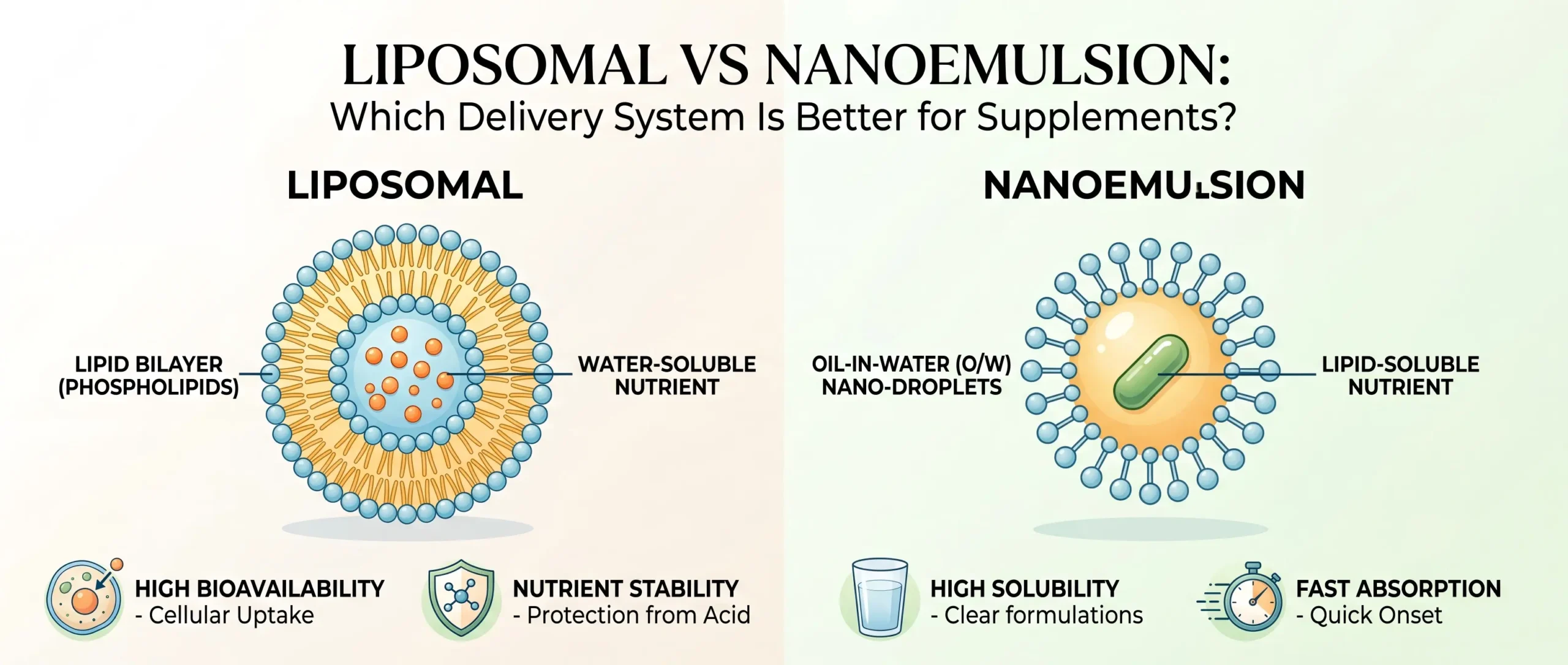
A liposome is a microscopic vesicle composed of one or more phospholipid bilayers that self-assemble in aqueous environments. Structurally, it mimics natural cell membranes. This dual-compartment architecture allows simultaneous encapsulation of:
- Hydrophilic (water-soluble) actives→ trapped in the aqueous core
- Hydrophobic (fat-soluble) actives→ integrated into the lipid bilayer
The encapsulation mechanism is passive (during vesicle formation) or active (using pH/ion gradients). Release occurs via diffusion, lipid degradation, or environmental triggers like pH shifts.
Key point for buyers: Liposomes offer true encapsulation—meaning the active ingredient is physically separated from the external environment until release. This is critical for oxidation-sensitive ingredients.
What Is a Nanoemulsion?
A nanoemulsion is a kinetically stable dispersion of nanometer-sized oil droplets (typically 20–200 nm) in a continuous aqueous phase, stabilized by surfactants. Unlike liposomes, nanoemulsions do not encapsulate actives in a bilayer structure; instead, lipophilic compounds are dissolved directly into the oil droplets.
Production typically involves high-energy methods such as high-pressure homogenization or ultrasonication to achieve uniform droplet size.
Key point for buyers: Nanoemulsions are fundamentally solubilization systems, not encapsulation systems. They excel at increasing the surface area of lipophilic actives but do not provide the same physical barrier protection as liposomes.
Structural Differences: The Technical Foundation of Your Procurement Decision
| Features | Liposomes | Nanoemulsion |
| Structure | Phospholipid bilayer vesicle | Oil droplets in aqueous phase |
| Encapsulation | Yes—physical barrier around active | No—active dissolved in oil phase |
| Stability | Medium—prone to oxidation, fusion, leakage | High—kinetically stable with proper surfactants |
| Cost | Higher (phospholipids, complex process) | Lower (simpler equipment, fewer steps) |
| Production Complexity | High (hydration, extrusion, active loading) | Moderate (homogenization, surfactant optimization) |
| Scalability | Moderate—requires specialized equipment | High—easier to scale with standard homogenizers |
| Shelf Life | 12–24 months (with antioxidant stabilization) | 24–36 months (with proper surfactant system) |
| Regulatory Path | Well-established (GRAS phospholipids) | Well-established (food-grade surfactants) |
Sources: Comparative analysis based on peer-reviewed literature on nanocarrier systems and industrial manufacturing data
Bioavailability Comparison: What the Clinical Data Actually Shows
Water-Soluble Actives
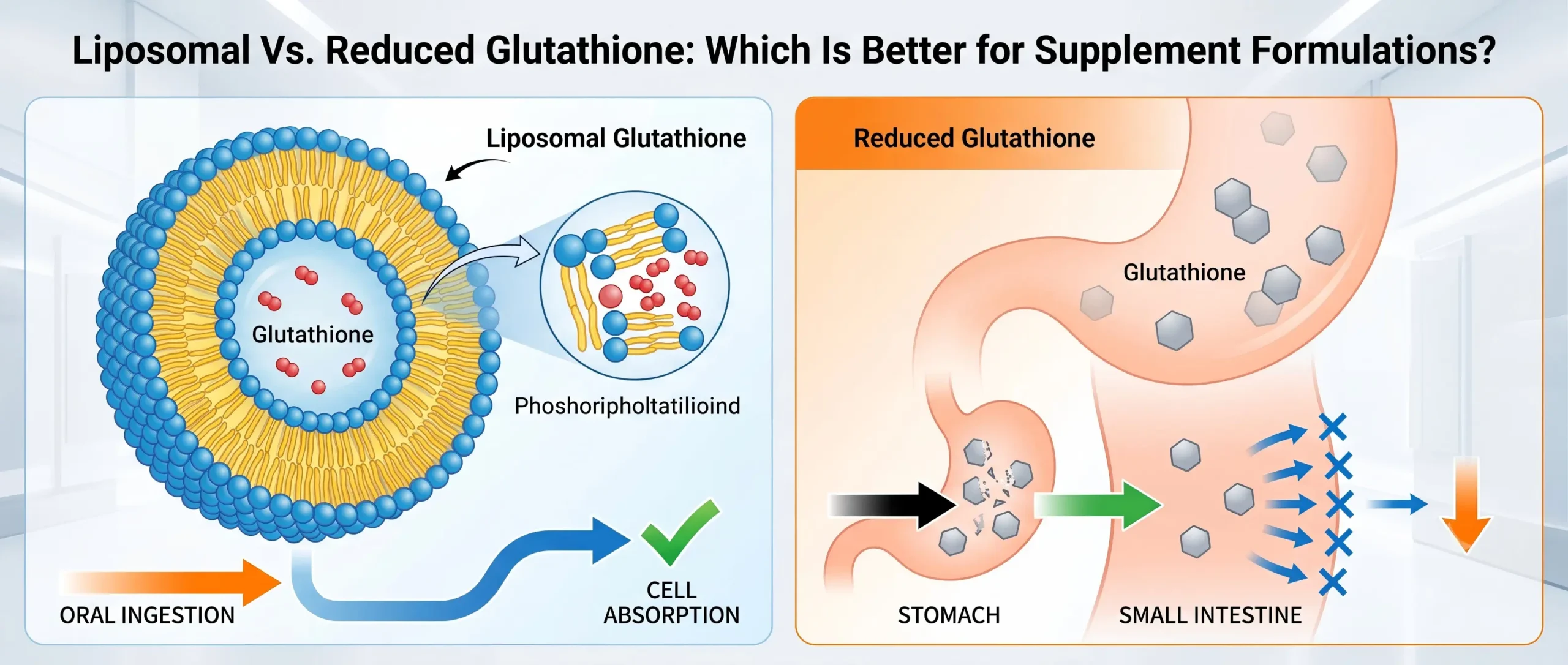
Liposomes have a clear advantage. The aqueous core of liposomes can physically entrap hydrophilic molecules like NMN, glutathione, and peptides, protecting them from gastric degradation and improving intestinal uptake.
A 2024 randomized, double-blind, crossover study published in Nutrition and Dietary Supplements demonstrated that liposomal berberine achieved a 70.1% higher Cmax and 42.8% higher AUC0-24 compared to standard unformulated berberine (p = 0.03). The same liposomal platform previously showed significantly increased vitamin C Cmax and AUC versus conventional forms.
Nanoemulsions are limited here. Because nanoemulsions lack an aqueous encapsulation compartment, their capacity for hydrophilic compounds is inferior. They may improve solubility marginally through surfactant micelles, but this is not true encapsulation.
Fat-Soluble Actives
Both systems perform well, but through different mechanisms.
- Liposomes:Hydrophobic actives integrate into the phospholipid bilayer. Encapsulation efficiency is typically high (>70–80%) but requires careful lipid ratio optimization to prevent instability or leakage.
- Nanoemulsions:The oil droplet serves as a direct solvent for lipophilic compounds. The fine droplet size (often ~110 nm with PDI ≤ 0.20) dramatically increases interfacial surface area, promoting efficient absorption.
Clinical data from pharmaceutical applications shows nanoemulsions can achieve 40–50% bioavailability improvements for poorly soluble compounds like cyclosporine, while liposomes increase bioavailability by 20–30% for certain drugs through controlled release properties.
Sensitive Ingredients
Liposomes provide superior protection. The phospholipid bilayer acts as a physical barrier against oxidation, enzymatic degradation, and pH shifts. For ingredients like glutathione (highly susceptible to oxidation) and peptides (vulnerable to proteolysis), this protection is clinically meaningful.
Nanoemulsions rely on surfactant stabilization. While they offer good kinetic stability, they do not provide the same level of physical encapsulation. Oxidation-sensitive actives in nanoemulsions require additional antioxidant stabilization strategies.
Manufacturing Considerations: What Your OEM Partner Must Prove
Equipment Requirements
| Technology | Core Equipment | Capital Investment | OEM Readiness Indicator |
| Liposomes | Microfluidizer or high-pressure homogenizer + extrusion system + active loading infrastructure | High ($500K–$2M+) | Ask for: particle size distribution data, PDI consistency across batches, extrusion pore size validation |
| Nanoemulsions | High-pressure homogenizer or ultrasonicator + surfactant mixing system | Moderate ($100K–$500K) | Ask for: droplet size consistency at scale-up, surfactant HLB optimization records |
Critical audit point: A 2026 study from Polymers (MDPI) demonstrated that phase inversion-based nanoemulsions maintained consistent droplet size (~110 nm, PDI ≤ 0.20) when scaled from 0.1 L to 1.0 L batches, confirming compositional robustness during scale-up. For liposomes, batch-to-batch consistency is harder to achieve—demand CofA data showing <15% particle size variation.
Production Cost
- Liposomes: Higher raw material costs (phospholipids, cholesterol or phytosterols) + multi-step processing (hydration, extrusion, possible active loading) = typically 2–4x the cost of standard formulations.
- Nanoemulsions: Lower raw material costs (food-grade oils, nonionic surfactants) + simpler processing (single-step homogenization) = cost-effective for mass-market positioning.
Procurement implication: If your target retail price point is under $35/bottle, nanoemulsion may be the only viable option. If you’re positioning in the premium functional medicine channel ($60+), liposomal technology can justify the cost premium.
Scalability
Nanoemulsions scale more predictably. The low-energy phase inversion method enables reproducible production under ambient, low-shear conditions with minimal variation when expanding from lab to pilot to production scale.
Liposomes require tighter process control. Conventional methods (thin film hydration, ethanol injection) are associated with heterogeneous size distribution, low encapsulation efficiency, and a lack of long-term stability. Advanced methods like supercritical CO₂ technology improve reproducibility but require high capital investment.
Shelf-Life Stability
| Stability Factor | Liposomes | Nanoemulsion |
| Oxidation risk | High (unsaturated phospholipids) | Moderate (depending on oil phase composition) |
| Aggregation/Fusion | Risk increases over time | Low with proper surfactant stabilization |
| Temperature sensitivity | Moderate—requires refrigerated or controlled storage | High—can tolerate wider temperature ranges |
| Typical shelf life | 12–24 months | 24–36 months |
A 2026 stability study showed nanoemulsion ampoules maintained structural integrity (droplet size variation <10%, PDI ≤ 0.20) after 28 days at 4°C, 25°C, and 40°C.
Liposomes typically require more stringent storage conditions and antioxidant co-formulations.
Best Use Cases for Each Technology
Liposomes: Best For
Based on clinical evidence and manufacturing feasibility, liposomal technology is the optimal choice for:
- NMN (Nicotinamide Mononucleotide)– Water-soluble, highly susceptible to gastric degradation – Liposomal encapsulation protects against stomach acid and improves intestinal absorption – Premium positioning in longevity/anti-aging market justifies higher cost
- Glutathione– Extremely oxidation-sensitive tripeptide – Unformulated glutathione has poor oral bioavailability (<1%) – Liposomal encapsulation is one of the few clinically validated methods to achieve meaningful plasma levels
- Peptides (Collagen peptides, bioactive peptides)– Vulnerable to proteolytic enzymes in GI tract – Liposomal bilayer provides physical protection against enzymatic degradation – Molecular size and hydrophilicity make liposomes the preferred carrier
- Water-Soluble Vitamins (Vitamin C, B-complex)– Aqueous core encapsulation maximizes loading efficiency – Clinical data shows significant Cmax and AUC improvements versus standard forms
Nanoemulsions: Best For
- CBD (Cannabidiol)– Highly lipophilic—ideal for oil-droplet solubilization – Large addressable market with price-sensitive consumers – Nanoemulsion cost structure supports competitive retail pricing
- Curcumin– Extremely poor water solubility limits unformulated bioavailability – Nanoemulsion droplet size <200 nm significantly enhances dissolution and absorption – Multiple peer-reviewed studies confirm bioavailability improvements
- CoQ10 (Coenzyme Q10) Lipophilic, large molecular weight – Nanoemulsion provides efficient solubilization without complex encapsulation – Cost-effective for mass-market cardiovascular/energy positioning
- Omega-3 Fatty Acids– Oil-in-water nanoemulsion is a natural fit for lipophilic fatty acids – Improves palatability and reduces fishy aftertaste compared to standard oil forms – Stable droplet structure prevents oxidation better than bulk oil emulsions
Procurement Decision Framework
Use this framework in your next OEM supplier evaluation:
Choose Liposomes When:
✅ Your active is water-soluble or oxidation-sensitive (NMN, glutathione, peptides, vitamin C)
✅ Your brand positioning is premium ($60+ retail, functional medicine, clinician-recommended)
✅ Clinical bioavailability claims are central to your marketing (supported by pharmacokinetic data)
✅ Your OEM has validated microfluidic or extrusion capabilities (demand particle size CofA, PDI <0.25)
✅ You can absorb 2–4x formulation cost increase and pass it through to retail pricing
✅ Shelf life requirements are 12–24 months with controlled storage conditions
Choose Nanoemulsions When:
✅ Your active is lipophilic (CBD, curcumin, CoQ10, omega-3)
✅ Your target market is price-sensitive (mass retail, Amazon, subscription models)
✅ Rapid onset of action is a desired consumer benefit (faster release kinetics)
✅ Your OEM has standard high-pressure homogenization equipment (lower barrier to entry)
✅ You need 24–36 month shelf life with ambient temperature stability
✅ You need to scale to high volumes quickly (simpler process validation, faster time-to-market)
Red Flags During OEM Audits:
For Liposomes: – Cannot provide particle size distribution data (DLS or NTA) with every batch – No validated extrusion pore size or microfluidic flow rate SOPs – Cannot demonstrate encapsulation efficiency >70% for your specific active – No antioxidant stabilization protocol (for oxidation-sensitive phospholipids) – Missing stability data at accelerated conditions (40°C/75% RH for 3+ months)
For Nanoemulsions: – Cannot provide droplet size and PDI data with every batch – No surfactant HLB optimization records for your oil phase – Droplet size >200 nm (approaches microemulsion range, reduced bioavailability advantage) – No scale-up validation data (lab to pilot to production) – Missing thermal cycling stability data (simulating shipping conditions)
OEM Manufacturing Support: What to Demand from Your Contract Partner
A credible B2B supplement contract manufacturer should provide:
For Liposomal Projects:
- Formulation Development: Phospholipid source selection (soy, sunflower, egg), cholesterol/phytosterol ratio optimization, active loading method validation
- Analytical Characterization: Dynamic light scattering (DLS), transmission electron microscopy (TEM), encapsulation efficiency assay, zeta potential
- Stability Testing: Real-time and accelerated stability (ICH guidelines), oxidation marker monitoring (peroxide value, anisidine value)
- Regulatory Documentation: GRAS affirmation for phospholipids, New Dietary Ingredient (NDI) guidance if applicable, EU Novel Food consultation support
- Scale-Up Validation: Technology transfer from lab (100 mL) to pilot (10 L) to production (100+ L) with equivalency data
For Nanoemulsion Projects:
- Formulation Development: Oil phase selection, surfactant HLB optimization, co-surfactant screening, phase inversion temperature (PIT) method validation
- Analytical Characterization: DLS droplet size/PDI, zeta potential, creaming index, centrifugal stability testing
- Stability Testing: Thermal cycling (4°C ↔ 40°C), freeze-thaw resistance, long-term ambient storage
- Regulatory Documentation: Food-grade surfactant compliance (FDA 21 CFR 172, EFSA food additive approvals), residual solvent testing
- Scale-Up Validation: Homogenization pressure optimization, batch-to-batch droplet size consistency, 1L+ scale-up data
FAQ: B2B Buyer Questions
Q: Can I switch from one technology to the other mid-product lifecycle?
A: No—not without reformulation and likely new stability studies. The two technologies are not interchangeable. Switching requires new manufacturing process validation, updated specifications, and potentially revised regulatory submissions.
Q: Which technology has stronger consumer recognition?
A: “Liposomal” currently has higher consumer awareness in premium supplement channels, driven by vitamin C and glutathione products. “Nanoemulsion” is more recognized in CBD and functional beverage markets. Your choice should align with your target channel’s consumer literacy.
Q: Are there regulatory risks with either technology?
A: Both use well-established, GRAS-status excipients. The primary risk is stability failure leading to label claim non-compliance. Ensure your OEM has validated stability protocols and can provide Certificates of Analysis with every batch.
Q: Can a manufacturer do both technologies well?
A: Rarely. Liposomal production requires microfluidic or precision extrusion expertise. Nanoemulsion production requires homogenization optimization. Most contract manufacturers specialize in one. Audit their core competency before committing.
Q: What’s the minimum viable order quantity (MOQ) for each?
A: Liposomal: typically 5,000–10,000 units due to complex setup. Nanoemulsion: often 2,000–5,000 units due to simpler process. Confirm with your OEM—these vary significantly by region and equipment.
Q: Should I consider hybrid systems?
A: Emerging “lipid-emulsion nanocarriers” combine liposome and nanoemulsion features, but these are still primarily in R&D. For commercial production in 2025–2026, stick to established liposomal or nanoemulsion platforms with proven stability and regulatory paths.
CTA: Evaluate Your Formulation with Our OEM Team
Choosing between liposomal and nanoemulsion technology isn’t a theoretical exercise—it’s a supply chain, regulatory, and commercial decision that affects your product’s viability for the next 3–5 years.
Our OEM manufacturing team provides: – Formulation feasibility assessment for your specific active ingredient – Side-by-side bioavailability modeling based on your active’s physicochemical properties – Regulatory pathway mapping for FDA, EFSA, and TGA compliance – Pilot batch production with full analytical characterization – Scale-up validation from lab to commercial volumes
[Request a Technical Consultation] → Schedule a 30-minute call with our formulation scientists to review your active ingredient, target market, and budget parameters. We’ll recommend the optimal delivery system and provide a preliminary manufacturing quote.
[Download Our OEM Capability Deck] → Get detailed equipment lists, capacity, certifications (GMP, ISO, HACCP), and case studies from 50+ liposomal and nanoemulsion projects.
References & Data Sources
- Chen, B.H., & Stephen Inbaraj, B. (2019). “Nanoemulsion and Nanoliposome-Based Strategies for Improving Anthocyanin Stability and Bioavailability.” Nutrients, 11(5), 1052. MDPI—Comprehensive review of encapsulation efficiency, stability challenges, and industrial scalability of both technologies. https://doi.org/10.3390/nu11051052
- Kim, J.H., et al. (2026). “Scalable Nanoemulsion Formation of Lipophilic Active Ingredients via Low-Energy Phase Inversion.” Polymers, 18(7), 794. MDPI—Peer-reviewed data on nanoemulsion scale-up from 0.1L to 1.0L with maintained droplet size (~110 nm, PDI ≤ 0.20) and 30-day stability. https://doi.org/10.3390/polym18070794
- BOC Sciences (2025). “Liposomal vs Nanoemulsion Drug Delivery.” — Technical comparison of encapsulation mechanisms, stability profiles, and scalability considerations. https://liposomes.bocsci.com/resources/liposomal-vs-nanoemulsion-drug-delivery.html
- Golfomitsou, I., et al. (2018). “Development of food-grade O/W nanoemulsions as carriers of vitamin D for the fortification of emulsion based food matrices: A structural and activity study.” Journal of Molecular Liquids, 268, 734–742. ScienceDirect—High-pressure homogenization data achieving <200 nm droplets with 10+ day stability in dairy matrices. https://doi.org/10.1016/j.molliq.2018.07.109
- WBCIL (2025). “Liposomal and Nanoemulsion Drug Delivery System.” — Market penetration data showing 12% annual growth in nanoemulsion adoption and bioavailability improvement ranges (liposomal: 20–30%; nanoemulsion: 40–50%). https://www.wbcil.com/blog/wbcil-global-footprint-cphi-frankfurt-2025/
- BOC Sciences (2024). “Nanoemulsion Technology: Difference, Advantages, Disadvantages and Application.” — Analysis of thermodynamic instability, high-energy requirements, and limited hydrophilic compound capacity in nanoemulsions. https://www.bocsci.com/resources/nanoemulsion-technology-difference-advantages-disadvantages-and-application.html
- Chen, T., et al. (2018). “A comparison study between lycobetaine-loaded nanoemulsion and liposome using nRGD as therapeutic adjuvant for lung cancer therapy.” European Journal of Pharmaceutical Sciences, 111, 293–302. PubMed/European Journal of Pharmaceutical Sciences—Head-to-head pharmacokinetic comparison showing liposomal sustained release vs. nanoemulsion faster release. https://doi.org/10.1016/j.ejps.2017.09.041
- Purpura, M., et al. (2026). “Liposomal Delivery as a Strategy to Improve Berberine Bioavailability.” Nutrition and Dietary Supplements, 18, 1–13. Dove Medical Press—Randomized, double-blind, crossover study demonstrating 70.1% higher Cmax and 42.8% higher AUC for liposomal vs. standard berberine. https://www.dovepress.com/liposomal-delivery-as-a-strategy-to-improve-berberine-bioavailability–peer-reviewed-fulltext-article-NDS
- Huang, R., et al. (2025). “Selection strategy for encapsulation of hydrophilic and hydrophobic ingredients with food-grade materials: A systematic review and analysis.” Food Chemistry: X, 25, 102149. ScienceDirect—Systematic review confirming liposomes and nanoemulsions can simultaneously load hydrophilic and hydrophobic cargo, with solid lipid nanoparticles suited for hydrophobic ingredients. https://doi.org/10.1016/j.fochx.2024.102149
- Merola, A., Baldino, L., & Procentese, A. (2025). “Enzyme Encapsulation in Liposomes: Recent Advancements in the Pharmaceutical and Food Sector.” Nanomaterials, 15(15), 1149. MDPI—Encapsulation efficiency data (40–93% depending on method) and liposome size characterization (140–181 nm range). https://doi.org/10.3390/nano15151149
Disclaimer: This article is intended for B2B educational purposes and does not constitute medical, regulatory, or legal advice. Always consult qualified regulatory professionals for market-specific compliance requirements. Clinical data cited reflect published research findings; individual formulation results may vary based on active ingredient, excipient selection, and manufacturing parameters.