





Develop Your Male Fertility Supplement Formula
Male fertility supplement formulas can vary considerably in serving size and dosage form, particularly when L-carnitine or acetyl-L-carnitine is included at gram-level amounts. The choice between powder, stick packs, and capsules affects serving configuration, capsule count, and manufacturing feasibility. Adding coenzyme Q10 introduces another formulation decision: its ingredient form and compatibility with the selected dosage form.
KS Nutripharma® supports OEM, ODM, and private-label projects by reviewing ingredient specifications, target amounts per serving, dosage form, and packaging requirements before preparing a formal quotation. Share your existing formula, a reference label, or an initial product concept to begin a feasibility review.
How to Begin with KS Nutripharma
Existing Formula
Send the formula sheet with ingredient forms and target amounts per serving. We review the formula against the intended dosage form and packaging configuration, and list the specifications still needed before a quotation.
Reference Label
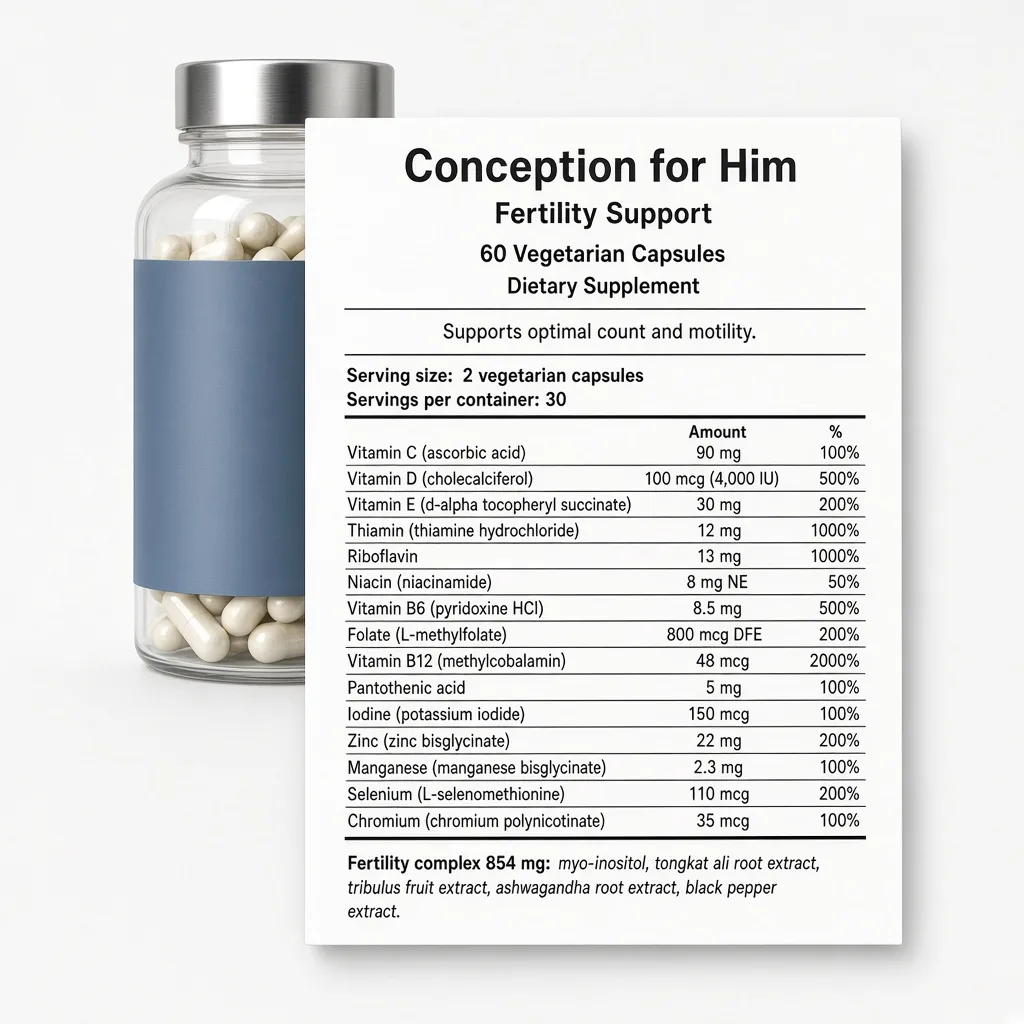
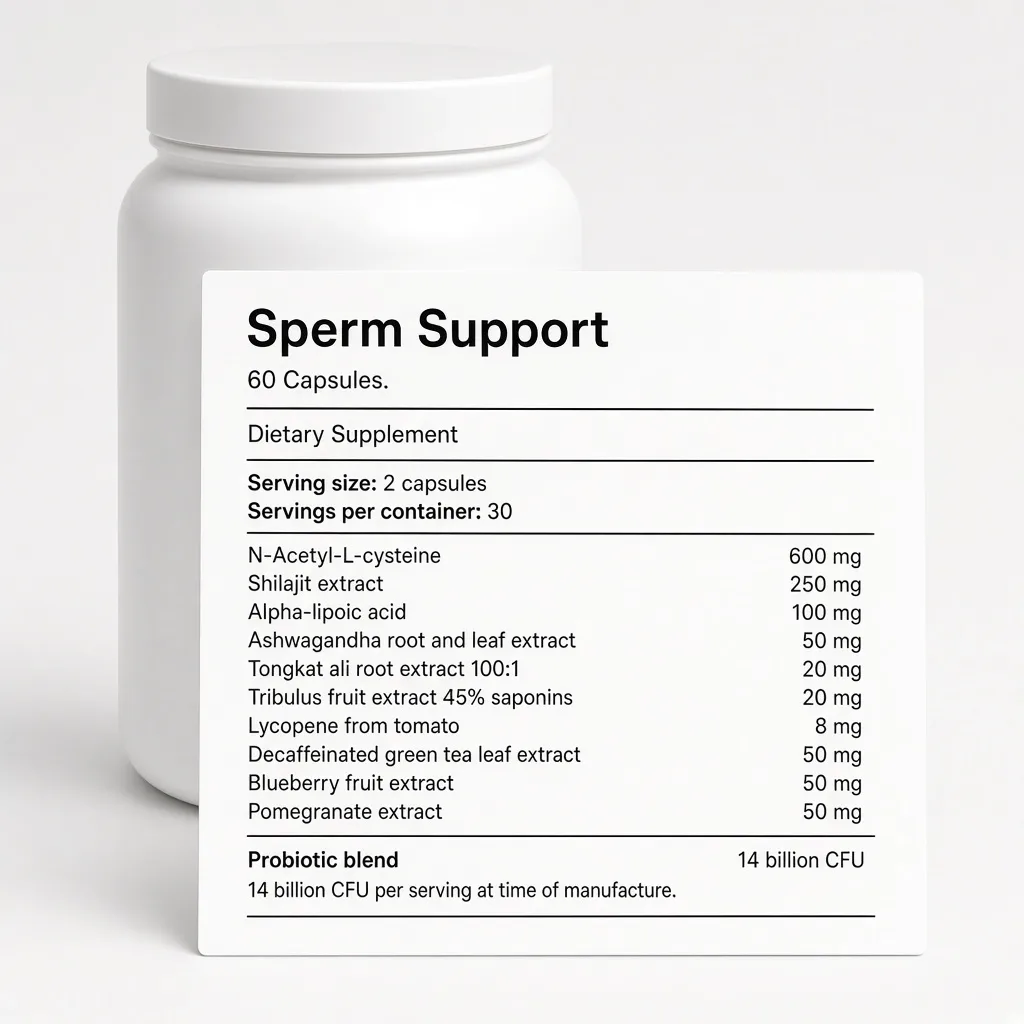
Share the Supplement Facts panel or a clear label photo. A reference label helps establish the target serving and declared ingredient amounts, but it does not reveal the original supplier specifications, ingredient grades, or manufacturing process.
Product Concept
Name the target ingredients, the intended grams or milligrams per serving, the preferred dosage form, and the pack. An estimated first order helps when you have one. These details establish the initial development direction. The final formula and quotation depend on the feasibility review.
Male Fertility Projects at a Glance
| Project fact | What this range covers |
|---|---|
| Product scope | L-carnitine or acetyl-L-carnitine, CoQ10 as an oil-based or dry grade, and zinc with folate. Maca, ashwagandha, and inositol formulas for women sit outside this range. |
| What changes the quote | Ingredient form, amount per serving, dosage form, packaging, order quantity, and the tests named for the project |
| Dosage forms | Powders and stick packs · hard capsules · softgels for an oil-based grade · tablets when the mineral formula specifies them |
| Documents | Supplier COA · incoming control · finished-unit release · third-party tests when the agreement names them |
Male Fertility Formulation Routes
These manufacturing routes are not a clinical-efficacy evaluation.
Route | Material | Dosage form commonly considered |
|---|---|---|
| L-carnitine | L-carnitine or acetyl-L-carnitine, each with its own specification | Powder or stick pack for a gram-level serving |
| CoQ10 | Ubiquinone or ubiquinol, oil-based or dry | Set with that grade and with the rest of the serving |
| Zinc and folate | Elemental zinc and the salt. Folic acid or 5-MTHF, specified separately | Hard capsule or tablet |
| Antioxidant companions | Dry powders, or an oil grade when the ingredient is an oil | Dry fill, or a softgel for the oil |

Specify: L-carnitine or acetyl-L-carnitine, the grade, and the grams per serving. They are different ingredients. Powder flow and caking risk are assessed against that grade and the handling requirements. A flow aid is specified only when it is required and compatible with the formula. When Halal compliance is required, the ingredient source and the supporting documents are reviewed against the applicable requirements.
Trade-off: The same target amount can be a weighed powder or stick-pack serving, or a capsule serving. The capsule count is set in the dosage-form review, before that option is quoted.

Specify: Ubiquinone or ubiquinol, whether the grade is oil-based or dry, and the milligrams per serving.
Trade-off: An oil-based grade and a dry grade lead to different dosage-form checks. A carnitine powder or capsule and an oil-based CoQ10 softgel can be specified as two finished units when one unit cannot hold both.
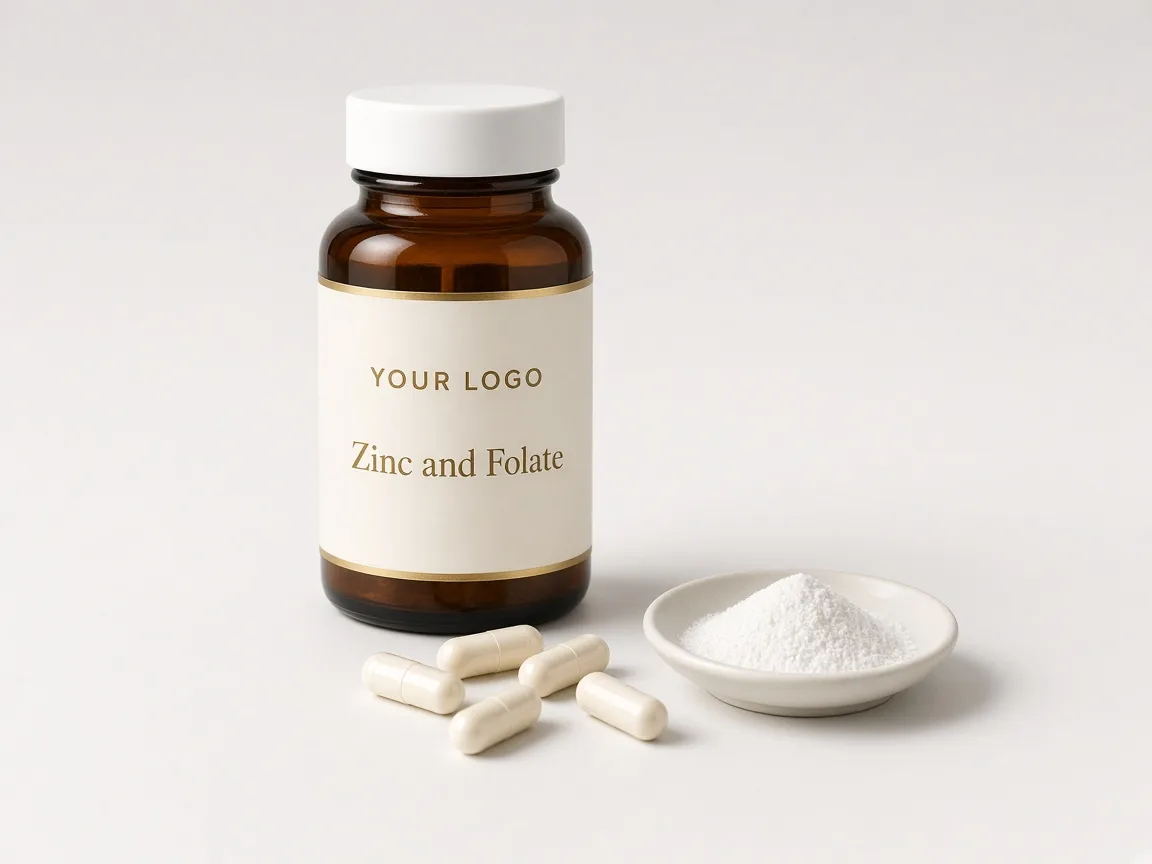
Specify: Elemental zinc and the salt. Zinc is quoted on elemental content, not on the weight of the salt alone. Folic acid and 5-MTHF are named separately. Selenium, as sodium selenite or selenomethionine, and vitamin B12 are included only when the formula states the form and the amount. Those amounts are reviewed against the requirements that apply to the target market.
Trade-off: A zinc–folate capsule or tablet can be a separate finished unit from a gram-level carnitine powder or stick pack. The serving configuration is set before the two are combined or split.

Specify: The amount and the grade. Vitamin C and N-acetylcysteine are dry powders. Vitamin E is named by its chemical form. Lycopene is an oil or a dry grade. Astaxanthin and an omega-3 oil are included only when the formula names them.
Trade-off: Dry powders stay in the dry fill. An oil grade is considered for a softgel, on its own fill and pack.
Choose the Male Fertility Format: Powders, Capsules, Softgels or Tablets
 Powders and Stick Packs
Best for: A serving packed by weight.
Confirm: Grams per serving, tub or stick, and the film or tub barrier.
Manufacturing note: Powders and granules are quoted as a finished pack, or in bulk by kilogram. Hard Capsules
Best for: Dry ingredients that fit the capsule.
Confirm: Capsules per serving, fill weight per capsule, and a gelatin or HPMC shell.
Manufacturing note: For capsule projects, the number of capsules per serving depends on the target amount and the feasible fill weight per capsule. Those figures are set before the capsule option is quoted. See hard capsules and high-dose capsule formulation. Softgels
Best for: An oil-based ingredient.
Confirm: Fill weight, shell, and the carrier oil on its own line.
Manufacturing note: Softgel pricing is based on the oil fill, the shell specification, and the packaging. Tablets
Best for: A zinc and folate formula that specifies tablets.
Confirm: Tablet weight, size, and a compression trial.
Manufacturing note: Tablets are quoted after that trial.
Ingredient Grades KS Nutripharma Supplies for the Quotation Options
The percentage on a grade is the assay of that raw material. It is not the milligram amount printed on the finished label.

Specify: Natural Haematococcus pluvialis, assayed by HPLC. Powder at 1%, 1.5%, 2%, 2.5%, 3%, 5%, and 10%. Oil at 5%, 10%, and 20%. Beadlets at 2% and 2.5%. Cold-water-dispersible beadlets at 1.5%, 2.5%, and 5%. Cold-water-soluble powder at 1% to 2%. See astaxanthin supplements.
Trade-off: A 5% powder and a 5% oil are different materials. The astaxanthin milligrams in the serving are calculated from the grade that is purchased. Lycopene
Specify: Lycopene from tomato starts as a crystal above 90%, then as powder at 5%, 6%, 10%, and 20%, cold-water-soluble powder at 5% and 10%, or beadlets at 5%, 8%, 10%, and 20%. Tomato-source oil suspension is 5%, 6%, 10%, and 20%. Fermentation-source oil suspension is 6%, 10%, 20%, and 30%. A cold-water-dispersible liquid is quoted on the assay of that grade.
Trade-off: The dry form is a beadlet. A 5% beadlet, a 5% cold-water-soluble powder, and a 5% oil are three purchases. A 30% oil is the fermentation grade. Vitamin B12
Specify: Vitamin B12 as cyanocobalamin at 99% and 99.8%, or as a 0.1%, 1%, or 5% trituration on dicalcium phosphate, mannitol, starch, or maltodextrin. Methylcobalamin at 99% and 99.8%, or as a 0.1% or 1% trituration on dicalcium phosphate.
Trade-off: The micrograms on the label are weighed from the trituration. The carrier counts in the capsule fill. The pure crystal is a different purchase. Folate
Specify: 5-MTHF calcium at 98% or above by HPLC on the anhydrous basis. Where the sheet states them, calcium is about 7.0–8.5% on the anhydrous substance and water is about 6–17%. The glucosamine salt is quoted at 98% or above, or at 95–105% of the salt, and the quotation names that basis. The same salt can instead be specified as 54–59% 5-MTHF and 34–46% glucosamine on the dry basis. Folic acid is a separate crystalline ingredient, quoted on its pharmacopoeial assay.
Trade-off: The same folate micrograms do not weigh the same as folic acid, calcium 5-MTHF, and the glucosamine salt. Zinc
Specify: Zinc is the elemental amount plus the salt. Picolinate, compound assay at least 98%, elemental zinc 20–21%. Gluconate, compound 97–102%, elemental zinc 13.5–14.5%. Citrate dihydrate, compound 98–102%, elemental zinc at least 31.3%. Bisglycinate, elemental zinc about 20–25%, confirmed on the specification. Oxide, acetate, and sulfate are quoted when the formula names that salt, and the elemental zinc is taken from its specification.
Trade-off: The same elemental milligrams are a heavier powder as gluconate than as citrate. The label figure is the elemental zinc, not the weight of the salt. CoQ10
Specify: Ubiquinone crystalline powder at HPLC 98% and 99%. Ubiquinone oil suspension at 10%, and in the 10–20% band. Water-dispersible ubiquinone powder or beadlet at 10%, 20%, and 40%. Ubiquinol crystalline powder at HPLC 98%, packed under nitrogen. Ubiquinol microencapsulated powder at 30%, where 333 mg of that powder supplies 100 mg of ubiquinol. Ubiquinol oil dispersion at 20–30%.
Trade-off: Ubiquinone and ubiquinol are different ingredients. An oil suspension is checked as a softgel fill. A water-dispersible powder is checked for the dry capsule or the stick. Vitamin E
Specify: Natural d-alpha-tocopherol oil at 1000, 1300, 1400, and 1430 IU/g. Natural d-alpha-tocopheryl acetate oil at 1200 and 1360 IU/g, beadlets at 950 IU/g, and cold-water-dispersible powder at 700 IU/g. Natural d-alpha-tocopheryl succinate at 1162, 1185, and 1210 IU/g, including a 200-mesh powder at 1210 IU/g. Mixed tocopherol oil at 25%, 30%, 50%, 70%, 90%, and 95%, and mixed tocopherol powder at 30% and 70%. Synthetic dl-alpha-tocopheryl acetate at 96% and 98%. Tocotrienols at 30%, 35%, and 80% are quoted apart from alpha-tocopherol. The cold-water-soluble polyethylene glycol succinate is quoted on its own specification.
Trade-off: The chemical form decides how much oil or powder is weighed for the same vitamin E milligrams on the label. Mixed tocopherols added to stabilize an oil are not that nutrient declaration.
Compare quotations only after these lines match. Different carnitine forms, serving amounts, CoQ10 grades, dosage forms, and pack configurations can be different products rather than equivalent offers.
Project input | Why it matters |
|---|---|
| Ingredient identity and grade | Defines which raw material is being quoted, and which specification the offer has to match |
| Amount per serving | Sets the target fill and the feasible unit configuration |
| Dosage form and units per serving | Separates a powder or stick-pack serving from a multi-capsule serving or a separate softgel |
| Pack and order quantity | Defines the finished unit being quoted and the planning quantity |
| Testing and documents | States which checks and files are in the agreed scope |
The feasibility review checks the proposed ingredient specifications, serving amounts, dosage form, and packaging configuration. It identifies any unresolved requirements and establishes the information needed for a comparable quotation. Final pricing and production timing depend on the approved specification and the project scope. Changes to the formula, dosage form, packaging, or testing scope can change the price and the lead time.
A supplier COA, an incoming check, and a finished-unit release answer different questions. A certification name is not a test result for the batch.
| Document | What it covers |
|---|---|
| Supplier COA | The raw-material supplier’s own certificate, for the items that certificate reports |
| Incoming control | Identity, assay, and other checks defined for that ingredient in the approved specification and the applicable test method |
| Finished-unit release | Results against the approved finished-product specification |
| Third-party testing | Included when the quality agreement names the laboratory and the tests |
Stability studies are included when they are specified in the agreed project scope. How to read a COA lists the fields on a certificate. Quality control is the plant program.
Packaging is selected against the product specification and the storage requirements. A powder may need a moisture barrier. An oil-based formula may need a pack suited to that oil and to the finished unit. The pack specification is agreed before the quotation and the production schedule are confirmed.
Labeling requirements are reviewed for the destination market. The brand owner remains responsible for the finished claims.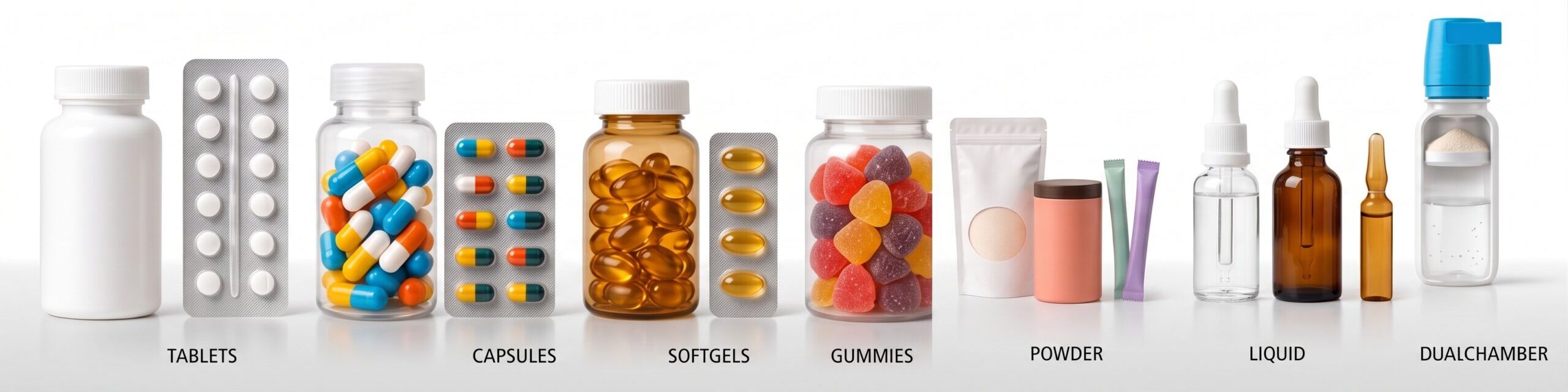
These ranges are planning references for finished retail units. They are not a guaranteed minimum, and they do not apply unchanged to every formula. Stick-pack counts also depend on the fill weight, the formula, the film, and the production schedule. Softgels are set in the quotation with the oil fill, the shell, and the pack.
| Format | Typical MOQ |
|---|---|
| Capsules | About 3,000–5,000 finished retail units |
| Tablets | About 5,000–10,000 finished retail units |
| Powder sticks | Often from about 10,000 individual stick packs |
| Softgels | Set in the quotation with the fill, shell, and pack |
| Bulk powder | By kilogram |
A sample is planned for 7–15 days after an approved preliminary manufacturing specification. Production is planned for 30–45 days after the final specification, pack, artwork, order, and schedule are in place.
- Send the formula, the reference label, or the product concept.
- Confirm the forms, the serving, and the dosage form.
- Approve the specification, the pack, and the artwork.
- Place the order on the production schedule.
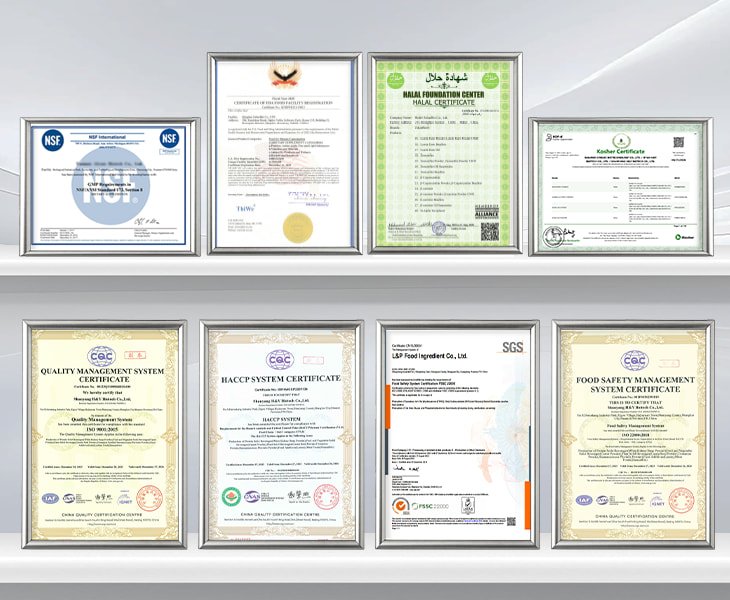
Reported daily production capacity is about 5+ million capsules, 12+ million tablets, and 2+ million softgels. Those figures do not cover powder stick packs. Stick packs are planned from the finished-pack range above. KS Nutripharma operates across 81,000+ m², with 12 production lines, five manufacturing bases, and two R&D centers, in operation since 2007. Certifications include cGMP, ISO 9001, ISO 22000, HACCP, FSSC 22000, Halal, and Kosher. They apply to the relevant quality systems and do not constitute approval of an individual product. See manufacturing capacity and certifications and compliance.
Related Men’s Health Routes
Send the Project Information
The first note can be short. Useful details, when you have them, are the destination market, ingredient forms and amounts per serving, dosage form and units per serving, estimated first-order quantity, packaging, and any test or document the project requires. An early concept can be sent before that list is complete.
The initial review identifies the open specifications and the information a comparable quotation needs. A project manager replies within one business day, and an NDA is available.
Request a formula feasibility review
Disclaimer: This page is for wholesale and supplement-manufacturing reference only. It does not provide medical advice. Product claims and labeling requirements vary by destination market. The brand owner is responsible for the final label and claims. KS Nutripharma provides manufacturing feasibility and the technical documents agreed for each project, not regulatory approval or legal advice.
Written by KS Nutripharma Formulation Team · Reviewed by KS Nutripharma Director of R&D (PhD, Food Science · 19+ years nutraceutical development) · Updated October 15, 2026 · About Us