30-Second Product Snapshot — Maca Supplement Manufacturing at KS Nutripharma
Items
KS Nutripharma Answers
OEM / ODM / Private Label Available — finished maca supplements and maca-based stacks under your brand MOQ Pilot-friendly programs starting from 3,000–5,000 units Lead Time Quote target within 48 hours of a complete brief · sample pathway often 7–21 days after formula lock Certifications cGMP · ISO 9001 · ISO 22000 · HACCP · FSSC 22000 · Halal · Kosher pathways · FDA-registered facility Dosage Forms & Daily Capacity Hard capsules 5+ million/day · Softgels 2+ million/day · Tablets 12+ million/day · Gummies 2.5+ million/day · Powders 5,000+ tons/year · Liquids 3,000+ tons/year Maca Ingredient Options Raw powder · Gelatinized powder · Extract 4:1 / 10:1 / 20:1 / 30:1 / 50:1 · Organic · Color-selected (yellow / black / red / mixed) Start Your Project Request an OEM Quote · Review Our Maca Manufacturing Page
A search for “maca” in a major online marketplace returns more than 3,000 supplement listings — powders, capsules, gummies, tinctures, and extracts that all carry the same botanical name, Lepidium meyenii (or L. peruvianum), on the label.[1] Yet two products sitting next to each other on a virtual shelf can differ so much in processing, measurement, and labeling that comparing them by milligram count alone is meaningless.
This guide answers the question in three steps, in the same order you should use when evaluating a product:
- What am I actually buying? — the ingredient preparation inside the package.
- How do these products differ? — the processing and label metrics that determine whether two products are comparable at all.
- How should I choose? — the decision criteria that match a product to your routine.
Here is the core principle this guide is built on:
The best maca supplement is not necessarily the one with the highest milligram count or extract ratio. It is the one whose ingredient preparation, serving amount, and product specifications match what you are looking for.
1. Start with the Basics: Maca Ingredient vs. Supplement Form
The single most common mistake when comparing maca products is treating the dosage form as the ingredient. It is not.
Ingredient preparation describes the physical and chemical state of the maca root after harvest. There are three preparations you will encounter:
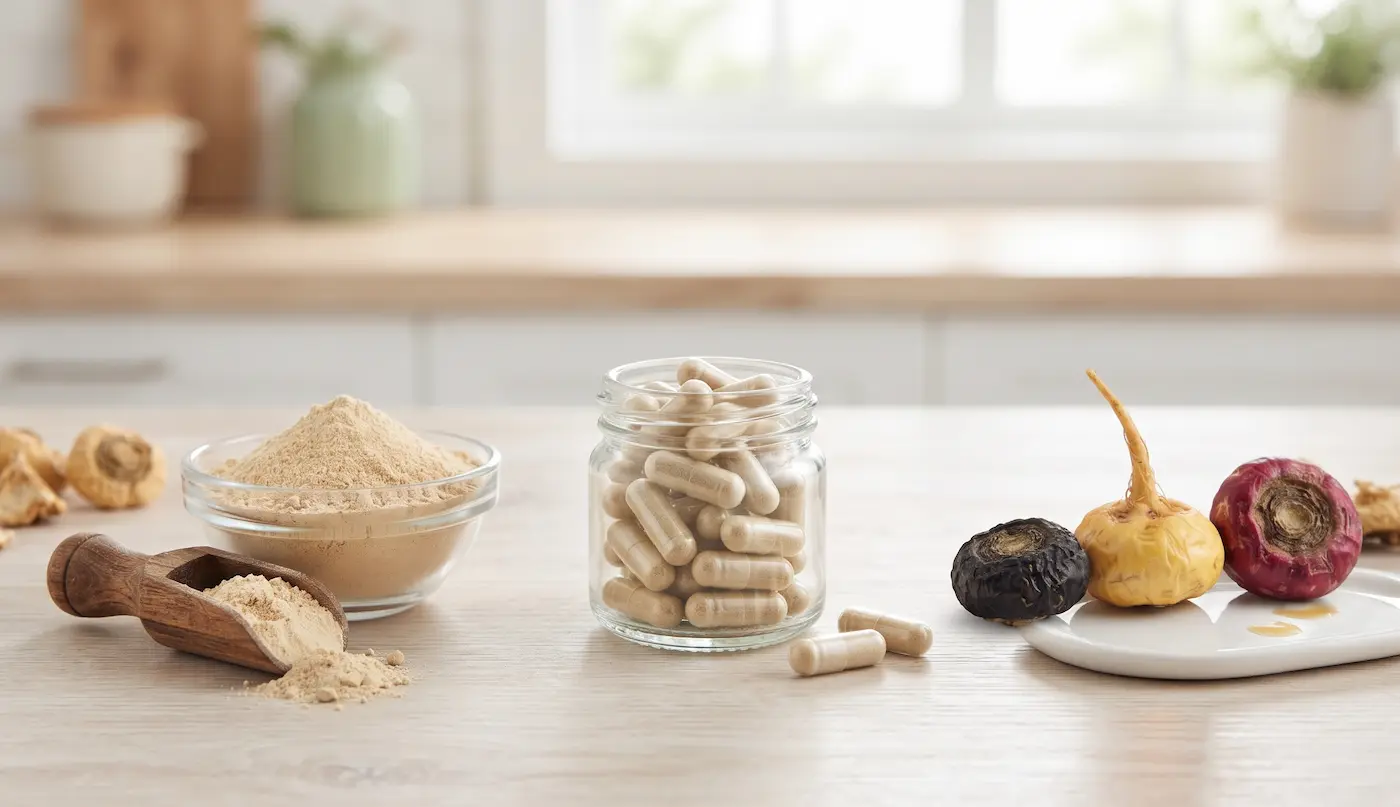
- Raw maca powder — the dried, milled root, with its natural starch profile intact.
- Gelatinized maca powder — the same root, processed with heat, pressure, and moisture to break down its starches. (Despite the name, no gelatin — animal or plant — is involved.)
- Maca extract — a concentrated preparation produced by processing a larger quantity of raw root into a smaller quantity of finished material, commonly declared with a ratio such as 4:1, 10:1, or 20:1.
Dosage form describes how the product reaches you: loose powder, capsule, tablet, gummy, stick pack, or liquid drops.
These two axes are independent. A capsule is only a delivery vehicle — it can hold plain raw powder, gelatinized powder, or a concentrated extract. The word “capsule” on a front label tells you nothing about which preparation is inside, which is why the Supplement Facts panel, not the front of the package, is where any serious comparison begins.[2]
2. Maca Powder: Raw vs. Gelatinized
Powder is the most traditional maca format, and it comes in two distinct preparations. Understanding the difference matters because it changes digestibility, handling, and — to a degree — chemistry.
How each is made
- Raw maca powder is produced by cleaning, drying, and milling the harvested hypocotyl (the fleshy taproot) into a fine powder. Traditional open-field drying in the Andes takes two to three months and involves natural freeze–thaw cycles and intense UV exposure, which itself alters the root’s glucosinolate and fatty-acid profiles.[1]
- Gelatinized maca powder takes that milled powder through an extrusion step that applies short-term high pressure, temperature, and moisture — the same starch gelatinization principle used in food processing. The result is a “pre-cooked,” more soluble powder.[1]
What gelatinization actually changes
Maca is a starchy root: dehydrated maca powder is roughly 55–73% carbohydrate, mostly starch, plus 8.9–21% protein and 8.2–25.6% fiber.[1] That starch load explains most of the practical differences:
Factor | Raw Maca Powder | Gelatinized Maca Powder |
|---|---|---|
| Starch content | Intact — the full natural starch load | Broken down — easier on digestion for starch-sensitive users |
| Glucosinolates | Retained in full (raw powder is roughly 20% higher in glucosinolates than gelatinized)[1] | Partially reduced by heat processing |
| Goitrogenic compounds | Present (relevant only at high intake for thyroid-sensitive individuals) | Reduced by moisture and heat[1] |
| Texture & solubility | Grittier; separates in liquids | More soluble; blends more smoothly |
| Stability | More shelf-stable | More hygroscopic — absorbs moisture and is less stable; needs tighter packaging[1] |
What the evidence does — and does not — support
Gelatinized maca is widely marketed as “gentler on the stomach,” and the starch-removal logic behind that claim is sound. Individual tolerance still varies, so new users of either powder typically start with a small serving (about half a teaspoon) and increase gradually over a week.
On efficacy, the picture is more nuanced than marketing suggests. In a 12-week clinical study, gelatinized maca root increased sexual desire in men without measurably changing serum testosterone or estradiol — demonstrating that maca’s effects, where they occur, do not map neatly onto “more processing = more actives.”[1] Published clinical trials have used raw, gelatinized, and extracted maca at daily doses ranging from roughly 300 mg to over 3 g, and outcomes differed across preparations, colors, and standardization levels — which is why no preparation can claim blanket superiority.[1]
3. Maca Extract: What Extract Ratios Really Tell You
Extracts are where label confusion is greatest. A clear reading of three numbers — the ratio, the actual extract weight, and any standardization — resolves most of it.
What the ratio means
An extract ratio states the proportion of starting raw root used to produce the finished extract. A 10:1 extract means approximately 10 parts of raw root were processed to yield 1 part of final extract.
Actual extract weight vs. nominal root equivalent
Labels and marketing copy routinely display two very different numbers:
- Actual extract weight — the physical weight of concentrated extract in the serving (e.g., 200 mg).
- Nominal root equivalent — a calculated figure representing the starting material (e.g., “equivalent to 2,000 mg of maca root” for a 10:1 ratio).
A capsule containing 200 mg of a 10:1 extract does not contain 2,000 mg of anything. It contains 200 mg of extract. The 2,000 mg figure is arithmetic, not powder.
Why a higher ratio does not automatically mean greater potency
- A ratio measures manufacturing input, not biological output. It says nothing by itself about the concentration of macamides, glucosinolates, or any other constituent.
- Extraction method changes the chemistry. Different solvents and protocols select for different compound classes, so a 20:1 extract from one supplier may have a completely different profile from a 20:1 extract from another.
- No clinical superiority is established. Human studies on maca have used very different preparations — from undefined powders to extracts standardized to specific glucosinolate levels — and results have been inconsistent across the board. No published clinical evidence demonstrates that a higher extract ratio produces better health outcomes.[1]
- Standardization is the missing piece. Most maca supplements do not declare standardized marker compounds at all,[1] which means two products with identical ratios can still differ substantially in what they actually deliver. Independent testing programs such as ConsumerLab have repeatedly found that maca products vary in what their labels claim versus what testing shows.[3]
Bottom line: treat the extract ratio as a manufacturing specification, not a potency score. The numbers that deserve your attention are the actual extract weight per serving and whether the extract is standardized to a declared marker.
4. Powder, Capsules, or Extract: What Are You Actually Comparing?
With the vocabulary from the previous sections in place, the comparison becomes a set of concrete questions rather than a feature checklist.
The five questions that determine comparability
| # | Core Question | Why It Matters |
|---|---|---|
| 1 | What is the ingredient preparation? | Raw powder, gelatinized powder, and extract are different materials with different handling and chemistry. |
| 2 | What is the dosage form? | The form (powder, capsule, gummy, liquid) controls convenience and serving size — it tells you nothing about preparation on its own. |
| 3 | What does the declared amount represent? | Milligrams may refer to actual powder weight, actual extract weight, or a calculated root equivalent. Only like-for-like numbers can be compared. |
| 4 | Is the ingredient standardized or otherwise specified? | Origin, color phenotype, ratio, and marker compounds are the only specifications that let you verify one batch — or one brand — against another.[1] |
| 5 | What fits your routine? | Taste tolerance, dosing flexibility, portability, and cost per day — the practical factors covered in Section 5. |
Why question 4 deserves extra weight
Maca’s composition varies with growing altitude, region, soil, color phenotype, and post-harvest handling.[1] The Botanical Adulterants Prevention Program has reported maca powder diluted with corn, wheat, and yam flours,[1] and root crops can accumulate heavy metals from soil.[1] Specifications such as origin verification, identity testing, and heavy-metal panels — documented on a Certificate of Analysis (COA) — are what separate a verifiable product from an attractive label. This applies equally whether you are a consumer reading a brand’s quality page or a brand owner qualifying a manufacturer.
A worked label example
Label Information | Product A (Powder) | Product B (Extract Capsules) |
|---|---|---|
| Ingredient | Maca root powder | Maca root extract |
| Declared amount per serving | 1,000 mg | 200 mg |
| Extract ratio | Not applicable | 10:1 |
| Nominal root equivalent | 1,000 mg | 2,000 mg |
Product B’s 2,000 mg is a calculated starting-material figure, not content. Product A delivers five times the physical weight of whole-root material; Product B delivers a concentrated fraction of it. Neither number alone tells you which product fits your goals — only questions 1–5 above do.
5. Choosing a Maca Supplement Based on Your Needs
The three formats map cleanly onto three different user profiles:
If your priority is… | Choose… | Because… |
|---|---|---|
| Dosing flexibility and cost per gram | Maca powder | You can scale servings by the quarter-teaspoon and compare products on a straightforward per-gram basis. Best for smoothie and food use. |
| Convenience, portability, and no earthy taste | Capsules or tablets | Pre-measured, travel-friendly, and the shell masks the pronounced earthy-malty flavor of raw maca. |
| A small serving footprint | Maca extract | A concentrated 200–500 mg serving replaces multiple grams of powder — useful for multi-ingredient stacks, provided you read the actual extract weight and ratio honestly. |
| Sensitive digestion with a powder habit | Gelatinized powder or capsules | The gelatinized pathway removes most of the starch load that causes heaviness in raw powder.[1] |
Two rules close the loop:
- Compare only within the same preparation. A 1,000 mg powder serving and a 200 mg extract serving are different products, not different doses of the same one.
- Match the format to your routine first, the spec sheet second. A perfectly standardized extract delivers no benefit sitting in a cabinet because the taste or the measuring routine did not fit your life.
6. Other Maca Formats, Briefly
- Gummies: Palatable and pill-free, but physical space limits how much maca fits in one gummy — check the Supplement Facts panel for actual maca weight and added sugar.
- Liquid extracts and drops: A genuine alternative for pill-averse users, but liquid densities and extraction ratios differ from dry extracts; rely on the manufacturer’s stated root equivalent per dropper, not on drop counts.
- Drink mixes and functional blends: Stick packs pairing maca with cocoa, protein, or other adaptogens are convenient, but multi-ingredient blends make the per-serving maca dose harder to verify. Transparent brands declare every ingredient’s amount rather than hiding behind a proprietary blend.
7. Frequently Asked Questions
Is maca powder better than maca capsules? Neither is universally better. Powder offers flexible dosing and lower cost per gram; capsules offer convenience and mask the earthy taste. The ingredient inside matters more than the shell.
Is gelatinized maca the same as maca extract? No. Gelatinization is a starch-modification process applied to whole-root powder; extraction concentrates selected compounds into a new material. A gelatinized powder is still a powder, not an extract.
Does a higher extract ratio mean a stronger product? Not by itself. Ratios describe starting-material proportions, and no published clinical evidence shows higher ratios produce better outcomes.[1] Actual extract weight and standardization are more meaningful numbers.
What is “maca root equivalent” on a label? A calculated figure: extract weight multiplied by the ratio. It represents starting material, not content in the capsule.
Can I swap powder for capsules one-for-one? Only after checking that the capsule serving matches your powder serving in preparation type and comparable amount. Counting capsules against spoonfuls without reading the panel leads to under- or over-dosing.
Is maca safe? Maca is generally well tolerated; mild gastrointestinal discomfort is the most commonly reported issue, usually addressed by starting with a small serving.[1] People with thyroid conditions, hormone-sensitive conditions, or those who are pregnant or breastfeeding should consult a healthcare professional before use — maca is a food-derived supplement, not a treatment for any disease.
8. For Brand Owners: Manufacturing Maca Supplements at Scale
Everything in this guide translates directly into product development decisions: the preparation defines your cost structure, the dosage form defines your channel fit, and the specification defines whether you can promise — and prove — consistency across reorders.
KS Nutripharma manufactures maca supplements across the full decision tree described above:
- Ingredient grades: raw powder, gelatinized powder, and extracts from 4:1 to 50:1, plus organic and color-selected (yellow / black / red) pathways — each with spec sheet, COA, TDS/SDS, identity, heavy-metals, and microbiological documentation.[4]
- Dosage forms: hard capsules (5+ million/day), softgels (2+ million/day), tablets (12+ million/day), gummies (2.5+ million/day), powders and stick packs (5,000+ tons/year), and liquids (3,000+ tons/year) — six forms under one facility, with pilot batches from 3,000–5,000 units.[5]
- Quality systems: cGMP, ISO 9001, ISO 22000, HACCP, and FSSC 22000 certified, with Halal and Kosher pathways, FDA-registered facilities, and lot-level traceability from incoming extract to shipped bottle.[5]
- Speed: quotation target within 48 hours of a complete brief; sampling often 7–21 days after formula lock.[4]
Market-proven starting points include a single-ingredient maca hero SKU, a Maca + Tongkat dual-botanical capsule, and a black maca men’s vitality complex — each customizable in ratio, dose, format, and claims pathway under your brand.[4]
Planning a maca project? Share your target ingredient specification, dosage format, and serving size, and our R&D team will respond with a formulation feasibility assessment and quote within 48 hours. Request an OEM Quote →
9. Sources
- Not All Maca Is Created Equal: A Review of Colors, Nutrition, Phytochemicals, and Clinical Uses — Nutrients (2024), PMC10892513
- Exploring the Chemical and Pharmacological Variability of Lepidium meyenii — Frontiers in Pharmacology (2024), PMC10910417
- Maca Supplements Review — ConsumerLab
- Maca Extract Supplements Manufacturer — KS Nutripharma
- Manufacturing Capacity — KS Nutripharma
Medical disclaimer: This article is for informational purposes only and is not medical advice. Maca is a dietary supplement, not a drug, and is not intended to diagnose, treat, cure, or prevent any disease. Consult a qualified healthcare professional before starting any supplement, especially if you have a thyroid condition, a hormone-sensitive condition, are pregnant or breastfeeding, or take medication.
Editorial note: This guide was prepared by the KS Nutripharma content team and reviewed against the peer-reviewed sources listed above.