

Magnesium Complex Supplement OEM, ODM & Private Label Service
KS Nutripharma is a magnesium complex supplement manufacturer for OEM, ODM, and private-label programs. We develop finished magnesium complex supplements — capsules, tablets, and selected powders — built from two or more magnesium salts in one unit, with the composition fully specified before anything is priced. If the number of salts is still open, the magnesium supplements category page maps each salt against the position it usually serves.
Buyers describe these products as a magnesium complex, a triple magnesium, a multi-magnesium, or a full-spectrum magnesium. The naming varies by brand and none of it is a technical standard. What decides the cost, the capsule count, and whether two quotes are comparable at all is the composition underneath the name — which salts, how much of each, and how much elemental magnesium each one actually contributes.
Already have a formula? Send Your BOM — we cost each salt, check whether oxide is carrying the elemental line, and tell you the fill weight your serving will land at.
Still choosing the blend? Request Formula Support — how many salts the format can carry, and which ones earn their place.
Comparing two complex products? Send two Supplement Facts panels — the full panels plus whatever specification or COA each supplier has given you, not front-of-bottle photos.
cGMP | ISO 9001 | ISO 22000 | HACCP | FSSC 22000 | Halal | Kosher | In-house lab + SGS/Eurofins pathways | Batch COA
Typical first reply is within one business day on a complete brief. Project manager assigned. NDA available.
Magnesium Complex Supplement Manufacturing at a Glance
| What we manufacture | Oral magnesium complex capsules and tablets; powders when the lead salt suits a flavored serving |
| Architecture | Two or more named magnesium salts in one finished unit, each with its own identity and assay |
| Core specification | Per salt: identity, compound weight, elemental magnesium contribution. Plus the blend total |
| The variable that moves cost | Which salt carries the elemental line. High-percentage salts reach the target on a fraction of the powder |
| The variable that moves quality risk | Blend uniformity. Minor salts at small inclusion levels are the hardest to keep even and to confirm |
| Formats | Capsules first; tablets when the compression trial and swallow size work; powders for a citrate- or malate-led serving |
| Scope | Adult oral dietary supplements. No injections, no softgels, no infant or pet SKUs |
| Documents | Per-salt incoming COA; finished-batch COA; SGS/Eurofins when the RFQ requires it |
Magnesium Complex Formulation Cards
Each salt’s identity, compound weight, and elemental contribution are locked on all seven architectures below. What follows is what changes beyond them.
Other companions come out of your brief with their own identity and assay — B6, vitamin D3, D3 with K2, ashwagandha. Each is developed on its own ingredient program, and where a companion is better sold as a separate SKU than folded into the complex, we will say so before it is quoted.
Use when: The brand wants three named magnesium salts covering a broad daily position, without expanding the salt list further. Typically glycinate with malate and citrate.
Key variables: Which of the three carries the elemental line; oxide in or out; capsules per serving; whether the three are supplied at compatible particle sizes.
Trade-off: Not F03. Three salts keeps the architecture relatively straightforward, and still easy to misquote if each salt’s elemental contribution is not specified. The oxide answer moves the fill weight before it moves anything else, so settle it first — it often decides whether this is a one-capsule or a two-capsule product.
Default format: Hard capsules.
Use when: The brand’s positioning calls for a wider salt list than three, and the artwork will use language such as full-spectrum. That term is a market convention, not a defined composition.
Key variables: What the fourth salt is there to do; each salt’s share of the elemental total; whether the added salt is at a level that survives a uniformity specification.
Trade-off: Not F01. Adding a fourth salt without raising the elemental target does not widen the product — it divides the same magnesium into smaller shares. If a salt’s share drops to a level chosen for the panel rather than the formula, you have taken on a sourcing line, a COA, and a uniformity risk in exchange for a word on the label.
Default format: Hard capsules.
Use when: The brief excludes magnesium oxide from the declared composition, usually to support a chelated or gentler market position.
Key variables: Written confirmation that oxide is absent — including inside any buffered salt; the resulting compound load; raw-material cost per serving; capsule size and count.
Trade-off: This is F01 with its densest elemental source removed, so lower-percentage salts carry the whole line and the compound load can rise substantially for the same declared number — how far depends on which salts replace it. Expect a larger capsule or an extra one, and a higher cost per serving. The positioning is defensible; it has to be priced honestly.
Default format: Hard capsules.
Use when: Glycinate is the named lead salt and one or two others support it. Brands generally build an evening or calm position around that lead, and the claim language and its substantiation stay with the brand and its local counsel.
Key variables: Whether the glycinate is fully reacted or buffered; its compound and elemental contribution; what the supporting salts add that glycinate does not. Glycinate is quoted from our magnesium bisglycinate program.
Trade-off: Not F03. Leading with one named salt makes that salt’s identity the whole product’s credibility. Buffered glycinate is glycinate blended with magnesium oxide to lift the elemental percentage — so a panel that leads with glycinate can be carrying oxide it never mentions, which quietly undoes a no-oxide claim made elsewhere on the artwork.
Default format: Hard capsules.
Use when: Citrate is the lead salt and the serving is consumed in water rather than swallowed. The drink occasion is the reason to choose this architecture.
Key variables: Citrate hydrate state; solubility and dispersion of every salt in the blend, confirmed by trial; flavor and acid system; serving mass; moisture plan for sticks or tubs.
Trade-off: Not F04. Moving a blend into water makes taste and solubility the gating constraints instead of fill weight. Salts that are unremarkable inside a capsule can turn gritty, bitter, or slow to disperse in a glass, so a capsule composition cannot simply be re-formatted as a powder.
Default format: Powder or stick packs.
Use when: The brief specifies magnesium L-threonate alongside other salts, either as a licensed grade or as a defined generic specification.
Key variables: Threonate identity and grade; its compound weight against its elemental contribution; total units per serving; how the remaining salts fit what is left of the capsule.
Trade-off: Not F02. Threonate’s elemental percentage is among the lowest in the category, so a contribution large enough to matter can consume most of the available fill weight on its own, leaving limited room for three additional salts in one capsule. In practice that pushes the serving toward two or more units, or holds threonate at a level that reads on the panel and does little in the formula. Both are legitimate; the choice should be made knowingly rather than discovered.
Default format: Hard capsules.
Use when: The product’s premise is the breadth of the salt list itself.
Key variables: All seven identities and contributions; which two or three supply most of the elemental total; inclusion level of the minor salts; blend and fill uniformity strategy; how many incoming COAs the program now carries every lot.
Trade-off: Not F03. As the salt count rises, uniformity, segregation control, supplier qualification, and verification matter progressively more — particularly where one or more salts sit at low inclusion levels, which are the hardest to distribute evenly and the hardest to confirm in a finished unit. A long salt list buys a marketing premise and pays for it in process control.
Default format: Hard capsules.
Choose the Magnesium Complex Format: Capsules, Tablets or Powder
Changing the format changes which specification fields control the project. These are the ones that move.

Best for: Most complex architectures, and the only practical route for high-compound-load blends such as threonate-containing or no-oxide compositions.
What controls it: Total compound load, capsule size, and units per serving. As a preliminary planning range, size 0 may take roughly 350–450 mg and size 00 roughly 500–650 mg of a powder blend; actual capacity follows the finished blend’s bulk and tapped density — not the individual salts’ — and is confirmed by trial. Because a complex mixes materials of different densities and particle sizes, flow is checked before the capsule size is fixed.
Default path: Hard capsules.

Best for: High-count bottles and low cost per serving, where a single unit has to carry more than a capsule can.
What controls it: Compressibility of the blend, tablet weight, hardness and friability, disintegration, coating, and swallow size. Multi-salt blends complicate compression because each salt compacts differently; some grades need granulation before they will hold a tablet at an acceptable hardness. A tablet can carry a heavier load than a capsule, which is often why an oxide-free blend ends up here.
Default path: Tablets.
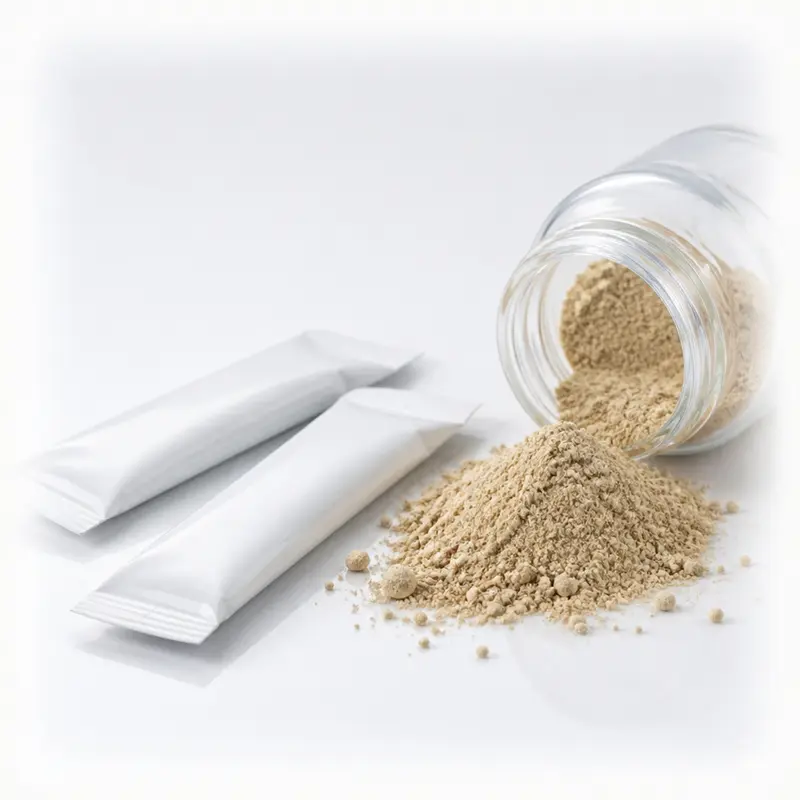
Best for: Citrate- or malate-led blends where the serving is a flavored drink.
What controls it: Serving mass, solubility and dispersion of every salt in the blend, taste, the flavor and acid system, and a moisture plan matched to any hygroscopic salt. The least soluble or slowest-dissolving component tends to become the practical constraint on the finished drink’s dispersion and mouthfeel — one poorly dispersing salt can leave sediment or grit even when the rest of the blend goes into solution cleanly. Gummies and softgels stay off the list for multi-salt magnesium: the compound load is beyond what a gummy mass carries at a credible declared level, and a dry salt blend gives a softgel no oil phase.
Default path: Powders and granules.
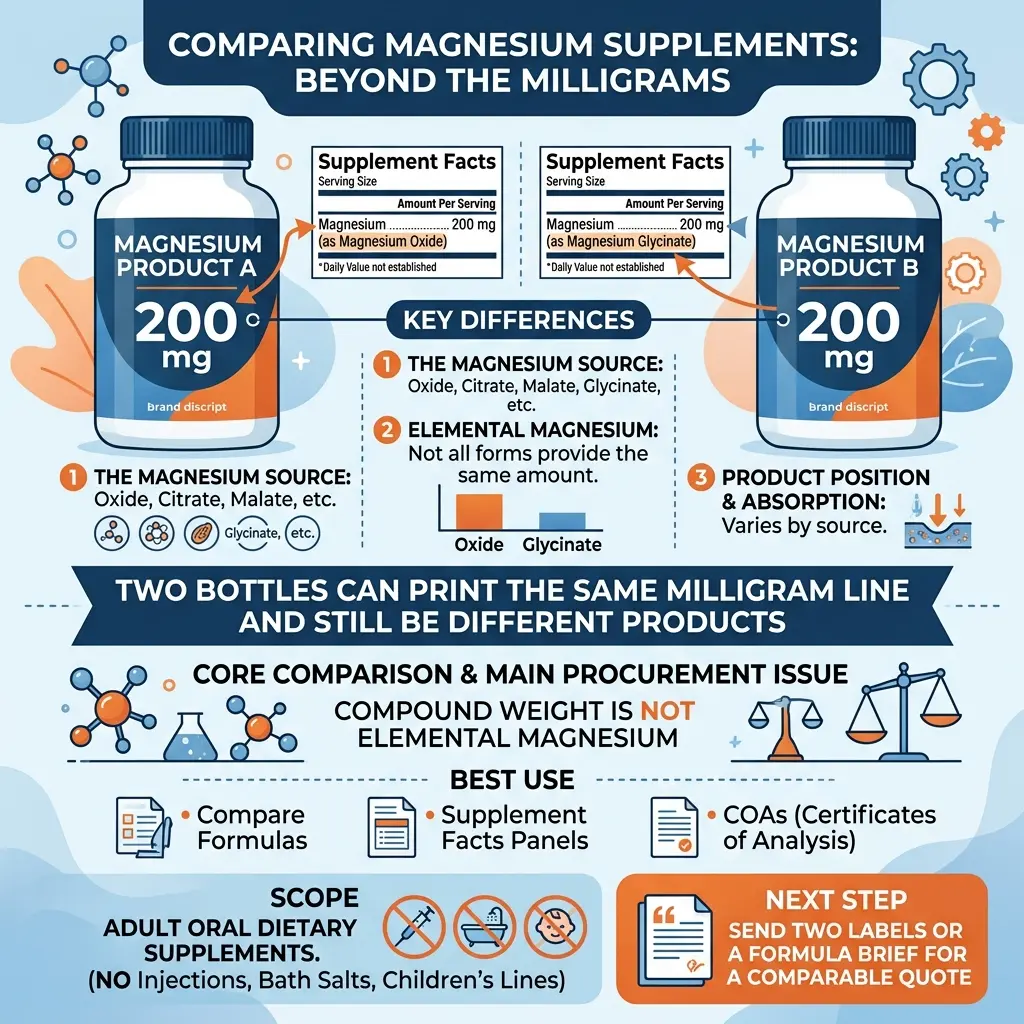
A single-salt quote can be checked against one number. A complex cannot, and the reason is arithmetic rather than opinion.
What the finished panel actually shows
In a US Supplement Facts panel, magnesium is declared as the dietary ingredient — the amount of elemental magnesium per serving with its percent Daily Value — while the source form is identified in the labeling as required [2][3]. The individual compound weights and the per-salt elemental split of a multi-salt formula are not normally visible as separate fields on the panel. A brand may choose to show more, and some do, but nothing obliges the panel to break the blend down for you.
That cuts both ways. A competitor’s panel reading “Magnesium 200 mg” with its %DV is not hiding anything; it is complying. And your own supplier’s quote reading “200 mg magnesium from a five-salt complex” is not a specification, because the same 200 mg can be assembled in ways that cost differently, fill differently, and test differently.
So there are three separate places these numbers live, and conflating them is where most complex projects go wrong:
| Layer | What it carries | Who needs it |
|---|---|---|
| Incoming raw material | Each salt’s identity, assay method, elemental percentage, batch COA | Purchasing and QC, per salt, per lot |
| Formulation and BOM | Each salt’s compound weight, its elemental contribution, the blend total, fill weight, units per serving | You and us, during development |
| Finished product | Total elemental magnesium and %DV on the panel, source forms identified, finished-batch COA | The consumer, the retailer, the market authority |
The middle layer is the one buyers most often never see, and it is the only one that makes two quotes comparable. The general version of that problem, across single-salt products as well as blends, is set out in why two magnesium labels are not comparable.
The same 200 mg, two very different products
Take a 200 mg elemental magnesium target and build it twice. The percentages below are nominal figures used to make the arithmetic visible, not specifications: hydrate state, grade, and lot all move them, and the batch COA governs the real number. The bisglycinate figure in particular assumes a fully reacted material — a buffered bisglycinate is already blended with magnesium oxide and carries a materially higher percentage, which is exactly the substitution that quietly rewrites a calculation like this one.
Blend A — no oxide
| Salt | Compound weight | Nominal elemental Mg | Contribution |
|---|---|---|---|
| Magnesium bisglycinate | 700 mg | ~14% | ~98 mg |
| Di-magnesium malate | 300 mg | ~20% | ~60 mg |
| Magnesium citrate | 260 mg | ~16% | ~42 mg |
| Total | 1,260 mg | ~200 mg |
Blend B — oxide carrying most of the line
| Salt | Compound weight | Nominal elemental Mg | Contribution |
|---|---|---|---|
| Magnesium oxide | 250 mg | ~60% | ~150 mg |
| Magnesium bisglycinate | 250 mg | ~14% | ~35 mg |
| Magnesium citrate | 90 mg | ~16% | ~14 mg |
| Total | 590 mg | ~199 mg |
Both panels can legitimately declare the same 200 mg of magnesium at the same %DV for the same target population. Both name three salts. But Blend A carries roughly 2.1× the compound weight of Blend B: on these figures alone Blend B sits inside a typical size-00 planning range while Blend A needs about two capsule fills, before lubricant, flow agents, and process allowances are added. Blend A can also carry a materially higher raw-material cost per serving, depending on the actual grades and supplier pricing.
Nothing in that comparison makes either blend wrong. Oxide is a legitimate, widely used magnesium source with a high elemental percentage, and removing it is not an upgrade — it is a decision that can increase the compound load substantially for the same declared number, depending on which salts replace it, and that then moves capsule count, bottle size, cost per serving, and the consumer-tolerance profile with it. How compound load turns into a capsule count is worked through in how fill weight limits capsule count. What makes a project fail is discovering that at the artwork stage.
The same arithmetic explains why “seven magnesiums” is a composition rather than seven doses. Seven salts means seven identities are present; the declared magnesium is still the sum of what each contributes, and a few high-percentage salts can supply nearly all of it while the rest sit at inclusion levels chosen for the label. Ask which salts carry the total before treating the count as a specification.
Run the two offers through the same sequence before you look at price. Each step either matches or it does not, and any mismatch means you are still comparing two different products.
- Salt identities. Glycinate, citrate, malate, taurate, threonate, and oxide are different materials with different elemental percentages. Confirm the actual salt named, including hydrate state where it applies.
- Compound weight per salt. Not the blend total — the individual figure for each salt, which is what your BOM is priced from.
- Elemental contribution per salt. The compound weight multiplied by that lot’s elemental percentage. This is where two identical-looking blends separate.
- Oxide position. Present or absent, and if present, how much of the elemental total it supplies. This determines the fill weight more than any other single answer.
- Total fill weight and units per serving. One capsule or three is a packaging, cost, and consumer-compliance difference, not a detail.
- Dosage form. A capsule blend, a compressed tablet, and a flavored powder are not the same formulation even at an identical composition.
- Release specification. Which tests run on incoming salts, which run on the finished batch, and what the agreed release criteria are.
Only when those seven lines match does a per-unit or per-bottle price mean anything.
If you want us to run it, send the two full Supplement Facts panels, whatever specification or COA each supplier has provided, your target market, your intended dosage form, and the serving size you want to land on. If a step is missing on one side, we will tell you which question to put back to that supplier rather than guessing at the number.
These are the fields we lock. Concepts behind them are covered above; this is the checklist itself.
Per salt, for each incoming lot under the approved specification
Salt name in full, with hydrate state and CAS where applicable. Identity confirmation and the method used. Elemental magnesium percentage as the batch result, not the specification floor. The assay method named, because different methods and reporting bases change how an elemental-magnesium result should be read. Particle size or mesh, plus bulk and tapped density, since these drive blending behavior and capsule size. Which of these run on every lot, and which are covered by supplier qualification, follows the approved raw-material specification for that salt rather than a single fixed panel. An elemental percentage on its own is not something a plant can blend against, and what a magnesium specification has to carry beyond it applies to each salt in a complex individually. Our general approach to reading incoming documentation is set out in how to read a COA.
Oxide disclosure, including inside other salts
Whether magnesium oxide is part of the declared composition, and how much of the elemental total it supplies. This extends to buffered chelates, where oxide is already blended into the incoming material — a specification that excludes oxide has to exclude it at that level too, in writing, or the exclusion is not real. How buffered and fully reacted materials differ, and why a label rarely reveals which one is in the bottle, is set out in buffered versus fully reacted magnesium.
Blend uniformity
Multi-salt blends are the one place where a magnesium program can meet specification on every incoming lot and still fail on the finished unit. Salts with different particle sizes and densities segregate during blending and during capsule filling, and the minor components segregate first. The controls are a defined blending sequence and time, particle-size ranges specified rather than accepted as delivered, and content uniformity checked across the fill run instead of on a single sample.
What finished-product testing can and cannot confirm
Finished-batch testing confirms the total elemental magnesium in the unit, along with the other finished-product tests the specification requires — uniformity, heavy metals, and microbiology among them. What it does not normally establish is the individual salt identities or their respective elemental contributions after blending: magnesium from oxide and magnesium from bisglycinate are the same analyte to the instrument, and no routine release test separates them. How finished-product magnesium is tested sets out what release testing does and does not settle.
Per-salt verification therefore happens at incoming, on qualified suppliers, before the salts are combined. That is the practical reason a complex has to be locked at the BOM stage — once blended, the individual contributions are controlled through the approved BOM and the incoming-material records rather than recovered by a release test.
Heavy metals, microbiology, and release criteria
Testing scope and COA fields follow the locked product specification, the destination market’s finished-product requirements, and the release criteria agreed at the start of the program — typically heavy metals including lead, arsenic, cadmium, and mercury, plus microbiology, identity, and assay as applicable. A multi-salt blend widens the incoming testing load in proportion to the number of salts, and US retail programs frequently apply tighter lead thresholds than an ingredient specification does.
Serving size on a complex is an output of the composition, not a decision taken before it — which is why two suppliers can hit the same declared magnesium and land two capsules apart. A usable quote therefore states all five together: elemental magnesium per serving, compound weight per serving, units per serving, total fill weight, and dosage form. Anything short of that is a price without a product attached.
The per-salt breakdown stays in your technical package, available to you and to a retailer’s technical review whether or not the artwork prints it.
Before the serving size is finalized, formulation and regulatory review should confirm the applicable supplemental-magnesium intake references and labeling requirements for each destination market [1][2]. Milligram and percentage figures on this page are development examples.
Can a Supplement Facts panel show what each salt contributes?
Some brands do print one voluntarily. Most do not, and the useful question is what you can infer without it. From a panel you can read the total magnesium, the salts present, and the order they are listed in. You cannot read how the total is divided, which means you cannot tell a blend that spreads the magnesium across its salts from one where two salts carry nearly all of it. That gap is not closed by reading harder; it is closed by asking for the specification.
Can a laboratory confirm the per-salt split in a finished capsule?
Not as a routine release test. Once the salts are blended, magnesium from oxide and magnesium from a chelate are the same element to an ICP instrument. Total elemental magnesium, identity, and uniformity are all confirmable on the finished batch; attributing milligrams back to individual salts is not. That is why per-salt qualification happens on incoming material and why the BOM, not the finished unit, is where a complex is actually controlled.
Does removing oxide change the capsule count?
Usually yes, and it is the most underestimated consequence of a no-oxide brief. Oxide’s elemental percentage is several times that of most chelates, so taking it out means lower-percentage salts carry the whole declared number. The compound load can roughly double for the same milligrams, which turns a one-capsule serving into two, enlarges the bottle, and raises the cost per serving. Worth deciding before packaging is specified.
Can a magnesium complex be declared as a proprietary blend?
It can be presented that way within the applicable labeling rules, and a proprietary blend should not be read as evasive by default. For manufacturing it changes nothing: we still need each salt, each compound weight, and each elemental contribution to build, cost, and release the product. What a proprietary blend does affect is your own ability to compare a competitor’s product, since the individual weights are not public.
Does a longer salt list change the qualification workload?
Yes, and it is the cost buyers forget. Each salt is qualified as its own material against its own approved specification, so a seven-salt product carries seven sourcing lines, seven specifications, and seven sets of incoming records every production lot. That widens qualification effort and can extend lead time when one supplier is slow, which is a practical argument for keeping the salt list as short as the positioning allows.
What happens if a supplier discontinues or reformulates one salt in the blend?
The elemental arithmetic has to be rebuilt, not patched. A replacement salt — or the same salt at a different hydrate state or grade — changes its elemental percentage, so the compound weight has to be recalculated to hold the declared magnesium, and the fill weight, capsule size, and sometimes the panel move with it. This is why the BOM records the elemental percentage each figure was calculated from, rather than only the milligrams.
Can we launch with three salts and add more later?
Adding a salt is a reformulation rather than an addition. The new material needs qualification, the compound weights are recalculated so the declared magnesium holds, fill weight and capsule size are rechecked, and the panel and artwork are revised. Brands planning a wider list later usually save work by specifying the target architecture at the start, even if the first launch ships a subset.
Can the per-salt breakdown stay confidential from our retailer?
The panel and the technical package are separate documents. What the panel shows is set by the applicable labeling rules; the per-salt breakdown lives in your specification, and you control who receives it. In practice retailer and marketplace technical reviews increasingly ask for enough of it to verify the declared magnesium, so it is worth deciding early what you are prepared to share and under what agreement.
Related
- Magnesium Bisglycinate Supplements Manufacturing
- Magnesium Malate Supplement Manufacturer
- Magnesium Citrate Supplement Manufacturer
- Magnesium Taurate Supplement Manufacturer
- Hard Capsules
- Tablets
- Powders and Granules
References
- NIH Office of Dietary Supplements. Magnesium — Health Professional Fact Sheet. https://ods.od.nih.gov/factsheets/Magnesium-HealthProfessional/
- US FDA. Dietary Supplement Labeling Guide. https://www.fda.gov/food/dietary-supplements-guidance-documents-regulatory-information/dietary-supplement-labeling-guide
- 21 CFR 101.36 — Nutrition labeling of dietary supplements. https://www.ecfr.gov/current/title-21/chapter-I/subchapter-B/part-101/subpart-A/section-101.36
Disclaimer: Wholesale and brand-manufacturing reference only. Not intended to diagnose, treat, cure, or prevent any disease. Dietary supplements are not drugs. A magnesium complex is a multi-salt finished-product architecture for OEM — not a treatment for any medical condition. Milligram and percentage figures on this page, including the illustrative blend calculations, are development examples rather than recommended intakes or guaranteed release specifications; nominal elemental percentages vary by grade, hydrate state, and lot, and the batch COA governs. Positioning and claim language referenced here are market conventions, not claim substantiation. Brand owners remain responsible for finished-label compliance and claim substantiation with local counsel.