Reviewed by KS Nutripharma Director of R&D (PhD, Food Science
19+ years nutraceutical development) | Updated September 2026
Introduction
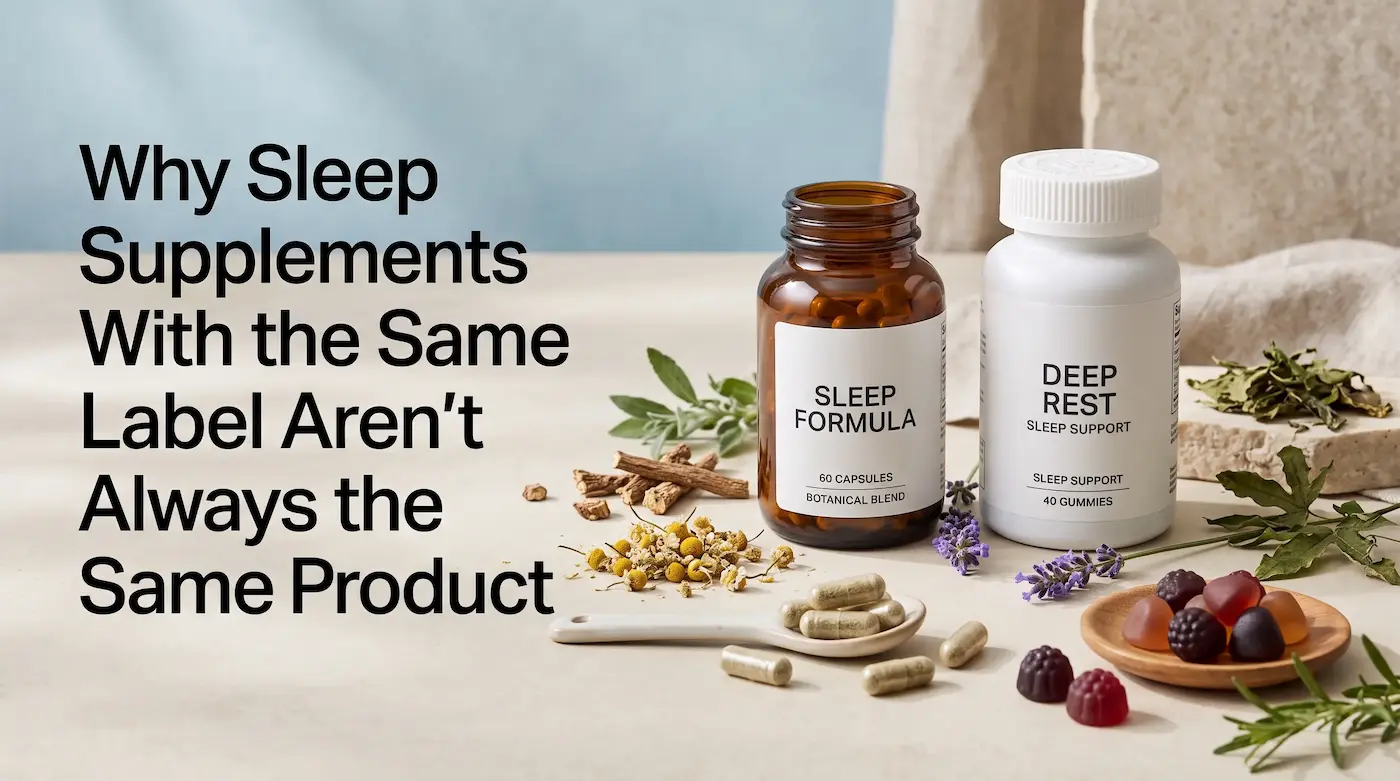
Two sleep supplements can print the same active amount and still be technically different products. Same label ≠ same specification ≠ same finished product. Release profile, ingredient form, elemental yield, finished-unit potency, blend uniformity, and packaging can all change what is actually delivered in the shipped unit. For a brand owner comparing suppliers, the important question is not whether two labels look similar, but whether the underlying specifications and finished-product controls are equivalent.
Finished units are quoted on the sleep-support manufacturing file: identity, printed potency, and whether the shipped capsule or gummy meets the approved finished-product specification.
Oral sleep supplements are dietary-supplement units. [1] OTC and prescription sleep drugs are a different legal class. This article compares specifications and finished-product controls. It does not rank which formula works for every person.
Five Reasons Two Sleep Supplements Can Differ
1. Release profile.
Two products can contain the same labeled melatonin amount while using different release systems. The labeled amount alone does not define the release profile. Immediate-release and modified-release products are designed to produce different dissolution or release profiles. If the commercial brief calls for immediate release or modified release, that requirement should be locked before quoting, formulation, and testing.
2. Ingredient form and elemental basis.
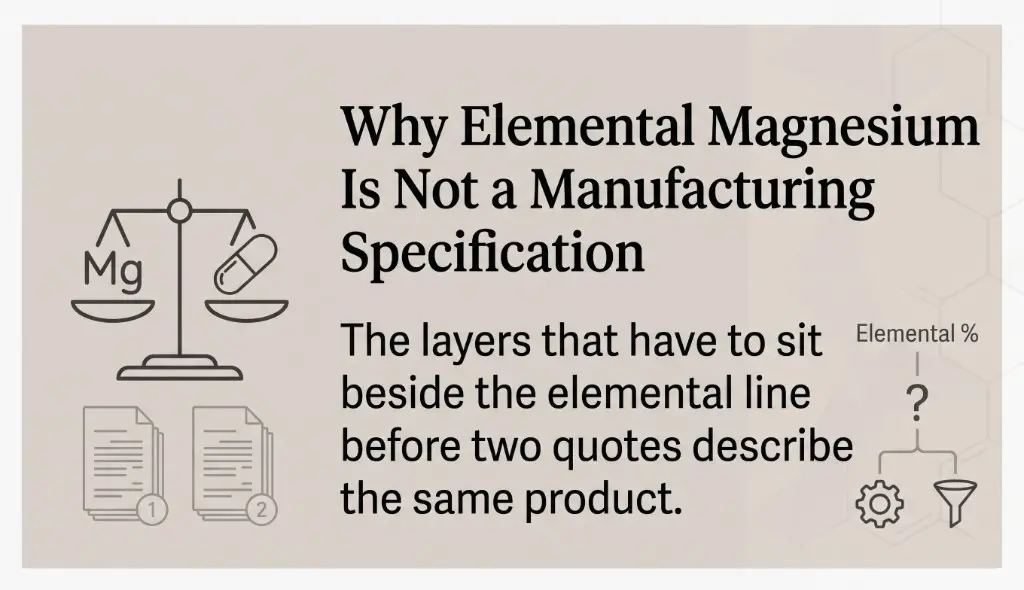
A supplier quote can describe magnesium as either the weight of the magnesium-containing compound or the elemental magnesium contribution. These are not interchangeable specifications. For U.S.-style Supplement Facts, the declared magnesium amount is the elemental magnesium amount, while the manufacturing specification should separately identify the magnesium source and its assay basis. [2] In development math, 200 mg of bisglycinate salt is still 200 mg of salt — elemental magnesium is a fraction of that weight unless the brief names 200 mg elemental. If the brief calls for magnesium bisglycinate, the raw-material identity and specification should be locked rather than relying on the generic word “glycinate.” Oxide and citrate are different salts. [2]
3. Finished-unit potency after process.
The question here is whether the finished dosage form contains the specified amount. Incoming COA verifies the received raw material. Finished-product testing verifies the manufactured unit against the finished-product specification. [3] Gummy processing conditions — cook temperature, residence time, water activity, and piece weight — can affect finished-product potency for some low-dose actives. A premix that tested on target in the drum can still miss the finished-unit assay.
4. What else is in the formula.
One melatonin capsule may be melatonin alone. Another adds theanine, magnesium, or valerian and still leads the front panel with the same milligram. Those are different bills of materials.
5. Blend and dosage-unit uniformity.
The question here is whether that amount stays consistent from unit to unit. Low-dose melatonin that was uniform in a lab batch can segregate in a production hopper if the trituration is poorly controlled. Capsules in the same batch can then sit below or above the specified range even when a composite assay looks acceptable. Moisture on a humid export lane can move fill weight and a printed percentage. Pack — HDPE plus induction seal and desiccant, or a higher barrier — belongs on the same technical file as potency.
The Label Number Is Only One Part of the Specification
A buyer comparing two melatonin labels with the same printed milligram, or two “200 mg magnesium” night capsules, may treat the printed number as the whole product.
Melatonin needs a release profile. Immediate-release and modified-release products can share an identity and an assay and still have different dissolution profiles. Artwork that only states a milligram amount does not tell a lab which profile to test. Gummies add heat and water activity. In pilot production the incoming isolate often tests on target while the cooked piece does not.
Magnesium 200 mg needs a salt name and a basis. Write whether a quote line is compound weight or elemental magnesium. Those two briefs produce different fills. The U.S. Supplement Facts line, if used, declares elemental magnesium. [2]
Valerian 400 mg needs the plant part and the method. Valeriana officinalis root or rhizome, powder or extract, and valerenic acids by a named method. [4] A 400 mg root powder, a 400 mg root extract, and a 400 mg extract standardized to a defined marker are three different specifications, even though the front-panel number may look similar. A UV number and an HPLC number are not interchangeable. A hops line that is xanthohumol isolate is a different material than a cone / strobile extract used in sleep-support pairs.
When two labels skip those lines, the documents describe two products. When two quotes skip them, the prices are for two products.
Why the Magnesium Form Changes the Specification
Yes — for an OEM brief, “magnesium” is incomplete. The specification should identify the salt, the elemental magnesium target, the assay basis, and the finished-product amount. Bisglycinate, citrate, and oxide are different raw-material specifications and should not be compared on a simple cost-per-gram basis. [2]
Why Raw-Material COAs Don’t Replace Finished-Product Testing
Incoming COA verifies the received raw material against its specification. Finished-product testing verifies the manufactured unit against the finished-product specification. [3] Stability testing addresses whether those specifications remain within limits through the defined storage period. Those are three files, not one.
In pilot production three gaps show up most often:
- Gummy cook. Cook temperature, residence time, water activity, and piece weight can affect finished-gummy potency and uniformity for some low-dose actives. Brands typically assay the finished gummy on the same method as the printed line.
- Blend and fill. A low-dose trituration that was uniform in a lab batch can segregate in a production hopper. Weight variation plus assay on the filled capsule is the check for dosage-unit uniformity.
- Moisture and pack. Hygroscopic botanicals and magnesium salts pick up water. Fill weight and a printed percentage can change. Pack belongs on the same technical file as potency.
A six-month note from a sample jar is not a climate-lane stability file. Stability documentation is issued when the brief scopes it.
Assay, Uniformity, and Dissolution Answer Different Questions
Identity, assay, and dissolution are not substitutes. A buyer who treats them as one “quality score” will compare two quotes that are not the same job.
Check | What it answers |
|---|---|
| Identity | Is this the intended ingredient or material? |
| Assay / potency | How much of the named active is present, and on which basis? |
| Dissolution / release | How does the dosage form release that active? |
| Uniformity | Do units in the same batch stay within the specified potency range? |
| Stability | Do the finished-product specifications remain within limits for the scoped storage period? |
A melatonin immediate-release capsule and a modified-release capsule can contain the same active and assay to the same potency while having materially different dissolution profiles. A gummy can pass an incoming isolate assay and miss the finished-unit assay.
Why “Stronger” Isn’t the Right Way to Compare OEM Quotes
Slogans that rank one sleep supplement as stronger than another compare artwork, not specifications. Two finished units compare on release profile, labeled potency, and whether the shipped unit meets the approved finished-product specification.
If melatonin is permitted in the destination market, the buyer should lock the intended labeled potency band and release profile before formulation and artwork are finalized. The exact permitted amount and labeling requirements remain market-specific. If the market does not allow melatonin, the next product is a melatonin-avoid formula: an amino-mineral pair or a named botanical pair.
Practitioner-brand complexes are someone else’s formula and license file. Brands typically send a named-identity bill of materials. We review whether that list can be built and tested.
How to Compare Two Sleep Supplement Specifications
Put the two labels, or the two COAs, on one sheet. A blank row means the two products are not comparable yet.
What to compare | Why it matters |
|---|---|
| Destination market | Ingredient status and labeling requirements vary by market |
| Formula direction | Melatonin-led, melatonin-free, and botanical-led units are different specifications. A supplier should not quote these as interchangeable alternatives unless the buyer has explicitly requested a formula comparison. |
| Melatonin release | Immediate-release and modified-release products have different dissolution profiles |
| Printed potency | Compare the same unit, serving basis, and potency band |
| Magnesium form | Identify the salt/source and elemental magnesium basis |
| Botanical identity | Identify Latin name, plant part, and powder/extract status |
| Marker + method | HPLC or UV, and as-is or dry basis, must be aligned before the numbers are compared |
| Finished-product testing | Verify potency on the actual shipped dosage form |
| Packaging | Barrier, seal, and desiccant can affect whether the specification holds in the intended distribution lane |
Send both labels or COAs together with the destination market. We can first determine whether the two products are actually comparable, then identify the specification differences that should be locked before an OEM quote. That review sits on the sleep-support manufacturing file.
Compare two sleep product specifications
Typical first reply is within one business day on a complete brief. Project manager assigned. NDA available.
What a Buyer Should Lock Before Requesting a Quote
Before asking two manufacturers to quote the “same” sleep supplement, lock the following specification lines. Otherwise, two apparently comparable quotes may represent different raw materials, testing requirements, or finished-product controls.
Brands typically put these lines on the procurement package, in sentences:
- Destination market class, and for the EU the member state.
- Active identity for each printed line.
- Potency basis — elemental versus compound weight; as-is versus dry basis.
- Release profile if melatonin is in scope.
- Dosage form, and whether a gummy will use finished-unit assay.
- Finished-product tests that must match the approved specification associated with the labeled amount.
- Whether a stability file is in scope.
- Pack — barrier, seal, desiccant when the active or climate lane requires it.
- One of: both labels, both COAs, or a bill of materials.
Quantity and lead time are quoted after format and pack are confirmed. That file sits on the manufacturing page, not here.
FAQ
Why can two sleep supplements with the same label still be different products?
The printed milligram is one line, not the specification. Release profile, salt or extract form, assay basis, finished-unit potency, the rest of the formula, blend uniformity, and pack can all differ. Manufacturing can lock identity, dissolution profile, and finished-unit assay so the shipped unit meets the approved finished-product specification. That is a specified product. It is not a promise that any one formula will work for every person.
Can two supplements with the same active amount have different specifications?
Yes. Active amount is only one specification line. Ingredient form, standardization, release profile, dosage form, assay basis, uniformity requirements, testing method, packaging, and stability requirements can all differ.
What should a buyer compare when two sleep supplements have the same dosage?
Ingredient identity, salt or extract form, release profile, assay basis, finished-unit potency, dosage form, and packaging. If any of those rows is blank, the two prices are not yet for the same product.
Why don’t two melatonin products with the same printed milligram perform the same?
The printed number is not the whole product. Immediate-release versus modified-release changes the dissolution profile. A capsule and a gummy are different process files. Dosage-unit uniformity and whether testing is on the finished piece or only on the isolate drum will separate two bottles. Ask for the release type and the finished-product method before you compare price.
Can two sleep gummies with the same melatonin amount be different products?
Yes. Cook temperature, residence time, water activity, piece weight, finished-unit assay, release profile, and whether a stability file is scoped can all change the shipped piece. Two gummies can share the same printed milligram and still return different finished-unit results.
Why is one supplier’s sleep supplement quote higher if the label looks identical?
The quote may cover a different raw-material specification, marker method, release system, finished-product testing, pack, or stability documentation. A lower price is not a lower-cost equivalent if those lines are not the same.
Why did a gummy sleep assay fail after a good drum COA?
The drum was the incoming material. Cook heat, water activity, flavor acids, and piece-weight variation can affect finished-gummy potency and uniformity. Re-test the finished gummy on the same method as the printed line. Then freeze cook time and water activity before the next pilot.
Do I need a finished-product COA if I already have the supplier’s?
Yes when the label prints a potency. Incoming qualification checks the drum. Finished-product testing checks the unit you ship. [3] Stability is a third file when the brief scopes it. Microbiology, metals, and pack integrity follow the shipped-unit file.
Is extended-release melatonin better than immediate-release?
They are different dissolution profiles, not a better/worse pair. Brands typically lock one. Printing both stories on one SKU mixes two products.
Related Sleep Product Lines
- L-Theanine + Magnesium Supplement Manufacturer
- Valerian Supplement Manufacturer
- Magnesium Bisglycinate Manufacturer
Technical and Regulatory References
- U.S. Food and Drug Administration. Dietary Supplements. https://www.fda.gov/food/dietary-supplements
- National Institutes of Health, Office of Dietary Supplements. Magnesium — Health Professional Fact Sheet. Supplement Facts declare elemental magnesium, not the weight of the magnesium-containing compound; oxide, citrate, and other salts are different forms; oxide is among the forms most often reported to cause diarrhea; some magnesium salts are used in laxatives. https://ods.od.nih.gov/factsheets/Magnesium-HealthProfessional/
- U.S. Food and Drug Administration. 21 CFR Part 111 — Current Good Manufacturing Practice in Manufacturing, Packaging, Labeling, or Holding Operations for Dietary Supplements. Finished-batch product specifications and verification that the finished dietary supplement meets identity, purity, strength, and composition specifications (§§ 111.70(e), 111.75). https://www.ecfr.gov/current/title-21/chapter-I/subchapter-B/part-111
- Royal Botanic Gardens, Kew. Valeriana officinalis L. Plants of the World Online. https://powo.science.kew.org/taxon/urn:lsid:ipni.org:names:860012-1
Disclaimer: Wholesale / brand manufacturing and product-development reference only. Not intended to diagnose, treat, cure, or prevent any disease. Dietary supplements are not drugs and are not sleeping pills. Structure/function language, ingredient status, and product classification vary by country. Brand owners remain responsible for finished-label compliance with local counsel. KS Nutripharma provides manufacturing feasibility and documentation support — not legal approval. Milligram figures and formula examples are development references, not recommended intakes or catalog guarantees.