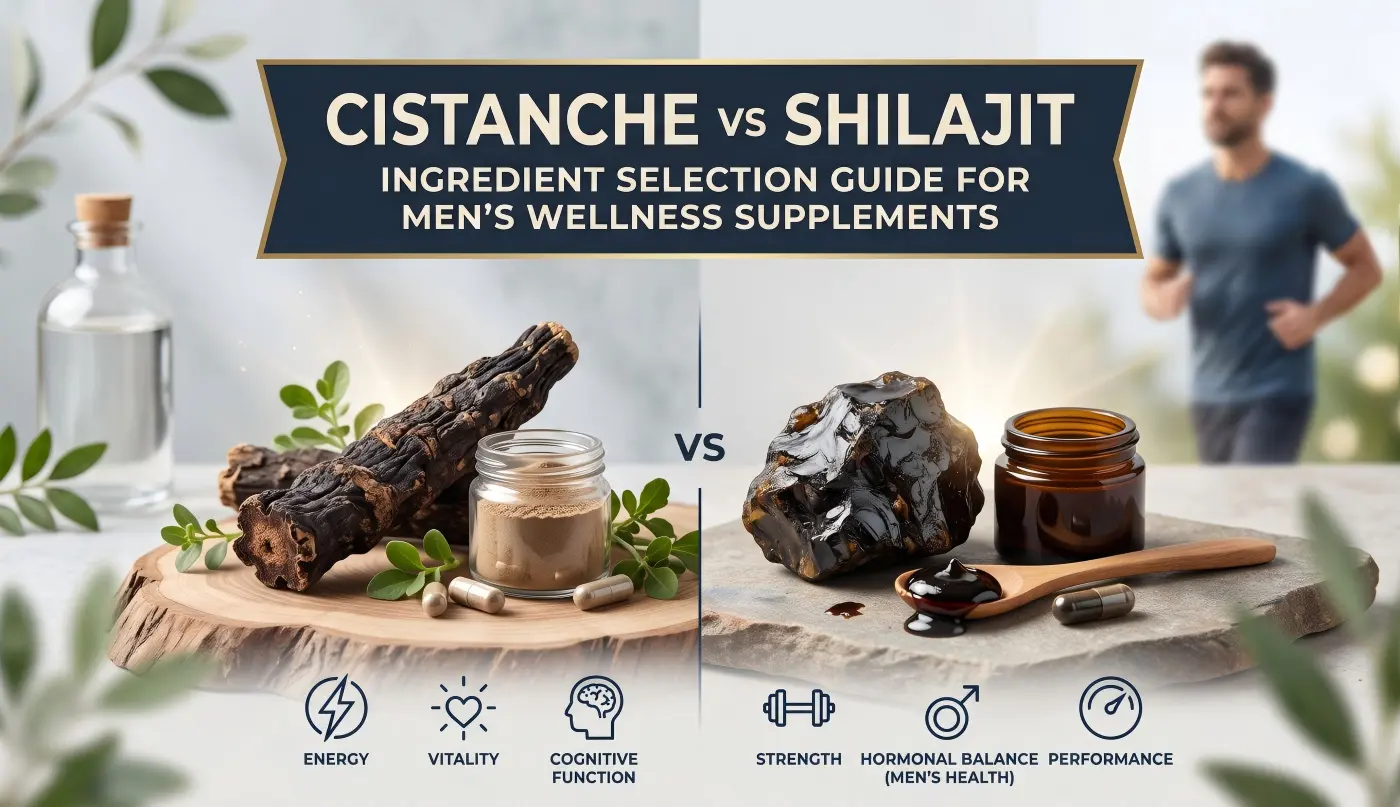
Introduction: Cistanche or Shilajit?
If you are developing a men’s wellness supplement, Cistanche and Shilajit should not be treated as interchangeable ingredients. Cistanche is a botanical ingredient derived from Cistanche species and is commonly supplied as a botanical powder or standardized extract. Its procurement specification can be built around botanical identity, plant part, extraction parameters, and measurable phytochemical markers such as echinacoside and acteoside.[1]
Shilajit is fundamentally different. It is a complex natural phyto-mineral substance containing humic substances, minerals and other organic constituents. Its quality assessment therefore depends more heavily on source, purification, compositional characterization, authenticity and contaminant control. Published reviews also note substantial variation in Shilajit’s composition among geographic sources.[2]
For a B2B buyer, the practical question is not simply which ingredient is ‘stronger.’ The better question is which ingredient provides the right product story, specification, quality-control framework, dosage form and commercial fit for the SKU you want to manufacture.
Quick Answer: Which Ingredient Fits Your Formula?
| Procurement Factor | Cistanche | Shilajit |
| Ingredient category | Botanical extract or botanical powder | Complex natural phyto-mineral substance |
| Typical identity focus | Cistanche species + plant material | Source, authenticity and compositional profile |
| Common marker focus | Echinacoside, acteoside, total phenylethanoid glycosides | Fulvic/humic fractions and other characteristic constituents |
| Standardization approach | Marker-based botanical specification | Source + purification + composition + contaminant control |
| Extract ratio relevance | Useful process descriptor, not a potency guarantee | Not a sufficient quality descriptor |
| Main procurement concern | Species and marker consistency | Authenticity, purification, composition and contaminants |
| Multi-botanical formulation fit | Generally strong | Depends more strongly on material form and sensory profile |
| Typical commercial story | Botanical men’s wellness | Traditional mineral-rich wellness |
Bottom line: Cistanche is generally easier to approach through a conventional botanical-extract specification. Shilajit requires a broader raw-material qualification process because its composition is intrinsically complex and source-dependent.[2]
Cistanche and Shilajit Are Fundamentally Different Ingredients
What Is Cistanche?
Cistanche refers to plants in the genus Cistanche. Two species frequently encountered in supplement and botanical ingredient discussions are Cistanche tubulosa and Cistanche deserticola. Commercial extracts are often evaluated through phenylethanoid glycosides (PhGs), with echinacoside and acteoside among the commonly measured constituents.[1]
For procurement, this creates a relatively familiar structure: botanical identity → extraction process → marker compounds → assay → contaminant testing → finished-ingredient specification.
A buyer should therefore avoid approving a material solely because it is labeled ‘Cistanche extract.’ The exact species, plant part, extraction ratio, marker specification and analytical method should be defined before commercial purchasing.
What Is Shilajit?
Shilajit is traditionally used in Ayurvedic medicine and is generally described in the scientific literature as a complex natural material containing humic substances, minerals and other organic constituents. A comprehensive review noted that its chemistry is not fully characterized and that composition varies by geographic source.[2]
This distinction matters commercially. A conventional botanical extract can often be specified primarily through botanical identity and marker compounds. Shilajit requires a broader question: what exactly is the material, where did it come from, how was it purified, what is its compositional profile, and what contaminants have been controlled?
Raw Shilajit and purified Shilajit should therefore not automatically be treated as equivalent commercial ingredients.
Cistanche vs Shilajit: Composition and Standardization Differences
| Characteristic | Cistanche | Shilajit |
| Primary category | Botanical material/extract | Complex natural phyto-mineral material |
| Identity | Species and botanical authentication | Source, authenticity and composition |
| Main analytical focus | Phenylethanoid glycosides | Humic/fulvic fractions, characteristic constituents and elements |
| Common marker examples | Echinacoside, acteoside | Fulvic/humic fractions; selected characteristic compounds |
| Processing | Extraction | Purification and processing |
| Extract ratio | Common commercial specification | Not a universal quality metric |
| Contaminant focus | Pesticides, heavy metals, microbiology and process contaminants as relevant | Heavy metals, microbiology and other source/process-related contaminants |
Cistanche Active Markers
Phenylethanoid glycosides are among the key analytical constituents used for Cistanche materials. A PubMed-indexed analytical study identifies echinacoside and acteoside as indicative components for phenylethanoid glycosides in Cistanche tubulosa.[1]
For commercial procurement, species identity and marker assay should be specified together. A statement such as ‘Cistanche 20:1’ describes only part of the raw-material specification.
Shilajit Quality Markers
Shilajit presents a different analytical challenge. Reviews describe humic substances as major components and report minerals and other organic compounds, including phenolic constituents and dibenzo-alpha-pyrones in some analyses.[2]
Fulvic acid can be a useful specification parameter for certain Shilajit materials, but it should not be treated as a universal measure of overall quality. A high stated fulvic-acid percentage does not by itself establish authenticity, purification quality, heavy-metal compliance or complete compositional consistency.
Don’t Compare Ingredients Without Comparing Specifications
Supplement brands do not ultimately purchase ‘Cistanche’ or ‘Shilajit’ as abstract categories. They purchase a specific raw-material specification. The most useful comparison is therefore specification-to-specification.
| Specification | Cistanche | Shilajit |
| Source identity | Botanical species and plant material | Geographic/source identity and traceability |
| Processing | Extraction | Purification/processing |
| Standardization | Echinacoside / acteoside / total PhGs as applicable | Fulvic/humic fraction and defined compositional parameters as applicable |
| Identity testing | Botanical authentication + analytical confirmation | Authenticity/compositional characterization |
| Contaminant risk | Botanical and process-related contaminants | Environmental/geological contaminants, especially metals |
| Batch consistency | Extract ratio + marker consistency | Source + purification + composition |
| COA focus | Marker assay + contaminants | Composition + contaminants |
Never compare ‘Cistanche 20:1’ with ‘Shilajit 50% fulvic acid’ as if those numbers represented the same type of potency. They describe different raw-material characteristics and should be interpreted within different specification systems.
What Does the Evidence Actually Support?
Cistanche Evidence
Cistanche has a substantial traditional-use history and a growing body of laboratory and preclinical research. However, evidence from a particular extract, isolated constituent, animal model or mechanistic study should not automatically be treated as evidence for every commercial Cistanche extract.
For B2B product development, the appropriate evidence hierarchy is: traditional use → preclinical evidence → human clinical evidence → evidence for the specific commercial preparation. The further a claim moves from the studied material, dose and population, the more cautiously it should be interpreted.
Shilajit Evidence
Shilajit also has a long traditional-use history. Human clinical evidence exists for specific purified preparations. For example, a randomized, double-blind, placebo-controlled study in healthy men aged 45–55 years evaluated a purified Shilajit preparation at 250 mg twice daily for 90 days and reported changes in testosterone-related endpoints.[3]
That finding should not be generalized automatically to raw Shilajit, every purified Shilajit preparation, every dose or every finished supplement. The identity and preparation used in a clinical study matter.
Evidence Does Not Automatically Equal Finished-Product Claims
A raw-material specification does not automatically authorize a finished-product health claim. The scientific evidence must be considered alongside the exact ingredient preparation, dose, population, endpoint, product formulation and target-market requirements.
For U.S. dietary supplements, FDA distinguishes health claims, nutrient-content claims and structure/function claims. Structure/function claims must be truthful and not misleading, require substantiation, and are subject to applicable notification and disclaimer requirements.[4][5]
Accordingly, a manufacturer should not convert ‘a study found X with a specific purified preparation’ into an unrestricted claim that every Cistanche or Shilajit supplement produces the same effect.
Cistanche vs Shilajit for Men’s Wellness Positioning
Cistanche: Botanical Men’s Wellness
Cistanche can fit naturally into products positioned around botanical men’s wellness, traditional herbal formulations, vitality-oriented products and multi-botanical formulas. The strongest B2B product story is usually the combination of botanical identity, standardized extract specifications and a clear formulation concept rather than an aggressive hormone or disease claim.
Shilajit: Traditional Mineral-Rich Wellness
Shilajit provides a different commercial story built around traditional use, a distinctive natural material identity and a mineral-rich/phyto-mineral positioning. It may be attractive for premium hero-ingredient products, but its raw-material qualification burden is also higher.
The product story should therefore be aligned with the actual material being purchased. ‘Purified Shilajit extract,’ ‘Shilajit resin,’ and a generic ‘fulvic acid’ ingredient should not be treated as interchangeable specifications.
Which Ingredient Fits Different Product Concepts?
| Product Concept | Better Starting Point | Procurement Rationale |
| Daily men’s botanical wellness | Cistanche | Clear botanical identity and marker-based specification |
| Traditional Chinese botanical formula | Cistanche | Strong botanical positioning |
| Multi-botanical men’s formula | Cistanche | Generally straightforward integration into botanical blends |
| Premium Ayurvedic-inspired formula | Shilajit | Distinct traditional and phyto-mineral identity |
| Energy/vitality-oriented concept | Either | Depends on positioning, evidence and specification |
| Resin-based premium SKU | Shilajit | Distinct ingredient and dosage-form story |
| Premium dual-ingredient concept | Cistanche + Shilajit | Different ingredient identities can support a differentiated formula |
What Should Buyers Specify When Purchasing Cistanche?
1. Botanical Species
Specify the exact species rather than simply requesting ‘Cistanche.’ Examples commonly encountered in the market include Cistanche tubulosa and Cistanche deserticola.
2. Plant Part
Identify the plant part used so the commercial specification is unambiguous.
3. Extract Ratio
Extract ratio can describe the relationship between starting material and extract, but it is not a direct potency score. A higher ratio does not automatically mean a higher marker concentration.
4. Marker Compounds
Depending on the material, specify echinacoside, acteoside and/or total phenylethanoid glycosides and define the minimum or target assay.
5. Analytical Method
Identify the validated method used for the marker assay, such as HPLC where appropriate, and require the method/result to be traceable on the COA.
6. Contaminants and Microbiology
Define applicable limits for heavy metals, pesticides, microbiological parameters and residual solvents or other process-related contaminants where relevant.
What Should Buyers Specify When Purchasing Shilajit?
1. Source and Origin
Request geographic/source information, lot identification and traceability documentation. Origin is useful for traceability but should not be treated as automatic proof of quality.
2. Raw vs Purified Material
Explicitly establish whether the material is raw, purified, standardized purified material, resin or another processed preparation.
3. Purification Process
Ask what purification process is used, what quality risks it is intended to control, and what testing is performed after purification.
4. Fulvic Acid Specification
If fulvic acid is specified, confirm the analytical method and specification range. Do not use the fulvic-acid percentage as the sole authenticity or safety criterion.
5. Characteristic Compounds
Where appropriate, evaluate additional characteristic constituents and compositional parameters rather than relying on one marker.
6. Heavy Metals
Consider lead, arsenic, cadmium and mercury testing, with additional elements or limits determined by the raw material, target market and risk assessment.
7. Other Contaminants
Establish microbiological and other relevant contaminant testing based on source, processing and market requirements.
Why Purification Matters More for Shilajit
Raw Shilajit vs Purified Shilajit
A commercial buyer should not assume that raw and purified Shilajit have the same composition, contaminant profile or manufacturing suitability. Purification should be treated as a defined processing step supported by documentation and analytical results.
Origin Alone Does Not Prove Quality
A geographic label can support traceability, but it does not by itself demonstrate authenticity, purity or safety. The quality decision should be based on source documentation plus analytical verification.
Heavy-Metal Control
Heavy-metal control deserves particular attention for Shilajit because published reviews describe elemental constituents and potential toxic elements in the material.[2] FDA has also highlighted heavy-metal risks associated with certain unapproved Ayurvedic products, demonstrating why traditional origin should never replace analytical quality control.[6]
For a commercial project, buyers should consider relevant testing for lead, arsenic, cadmium and mercury and establish limits appropriate to the target market.
Batch-to-Batch Composition
Because Shilajit’s composition can vary by source, a supplier should demonstrate how the purification and standardization process controls batch variability. A single representative COA is not enough to establish long-term supply consistency.
Documentation Buyers Should Request
- Source and origin documentation
- Raw-material or processing specification
- Purification description
- Current batch COA
- Marker/composition assay
- Heavy-metal testing
- Microbiological testing
- Other risk-based contaminant testing
- Lot traceability
- Batch-to-batch consistency information where available
How to Verify Cistanche and Shilajit Before Ordering
Use the following procurement checklist before approving a commercial ingredient.
Cistanche Procurement Checklist
- Botanical species confirmed
- Plant part defined
- Country/region of origin documented
- Extract ratio specified
- Echinacoside specification defined
- Acteoside or total PhGs specification defined where applicable
- Analytical method identified
- Representative COA reviewed
- Heavy metals tested
- Pesticides tested where relevant
- Microbiology tested
- Residual-solvent information reviewed where relevant
- Batch traceability established
Shilajit Procurement Checklist
- Source and origin documented
- Raw vs purified status confirmed
- Purification process documented
- Fulvic-acid specification defined where applicable
- Analytical method identified
- Characteristic composition evaluated where appropriate
- Lead, arsenic, cadmium and mercury testing reviewed
- Microbiological testing reviewed
- Other risk-based contaminant testing reviewed
- Representative COA reviewed
- Lot traceability established
- Batch consistency evidence requested
A COA Is Not the Same as Supplier Qualification
A Certificate of Analysis is an important quality document, but it should not be treated as the entire supplier-qualification process. FDA’s dietary-supplement CGMP framework emphasizes specifications and controls for identity, purity, quality, strength, composition and contamination, together with appropriate manufacturing and documentation controls.[7]
A stronger B2B qualification process is: supplier qualification → raw-material specification → identity verification → COA review → verification testing where appropriate → pilot formulation → finished-product testing.
Cistanche vs Shilajit: Cost, Supply and Procurement Considerations
Cost Drivers for Cistanche
- Species and raw-material availability
- Extract ratio
- Marker standardization level
- Assay requirements
- Organic or other certification requirements
- Testing panel
- Order volume and packaging
Cost Drivers for Shilajit
- Source and material availability
- Purification process
- Standardization requirements
- Fulvic-acid or other compositional specification
- Contaminant testing
- Material form such as powder, extract or resin
- Batch availability and supply continuity
Supply Continuity
- Can the supplier consistently provide the same specification?
- Can the same or equivalent raw-material grade be reserved for future production?
- Is there sufficient batch documentation?
- Is there a qualified backup source if the primary source becomes unavailable?
- Can the manufacturer maintain finished-product consistency when the raw material changes?
Cistanche vs Shilajit: Formulation Considerations
Dose and Serving Size
The formulation team should determine the intended dose before selecting the final dosage form. A raw-material specification is not automatically a finished-product formula. Total active load, serving size and the amount of other ingredients all affect manufacturing feasibility.
Bulk Density and Capsule Capacity
For capsules, evaluate bulk density, flowability, fill weight, capsule size and blend uniformity. A formula that looks reasonable on paper may not fit the intended capsule size once all active and excipient requirements are included.
Taste, Odor and Color
Shilajit can present stronger sensory challenges because of its characteristic odor and dark color. Cistanche extracts can also contribute botanical taste or color. These factors become especially important in gummies, powders and other formats where the ingredient is more exposed to the consumer.
Solubility and Dispersibility
For powders and drink mixes, evaluate dispersion, wetting, sedimentation, taste and stability rather than assuming that a capsule-grade material will perform well in a beverage-oriented format.
Stability
Stability should be evaluated in the final formula and package, considering moisture, temperature, light, oxygen exposure and interactions among active ingredients and excipients.
Compatibility With Other Botanicals
For multi-botanical formulas, assess physical compatibility, analytical methods, total active load and potential interactions. The formulation should be designed around a coherent product architecture rather than simply maximizing the ingredient count.
Cost Per Serving
Ingredient cost should be evaluated at the finished serving level, including excipients, testing, processing, packaging and expected yield. A lower raw-material price is not necessarily the lower-cost commercial formula if it requires more processing or creates formulation problems.
Cistanche vs Shilajit for Different Dosage Forms
| Dosage Form | Cistanche Considerations | Shilajit Considerations |
| Capsules | Generally suitable for dry extracts; evaluate dose, density, flow and blend uniformity. | Evaluate material form, odor, color, dose, density and contaminant specification. |
| Tablets | Evaluate compressibility, flow, tablet hardness and disintegration. | Evaluate physical properties, mineral contribution, compressibility and sensory impact. |
| Gummies | Dose feasibility, taste, color, heat/process exposure and stability. | Dose feasibility plus stronger attention to odor, dark color, taste masking and stability. |
| Powders / Sachets | Taste, flow, dispersibility and botanical load. | Taste, odor, dispersion, mineral profile and batch consistency. |
| Shilajit Resin | Not the typical format. | Serving consistency, viscosity, packaging, temperature sensitivity and dosing convenience. |
Can Cistanche and Shilajit Be Combined?
Why Brands May Combine Them
The two ingredients have different identities. Cistanche provides a botanical-extract story, while Shilajit provides a traditional phyto-mineral story. A combination can therefore create a differentiated men’s wellness concept.
However, the presence of two ingredients should not automatically be described as a clinically proven synergy. Unless the specific combination has been studied, it is more accurate to describe the formula as a multi-ingredient formulation.
Formulation Considerations
- Total active load
- Serving size
- Capsule capacity
- Powder flow and bulk density
- Color and odor
- Taste
- Ingredient compatibility
- Heavy-metal specification
- Stability
- Cost per serving
- Target-market regulatory requirements
When Combination Is Not Necessary
A combination may not be appropriate when the brand already has a strong hero-ingredient concept. A focused Cistanche botanical product or a focused purified Shilajit product can be commercially clearer than a formula that adds ingredients solely to increase the Supplement Facts panel.
7 Common Procurement Mistakes
Mistake 1 — Choosing by Extract Ratio Alone
Extract ratio does not automatically establish marker concentration, potency or finished-product performance.
Mistake 2 — Choosing by Marker Percentage Alone
A higher stated marker percentage does not automatically establish superior authenticity, purity or safety.
Mistake 3 — Ignoring Species or Identity Verification
The ingredient name on a quotation is not a complete identity specification.
Mistake 4 — Buying Shilajit Without Purification Documentation
A ‘purified’ label should be supported by process information and analytical evidence.
Mistake 5 — Comparing COAs Generated With Different Analytical Methods
Results are not necessarily comparable when laboratories, methods or calculation bases differ.
Mistake 6 — Ignoring Target-Market Requirements
Contaminant limits, ingredient status, labeling and claim requirements can differ by jurisdiction.
Mistake 7 — Selecting Ingredients Before Defining the SKU
The right ingredient depends on dose, dosage form, product positioning, target market and manufacturing constraints.
Three Common Product Development Scenarios
Scenario 1 — Standardized Men’s Botanical Formula
Objective: predictable marker specification, straightforward capsule development and a botanical men’s wellness identity. Cistanche may be the more straightforward starting point because the raw material can be defined through species, extraction and marker specifications.
Scenario 2 — Premium Traditional Wellness SKU
Objective: a distinctive hero ingredient with a traditional Ayurvedic or phyto-mineral story. Purified Shilajit may be considered, provided source, purification, composition and contaminant controls are adequately documented.
Scenario 3 — Dual-Ingredient Men’s Wellness Formula
Objective: combine a botanical ingredient identity with a traditional phyto-mineral ingredient identity. Cistanche plus Shilajit may be evaluated when the additional formulation complexity is justified by the product concept and target price position.
Cistanche vs Shilajit: 5-Question Buyer Decision Framework
1. What is your product positioning?
Botanical men’s wellness generally points toward Cistanche; traditional mineral-rich or Ayurvedic-inspired positioning may point toward Shilajit.
2. What ingredient story does your brand want?
Cistanche supports a botanical story; Shilajit supports a traditional phyto-mineral story.
3. What specification can you reliably verify?
Cistanche: species + markers + assay. Shilajit: source + purification + composition + contaminants.
4. What dosage form are you developing?
Capsules, tablets, gummies, powders, sachets and resin formats create different technical requirements.
5. Which regulatory market are you targeting?
The U.S., EU, UK, Canada, Australia and other markets can differ in ingredient, labeling, claim and contaminant requirements.
From Ingredient Selection to Finished Men’s Wellness Supplement
Step 1 — Define Product Positioning
Target consumer, product concept, ingredient story, dosage form, serving size, target market and price position.
Step 2 — Choose Cistanche, Shilajit or Both
Select the ingredient architecture that best supports the product concept and quality requirements.
Step 3 — Lock Ingredient Specifications
Define identity, marker assays, extraction/purification requirements, contaminant limits, microbiology and COA requirements.
Step 4 — Build the Formula
Evaluate dose feasibility, compatibility, excipients, physical properties, sensory performance and cost.
Step 5 — Select the Dosage Form
Choose capsules, tablets, gummies, powders, sachets, resin or another suitable format.
Step 6 — Validate QC Documentation
Review raw-material COAs, identity tests, marker assays, contaminant tests and finished-product specifications.
Step 7 — Move to Commercial Manufacturing
Proceed through sampling, pilot development, formula confirmation, packaging development, stability/QC planning and commercial production.
How KS Nutripharma Can Support Cistanche-Based Men’s Wellness Formulation
For brands developing Cistanche-based men’s wellness supplements, KS Nutripharma can support the transition from ingredient concept to manufacturable finished product.
- Cistanche ingredient specification review
- Formula development
- Ingredient compatibility assessment
- Capsule formulation
- Tablet formulation
- Powder and sachet development
- Multi-ingredient men’s wellness formulas
- Packaging coordination
- Quality-control documentation
- OEM / ODM manufacturing
A productive development discussion should begin with the intended product, target market, dosage form, serving size and raw-material specification—not simply with the question of how much Cistanche to add.
FAQ
Is Cistanche or Shilajit easier to standardize?
Cistanche is generally more straightforward to standardize through botanical identity and measurable phytochemical markers. Shilajit requires a broader framework involving source, purification, composition and contaminant control.
Which ingredient is better for men’s wellness supplements?
Neither is universally better. Cistanche may fit a botanical men’s wellness concept more naturally, while Shilajit may fit a premium traditional or phyto-mineral concept.
What should buyers look for in a Cistanche COA?
Look for identity information, species where applicable, marker assay, analytical method, heavy metals, microbiology, relevant contaminants and lot information.
What should buyers look for in a Shilajit COA?
Look for material identity, lot/source information, composition or fulvic-acid assay where specified, analytical method, heavy metals, microbiology and other risk-based contaminant tests.
Is a higher fulvic-acid percentage better?
Not automatically. Fulvic acid is only one compositional parameter and does not by itself establish authenticity, purification quality or safety.
Is a higher Cistanche extract ratio better?
Not necessarily. Extract ratio does not directly establish the concentration of the desired marker compounds.
What is the difference between raw and purified Shilajit?
Purified Shilajit has undergone a defined processing step intended to produce a more controlled material. Buyers should request documentation and analytical evidence rather than relying on the word ‘purified’ alone.
Why is heavy-metal testing important for Shilajit?
Shilajit is a complex natural material associated with geological environments and may contain elemental constituents. Published reviews and regulatory guidance support the need for appropriate contaminant control.[2][6]
Can Cistanche and Shilajit be combined?
Yes, if the formula is technically feasible and appropriate for the target market. The combination should not automatically be described as clinically proven synergy.
Which ingredient is easier to formulate into capsules?
Cistanche dry extracts are generally straightforward to evaluate for capsule formulation. Shilajit can also be formulated into capsules, but material form, odor, color, density and contaminant specifications require careful assessment.
Can Cistanche be used in a private-label men’s supplement?
Yes. Cistanche can be developed into several finished-product formats depending on the raw material and formula, including capsules, tablets and powders.
What information should I include when requesting a Cistanche supplement quote?
Provide the intended dosage form, target serving size, Cistanche species or preferred extract, marker specification if known, target market, estimated quantity, packaging requirements and any certification or testing requirements.
Conclusion: Choose the Specification Before Choosing the Ingredient
Cistanche and Shilajit can both fit men’s wellness supplement concepts, but they should not be purchased or evaluated using the same framework.
Cistanche is generally approached as a standardized botanical ingredient: species → plant part → extraction → marker compounds → assay → contaminants → batch consistency.
Shilajit requires a broader natural-material qualification process: source → purification → authenticity → composition → marker profile → contaminants → batch consistency.
For procurement teams, the most important lesson is that a high extract ratio, high marker percentage or attractive ingredient story is not enough to qualify a commercial raw material. The stronger approach is to define the product first, then establish the ingredient specification required to manufacture that product consistently.
For brands developing a Cistanche-based men’s wellness product, KS Nutripharma can help translate the ingredient concept into a manufacturable supplement specification and finished SKU.
Developing a Cistanche men’s wellness supplement? Share your target dosage form, serving size, target market and preferred ingredient specification with KS Nutripharma to begin a formulation and manufacturing discussion.
References
[1] Pei W, Guo R, Zhang J, Li X. Extraction of Phenylethanoid Glycosides from Cistanche tubulosa by High-Speed Shearing Homogenization Extraction. Journal of AOAC International. PubMed.
https://pubmed.ncbi.nlm.nih.gov/30029698/
[2] Kamgar E, Kaykhaii M, Zembrzuska J. A Comprehensive Review on Shilajit: What We Know about Its Chemical Composition. Critical Reviews in Analytical Chemistry. PubMed.
https://pubmed.ncbi.nlm.nih.gov/38133965/
[3] Pandit S, Biswas S, Jana U, et al. Clinical Evaluation of Purified Shilajit on Testosterone Levels in Healthy Volunteers. Andrologia. PubMed.
https://pubmed.ncbi.nlm.nih.gov/26395129/
[4] U.S. Food and Drug Administration. Label Claims for Food & Dietary Supplements.
https://www.fda.gov/food/nutrition-food-labeling-and-critical-foods/label-claims-food-dietary-supplements
[5] U.S. Food and Drug Administration. Notifications for Structure/Function and Related Claims in Dietary Supplement Labeling.
https://www.fda.gov/food/information-industry-dietary-supplements/notifications-structurefunction-and-related-claims-dietary-supplement-labeling
[6] U.S. Food and Drug Administration. FDA Warns About Heavy Metal Poisoning Associated with Certain Unapproved Ayurvedic Drug Products.
https://www.fda.gov/drugs/fraudulent-products/fda-warns-about-heavy-metal-poisoning-associated-certain-unapproved-ayurvedic-drug-products
[7] U.S. Food and Drug Administration. Backgrounder on the Final Rule for Current Good Manufacturing Practices (CGMPs) for Dietary Supplements.
https://www.fda.gov/food/dietary-supplements-guidance-documents-regulatory-information/backgrounder-final-rule-current-good-manufacturing-practice-cgmps-dietary-supplements
[8] European Commission. Contaminants – Food Safety.
https://food.ec.europa.eu/food-safety/chemical-safety/contaminants_en
Medical and Regulatory Disclaimer
This article is intended for educational and product-development purposes. It does not diagnose, treat, cure or prevent any disease and should not be interpreted as medical advice.
Evidence for an ingredient depends on the specific material, extraction or purification process, dose, formulation and study population. Results from a study using a specific standardized or purified ingredient should not automatically be generalized to all commercial raw materials.
Supplement brands should review ingredient status, labeling, claims and contaminant requirements for each target market before commercializing a product.