Introduction:
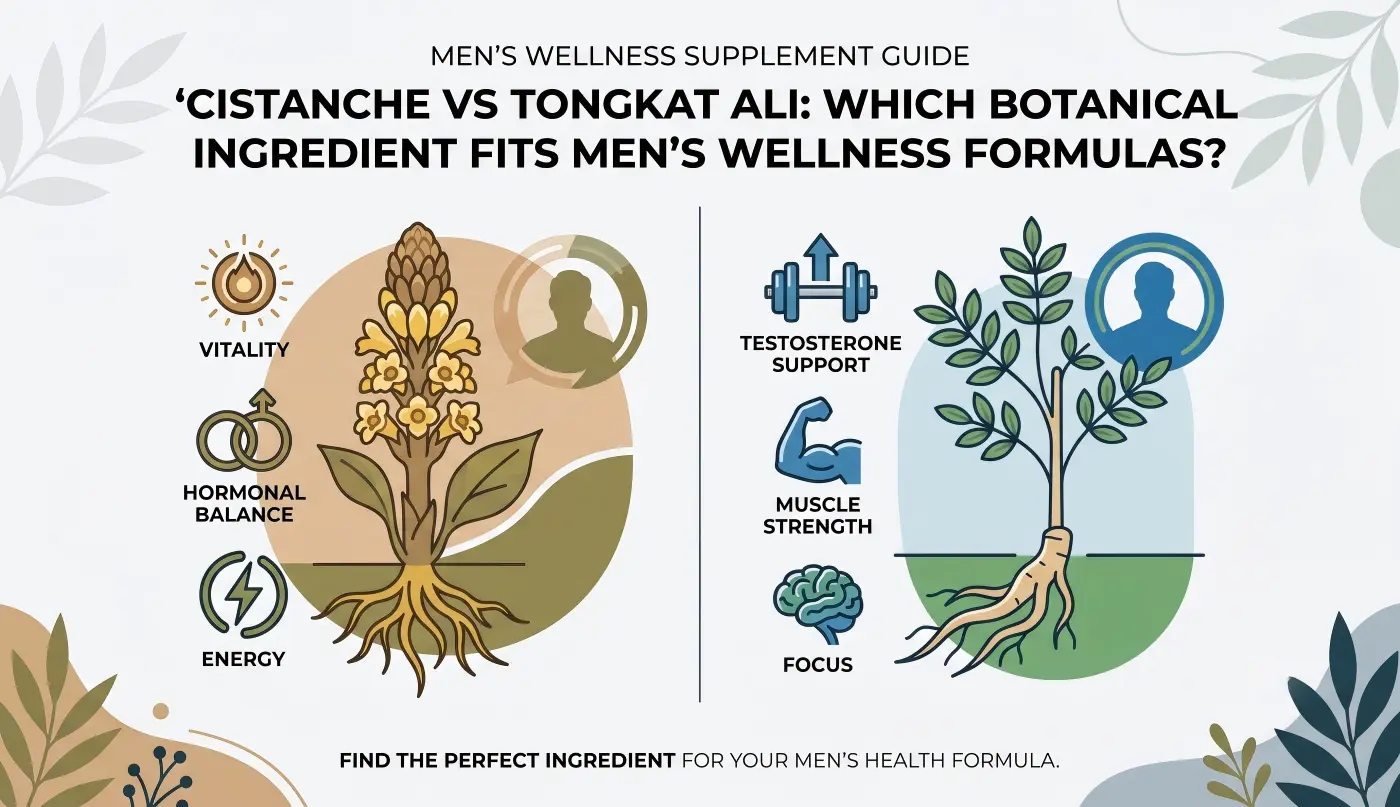
When procurement managers and product developers evaluate botanical ingredients for a men’s wellness line, the question is rarely “which herb is stronger?” The real question is: which botanical aligns with your product positioning, target market, regulatory framework, and formulation architecture? This guide compares Cistanche and Tongkat Ali not as competing “superfoods,” but as distinct raw materials with different botanical identities, marker compounds, standardization logic, and commercial applications.
Quick Answer: Cistanche or Tongkat Ali?
| Formulation Consideration | Cistanche | Tongkat Ali |
|---|---|---|
| Botanical source | Cistanche tubulosa / C. deserticola | Eurycoma longifolia |
| Typical positioning | Traditional men’s vitality / wellness / botanical positioning | Men’s vitality / performance-oriented positioning |
| Key standardization markers | Echinacoside, acteoside / total phenylethanoid glycosides (PhGs) | Eurycomanone and/or specified quassinoids |
| Traditional-use positioning | Strong (TCM, “Desert Ginseng”) | Strong (Southeast Asian traditional medicine) |
| Extract specification | Ratio + marker standardization (HPLC) | Ratio + marker standardization (HPLC) |
| Formula role | Core or complementary botanical | Core or complementary botanical |
| Best formulation fit | Traditional wellness / balanced men’s formulas | Performance-oriented men’s formulas |
| Procurement priority | Species + PhGs + assay method | Species + eurycomanone + assay + authenticity |
| Combination potential | Can be paired depending on formulation objective | Can be paired depending on formulation objective |
Neither ingredient is universally “better.” Cistanche and Tongkat Ali occupy different formulation positions. The optimal choice depends on your product claim strategy, target demographic, dosage form, active-marker specification, and desired market positioning.
Cistanche and Tongkat Ali Are Not Interchangeable Ingredients
Cistanche
Tongkat Ali
Cistanche vs Tongkat Ali: What Should Buyers Specify?
Botanical Identity
The Buyer Specification Matrix
| Requirement | Cistanche | Tongkat Ali |
|---|---|---|
| Botanical species | C. tubulosa or C. deserticola [1] | E. longifolia [3] |
| Plant part | Stem | Root |
| Extract ratio | 5:1–20:1 | 50:1–200:1 |
| Marker compound | Total PhGs / echinacoside / acteoside [2] | Eurycomanone (% HPLC) [3] |
| Identity verification | Botanical + analytical | Botanical + analytical + adulteration screen |
| Contaminants | Heavy metals, pesticides, microbes | Heavy metals, pesticides, microbes |
| Batch consistency | 3-batch COA review | 3-batch COA review |
Why Extract Ratio Alone Is Not Enough
Critical procurement rule: Do not compare two extracts by extract ratio alone. Ratio without marker standardization is an incomplete specification.
Cistanche vs Tongkat Ali for Men’s Wellness Positioning
Cistanche: Traditional Men’s Vitality & Wellness Positioning
- Traditional men’s vitality and “Desert Ginseng” botanical storytelling
- Healthy aging and daily wellness protocols
- Premium traditional herbal formulas with TCM or Kampo heritage
- Balanced, non-stimulant men’s wellness positioning
Tongkat Ali: Performance-Oriented Men’s Wellness Positioning
- Men’s performance and active lifestyle
- Energy-oriented formulas and sports-adjacent positioning
- Stress resilience positioning
Which Ingredient Fits Different Men’s Supplement Concepts?
| Product Concept | Ingredient to Evaluate | Rationale |
|---|---|---|
| Traditional men’s wellness | Cistanche | Strong traditional botanical positioning |
| Performance-oriented concept | Tongkat Ali | Existing research and market positioning |
| General men’s wellness | Either | Depends on specification and formula strategy |
| Premium dual-botanical SKU | Both | Differentiated ingredient architecture |
Formulation principle: Ingredient selection should follow the product concept—not the reverse.
Formulation & Commercial Considerations
How Extract Standardization Affects Product Cost
Cost per kg × inclusion rate × serving size × servings per bottle = botanical cost per bottle
- Capsule count and capsule size
- Serving size per day
- Excipient load
- Packaging
- MOQ
Dosage Form Fit
| Dosage Form | Considerations |
|---|---|
| Capsules | Best fit for standardized extracts requiring precise dosing. Both ingredients suitable. |
| Tablets | Requires compressibility testing; bitter quassinoid profile may need masking for chewable formats. |
| Gummies | Botanical loading, bitterness, and flavor masking are major development constraints. |
| Powders | Solubility, dispersibility, and hygroscopicity require testing. Cistanche PhG extracts may be hygroscopic. |
Should You Use Cistanche and Tongkat Ali Together?
Why Brands May Combine Them
- Different botanical identities: Two distinct species provide formulation narrative depth
- Different marker compounds: PhGs and quassinoids offer separate analytical anchor points
- Positioning differentiation: A dual-botanical SKU stands apart from single-ingredient competitors
What Formulators Need to Check
- Total active load per serving: Can the target dose fit in a two-capsule serving?
- Capsule capacity: High-ratio extracts consume significant volume
- Standardization balance: Does the serving size deliver meaningful amounts of both markers?
- Cost per serving: Dual-botanical formulas increase raw material cost—does the SKU support premium pricing?
Formulation caution: Combining two botanicals does not automatically make a formula better. The combination should have a defined formulation rationale, target dosage, and stability data.
Supplier Qualification Checklist
- Botanical species confirmation (with documentation)
- Plant part verification
- Extract ratio and extraction solvent
- Marker compound specification (HPLC quantification)
- Representative HPLC chromatogram
- 3-batch COAs showing acceptable variation
- Heavy metals testing (ICP-MS, USP <232>/<233> or EU 1881/2006)
- Pesticide residue screening
- Microbiological testing (USP <61>/<62>)
- Residual solvent data (where applicable)
- Stability data under ICH conditions
- Regulatory documentation for target market
From Botanical Selection to Finished Men’s Wellness Supplement
- Select the Botanical — Determine whether Cistanche, Tongkat Ali, or a combination best serves your product concept.
- Lock the Ingredient Specification — Define species, plant part, extract ratio, and marker compound targets. Require supplier COAs with HPLC data.
- Develop the Formula — Align dosage with traditional use ranges and study parameters; match serving size to capsule/tablet/gummy capacity.
- Confirm QC Documentation — Require per-batch COA with assay, heavy metals, microbiology, and stability data.
- Manufacture and Package — Select a contract manufacturer with botanical formulation experience and cGMP certification.
Developing a Cistanche or Tongkat Ali men’s wellness supplement? Contact a Cistanche supplement manufacturer to discuss ingredient selection, extract standardization, and finished product development for your SKU.
FAQ
Is Cistanche better than Tongkat Ali?
Can Cistanche and Tongkat Ali be combined?
Is a higher extract ratio always better?
How should Cistanche extract be standardized?
How should Tongkat Ali extract be standardized?
What should buyers request from an extract supplier?
Can you manufacture private-label Cistanche or Tongkat Ali supplements?
Conclusion
- Cistanche ≠ Tongkat Ali. They are botanically and chemically distinct ingredients.
- Neither is universally better. Each serves different product positioning and market narratives.
- Choose based on positioning + specification + formulation + regulatory requirements. The ingredient should serve the product concept, not the reverse.
Ready to formulate? Contact our team to evaluate Cistanche and Tongkat Ali specifications for your next men’s wellness SKU.