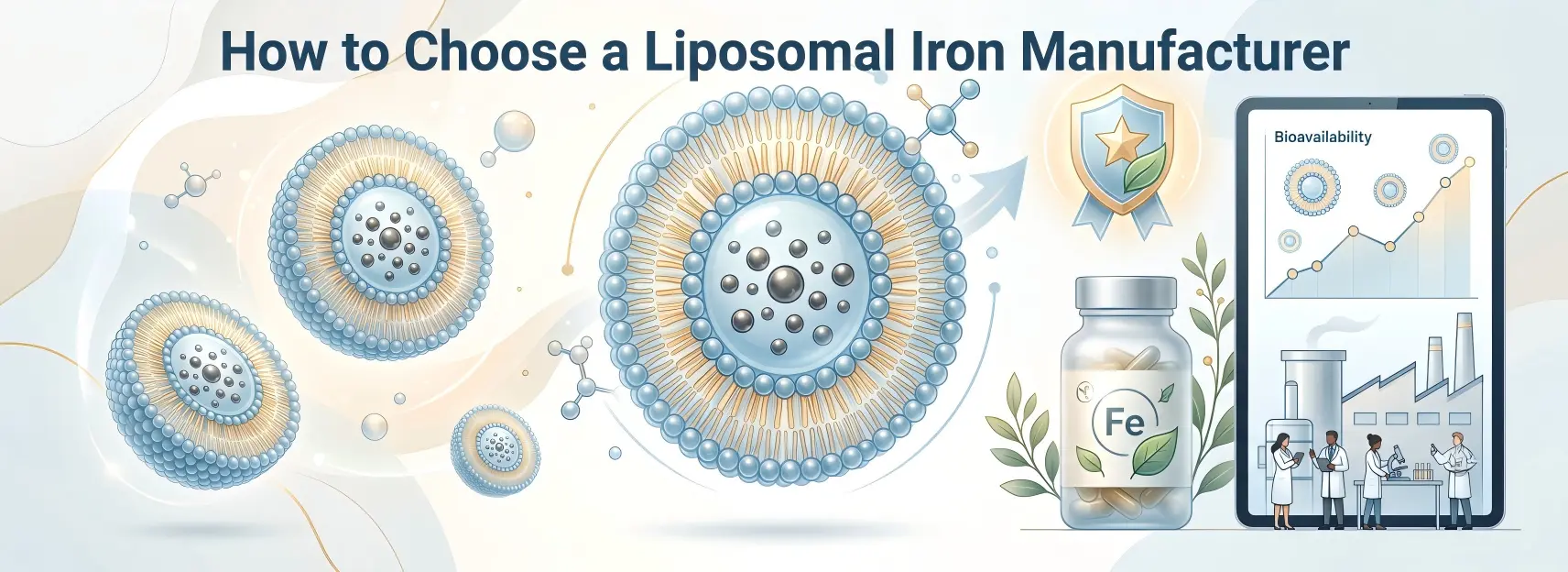
Liposomal iron OEM projects fail when brands buy marketing language instead of a qualification system. This page is a procurement operating manual: how to screen, diligence, pilot, launch, and manage a liposomal iron manufacturer – including kill gates that should stop a bad PO.
Related decision tools:
Which iron form fits your brand | Formulation, dose & format guide | Liposomal iron OEM manufacturing
Supplier Qualification Workflow
Q: What does a real liposomal iron supplier qualification look like?
A: Six phases – not a single COA request.
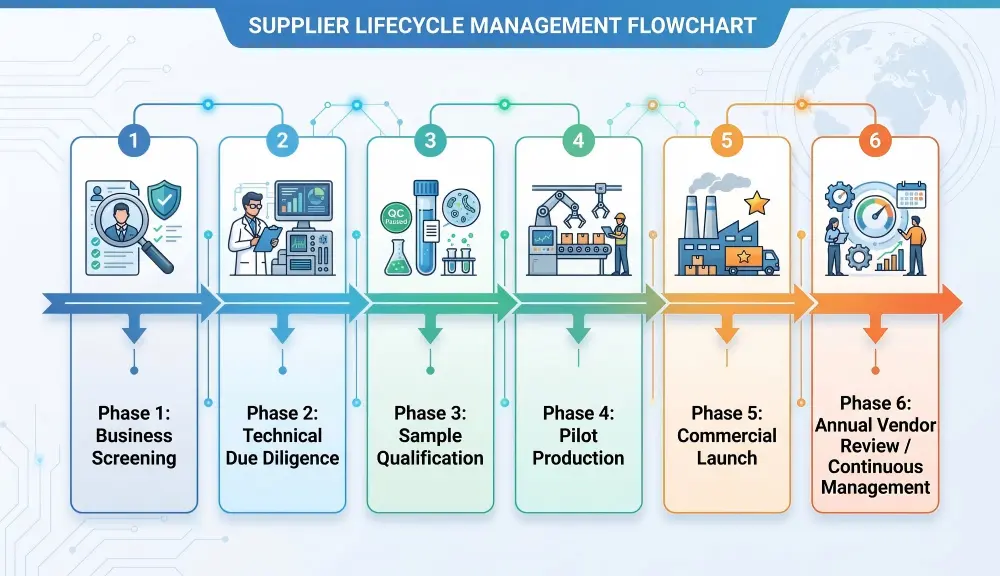
Phase | Buyer objective | Must-pass outputs | Typical fail mode |
|---|---|---|---|
| 1. Business Screening | Can this factory be a long-term partner? | Capacity path, certifications, export experience, NDA willingness | Brochure-only vendor; refuses basic transparency |
| 2. Technical Due Diligence | Is the liposome real and controllable? | Iron identity, PSD/PDI, EE% method, phospholipid class, draft release spec | No EE% method; “nano” with no DLS |
| 3. Sample Qualification | Does the sample match the claim? | Sensory + assay + characterization on your brief | Pretty sample that cannot be repeated |
| 4. Pilot Production | Will lab success survive plant reality? | Pilot batch, retain samples, CQA lock | Bench-only process with no pilot path |
| 5. Commercial Launch | Can we ship compliant finished goods? | Finished COA, CRC/warning support, stability plan, lead time | Artwork/compliance afterthought |
| 6. Annual Review | Will reorders stay consistent? | Multi-lot trends, deviation handling, change notifications | Silent phospholipid or process swaps |
Best practice: Each phase may kill the vendor. Cheap samples that cannot survive pilot are still expensive.
Procurement Decision Tree
Q: How should procurement decide format, iron core, and vendor path?
A: Decide product job first, then chemistry, then factory capability.
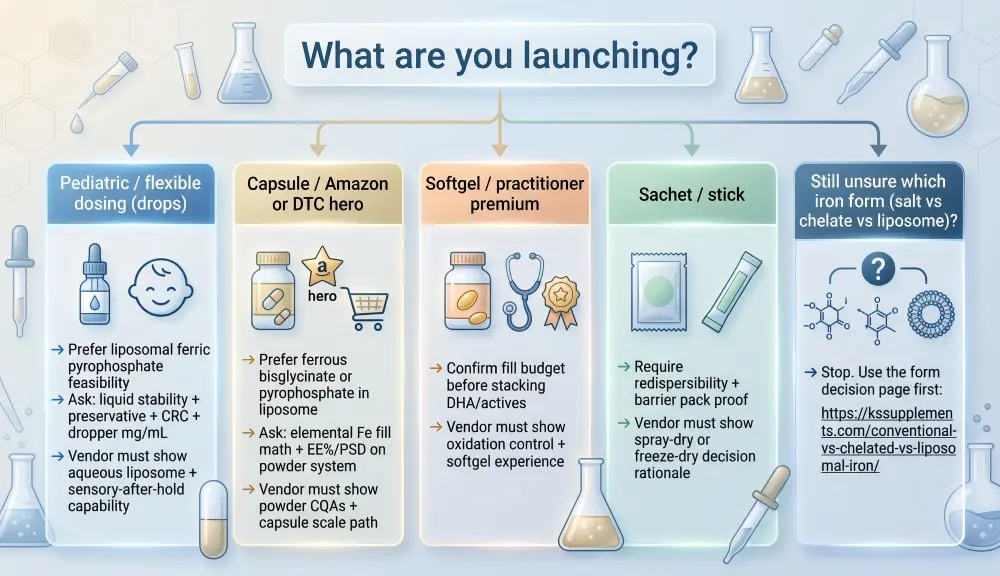
Dose/cofactor/package design worksheet: Liposomal Iron Formulation Guide.
Kill Gates (Reject Before You Waste Pilot Money)
Q: When should we reject a liposomal iron supplier immediately?
A: Use sequential kill gates. Do not negotiate past a Critical fail.
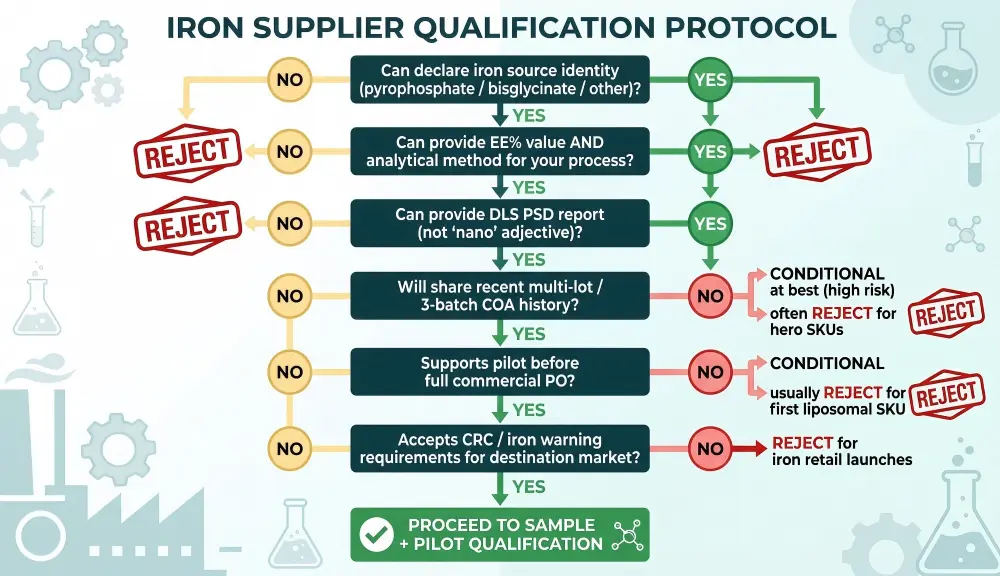
Gate | Pass | Fail action |
|---|---|---|
| Iron source declared | Spec + assay method | Reject |
| EE% method disclosed | Method summary + limit | Reject |
| PSD/DLS available | Batch report + target range | Reject |
| Multi-lot evidence | 3-batch trend | Conditional / reject for premium |
| Pilot path | Defined kg/units | Reject for first SKU |
| Iron packaging literacy | CRC + warning support | Reject for regulated retail |
Vendor Risk Matrix
Supplier behavior | Risk level | Why it matters |
|---|---|---|
| No PSD report | High | Cannot support vesicle-scale claims |
| No EE% method | Critical | “Liposomal” may be lecithin + iron |
| Won’t disclose phospholipid class (soy/sunflower) | Critical | Label, allergen, and clean-label failure |
| Marketing brochure only | High | No audit trail |
| No stability protocol for finished form | Medium-High | Shelf-life and returns risk |
| No pilot support | Medium-High | Scale-up surprises transfer to your brand |
| Quotes in <24h with no formulation review | High | Usually copying a generic SKU, not your brief |
| Says “all liposomes are the same” | Critical | Process ignorance |
| Refuses NDA before sharing real methods | Context-dependent | Protect IP – but opacity after NDA is a red flag |
| Cannot explain free vs encapsulated iron | Critical | Cannot defend EE% or PDP claims |
Commercial Red Flags
Reject or escalate when a supplier:
- Only presents marketing slides
- Provides no analytical reports with the quote
- Quotes within 24 hours without asking format, elemental target, market, or pack
- Claims all liposomal iron is interchangeable
- Skips QA/technical meeting before PO
- Refuses reasonable NDA / transparency after NDA
- Cannot distinguish free iron vs encapsulated iron
- Treats CRC / iron overdose warnings as “optional artwork”
- Offers one COA as proof of process capability
Good vs. Average vs. Marketing Supplier
Question | Good supplier | Average supplier | Marketing supplier |
|---|---|---|---|
| EE% method | Disclosed + used in release logic | Number only / vague method | Missing or invented |
| PSD / DLS | Batch reports + targets | Occasional R&D graph | “Nano” adjective |
| Pilot path | Defined powder/unit pilots | Possible if pushed | “Go straight to 50k” |
| Scale-up control | CPP lock + equivalence checks | Hope-based transfer | Denied as an issue |
| Regulatory / CRC support | Proactive checklist | Reactive | Blank stare |
| Multi-lot history | Shared willingly | Partial | Refused |
| Change control | Written notification rules | Informal | Silent swaps |
| Quote quality | Asks brief questions first | Template price | Instant price, no brief |
Factory Audit Questions (What to Ask On-Site or in Technical Review)
Q: What should QA ask beyond document requests?
A: Ask how the process is controlled – not whether a brochure says “liposomal.”
Process/CPP
- Which critical process parameters (CPPs) most affect liposome particle size?
- What homogenizer pressure/pass strategy is used, and how is it verified?
- What causes batch-to-batch PSD drift in your plant experience?
- Which CQAs are monitored in-process vs only at release?
Analytics
- Walk us through your EE% method and calculation.
- Can a third lab reproduce identity/assay if needed?
- How often is DLS system suitability checked?
Materials/oxidation
- How is phospholipid oxidation prevented (handling, nitrogen, antioxidants, pack)?
- Soy vs sunflower: what changes in process and documentation?
Scale/quality system
- Show a recent OOS/OOT example and disposition.
- How are pilot parameters locked into commercial batch records?
- Who owns deviation communication to the brand customer?
Use the same questions on every shortlisted vendor – including KS Nutripharma.
Manufacturing Change Control (Ask Before It Becomes Your Crisis)
Q: If the factory changes lecithin source or process, what must be revalidated?
A: Material and process changes can move EE%, PSD, taste, and stability. Require written change control.
Change example | Likely impact | Buyer expectation |
|---|---|---|
| Soy lecithin -> sunflower lecithin | EE%/PSD/taste/label claims | Notification + feasibility; often pilot + stability bridge |
| New phospholipid supplier (same class) | Subtle CQA drift | Qualification data + notification |
| New iron core supplier | Assay, impurities, sensory | Full incoming + possibly pilot |
| Homogenizer pressure window change | PSD/PDI/EE% | Re-lock CPP; equivalence evidence |
| Spray-dry -> freeze-dry (or reverse) | Cost, redispersibility, moisture | Treat as new process family |
| Pack film / bottle change | Shelf life | Stability justification |
Ask in RFQ:
- Will you notify us before phospholipid class or key CPP changes?
- Which changes trigger mandatory re-pilot?
- Who approves customer notification?
Supply Chain Risk Assessment
Q: What supply risks should iron + phospholipid programs plan for?
A: Dual-source strategy and lead-time reality matter as much as EE%.
Risk areas | Questions to ask |
|---|---|
| Iron raw material origin | Qualified alternate suppliers? Geographic concentration? |
| Phospholipid supply | Soy vs sunflower dual path? What if soy supply is interrupted? |
| Lead time | Standard vs custom; peak-season buffers? |
| Inventory strategy | Safety stock for hero SKUs? Shared vs dedicated lots? |
| Export documentation | Typical COA/pack turnaround for US/EU/iHerb onboarding? |
| Single-point equipment | Homogenizer / dryer redundancy or recovery plan? |
Best practice: Do not approve a hero liposomal SKU with a single undeclared phospholipid source and no change-notification clause.
Scale-Up Risk: Bench vs. Pilot vs. Commercial
Q: What usually changes from lab sample to commercial batch?
A: Particle size, EE%, taste, viscosity (liquids), and moisture behavior (powders) are the common movers.
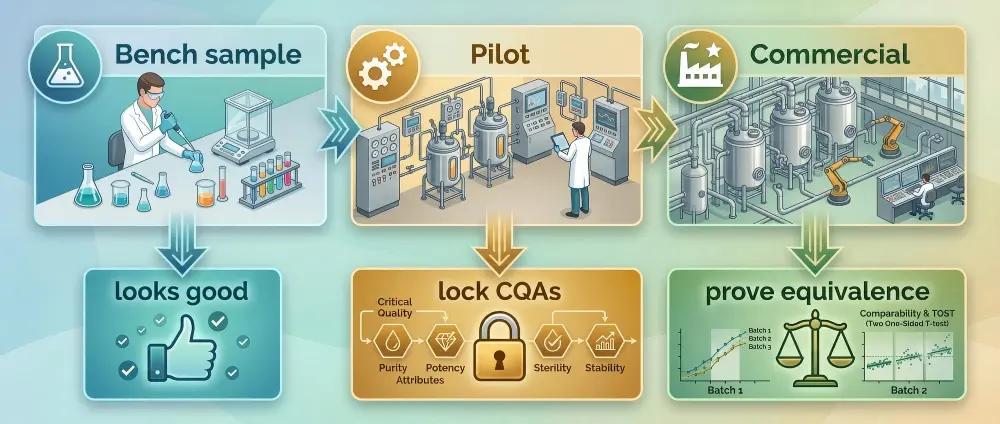
Attribute | Why it drifts at scale | Mitigation |
|---|---|---|
| Particle size / PDI | Shear/pressure/residence time differ | Lock CPP; same DLS method |
| EE% | Free iron rises after drying/scale | Same EE% method at pilot + commercial |
| Taste (liquids) | Oxidation over weeks | Hold tests; antioxidant/pack design |
| Viscosity/separation | Emulsion stress at volume | Liquid-specific pilot |
| Moisture/caking | RH and pack differences | Barrier + process humidity specs |
Do not approve commercial artwork on bench sensory alone.
Procurement Timeline (Typical Planning)
Week (indicative) | Activity | Output |
|---|---|---|
| Week 1 | RFQ + NDA + brief (format, elemental Fe, market, pack) | Comparable quotes |
| Week 2 | Technical review / kill gates | Shortlist or reject |
| Week 3-4 | Samples + characterization review | Pass/fail sample gate |
| Week 5-7 | Pilot batch | CQA lock candidates |
| Week 7-8 | Artwork + CRC/warning + regulatory check | Launch-ready files |
| Week 8-12 | Commercial PO / production (often ~45-60 days after lock for custom liposomal) | Finished goods + COA |
| Launch + | Complaint + multi-lot monitoring | Annual vendor review inputs |
Exact timing varies by format complexity. Align commercial path details on the OEM pillar.
RFQ Template & Vendor Scorecard
RFQ fields to require from every supplier
Field | Your requirement | Supplier response |
|---|---|---|
| Iron source identity | e.g., ferric pyrophosphate / ferrous bisglycinate | |
| Elemental Fe per serving target | ||
| Dosage form + pack (CRC?) | ||
| Destination markets | ||
| Phospholipid class | soy / sunflower / PC% | |
| PSD target + DLS report | ||
| PDI acceptance | ||
| EE% limit + method | ||
| Stability plan (finished form) | ||
| Pilot size / timing | ||
| Commercial MOQ / lead time | ||
| Certifications | ||
| Change-control notification | Yes/No + policy | |
| Score(1-5) |
Scoring weights (copy into Excel)
Criterion | Suggested weight | Notes |
|---|---|---|
| Liposome characterization (EE% method + PSD) | Highest | Critical gate |
| Iron identity clarity | High | |
| Multi-lot consistency | High | |
| Format experience (your format) | High | |
| Stability + packaging literacy (CRC) | High | |
| Pilot flexibility | Medium-High | |
| Change control / supply transparency | Medium-High | |
| Documentation speed | Medium | |
| Price | Medium | Never #1 alone |
| Communication quality | Medium | Predicts deviation handling |
Disqualify immediately if: no EE% method, refuses multi-lot data, cannot declare iron source, or dismisses CRC/warning requirements.
Download Liposomal Iron Supplier RFQ / Scorecard | Request Side-by-Side Vendor Comparison
Why Liposomal Iron OEM Projects Fail
Common failure patterns (anonymized):
- Bought “liposomal,” received lecithin blend – failed retailer PSD/EE% questions.
- Locked bisglycinate softgel story, then needed pediatric drops – taste/cost forced emergency core switch.
- Ignored iron CRC/warning until marketplace rejection – repack write-off.
- Approved liquid flavor on day 0 – metallic notes after oxidation hold.
- Scaled without pilot – PSD widened and EE% dropped at commercial.
How KS Nutripharma Fits This Qualification Manual
Evaluate KS Nutripharma with the same kill gates as any other factory – then compare evidence, not adjectives.
Qualification need | How KS Nutripharma typically supports |
|---|---|
| Characterized liposomal systems | High-pressure homogenization; PSD / PDI / EE% evaluation support; HPLC analytics |
| Format path | Capsules, softgels, liquids/drops, sachets, powders, gummies (feasibility by brief) |
| Pilot before scale | Powder kg-class and finished-unit pilots for commercial readiness |
| Clean-label options | Sunflower phospholipid paths where the formula allows |
| Documentation/export | COA packages, statements, multi-market onboarding support |
| Iron compliance literacy | CRC / warning awareness for destination-market launches |
Start with the product page that matches your job:
Liposomal Iron Supplements OEM / Private Label
If you are still choosing the iron lane (conventional vs chelated vs liposomal):
Brand decision comparison
If you need dose, format, stability, and compatibility design:
Formulation guide
Send acceptance criteria and destination markets – we will respond against your gates, not a generic brochure.
Request Technical Pack + 3-Batch Style History | Schedule Process / Audit Review | Request Pilot Plan
FAQ
What is the single most important question to ask a liposomal iron factory?
Show me your encapsulation-efficiency method and recent particle-size results for the exact process you will use for my SKU.
Is a COA enough?
No. A COA is necessary but not sufficient. Add specifications, method clarity, multi-lot history, and finished-form stability planning.
How do I choose between pyrophosphate and bisglycinate vendors?
Use the decision tree: drops often shortlist pyrophosphate; premium capsules often shortlist bisglycinate. Then compare fill, cost, and CQAs – see also the formulation guide.
Can I start with capsules and add liquids later?
Yes, but qualify liquids as a new risk class (microbiology, oxidation, taste, preservatives). Capsule approval does not transfer.
Should I require sunflower phospholipids?
If clean-label / non-soy is part of the brand promise, specify early and budget for it.
How do I compare two “>=85% EE” quotes?
Only if methods and definitions match.
What is a realistic qualification timeline?
Often RFQ-to-pilot in about 5-7 weeks of active work, then commercial production commonly around 45-60 days after formula lock for custom liposomal programs – format-dependent.
What documents prove a liposome is real?
At minimum: iron identity/assay, DLS PSD, PDI, EE% with method, stability plan; preferably morphology support and oxidation controls.
Does KS Nutripharma manufacture liposomal iron finished supplements?
Yes – OEM/private label paths are outlined on the liposomal iron manufacturing page. Apply the same qualification gates.
What if a supplier refuses pilot?
Treat as high risk for a first liposomal SKU. Pilot is how you discover scale-up drift before ads spend.
References
- NIH ODS. Iron Fact Sheet for Health Professionals. https://ods.od.nih.gov/factsheets/Iron-HealthProfessional/
- U.S. FDA. 21 CFR 101.17(e) iron warning. https://www.ecfr.gov/current/title-21/chapter-I/subchapter-B/part-101/section-101.17
- U.S. CPSC. 16 CFR 1700.14(a)(13) iron special packaging. https://www.ecfr.gov/current/title-16/chapter-II/subchapter-E/part-1700/section-1700.14
- U.S. FDA. 21 CFR Part 111 dietary supplement CGMP. https://www.ecfr.gov/current/title-21/chapter-I/subchapter-B/part-111
- ICH Q1A(R2) Stability Testing. https://www.ich.org/page/quality-guidelines
- Fischer JAJ, et al. Ferrous bisglycinate meta-analysis. Nutrition Reviews. 2023. https://pmc.ncbi.nlm.nih.gov/articles/PMC10331582/