A Technical Buying Guide to Solubility, Stability, Delivery Systems, Procurement, and Formulation Selection
Formulators and buyers searching this topic are rarely asking which word sounds better on a brochure. They are deciding:
Which glabridin form should we procure for this chassis?
Typical decision pressures include whether water-soluble is “better,” whether activity is diluted by carriers, why prices differ so widely, which form is more stable, which is easier to process, which fits essences/emulsions/sprays, whether “water-soluble” means cyclodextrin, whether liposomes outperform inclusion complexes, what documentation suppliers must provide, and which option scales for OEM.
This page is a technical selection and buying guide for cosmetic manufacturers–covering formulation, procurement, regulatory labeling, validation, and commercial risk–not consumer education.
Request Spec Package | Request Water-Soluble Sample | Ask Delivery-System TDS | Book Formulation Review
Quick Answer
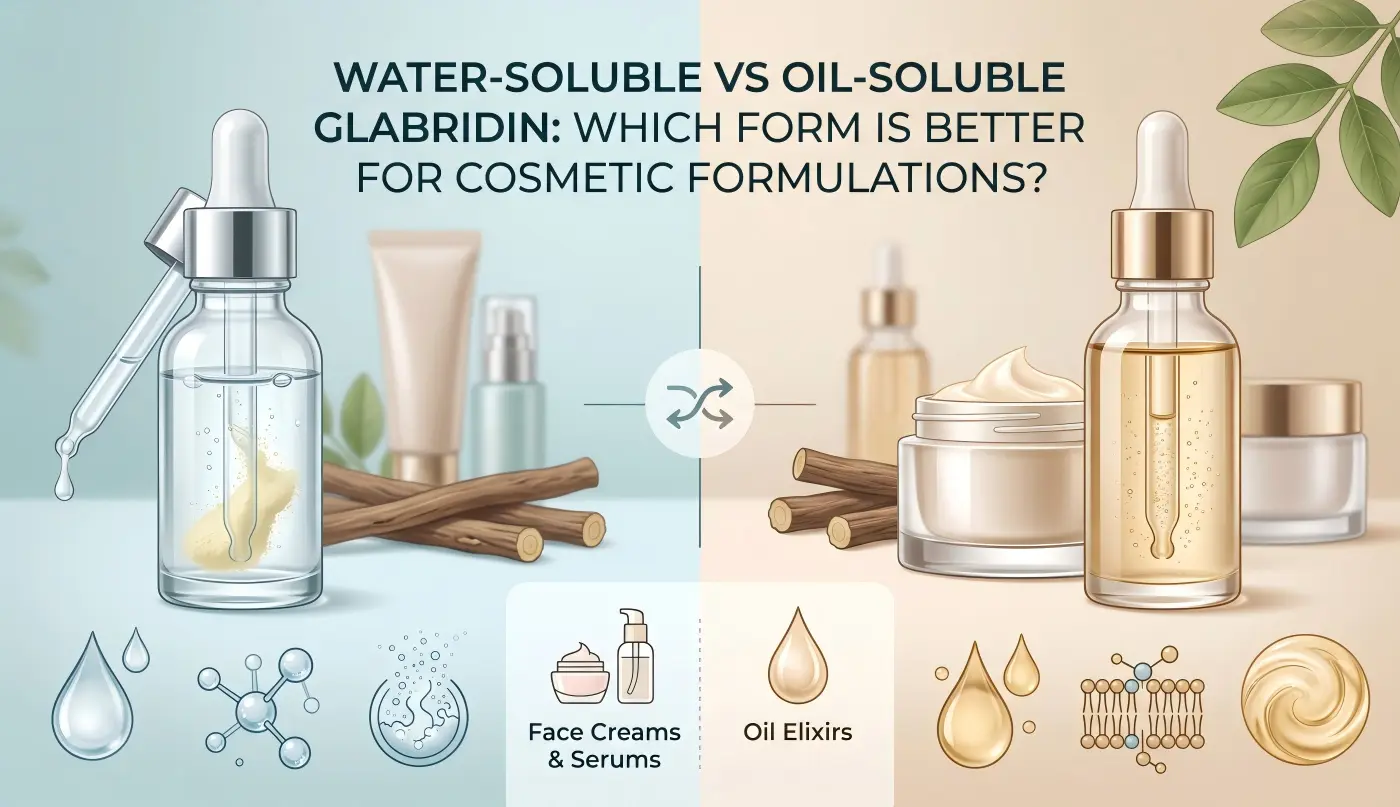
Oil-soluble glabridin is the naturally lipophilic form and remains the preferred choice for emulsions, oils, anhydrous systems, and many cream architectures.
Water-soluble glabridin is typically created through advanced delivery technologies–such as cyclodextrin inclusion complexes, liposomes, nanoemulsions, micelles, polymeric carriers, or broader supramolecular systems–to improve dispersibility in aqueous formulations. That modification improves handling in water. It does not automatically create a stronger intrinsic molecule.
The best choice depends on formulation type, processing conditions, stability requirements, target claims, manufacturing cost, and the exact delivery technology behind the supplier’s SKU.
Which Glabridin Form Should You Choose? (Decision Tree)
Start here
->
Is your chassis primarily water-based (toner, essence, clear serum, mist, gel)?
-> YES
    Need transparent / low-haze appearance?
    -> YES -> Prefer water-soluble technology
        Need premium delivery storytelling + budget?
        -> Cyclodextrin (manufacturability)
        -> Liposome / nanoemulsion (premium sensory + characterization burden)
        -> Micelle / polymeric (clarity / controlled-release projects)
-> NO
    Oil-rich system (cream, lotion, oil, balm, stick)?
    -> YES -> Prefer oil-soluble native glabridin
        Need stronger whitening / high-assay positioning?
        -> 90% / 95% / 98% oil-soluble grades (cost-per-active modeling required)
->
Suspected melasma / medical pigment claims?
-> Stop cosmetic self-positioning; keep cosmetic appearance language only
Buyer rule: Lock the dosage form first, then select the glabridin form. Do not force one hero SKU into every chassis.
Recommendations by Buyer Type
Buyer type | Starting recommendation | Why |
|---|---|---|
| Startup skincare brand | Water-soluble for first aqueous hero | Fewer incorporation failures; faster pilot clarity |
| Large OEM / contract manufacturer | Both oil-soluble and water-soluble SKUs | Chassis diversity across private-label clients |
| Premium luxury brand | Documented liposome/nanoemulsion/advanced inclusion | Story + sensory + analytical pack |
| Whitening cream manufacturer | Oil-soluble (often 90%+) | Emulsion oil-phase familiarity; lower COGS |
| Medical-aesthetic adjacent brand | High-purity oil-soluble or fully validated aqueous delivery | Irritation + claim discipline first |
| Ingredient distributor | Dual catalog with carrier disclosure sheets | Quote fairness across customers |
| Clean / natural-index focused brand | Oil-soluble may simplify some claim builds; verify carrier for water-soluble | ISO 16128 / natural-index strategy is carrier-dependent[7] |
Best Glabridin Form by Product Type
Product Type | Better starting form | One-line rationale |
|---|---|---|
| Brightening serum (clear water) | Water-soluble | Aqueous continuous phase + clarity |
| Anti-aging serum (emulsion-serum) | Either (design-dependent) | Match continuous phase and co-actives |
| Whitening cream | Oil-soluble | Classic oil-phase loading |
| Spot corrector | Often oil-soluble in cream; water-soluble in aqueous gel | Match leave-on texture |
| Eye cream | Oil-soluble common; water-soluble in light gels | Mild chassis + stability |
| Ampoule | Depends on clear water vs oil ampoule | Technology must match fill |
| Sleeping mask | Oil-soluble in cream masks; water-soluble in hydrogel | Matrix polarity |
| Gel cream | Case-by-case | Dual-phase design opportunity |
| Body lotion | Oil-soluble | Cost and emulsion scale |
| Body serum | Water-soluble if watery; oil-soluble if oil serum | Sprayability vs occlusion |
| Sunscreen (adjunct brightening) | Usually oil-soluble in emulsion SPFs | Oil phase + photostability pilots |
| Lip care | Oil-soluble | Anhydrous / wax systems |
| Scalp serum | Water-soluble often easier | Aqueous leave-ons / sprays |
| Facial mist/spray | Water-soluble | Nozzle clog and haze control |
| Sheet/hydrogel mask | Water-soluble | Hydrated matrix |
| Freeze-dried essence | Documented carrier system required | Reconstitution is the project |
At-a-Glance Comparison
Features | Water-Soluble Glabridin | Oil-Soluble Glabridin |
|---|---|---|
| Natural native form | No (delivery-modified) | Yes |
| Water compatibility | Excellent (technology-dependent) | Poor |
| Oil compatibility | Moderate | Excellent |
| Ease of aqueous formulation | High | Moderate to low |
| Stability | Depends on carrier/process | Often robust in oil phases when protected |
| Skin delivery narrative | Technology-dependent | Strong lipophilic vehicle fit |
| Typical cost | Higher | Lower |
| Best Starting Applications | Toners, essences, water serums, mists, gels | Creams, oils, balms, anhydrous treatments |
What Is Oil-Soluble Glabridin?
Oil-soluble (native / standard) glabridin is the prenylated isoflavan isolated or enriched from Glycyrrhiza glabra root (CAS 59870-68-7, C20H20O4). It is a lipophilic flavonoid marker sold as HPLC-standardized powders.[1][2]
Commercial patterns
Topic | Typical details |
|---|---|
| Identity | Glabridin, CAS 59870-68-7 |
| Common assay grades | 10% / 90% / 95% / 98% |
| Appearance | Brown (typical 10%) to white (90%+) |
| Default solubility behavior | Preferential oil / ester / lipophilic solvent compatibility |
| Catalog role | Baseline cosmetic and nutraceutical raw material |
Grade economics and cost-per-active modeling: Glabridin 10% vs 90% vs 98%
What Is Water-Soluble Glabridin?
Water-soluble glabridin is not a different natural molecule discovered in the plant. In commerce, it usually means:
Native lipophilic glabridin + a delivery/solubilization technology
Common technology families:
- Cyclodextrin inclusion complexes
- Liposomes
- Nanoemulsions
- Micellar systems
- Supramolecular host-guest systems
- Polymer encapsulation / polymeric micelles
- Phytosomes/phospholipid complexes
- Solid dispersions
- Microcapsules
- SLN / NLC (solid/nanostructured lipid carriers)
- Self-emulsifying systems
- Hydrogel or silica carriers (project-specific)
- Related carrier blends disclosed (or not disclosed) on the TDS
Critical procurement warning: Two SKUs both labeled “water-soluble glabridin 10%” can differ in carrier chemistry, loading efficiency, particle size, release profile, odor, regulatory labeling, and real matrix stability. Always demand the delivery-system disclosure, not only the glabridin assay percentage.
Misconception: “Water-Soluble” Is Not One Ingredient
Water-soluble glabridin
  != Cyclodextrin inclusion
  != Liposome
  != Nanoemulsion
  != "Supramolecular" (marketing umbrella)
  != Instantly molecularly dissolved free glabridin in pure water
Treat “water-soluble” as a commercial category, then identify the actual technology class on the TDS before comparing price or performance.
Why Does Solubility Matter for Skin Delivery?
Solubility choice is not only a manufacturing convenience. It shapes how the active partitions and releases in a cosmetic matrix.
Concept | Why formulators care |
|---|---|
| LogP / oil-water partition | Native glabridin prefers lipophilic environments; aqueous systems need carriers |
| Diffusion through stratum corneum | Vehicle polarity and thermodynamic activity often matter more than brochure adjectives |
| Release kinetics | Inclusion complexes, liposomes, and nanoemulsions release differently |
| Thermodynamic activity | Oversaturation, crystallization, and incomplete dissolution kill real performance |
| Finished-product contact | Clear serum vs cream changes dose delivery to skin surface |
Mechanistic interest in glabridin’s melanogenesis-related research does not equal proven superiority of any commercial delivery SKU.[3] Validate in your chassis.
Why Is Native Glabridin Oil-Soluble?
Chemical structure
Glabridin’s scaffold combines phenolic hydroxyls with a largely hydrophobic prenylated isoflavan framework. The net polarity profile favors partitioning into lipophilic environments rather than free aqueous dissolution.[1][2]
Partition behavior
In practical formulation language, native glabridin behaves as a high-LogP / lipophilic active: it prefers oil phases, esters, and selected glycols over water. Forcing it into clear aqueous systems without a carrier typically causes haze, sedimentation, or incomplete incorporation.
Solubility profile (directional)
Medium | Native oil-soluble Glabridin | Water-soluble (delivery-modified) grades |
|---|---|---|
| Water | Poor | Designed to improve dispersibility |
| Alcohols/selected glycols (e.g., PG) | Often workable wetting / pre-dissolve aids | Technology-dependent |
| Cosmetic esters/triglycerides | Generally favorable | May be unnecessary or suboptimal |
| Anhydrous oils/balms | Strong fit | Often the wrong default |
Process tips for both families: Glabridin Formulation Guide
How Water-Soluble Glabridin Is Produced (and Related Alternatives)
Cyclodextrin inclusion complex
What it is: Host-guest inclusion (often beta- or modified cyclodextrins) hosting lipophilic glabridin.
Advantages: Industrially mature; improves aqueous handling; analytically familiar.
Limits: Carrier mass dilutes “pure active” story; load limits; do not overstate free-dissolved status.
Best fit: Essences, gels, water serums, some sprays.
Liposome encapsulation
Advantages: Premium delivery narrative; flexible bilayer design.
Limits: Cost; physical stability; scale-up sensitivity; characterization burden.
Best fit: High-end serums/ampoules.
Nanoemulsion
Advantages: Fine droplet size, elegant skin feel, aqueous-compatible oil delivery.
Limits: Emulsifier selection, Ostwald ripening, process energy.
Best fit: Light lotions, essence-emulsion hybrids.
Micellar technology
Useful for transparent or translucent aqueous systems when surfactant design is robust. Watch irritation and preservative interactions.
Supramolecular technology
Commercial language for engineered non-covalent assemblies. Treat as a documented technology class, not a synonym for “stronger glabridin.”
Polymeric delivery/solid dispersion/microcapsule
Can improve handling and controlled-release narratives. Demand polymer/wall identity for labeling and safety assessment.
Phytosome/phospholipid complex
Often positioned for botanical actives with phospholipid affinity stories. Require disclosure and matrix pilots.
SLN/NLC and self-emulsifying systems
Useful when solid-lipid structuring or spontaneous emulsification fits the chassis. Physical stability rules differ from simple inclusion complexes.
Hydrogel/silica carriers
Project-specific options for powders, masks, or controlled deposition. Confirm residual carrier and sensory impact.
Delivery Technology Comparison (Typical Ranges)
Ranges below are directional industrial starting points for buyer conversations–not guarantees for any specific supplier lot. Always use the supplier’s DLS/ EE/stability pack for the exact SKU.
Technology | Typical particle/droplet size | Typical entrapment/loading discussion | Typical PDI target (when applicable) | Cost | Industrial maturity |
|---|---|---|---|---|---|
| Cyclodextrin inclusion | Molecular inclusion (not always “nano”) | Loading limited by host capacity; assay on powder still required | N/A or method-specific | Mid | High |
| Liposomes | Often ~80-200 nm (SKU-dependent) | EE% often discussed in ~60-90% project ranges | Often <0.3 when well-controlled | High | Mid-high |
| Nanoemulsion | Often ~50-200 nm droplets | Oil-phase payload design | Often <0.3 | Mid-high | High |
| Micelles | Typically smaller colloidal scale | Surfactant/micelle loading limits | Method-specific | Mid | High |
| SLN / NLC | Often submicron; process-dependent | Lipid matrix loading limits | Method-specific | High | Mid |
| Polymeric micelles | Project-specific | Polymer-dependent | Method-specific | High | Mid |
Buyer rule: Score the technology + TDS + stability pack, not the marketing adjective “water-soluble.”
Why Water-Soluble Prices Differ So Widely
Cost drivers | What changes the quote |
|---|---|
| Carrier chemistry | Cyclodextrin type vs phospholipid vs polymer |
| Loading/inclusion efficiency | Lower payload = higher cost per mg active |
| Assayed glabridin purity inside the complex | 10% water-soluble is not equal across carriers |
| Process yield and scale | Lab vs industrial encapsulation |
| Analytical package | PSD, EE%, residual solvents, microbiology |
| Customization | Tailored loading, odor masking, spray-dried forms |
Compare cost per mg glabridin delivered into the finished formula, not drum price alone.
Common Marketing Claims Explained
Claim language | Better technical reading |
|---|---|
| Nano | Ask for PSD method, mean size, PDI, and stability–not adjective-only |
| Supramolecular | Ask which host-guest / assembly chemistry is actually used |
| Water dispersible | May wet/disperse without true molecular solubility |
| Instant soluble | Method- and concentration-dependent; demand test protocol |
| Fully soluble | Rarely absolute; define solvent, %, temperature, time, clarity criteria |
| High penetration | Requires appropriate evidence; do not accept brochure-only superiority |
Formulation Performance Comparison
Property | Water-Soluble | Oil-Soluble |
|---|---|---|
| Aqueous solubility/dispersibility | Excellent | Poor |
| Oil-phase incorporation | Moderate | Excellent |
| Processing flexibility in water bases | Excellent | Moderate to low |
| Typical oxidation management need | High (carrier-dependent) | High |
| Heat process tolerance | Validate (carrier limits) | Often good in oils if controlled |
| Cost efficiency | Moderate | Excellent |
| Skin-delivery claim defensibility | Technology-dependent | Vehicle-dependent |
Does Water-Soluble Glabridin Work Better?
Not necessarily.
Separate five different questions buyers often collapse into one:
Question | Better framing |
|---|---|
| Intrinsic molecular activity | Same core marker if assay identity is true glabridin |
| Delivery efficiency | Depends on carrier, release, and chassis |
| “Bioavailability” | Do not claim without appropriate evidence |
| Skin penetration | Highly vehicle- and method-dependent |
| Finished-product performance | Stability + aesthetics + consumer tolerance often decide winners |
A poorly stabilized water-soluble grade in a clear mist can underperform a well-built oil-soluble cream with correct emulsification and packaging.
Stability Comparison
Heat/light/oxidation/pH/storage
Map temperature x time for hot processes. Protect both forms from light and oxygen. Validate finished pH windows–especially acidic vitamin C chassis for aqueous grades. Carrier hydration, water activity, and preservative quality matter more for water-soluble SKUs.
Stability program design principles can be adapted from ICH Q1A(R2) thinking for accelerated and real-time study structure; this is guidance for disciplined testing, not an automatic legal mandate for every cosmetic SKU.[4]
Recommended Stability Validation Protocols
Use this as an OEM/R&D starting checklist. Adapt to local SOP and pack.
Test | Typical purpose | Notes for glabridin forms |
|---|---|---|
| 40C accelerated | Early physical + assay trend | Watch carrier collapse / color/odor |
| Real-time ambient | Label shelf-life support | Keep pack-identical samples |
| Freeze-thaw cycles | Physical robustness | Critical for water-soluble clarity systems |
| UV / light exposure | Photostability | Opaque vs clear pack comparison |
| High humidity (e.g., 75% RH) | Hygroscopic powder/pack risk | Especially water-soluble bulk powders |
| Centrifuge stress | Early emulsion/dispersion failure | Sedimentation / creaming signals |
| Assay (HPLC) over time | Active retention | Method must fit complex matrices |
| Appearance/odor/pH/viscosity | Consumer-relevant failure modes | Log every pull point |
| Micro challenge / preservative efficacy | Aqueous system safety | Required for many leave-on waters |
Pass language tip: Define acceptance criteria before the pilot (haze, assay drop %, viscosity window)–do not decide after seeing the data.
Compatibility Ranking with Common Actives
Directional starting matrix only. Always confirm in the finished formula.
Ingredients/system | Water-Soluble Glabridin | Oil-Soluble Glabridin |
|---|---|---|
| Vitamin C (aqueous) | Good to moderate (validate redox / pH) | Moderate (phase strategy needed) |
| Niacinamide | Excellent | Good |
| Tranexamic acid (TXA) | Good (aqueous chassis) | Moderate |
| Alpha-arbutin | Good | Moderate |
| Hexylresorcinol / 4-butylresorcinol | Case-by-case | Often good in oil/emulsion systems |
| Azelaic acid | Validate (pH/solubility) | Validate in emulsion design |
| Retinol | Moderate (irritation stack risk) | Good in oil systems with care |
| Bakuchiol | Moderate | Good |
| AHA / BHA / PHA | Validate (pH + barrier stress) | Validate |
| Panthenol/Allantoin | Excellent | Good |
| Centella/madecassoside | Good | Moderate |
| EGCG/resveratrol | Validate oxidation | Validate oil-phase oxidation |
| CoQ10 / vitamin E | Moderate | Excellent |
| Ferulic acid | Validate | Good in antioxidant oil/serum designs |
| Ceramides | Moderate | Excellent |
| Peptides | Good | Good (phase design) |
| Hyaluronic acid | Excellent | Poor as co-solute in water |
| Plant oils/esters | Moderate | Excellent |
| Typical preservative systems | Validate each system | Validate each system |
EU cosmetic ingredient orientation for labeling discussions: CosIng.[6] Safety assessment portals such as CIR remain useful for related cosmetic ingredients and carriers.[5]
Can Water-Soluble and Oil-Soluble Glabridin Be Used Together?
Yes–when the design is intentional.
Dual-use scenario | Practical approach | Advantages | Limitations |
|---|---|---|---|
| O/W emulsion | Oil-soluble in oil phase + water-soluble in water phase | Dual-phase loading; texture flexibility | Higher BOM complexity; must prove no crystallization / haze |
| Encapsulation strategy | One form as hero; second as support | Story + performance options | Cost stacking; claim confusion risk |
| Processing sequence | Add heat-labile water-soluble after cool-down; oil-soluble with oil phase | Protects carriers | Requires disciplined batch cards |
| Dual-chamber / kit systems | Separate SKUs under one brand story | Cleaner stability per chassis | Higher packaging cost |
Do not blend the two powders “to average solubility.” Control assay contribution from each grade and validate the finished product.
Manufacturing Considerations
Topic | Oil-soluble focus | Water-soluble focus |
|---|---|---|
| Heating | Pre-dissolve in oil esters; control peak T x time | Respect carrier thermal limits |
| Homogenization | Emulsion droplet design | Avoid destructive shear if liposomes/nano structures are shear-labile |
| Mixing sequence | Oil-phase addition before/during emulsification | Usually water-phase incorporation after cool-down if heat-labile |
| Particle size | Emulsion droplet specs | DLS / PDI for nano / liposome SKUs |
| Carrier compatibility | Emulsifier HLB / polarity | Cyclodextrin/polymer / phospholipid identity |
Packaging Recommendations
Risk | Practical pack response |
|---|---|
| Oxygen | Airless pumps; minimized headspace; nitrogen flush where justified |
| Light | Amber/opaque/secondary carton |
| Moisture (especially hygroscopic water-soluble powders in bulk) | Barrier packs for raw material and finished goods |
| Consumer serum oxidation | Airless + opaque is a strong default |
Cost Comparison and Hidden Costs Beyond Raw Material Price
Cost drivers | Oil-soluble | Water-soluble |
|---|---|---|
| Raw material price/kg | Lower | Higher (technology premium) |
| Cost per mg glabridin active | Model from assay | Model from assay and payload/inclusion efficiency |
| Manufacturing complexity | Classic emulsion know-how | Carrier-specific process control |
| Scalability | Excellent for standard powders | Excellent only if technology is industrially mature |
Hidden costs procurement should model
Hidden cost | How it shows up |
|---|---|
| Failed batches/sedimentation/haze | Rework, scrap, delayed launch |
| Extra emulsifier/solubilizer/preservative | Formula cost creep |
| Pilot validation and repeated QC | Lab hours and outside testing |
| Packaging upgrades (airless/opaque) | Unit COGS increase |
| Customer returns/complaints | Brand damage beyond RM price |
| Dual-grade inventory | Working capital for OEM plants |
Procurement should compare finished-formula cost and risk, not drum price alone.
MOQ, Lead Time, and Supply Pattern (Directional)
Form | Typical MOQ pattern | Lead time pattern | Customization |
|---|---|---|---|
| Oil-soluble standard grades | Often broader availability; lower specialty MOQ | Usually shorter for catalog grades | Assay grade selection (10/90/95/98) |
| Water-soluble / delivery grades | Often higher specialty MOQ | Often longer; process-dependent | Carrier, loading, spray-dried options |
Confirm live MOQ and lead time on RFQ–do not treat this table as a quotation.
How to Compare Supplier Quotations
Use one scorecard for every quote:
Comparison field | Supplier A | Supplier B | Supplier C |
|---|---|---|---|
| Declared form (oil/water) | |||
| Assay % (HPLC) + method | |||
| Carrier/technology disclosure | |||
| Loading / EE% / inclusion data | |||
| PSD / PDI (if nano/liposome) | |||
| Residual solvents | |||
| Heavy metals/micro | |||
| COA + TDS + SDS completeness | |||
| Stability summary in relevant chassis | |||
| MOQ / lead time / Incoterms | |||
| Price/kg | |||
| Modeled cost per mg active in formula | |||
| Dual-lot consistency evidence |
Supplier diligence playbook: How to Choose a Glabridin Supplier
Sample Evaluation Checklist
Before approving a commercial grade:
Pilot the commercial grade you will scale–not a “lab show” grade.
Regulatory and INCI Considerations by Market
Orientation only–not legal advice. Verify before launch.
Topic | Planning reminder |
|---|---|
| INCI/labeling | Glabridin identity plus any declarable carriers/processing aids as required by market rules |
| Carrier Declaration | Cyclodextrins, phospholipids, polymers, and solvents may need explicit listing |
| EU | Cosmetic Regulation + CosIng orientation; SCCS opinions when relevant to substances/carriers[6][8] |
| United States | Cosmetic vs drug claim line; truthful labeling |
| China / Japan / ASEAN | Country notification/ingredient inventories and claim pathways differ–confirm locally |
| ISO 16128 Natural Index | Carrier choice can change natural/organic index strategy[7] |
| Vegan / Halal | Carriers and processing aids can block claims even if glabridin itself seems acceptable |
| COSMOS/natural-leaning schemes | Water-soluble carriers are often the limiting factor–review early |
Anonymous OEM Validation Example
Stage | What happened |
|---|---|
| Customer goal | Premium clear brightening serum |
| Problem | Native oil-soluble trials showed haze and sedimentation in water chassis |
| Solution | Switch to documented cyclodextrin water-soluble grade + airless opaque pack |
| Validation | Freeze-thaw + 40C accelerated + assay pulls |
| Results | Prototype passed 3-month accelerated physical criteria under internal SOP; launched with route-specific cosmetic claims |
This is a pattern example for education–not a guarantee of identical results in every matrix.
Static Recommendation Path (for Sales/ R&D Intake)
Tell us:
Product type
-> Texture goal (clear water / emulsion / anhydrous)
-> Transparency need
-> Target market / claim language
-> Budget band
->
We recommend:
Form (oil vs water) + technology class + assay grade + pilot package
Common Mistakes When Selecting Glabridin
- Assuming water-soluble is always more effective
- Ignoring which carrier technology is actually in the SKU
- Overheating either form during process
- Choosing emulsifiers that fight polarity / HLB needs
- Ignoring pH windows in acidic aqueous serums
- Using clear PET for oxygen- and light-sensitive actives
- Comparing only “% glabridin” without delivery-system evaluation
- Substituting water-soluble and oil-soluble grades as if BOM-identical
- Skipping sedimentation / freeze-thaw / light-exposure pilots
- Buying on price/kg without cost-per-active and reject-risk modeling
Procurement Checklist for OEM Buyers
Glossary
Term | Plain meaning |
|---|---|
| LogP | Oil-water partition tendency; higher usually means more lipophilic |
| PDI | Polydispersity index; lower often means tighter size distribution |
| PSD | Particle size distribution |
| Entrapment efficiency (EE%) | How much active is associated with/inside the carrier system in that method |
| Inclusion efficiency | How effectively a host (e.g., cyclodextrin) hosts the guest active |
| Carrier | Excipient systems enabling dispersibility/delivery |
| Encapsulation | Active enclosed or associated with a delivery structure |
| Hydrophilic | Water-preferring |
| Lipophilic | Oil-preferring |
| Water dispersible | Can suspend/disperse in water without necessarily being molecularly dissolved |
Frequently Asked Questions
Is water-soluble glabridin more effective?
Not automatically. It is more workable in water systems. Efficacy depends on formula, dose, release, and study design.
Is oil-soluble glabridin “natural”?
It is the native lipophilic marker form. Commercial grades are still purified/standardized.
Why is water-soluble glabridin more expensive?
You pay for delivery technology, processing, characterization, and often lower payload efficiency–not for a magically stronger molecule.
Does cyclodextrin reduce efficacy?
It can change release kinetics. It does not mean the glabridin marker is fake. Validate performance in your chassis.
Which form penetrates skin better?
Neither wins universally. Penetration is vehicle-, dose-, and method-dependent. Avoid unqualified superiority claims.
Which is more stable?
Oil-soluble grades are often robust in protected oil phases. Water-soluble stability depends heavily on carrier and pack. Compare data, not adjectives.
Can oil-soluble glabridin be used in serums?
Yes in emulsion-serums or oil serums. Clear water serums usually need water-soluble technology.
Can water-soluble glabridin be used in creams?
Yes, typically in the water phase, with emulsification and stability checks.
Is liposomal glabridin better than cyclodextrin glabridin?
Different tools. Liposomes may win premium sensory/story budgets; cyclodextrin often wins manufacturability and cost discipline.
What pH is best?
There is no single universal pH. Validate in your finished window, especially with acids and reactive antioxidants.
Which is suitable for sensitive skin?
Either, if the chassis is mild. Irritation often comes from co-actives, fragrance, or acids–not only glabridin form.
Which is easier to manufacture at OEM scale?
For water bases, water-soluble grades usually reduce incorporation failures. For classic creams, oil-soluble remains straightforward.
Which is best for OEM private label?
Match form to chassis first. Do not force one hero SKU into every format.
How should each form be stored?
Cool, dry, light-protected, tightly sealed. Water-soluble powders may need stricter humidity control–follow TDS.
Can the two forms be combined?
Yes in dual-phase designs, with clear BOM control and stability proof. Do not blend blindly.
Is every water-soluble grade a cyclodextrin complex?
No. Ask for technology disclosure.
Does higher assay (98%) make oil-soluble water-compatible?
No. Higher purity remains lipophilic unless delivery-modified.
Should sprays ever use native oil-soluble powder?
Only with a validated solubilization system. Default to water-soluble technology.
How do I compare two water-soluble quotes fairly?
Compare assay, carrier identity, load efficiency, PSD, stability pack, and cost per mg active in the finished formula.
Which is better for Korean skincare textures?
Often water-soluble for essences, gels, and watery serums; oil-soluble still dominates many cream emulsions.
Which is better for Japanese cosmetics development?
Depends on chassis and claim pathway. Clear aqueous leave-ons often favor documented water-soluble grades; always confirm local labeling.
Can both forms support ISO 16128 strategies?
Possibly–carrier choice frequently decides the index outcome. Review early.[7]
Can both forms be COSMOS compatible?
Not automatically. Water-soluble carriers are common blockers; verify scheme rules before sampling.
Can water-soluble glabridin replace propylene glycol as a solvent?
No. It is an active delivery system, not a general-purpose solvent replacement.
Can glabridin be spray dried?
Some water-soluble / carrier systems are offered as spray-dried powders. Confirm process history and reconstitution behavior.
Does the carrier affect INCI?
Often yes. Declare required carrier components per market rules.
Can I customize loading?
Many specialty suppliers can discuss custom loading–expect MOQ and lead-time impact.
Can I request carrier-free water solubility?
True carrier-free aqueous molecular solubility of native glabridin is not a realistic default. Demand chemistry disclosure for any “solvent-only” claim.
What documentation should suppliers provide?
COA, TDS, SDS, assay method summary, carrier disclosure, and–for advanced delivery–PSD/PDI, loading/EE data, and stability summaries.
Key Takeaways
Selection criteria | Recommended form |
|---|---|
| Traditional cream emulsions | Oil-soluble glabridin |
| Water-based serums and essences | Water-soluble glabridin |
| Budget-friendly formulations | Oil-soluble glabridin |
| High-end aqueous cosmetic positioning | Water-soluble glabridin |
| Simplified aqueous manufacturing | Water-soluble glabridin |
| Maximum oil-system active loading | Oil-soluble high-assay grades |
| Sprays/mists/clear gels | Water-soluble glabridin |
| Anhydrous balms/facial oils | Oil-soluble glabridin |
References
- National Library of Medicine / NCBI. PubChem Compound Summary for CID 124052, Glabridin. https://pubchem.ncbi.nlm.nih.gov/compound/124052
- Simmler C, Pauli GF, Chen SN. Phytochemistry and Biological Properties of Glabridin. Planta Med. 2013. https://pmc.ncbi.nlm.nih.gov/articles/PMC3795865/
- Yokota T, et al. The inhibitory effect of glabridin from licorice extracts on melanogenesis and inflammation. Pigment Cell Res. 1998. https://pubmed.ncbi.nlm.nih.gov/9870547/
- International Council for Harmonisation (ICH). Q1A(R2) Stability Testing of New Drug Substances and Products. https://database.ich.org/sites/default/files/Q1A%28R2%29%20Guideline.pdf
- Cosmetic Ingredient Review (CIR). Ingredient safety assessment portal. https://www.cir-safety.org/
- European Commission CosIng database (ingredient regulatory orientation for EU cosmetics).
- International Organization for Standardization. ISO 16128-1:2016 Guidelines on technical definitions and criteria for natural and organic cosmetic ingredients and products — Part 1: Definitions for ingredients. https://www.iso.org/standard/62503.html
- European Commission. Scientific Committee on Consumer Safety (SCCS) opinions portal.
https://health.ec.europa.eu/scientific-committees/scientific-committee-consumer-safety-sccs_en
Editorial note: Delivery-technology literature is broad. Require supplier-specific validation for the exact SKU you will scale. Do not generalize one cyclodextrin paper to every “water-soluble” quote.
Related Resources
- Glabridin Ingredient Manufacturer
- Glabridin Formulation Guide
- Glabridin 10% vs 90% vs 98%
- How to Choose a Glabridin Supplier
- Glabridin vs Glycyrrhizin
- Glabridin vs Hydroquinone
- Beauty Supplements