- Category: Ingredient Sourcing & Formulation Guidance
- Audience: Supplement Brands, Procurement Teams, Product Developers
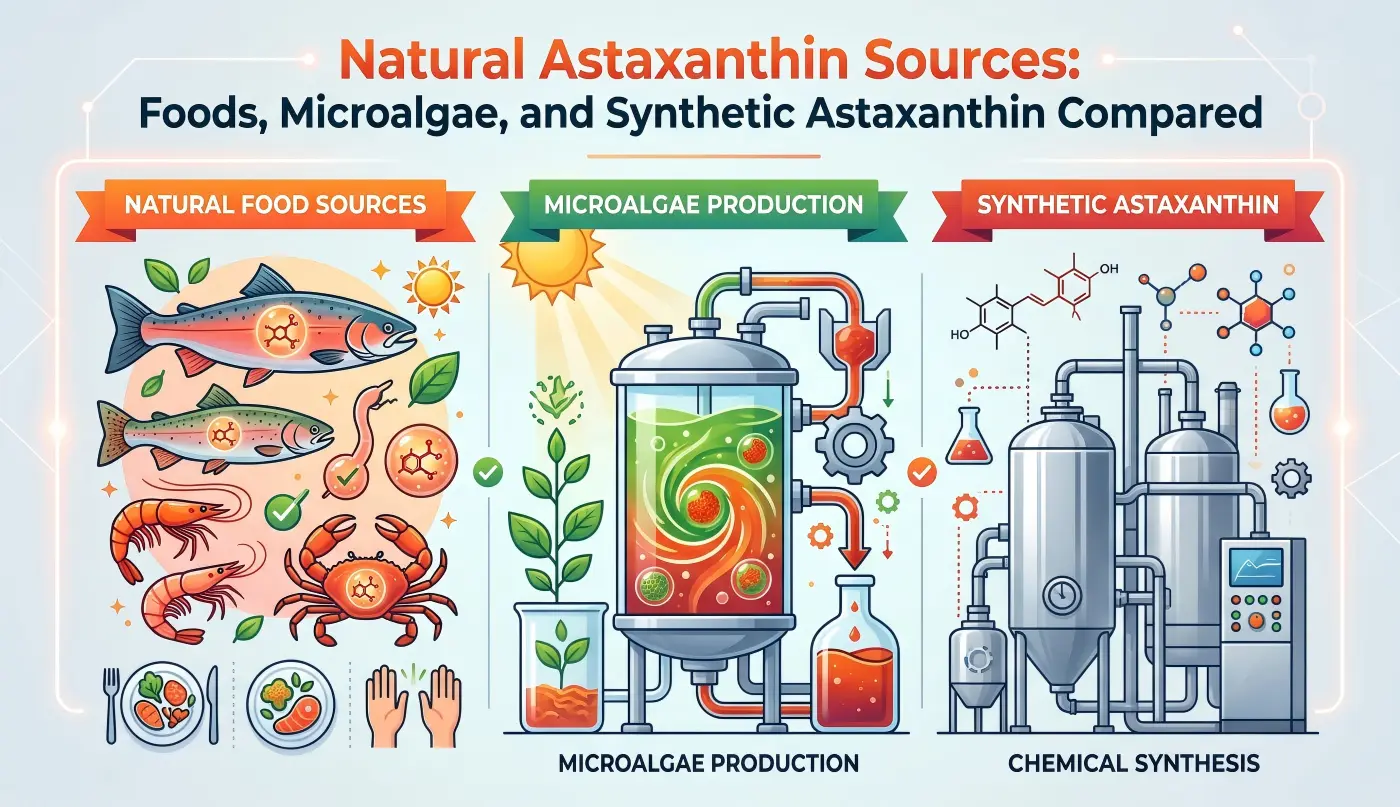
Astaxanthin occurs naturally throughout the aquatic food chain. Salmon, trout, shrimp, krill, crab, crayfish, and lobster contain the red-orange carotenoid, but these animals generally obtain astaxanthin or its carotenoid precursors through their diets rather than producing it independently.
For commercial dietary supplements, the source must provide more than a recognizable name. Brands need a standardized, traceable ingredient with documented identity, active concentration, extraction method, carrier system, contaminant controls, stability, and regulatory status.
Haematococcus pluvialis microalgae is the principal natural astaxanthin source used for premium human supplement positioning. Other sources include yeast, bacteria, crustacean by-products, and chemical synthesis, but they differ in concentration, stereoisomer composition, esterification, manufacturing economics, regulatory status, and commercial application.
Quick answer: Seafood provides dietary astaxanthin, but its concentration varies. A standardized Haematococcus pluvialis extract is generally more practical for supplement manufacturing because it provides a controlled amount of active astaxanthin in oil, powder, beadlet, or water-dispersible formats.
Regulatory Notice: This article is intended for supplement brands, procurement teams, and product developers. Ingredient authorization depends on the specific source, manufacturing process, use level, population, product category, and target country. “Natural” does not automatically mean authorized or suitable for every application.
What Foods Contain Astaxanthin?
The main astaxanthin foods are aquatic animals with red, pink, or orange pigmentation.
Common dietary sources include:
- Wild and farmed salmon
- Rainbow trout
- Shrimp and prawns
- Krill
- Crab
- Crayfish
- Lobster
- Red sea bream
- Salmon roe and selected other seafood products
Astaxanthin is not normally present in meaningful quantities in common fruits, vegetables, grains, or terrestrial animal foods.
Seafood concentration varies according to:
- Species
- Wild or farmed origin
- Feed composition
- Harvest season
- Geographic location
- Tissue tested
- Cooking method
- Storage
- Analytical method
The color of a food is therefore not an accurate quantitative measure of its astaxanthin content.
How Much Astaxanthin Is in Salmon and Other Seafood?
Published estimates vary considerably.
A scientific review reported approximately:
| Food source | Reported astaxanthin concentration |
| Wild sockeye salmon flesh | 26–38 mg/kg |
| Farmed Atlantic salmon flesh | 6–8 mg/kg |
| Selected European-market large trout | Approximately 6 mg/kg |
| Selected Japanese-market large trout | Approximately 25 mg/kg |
| Chum salmon | Approximately 3 mg/kg in some reports |
| Shrimp meat | Approximately 7.42–14.01 µg/g in one reviewed dataset |
Expressed per 100 grams, 26–38 mg/kg in wild sockeye salmon equals approximately 2.6–3.8 mg per 100 g.[1]
The same review estimated that approximately 165 g of salmon could provide 3.6 mg of astaxanthin, but this is not a universal food-composition value. A 165 g serving of lower-concentration salmon could provide substantially less.[1]
Astaxanthin concentrations in crustacean heads and shells can be considerably higher than in edible muscle. Values based on the whole animal or processing by-products should not be presented as the amount a consumer receives from ordinary shrimp meat.
Why Food Values Should Be Treated as Estimates
A label claim on a supplement must be based on a tested, standardized input. A consumer meal does not normally carry the same compositional control.
For example, two salmon portions of equal weight can differ because:
- One is sockeye and the other is Atlantic salmon.
- One fish obtained carotenoids from a wild diet.
- The other received a controlled aquaculture feed.
- The pigment is distributed differently between skin and muscle.
- Storage and cooking have affected carotenoid retention.
Food data helps explain where natural astaxanthin occurs. It should not be used as an exact substitute for a standardized supplement dose.
Why Are Salmon and Shrimp Red or Pink?
Astaxanthin is synthesized by primary producers, including certain microalgae and microorganisms. It then moves through the food chain.
Small aquatic organisms consume astaxanthin-producing algae. Krill and other crustaceans accumulate carotenoids. Salmon and trout obtain them through prey or aquaculture feed.
Aquatic animals use and deposit carotenoids differently, creating the characteristic coloration seen in:
- Salmon muscle
- Trout muscle and skin
- Shrimp shells
- Crab shells
- Lobster shells
- Salmon roe
Cooking can make crustaceans appear more intensely red because heat changes pigment-protein complexes. The more visible color does not mean cooking has created additional astaxanthin.
Can Astaxanthin Foods Replace a Standardized Supplement?
Food and supplements serve different product and consumer needs.
Seafood provides:
- Protein
- Fatty acids
- Minerals
- Other carotenoids
- Naturally occurring astaxanthin
A standardized natural astaxanthin supplement provides:
- A defined active amount
- Lot-specific assay documentation
- Predictable serving instructions
- Controlled dosage form
- Traceable ingredient origin
- A stable commercial specification
A food-first message can be appropriate for consumer education, but a supplement brand should not imply that its product is equivalent to eating a specific amount of salmon unless the comparison is accurate, relevant, and adequately substantiated.
Seafood allergens, dietary preferences, sustainability concerns, cost, and variability also make direct equivalence claims difficult.
What Is the Best Natural Source of Astaxanthin?
For commercial human supplements, Haematococcus pluvialis is generally considered the leading natural source because it can accumulate a high percentage of astaxanthin under controlled stress conditions.
Published research on H. pluvialis red-cyst biomass reports astaxanthin accumulation of up to approximately 3.8% by dry weight in some analyses[1], with other reviews reporting typical ranges of roughly 1–5%, depending on the strain, cultivation conditions, stress stage, and analytical method.
This is substantially more concentrated than edible seafood tissue.
“Best source,” however, depends on the application:
- For normal dietary intake:salmon, trout, and crustaceans are relevant sources.
- For standardized human supplements: pluvialis extract is generally the strongest commercial fit.
- For aquaculture pigmentation:synthetic and fermentation-derived sources may be economically important.
- For food or beverage development:a regulatory-authorized microencapsulated or water-dispersible source may be required.
- For vegan positioning:microalgae-derived astaxanthin is usually preferable to crustacean-derived material.
Source selection should follow the product brief rather than a universal ranking.
What Is Haematococcus Pluvialis Astaxanthin?
Haematococcus pluvialis is a freshwater microalga with a two-stage commercial production cycle.
Green Growth Stage
During the first stage, producers optimize conditions for cell growth and biomass production. The cells are generally green and motile.
Important controls include:
- Water quality
- Nutrient composition
- Temperature
- Light
- Carbon supply
- Culture purity
- Microbial contamination
Red Stress Stage
The cells are then exposed to controlled stress, such as high light intensity or nutrient limitation. They form thick-walled red cysts and accumulate astaxanthin-rich lipid droplets.
Astaxanthin helps protect the microalgal cells from environmental stress. Research on nitrogen limitation and light intensity confirms that both factors significantly influence astaxanthin accumulation during this stress-induced stage.[2]
KS Nutripharma’s Haematococcus Pluvialis Cultivation Base
KS Nutripharma operates its own Haematococcus pluvialis cultivation base using a closed, natural-sunlight column photobioreactor (PBR) system rather than open raceway ponds. The system supports controlled two-stage cultivation—green growth followed by a light- and nutrient-triggered induction phase—with documented parameters for light path, gas flow rate, and temperature at each stage.
Reported industry ranges associate closed PBR cultivation with higher and more consistent astaxanthin accumulation (approximately 4–6% dry weight) compared with open pond systems (approximately 1–2% dry weight), though actual results depend on strain, site conditions, and process control.
For a full technical breakdown of the reactor design, induction parameters, and quality control system, see KSNutripharma’s Haematococcus pluvialis cultivation base.
Harvesting and Cell Disruption
Red cysts are harvested and dried. Their thick cell walls make disruption important for efficient extraction and downstream use.
Manufacturers may use mechanical processes to break the cells before extraction. A supplier should document how the biomass is processed and how identity and active concentration are controlled.
Extraction and Standardization
Astaxanthin can be extracted using food-compatible solvents or supercritical carbon dioxide systems, depending on the process.
A study evaluating supercritical carbon dioxide extraction reported up to 95% recovery under its optimized experimental conditions of 50°C and 50 MPa.[3] This is a process-specific research result, not a guarantee for every commercial ingredient.
The resulting extract may be standardized as:
- Oleoresin
- Oil suspension
- Powder
- Beadlets
- Microencapsulated powder
- Cold-water-dispersible powder
For format comparisons, see the KS Nutripharma guide to astaxanthin powder, oil, softgels, capsules, and gummies.
What Other Natural Astaxanthin Sources Exist?
Xanthophyllomyces Dendrorhous
The red yeast Xanthophyllomyces dendrorhous, formerly called Phaffia rhodozyma, can produce astaxanthin through fermentation.
Its astaxanthin profile differs from that of H. pluvialis. Yeast-derived astaxanthin is associated mainly with the 3R,3′R stereoisomer and is generally present in an unesterified form.[4]
Possible commercial advantages include controlled fermentation and reduced dependence on light. However, brands must confirm:
- Human-food regulatory status
- Strain identity
- Manufacturing history
- Active concentration
- Stereoisomer profile
- Safety documentation
- Target-market authorization
Paracoccus Carotinifaciens
Paracoccus carotinifaciens is a carotenoid-producing bacterium. It can produce astaxanthin together with other carotenoids.
As with yeast-derived material, its suitability depends on the specific ingredient and jurisdiction. Research using one microbial source cannot automatically substantiate a product made from another.
Krill and Crustacean By-Products
Shrimp shells, crab shells, crayfish waste, and krill contain astaxanthin and can be used as extraction feedstocks.
These sources may support marine upcycling narratives, but they create additional considerations:
- Shellfish-allergen risk
- Odor and flavor
- Seasonal variation
- Raw-material degradation
- Salt and ash
- Environmental contaminants
- Source authentication
- Vegan-positioning restrictions
- Batch-to-batch variation
A seafood-derived ingredient should not be presented as equivalent to microalgal astaxanthin without comparative documentation.
Natural vs. Synthetic Astaxanthin: What Is the Difference?
Natural and synthetic astaxanthin share the same basic molecular formula, but they can differ in stereoisomer distribution and esterification.
Astaxanthin has three principal optical configurations:
- 3S,3′S
- 3R,3′S, also called the meso form
- 3R,3′R
Haematococcus Pluvialis Astaxanthin
Astaxanthin from H. pluvialis is predominantly:
- 3S,3′S
- All-trans
- Esterified with fatty acids
- Present mainly as monoesters and diesters
One scientific review described the approximate profile as majority monoesterified, with the remainder present as diesters and a small free-astaxanthin fraction, although actual commercial specifications can vary and should be confirmed against the supplier’s certificate of analysis.[4]
Synthetic Astaxanthin
Conventional synthetic astaxanthin is generally:
- Manufactured through chemical synthesis
- Predominantly unesterified
- A mixture of optical isomers
- Typically present in a 1:2:1 ratio of 3S,3′S, meso, and 3R,3′R forms
Does This Mean Natural Astaxanthin Is Clinically Superior?
Not automatically.
Differences in stereochemistry and esterification are scientifically relevant. However, claims of superior human outcomes require direct, appropriate comparative evidence.
A brand should not convert an in vitro antioxidant comparison into a claim that one source treats disease or is a specific multiple “more powerful” in the human body.
For B2B sourcing, the strongest practical reasons to choose H. pluvialis are:
- Established premium human-supplement positioning
- Availability of human research
- Regulatory history
- Consumer recognition
- Natural and microalgae-derived claims
- Multiple commercially available delivery formats
- Standardized active concentrations
Is Synthetic Astaxanthin Used in Human Supplements?
Synthetic astaxanthin is widely used in aquaculture feed to pigment salmonids and crustaceans. Its authorization for animal feed should not be interpreted as authorization for human dietary supplements.
In the European Union, EFSA has assessed synthetic astaxanthin as a feed additive for salmonids, crustaceans, and other fish.[5] Separately, astaxanthin-rich oleoresin from H. pluvialis is authorized as a novel food for specified human supplement uses.[6]
A scientific review of food-industry applications reported that synthetic astaxanthin is not permitted for use in human foods under the cited EU framework and does not have the same U.S. GRAS status described for selected H. pluvialis extracts.[7]
Regulatory conclusions must nevertheless be based on current official rules and the exact commercial ingredient. Brands should not assume that every “astaxanthin” source has interchangeable legal status.
What Is the Regulatory Status of Haematococcus Pluvialis Astaxanthin?
United States
FDA records list multiple New Dietary Ingredient notifications concerning H. pluvialis algae or astaxanthin extracted from it.[8]
FDA has also responded with “no questions” to certain GRAS notices for defined H. pluvialis extracts under specified food-use conditions. For example, GRAS Notice No. 294 concerns an extract containing astaxanthin esters for specified food categories at a use level providing 0.1 mg astaxanthin per serving.[9]
This does not mean:
- Every pluvialisextract is GRAS.
- GRAS status for conventional food use automatically covers supplements.
- Every intended dosage or food category is included.
- One supplier’s notice legally applies to another materially different ingredient.
The regulatory review must match the identity, manufacturing process, specifications, intended use, and marketed product.
European Union
EFSA’s 2020 opinion evaluated 8 mg of astaxanthin per day from food supplements, together with estimated background dietary exposure. It concluded that this combined intake was safe for adults under the assessed conditions.[6]
The EU Union List defines authorized conditions for astaxanthin-rich oleoresin from H. pluvialis, including source, use levels, age categories, and labeling conditions. These requirements have been amended over time, so brands should review the current consolidated regulations rather than relying on an old supplier presentation.[10]
How Should Brands Compare Astaxanthin Sources?
Use a documented specification rather than the words “natural astaxanthin” alone.
| Qualification area | Questions to verify |
| Biological identity | What species and strain produced the astaxanthin? |
| Source | Microalgae, yeast, bacteria, crustacean material, or synthesis? |
| Active concentration | What percentage of active astaxanthin is guaranteed? |
| Stereoisomers | What optical and geometric isomer profile is present? |
| Esterification | Is the astaxanthin free, monoesterified, diesterified, or mixed? |
| Extraction | Which solvents or extraction technologies are used? |
| Carrier | Is the ingredient in olive oil, MCT oil, sunflower oil, starch, gelatin, or another matrix? |
| Testing | Which validated method measures the active astaxanthin? |
| Contaminants | Are heavy metals, microbiology, pesticides, solvents, PAHs, and other relevant contaminants controlled? |
| Stability | What conditions and packaging support the stated shelf life? |
| Regulatory status | Is this exact ingredient suitable for the target market and use? |
| Traceability | Can the supplier trace the lot to cultivation or fermentation? |
| Certifications | Which GMP, food-safety, organic, non-GMO, kosher, halal, or vegan documentation is available? |
Which Astaxanthin Ingredient Format Should a Brand Buy?
Oleoresin or Oil Suspension
Best suited to:
- Softgels
- Oil-based drops
- CoQ10 combinations
- Omega-3 combinations
- Vitamin E combinations
Advantages include active-dose density and lipid compatibility. Risks include oil oxidation, separation, leakage, and limited water dispersibility.
Standardized Powder
Best suited to:
- Hard capsules
- Tablets
- Dry premixes
Brands should verify powder concentration, carrier composition, flow, moisture, and blend uniformity.
Beadlets
Best suited to:
- Capsules
- Tablets
- Multi-active formulas
Beadlets may improve handling and protection but introduce wall materials that affect label claims and capsule space.
Microencapsulated or CWS Powder
Best suited to:
- Gummies
- Drink powders
- Gels
- Selected beverages
- Functional food applications
CWS means cold-water-dispersible. It does not always mean that astaxanthin forms a true transparent molecular solution. Turbidity, sedimentation, color, and reconstitution should be tested in the finished matrix.
What Should Be Included in an Astaxanthin RFQ?
A useful request for quotation should specify:
- Target market
- Intended product category
- Target population
- Desired natural-source claim
- Active astaxanthin per serving
- Units per serving
- Preferred dosage form
- Required ingredient concentration
- Preferred or excluded carrier oils
- Vegan, halal, kosher, non-GMO, or organic requirements
- Allergen restrictions
- Bottle, blister, pouch, or sachet format
- Target shelf life
- Required regulatory documentation
- Required analytical and contaminant testing
- Pilot and commercial order quantities
- Annual volume forecast
The RFQ should distinguish between “12 mg astaxanthin” and “12 mg astaxanthin preparation.” Only the active amount supports the finished Supplement Facts declaration.
Frequently Asked Questions
What foods are highest in astaxanthin?
Wild sockeye salmon is among the richest commonly consumed astaxanthin foods. Trout, shrimp, crab, crayfish, krill, and lobster also contain astaxanthin, but concentrations vary.
Is astaxanthin found in plants?
Astaxanthin is produced by selected microalgae and microorganisms. Common fruits and vegetables are not meaningful dietary sources.
Is salmon the original source of astaxanthin?
No. Salmon generally obtains carotenoids through its diet. Microalgae and other primary producers introduce astaxanthin into the aquatic food chain.
Is natural astaxanthin vegan?
Microalgae-derived astaxanthin can support vegan positioning, but the carrier, encapsulation material, capsule shell, processing aids, and manufacturing controls must also be verified.
What is Haematococcus pluvialis?
Haematococcus pluvialis is a freshwater microalga capable of accumulating high levels of natural astaxanthin when exposed to controlled environmental stress.
Is astaxanthin from algae better than astaxanthin from shrimp?
Algal astaxanthin is generally easier to standardize for premium supplements and avoids shellfish-allergen and marine-animal sourcing concerns. “Better” still depends on the specification, application, evidence, and regulatory status.
Is synthetic astaxanthin the same as natural astaxanthin?
They share the same basic molecule but differ in stereoisomer distribution, esterification, production method, regulatory status, and common commercial use.
Can capsule color prove that astaxanthin is natural?
No. Color cannot verify source, identity, concentration, purity, or potency. These require documentation and analytical testing.
Does “algae astaxanthin” guarantee Haematococcus pluvialis?
No. The species should be declared in the specification, certificate of analysis, traceability records, and regulatory documentation.
What is the best source for a natural astaxanthin supplement?
For many premium human supplement projects, standardized Haematococcus pluvialis extract offers the strongest combination of market recognition, human research, traceability, regulatory history, and format availability.
Source Natural Astaxanthin with KS Nutripharma®
KS Nutripharma provides custom natural astaxanthin supplement manufacturing using standardized microalgae-derived oils, powders, beadlets, and water-dispersible systems, cultivated at our own Haematococcus pluvialis cultivation base.
Available formats include:
- Astaxanthin softgels
- Hard capsules
- Tablets
- Gummies
- Powder sachets
- Multi-ingredient antioxidant products
- Custom packaging
Astaxanthin can also be incorporated into broader antioxidant supplement formulations.
Ask KS Nutripharma for source identity, active assay, carrier composition, contaminant testing, certifications, regulatory documentation, format options, and production feasibility for your target market.
References
- Ambati RR, Moi PS, Ravi S, Aswathanarayana RG. “Astaxanthin: Sources, Extraction, Stability, Biological Activities and Its Commercial Applications—A Review.” Marine Drugs. 2014;12(1):128. https://pmc.ncbi.nlm.nih.gov/articles/PMC3917265/
- Frontiers in Marine Science. “Effects of Nitrogen and Light Intensity on the Astaxanthin Accumulation in Motile Cells of Haematococcus pluvialis.” 2022. https://doi.org/10.3389/fmars.2022.909237
- Molino A, et al. “Effect of CO₂ Flow Rate on the Extraction of Astaxanthin and Fatty Acids From Haematococcus pluvialis Using Supercritical Fluid Technology.” Molecules. 2020.
https://pmc.ncbi.nlm.nih.gov/articles/PMC7766558/ - Marine Drugs.”Astaxanthin as a King of Ketocarotenoids: Structure, Synthesis, Accumulation, Bioavailability and Antioxidant Properties.” 2023. https://www.mdpi.com/1660-3397/21/3/176
- European Food Safety Authority. “Scientific Opinion on the Safety and Efficacy of Synthetic Astaxanthin as a Feed Additive.” EFSA Journal. 2014. https://doi.org/10.2903/j.efsa.2014.3724
- European Food Safety Authority. “Safety of Astaxanthin for Its Use as a Novel Food in Food Supplements.” EFSA Journal. 2020;18(2):5993. https://efsa.onlinelibrary.wiley.com/doi/10.2903/j.efsa.2020.5993
- Stachowiak B, Szulc P. “Astaxanthin for the Food Industry.” Molecules. 2021;26(9):2666. https://pmc.ncbi.nlm.nih.gov/articles/PMC8125449/
- S. Food and Drug Administration. “Submitted 75-Day Premarket Notifications for New Dietary Ingredients.”
https://www.fda.gov/food/new-dietary-ingredient-ndi-notification-process/submitted-75-day-premarket-notifications-new-dietary-ingredients - S. Food and Drug Administration. “GRAS Notice No. 294: Haematococcus pluvialis Extract Containing Astaxanthin Esters.”
https://www.hfpappexternal.fda.gov/scripts/fdcc/index.cfm?id=294&set=GRASNotices - EUR-Lex. “Commission Implementing Regulation (EU) 2023/1581.”
https://eur-lex.europa.eu/legal-content/EN/TXT/HTML/?uri=CELEX:32023R1581