- Bioavailability, Stability & OEM Manufacturing Guide
- A Technical & Commercial Comparison for Supplement Brands and Procurement Managers
- Evidence-based analysis with authoritative clinical data and real-world OEM parameters
Table of Contents
- Introduction
- Structure & Mechanism Comparison
- Human Clinical Evidence Comparison
- Ingredient Compatibility Comparison
- Technology Selection Decision Framework
- OEM Manufacturing Comparison
- OEM Quality Assurance Framework
- OEM Commercial Comparison Matrix
- Common OEM Development Challenges
- How We Evaluate Delivery Technology
- Stability Comparison Summary
- Regulatory Snapshot
- Cost Structure Comparison
- Frequently Asked Questions
- Why OEM Brands Choose Our Partnership
- References
Introduction
The dietary supplement industry is shifting rapidly toward advanced delivery technologies that demonstrably improve bioavailability. Two phospholipid-based systems dominate this space: liposomal encapsulation and phytosome complexation. While both technologies use phospholipids to enhance nutrient absorption, they operate on fundamentally different physicochemical principles and serve different ingredient categories.
Market data underscores the commercial importance of this decision. The global liposomal supplements market was valued at approximately USD 361 million in 2022 and is projected to reach USD 627 million by 2030, growing at a CAGR of 7.17% (GMPriority Pharma, 2024; Industry Report, 2025). Meanwhile, the berberine phytosome market alone reached USD 1.53 billion in 2025 and is projected to grow to USD 2.27 billion by 2032 (Intel Market Research, 2025). These figures reflect accelerating B2B investment in differentiated delivery systems.
For procurement managers and product development teams, the central question is not “Which technology is better?” but “Which technology is right for my specific ingredient, target market, and commercial constraints?” This guide answers that question through a structured comparison of structure, mechanism, clinical evidence, manufacturing parameters, and commercial considerations—designed specifically for B2B decision-makers evaluating OEM partnerships.
Section 1: Structure & Mechanism Comparison
1.1 Liposomal Technology: Vesicle-Based Encapsulation
Liposomal technology creates microscopic vesicles composed of one or more phospholipid bilayers surrounding an aqueous core. The structure mimics natural cell membranes, enabling fusion with intestinal epithelial cells and enhanced cellular uptake.
- Phospholipid Bilayer: Typically phosphatidylcholine (PC) derived from sunflower or soy lecithin
- Aqueous Core: Hydrophilic actives (vitamin C, glutathione, NMN) are encapsulated within the water-filled interior
- Hydrophobic Layer: Lipophilic compounds (CoQ10, curcumin) are incorporated within the lipid bilayer itself
- Size Range: Optimal therapeutic liposomes measure 50–200 nm in diameter, with narrow polydispersity index (PDI < 0.2) (PMC3205135)
Mechanism of Action: Liposomal encapsulation protects active compounds from gastric degradation, enables lymphatic transport that bypasses hepatic first-pass metabolism, and facilitates vesicle fusion with enterocyte membranes for direct intracellular delivery.
1.2 Phytosome Technology: Molecular Complexation
Phytosome technology, developed and patented by Indena S.p.A. (Italy), creates a molecular complex (not a vesicle) between standardized botanical extracts and phospholipids—primarily phosphatidylcholine. Unlike liposomes, where the active ingredient is physically encapsulated within a vesicle, phytosomes form chemical bonds between the phytoconstituent and the phospholipid polar head (ScienceDirect, 2025; IntechOpen, 2025).
- Molecular Complex: Hydrogen bonds and polar interactions between polyphenols and phospholipid phosphate/ammonium groups
- No Vesicle Formation: The complex exists as individual molecular units, not bilayer structures
- Amphiphilic Nature: The resulting complex is miscible in both aqueous and lipid environments
- Phospholipid Ratio: Typically 1:1 or 1:2 (w/w) phytoconstituent-to-phospholipid, significantly lower lipid content than liposomes
Mechanism of Action: Phytosome technology transforms hydrophilic polyphenols into lipid-compatible molecules through molecular complexation. The resulting complex resembles cell membrane components, facilitating passive diffusion across intestinal membranes. The phosphatidylcholine component itself provides additional hepatoprotective benefits (IntechOpen, 2025).
1.3 Structural Comparison Summary
| Parameter | Liposomal Technology | Phytosome Technology |
| Core Technology | Encapsulation within vesicles | Molecular complexation |
| Physical Structure | Bilayer vesicle (spherical) | Molecular aggregate (non-vesicular) |
| Bonding Mechanism | Physical entrapment | Chemical bonds (hydrogen/polar) |
| Phospholipid Ratio | Up to 10:1 lipid-to-active | 1:1 to 2:1 (w/w) |
| Suitable Ingredients | Water-soluble & fat-soluble | Primarily botanical polyphenols |
| Particle Size | 50–200 nm (critical) | Not applicable (molecular level) |
| Typical Applications | Vitamins, NMN, Glutathione, CoQ10 | Silybin, Curcumin, Quercetin, Berberine |
Critical Distinction: Liposomes encapsulate; phytosomes complex. This fundamental difference determines ingredient compatibility, manufacturing requirements, and cost structures.
Section 2: Human Clinical Evidence Comparison
Current human evidence suggests that liposomal systems demonstrate the strongest advantages for unstable water-soluble compounds, whereas phytosome systems have the most robust evidence for botanical polyphenols. The following table summarizes the key clinical findings from peer-reviewed studies:
| Ingredients | Technology | Human Clinical Evidence | Improvement |
| Vitamin C | Liposomal | Caco-2 cell model; 22.28% greater permeability (p < 0.05) (J Food Res, 2025) | 1.2–1.4× |
| Glutathione | Liposomal | Human PK (n=12); 6× plasma conc.; 100% wound healing at 24h (PMID 41559937, 2026) | 6× |
| CoQ10 | Liposomal | RCT (n=18); 31.3% higher Cmax (Front Nutr, 2025) | 1.3× |
| Curcumin | Phytosome (Meriva®) | Human studies; 29× total curcuminoid absorption (Indena; J Nat Prod, 2010) | 29× |
| Quercetin | Phytosome (QuerceFit®) | Human crossover (n=12); 20× Cmax; P < 0.0001 (PMC6418071, 2019) | 20× |
| Silybin | Phytosome (Siliphos®) | Human PK; 4.6× bioavailability; Cmax 860 vs. 83 ng/mL (WJG, 2011) | 4.6× |
| Berberine | Phytosome | RCT; metabolic improvements at 550mg BID (Springer, 2025) | 3–5× |
Key Insights: For hydrophilic vitamins and synthetic compounds (glutathione, vitamin C, NMN), liposomal encapsulation provides superior protection and cellular delivery. For botanical polyphenols (quercetin, silybin, curcuminoids), phytosome complexation leverages molecular affinity for enhanced membrane permeation.
Section 3: Ingredient Compatibility Comparison
3.1 Best Candidates for Liposomal Delivery
Water-Soluble Actives: Vitamin C (enhanced gastric protection and intestinal permeability), Glutathione (protection from enzymatic degradation; 6× plasma levels demonstrated), NMN (improved cellular uptake for NAD+ synthesis), PQQ (mitochondrial targeting).
Fat-Soluble Actives: CoQ10 (31.3% higher peak concentration; sustained release profile), Vitamin D3/K2 (enhanced lymphatic transport), Astaxanthin (protection from oxidation), Resveratrol (overcomes rapid metabolism and low water solubility).
Hybrid Applications: Curcumin can be formulated in liposomes (5–10× bioavailability) or phytosomes (29× with Meriva®). Melatonin supports sustained-release liposomal formulations for sleep support.
3.2 Best Candidates for Phytosome Delivery
Clinically Validated Phytosomes: Silybin / Siliphos® (4.6× bioavailability; liver health applications), Curcumin / Meriva® (29× absorption vs. standard curcumin), Quercetin / QuerceFit® (20× Cmax improvement), Berberine Phytosome (metabolic health at 550mg BID).
Emerging Applications: Boswellia (anti-inflammatory), Green Tea Catechins / EGCG (enhanced systemic exposure), Ginkgo Biloba (cognitive support), Olive Polyphenols (cardiovascular health).
3.3 Compatibility Summary
| Ingredient Category | Liposomal | Phytosome |
| Water-soluble vitamins (C, B-complex) | Excellent | Not applicable |
| Glutathione, NMN, PQQ | Excellent | Poor |
| CoQ10, Vitamin D, Astaxanthin | Excellent | Moderate |
| Botanical polyphenols (Quercetin, Silybin) | Moderate | Excellent |
| Curcuminoids | Good (5–10×) | Superior (29× with Meriva®) |
| Berberine (alkaloid) | Moderate | Excellent |
Section 4: Technology Selection Decision Framework
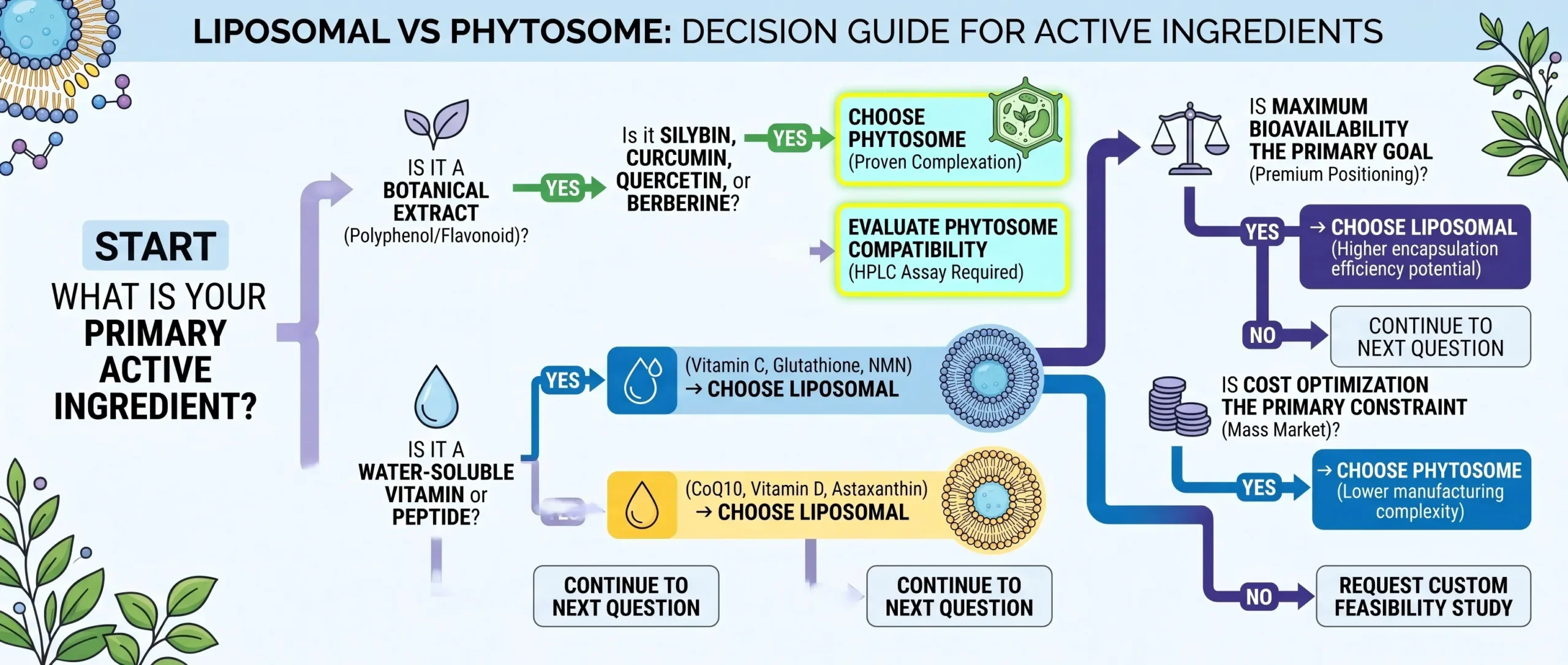
4.1 Procurement Decision Tree
START: What is your primary active ingredient?
├─→ Is it a botanical extract (polyphenol/flavonoid)?
├─→ YES → Is it silybin, curcumin, quercetin, or berberine?
│ ├─→ YES → CHOOSE PHYTOSOME (proven complexation)
│ └─→ NO → Evaluate phytosome compatibility (HPLC assay required)
└─→ NO → Continue
├─→ Is it a water-soluble vitamin or peptide?
├─→ YES (Vitamin C, Glutathione, NMN) → CHOOSE LIPOSOMAL
└─→ NO → Continue
├─→ Is it a fat-soluble nutrient or antioxidant?
├─→ YES (CoQ10, Vitamin D, Astaxanthin) → CHOOSE LIPOSOMAL
└─→ NO → Continue
├─→ Is maximum bioavailability the primary goal (premium positioning)?
├─→ YES → CHOOSE LIPOSOMAL
└─→ NO → Continue
└─→ Is cost optimization the primary constraint (mass market)?
├─→ YES → CHOOSE PHYTOSOME (lower manufacturing complexity)
└─→ NO → Request custom feasibility study
4.2 Commercial Decision Matrix for OEM Brands
| Scenario | Recommended Technology | Rationale |
| Amazon/e-commerce brand | Liposomal | Higher perceived value; premium positioning |
| Clinical botanical (liver/metabolic) | Phytosome | Superior clinical evidence for silybin, berberine; lower MOQ |
| Premium longevity/anti-aging | Liposomal | NMN, NAD+, resveratrol require cellular protection |
| Sports nutrition | Liposomal | CoQ10, PQQ benefit from sustained-release; 31.3% higher absorption |
| Traditional herbal formula | Phytosome | Botanical compatibility; cost-effective for multi-herb blends |
| Private label startup | Phytosome | Lower MOQ; simpler QC; shorter lead times |
| Immune support | Liposomal | Vitamin C, glutathione need gastric protection |
| Cognitive health (combo) | Both | Curcumin (phytosome) + DHA (liposomal) for synergistic positioning |
Section 5: OEM Manufacturing Comparison
5.1 Commercial Manufacturing Considerations
Rather than focusing on laboratory-scale equipment specifications, procurement managers should evaluate manufacturing partners on operational capabilities that directly impact commercial success:
| Parameter | Liposomal | Phytosome |
| Capital Investment | High (homogenizers, extruders) | Medium (standard reactors, dryers) |
| Process Validation | Extensive (particle size critical) | Moderate (HPLC assay sufficient) |
| Batch-to-Batch Variability | Higher (sensitive to process parameters) | Lower (more robust chemistry) |
| Scale-Up Complexity | High (maintaining size distribution) | Medium (standard chemical processing) |
| Operator Requirements | Specialized training required | Standard pharmaceutical training |
| Cleanroom Requirements | ISO 7–8 for aseptic processing | Standard GMP environment |
5.2 OEM Manufacturing Capability Checklist
- Batch consistency — Documented SOPs with validated process parameters
- Scale-up capability — Pilot-scale (1–5 kg) through commercial production (500+ kg)
- Particle size reproducibility — Target 50–200 nm with PDI < 0.2 (liposomal)
- Stability validation — ICH Q1A(R2) compliant stability programs
- Encapsulation verification — HPLC or UV-Vis quantification; target >85% EE
- Packaging compatibility — Amber glass, nitrogen flush, desiccant integration
- Documentation package — COA, TDS, MSDS, Allergen Statement, Non-GMO Statement
- Regulatory support — NDI notification assistance (US), Novel Food guidance (EU), ARTG listing (AU)
5.3 Lead Time & MOQ Comparison
| Parameter | Liposomal | Phytosome |
| Typical MOQ | 5,000–10,000 units | 3,000–5,000 units |
| Lead Time | 45–60 days | 30–45 days |
| Unit Cost Premium | 40–80% vs. standard | 20–40% vs. standard |
| Packaging Cost | Higher (amber glass, nitrogen) | Standard (HDPE bottles) |
| Storage Cost | Higher (cold chain for liquids) | Standard (ambient for powders) |
Section 6: OEM Quality Assurance Framework
Quality assurance for advanced delivery systems follows a structured pathway from raw material receipt to finished product release. Procurement managers should ensure their manufacturing partner operates under the following framework:
Incoming Raw Material Control
- Certificate of Analysis (COA) for all phospholipids and active ingredients
- Identity testing (FT-IR, HPLC fingerprinting)
- Microbial screening per USP <61>/<62>
- Heavy metals testing per USP <231>/<232>
In-Process Quality Control
- Liposomal: Particle size monitoring (DLS), zeta potential, pH
- Phytosome: Complexation ratio verification (HPLC), residual solvent monitoring
- Encapsulation efficiency testing at defined process checkpoints
- Environmental monitoring (ISO 7–8 cleanroom where applicable)
Finished Product Testing
- Identity and potency (HPLC assay)
- Microbial limits (USP <2021>/<2022>)
- Heavy metals (ICP-MS)
- Physical specifications (appearance, color, odor, viscosity)
Stability Program
- ICH Q1A(R2) compliant: Long-term (25°C/60% RH) and accelerated (40°C/75% RH)
- Real-time stability for intended shelf life + 12 months
- Ongoing stability monitoring for commercial batches
Release Testing & Documentation
- Full COA with reference standards
- Stability summary report
- Residual solvent report (per ICH Q3C)
- Third-party verification (optional, per client requirements)
Section 7: OEM Commercial Comparison Matrix
This matrix summarizes the commercial parameters that most directly impact procurement decisions:
| Parameter | Liposomal | Phytosome | Procurement Implication |
| MOQ | 5,000–10,000 units | 3,000–5,000 units | Phytosome enables smaller test batches |
| Development Cost | Higher | Moderate | Liposomal requires specialized equipment validation |
| Scale Difficulty | Higher | Moderate | Liposomal particle size harder to maintain at scale |
| Shelf Life (powder) | 36–60 months (freeze-dried) | 24–36 months (room temp) | Liposomal powders offer longest stability |
| Lead Time | 45–60 days | 30–45 days | Phytosome faster to market |
| Clinical Story | Strong for vitamins, peptides | Strong for botanicals | Match technology to ingredient category |
| Patent/Trademark Risk | Lower | Higher (Indena patents) | Verify IP status for phytosome formulations |
| Brand Positioning | Premium/advanced technology | Clinical botanical/extract | Liposomal commands higher retail pricing |
| Marketing Premium | 40–80% above standard | 20–40% above standard | Liposomal supports highest price positioning |
| QC Cost per Batch | $800–$1,500 | $400–$800 | Phytosome lower ongoing QC investment |
Section 8: Common OEM Development Challenges
Based on our experience managing liposomal and phytosome formulation projects, the following challenges arise most frequently during development and scale-up:
Low Encapsulation Efficiency
Challenge: Achieving >85% encapsulation for certain hydrophilic actives (<500 Da). Mitigation: Optimization of phospholipid ratio, cholesterol incorporation, pH adjustment. Our approach: We typically evaluate encapsulation efficiency at pilot scale (1–5 kg) before committing to commercial batch sizes.
Botanical-Phospholipid Compatibility
Challenge: Not all botanical extracts form stable complexes with phosphatidylcholine. Mitigation: HPLC-based complexation assay; alternative phospholipid sources (sunflower vs. soy). Our approach: Feasibility screening with FT-IR confirmation before full formulation development.
Oxidation Control
Challenge: Unsaturated phospholipids susceptible to lipid peroxidation during processing and storage. Mitigation: Inert atmosphere (nitrogen) processing; antioxidant addition (α-tocopherol, 0.01–0.1%); saturated lipid alternatives (DSPC, DPPC). Our approach: Real-time oxidation monitoring during manufacturing; oxygen headspace analysis for finished products.
Scale-Up Consistency
Challenge: Maintaining particle size distribution (liposomal) or complexation ratio (phytosome) when transitioning from lab to commercial batches. Mitigation: Defined process parameters; validated scale-up protocols; in-process DLS monitoring. Our approach: We conduct feasibility batches at 1–5 kg before scaling to 50+ kg to identify and resolve consistency issues early.
Packaging Selection
Challenge: Liposomal liquids require oxygen-impermeable containers; improper packaging leads to rapid degradation. Mitigation: Amber glass with nitrogen flush; desiccant integration; oxygen scavengers. Our approach: Packaging compatibility testing as part of stability program design.
Shelf-Life Validation
Challenge: Clients often require 24+ month shelf life but lack stability data at project initiation. Mitigation: Accelerated stability studies (40°C/75% RH); predictive shelf-life modeling. Our approach: 6-month accelerated data available for feasibility assessment; full ICH stability program for commercial batches.
Section 9: How KSNutripharma® Evaluate Delivery Technology for New Projects
Our formulation team assesses seven critical parameters simultaneously when recommending liposomal vs. phytosome delivery for a new OEM project:
1. Active Ingredient Characterization
We analyze molecular weight, solubility profile (log P), pKa, and thermal stability. Highly hydrophilic molecules (<500 Da) may leak from liposomes; polyphenols with multiple hydroxyl groups complex most effectively with phospholipids.
2. Target Claims & Market Positioning
Premium positioning (>USD 40 retail per unit) favors liposomal technology due to perceived innovation value. Clinical botanical positioning favors phytosome for ingredients with established complexation data.
3. Dosage Form Selection
Liquid liposomal formulations offer fastest time-to-market but require cold chain. Freeze-dried liposomal powders provide 36–60 month shelf life but add processing cost. Phytosome powders offer the simplest manufacturing and storage profile.
4. Stability Assessment
We evaluate oxidative sensitivity, hydrolytic stability, and light sensitivity. Our formulation engineers have observed that particle size consistency becomes increasingly difficult during commercial scale-up beyond laboratory batches. In most OEM projects, reproducibility and oxidation control often become more important than achieving the smallest theoretical particle size.
5. Manufacturing Feasibility
When evaluating OEM feasibility, we typically assess ingredient compatibility, phospholipid ratio, encapsulation efficiency, oxidative stability, and intended dosage form simultaneously rather than optimizing a single parameter. This integrated approach prevents costly reformulation cycles later in development.
6. Regulatory Pathway
US (FDA): Liposomal vitamins generally classified as dietary ingredients under DSHEA; NDI notification may be required for novel complexes. EU (EFSA): Liposomal forms may require Novel Food authorization if not consumed significantly before 1997; phytosome botanical claims face strict limitations following CJEU Case C-386/23 (April 2025). Australia (TGA): Delivery technology itself not regulated; active ingredients must appear on Permissible Ingredients Determination (updated March and June 2024).
7. Commercial Cost Optimization
We model raw material, processing, QC, packaging, and storage costs at target batch size. Our experience indicates that liposomal projects typically require 30–50% higher development investment than phytosome projects, but can command 40–80% higher unit pricing when positioned correctly.
Section 10: Stability Comparison Summary
| Stability Factor | Liposomal | Phytosome |
| Temperature Sensitivity | High (requires cold chain for liquids) | Moderate (room temp stable for powders) |
| Oxidation Risk | High (lipid-rich) | Low (chemical bonds) |
| Hydrolysis Risk | High (aqueous core) | Low (dry powder preferred) |
| Shelf Life (liquid) | 12–24 months (refrigerated) | 12–18 months (refrigerated) |
| Shelf Life (powder) | 36–60 months (freeze-dried) | 24–36 months (room temperature) |
| Packaging Requirements | Amber glass, nitrogen flush, desiccant | Standard HDPE, desiccant |
| Transportation | Cold chain required for liquids | Ambient shipping acceptable for powders |
Mitigation for Liposomal Products
- Antioxidants: α-Tocopherol, ascorbic acid (0.01–0.1% w/v)
- Saturated lipids: DSPC, DPPC instead of unsaturated PC
- Cholesterol: 30–50 mol% to increase membrane rigidity
- Cryoprotectants: Trehalose, sucrose for freeze-dried products
Section 11: Regulatory Snapshot
United States (FDA)
- Liposomal and phytosome supplements classified as dietary ingredients under DSHEA (1994)
- NDI notification required for novel ingredients (75-day pre-market notice)
- cGMP compliance: 21 CFR Part 111 mandatory for all manufacturers
- Structure/function claims must be substantiated by competent and reliable scientific evidence
- Indena patents: Meriva®, Siliphos®, and Quercetin Phytosome® require licensing for branded formulations
European Union (EFSA)
- Critical Update (April 2025): CJEU Case C-386/23 confirmed that over 1,500 on-hold botanical health claims cannot be used in EU advertising or labeling—significantly impacting phytosome products with botanical actives (TGC Compliance, 2025)
- Liposomal vitamins/minerals may require Novel Food authorization under Regulation (EU) 2015/2283
- Only authorized health claims per EU Register (Regulation EC 1924/2006) may be used
Australia (TGA)
- All complementary medicines must be listed on ARTG before sale
- TGA updated Permissible Ingredients Determination in March and June 2024
- Delivery technology itself not regulated; active ingredients must be permissible
Manufacturers should confirm ingredient-specific regulatory requirements before commercialization in each target market.
Section 12: Cost Structure Comparison
12.1 Raw Material & Processing Costs
| Component | Liposomal | Phytosome |
| Phospholipids | High (up to 10:1 ratio) | Low (1:1 to 1:2 ratio) |
| Antioxidants | Required (α-tocopherol) | Minimal |
| Cryoprotectants | Required for freeze-drying | Optional |
| Manufacturing Complexity | High (specialized equipment) | Medium (standard reactors) |
| Yield | 70–85% (encapsulation losses) | 85–95% (chemical complexation) |
| Energy Consumption | High (homogenization) | Moderate (evaporation/drying) |
12.2 Commercial Cost Summary
| Parameter | Liposomal | Phytosome |
| Typical MOQ | 5,000–10,000 units | 3,000–5,000 units |
| Lead Time | 45–60 days | 30–45 days |
| Unit Cost Premium | 40–80% vs. standard | 20–40% vs. standard |
| QC Cost per Batch | $800–$1,500 | $400–$800 |
| Stability Studies per SKU | $3,000–$5,000 | $2,000–$4,000 |
Section 13: Frequently Asked Questions
Q1: Can liposome replace phytosome (or vice versa)?
No. Phytosomes are designed for botanical polyphenols through molecular complexation. Liposomes are vesicular systems suitable for both hydrophilic and lipophilic compounds. They serve different ingredient categories and cannot be interchangeably substituted without reformulation and clinical validation.
Q2: Is liposomal better than phytosome?
Neither is universally “better.” Liposomal technology excels for water-soluble vitamins, peptides, and synthetic compounds requiring gastric protection. Phytosome technology is superior for botanical polyphenols and flavonoids. The optimal choice depends on your specific active ingredient, target bioavailability, and cost constraints.
Q3: Which one costs more?
Liposomal manufacturing typically costs 40–80% more than standard formulations due to specialized equipment, higher phospholipid ratios, complex QC requirements, and cold-chain storage. Phytosome manufacturing costs 20–40% more than standard formulations. The retail price premium for liposomal products is generally higher.
Q4: Can they be combined in one product?
Yes, combination formulations are technically feasible and may offer synergistic benefits. However, compatibility testing is essential to ensure the phytosome complex does not disrupt liposomal vesicle integrity or vice versa. Stability data should be generated for any combination product.
Q5: Which one is better for curcumin?
Phytosome (Meriva®) demonstrates superior clinical evidence for curcumin, with 29× greater absorption of total curcuminoids compared to standard curcumin. Liposomal curcumin shows 5–10× improvement. For maximum curcumin bioavailability, phytosome is the evidence-based choice.
Q6: Which one is better for vitamin C?
Liposomal vitamin C is the clear choice. Clinical data shows 22.28% higher bioavailability in Caco-2 cell models, with higher peak plasma concentrations and prolonged systemic retention compared to non-encapsulated vitamin C (Journal of Food Research, 2025).
Q7: Which one has better stability?
Phytosomes generally exhibit superior inherent stability due to chemical bonding. However, freeze-dried liposomal powders can achieve 36–60 months shelf life at room temperature, comparable to or exceeding phytosome powders. Liquid liposomes require refrigeration (12–24 months).
Q8: Which one is better for OEM/private label?
It depends on your product positioning and budget. Phytosome offers lower MOQ (3,000–5,000 units), shorter lead times (30–45 days), and simpler QC—ideal for startups and budget-conscious brands. Liposomal offers stronger premium positioning and higher retail margins but requires higher minimum investment and longer development timelines.
Section 14: Why OEM Brands Choose KSNutripharma®:
Pharmaceutical-Grade Phospholipid Sourcing
Direct relationships with Lipoid GmbH, Cargill, and ADM for certified non-GMO, sunflower-derived phosphatidylcholine with full traceability documentation.
Liposomal & Phytosome Formulation Engineering
Dedicated R&D team with 15+ years of experience in phospholipid-based delivery systems, from feasibility studies to commercial scale-up.
Particle Size Optimization
In-house Dynamic Light Scattering (DLS) and Transmission Electron Microscopy (TEM) capabilities for real-time particle size verification and optimization.
Encapsulation Efficiency Validation
HPLC-based encapsulation efficiency quantification with documented SOPs; typical target >85% for liposomal, >90% for phytosome complexes.
Pilot-Scale Feasibility Batches
1–5 kg batch sizes for formulation development, clinical sample production, and stability screening before commercial commitment.
Multi-Dosage Manufacturing
Liquid suspensions, softgel capsules, freeze-dried powders (sachets/capsules), and liquid sticks—all under one GMP-compliant facility.
Global Documentation Package
Complete regulatory support including COA, TDS, MSDS, Allergen Statement, Non-GMO Statement, Residual Solvent Report, and ICH-compliant Stability Data.
Commercial Scale Production
Batch capacity from 50 kg to 500+ kg with validated scale-up protocols and batch-to-batch consistency documentation.
OEM/ODM Support
End-to-end service from formulation development and stability testing to regulatory guidance and finished product release.
Request a Technical Consultation: Contact our formulation team to discuss your specific ingredient, target bioavailability, and commercial requirements. We provide feasibility assessments, projected cost structures, and regulatory pathway analysis within 48 hours.
References
- Shivaprasad, H.N., et al. (2025). Advanced Characterization of Liposomal Vitamin C: TEM, Cryo-EM, and Caco-2 Bioavailability Studies. Journal of Food Research, 14(2), 36–50. DOI: 10.5539/jfr.v14n2p36. https://ccsenet.org/journal/index.php/jfr/article/view/0/51398
- Prasad, K.N., et al. (2026). Liposomal glutathione outperforms plain glutathione in uptake, cell regeneration and systemic availability: evidence from cellular and human models. British Journal of Nutrition, Jan 21:1-8. PMID: 41559937. https://pubmed.ncbi.nlm.nih.gov/41559937/
- Jäger, R., et al. (2025). Impact of liposomal delivery on coenzyme Q10 absorption: a double-blind, placebo-controlled, randomized trial. Frontiers in Nutrition, 12, 1605033. DOI: 10.3389/fnut.2025.1605033. https://www.frontiersin.org/journals/nutrition/articles/10.3389/fnut.2025.1605033/full
- Riva, A., et al. (2019). Improved Oral Absorption of Quercetin from Quercetin Phytosome®. European Journal of Drug Metabolism and Pharmacokinetics, 44(2), 169-177. PMCID: PMC6418071. https://pmc.ncbi.nlm.nih.gov/articles/PMC6418071/
- Loguercio, C., & Festi, D. (2011). Silybin and the liver: from basic research to clinical practice. World Journal of Gastroenterology, 17(18), 2288-2301. PMCID: PMC3098397. https://pmc.ncbi.nlm.nih.gov/articles/PMC3098397/
- Cuomo, J., et al. (2011). Comparative absorption of a standardized curcuminoid mixture and its lecithin formulation. Journal of Natural Products, 74(4), 664-669. DOI: 10.1021/np1007262 (Meriva® bioavailability study).
- ScienceDirect. (2025). Phytosomes: A promising nanocarrier system. Phytomedicine Plus. https://www.sciencedirect.com/science/article/pii/S2667031325000521
- IntechOpen. (2025). Phytosome: A Novel Drug Delivery Approach in Herbal Medicine. https://www.intechopen.com/online-first/1180296
- Intel Market Research. (2025). Berberine Phytosome Market Outlook 2025-2032. https://www.intelmarketresearch.com/berberine-phytosome-market-3479
- TGC Compliance. (2025). Food Supplements Compliance Services — EU Botanical Claims Update. https://tecexglobalcompliance.com/food-supplements-compliance/
- GMPriority Pharma. (2024). TRUE Liposome Specialists — Company Presentation. https://gmprioritypharma.co.uk/
- PMC3205135. (2011). Protein-entrapped liposomes: preparation, characterization, and stability. International Journal of Nanomedicine. https://pmc.ncbi.nlm.nih.gov/articles/PMC3205135/
- PMC8150985. (2021). High Encapsulation Efficiencies for APIs in Liposomes. International Journal of Molecular Sciences. https://pmc.ncbi.nlm.nih.gov/articles/PMC8150985/
- Belcaro, G., et al. (2010). Product-evaluation registry of Meriva® for osteoarthritis. Panminerva Medica, 52(2 Suppl 1), 55-62.
- Springer. (2025). Berberine as a multi-target therapeutic agent for obesity. European Journal of Medical Research, 30, Article 527. https://link.springer.com/article/10.1186/s40001-025-02738-6
Disclaimer: This guide is intended for B2B procurement professionals and product development managers in the dietary supplement industry. All clinical claims are supported by peer-reviewed publications cited above. Regulatory information reflects current frameworks as of June 2026; consult qualified regulatory affairs professionals for jurisdiction-specific compliance strategies. Market data sourced from published industry reports; projections are subject to market conditions.