A B2B Procurement Guide for Multi-Phase Supplement Manufacturing
Table of Contents
- Why Supplement Brands Are Investing in Dual-Chamber Softgels
- Market Trends Driving Dual-Chamber Supplement Growth
- Consumer Questions Driving Dual-Chamber Innovation
- When Should You Use Dual-Chamber Softgels?
- Real-World Supplement Applications
- Dual-Chamber Softgel vs Other Delivery Technologies
- Oil Phase vs Water Phase: The Technical Foundation
- Why Active Ingredients Must Be Separated
- Why Dual-Chamber Softgels Are Difficult to Manufacture
- Stability Testing Requirements
- Is Dual-Chamber Softgel Worth the Additional Cost?
- How to Evaluate a Dual-Chamber Softgel Manufacturer
- Why Brands Choose KS Nutripharma for Advanced Softgel Projects
- Dual-Chamber Softgel Development at KS Nutripharma
- Frequently Asked Questions
- Related Technologies
- References and Verified Data Sources
1. Why Supplement Brands Are Investing in Dual-Chamber Softgels
The global softgel supplement market is projected to exceed $7.5 billion by 2027. Within this growth, dual-chamber softgel technology — also known as dual-phase softgel, two-chamber softgel, or multi-phase softgel — is emerging as the preferred delivery architecture for brands targeting premium positioning.
For B2B procurement professionals, the investment case rests on four pillars:
1.1 Premium Positioning
Dual-chamber products typically achieve 20–40% higher shelf price than equivalent single-chamber formulations. The visible separation of two distinct actives in one capsule signals advanced formulation science to consumers and justifies premium pricing in retail and direct-to-consumer channels.
1.2 Formula Differentiation
Standard softgel OEM capabilities are widely available. Dual-chamber manufacturing requires modified rotary die equipment, dual-injection fill systems, and validated partition wall geometry — capabilities that fewer contract manufacturers possess. This creates a genuine moat: products competitors cannot easily replicate.
1.3 Higher Active Loading Without Compromise
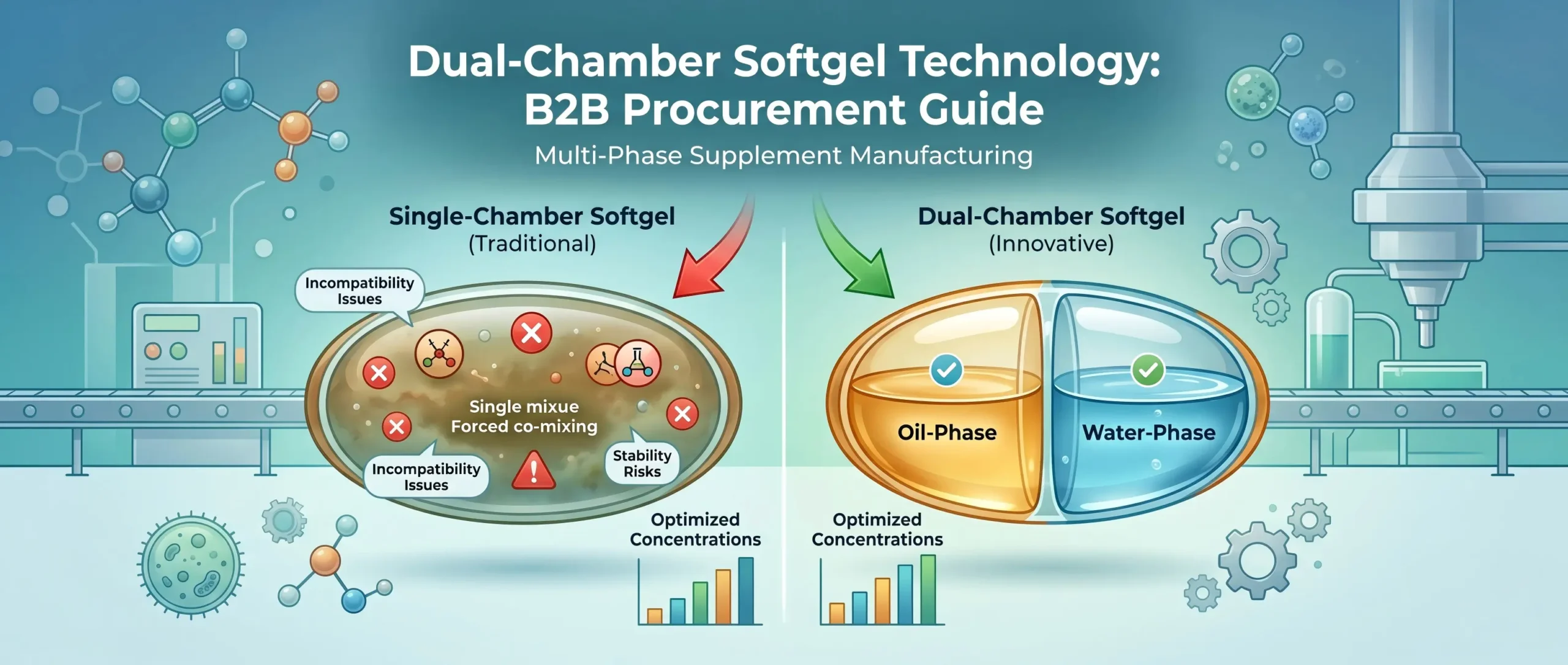
Single-chamber softgels force formulators to choose between oil-soluble and water-soluble actives, or to accept the stability risks of co-mixing incompatible ingredients. Dual-chamber architecture allows simultaneous delivery of oil-phase and water-phase actives at their individually optimized concentrations.
1.4 Better Consumer Experience
- Fewer capsules per day— one dual-chamber softgel replaces two or three separate products
- Simpler routines— consumers prefer consolidated dosing over multi-bottle regimens
- Reduced pill fatigue— a measurable driver of compliance and reorder rates in subscription models
CTA 1: Planning a dual-chamber softgel product line? Contact our formulation team for a compatibility assessment and pilot batch proposal.
2. Market Trends Driving Dual-Chamber Supplement Growth
Understanding the market dynamics behind dual-chamber demand is essential for procurement teams making portfolio decisions. The following trends are directly shaping OEM investment in multi-phase softgel capacity.
2.1 Growth of Combination Supplements
Consumers increasingly prefer all-in-one formulations that reduce capsule count while delivering multiple health benefits. According to industry data, the average supplement consumer now takes 4–6 products daily. Brands that consolidate these into fewer SKUs see measurable improvements in customer lifetime value and subscription retention.
Dual-chamber softgels are uniquely positioned to serve this trend because they combine oil-soluble and water-soluble actives — the two most common ingredient classes — in a single, hermetically sealed dose.
2.2 Rise of Longevity Formulations
The longevity supplement market is one of the fastest-growing categories globally. Key ingredients frequently combined in advanced healthy aging supplements include:
- NMN(Nicotinamide mononucleotide) — NAD+ precursor
- Resveratrol— Sirtuin activator
- Urolithin A— Mitophagy inducer
- Spermidine— Autophagy promoter
- CoQ10— Mitochondrial energy production
- PQQ— Cellular repair and mitochondrial biogenesis
Many of these ingredients have incompatible solubility profiles and stability requirements. NMN and Resveratrol, for example, are water-soluble and degrade in oxidative environments, while CoQ10 and PQQ are lipophilic and require oil carriers for optimal absorption. Dual-chamber architecture resolves this incompatibility.
2.3 Premium Beauty Supplements
The global nutricosmetics market is growing at a CAGR of approximately 8.5%, with Asia-Pacific and North America as the largest addressable markets. Astaxanthin + Glutathione + Hyaluronic Acid combinations continue to expand, particularly in South Korea, Japan, and China.
These formulations are inherently multi-phase: astaxanthin is highly lipophilic (log P ≈ 14.5) and requires an oil matrix, while glutathione and hyaluronic acid are water-soluble and require pH-controlled aqueous environments. Single-chamber co-formulation would compromise the stability of all three actives.
2.4 Sports Nutrition Consolidation
Athletic supplement consumers are moving away from multi-bottle stacks toward consolidated products. The demand for Omega-3 + Magnesium + Electrolyte combinations in a single dose is growing, particularly in endurance sports and CrossFit communities. Dual-chamber softgels address the technical challenge of combining hygroscopic magnesium salts with oil-phase omega-3s without shell integrity issues.
3. Consumer Questions Driving Dual-Chamber Innovation
Search behavior on Reddit, Quora, and Google directly validates the market need for dual-chamber technology. These are not hypothetical questions — they are the queries your future customers are already typing.
3.1 “Why Can’t Vitamin C and Fish Oil Be Mixed?”
This is one of the most frequently discussed formulation challenges in supplement chemistry. The mechanism is well-documented:
- Ascorbic acid (Vitamin C)is a strong reducing agent with a pKa of approximately 4.17. In aqueous environments, it readily donates electrons and is itself oxidized.
- Polyunsaturated fatty acids (PUFAs)in fish oil contain multiple double bonds highly susceptible to lipid peroxidation — an autocatalytic chain reaction initiated by free radicals.
- When co-formulated in a single matrix, the pro-oxidant environment created by ascorbic acid degradation accelerates the oxidation of PUFAs, leading to rancidity, off-flavors, and loss of EPA/DHA potency.
Research published in the Journal of Agricultural and Food Chemistry has demonstrated that the peroxide value (PV) of fish oil increases exponentially when stored in the presence of transition metal ions and acidic conditions — precisely the environment created by ascorbic acid dissolution. Fish oil products with elevated peroxide values (>5 meq O₂/kg) face rejection by quality-conscious retailers and regulatory scrutiny.
The dual-chamber solution: Vitamin C resides in the water-phase chamber; fish oil in the oil-phase chamber. The gelatin partition wall eliminates the degradation pathway entirely.
3.2 “Do Beauty Supplements Lose Potency Over Time?”
Yes — when incompatible actives are forced into a single matrix. Reduced L-glutathione (GSH), a tripeptide serving as the body’s primary intracellular antioxidant, is particularly vulnerable:
| Stability Factor | Single-Chamber Risk | Dual-Chamber Mitigation |
| Oxidation | GSH → GSSG (oxidized dimer) in presence of oxygen and metal ions | Anaerobic oil chamber prevents oxidation; aqueous chamber can include chelating agents |
| pH sensitivity | Optimal stability at pH 2–3; degrades rapidly above pH 7 | Aqueous chamber formulated to target pH range |
| Temperature | Degradation accelerates above 40°C | Each chamber optimized independently for thermal stability |
The hermetic sealing technology inherent to softgel manufacturing provides complete protection against oxygen, moisture, and light — critical for sensitive ingredients like glutathione, which can maintain potency for 3–4 years when properly sealed.
3.3 “How Are Sensitive Ingredients Protected in Premium Supplements?”
Astaxanthin is a ketocarotenoid with demonstrated benefits for skin elasticity, UV protection, and oxidative stress management. Its molecular structure contains conjugated double bonds that make it:
- Highly lipophilic (log P ≈ 14.5)
- Extremely light-sensitive
- Prone to oxidative degradation when exposed to air
In a dual-chamber configuration, astaxanthin is stabilized in an oil-based matrix (typically MCT oil or olive oil) with added tocopherols as synergistic antioxidants, while water-soluble co-actives (such as Vitamin C or hyaluronic acid) reside in the adjacent chamber. This architectural separation prevents cross-contamination of degradation products and preserves the bioactivity of both phases.
3.4 “Are Multi-Phase Supplements More Effective?”
From a bioavailability perspective, multi-phase delivery does not inherently increase absorption. However, from a commercial effectiveness standpoint, dual-chamber products deliver measurable advantages:
- Higher consumer compliance (fewer SKUs to manage)
- Reduced return rates (no rancidity complaints from oil-water incompatibility)
- Stronger brand differentiation (visible two-tone capsule design)
- Premium pricing justification (advanced technology positioning)
4. When Should You Use Dual-Chamber Softgels?
Not every formulation benefits from dual-chamber architecture. Procurement teams should use the following framework to determine whether the technology is appropriate for their product concept.
4.1 Ideal Applications
| Application Category | Rationale | Example Formulations |
| Oil + Water Formulas | Fundamental incompatibility between lipophilic and hydrophilic actives | Astaxanthin + Glutathione, CoQ10 + NMN |
| Oxidation-Sensitive Ingredients | One active accelerates degradation of another | Vitamin C + Fish Oil, Glutathione + Astaxanthin |
| Premium Beauty Supplements | Consumer expectation of ingredient separation and stability | Astaxanthin + Vitamin C + Hyaluronic Acid |
| Healthy Aging Stacks | Multi-ingredient longevity formulas with incompatible solubility | CoQ10 + PQQ + Resveratrol + NMN |
| Sports Recovery Systems | Combination of oil-phase anti-inflammatories and water-phase electrolytes | Omega-3 + Magnesium + Electrolytes |
| Women’s Health Formulations | Hormonal support + beauty actives with different solubility profiles | Evening Primrose Oil + Biotin + Hyaluronic Acid |
| Cognitive Health | Lipophilic brain lipids + water-soluble nootropics | DHA + Phosphatidylserine + Citicoline |
| Eye Health | Carotenoids + water-soluble antioxidants | Lutein + Zeaxanthin + Bilberry Extract |
| Immune Support | Oil-soluble vitamins + water-soluble minerals and botanicals | Vitamin D3 + Zinc + Vitamin C |
4.2 Not Recommended For
| Application Category | Rationale | Better Alternative |
| Single Ingredient Fish Oil | No incompatibility to resolve; added cost without benefit | Standard single-chamber softgel |
| Standard Vitamin D3 | Lipophilic single active; no water-phase requirement | Standard single-chamber softgel |
| Simple Botanical Oils | No multi-phase complexity; standard softgel is cost-optimal | Standard single-chamber softgel |
| Low-Cost Mass Market Products | Dual-chamber premium cannot be recovered at mass-market price points | Standard single-chamber softgel or hard capsules |
| Highly Acidic Water-Phase Formulas | pH < 2.0 can compromise gelatin shell integrity over time | Hard capsules with enteric coating |
| High-Aldehyde Ingredients | Aldehydes cause gelatin cross-linking (Maillard reaction) | HPMC-based softgels or hard capsules |
Decision Framework: If your formulation contains two or more actives with different solubility classes (oil-soluble vs. water-soluble) and at least one active is stability-sensitive, dual-chamber softgel is likely the optimal delivery technology.
5. Real-World Supplement Applications
The following application profiles represent the highest-demand dual-chamber softgel categories in the 2024–2026 market. Each profile includes chamber-specific ingredient assignments, functional rationale, and market context.
5.1 Beauty From Within Formulas
| Chamber | Active Ingredients | Functional Role |
| Oil Phase | Astaxanthin, Vitamin E (Tocopherols) | Lipophilic antioxidant protection, skin elasticity, UV defense |
| Water Phase | L-Glutathione (reduced), Vitamin C (Ascorbic acid) | Hydrophilic antioxidant, melanin inhibition, collagen synthesis support |
Market Context: The global nutricosmetics market is growing at a CAGR of approximately 8.5%. Products combining astaxanthin and glutathione command premium positioning in both retail and e-commerce channels, particularly in Asia-Pacific markets where skin-brightening supplements represent a $2.3 billion addressable market.
5.2 Healthy Aging & Longevity Formulas
| Chamber | Active Ingredients | Functional Role |
| Oil Phase | Coenzyme Q10 (Ubiquinone), PQQ (Pyrroloquinoline quinone) | Mitochondrial energy production, cellular repair, mitochondrial biogenesis |
| Water Phase | NMN (Nicotinamide mononucleotide), Resveratrol | NAD+ precursor support, sirtuin activation |
Formulation Note: CoQ10 is highly lipophilic and requires an oil carrier for optimal absorption. NMN is water-soluble and degrades in acidic, oxidative environments. Single-chamber co-formulation would compromise both actives. Dual-chamber separation preserves potency in each phase.
Extended Longevity Combinations:
| Combination | Oil Phase | Water Phase | Synergistic Mechanism |
| NMN + Resveratrol | Resveratrol (lipophilic) | NMN (water-soluble) | NAD+ synthesis + SIRT1 activation |
| Urolithin A + CoQ10 | CoQ10 (lipophilic) | Urolithin A (water-soluble) | Mitophagy + mitochondrial ATP production |
| Spermidine + Polyphenols | Polyphenol extract (lipophilic) | Spermidine (water-soluble) | Autophagy + antioxidant protection |
| Mitochondrial Support Complex | CoQ10 + PQQ | NMN + Resveratrol | Comprehensive mitochondrial health stack |
5.3 Women’s Health Formulas
| Chamber | Active Ingredients | Functional Role |
| Oil Phase | Evening Primrose Oil (GLA-rich) | Hormonal balance, skin hydration, PMS symptom relief |
| Water Phase | Biotin, Hyaluronic Acid | Hair and nail strength, dermal moisture retention |
Consumer Insight: Women’s health supplement buyers show high sensitivity to ingredient transparency. The visible separation of oil and water phases in a dual-chamber capsule reinforces the message that each active is preserved in its optimal environment.
5.4 Sports Recovery Formulas
| Chamber | Active Ingredients | Functional Role |
| Oil Phase | Omega-3 fatty acids (EPA/DHA) | Anti-inflammatory, joint mobility, cardiovascular support |
| Water Phase | Magnesium (as chelate), Electrolytes (potassium, sodium) | Muscle relaxation, cramp prevention, hydration balance |
Formulation Note: Magnesium salts are hygroscopic and can cause gelatin shell cross-linking if directly mixed with oil-phase ingredients. Separation into distinct chambers prevents shell integrity issues while delivering both actives in a single dose.
5.5 Cognitive Health Formulas
| Chamber | Active Ingredients | Functional Role |
| Oil Phase | DHA (Docosahexaenoic acid), Phosphatidylserine | Structural brain lipids, cell membrane integrity, cognitive function |
| Water Phase | Citicoline (CDP-Choline), Lion’s Mane Extract (Hericium erinaceus) | Acetylcholine precursor, neurogenesis support, nerve growth factor stimulation |
Formulation Note: DHA is highly lipophilic and optimally absorbed when delivered in an oil matrix. Citicoline is water-soluble and stable in neutral pH aqueous environments. Lion’s Mane extract is typically water-soluble and can be standardized for hericenones and erinacines. The dual-chamber format allows each nootropic to be preserved in its optimal environment while delivering a comprehensive cognitive support stack in a single dose.
5.6 Eye Health Formulas
| Chamber | Active Ingredients | Functional Role |
| Oil Phase | Lutein, Zeaxanthin | Macular pigment density, blue light filtering, antioxidant protection for retina |
| Water Phase | Bilberry Extract (anthocyanins), Vitamin C | Microcirculation support, collagen synthesis for ocular tissues, water-soluble antioxidant |
Formulation Note: Lutein and zeaxanthin are carotenoids with high lipophilicity that require oil-phase delivery for optimal bioavailability. Bilberry anthocyanins are water-soluble polyphenols that support retinal microcirculation. Co-formulation in a single matrix would result in poor lutein absorption and rapid anthocyanin degradation.
5.7 Immune Support Formulas
| Chamber | Active Ingredients | Functional Role |
| Oil Phase | Vitamin D3 (Cholecalciferol) | Immune modulation, T-cell activation, antimicrobial peptide production |
| Water Phase | Zinc (as bisglycinate), Vitamin C (Ascorbic acid), Elderberry Extract | Zinc-dependent immune signaling, antioxidant defense, viral inhibition |
Formulation Note: Vitamin D3 is lipophilic and optimally absorbed with dietary fat. Zinc and Vitamin C are water-soluble and can interact negatively with oil-phase ingredients if co-mixed (zinc can catalyze lipid oxidation; Vitamin C is acidic and can destabilize oil matrices). Dual-chamber separation ensures each immune-supportive nutrient retains its potency and bioavailability.
CTA 2: Have a specific dual-chamber formula in mind? Request our application-matched formulation portfolio and MOQ structure for your target category.
6. Dual-Chamber Softgel vs. Other Delivery Technologies
Procurement teams frequently search for comparative content when evaluating delivery technologies. The following comparison framework addresses the most common competitive alternatives.
6.1 Dual-Chamber Softgel vs Standard Softgel
| Criterion | Standard Softgel | Dual-Chamber Softgel |
| Active compatibility | Oil-soluble only or emulsified blends | Oil + water phases simultaneously |
| Stability risk | High for incompatible actives | Eliminated by physical separation |
| Formula complexity | Limited | High — supports multi-active stacks |
| Manufacturing cost | Lower | Higher (modified tooling, dual fill) |
| Shelf differentiation | Moderate | Excellent — visible two-tone design |
| Premium pricing | Moderate | High — 20–40% price premium achievable |
| OEM availability | Widespread | Limited — requires specialized equipment |
Verdict: Standard softgels remain the right choice for single-oil formulations (e.g., pure fish oil, Vitamin D3). Dual-chamber is the superior architecture when the formula requires both oil-soluble and water-soluble actives at full potency.
6.2 Dual-Chamber Softgel vs. Capsule-in-Capsule
Capsule-in-capsule (CiC) technology nests a smaller hard gelatin capsule inside a larger softgel capsule. While it achieves physical separation, it introduces significant drawbacks:
| Criterion | Capsule-in-Capsule | Dual-Chamber Softgel |
| Shell thickness | Two complete shells + air gap | Single shell with internal partition |
| Disintegration time | Longer (sequential shell rupture) | Faster (simultaneous release) |
| Fill volume efficiency | Lower (shells consume volume) | Higher (partition wall is minimal) |
| Manufacturing complexity | Very high — alignment and nesting challenges | High — but continuous rotary process |
| Consumer swallowability | Larger overall size | More compact for equivalent fill volume |
| Cost per unit | Significantly higher | Moderately higher vs standard softgel |
Verdict: Capsule-in-capsule is viable for pharmaceutical applications requiring exact dose separation (e.g., incompatible APIs). For dietary supplements, dual-chamber softgel offers superior fill efficiency, faster release, and lower unit cost.
6.3 Dual-Chamber Softgel vs Tablet-in-Softgel
Tablet-in-softgel (TiS) embeds a compressed tablet inside a softgel shell. This approach is rarely used in supplements due to:
- Disintegration mismatch: Tablets typically disintegrate in 15–30 minutes; softgel shells rupture in 5–15 minutes. The tablet may not release until the softgel shell has already passed the absorption window.
- Fill volume penalty: The tablet occupies significant volume, reducing the oil-phase fill capacity.
- Manufacturing yield: Tablet alignment within the softgel is difficult to control at high speeds.
Verdict: Tablet-in-softgel is not a practical alternative for most supplement applications. Dual-chamber softgel provides superior release kinetics and manufacturing efficiency.
6.4 Dual-Chamber Softgel vs Multi-Layer Capsules
Multi-layer hard capsules (e.g., HPMC capsules with internal compartments) achieve separation through molded internal walls. Comparison:
| Criterion | Multi-Layer Hard Capsule | Dual-Chamber Softgel |
| Shell material | HPMC or gelatin | Gelatin (Type A or B) |
| Light/oxygen barrier | Moderate (HPMC is more permeable) | Excellent (hermetically sealed) |
| Moisture protection | Moderate | Excellent |
| Consumer preference | Perceived as “pharmaceutical” | Perceived as “premium supplement” |
| Active loading | Lower (rigid shell limits fill volume) | Higher (flexible shell accommodates more fill) |
| Cost | Lower | Moderate |
Verdict: Multi-layer hard capsules suit moisture-sensitive powder formulations. Dual-chamber softgels are the optimal choice for liquid or semi-liquid fills requiring hermetic sealing and high active loading.
7. Oil Phase vs Water Phase: The Technical Foundation
While procurement decisions are driven by commercial outcomes, a working understanding of phase formulation principles enables better supplier evaluation and quality agreement negotiation.
7.1 Oil Phase Formulation Principles
Primary Carriers: – Medium-chain triglycerides (MCT oil) — rapid gastric emptying, neutral taste – Olive oil — natural antioxidant content, consumer familiarity – Fish oil — delivers EPA/DHA while serving as carrier for lipophilic actives – Sunflower oil — cost-effective, low allergenicity
Lipophilic Actives Commonly Assigned to Oil Phase:
| Active Ingredient | Solubility Class | Stability Concern in Mixed Phase |
| Astaxanthin | Highly lipophilic | Oxidation accelerated by water-soluble pro-oxidants |
| Coenzyme Q10 (Ubiquinone) | Lipophilic | Reductive degradation in aqueous acidic environments |
| Vitamin E (Tocopherols) | Lipophilic | Synergistic antioxidant; stable in oil matrix |
| Vitamin D3 (Cholecalciferol) | Lipophilic | Degrades in presence of peroxides |
| Lycopene | Lipophilic | cis-trans isomerization under oxidative stress |
| Omega-3 fatty acids | Lipophilic | Lipid peroxidation chain reaction |
| DHA | Highly lipophilic | Oxidative degradation in aqueous environments |
| Lutein / Zeaxanthin | Lipophilic | Degradation in presence of acidic aqueous phases |
Excipient Considerations: Using a blend of emulsifiers (such as lecithin combined with polysorbates) provides superior long-term stability compared to single-emulsifier systems. Key formulation rules: select the correct emulsifier system with HLB compatibility; verify phase ratios; add co-emulsifiers for structural support; control process temperature at 70–75°C; conduct accelerated stability and freeze-thaw cycles.
7.2 Water Phase Formulation Principles
Hydrophilic Actives Commonly Assigned to Water Phase:
| Active Ingredient | Solubility Class | Optimal pH Range |
| L-Glutathione (reduced) | Water-soluble | pH 2.0–3.5 |
| Vitamin C (Ascorbic acid) | Water-soluble | pH < 4.0 |
| Hyaluronic acid | Water-soluble | pH 6.0–7.5 |
| Collagen peptides | Water-soluble | pH 5.5–7.0 |
| Niacinamide | Water-soluble | pH 5.0–7.0 |
| NMN | Water-soluble | pH 6.0–7.0 |
| Resveratrol (trans-) | Slightly water-soluble | pH 5.0–7.0 |
| Citicoline | Water-soluble | pH 6.0–7.5 |
| Zinc (chelated) | Water-soluble | pH 5.5–7.0 |
Critical Water Phase Considerations:
- Water activity (a_w): Must be controlled to prevent shell swelling and microbial proliferation. Target a_w < 0.65 for the finished product.
- Preservative system: If the water phase is not self-preserving (e.g., through low pH or high osmolarity), a preservative system compliant with 21 CFR 172 must be incorporated.
- Compatibility with gelatin shell: The water phase must not contain ingredients that cause cross-linking of gelatin polymers (e.g., high levels of aldehydes or peroxides in PEG-based formulations).
7.3 Why Two Chambers Are Better Than One Emulsion
A common question: “Why not simply create a stable emulsion and fill a single-chamber softgel?”
- Emulsions are metastable systems.Over time, droplets coalesce, cream, or undergo phase separation. Temperature fluctuations and mechanical stress accelerate the rate of destabilization.
- Shelf life limitations:Even optimally formulated emulsions show signs of instability within 12–18 months. For supplement products targeting 24–36 month shelf lives, this is commercially unacceptable.
- Consumer perception:Phase separation in a softgel is interpreted as a product defect, leading to returns and negative reviews.
Dual-chamber technology eliminates the emulsion interface entirely. Each active resides in its own optimized environment, separated by a gelatin partition formed simultaneously with the outer shell during the rotary die encapsulation process.
8. Why Active Ingredients Must Be Separated
This section consolidates the technical rationale for dual-chamber architecture across the most common incompatible active pairs in premium supplement formulations.
8.1 Vitamin C + Fish Oil
Incompatibility mechanism: Ascorbic acid accelerates lipid peroxidation of PUFAs through metal-catalyzed redox cycling. The peroxide value of fish oil increases exponentially in acidic, oxidative environments.
Dual-chamber solution: Vitamin C in the water-phase chamber (pH-buffered to 2.5–3.5); fish oil in the oil-phase chamber with added tocopherols and citric acid as chelating agents.
8.2 Glutathione + Astaxanthin
Incompatibility mechanism: Reduced glutathione is oxidized to GSSG in the presence of oxygen and transition metal ions. Astaxanthin, while an antioxidant, cannot protect glutathione from oxidation in a mixed aqueous environment.
Dual-chamber solution: Glutathione in the water-phase chamber with nitrogen blanketing and chelating agents; astaxanthin in the oil-phase chamber with MCT oil and mixed tocopherols.
8.3 CoQ10 + NMN
Incompatibility mechanism: CoQ10 (ubiquinone) is lipophilic and requires an oil carrier. NMN is water-soluble and degrades in acidic, oxidative environments. Co-mixing would result in poor CoQ10 absorption and rapid NMN degradation.
Dual-chamber solution: CoQ10 in the oil-phase chamber with MCT oil and liposomal enhancement; NMN in the water-phase chamber with pH buffering and antioxidant stabilization.
8.4 Omega-3 + Magnesium
Incompatibility mechanism: Magnesium salts are hygroscopic and can cause gelatin shell cross-linking when in direct contact with oil-phase ingredients. Additionally, magnesium can catalyze lipid oxidation in the presence of moisture.
Dual-chamber solution: Omega-3 in the oil-phase chamber with antioxidant protection; magnesium chelate in the water-phase chamber with controlled water activity and pH stabilization.
8.5 DHA + Citicoline
Incompatibility mechanism: DHA is highly lipophilic and requires an oil matrix for absorption. Citicoline is water-soluble and hygroscopic. Co-mixing would result in poor DHA bioavailability and potential citicoline degradation in the oil environment.
Dual-chamber solution: DHA in the oil-phase chamber with phosphatidylserine as co-carrier; citicoline in the water-phase chamber with pH buffering.
8.6 Lutein + Bilberry
Incompatibility mechanism: Lutein is a carotenoid with high lipophilicity. Bilberry anthocyanins are water-soluble polyphenols that degrade rapidly in acidic or oxidative oil environments.
Dual-chamber solution: Lutein + zeaxanthin in the oil-phase chamber; bilberry extract + Vitamin C in the water-phase chamber.
9. Why Dual-Chamber Softgels Are Difficult to Manufacture
Understanding the technical barriers to dual-chamber manufacturing helps procurement teams evaluate why this capability is scarce and why it commands a premium.
9.1 Partition Wall Formation
The internal partition wall in a dual-chamber softgel is not a separate component inserted after encapsulation. It is formed in-situ during the rotary die process by introducing a third, thinner gelatin ribbon between the two primary ribbons. This requires:
- Precision ribbon thickness control: The partition ribbon must be thin enough to minimize fill volume loss (typically 0.015–0.020 in) but thick enough to maintain structural integrity during drying and handling.
- Synchronized ribbon speed: All three ribbons must advance at exactly the same linear velocity to prevent wrinkling, tearing, or misalignment of the partition wall.
- Temperature uniformity: The partition ribbon must maintain the same gel mass temperature as the outer ribbons (55–65°C) to ensure consistent viscosity and sealing properties.
9.2 Dual Fill Synchronization
Two independent fill materials — with different viscosities, densities, and surface tensions — must be injected simultaneously into their respective chambers without cross-contamination:
- Viscosity matching:Oil-phase fills typically have viscosities of 50–200 cP; water-phase fills range from 1–100 cP. Mismatched viscosities cause uneven chamber fill distribution.
- Density balancing:If the oil-phase fill is significantly denser than the water-phase fill, gravitational separation during the brief interval between injection and sealing can cause chamber collapse.
- Surface tension control:The interfacial tension between the fill material and the gelatin ribbon affects wetting and spreading. Poor wetting leads to air pockets and incomplete chamber formation.
9.3 Seal Integrity
The seal between the two chambers and the outer shell must be hermetic under all storage conditions:
- Seal thickness consistency: Variations >0.05 mm in seal thickness create weak points prone to leakage during temperature cycling.
- Gelatin cross-linking prevention: Water-phase ingredients with aldehyde content or high peroxide values can cause localized gelatin cross-linking at the seal interface, compromising integrity over time.
- Drying stress management: As the shell loses moisture during primary and secondary drying, differential shrinkage between the outer shell and partition wall can induce microcracks at the seal junction.
9.4 Chamber Leakage Prevention
Leakage between chambers is the most critical quality defect in dual-chamber softgels. Prevention requires:
- Dye penetration testing: Every production batch must be sampled for dye penetration (typically using methylene blue or fluorescein) to verify partition wall integrity.
- Pressure differential testing: Some manufacturers apply a slight pressure differential between chambers during in-process testing to detect microscopic leaks.
- Accelerated stability verification: Chamber integrity must be confirmed at T=0, 3, 6, and 12 months under both long-term and accelerated conditions.
9.5 Yield Optimization
Dual-chamber softgels have inherently lower manufacturing yields than single-chamber products:
| Yield Factor | Single-Chamber | Dual-Chamber | Root Cause |
| Startup Rejections | 2–3% | 5–8% | Dual fill synchronization takes longer to stabilize |
| Partition wall defects | N/A | 3–5% | Wrinkling, tearing, or misalignment of third ribbon |
| Seal integrity failures | <1% | 2–4% | Incomplete sealing at die interface |
| Chamber cross-contamination | N/A | 1–3% | Fill material migration during injection |
| Overall first-pass yield | 95–98% | 88–93% | Cumulative defect rates |
Yield optimization is an ongoing process that requires statistical process control (SPC), real-time monitoring of critical process parameters, and continuous operator training.
9.6 Stability Validation
Dual-chamber products require a more extensive stability validation program than single-chamber equivalents:
- Per-chamber content uniformity: Each chamber must be assayed independently at every stability time point.
- Partition wall integrity over time: Dye penetration testing must be repeated at 6, 12, 18, 24, and 36 months.
- Cross-chamber migration studies: Even with intact partition walls, some active ingredients may migrate through the gelatin matrix over extended storage. Migration studies using radiolabeled or highly sensitive analytical methods are recommended for products with 36-month shelf life targets.
10. Stability Testing Requirements
A defensible stability program is non-negotiable for dual-chamber softgel products. The following framework represents the minimum standard for B2B procurement evaluation.
10.1 ICH Q1A(R2) Stability Testing Framework
The International Council for Harmonisation (ICH) Q1A(R2) guideline provides the foundational framework for stability testing. While dietary supplements are regulated differently from pharmaceuticals in most jurisdictions, applying ICH standards demonstrates scientific rigor and supports premium positioning.
| Study Type | Temperature | Relative Humidity | Duration | Purpose |
| Long-term | 25°C ± 2°C | 60% ± 5% RH | 12 months minimum | Establish real-world shelf life |
| Intermediate | 30°C ± 2°C | 65% ± 5% RH | 6 months minimum | Climatic Zone II simulation |
| Accelerated | 40°C ± 2°C | 75% ± 5% RH | 6 months minimum | Predict degradation trends |
For tropical markets (Climatic Zones IVa/IVb), long-term conditions shift to 30°C ± 2°C / 75% ± 5% RH.
10.2 USP Testing Requirements
| Test | Method | Acceptance Criteria | Relevance to Dual-Chamber |
| USP <701> Disintegration | Standard apparatus, 37°C | ≤30 minutes | Confirms both chambers release simultaneously |
| USP <2040> Rupture | Modified apparatus | Shell rupture within specified time | Validates partition wall integrity |
| USP <1217> Hardness | Compression or penetration | Within specification range | Ensures mechanical integrity during handling |
Research from St. John Fisher University demonstrated that softgel capsules subjected to accelerated stability conditions (40°C/75% RH) for four weeks passed USP <701> disintegration but showed differences in USP <2040> rupture test performance — highlighting the importance of method selection in stability protocols.
10.3 FDA Stability Testing Requirements for Softgels
The FDA’s guideline on stability testing specifies that soft gelatin capsule testing should include:
- Appearance: Color, clarity, shape consistency
- Odor of content: Rancidity detection for oil phases
- Assay: Potency of all active ingredients in both chambers
- Degradation products: Related substances by HPLC
- Dissolution: Release profile under specified conditions
- Microbial limits: Total aerobic count, yeast and mold
- Leakage: Visual inspection and dye penetration testing
10.4 Dual-Chamber Specific Stability Considerations
Beyond standard softgel testing, dual-chamber products require additional validation:
| Test Parameter | Method | Acceptance Criteria |
| Chamber integrity | Dye penetration test | No cross-chamber leakage |
| Fill weight uniformity | Gravimetric (per chamber) | ±5% of target |
| Content uniformity | HPLC (per chamber) | USP <905> requirements |
| Moisture permeation | USP <671> | <1 mg/day |
11. Is Dual-Chamber Softgel Worth the Additional Cost?
This is the question procurement managers ask most frequently. The answer depends on the formulation, the target market, and the brand’s positioning strategy.
| Factor | Standard Softgel | Dual-Chamber Softgel |
| Manufacturing Complexity | Low | High |
| Formula Flexibility | Moderate | Excellent |
| Shelf Differentiation | Moderate | Excellent |
| Premium Pricing Potential | Moderate | High (20–40% premium) |
| Stability Performance | Moderate | High |
| Consumer Compliance | Moderate (multiple SKUs) | High (single-dose convenience) |
| Return Rate Risk | Higher (rancidity, degradation) | Lower (physical separation) |
| Competitive Moat | Low | High |
The critical insight: When the formulation contains incompatible active ingredients, the cost of instability — product returns, negative reviews, retailer rejection, and reformulation — often exceeds the additional manufacturing cost of dual-chamber architecture.
Investment Considerations:
Typical dual-chamber projects require significantly higher tooling, development, validation, and quality control investment than standard softgels. Actual costs vary based on capsule size, chamber ratio, ingredient complexity, and regulatory requirements. Key cost drivers include:
- Modified die tooling: Dual-chamber requires custom die rolls with partition geometry
- Extended development timeline: Formulation optimization for two independent phases
- Enhanced QC requirements: Per-chamber testing at every stage
- Lower production yields: 88–93% vs. 95–98% for standard softgels
- Higher MOQ: Due to die changeover and setup costs
For brands targeting premium positioning in beauty, healthy aging, or sports recovery categories, the dual-chamber investment is typically recovered within the first production run through higher unit pricing and lower return rates.
12. How to Evaluate a Dual-Chamber Softgel Manufacturer
Procurement teams should evaluate OEM partners across six dimensions. The following framework provides a structured assessment methodology.
12.1 Equipment Capability
| Requirements | What to Verify | Documentation to Request |
| Rotary die encapsulators | Dual-chamber capability (dual-ribbon, dual-injection configuration) | Equipment list with model numbers and specifications |
| Drying capacity | Sufficient tunnel dryer capacity for projected volumes | Tunnel dryer specifications and loading capacity |
| Environmental control | Temperature and humidity control in production and drying areas | Environmental monitoring mapping reports |
12.2 Stability Testing Capability
| Requirements | What to Verify | Minimum Standard |
| In-house analytical lab | HPLC, dissolution apparatus, hardness testers | Full in-house capability; no outsourced testing with >5-day turnaround |
| Stability chambers | ICH-compliant long-term, intermediate, and accelerated conditions | Validated chambers with continuous monitoring and alarm systems |
| Stability protocol | ICH Q1A-compliant with dual-chamber specific parameters | 12-month long-term data available for reference products |
12.3 Regulatory Documentation
| Requirements | What to Verify | Red Flags |
| GMP certification | Current FDA/EMA/NSF GMP certificate | Expired, conditional, or pending certification |
| Regulatory filing experience | DMF, ANDA, or NDI filing history | No experience with formal regulatory submissions |
| Export documentation | COA, CFS, Certificate of Origin capability | Inability to provide market-specific documentation |
12.4 Commercial Scale Experience
| Requirements | What to Verify | Minimum Standard |
| Dual-chamber portfolio | Number of successfully commercialized dual-chamber SKUs | ≥3 commercialized products with stability data |
| Batch records | Complete traceability from raw material to finished goods | Redacted batch records available for review |
| Change control | Formal risk assessment for all formulation changes | Documented SOP with QA approval workflow |
12.5 MOQ Flexibility
| Requirements | What to Verify | Consideration |
| Minimum order quantity | Per-SKU and per-formulation MOQ | Dual-chamber MOQs are typically higher than standard softgels due to die setup costs |
| Scale-up pathway | Pilot batch to commercial batch transition | Clear scale-up protocol with validated process parameters |
| Multi-SKU flexibility | Ability to run multiple dual-chamber SKUs on shared tooling | Tooling changeover time and cost |
12.6 Global Export Experience
| Requirements | What to Verify | Key Markets |
| Export documentation | COA, CFS, Certificate of Free Sale, Halal/Kosher certificates | US, EU, ASEAN, Middle East |
| Regulatory compliance | FDA registration, EFSA notification, TGA listing | Target market-specific compliance |
| Logistics capability | Temperature-controlled shipping, customs documentation | Cold chain for oil-phase products |
13. Why Brands Choose KS Nutripharma for Advanced Softgel Projects
13.1 Manufacturing Scale and Experience
- 19+ years of softgel manufacturing experience
- 81,000㎡GMP-certified facility
- 12 production lines, including rotary die encapsulators with dual-chamber capability
- 260+ specialists across production, QC, and R&D
- 2 R&D centers dedicated to formulation development and stability testing
- 500+ global brands served across 60+ countries
13.2 Advanced Multi-Component Delivery Systems
Beyond dual-chamber softgels, KS Nutripharma’s technology portfolio includes:
- Capsule-in-Capsule Technology— For exact dose separation of incompatible APIs
- Tablet-in-Softgel Technology— For solid + liquid active combinations
- Pellet-in-Softgel Technology— For delayed-release + immediate-release combinations
- Delayed Release Softgels— Enteric-coated softgels for acid-sensitive actives
- Vegetarian Softgels— HPMC and pullulan-based shells for vegan positioning
- Bi-Color Softgels— Aesthetic differentiation for premium brands
This multi-technology capability allows KS Nutripharma to recommend the optimal delivery system for each formulation, rather than defaulting to a single technology platform.
13.3 End-to-End Development Support
From ingredient compatibility evaluation through commercial scale-up, KS Nutripharma provides:
- Formulation development: Oil-phase and water-phase optimization with excipient screening
- Pilot stability verification: ICH Q1A-compliant accelerated and long-term programs
- Regulatory documentation: COA, CFS, stability summaries, and market-specific filings
- Commercial manufacturing: Validated processes with SPC-controlled critical parameters
- Quality assurance: In-house analytical lab with HPLC, dissolution, and hardness testing
- Global logistics: Temperature-controlled shipping and export documentation
14. Dual-Chamber Softgel Development at KS Nutripharma
This section details the specific capabilities and processes that KS Nutripharma applies to dual-chamber softgel projects.
14.1 Dual-Chamber Development Process
Stage 1: Ingredient Compatibility Evaluation
Before any development work begins, our formulation team conducts a comprehensive compatibility assessment for both proposed actives. Key evaluation parameters include:
- Chemical properties (molecular weight, solubility, stability in formulation and storage)
- Physical form (solid, liquid, or semi-solid — affects solvent and excipient selection)
- Thermal properties (melting point and thermal stability determine processing conditions)
- Hygroscopicity (moisture absorption from shell mass can cause stability issues)
- Polymorphism (different crystal forms impact solubility and stability)
Decision Gate: If either active is incompatible with gelatin (e.g., aldehyde-containing ingredients that cause cross-linking), we evaluate modified shell formulations (HPMC, pullulan, or starch-based alternatives).
Stage 2: Multi-Phase Formula Development
Our R&D team develops the oil-phase and water-phase formulations independently, optimizing each for:
- Active ingredient stability (pH, antioxidant protection, chelation)
- Fill viscosity and density matching (critical for encapsulation uniformity)
- Excipient compatibility with the gelatin shell
- Sensory profile (taste, odor, color for consumer acceptance)
Stage 3: Pilot Stability Verification
Before commercial scale-up, we conduct a pilot stability program:
- Accelerated stability:40°C / 75% RH for 6 months (ICH Q1A)
- Long-term stability:25°C / 60% RH for 12 months minimum
- Chamber integrity testing: Dye penetration and cross-chamber leakage verification
- Content uniformity: HPLC quantification per chamber at T=0, 1, 3, 6, 12 months
Stage 4: Commercial Scale Manufacturing
The rotary die process is modified for dual-chamber production:
- Two gelatin ribbons are cast from heated drums
- A third, thinner gelatin ribbon is introduced as the partition wall
- Two independent injection wedges deliver oil fill and water fill simultaneously
- Modified die rolls create the dual-chamber geometry
- Sealing and cutting occur in one continuous operation
Critical Process Parameters (CPPs):
| CPP | Target Range | Control Method |
| Ribbon thickness | 0.025–0.032 in (0.64–0.81 mm) | Laser micrometer, ±0.1 mm tolerance |
| Gel mass temperature | 55–65°C | Jacketed transfer pipes with PID control |
| Die roll temperature | 37–40°C | Heated oil circulation |
| Fill temperature | 20–30°C (oil); 15–25°C (aqueous) | Jacketed tanks with cooling |
| Injection pressure | 2–5 bar | Precision pump with feedback control |
Stage 5: Quality Control and Release
In-process and finished product testing for dual-chamber softgels includes:
- Shell strip thickness (each ribbon)
- Seal thickness at encapsulation
- Fill weight per chamber (±5% tolerance)
- Moisture level of shell wall
- Softgel hardness at end of drying phase
- Organoleptic properties (coloration, appearance, cracking, shrinkage)
- Active ingredient quantification per chamber (HPLC)
- Disintegration time (USP <701>)
- Content uniformity (USP <905>)
- Microbiological controls
- Shelf-life stability (ongoing annual testing)
14.2 Quality Agreement Essentials
The quality agreement between KS Nutripharma and brand partners explicitly addresses:
- Dual-chamber specific specifications: Fill weight per chamber, partition wall integrity, cross-chamber leakage limits
- Stability commitment: Minimum 12-month long-term data before commercial release; ongoing annual stability
- Deviation management: Classification of dual-chamber specific defects (chamber collapse, uneven fill distribution, partition wall thinning)
- Recall procedures: Traceability to batch, lot, and chamber-level fill records
- Technology transfer: Documentation requirements if manufacturing is moved to a secondary site
CTA 3: Ready to develop your dual-chamber softgel product line? Request a formulation compatibility assessment, pilot batch proposal, and commercial MOQ structure from our technical team.
15. Frequently Asked Questions
What is a dual-chamber softgel?
A dual-chamber softgel is a soft gelatin capsule containing two physically separated compartments, each filled with a different formulation. Typically, one chamber contains an oil-phase formulation and the other contains a water-phase formulation, allowing incompatible active ingredients to be delivered in a single dose without degradation.
How does a dual-phase softgel work?
During ingestion, the gelatin shell dissolves in the gastric environment, releasing both chambers simultaneously. The oil-phase contents form micelles for lipophilic active absorption, while the water-phase contents dissolve directly into the aqueous gastric fluid. Both actives are absorbed through their respective pathways.
What ingredients can be separated in a dual-chamber softgel?
Any combination of oil-soluble (lipophilic) and water-soluble (hydrophilic) actives can be separated. Common pairings include: astaxanthin + glutathione, CoQ10 + NMN, omega-3 + magnesium, DHA + citicoline, lutein + bilberry extract, and vitamin D3 + zinc.
Is dual-chamber technology better than capsule-in-capsule?
For dietary supplements, dual-chamber softgels are generally superior to capsule-in-capsule (CiC) technology. Dual-chamber softgels offer faster disintegration (simultaneous release vs. sequential), higher fill volume efficiency, lower unit cost, and more compact size for equivalent active loading.
Can NMN and CoQ10 be combined in a dual-chamber softgel?
Yes. NMN is water-soluble and optimally stable in a neutral pH aqueous environment. CoQ10 is lipophilic and requires an oil carrier for absorption. A dual-chamber softgel places NMN in the water-phase chamber and CoQ10 in the oil-phase chamber, preserving the stability and bioavailability of both actives.
Can glutathione and astaxanthin be formulated together?
Yes, but only in a dual-chamber configuration. Glutathione is water-soluble and oxidizes rapidly in the presence of oxygen and metal ions. Astaxanthin is oil-soluble and stable in an oil matrix with antioxidant protection. Physical separation in a dual-chamber softgel prevents cross-degradation.
What is the shelf life of dual-chamber softgels?
When properly formulated and stored, dual-chamber softgels typically achieve a shelf life of 24–36 months. The hermetic sealing of the gelatin shell protects both chambers from oxygen, moisture, and light. Stability must be verified through ICH Q1A-compliant long-term and accelerated testing programs.
Are dual-chamber softgels suitable for beauty supplements?
Yes. Beauty supplements are one of the primary applications for dual-chamber technology. Formulations combining astaxanthin (oil-phase) with glutathione and hyaluronic acid (water-phase) are particularly well-suited to dual-chamber delivery, as these actives have incompatible solubility profiles and stability requirements.
What is the MOQ for dual-chamber softgel manufacturing?
Minimum order quantities for dual-chamber softgels are typically higher than standard softgels due to custom die tooling and extended setup requirements. Actual MOQ depends on capsule size, chamber ratio, and formulation complexity. Contact our technical team for project-specific MOQ and pricing.
How are chamber leakage risks controlled?
Chamber leakage is controlled through three mechanisms: (1) precise partition wall thickness and uniformity during rotary die encapsulation; (2) dye penetration testing of every production batch; and (3) ongoing stability verification at 6, 12, 18, 24, and 36 months to detect any degradation of partition wall integrity over time.
Can vegetarian shells be used for dual-chamber softgels?
Yes. HPMC (hydroxypropyl methylcellulose) and pullulan-based shells can be adapted for dual-chamber configurations. However, vegetarian shells have different mechanical properties and moisture permeation characteristics compared to gelatin, requiring reformulation of the shell composition and drying parameters. Vegetarian dual-chamber projects require additional development time and validation.
What testing is required before commercialization?
Before commercial release, dual-chamber softgels require: (1) per-chamber content uniformity testing; (2) chamber integrity verification (dye penetration); (3) USP <701> disintegration testing; (4) USP <2040> rupture testing; (5) ICH Q1A-compliant accelerated stability (6 months at 40°C/75% RH); (6) ICH Q1A-compliant long-term stability (12 months at 25°C/60% RH); and (7) microbiological testing per USP <61> and <62>.
16. Related Technologies
KS Nutripharma’s softgel technology portfolio extends beyond dual-chamber systems to support a wide range of formulation requirements:
- Capsule-in-Capsule Technology— For exact dose separation of incompatible APIs with pharmaceutical-grade precision
- Tablet-in-Softgel Technology— For solid active + liquid active combinations requiring different release profiles
- Pellet-in-Softgel Technology— For delayed-release + immediate-release combinations within a single dose
- Delayed Release Softgels— Enteric-coated softgels for acid-sensitive actives requiring intestinal release
- Vegetarian Softgels— HPMC and pullulan-based shells for vegan and vegetarian positioning
- Bi-Color Softgels— Two-tone gelatin shells for aesthetic differentiation and brand recognition
17. References and Verified Data Sources
All data, guidelines, and technical specifications cited in this guide are sourced from publicly available, verifiable references, categorized by authority level.
Primary Sources (Regulatory and Academic)
- “Stability Testing of Drug Substances and Drug Products.”GMP Compliance Academy. http://academy.gmp-compliance.org/guidemgr/files/1-7-3.pdf
- PMC (PubMed Central).“Shell Formulation in Soft Gelatin Capsules: Design and Evaluation.” https://pmc.ncbi.nlm.nih.gov/articles/PMC11468233/
- John Fisher University. “Evaluation of Dietary Softgel Capsules using USP<701> and USP<2040>: A Comparative Disintegration Study.”Pharmacy Faculty Publications. https://fisherpub.sjf.edu/pharmacy_facpub/218/
- MHLW (Japan).“FDA Container Closure System Guidelines.” https://mhlw-grants.niph.go.jp/system/files/2004/044051/200401201A/200401201A0007.pdf
- Aenova Group.“Formulation Development — Softgel Capsules.” https://www.pharmacompass.com/pdf/party/content/aenova-group-party-content-15022.pdf
- JinLu Packing.“How Softgel Capsules Are Made: Complete Manufacturing Process Guide.” https://www.jinlupacking.com/blogs/how-softgel-capsules-are-made/
- ISAR Publisher.“Softgel Quality Control and Stability Testing.” https://article.isarpublisher.com/download/541
- “Gelatin Capsule Hardness tester Softgel Pharmacopeia USP.” https://www.ruptureforce.com/gelatin-capsule-hardness-tester/
- University of Basrah.“Soft-gels.” Pharmaceutics Lecture Notes. https://un.uobasrah.edu.iq/lectures/6037.pdf
- Nutricraft Labs.“Softgels Manufacturing.” Dosage Forms Guide. https://nutricraftlabs.com/dosage-forms/softgels
- BioBoston Consulting.“A Deep Dive into ICH Stability Guidelines (Q1A-Q1F).” https://biobostonconsulting.com/a-deep-dive-into-ich-stability-guidelines-q1a-q1f/
- “What are the ICH Q1A stability testing temperature requirements?” https://www.senseanywhere.com/what-are-the-ich-q1a-stability-testing-temperature-requirements/
- in.“ICH Guidelines for API Stability: Q1A–Q1E and Q3C Explained.” https://www.stabilitystudies.in/ich-guidelines-for-api-stability-q1a-q1e-and-q3c-explained/
- The Cosmetic Formulator.“The Science Behind Creating Stable Emulsions.” https://www.thecosmeticformulator.com/post/how-to-stop-emulsions-separating-the-science-behind-creating-stable-emulsions
- edu.“Formulation and stability of topical water in oil emulsion containing corn silk extract.” https://www.academia.edu/74138957/Formulation_and_stability_of_topical_water_in_oil_emulsion_containing_corn_silk_extract
About This Guide
The KS Nutripharma technical team prepared this technical guide for B2B procurement professionals evaluating dual-chamber softgel OEM partners. All regulatory references reflect publicly available guidance documents as of June 2026. For product-specific regulatory advice, consult qualified regulatory affairs professionals familiar with your target markets.
Keywords: dual chamber softgel, dual phase softgel, two chamber softgel, multi phase softgel, oil and water softgel, softgel OEM, supplement contract manufacturing, glutathione softgel, astaxanthin softgel, beauty supplement formulation, ICH Q1A stability testing, USP softgel testing, softgel quality control, dual chamber vs capsule in capsule, dual chamber softgel cost, NMN softgel, CoQ10 softgel, longevity supplement manufacturing, cognitive health softgel, eye health softgel, immune support softgel