Oral glutathione is not one specification. Reduced GSH oxidizes to GSSG in process and pack; that shows up as assay drift and, often, yellowing. Before you compare factory quotes, lock the milligram basis and the GSH/GSSG fields — then send the brief to a glutathione supplement manufacturer.
Why glutathione yellows in the bottle
Reduced glutathione (the usual reduced L-glutathione conversation) is a tripeptide. The cysteine thiol is the chemically active handle — and the reason a glutathione fill is not a generic “antioxidant powder” in the hopper. That thiol oxidizes to glutathione disulfide (GSSG) when moisture, heat, oxygen, or light get a chance. Incoming powder is often white or off-white. Packed capsules that later look yellow, tan, or mottled are showing the same chemistry in the bottle. Yellowing is a visible signal. It is not a second, more potent antioxidant story.
The change is faster when water activity in the fill is high, when weigh-up and blending leave the powder open to humid air, when bottle or sachet headspace holds oxygen, when the pack transmits light, and when the climate lane is hot or humid for weeks. Time in a warehouse is not the only clock. A long ocean freight run — heat in a container, humidity at destination — can do more to a poorly packed reduced-glutathione SKU than a short temperate lane.
Process exposure is often where two “same formula” lots diverge. Reduced glutathione that sits in an open hopper, a long blend, or a slow encapsulator sees more oxygen and moisture than a short, closed handling window. Capsule color that shifts uniformly is one picture; tablet mottling is another. Both are reasons to re-assay finished units. Neither is a reason to treat a darker shell or a film coat as the stability specification.
Pack is part of stability, not a graphic afterthought. Desiccant is a moisture play inside a bottle. Nitrogen or a tighter headspace is an oxygen play. They are not substitutes for each other, and neither is a universal line setting. A clear bottle plus a windowed carton is a light path; an opaque pack removes that path and still leaves moisture and oxygen to manage. Bottle versus blister, and the destination climate, belong on the same brief as the milligram line. If the only pack sentence on the RFQ is “HDPE 60 count,” two factories can quote the same fill and still ship different remaining reduced glutathione six months later.
Stick packs add a seal question. A weak seal or a pinhole is a moisture path into a high-surface fill. Glutathione milligrams declared per stick still need a stick-level assay; a drum certificate on the glutathione powder does not speak for the laminated pack after freight.
A useful factory check is incoming versus packed. A white drum COA does not prove the capsule in the shipper. If the powder was in spec and the finished units yellowed, the problem is process, pack, or both — humidity during blending and fill, residence time, seal integrity, barrier, or storage — not a need to rename the SKU. When a retailer opens a complaint, re-assay finished units on the named method. Do not answer with a new brochure.
When you compare two supplier files, read GSH and GSSG on the same method. A headline “98% glutathione” on the incoming drum does not tell you how much is still reduced in the bottle, and it does not tell you whether the second source used the same assay. Purity on the raw-material certificate and remaining reduced glutathione after fill are different questions.
Liquids, drink sticks, and gummies are harsher than a dry capsule: water, heat, and (for gummies) the commercial cook all move the thiol. If the artwork will still declare reduced glutathione after a cook or a liquid fill, the release conversation has to include assay of the finished piece, not only the recipe.
GSH vs GSSG on the COA
Reduced GSH is the shelf conversation for most oral SKUs: milligrams declared as reduced L-glutathione, with a named method. HPLC is the usual commercial conversation for the glutathione line. GSSG belongs on the certificate as a ratio or oxidation check — not a second labeled glutathione SKU, and not a milligram claim next to GSH unless the brief says so.
Put GSH/GSSG on release when the climate lane is humid, when the format is stick, gummy, or liquid, or when the label stresses reduced glutathione. Otherwise keep GSSG in the file as an oxidation check, so a later yellowing complaint has a baseline. For how the blocks of a certificate are read in general, see How to Read a COA.
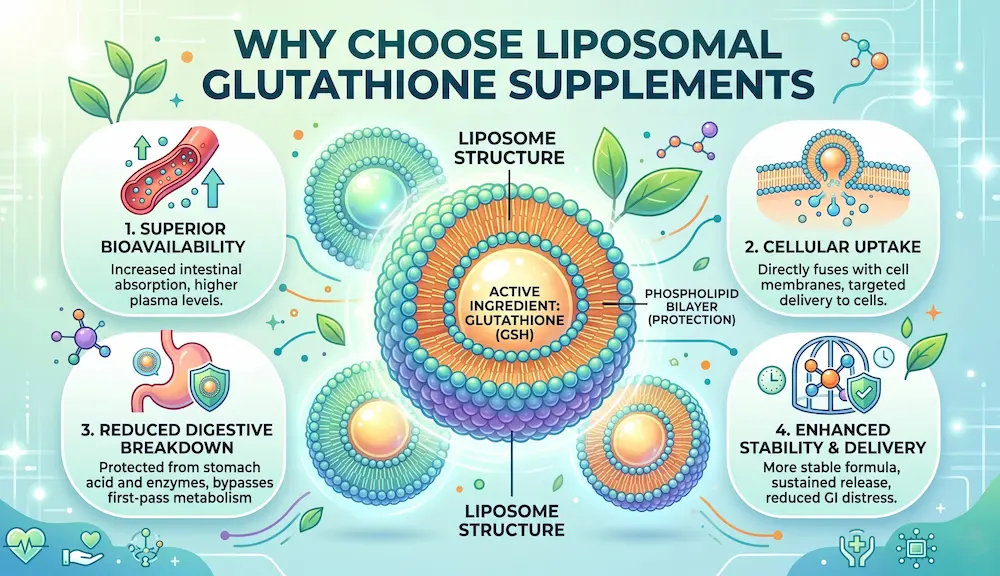
S-acetyl glutathione is a different labeled ingredient (different milligram basis). If the artwork will print liposomal, the file needs a vesicle method — not lecithin listed next to GSH. That architecture is quoted as liposomal glutathione. A liposomal claim does not mean GSH/GSSG can be skipped.
What oral GSH studies do — and do not — tell a brand
A single pharmacokinetic paper is not a Supplement Facts line. Do not copy a study milligram, a blood-GSH delta, or a weeks-long protocol onto the label as if the commercial bottle were the trial material. Liposomal, micellar, and S-acetyl doses do not transfer 1:1 onto a reduced L-glutathione powder in a two-piece capsule. That is brand expectation management — not a reason to abandon a dry capsule SKU, and not a license to write a clinical outcome on pack. Disease endpoints and skin-whitening clinical copy stay off the brief; antioxidant and beauty-from-within positioning remains a destination-market counsel job.
Claim lines that do not belong on a GSH deck
Keep the artwork inside oral dietary-supplement positioning. The following lines do not belong on the brief:
- Skin bleaching / whitening / tyrosinase-drug copy. The EU register does not give glutathione a whitening health claim to copy onto pack. That path is a drug or cosmetic-drug file, not this program.
- Treat liver disease or “Phase I/II detox drug” language. Liver-wellness positioning, when a formula actually names milk thistle, is still a counsel-owned structure/function question — not a treatment claim.
- IV / injectable glutathione. This program covers oral dietary supplements.
- Unauthorized branded clinical extracts as the factory default. Unbranded fermentation-derived L-glutathione with a named assay is the usual starting specification. A trademarked grade appears when the customer supplies the license and the documentation.
Allowed conversations, where the destination market permits structure/function language: antioxidant, cellular wellness, beauty-from-within. Local counsel owns the finished label.
What to send before you ask for a quote
A comparable quote needs more than “glutathione 500 mg, capsules.” Name destination market; reduced L-glutathione, S-acetyl, or liposomal; milligram basis (as GSH or as S-acetyl); dosage form; whether GSH/GSSG must appear on release; pack and climate lane. If you are comparing sources, send two certificates of analysis against the same declared strength and the same method name.
Specification-led quoting lives on the glutathione supplement manufacturer page.
Send this brief to manufacturing
Frequently Asked Questions
Does yellow always mean the lot failed?
No. Yellowing is a visual cue that oxidation may have moved. Failure is an assay question: whether finished units still meet the named glutathione window — and GSH/GSSG when that field is on the release file. A still-white capsule is not a substitute for that test either.
Can we hide yellowing with a dark capsule shell?
An opaque or dark shell can hide color in a product photo. It does not stop the thiol from oxidizing, and it does not replace finished-unit assay. Appearance and remaining reduced glutathione are different specifications.
Is GSSG dangerous, or just a QC ratio?
GSSG is a specification field — a ratio or oxidation check — not a second consumer SKU and not a medical conclusion. Read it as how much of the glutathione line is still reduced, under the same method as the GSH assay.
Can an incoming “98% glutathione” COA stand in for finished-unit GSH?
No. Incoming purity and remaining reduced glutathione after fill are different specifications. Compare GSH — and GSSG when it is on release — on finished units, on the same named method. Two drums that both say 98% are not comparable if the methods differ.
Should we copy a PK study milligram onto the label?
No. Trial material, delivery system, duration, and population are not your commercial bottle. Declare the named form and milligrams you will actually fill and test. Do not import a paper’s dose or a blood-GSH change as artwork.
Do gummies and liquids yellow faster than capsules?
They usually give the thiol more water, heat, or both. Expect a tighter retention conversation and assay of the finished piece. Dry capsules remain the usual first SKU for reduced L-glutathione; format engineering sits on the manufacturer file.
Related
Disclaimer: Educational and product-development reference only. Dietary supplements are not intended to diagnose, treat, cure, or prevent any disease. KS Nutripharma manufactures oral dietary supplements. Injectable glutathione, skin-bleaching drugs, and liver-disease treatment claims sit outside this program. Structure/function language varies by country; brand owners remain responsible for finished-label compliance with local counsel. Milligram figures in published studies are not recommended intakes and are not a license to copy a trial protocol onto pack.
Written by KS Nutripharma Formulation Team | Reviewed by KS Nutripharma Director of R&D (PhD, Food Science | 19+ years nutraceutical development) | Technical review scope: glutathione oxidation in process and pack, GSH/GSSG on batch documentation, oral-study expectation for brands, and claim boundaries | Updated September 2026