
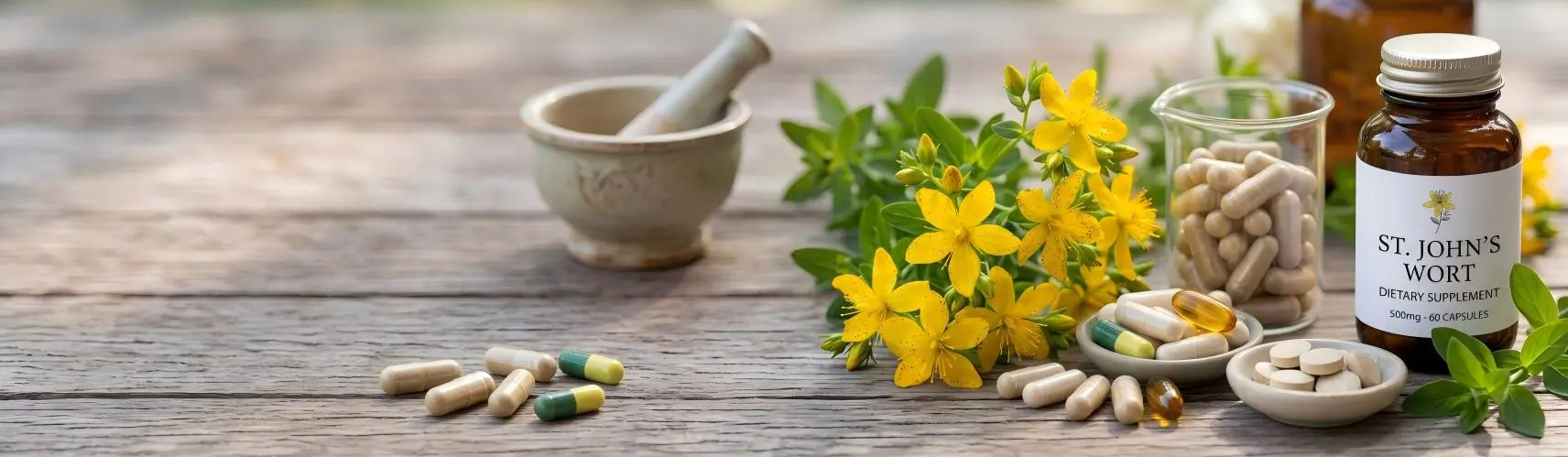
St. John's Wort Supplements Manufacturing Solutions
KS Nutripharma is a St. John’s Wort supplement manufacturer for OEM, ODM, and private-label programs. We manufacture finished mood support capsules, tablets, and powders from specification-controlled Hypericum perforatum.
Choose whole-herb, ratio, hypericins-standardized, or hyperforin-specified material, then develop the SKU against the approved specification. A St. John’s Wort extract quote is comparable only after botanical, plant part, marker, and assay method match.
Buyer Snapshots
| Field | Typical project answer |
|---|---|
| Botanical | Hypericum perforatum L. (Hyperici herba). Other Hypericum species are quoted separately |
| Plant part | Flowering herb / aerial parts |
| Working grades | Herb powder (identity). Ratio 4:1, 10:1, or 20:1. Hypericins 0.3% (HPLC or UV — method named). Hyperforin 1%–4% HPLC as a typical minimum, or a named maximum when the brief requires a low-hyperforin file. Final specification is project-dependent |
| Assay / release | Hypericins by named HPLC (preferred) or UV; hyperforin by HPLC when specified. Incoming identity, moisture, microbiology, heavy metals, pesticides, residual solvents. Sample and commercial batch released against the same spec |
| Serving math | 300 mg × 0.3% hypericins = 0.9 mg hypericins. Illustration only. Common capsule fills: 300 mg / 500 mg extract |
| Formula architectures | F01 standardized extract · F02 whole herb · F03 B-complex · F04 B6 + magnesium · F05 lemon balm · F06 L-theanine · F07 passionflower · F08 rhodiola · F09 ashwagandha |
| Format | Capsules first. Tablets when minerals or vitamins increase fill. Powder, gummies, liquids, and softgels as separate SKUs |
| Target market | Country + food-supplement vs herbal-medicine classification |
| Typical start | Capsules ~3,000–5,000 units · tablets ~5,000–10,000 · retail sticks often from ~10,000 · bulk extract by kg. Sample 7–15 days after spec agreement · commercial production 30–45 days after sample approval |
| Documents | Batch COA · specification · SDS · Halal / Kosher when required · SGS / Eurofins as scoped |
| Program | OEM / ODM / private-label finished SKUs. Bulk extract on the same project |
cGMP | ISO 9001 | ISO 22000 | HACCP | FSSC 22000 | Halal | Kosher | In-house lab + third-party pathways (SGS / Eurofins) | Batch COA | Traceable release
-> About Us | Manufacturing Capacity | Certifications | Quality Control
- Already have a formula? Send Your BOM
- Still deciding the specification? Get a St. John’s Wort Spec Recommendation
- Comparing suppliers? Send Your COA for Comparison
What your first project package includes from KS Nutripharma
- Specification review — Botanical identity, marker, assay method, extract type.
- Formula feasibility — Fill weight, format, co-actives, manufacturing constraints.
- Sample + COA — Prototype made against the agreed specification.
- Commercial quote — SKU-level pricing, MOQ, packaging, and lead time.
- Production documentation — Batch COA and agreed release documents.
Custom St. John's Wort Supplement Formulation for Private Label SKUs
Starting architectures for dietary-supplement SKUs. Serving size, extract grade, format, and pack stay customizable. KS Nutripharma’s formulation team and R&D center match the closest card — or your BOM — to the channel inside cognitive and mental-health assortments, then set the Hypericum grade against that BOM.
For F03–F09, each companion ingredient retains its own identity, assay, and regulatory file. Custom stacks (5-HTP, SAMe, GABA, saffron) are quoted after market review.
Positioning: Botanical calm blend distinct from lemon balm (F05).
Typical format: Capsule.
Key specification: Passionflower identity + Hypericum assay.
Main decision: Separate claim file for each herb.
Positioning: Two-botanical stress relief stack.
Typical format: Capsule.
Key specification: Rosavins / salidroside as a separate spec + Hypericum method.
Main decision: Two marker methods; blend uniformity.
Positioning: Stress-mood stack distinct from rhodiola (F08).
Typical format: Capsule.
Key specification: Ashwagandha species, withanolides method, and Hypericum marker.
Main decision: Ashwagandha grade changes fill more than Hypericum does.
St. John's Wort Capsules, Tablets & Powder, Choose the Right Dosage Form
Choose the format after the formula is defined. Fill weight, odor, compression, and serving configuration can change the BOM.
- Capsules
Default for: Standardized extracts and multi-ingredient formulas (F01, F02, F05–F09).
Main constraint: Total fill weight and capsule size.
Why it fits: Simplest path for marker-standardized dry extracts; two-piece shells isolate odor. Common starting fills: 300 mg / 500 mg extract.
→ Hard Capsules - Tablets
Default for: F03 / F04 when B-vitamins or magnesium increase fill; F01 when the channel wants a compact bottle.
Main constraint: Compression, hardness, coating. Dark extract can speckle an uncoated tablet.
Why it fits: Pack density and unit cost at volume. A capsule formula is re-validated before a tablet run.
→ Tablets - Powder / stick packs
Default for: Convenience SKUs with flexible serving weight — a different selling SKU, not a cheaper F01.
Main constraint: Taste, odor, staining, moisture-barrier film.
Why it fits: The consumer opens the pack every use. Specify powder as its own SKU from the start.
→ Powders & Granules - Gummies / liquids / softgels
Project-scoped. Gummy piece load, heat, water activity, and assay are reviewed separately. Oil macerates and tinctures use a different fill system from dry extract. Active-per-piece and serving configuration are confirmed before artwork.
St. John’s Wort extract is not a complete specification. Hypericum perforatum extract quotes are comparable only after the fields below match.
Material Types
| Material type | What you are buying | Typical commercial grade |
|---|---|---|
| Whole herb / powder | Milled flowering herb / aerial parts; identity without a guaranteed marker milligram | F02 |
| Ratio extract | Concentrated herb as input-to-output ratio | 4:1, 10:1, or 20:1 |
| Hypericins-standardized | Named hypericin or total hypericins (often hypericin + pseudohypericin) | 0.3% — HPLC or UV named |
| Hyperforin-specified | Hyperforin as a minimum or a maximum | 1%–4% HPLC as a typical minimum band |
| Custom | Organic-certified material, dual marker, or a named branded input on the RFQ | Project-defined |
Six fields to specify
Botanical → Plant part → Extract type / DER → Marker → Assay method → Solvent / carrier
Extraction solvent belongs on the specification because it affects marker profile and residual solvents. Final specification is project-dependent.
Five procurement rules
- Define the botanical — Hypericum perforatum L., flowering herb / aerial parts.
- Define the extract — Powder, ratio, or standardized. Ratio ≠ marker potency. A 10:1 extract is not 10× hypericin.
- Name the marker — Hypericin ≠ total hypericins ≠ hyperforin. Hyperforin may be a minimum or a maximum.
- Name the assay method — UV ≠ HPLC. Two lots that both say “0.3%” are different materials if the methods differ.
- Compare price only after specifications match — $/kg is comparable only after these fields match.
Serving math
Extract weight × assay = marker amount per serving
300 mg × 0.3% hypericins = 0.9 mg hypericins. A 300 mg extract line is not 300 mg hypericin. 300 mg / 500 mg are fill starting points, not a factory daily dose.
Standardized botanical pathways: Standard Extracts.
Before comparing $/kg, match these fields:
| Field | What must match |
|---|---|
| Botanical | Hypericum perforatum L. |
| Plant part | Herb / aerial parts |
| Extract type | Powder / ratio / standardized |
| Marker | Hypericin / total hypericins / hyperforin |
| Assay method | HPLC or the named validated method |
| Hyperforin specification | Minimum / maximum / not specified |
| Carrier / solvent | Declared |
| Testing package | Identity + assay + contaminants |
If two quotes do not match these fields, the lower price may simply reflect a different material specification.
Send both COAs — we will map the differences before you compare price. Send Your COA for Comparison
Confirm classification before you finalize the extract grade. The same botanical can sit on a dietary-supplement label in one market and on a herbal-medicinal-product file in another. The EMA maintains an EU herbal monograph for Hyperici herba; it informs herbal-medicine classification in the EU, not a global food-supplement claim list.
Regulatory checkpoints before formula freeze
- Product classification — Food supplement vs herbal medicine.
- Permitted claims — Mood / emotional-wellness structure/function where allowed.
- Interaction / warning review — CYP3A4 / P-gp concerns are a label issue; literature often discusses them together with hyperforin level. A low-hyperforin grade does not by itself clear interaction language.
- Hypericin / hyperforin specification — Agree analyte, method, and min vs max before artwork.
- Finished-label review — Pregnancy, medication-use, and photosensitivity cautions follow market-specific requirements.
| Market | What to confirm |
|---|---|
| United States | DSHEA dietary-supplement path; structure/function vs disease language |
| European Union | Country-specific food-supplement and/or herbal-medicinal-product path |
| United Kingdom | Reviewed separately from EU files |
| Australia / Canada | Complementary medicine / NHP path as applicable |
| Other markets | Local classification, claims, notification or registration |
KS Nutripharma supports manufacturing feasibility and technical documentation; final classification, claims, and labeling remain the brand owner’s responsibility.
Consistency is built in process — incoming assay, fill, pack, and dating — rather than copied from a drum COA onto the bottle.
01 — Marker stability. Hyperforin may need tighter handling, headspace, and pack than a hypericins-only specification. A photostability check on hypericins is a separate decision.
02 — Odor, color, and sensory. Capsules isolate characteristic herb odor and dark color. Powders and gummies need a sensory and staining plan before artwork.
03 — Flow and fill. Herb powder (F02) and some extracts are low-density. Particle size and equipment set-up are confirmed at sample, especially for F04 mineral stacks.
04 — Packaging and shelf life. HDPE/PET + induction seal is a common capsule/tablet start. Final dating follows formulation, pack, storage, and stability data. Incoming extract stability is not finished-SKU dating.
Humidity, barrier, and dating: Moisture Control & Stability Engineering.
The commercial batch is released against the same approved specification used for the sample: specification → sampling → testing → release.
| Stage | What is checked |
|---|---|
| Incoming | Identity (H. perforatum; herb / aerial parts; HPTLC as scoped, including dye screen for UV hypericins), named assay, moisture, microbiology, heavy metals, pesticides, residual solvents as scoped |
| In-process | Blend uniformity, fill or tablet weight, hardness where applicable |
| Finished SKU | Agreed specification, microbiology, physical parameters, pack inspection |
A usable COA has four blocks: identity, potency (named analyte + named method), safety, and physical. A file that only says “0.3%” without analyte or method is not a comparable grade.
Lab: in-house release; SGS or Eurofins when the RFQ requires it. Methods: Quality Control.
01 RFQ → 02 Market & specification review → 03 Extract specification → 04 Formula → 05 Sample → 06 Pilot → 07 Stability / QC as scoped → 08 Production → 09 Shipment
Target-market review happens before formula freeze.
MOQ and lead time
Final MOQ depends on formula, packaging, testing, and production schedule. A bulk kilogram and a finished capsule SKU are quoted separately.
Project stage | Typical timeline |
|---|---|
| Sample development | 7–15 days* |
| Pilot production | 15–25 days* |
| Mass production | 30–45 days* |
| Scope | Typical start |
|---|---|
| Capsules | ~3,000–5,000 units |
| Tablets | ~5,000–10,000 units |
| Retail sticks | Often from ~10,000 units |
| Bulk extract | Quoted by kg |
| Gummies / liquids / softgels | Project-scoped |
Subject to pack, testing, and schedule.
Seven fields for a usable RFQ
- Finished SKU or bulk extract
- Material type (herb powder / ratio / hypericins / hyperforin min or max / “recommend”)
- Marker % + HPLC or named method; attach a CoA if matching
- F01–F09 or BOM
- Format
- First PO + annual forecast
- Country + classification + channel
A complete brief is usually enough for an initial technical review within two business days.
Integrated St. John’s Wort Manufacturing
Since 2007 · 81,000+ m² · 5 manufacturing bases · 12 production lines
2 R&D centers · 260+ professionals · 500+ brand projects · 60+ export markets
cGMP · ISO 9001 · ISO 22000 · HACCP · FSSC 22000 · Halal · Kosher
Site-level figures: Manufacturing Capacity.
Get a St. John’s Wort Supplement Quote
Name the country, whether the SKU is F01–F09 or a custom BOM, and whether the label will state hypericins, hyperforin, or Hypericum perforatum identity only. If you already have a CoA or a BOM, send that — we will tell you whether the quotes in front of you are comparable.
- Have a BOM? Send Your BOM
- Still choosing a grade? Get a St. John’s Wort Spec Recommendation
- Comparing suppliers? Send Your COA for Comparison