
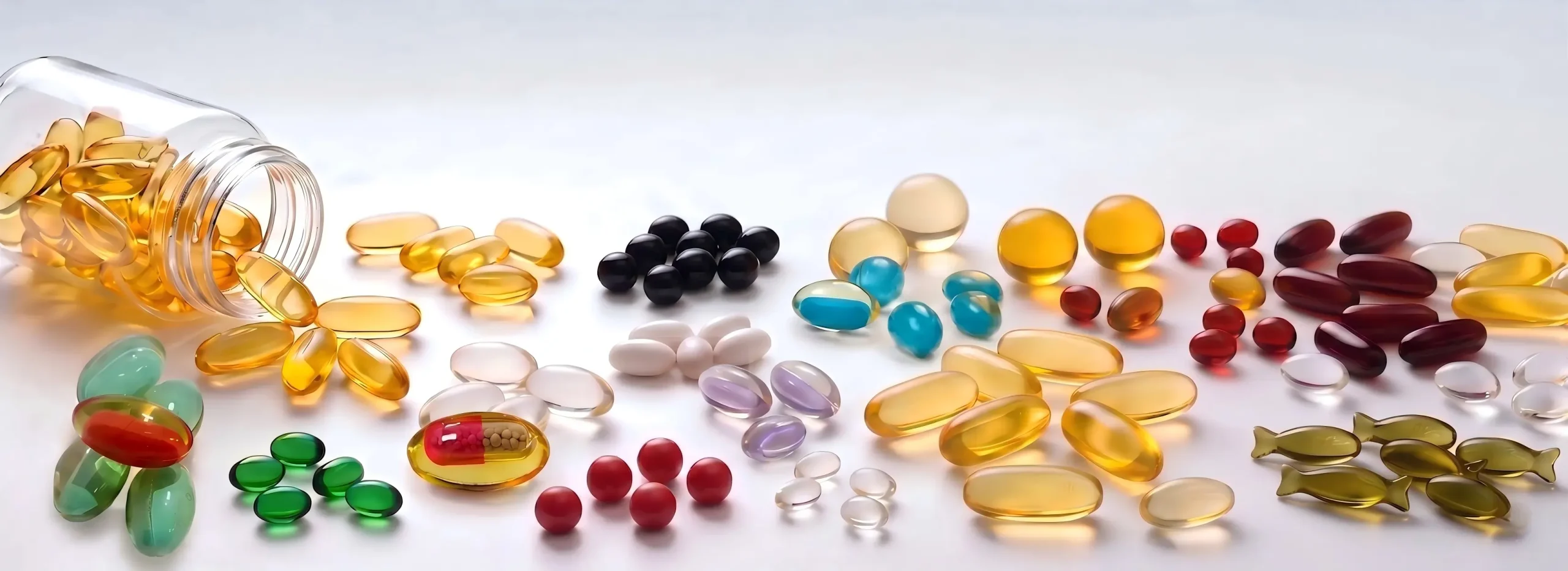
Introduction:
Softgel vs hard capsule is a manufacturing-format decision: which platform can hold this active in a commercially workable unit. A softgel manufacturer and a hard capsule manufacturer run different machines. Lock the format before you lock a rotary die or a size 00.
Quick answer: For most nutraceutical products, free-flowing oils and many liquid or suspension fills are better suited to softgels, while dry powders, granules, and blends are more commonly filled into two-piece hard capsules. Specialty liquid-filled hard capsules are available when the formulation and shell system are designed for them. Do not force extract powder into a softgel to look like an oil SKU. Free oils generally require a qualified liquid-fill and sealing system when a two-piece capsule is used.
You do not need to choose the format — or a die or capsule size — before contacting the manufacturer. Send the formulation inputs; the manufacturer evaluates the manufacturing route.
Key takeaways
- Fit-for-formulation, not “which is better.”
- In practice, format selection starts from the physical form of the proposed fill, then dose, fill characteristics, shell requirements, and process feasibility — not from capsule appearance.
- Powder ≠ automatic hard capsule.
- Changing the dosage-form platform usually requires a new feasibility and development assessment rather than a simple tooling change.
- You do not need to have chosen a die or a size 00 first.
Softgel vs Hard Capsule: The Manufacturing Difference
A softgel is a one-piece unit. Ribbons of gelatin or vegetarian / plant-based shell are formed separately; fill is metered between them; rotary dies then form, seal, and cut individual units, which are dried. The shell does not exist as an empty capsule you buy and later fill.
A two-piece hard capsule is an empty cap-and-body shell that is purchased, oriented, filled, and locked. Gelatin or HPMC empty shells are the usual components. Filling is a powder operation on the standard path, or a designed liquid on a specialty path.
They use different equipment, development parameters, and in-process controls. Process maps sit on the rotary-die page and the two-piece filling page; this page only decides which platform to open.
Which Format Should You Evaluate First?
Physical form → manufacturability → dose feasibility → shell and process requirements → format → tooling.
Step 1 — What is the physical form?
Oil / liquid: evaluate a softgel first.
Dry powder / granule: evaluate a two-piece hard capsule first.
Suspension / paste / specialty liquid: a feasibility review, not a default.
Step 2 — Can the formulation run consistently?
Softgel: viscosity, suspension stability, shell compatibility, sealing.
Hard capsule: bulk density, flow, segregation, fill-weight consistency.
Step 3 — Can the target dose fit commercially?
Target dose plus density or fill behavior plus serving requirement. Milligrams alone do not set the format.
Step 4 — Then select size or die
Capsule size or rotary die follows the feasibility assessment. It is not the first input.
Format Selection By Manufacturing Input
First platform to evaluate — not a winner list. The main question is whether that platform can run.
Free-flowing oil
First platform: Softgel
Main question: Fill viscosity, oxidation, shell compatibility
Oil + dissolved active
First platform: Softgel
Main question: Solubility, fill stability, viscosity
Oil + suspended powder
First platform: Softgel
Main question: Sedimentation, particle size, suspension stability
Dry extract powder
First platform: Hard capsule
Main question: Bulk density, flow, fill-weight consistency
Multi-ingredient powder blend
First platform: Hard capsule
Main question: Segregation, flow, blend uniformity
Liquid requiring a two-piece shell
First platform: Specialty hard capsule
Main question: Shell and seal compatibility
High-dose powder
First platform: Hard capsule first
Main question: Required fill volume or number of units
Poor-flowing or hygroscopic powder
First platform: Hard-capsule feasibility study
Main question: Flow, moisture, tooling and filling behavior
When a Softgel Is the Better Manufacturing Fit
The manufacturing reason is not appearance. When the brief is a liquid or semi-liquid fill, the question is whether the rotary-die chain can run it: a defined mass inside a sealed shell, without an open two-piece join.
Softgel feasibility depends on fill behavior, viscosity, suspension stability, and sealing performance. What usually has to be feasible:
- Fill viscosity and flow at the wedge
- Suspension hold and transfer, when the active is not dissolved
- Shell–fill compatibility
- Oxidation control for lipid fills that need it
- Seam integrity after drying and pack
Path selection inside the ribbon — solution vs suspension vs leave the format — sits on oil fill vs suspension softgels.
Do not use a softgel because the brand wants a “liquid look” for a dry extract. That is a format error, not a positioning upgrade.
When a Two-Piece Hard Capsule Is the Better Fit
When the brief is a dry fill, the question is whether the powder can occupy the shell repeatedly on a filling machine.
Powder ≠ automatic hard capsule. What usually decides that:
- Bulk density (mass vs the shell volume)
- Flowability
- Particle size
- Segregation tendency
- Hygroscopicity
- Target fill weight vs capsule volume
- Blend uniformity for the named active
Those measurements and filling implications sit on powder flow and bulk density for capsule filling. This page only uses them as the reason a dry brief usually opens a two-piece file — and why a sticky, fluffy, or segregating powder can still fail that file.
What a Manufacturer Checks Before Recommending the Format
Liquid brief
- Active concentration
- Solubility or suspension state
- Viscosity
- Target fill weight
- Oxidation sensitivity
- Shell compatibility
Powder brief
- Bulk density
- Flowability
- Particle size
- Hygroscopicity
- Target fill weight
- Blend uniformity
- Required capsule size
If those measurements are not yet available, send the ingredient specification or COA you already have. The first format review does not require a die or capsule size.
Does the Dose Affect the Format Choice?
Yes — but dose alone does not determine the format.
Target dose is not enough by itself. The manufacturer also needs the physical form and density or fill characteristics to determine whether the target amount can fit into a commercially practical unit. A 500 mg powder fill and a 500 mg oil fill do not necessarily require the same capsule format or unit volume.
- Density matters for powders; viscosity matters for liquids.
- Serving size can require more than one unit.
- Final size or die is selected after feasibility assessment, not from the milligram line on the brief.
Softgel die screening and two-piece size screening are separate files. This page only names the principle: mg ≠ capsule size.
What Changes in Manufacturing and QC?
Decision variables, not a winner table. Copying QC language across formats hides the real file.
Sealing
Softgel: Formed and sealed during encapsulation.
Hard capsule: Two-piece shell; lock after fill. Banding or another seal is a specialty add-on, not the default powder SKU.
Size language
Softgel: Die selection (shape + volume class on the drawing you will run) — how to choose softgel size.
Hard capsule: Empty-shell size plus fill volume — how to choose capsule size. Size 00 is not a softgel die name.
Shell names that get mixed
Softgel vegetarian: A named plant-gel ribbon — gelatin vs vegetarian softgels.
Hard-capsule vegetarian: Usually HPMC two-piece shells — HPMC vs gelatin capsules. HPMC is not a softgel ribbon. Do not specify “HPMC softgel” unless you mean a specific qualified plant-based softgel shell system.
Dual-SKU briefs
A dry botanical extract plus an oil-based companion is two SKUs (or a scoped twin pack), not one die that does both fills.
Softgel QC focus
Fill weight (net mass of liquid fill); seam integrity; leakage; oxidation-related tests where the lipid fill requires them. How to specify fill weight vs assay vs seam sits on softgel fill weight and seam integrity. Leak diagnosis sits on why softgels leak.
Hard-capsule QC focus
Fill-weight variation of the powder fill; blend uniformity where specified; capsule locking; moisture and appearance. Weight vs assay is a separate two-piece file — not this page’s testing SOP.
Disintegration, stability, and shelf life follow the finished specification and pack. They are not a reason to declare one format superior.
Can You Use a Specialty Format?
Exceptions exist. They are designed paths, not defaults.
- Suspension softgels — when the active will not dissolve but can stay dispersible through encapsulation. Still a ribbon file.
- Liquid-filled / sealed two-piece capsules — when the brief requires a two-piece format for a liquid or paste and the shell-plus-seal system is qualified for that fill.
- Banded or otherwise sealed hard capsules — leak control on a two-piece join, not a substitute for a standard oil softgel without a design file.
Liquid-in-two-piece manufacture, delayed-release shells, and capsule-in-capsule sit on advanced hard capsule technologies. Do not specify them by writing “put the oil in HPMC.”
What Should You Send to the Manufacturer?
Format review needs more than “oil or powder.” Send what you have. If you do not have viscosity, bulk density, or flow data, send the ingredient specification or COA you already have. The initial format review does not require you to have selected a die or capsule size.
- Ingredient / extract form
- Target dose per serving
- Oil, suspension, or powder
- Target fill weight, if known
- Density or viscosity, if available
- Serving-count limit, if any
- Shell preference and vegetarian / vegan requirement, if any
- Target market
- Estimated order volume
- Existing specification, if any
Not Sure Which Format Fits?
You do not need to finalize the capsule size or softgel die before contacting us.
Send the ingredient and form, target dose, whether the fill is oil, suspension, or powder, density or viscosity if you have them, serving size, shell preference, and target market. KS Nutripharma can use those inputs to determine which manufacturing platform should be evaluated first — then quote softgel manufacturing or hard capsule manufacturing from that review.
Request a Format Feasibility Review
Related Softgel and Capsule Manufacturing Guides
- What Are Softgels Made Of?
- Gelatin vs Vegetarian Softgels
- Oil Fill vs Suspension Softgels
- How to Choose Softgel Size
- How Softgels Are Made
- Why Softgels Leak
- Softgel Fill Weight and Seam Integrity
- What Are Hard Capsules Made Of?
- HPMC vs Gelatin Capsules
- How to Choose Capsule Size
- Hard Capsule Manufacturing Process
- Powder Flow and Bulk Density for Capsule Filling
- Advanced Hard Capsule Technologies
Not as the default unsealed powder path. A designed liquid-filled and sealed two-piece system is a specialty file. Most free oils are evaluated as a softgel first unless that specialty path is specified and qualified.
Only as a designed suspension — or not at all. Dumping powder into oil is not a process. Dry powders are commonly evaluated as a two-piece fill first.
Yes, in some cases, but the formulation and manufacturing process may need to be redesigned for the selected platform. Physical form, dose, and process feasibility still decide — not the ingredient name alone.
No. Provide the target dose, physical form, density or viscosity data where available, and serving requirements first. Capsule size or die selection follows feasibility assessment.
Treat it as a feasibility review: suspension, paste, liquid-filled hard capsule, or another designed system. Do not default it into a standard oil ribbon or an unsealed two-piece powder fill.
Neither is universally better. Dry extracts and powders are commonly two-piece fills when flow and volume work. Oil-based or lipid-soluble botanicals are commonly evaluated as softgel fills. Lipid-soluble does not mean the SKU must be a softgel. The physical form decides, not the plant name.
For two-piece capsules, that is an empty-shell polymer choice. For softgels, vegetarian means a named plant-gel ribbon, not HPMC. Do not specify “HPMC softgel” unless you are referring to a specific qualified plant-based softgel shell system. HPMC is normally associated with two-piece hard capsules.
Regulatory. FDA dietary-supplement CGMP describes specifications, testing, and batch records for finished lots. It does not decide whether a SKU must be a softgel or a two-piece capsule.
- U.S. Food and Drug Administration. Dietary Supplements.
- U.S. Food and Drug Administration. Current Good Manufacturing Practice in Manufacturing, Packaging, Labeling, or Holding Operations for Dietary Supplements, 21 CFR Part 111. Specifications and testing against those specifications — not a format winner.
Technical. These sources support dosage-form terminology and manufacturing technology. They are not a nutraceutical format-selection SOP. Pharmacopeial capsule chapters describe dosage-form classes; they are not a requirement that every dietary-supplement SKU adopt a pharmacopeial uniformity or disintegration panel.
- Gullapalli RP. Soft gelatin capsules (softgels). J Pharm Sci. 2010;99(10):4107-4148. One-piece rotary-die fill-and-seal of a liquid or semi-solid fill — process context, not a superiority claim.
- United States Pharmacopeia. General Chapter <1151> Pharmaceutical Dosage Forms. Capsules as a dosage-form class (including hard and soft types in pharmacopeial terminology). Use for nomenclature only.