
Introduction:
How to choose softgel size is a volume decision: milligrams on the brief are mass; the cavity is minims or milliliters on the die drawing you will run. A softgel manufacturer converts target mass into a candidate volume with the actual fill density, then screens a die and qualifies it on the fill you will run.
Quick answer: A designation such as “20 oblong” is a shape plus a volume class on that drawing. Oil and suspension densities differ, so the same milligrams can need different cavities. Screening math proposes a candidate. The commercial die is the one that fills, seals, and holds.
Key takeaways
- Softgel size is die volume + fill density + trial qualification.
- Active dose, concentration, and total fill weight are different numbers.
- Fill volume (mL) ≈ fill weight (g) ÷ density (g/mL) is a screen.
- Volume, dimensions, and shape answer fill, swallow/pack, and geometry.
- High milligrams on the serving are not automatically one larger die.
Softgel Size vs Hard-Capsule Size
Two-piece capsules use 000–5. Softgels use rotary-die cavities. “Size 00” on a softgel RFQ does not select a tool. Two-piece volume language sits on how to choose capsule size.
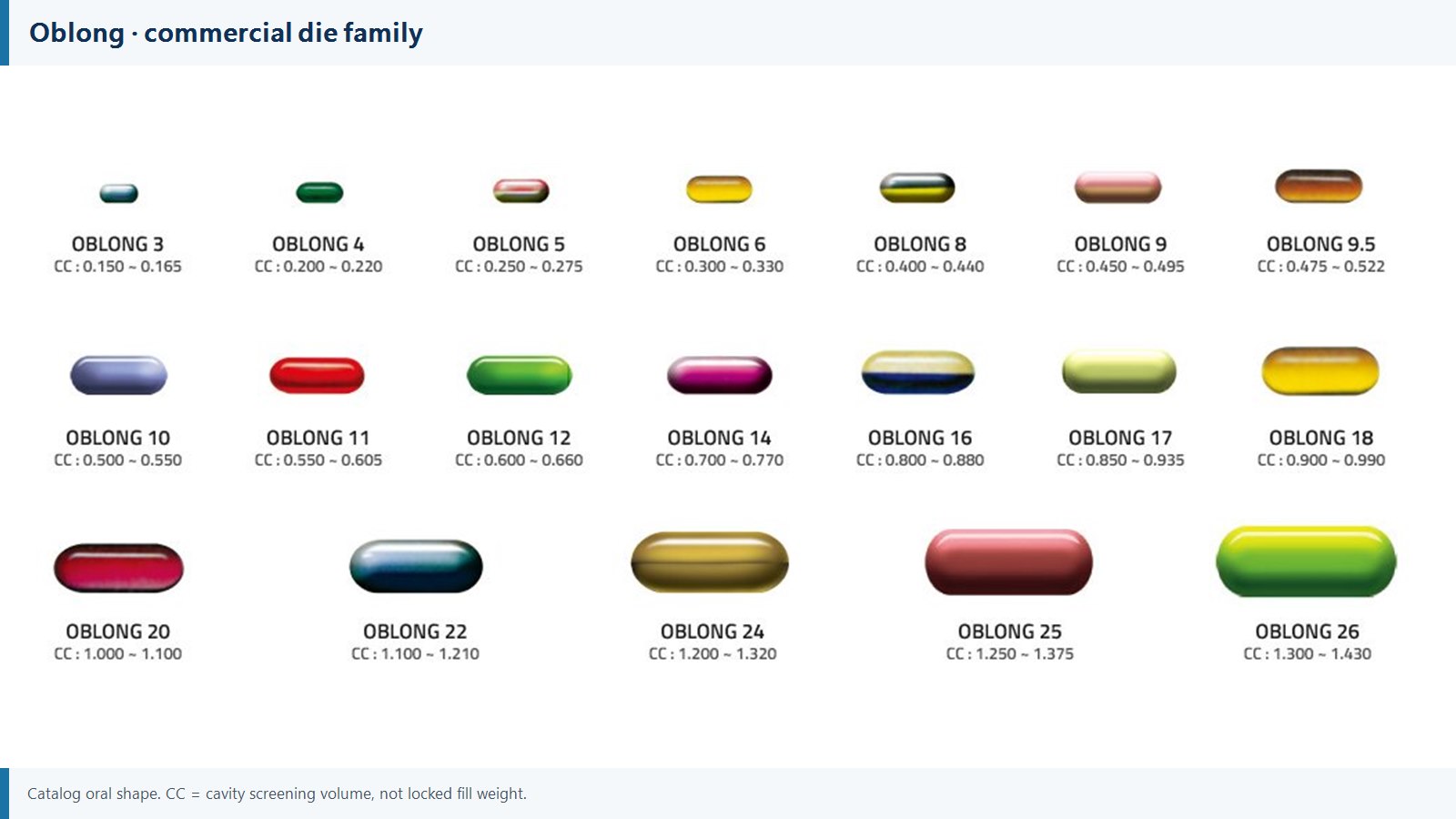
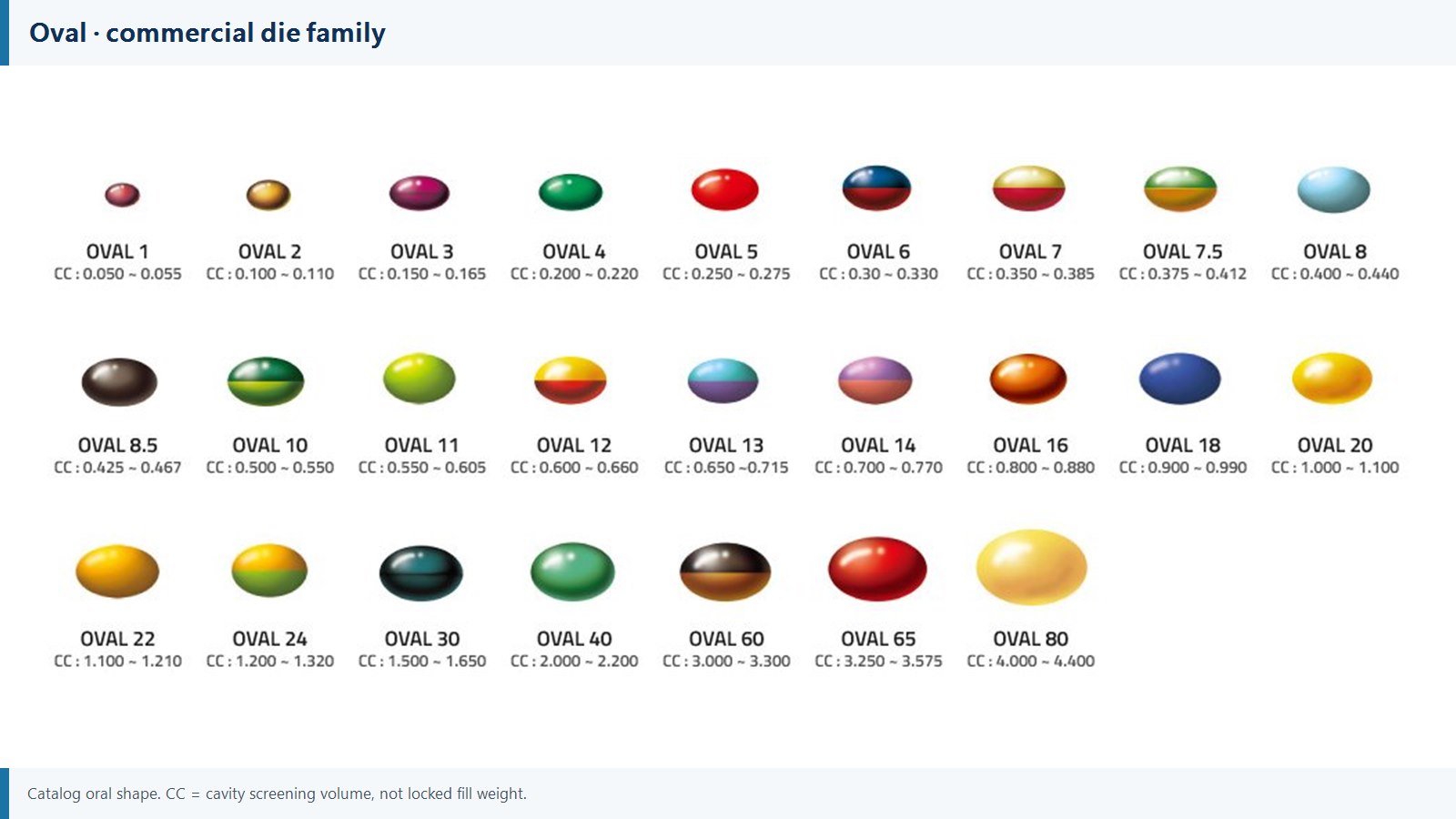
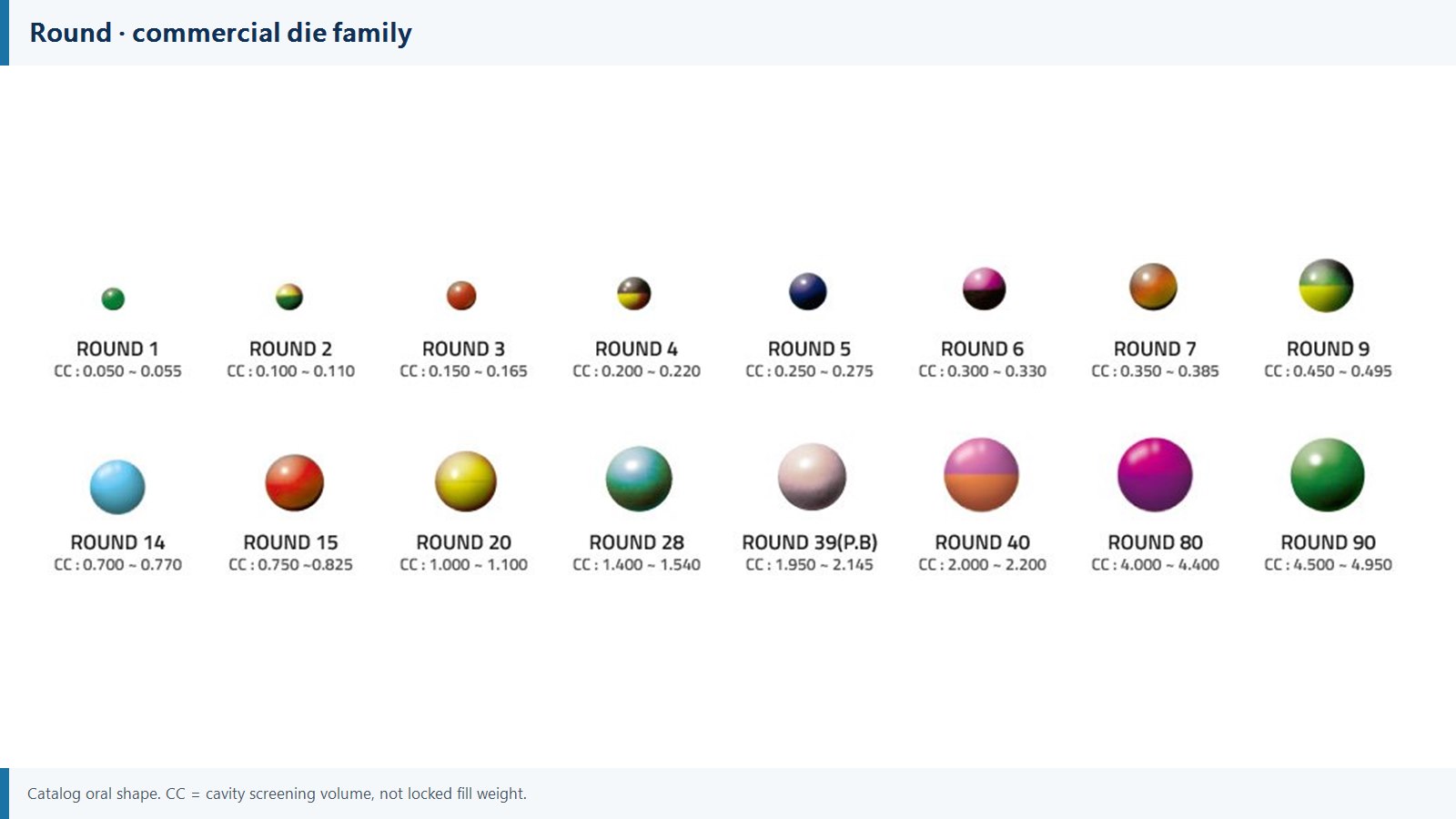
A commercial name such as “20 oblong” is a die identity on a supplier drawing. Another factory’s chart is a different catalog until the drawing in front of you is the one that will run.
What Determines Softgel Size?
The chain to communicate with the factory:
Target active dose → concentration → total fill weight → fill density → fill type (viscosity / solids) → units per serving → swallowability and pack fit → candidate die → trial → commercial die
Fill weight
Mass of the finished fill as pumped (solution or suspension), not a slogan milligram on the label unless those two numbers are the same.
Fill density
Mass per milliliter of that fill. Temperature, solids loading, and settling change what the pump delivers.
Active concentration
How much of the fill is the named active. A 1,000 mg active at 20% solids is a 5,000 mg fill.
Fill type
Oil solution vs suspension changes density, viscosity, settling, and pumpability. Class selection sits on oil fill vs suspension softgels. This page only sizes the cavity.
Shape and dimensions
Geometry and the length/width/thickness the consumer swallows and the pack must hold.
Active Dose vs Fill Weight
A line that says “1,000 mg softgel” can mean 1,000 mg of total fill or 1,000 mg of a named active carried in a larger oil or suspension phase. Those are different sizing problems.
Active dose → formula concentration → total fill weight → density → volume
If the named active is 20% of a suspension, 1,000 mg of active is about 5,000 mg of fill before density is even applied. That is why a high active dose can require two units even when a high oil milligram still fits one cavity.
Fill-weight acceptance for the SKU is written in the specification after trial. There is no public ±% on this page because tare, density, and process window are fill- and die-dependent. That control file sits on softgel fill weight and seam integrity.
What Does “Minim” Mean in Softgel Sizing?
A minim is a volume reference on many rotary-die charts. Milligrams depend on fill density; finished length depends on the dried capsule.
mL is the metric volume for screening.
Die cavity is the geometry on the drawing for the tool you will run.
For screening purposes, many softgel die charts use approximately 0.06 mL per minim, but the conversion should be treated as chart-specific rather than a universal manufacturing specification.
That is why this page does not publish a 1–40 minims chart as a KS standard. Charts differ by supplier. A “10 / 20 / 30 minim” line is a catalog label until it is tied to your drawing. If two quotes both say “20 oblong,” match them to the same drawing.
How to Calculate Candidate Fill Volume
Fill volume (mL) ≈ fill weight (g) ÷ density (g/mL)
Use the weight of the finished fill as pumped, and a density measured or estimated on that fill.
Worked examples (screening only)
Example A — 1,000 mg oil fill
Fill weight: 1,000 mg (1.0 g) of oil solution.
Density: 0.90 g/mL.
Candidate volume: 1.0 ÷ 0.90 ≈ 1.11 mL.
Example B — 1,000 mg suspension fill
Fill weight: 1,000 mg (1.0 g) of finished suspension.
Density: 1.05 g/mL.
Candidate volume: 1.0 ÷ 1.05 ≈ 0.95 mL.
Example C — 1,000 mg named active in a 20% suspension
Active: 1,000 mg. Concentration: 20% w/w.
Total fill weight: 1,000 ÷ 0.20 = 5,000 mg (5.0 g).
Then divide 5.0 g by that fill’s density to get milliliters. The active dose matches Example A’s milligram label; the cavity problem does not.
The milligram figure can look identical; the candidate cavity volume does not. The suspension in Example B also needs a pumpability and settling check before the die is frozen. Ribbon thickness reduces usable fill versus a theoretical empty cavity; usable volume is die- and gel-mass-dependent.
How Fill Type Affects Die Selection
Oil-based liquid fills
Density is usually the cleanest first input. Viscosity still has to meter and seal. A named oil solution is the usual screening start when the shell family is already in the brief.
Suspension fills
Volume is solids plus carrier. Particle size, concentration, hold-time settling, and viscosity can change delivered weight versus the lab density on paper. High solids often tighten the pump window: candidate milliliters can still fail if the mass will not move through the wedge and seal.
A density taken after a long hold is not automatically the density at the nozzle. Assay uniformity is a different file from fill-weight uniformity.
How to Choose Oval, Oblong or Round
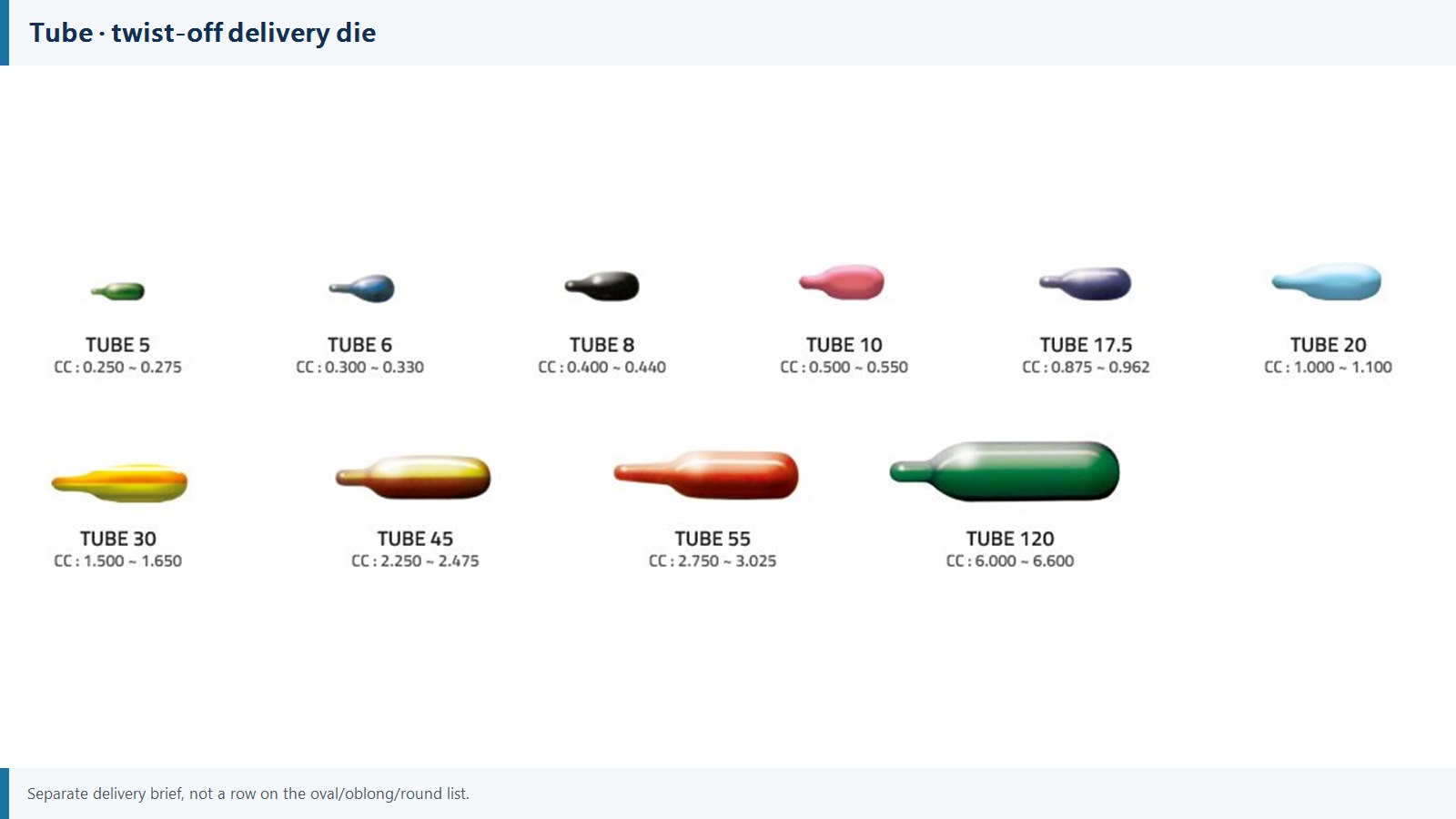
Select shape with target volume and swallowability. Twist-off, tube, and pearl dies are a different delivery brief, not a row on the oval/oblong/round list.
Choose oval when
The brief is a conventional oil or lipid softgel, a standard bottle or blister, and there is no unusual length constraint.
Choose oblong when
A longer, narrower profile helps swallowability, or the target fill sits better in that geometry, and pack dimensions allow the extra length.
Choose round when
The presentation is small-volume, the brand wants that silhouette, and the pack (bottle neck or blister) supports a round unit.
Die volume
Controls: Fill capacity. Buyer question: Can this formula fit one unit?
Length / width / thickness
Controls: Physical size after drying. Buyer question: Can it be swallowed, and does it pack?
Shape
Controls: Geometry and appearance. Buyer question: Brand and pack layout.
Shell thickness
Controls: Shell mass and how much of the cavity remains for fill; also sealing. Buyer question: Will this gel mass run and seal on this die? Set-points stay in the batch record.
A die that fits the fill on paper can still be the wrong choice if finished dimensions make an inefficient bottle, blister cavity, or carton. Pack format belongs on the size brief with swallow limits.
When to Use One vs Two Softgels
“1,500 mg or 2,000 mg in one softgel” is a serving request. Decide with five checks: fill volume, active concentration, viscosity, swallowability, and serving count.
A 2,000 mg lipid fill and a 2,000 mg botanical extract suspension are different manufacturing loads even when the milligram line matches.
One softgel
Screening volume and pumpability fit a production die the market will swallow, and appearance holds on trial.
Two smaller softgels
One cavity would be too large to swallow, too viscous to pump cleanly, or too concentrated to keep as one fill. Count becomes part of the label and the pack.
Another dosage form
The fill does not belong in a rotary-die ribbon at that dose. Dry powder and many high-Aw systems leave this format — softgel vs hard capsule.
Does an Existing Die Work for a New Formula?
Existing die. Geometry may match a new SKU if fill volume, density, and pumpability are close. The new fill still needs a qualification trial. Same cavity name, different density or solids, is a new file.
New / catalog die. Used when screening volume or shape is outside the incumbent cavity. Tooling lead time and cost are manufacturer- and die-specific — put them on the quotation, not on a public page.
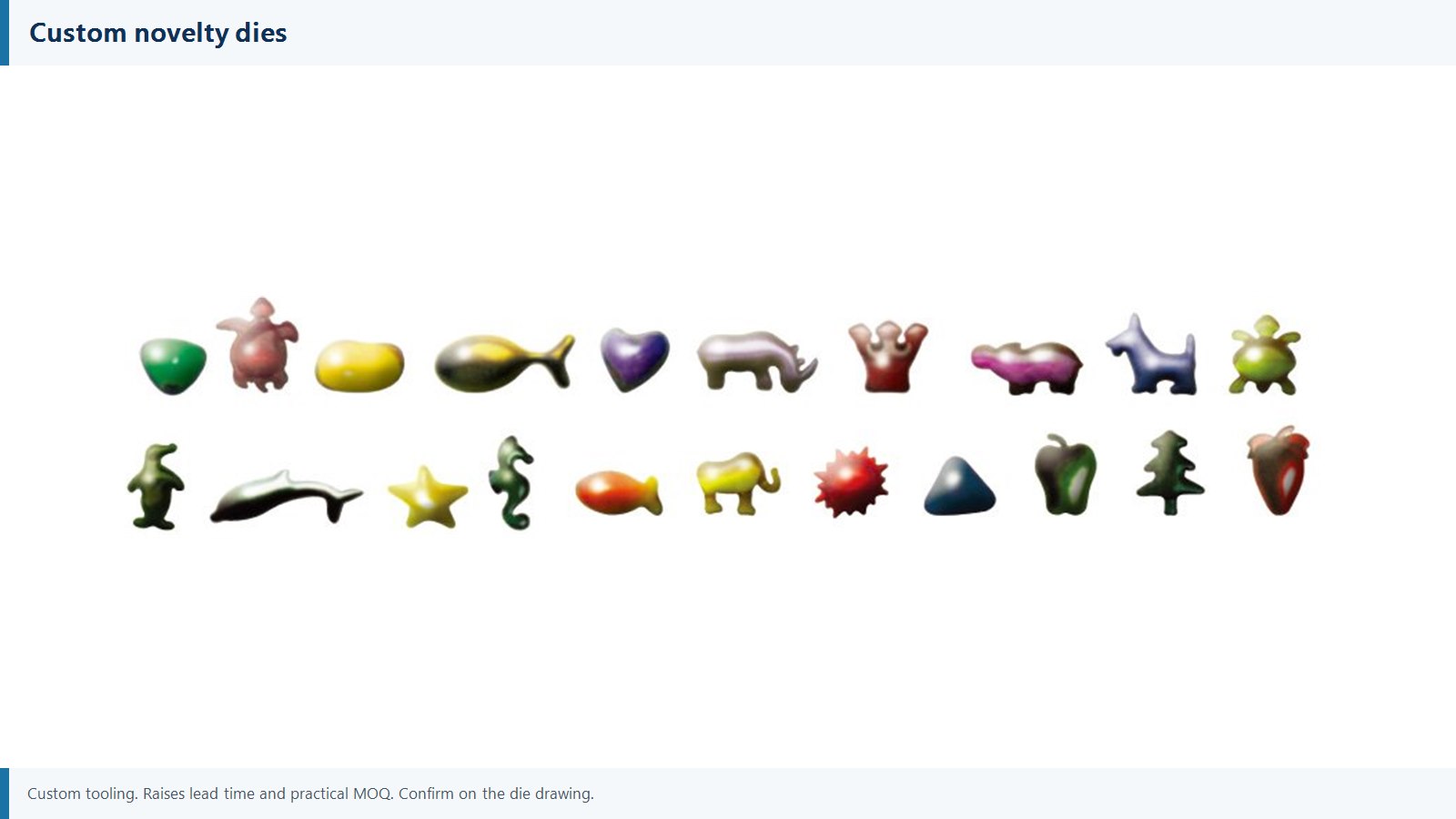
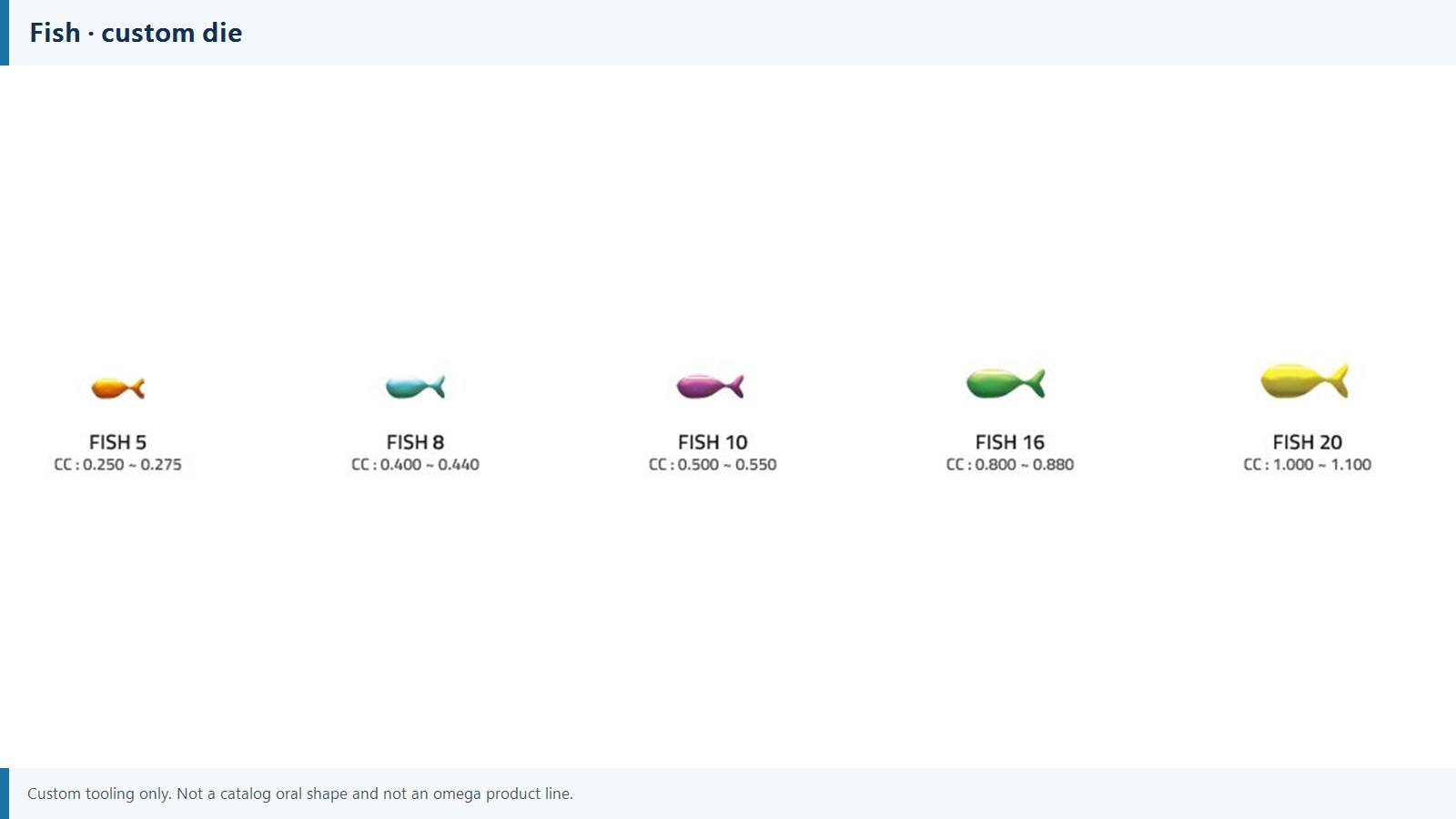
Custom geometry. Used when catalog ovals/oblongs/rounds cannot meet volume plus finished dimensions (including pack). That is a separate tooling brief: expected dimensions, pack, and trial path.
Artwork that freezes a die before trial is a common rewrite.
Softgel Size Selection: From Calculation to Production
Say the three stages once, then use them in the RFQ.
- Screening — active dose and concentration → total fill weight → density → candidate volume (mL / minims on a named chart) → candidate die and shape.
- Development trial — encapsulate on a production-relevant die; check fill weight, seam, leak, appearance, and pumpability. Leak diagnosis sits on why softgels leak. Process order sits on how softgels are made.
- Commercial qualification — approved die plus the validated process and specification for that SKU, including pack.
What to Send on a Softgel Size RFQ
Specify what you have. Incomplete briefs get a candidate range, not a frozen die.
- Named active dose and whether milligrams mean fill or active
- Target fill weight of the finished fill, if known
- Fill type: oil solution / suspension / “recommend”
- Density if known, or a sample
- Viscosity if known
- Target serving count (one vs two units)
- Shape preference, if it is real
- Maximum dimensions (swallow or pack)
- Destination market
- Existing die or current SKU, if this is a conversion
- Packaging format
- Target volume band / MOQ
If density is unknown, send a sample or enough formula to estimate. One die vs two units vs format change is decided before a commercial quotation.
What Your Manufacturer Should Confirm
From a complete brief, a size review should return:
- Candidate fill volume
- Candidate die geometry (and whether an existing die is in scope)
- Expected finished dimensions (screening, drawing-dependent)
- Recommended units per serving
- Whether a manufacturing trial is required
- Formulation constraints that affect sizing (viscosity, solids, settling)
- Tooling requirement (existing / catalog / custom)
- MOQ and lead-time as quotation assumptions (manufacturer-specific)
- What is included in the commercial quotation
MOQ can move with tooling, setup, formulation complexity, and pack. There is no universal softgel MOQ on this page.
Send Your Softgel Size Brief
Send target active dose, whether that milligram is fill or active, fill type, density if known, serving-count limit, and any shape, swallow, or pack constraint.
What we can confirm from that brief: candidate fill volume and die geometry; whether one unit vs two (or another format) is in scope; fill compatibility notes for sizing; what the trial must show; then the production quotation path for softgel manufacturing.
Related Softgel Manufacturing Guides
A volume unit on many softgel die charts. For screening, many charts use about 0.06 mL per minim; use the convention on the drawing you will run.
It depends on whether the milligrams are fill or active, then on density and cavity. Screening uses weight ÷ density.
Fill volume (mL) ≈ fill weight (g) ÷ density (g/mL). That volume selects a candidate die.
Yes. Lower density means more milliliters for the same milligrams.
Often, even at the same fill milligrams. Solids plus carrier occupy volume; settling and viscosity change what the pump delivers.
Geometry may match. Density and pumpability may not. Run a trial on the new fill.
A different cavity usually means different tooling (or a different catalog die). Cost and lead time are manufacturer-specific. An existing die used on a new formula still needs qualification.
Tooling, setup, formulation complexity, and packaging can affect the quoted MOQ. The number is manufacturer-specific.
Select with volume, swallowability, and pack. Confirm capacity on the drawing you will run.
Only if volume, concentration, viscosity, swallow dimensions, and seam hold on trial. High active dose and high fill weight are different problems.
When one cavity is too large, too viscous, or too concentrated — or when the serving is designed as two units.
We can screen a candidate from dose, fill type, and density (or an analog). The commercial die waits on the fill you will run.
FDA dietary-supplement CGMP describes how finished lots are specified and tested. It does not publish a minim chart, milligram-to-die table, or fill-weight tolerance. The ~0.06 mL per minim convention is die-supplier chart practice — not an FDA sizing rule.
- U.S. Food and Drug Administration. Dietary Supplements.
- U.S. Food and Drug Administration. Current Good Manufacturing Practice in Manufacturing, Packaging, Labeling, or Holding Operations for Dietary Supplements, 21 CFR Part 111. Specifications, testing against those specifications, and batch records — not a die-volume formula.
- Gullapalli RP. Soft gelatin capsules (softgels). J Pharm Sci. 2010;99(10):4107-4148. Supports rotary-die formation of a one-piece fill-and-seal unit whose cavity is a manufacturing geometry — process context, not a KS minims catalog.