
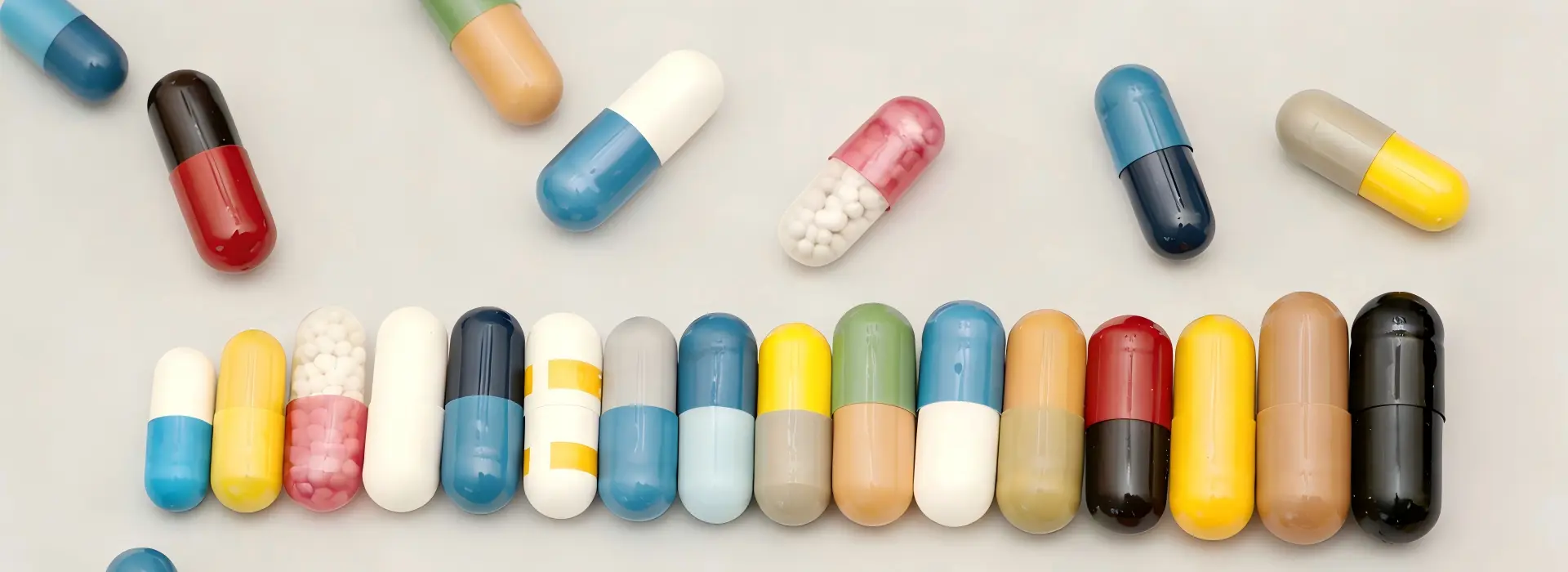
Introduction:
A two-piece hard capsule consists of an empty shell and a fill. The shell is usually gelatin or HPMC (hypromellose), plus water and any colorants or opacifiers specified for that empty-capsule grade. The fill is the actives plus the functional excipients needed to dose the blend at commercial speed. A hard capsule manufacturer needs both specifications — shell and fill — before size, filling method, and packaging can be set for a quotation.
Hard capsules are not household plastic. They are also not one-piece oil softgels. A brief that says “500 mg per capsule” is a target mass for the fill. It does not name the shell polymer, the empty-shell additives, or the capsule volume that fill will occupy.
- Empty shell — polymer, residual moisture, color, opacifier, and any gelling or processing aid named on the empty-capsule specification.
- Fill — actives, functional excipients, and the physical form being filled (most often powder; sometimes granules, pellets, mini-tablets, or beadlets).
The same capsule size does not hold the same weight of every powder. Shell material should be chosen with the formula’s moisture behavior, target market, and packaging in view.
How a Hard Capsule Is Constructed
A hard capsule is supplied as two pre-formed pieces and filled on capsule-filling equipment. The empty shell is already a manufactured component. The fill is a second bill of materials.
Component | What it does |
|---|---|
| Body | The longer piece that holds most of the fill |
| Cap | The shorter piece that fits over the body |
| Locking features | Pre-formed grooves or dimples that help the closed capsule stay shut after filling |
| Shell wall | The polymer film that gives the capsule its shape and a first barrier to handling and environment |
| Fill | Actives plus functional excipients, in the physical form the filler can dose |
Cap and body are usually the same polymer family. Color, opacity, size, and print are empty-capsule options. They are not substitutes for a fill specification.
What Are Hard Capsule Shells Made Of?
The empty shell is what most people mean by “what is the capsule made of.” It is also the part that has to match market claims (vegetarian, Halal, Kosher, TiO₂-free) and the part that can interact with a hygroscopic or reactive fill.
Exact residual-moisture windows, storage statements, and additive lists are empty-capsule manufacturer specifications. They vary by polymer, grade, color, and lot. Use the shell CoA for the lot you will fill — not a generic industry number.
Gelatin shells
Gelatin for hard capsules is produced from collagen (typically bovine, porcine, or fish) and formed into cap and body by empty-capsule manufacturers. “Gelatin” on a brief is incomplete until source, documentation, and grade are named.
What usually sits in a gelatin empty-shell specification:
- Gelatin (animal-origin polymer)
- Residual moisture at a level set by the shell manufacturer (gelatin grades are typically specified wetter than HPMC grades from the same supplier family)
- Optional colorants
- Optional opacifiers
- Any processing aid the empty-capsule manufacturer declares for that grade
Specifications to confirm
Requirement | Why it matters |
|---|---|
| Gelatin source | Animal-origin declaration; Halal, Kosher, and market-file language |
| TSE/BSE documentation | Required in many destination files when the polymer is bovine |
| Grade and size | Filling performance and fill volume |
| Color and opacity | Brand presentation; some markets restrict specific opacifiers |
| Moisture specification | Shell brittleness, softening, and compatibility with the fill |
| Empty-capsule supplier | The shell is a qualified component with a lot CoA |
Gelatin remains widely used for conventional dry fills. Low-humidity handling can make shells more brittle. Some botanical fills and some excipients can raise gelatin cross-linking risk over shelf life (reduced shell solubility). That is a compatibility and stability question, not a reason to treat gelatin as universally unsuitable. Hygroscopic extracts, aldehyde-related issues, and sticking during filling are covered in capsule filling problems in botanical supplements.
HPMC (hypromellose) shells
HPMC hard capsules are plant-derived cellulose chemically modified to hypromellose. They are the usual vegetarian / vegan two-piece option. HPMC is not a softgel ribbon; it is a two-piece hard-capsule polymer.
What usually sits in an HPMC empty-shell specification:
- HPMC (hypromellose)
- Residual moisture at a level set by the shell manufacturer (typically a lower window than gelatin grades)
- Optional colorants and opacifiers
- In some grades, a gelling system (for example gellan gum) used to form the shell; other grades are designed around thermal gelation without that aid
“HPMC” on a purchase order is still incomplete. The empty-capsule product name, gelling system if any, color system, and moisture specification belong in the file.
HPMC’s different moisture profile can help some moisture-sensitive fills. It is not a rule that HPMC is automatically better. Shell selection should be evaluated with the formula’s hygroscopicity, water activity, packaging, and stability data — not from the polymer name alone.
Procurement specifications for HPMC follow the same fields as gelatin: vegetarian/vegan claim versus the actual empty-shell bill of materials, color/opacifier restrictions, size, moisture specification, and a qualified empty-capsule supplier.
Other shell materials
Pullulan and certain specialty or coated shells (including enteric systems) exist for specific barrier, release, or positioning needs. They are not the default two-piece capsule for most dietary-supplement powders. If the brief needs a named specialty shell, that is a separate specification — not a substitute for locking gelatin or HPMC on a standard fill.
Colorants, opacifiers, and “clean-label” shells
Empty capsules are not only polymer and water. Color and opacity are part of what the shell is made of.
Titanium dioxide (TiO₂, E171) has been used as a white opacifier in some capsule shells. The European Union no longer authorizes titanium dioxide as a food additive, so food-supplement SKUs for that market often need a TiO₂-free empty-capsule grade. Other markets still allow it under their own rules. [2] Treat TiO₂-free, natural color, or clear shells as named empty-capsule options, not as automatic attributes of “HPMC” or “gelatin.”
What Is Inside a Hard Capsule?
The filled capsule is not the same object as the empty shell. Search copy that lists only gelatin or HPMC is answering half of the question.
Active ingredients
Hard capsules are used for dry or dry-compatible dietary-supplement fills, including:
- Botanical extracts and powdered botanicals
- Vitamins and minerals
- Amino acids
- Enzymes
- Probiotics (with moisture and packaging treated as part of the same file)
- Other functional powders that can be blended and dosed
The ingredient category alone does not determine shell material, capsule size, or whether the blend can be filled commercially.
Functional excipients
Excipients in a hard capsule are there so the fill can be blended, fed, dosed, and closed at commercial speed with an acceptable weight range. They are not a euphemism for “cheap filler,” and they are not a required cocktail for every formula.
Typical functions:
- Diluent / bulking agent — adjusts fill volume when the active dose occupies too little (or, with density, too much) of the capsule
- Glidant / flow aid — improves hopper flow
- Lubricant — reduces sticking to dosing parts
- Disintegrant — may be used when extra disintegration performance is specified; the shell already provides a dosage-form structure, so not every capsule formula includes one
- Carrier — used when an oil, flavor, or other material that cannot be filled as a dry powder without a carrier has to be presented as a powder
Example fill
A botanical capsule might contain a standardized botanical extract as the active, microcrystalline cellulose as a diluent, silicon dioxide as a flow aid, and magnesium stearate as a lubricant. That example is a pattern: active + the minimum functional set the powder needs. It is not a default bill of materials. A “no magnesium stearate” brief is possible, but flow and sticking then have to be solved another way.
Why Do Hard Capsule Formulations Need Excipients?
The milligram line on a formula sheet is the active. It is not yet a blend that will feed from a hopper, pack into a shell, and close without sticking. Functional excipients exist to make that conversion.
Problem | Why it occurs | What formulation may do |
|---|---|---|
| Dose occupies too little of the capsule | Low milligram active in a large shell | Add a diluent so fill volume and weight are controllable |
| Dose will not fit the target size | Low bulk density or too many actives | Larger size, two capsules per serving, densification, or a different serving design — see high-dose capsule formulation |
| Inconsistent fill weight | Poor flow or variable bulk density | Flow aid, blend/process change, or granulation |
| Powder sticks to tooling | Cohesive or under-lubricated fill | Lubricant level or process adjustment |
| Blend uniformity risk | Mixed particle sizes and densities | Particle-size control, ordered mixing, or granulation |
| Release slower than specified | Compacted or poorly wetting fill | Disintegrant or process change if the specification requires it |
Without that work, the active milligrams on a formula sheet are not a fill that can be dosed consistently on a production encapsulator. Excipient choice is part of what the finished capsule is made of.
Why the Same Capsule Size Cannot Hold the Same Weight of Every Powder
Capsule size is a volume. Fill weight is a mass. Bulk density (and how the powder packs on the machine) connects the two.
Two formulas can both list 500 mg of active and still need different capsule sizes, because the powders occupy different volumes. A bulky botanical extract and a dense mineral salt are not interchangeable on a size chart. Excipients add volume as well. That is why a manufacturer cannot set capsule size from the active dose alone.
What still has to be known:
- Bulk density and, where useful, tapped density of the finished blend, not only of the hero active
- Excipient percentage and total fill weight
- Flow and packing behavior on the intended filler
- Target size, or willingness to move size / capsule count if the volume does not fit
- Whether granulation or another pre-process is in scope
If the brief lists only a milligram target, the next step is a density and fill-feasibility review, not a frozen size on the quotation. How size is chosen in practice is the job of how to choose capsule size.
Powder properties that decide whether that volume can be filled at all:
Powder property | What can go wrong | What manufacturing may do |
|---|---|---|
| Low bulk density | Capsule too small for the serving | Larger size, two-count serving, or densification |
| Poor flow | Weight variation, machine stops | Flow aid, granulation, or process adjustment |
| High hygroscopicity | Clumping; shell softening or brittleness | Humidity control, packaging, and shell/fill review together |
| Wide particle-size mix | Segregation | Particle-size control, blending strategy, or granulation |
| Sticky fill | Tooling adhesion | Lubricant or process change |
Carr’s index, Hausner ratio, and angle of repose are tools a plant may use; they are not a ritual performed on every dietary-supplement brief. The decision is whether the blend will feed and dose. Measurement methods and scale-up sit on powder flow and bulk density for capsule filling.
Gelatin vs HPMC: How Should an OEM Buyer Choose?
Choose the empty-shell polymer after the formula, target market, stability needs, and packaging are on the table — not before.
Buyer requirement | Usually consider |
|---|---|
| Conventional animal-derived two-piece capsule | Gelatin, with source and certificates named |
| Vegetarian / vegan positioning | HPMC, with the empty-shell bill of materials checked against the claim |
| Religious sourcing requirement | A named, certified shell source (gelatin or a documented plant shell) |
| Moisture-sensitive fill | HPMC together with formula, water activity, and pack |
| Cost-sensitive conventional SKU | Gelatin may have a raw-material cost advantage |
| Highly reactive or aldehyde-prone fill | Compatibility and stability data for that fill |
| TiO₂-free or named color system | A specific empty-capsule grade, independent of gelatin vs HPMC |
Gelatin and HPMC are not ranked as universally better or worse. The usable choice is the grade whose specification matches the fill, the claim file, and the stability pack. The deeper comparison is HPMC vs gelatin capsules.
Can Hard Capsules Contain More Than Powder?
Yes. Depending on the filling technology, hard capsules can hold powders, granules, pellets, mini-tablets, beadlets, and some combinations of those. Standard dietary-supplement work is still a powder blend. Combination fills are a capability to specify when the formula needs them — not a default upgrade.
Free oil in a two-piece hard capsule is not the usual path. Liquid-filled hard capsules need a separate feasibility review. Lipid-only products are more often a one-piece softgel. Do not write “HPMC vegetarian softgel” on an RFQ; that sends the project down the wrong shell and the wrong machine.
Hard capsules are a poor fit when the serving is a free liquid, when the serving mass cannot be divided into a swallowable capsule count, or when the brief is really a compressed tablet. That is a format decision, not a shell-ingredient decision.
What Matters in Commercial Hard Capsule Manufacturing
Empty-shell composition and fill composition meet on the filler. Complexity — and quotation quality — usually tracks:
Formula complexity → powder processing → filling technology → in-process weight control → packaging → testing → batch efficiency
Raw-material identity testing, blend time, and weigh-check frequency are defined in the project’s specifications and SOPs. They are not the same menu for every powder. What the buyer should ask is whether the plant will evaluate flow, density, shell compatibility, and fill-weight control for this blend, not whether a brochure lists seven universal steps.
Process design, equipment, and scale-up belong on hard capsule manufacturing process. Fill-weight variation, in-process checks, and release documents belong on capsule weight variation and quality control.
Facility certificates (cGMP, ISO, HACCP, and others) describe a quality system. They do not replace product-specific specifications, testing, or batch records. An empty-capsule CoA and a finished-product CoA answer different questions: one is what the shell was made of and whether that lot met its spec; the other is whether the filled batch met the finished-product spec.
What to Send for a Hard Capsule Quotation
A reliable OEM quote should not be based on active dose alone.
Send as much of the following as you have:
- Ingredient list and extract / salt specifications (not only common names)
- Target amount per capsule and capsules per serving
- Existing formula, if any (with excipients)
- Capsule preference if you have one: gelatin or HPMC, color, TiO₂-free, size — or “recommend”
- Target market (label and additive rules sit here)
- Packaging: bottle, blister, desiccant, count
- Certification needs for the finished SKU and for the empty shell
- Expected volume
If size or fill feasibility is not yet defined, the manufacturer should evaluate powder behavior and capsule volume rather than freezing a size from the milligram line.
Have a formula but are not sure which capsule size or shell the fill can support?
Send the active list, target dose, existing formula if you have one, target market, and packaging intent. KS Nutripharma can review shell material, fill feasibility, and capsule size as one file — then quote hard capsule manufacturing from that review.
Related Capsule Manufacturing Guides
– What Are Hard Capsules Made Of
– HPMC vs Gelatin Capsules
– How to Choose Capsule Size
– High-Dose Capsule Formulation
– Powder Flow and Bulk Density for Capsule Filling
– Capsule Filling Problems in Botanical Supplements
– Hard Capsule Manufacturing Process
– Capsule Weight Variation and Quality Control
– Advanced Hard Capsule Technologies
– How to Read a COA
Technical and Regulatory References
- U.S. Food and Drug Administration. Dietary supplements. https://www.fda.gov/food/dietary-supplements
- Commission Regulation (EU) 2022/63 of 14 January 2022 amending Annexes II and III to Regulation (EC) No 1333/2008 as regards the food additive titanium dioxide (E 171). Official Journal of the European Union. http://data.europa.eu/eli/reg/2022/63/oj
No. Standard two-piece supplement capsules are gelatin or HPMC films, plus water and any declared colorants, opacifiers, or gelling aids. They are not molded household plastic.
HPMC (hypromellose) is the main polymer. The empty shell also contains residual moisture and, depending on grade, colorants, opacifiers, and sometimes a gelling aid. Ask for the empty-capsule specification, not only the word “vegetarian.”
No. Size is a volume; dose is a mass. Lock size from the finished blend, not from the milligram line alone.
Not reliably. Send the formula or a sample so bulk density and excipient load can be reviewed.
No. The shell CoA covers that empty-capsule lot. The filled batch still needs its own specification and release tests.
Some grades do; some are made without it. Destination-market additive rules and brand claims decide whether a TiO₂-free shell is required. [2]
Yes, when the filling technology and the formula require it. Most commercial supplement SKUs remain powder fills.
Actives and specs, target dose and serving, existing formula if any, shell and color preferences (or “recommend”), target market, packaging, and volume. If density is unknown, ask for a fill-feasibility review before locking size.