High-Absorption Magnesium Supplements for Sleep, Stress & Muscle Recovery
KS Nutripharma is a magnesium bisglycinate / glycinate supplement manufacturer for OEM, ODM, and private-label programs. We develop finished magnesium bisglycinate supplements with a locked salt identity, compound milligrams, elemental magnesium line, and batch COA. For how this salt sits beside citrate, malate, and the other magnesium product architectures, see magnesium supplements. A nighttime mineral SKU is quoted on this page. A full sleep line — melatonin on or off, herbal pair, or theanine + magnesium — starts on sleep support supplements.
Develop private label magnesium bisglycinate supplements for sleep support, stress and emotional wellness, women’s formulas, and sports recovery—with a long-term OEM partner that can take you from concept to scalable global supply.
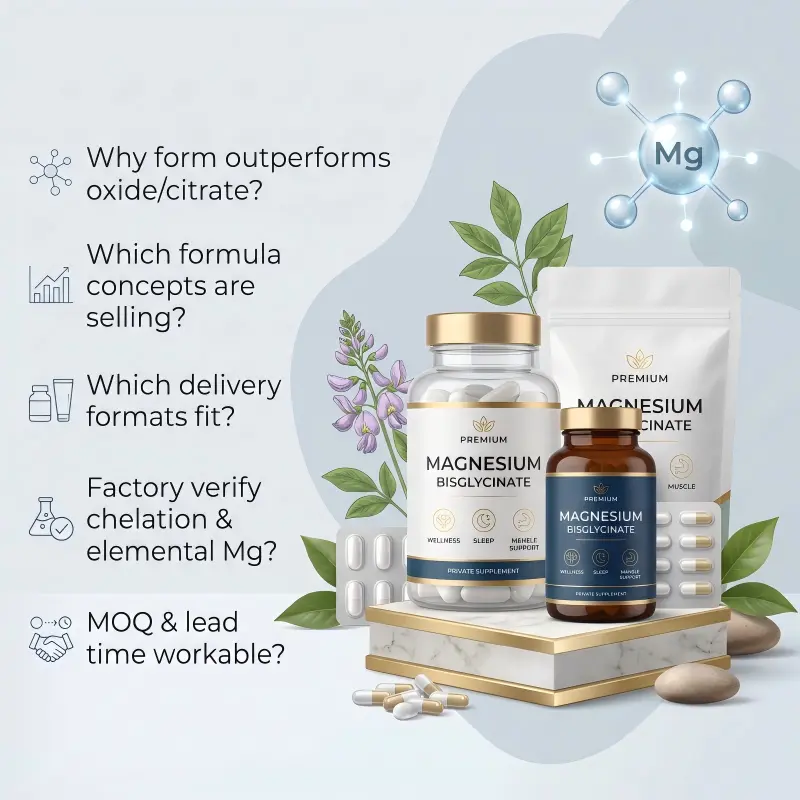
If you are searching for a magnesium glycinate supplement manufacturer or a magnesium bisglycinate private label partner, you usually need five answers fast: why this form outperforms oxide and citrate for premium SKUs, which formula concepts are selling now, which delivery formats fit your channel, whether the factory can verify chelation and elemental magnesium correctly, and whether MOQ and lead time are workable.
- Chelated Magnesium Bisglycinate
- Gentle on the Stomach
- Multiple Delivery Formats
- Custom Formulation Services
- cGMP & ISO Certified Manufacturing
Manufacturing Capacity At a Glance
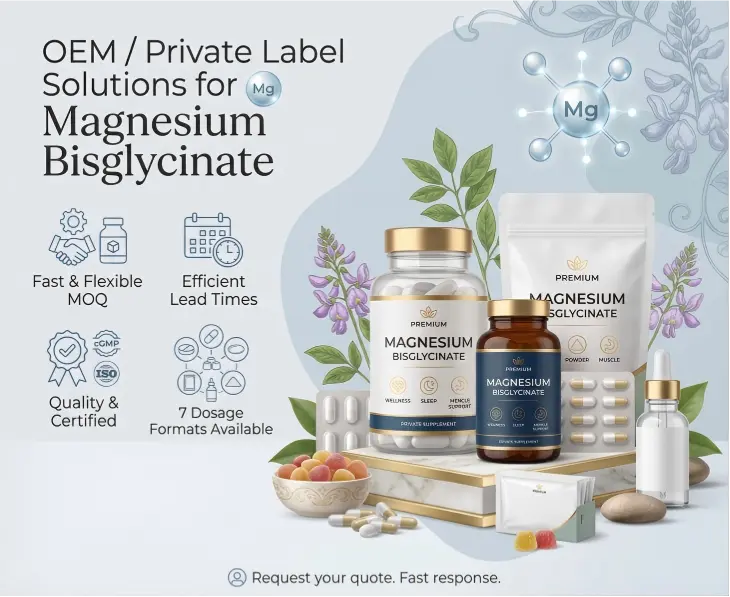
- OEM / Private Label Available— tablets, capsules, softgels, gummies, powders, drops, and liquids under your brand
- MOQ from 1,000 finished retail units per SKU (powders and sachets); 3,000–5,000 units for tablets, capsules, and softgels
- Lead Time: samples in 7–15 days; pilot batch 15–25 days; mass production 30–45 days
- Quality & Certifications: cGMP manufacturing; ISO 9001, ISO 22000, FSSC 22000 and HACCP; Halal and Kosher certified
- 7 Dosage Formats: tablets, capsules, softgels, gummies, powders, sachets, and liquids
- Request a Quote: Initial project response within one business day
Why Magnesium Bisglycinate Is One of the Fastest-Growing Magnesium Ingredients
Magnesium is no longer a generic mineral aisle SKU. In the US and EU, brand buyers are building magnesium lines around sleep, stress management, women’s wellness, sports recovery, and emotional wellness—the application lanes where magnesium bisglycinate grows fastest.
For procurement and brand teams, the commercial question is not “Do consumers want magnesium?” Consumers already do. The better question is:
Why should we launch magnesium bisglycinate instead of another oxide, citrate, or commodity blend?
Three forces are pushing brands to act now:
- Shoppers are upgrading away from poorly tolerated magnesium.Magnesium oxide is widely associated with digestive discomfort and weak absorption stories. Premium buyers search for high-absorption magnesium supplements that feel gentler.
- Sleep and stress remain durable high-intent categories.Magnesium for sleep and magnesium for stress/anxiety-adjacent wellness searches continue to convert because the occasion is clear: evening wind-down, busy professionals, and daily calm routines.
- Formulation differentiation is now the real battleground.Single-ingredient magnesium still sells—but sleep stacks, ashwagandha blends, women’s formulas, gummies, and multi-magnesium complexes create higher AOV and clearer brand stories.
Market context brands should track (directional, for commercial planning):
- Sleep supplements remain one of the most commercially active wellness categories in North America and Europe.
- Emotional wellness and stress-support products continue to expand beyond classic adaptogen-only positioning.
- Women’s wellness (PMS support, menopause support, mood balance) is creating room for magnesium-led SKUs that are not another multivitamin.
For scientific background on magnesium’s role in human nutrition—including nervous system, muscle, bone, and cardiovascular-related functions—see the NIH Office of Dietary Supplements Magnesium Fact Sheet for Health Professionals.
Bottom line for B2B buyers: Magnesium bisglycinate is growing because it solves consumer complaints (tolerance + absorption narrative) while unlocking premium positioning across sleep, stress, women’s, and recovery formulas.
Hot-Selling Magnesium Bisglycinate Formulation Concepts
This is the inquiry-conversion core of the page: what should we develop that can actually sell?
Below are commercially validated concept directions inspired by category leaders and marketplace trends (Nature Made, Pure Encapsulation, Thorne, Doctor’s Best, California Gold Nutrition, New Chapter, Goli, Ritual-type sleep drinks, Sports Research, Momentous, Transparent Labs, BioEmblem, BIOptimizer, and others). These are concept frameworks for OEM discussion—not copies of any brand’s proprietary formula.
Market Opportunity Matrix
| Formula | Competition | Growth | OEM Potential |
| Sleep Formula | High | High | ★★★★★ |
| Stress Formula | Medium | Very High | ★★★★★ |
| Women’s Formula | Medium | Very High | ★★★★★ |
| Gummies | Low–Medium | Explosive | ★★★★★ |
| Beauty Sleep | Low | Explosive | ★★★★★ |
| Triple Magnesium | Medium | High | ★★★★ |
| Sports Recovery | Medium | High | ★★★★ |
| Cognitive Formula | Low–Medium | High | ★★★★★ |
Top 5 SKUs Worth Developing Now
- Magnesium + Saffron Sleep Gummies— still relatively white-space vs capsule sleep stacks
- Magnesium + Ashwagandha Gummies— stress + sleep + mood upgrade
- Magnesium Beauty Sleep Powder— beauty-from-within × evening ritual
- Women’s PMS Magnesium Formula— high-intent women’s search demand
- Triple Magnesium Complex— proven Amazon premium complex trend
These directions align with Amazon velocity patterns, iHerb premium demand, Costco-style clean-label expectations, GNC functional upgrades, and sustained growth in sleep and emotional wellness.
Key Ingredients & Suggested Dosage
- Magnesium Bisglycinate – 100 mg
- L-Theanine – 100 mg
- Lemon Balm Extract – 100 mg
- Passion Flower Extract – 50 mg
Positioning
Sleep support • Daily relaxation • Younger consumer appeal • Convenient bedtime routine
Suggested Formats
Sugar-Free Gummies | Reduced-Sugar Gummies | Pectin Gummies
Market Opportunity
★★★★★
Ideal Channels
Amazon • DTC Brands • Women’s Wellness Brands • Functional Gummy Brands
CTA
Planning to launch magnesium gummies?
Request gummy feasibility reviews and sample development support.
Key Ingredients & Suggested Dosage
- Magnesium Bisglycinate – 200 mg
- Collagen Peptides – 2,500 mg
- Hyaluronic Acid – 120 mg
- Saffron Extract – 28 mg
Positioning
Beauty-from-within • Sleep and skin support • Evening wellness ritual
Suggested Formats
Powder Sticks | Gummies | Functional Beverages
Market Opportunity
★★★★★
Ideal Channels
Beauty Brands • Nutricosmetic Brands • Women’s Wellness Brands • DTC Premium Brands
CTA
Interested in beauty sleep concepts?
Discuss collagen-based evening wellness formulations with our development team.
Key Ingredients & Suggested Dosage
- Magnesium Bisglycinate – 250 mg
- Saffron Extract – 28 mg
- Black Cohosh Extract – 80 mg
- Vitamin D3 – 2,000 IU
- Vitamin K2 (MK-7) – 100 mcg
Positioning
Healthy aging • Bone support • Sleep and mood balance • Menopause wellness
Suggested Formats
Capsules | Tablets | Gummies
Market Opportunity
★★★★★
Ideal Channels
Women’s Health Brands • Pharmacy • Healthy Aging Brands
CTA
Looking to expand your women’s healthy aging portfolio?
Request customized menopause and active-aging formulations.
Key Ingredients & Suggested Dosage
- Albion TRAACS® Magnesium Bisglycinate or equivalent – 240 mg elemental magnesium
- Organic Tart Cherry Extract – 500 mg
- Organic Lemon Balm Extract – 200 mg
Positioning
Clean label • Premium wellness • Non-GMO and vegan positioning • Transparency-driven products
Suggested Formats
Capsules | Powder Sticks | Gummies
Market Opportunity
★★★★★
Ideal Channels
Costco-Style Retail • Natural Product Stores • Premium DTC Brands • iHerb
CTA
Building a clean-label magnesium product?
Request guidance on vegan, sugar-free, and third-party tested product development.
Our formulation team can support:
✓ Custom ingredient selection and dosage optimization
✓ Branded or equivalent ingredient sourcing
✓ Capsule, gummy, powder, stick pack, and beverage development
✓ Flavor, stability, and packaging support
✓ MOQ evaluation and cost optimization
✓ Regulatory and market positioning recommendations
Ready to develop your next magnesium supplement?
Why a Muscle-Comfort or Midlife Brief Is Not the Sleep Capsule With One Line Changed
A glycinate / bisglycinate drum can sit in an evening sleep stack, a training stick, a cycle capsule, or a midlife mineral — and still be four purchase orders. The salt name is shared. The companion list, the serving occasion, and the claim file are not. The two cards below are the briefs the sleep and stress stacks on this page do not cover. They are not extra “benefits.” They are different specification packages.
Definition
Magnesium bisglycinate is a chelated form of magnesium in which one magnesium ion is bound to two glycine molecules. In commercial language, it is often positioned as a highly bioavailable, stomach-friendly magnesium ingredient suitable for daily use and premium private label formulas.
Magnesium Glycinate vs. Magnesium Bisglycinate
Brand teams and consumers frequently ask whether magnesium glycinate, magnesium bisglycinate, and magnesium diglycinate are different ingredients.
In most commercial supplement contexts:
- Magnesium glycinate
- Magnesium bisglycinate
- Magnesium diglycinate
are used as near-synonymous trade names for magnesium chelated with glycine. “Bis-” and “di-” both indicate a 1:2 magnesium-to-glycine relationship. Label and specification sheets should still confirm the exact raw material identity, elemental magnesium content, and whether the material is fully reacted or buffered.
For OEM documentation, do not rely on marketing synonyms alone. Confirm:
- Chemical identity and CAS/supplier specification
- Elemental magnesium percentage
- Fully reacted vs. buffered status
- Residual free glycine/oxide content where relevant
- Heavy metals and microbiology
For a deeper purchasing and labeling comparison, see: Magnesium Bisglycinate vs. Magnesium Glycinate.
How Chelated Magnesium Works
Chelation binds magnesium to an amino acid ligand (glycine). The commercial rationale for chelated magnesium bisglycinate typically includes:
- Amino acid chelation is intended to support mineral stability and transport characteristics.
- A more favorable gastrointestinal tolerance profile vs. oxide for many consumers
- Stronger premium storytelling for sleep, stress, and daily magnesium routines
Important formulation note: absorption and tolerance claims should be written carefully for your market. Focus on structure–function language, comparative formulation rationale, and quality documentation—not disease treatment claims.
Magnesium supports multiple physiological systems. For brand positioning, magnesium bisglycinate is most often used in formulas that communicate relaxation, sleep readiness, stress resilience, muscle function, and everyday mineral sufficiency—without medical overclaim.
From a product line perspective, benefits should be mapped to SKU jobs:
| Benefit lane | Best-fit SKU types | Typical companions |
| Sleep & relaxation | Night capsules, sleep gummies, bedtime powders | L-theanine, lemon balm, apigenin, tart cherry |
| Stress & emotional wellness | Day/night capsules, gummies | Ashwagandha, saffron, B6 |
| Muscle & recovery | Powders, stick packs | Potassium, taurine, electrolytes |
| Women’s wellness | Capsules, gummies | B6, D3, saffron |
| Healthy aging | Capsules, clean-label retail | D3, K2, multi-mineral systems |
Supports Relaxation and Healthy Sleep
Consumer search intent remains strong around magnesium for sleep and natural sleep support. Sleep specialists and consumer-education outlets frequently discuss magnesium as part of a broader wind-down routine, which helps explain why magnesium continues to convert in the sleep aisle even as new botanicals enter the category.
The commercial story for magnesium bisglycinate sleep formulas usually combines:
- Magnesium’s role in nervous system function and muscle relaxation
- Glycine’s association with calming evening routines in many consumer education articles
- Synergy with L-theanine, lemon balm, apigenin, tart cherry, or low-dose melatonin where compliant
Mechanism language used in marketing education (keep non-disease and market-compliant):
- Support for normal nervous system function relevant to evening calm
- Glycine as part of a calming amino-acid narrative
- Compatibility with parasympathetic “wind-down” lifestyle positioning
Claim caution: Avoid insomnia treatment language. Prefer “supports relaxation,” “supports healthy sleep,” or market-compliant equivalents reviewed by your regulatory team.
Helps Manage Stress and Emotional Wellness
Stress and emotional wellness are no longer secondary claims bolted onto a sleep SKU. Many shoppers now search for daily resilience, mood balance, and cortisol-support concepts as standalone needs.
Magnesium bisglycinate pairs well with cortisol-support and mood-adjacent stacks:
- Ashwagandha (e.g., KSM-66®-type)
- Saffron extract
- Vitamin B6 (including P5P)
- L-theanine
This is one of the fastest commercial upgrades from “sleep only” to “stress + sleep + mood.” For brand architecture, a daytime stress capsule and a nighttime magnesium sleep SKU can cross-sell without cannibalizing each other.
Supports Muscle Function and Recovery
Sports nutrition buyers use magnesium bisglycinate in:
- Cramp-support concepts
- Electrolyte powders and stick packs
- Post-training recovery stacks with potassium, taurine, and coconut water powder
Consumer education around magnesium and muscle comfort remains commercially relevant. For OEM planning, recovery formulas should prioritize mixability, flavor, sodium/potassium balance, and clear serving occasions (training day vs evening recovery).
Supports Nervous System Function
Magnesium contributes to normal nervous system function in many regulatory frameworks (e.g., EFSA-authorized wording in EU where applicable). This supports clean daytime or evening mineral positioning beyond sleep alone and is useful for brands that want a broader “daily magnesium” hero before launching specialized sleep or stress flankers.
Supports Bone and Cardiovascular Health
Magnesium is involved in bone health and cardiovascular-related nutritional roles discussed in authoritative references such as the NIH ODS magnesium fact sheet. Brands often use this for healthy-aging and women’s bone-support line extensions—again with compliant language only.
For private label roadmaps, bone/cardiovascular support is rarely the first Amazon headline. It is more often the scientific depth layer for Costco-ready, practitioner, or healthy-aging labels once the sleep/stress hero SKU is established.
Magnesium Bisglycinate vs. Magnesium Oxide
| Factor | Magnesium Bisglycinate | Magnesium Oxide |
| Absorption narrative | High / premium | Low / commodity |
| GI tolerance | Generally excellent for premium positioning | Often poor; associated with digestive discomfort |
| Sleep positioning | Excellent | Weak |
| Laxative effect | Minimal for most formulations | High association |
| Brand positioning | Premium private label | Value / bulk mineral |
Procurement takeaway: Oxide can still appear in buffered products or cost-driven formulas, but it is a weak hero ingredient for premium sleep and stress SKUs.
Magnesium Bisglycinate vs. Magnesium Citrate
| Factor | Magnesium Bisglycinate | Magnesium Citrate |
| Premium sleep positioning | Strong | Moderate |
| GI comfort story | Strong | Moderate (dose-dependent) |
| Drink mix familiarity | Growing | High |
| Chelated amino-acid narrative | Yes | No |
| Cost positioning | Premium | Mid |
Magnesium citrate is familiar, relatively well absorbed compared with oxide, and common in digestion-oriented or value mineral products. It also appears in some powdered drink mixes because citrate systems are widely understood by formulators.
Magnesium bisglycinate is usually preferred when the brand priority is evening relaxation, daily tolerance, and premium chelated positioning. If your Amazon listing or retail shelf story is “high-absorption magnesium for sleep and stress,” bisglycinate generally carries the cleaner premium message. Citrate can still be useful as a supporting salt inside multi-magnesium complexes or cost-optimized twin SKUs.
Magnesium Bisglycinate vs. Magnesium L-Threonate
| Factor | Magnesium Bisglycinate | Magnesium L-Threonate |
| Core commercial lane | Sleep, stress, women’s, daily Mg | Cognitive / brain support |
| Price architecture | Premium | Ultra-premium |
| Gummy feasibility | Better dose flexibility | Often constrained |
| Education burden | Moderate | Higher |
| Stack potential | Excellent base mineral | Excellent specialty add-on |
Magnesium L-threonate is often positioned for cognitive and brain-support storytelling and commands premium price points. Magnesium bisglycinate is typically stronger for sleep, stress, women’s wellness, gummies, and broad daily magnesium use.
Many advanced brands do not treat this as an either/or decision. They use bisglycinate as the foundational calm/sleep mineral and add threonate when they want a cognition-led SKU or a dual-magnesium “brain + wind-down” formula. That architecture helps protect margin while keeping the hero story easy to explain.
Magnesium Bisglycinate vs. Magnesium Malate
| Factor | Magnesium Bisglycinate | Magnesium Malate |
| Day vs night fit | Night/calm | Day/active |
| Energy positioning | Secondary | Stronger |
| Sleep positioning | Strong | Moderate |
| Complex formula role | Calm pillar | Daytime pillar |
Magnesium malate is frequently used in daytime energy, muscle comfort, and active-lifestyle concepts. Bisglycinate is more often reserved for PM, calm, and sleep-adjacent SKUs. Triple magnesium complexes commonly include both so the brand can market “day + night coverage” without forcing one salt to do every job.
Which Magnesium Form Is Best for Sleep Supplements?
For most sleep supplement launches, magnesium bisglycinate (glycinate) is the default premium choice because it supports:
- Gentle daily use storytelling
- Evening wind-down routines
- Stackability with L-theanine, botanicals, and low-dose melatonin
- Capsule, powder, stick pack, and (dose-permitting) gummy formats
Practical recommendations for brand buyers:
- Hero sleep SKU: Magnesium bisglycinate ± L-theanine ± botanicals
- Sleep drink SKU: Bisglycinate + tart cherry + glycine
- Sleep + cognition SKU: Bisglycinate + threonate
- Value twin SKU: Citrate or mixed salts only if price architecture requires it
- Avoid as hero sleep magnesium: Magnesium oxide
Citrate can work in some sleep drinks; threonate can appear in sleep + cognition hybrids; oxide is rarely ideal as the hero sleep magnesium if your brand promise is premium tolerance and absorption.
Magnesium glycinate for pregnancy is a label and audience review, not a new salt and not a prenatal dose we print. Brands typically arrive with an adult evening glycinate already quoted, then ask whether the same drum can wear a pregnancy line. The drum can be the same chelate. The finished file is not the same SKU.
In OEM projects the fork is:
- Adult evening mineral with no pregnancy language on pack.
- Prenatal-adjacent listing that names pregnancy on the storefront or the panel. That listing needs destination-market counsel, a healthcare-professional statement where the market requires it, and a companion list that matches a prenatal file (iron, folate, iodine) — or a written decision that this bottle stays a single-mineral and will not impersonate a prenatal.
Public adult reference intakes and the U.S. tolerable upper intake level for supplemental magnesium (often discussed as 350 mg/day of magnesium from supplements and medications, not from food) live on the NIH ODS magnesium fact sheet. Those numbers are a protective nutrition file, not a pregnancy serving we recommend and not an EU-wide maximum. Do not treat “200 mg” or “250 mg” artwork from other cards on this page as a prenatal recipe.
We do not run a default pregnancy OEM path and we do not write intake advice. If the brand needs pregnancy on the label, send the destination market, the exact panel sentence, and whether iron or folate is in the same unit. A longer pregnancy-only article is not required to start that review.
Send the panel sentence for a pregnancy-adjacent review — market, wording, and whether this stays a single-mineral bottle.
Out of scope on this card: children’s or infant glycinate; lactation dose tables; “safe in pregnancy” as a manufacturing claim.
Chelation Technology
Chelated magnesium is manufactured so magnesium is bound to glycine. Quality varies by supplier process. Brands should request:
- Certificate of Analysis (COA)
- Elemental magnesium assay
- Identity testing
- Statement on fully reacted vs. buffered composition
From an OEM standpoint, “chelated” should be treated as a specification claim that must be supported by supplier documentation—not only front-of-pack language. If your brand plans to educate consumers on amino-acid chelation or improved gastrointestinal tolerance, the underlying material must match the story.
Gastrointestinal Tolerance
A major commercial reason brands switch to bisglycinate is consumer feedback around digestive comfort versus oxide-heavy products. Marketplace reviews and community discussions repeatedly cite digestive discomfort as a reason shoppers abandon low-grade magnesium products.
Tolerance still depends on dose, formula matrix, and individual response—so marketing should stay measured. For product developers, the practical implication is clear: if your creative promises “gentle” or “easy on the stomach,” oxide-heavy buffered systems create brand risk.
Elemental Magnesium Explained
This is one of the most important EEAT and anti-misleading education modules on a magnesium OEM page.
Critical point many brands misunderstand:
1,000 mg magnesium bisglycinate ≠ 1,000 mg elemental magnesium
Labels and specifications must distinguish:
- Compound weight(magnesium bisglycinate material)
- Elemental magnesium(actual magnesium mineral content)
Consumers and even some brand buyers search for “elemental magnesium” and “buffered magnesium glycinate” because marketplace labels can be confusing. Some products advertise large milligram numbers that refer to the compound, while the elemental magnesium contribution is substantially lower. Other products raise elemental percentage by buffering with oxide, which may conflict with a premium chelate narrative.
How to Read Magnesium Labels
When reviewing a finished label or raw material COA, check:
- Does the Supplement Facts panel declare elemental magnesium?
- Is the source listed as magnesium bisglycinate/glycinate?
- Is the material fully reacted or buffered (sometimes with added oxide)?
- What is the elemental magnesium per serving vs. serving size of the chelate?
- Are third-party tests available for identity, potency, and heavy metals?
- If using a branded chelate (e.g., TRAACS®), does packaging and documentation support the trademark use requirements?
KS Nutripharma helps brand teams align formula targets, label declarations, and raw material specifications so elemental magnesium claims match the actual input.
Example Label Logic (Illustrative Only)
| Declared item | What it means | Buyer checkpoint |
| Magnesium (as bisglycinate) 200 mg | Usually elemental magnesium | Confirm assay basis with COA |
| Magnesium bisglycinate 1,000 mg | Compound weight | Ask for elemental yield |
| Buffered magnesium glycinate | May include non-glycinate Mg sources | Request composition breakdown |
| TRAACS® magnesium bisglycinate chelate | Branded chelate system | Confirm supply and claim permissions |
Use this table in sales decks when onboarding non-technical brand founders. It prevents costly label revisions after packaging is printed.
For B2B positioning, think in consumer segments that map to SKUs—not medical populations. The goal is to help procurement teams choose an initial beachhead audience.
Adults with High Stress Levels
White-collar professionals and high-stimulus lifestyles drive demand for stress + magnesium combinations, especially with ashwagandha and B vitamins. These shoppers often already buy adaptogens and are ready for a mineral upgrade that feels more complete.
Consumers Looking for Better Sleep Support
Evening routines, racing-mind wind-down, and natural sleep aisle shoppers remain the largest commercial home for magnesium bisglycinate. This segment converts well to subscriptions when the sensory experience (capsule ease, gummy taste, or drink ritual) is strong.
Athletes and Active Individuals
Recovery, muscle comfort, and electrolyte replenishment create strong powder and stick-pack opportunities. Athletes may also cross over into sleep SKUs because training stress and rest quality are commercially linked in sports wellness storytelling.
Women’s Wellness Products
Includes PMS-oriented formulas, cycle comfort concepts, and menopause / healthy-aging women’s stacks with vitamin D3, B6, saffron, and bone-support nutrients. Women’s search behavior around magnesium for PMS and menopause creates durable long-tail demand for specialized formulas rather than generic magnesium bottles.
Healthy Aging Products
Magnesium fits broader healthy-aging portfolios covering sleep quality, muscle function, bone support, and daily mineral sufficiency. In this lane, clean label, third-party testing, and transparent elemental magnesium declarations matter as much as the ingredient story itself.
Delivery format is often the first B2B decision after the hero ingredient.
Capsules
- Best for premium clinical-looking positioning
- Easiest path for multi-ingredient sleep and stress stacks
- Strong for iHerb, practitioner-adjacent, and Amazon capsule leaders
Tablets
- Cost-efficient for high-volume retail
- Useful for multi-mineral or value twin SKUs
- Less “premium chelate” perception than capsules for some shoppers
Gummies
One of the fastest-growing formats in magnesium-adjacent sleep and stress products—especially for women and younger consumers. Dosage load and taste masking are the main technical constraints; premium magnesium gummies are still under-served in many markets.
Powder Drink Mixes
Ideal for:
- Electrolyte products
- Sleep beverages
- Higher-dose glycine + magnesium night drinks
Stick Packs
High convenience, strong travel/subscription potential, excellent for sleep drink mixes and recovery electrolytes.
Functional Beverages/RTD
Emerging for tart cherry + magnesium sleep drinks and evening ritual beverages. Requires beverage process capability, flavor system expertise, and stability planning.
Core buyer questions answered here:
- Can we manufacture it?
- What will cost and margin architecture look like?
- What MOQ should we plan?
- Which SKU is worth launching first?
Which Magnesium SKU Should You Launch First?
| Brand Type | Recommended First SKU | Why |
| Amazon Seller | Sleep Capsules | Clear search intent, proven stack logic, easier education |
| Women’s Brand | PMS Gummies or Capsules | High-intent women’s searches, strong loyalty potential |
| Beauty Brand | Beauty Sleep Powder | Differentiated white space vs commodity magnesium |
| Sports Brand | Recovery Stick Pack | Occasion-based usage, powder channel fit |
| Functional Beverage Brand | Sleep Drink Mix | Ritual beverage growth, stick pack / RTD extensions |
| Premium Longevity / Biohacker Brand | Triple or Multi-Magnesium Complex | Higher AOV and education-led conversion |
| Retail / Club-Oriented Brand | Clean-Label Bisglycinate Capsules | Certification and transparency requirements |
Not sure which lane fits? [Request a first-SKU recommendation]
Recommended Launch Sequence
SKU 1 → Sleep Formula (hero demand)
SKU 2 → Stress Formula (daytime adjacent demand)
SKU 3 → Gummies (trial + younger demographics)
SKU 4 → Women’s Formula (segment expansion)
SKU 5 → Triple Magnesium (premium AOV upgrade)
Decision Checklist Before Sampling
- Target channel locked (Amazon, DTC, retail, beverage, sports)
- Hero benefit locked (sleep, stress, women’s, recovery, beauty sleep)
- Format locked (capsule / gummy / stick pack / powder)
- Fully reacted vs buffered policy locked
- Branded ingredients yes/no (TRAACS®, KSM-66®, etc.)
- Claim and clean-label constraints listed
- First-year forecast and MOQ tolerance confirmed
Practical Go-to-Market Steps
- Choose the first job-to-be-done.
- Lock the hero magnesium story (usually fully reacted bisglycinate for premium launches).
- Pick one primary format.
- Add one differentiator only.
- Prepare the second SKU before creative fatigue.
- Build comparison, elemental magnesium, and FAQ content deep enough for SEO and sales decks.
Most OEM landing pages avoid cost language. Procurement teams search for it anyway: magnesium supplement margins, magnesium supplement manufacturing cost, private label magnesium cost drivers.
This section is directional for planning—not a fixed quotation. Final pricing depends on raw material grade, branded actives, format, packaging, testing, and volume.
Major Cost Drivers
| Factor | Impact on COGS | Notes |
| Fully reacted chelate | Very High | Premium story + better label integrity |
| TRAACS® / branded chelate | Very High | Claim strength and supply continuity premium |
| Gummies | High | Process complexity, flavor, dose constraints |
| Stick packs | Medium | Packaging and filling contribute meaningfully |
| Capsules (standard) | Medium | Often best first-test cost architecture |
| Saffron inclusion | Very High | High-value botanical; strong differentiation |
| KSM-66® / branded ashwagandha | High | Brand recognition and licensing considerations |
| Triple / multi-magnesium systems | High | Multiple salts + heavier education burden |
| Third-party testing panels | Medium–High | Retail and premium marketplace expectation |
| Sugar-free / clean-label systems | Medium | Especially relevant for gummies and drink mixes |
Typical Premium Positioning (Retail Architecture)
| Product Type | Relative Retail Positioning | Margin Logic |
| Basic capsules | $$ | Volume and subscription friendly |
| Premium sleep capsules | $$$ | Strong repeat purchase |
| Gummies | $$$ | Higher perceived convenience / trial |
| Sleep drink/stick packs | $$$ | Ritual premium + packaging value |
| Multi-magnesium complexes | $$$$ | Education-led, higher AOV |
| Beauty sleep formulas | $$$$ | Cross-category premium storytelling |
Margin Planning Notes for Brand Buyers
- Do not chase the lowest magnesium input cost if your listing promises gentle, high-absorption, fully chelated magnesium. Buffered oxide systems can destroy review quality and brand trust.
- Gummies and stick packs often support stronger retail price points than plain capsules when sensory experience is excellent.
- Branded actives raise COGS but can improve conversion, retailer acceptance, and defensive differentiation.
- First SKU should optimize for sell-through clarity, not maximum formula complexity.
Need a directional cost model for your SKU? [Request Cost Estimate]
| Product Concept | Market Saturation | Premium Potential | OEM Opportunity |
| Magnesium Oxide | Very High | Low | Weak as hero SKU |
| Magnesium Citrate | High | Medium | Useful support salt/value twin |
| Magnesium Bisglycinate | Medium | High | Strong default premium hero |
| Triple Magnesium | Medium | Very High | Strong Amazon complex trend |
| Sleep Gummies (Mg-led) | Low–Medium | Very High | High growth, still under-served at true premium |
| Beauty Sleep Mg Formulas | Very Low | Extremely High | White-space differentiation |
| Women’s PMS Mg Formulas | Medium | Very High | Durable women’s search demand |
| Mg Sleep Drink Mixes | Low–Medium | Very High | Beverage ritual expansion |
| Mg + Ashwagandha Stress Stacks | Medium | Very High | Fast upgrade from sleep-only |
| Multi / 7-Magnesium Complexes | Medium | Extremely High | High AOV biohacker lane |
Competitive Reality Check
- Oxide-led products win on price and lose on premium trust.
- Single-ingredient bisglycinate is validated—but differentiation increasingly comes from stacks, formats, and clean-label proof.
- The best open lanes for many new brands are sleep gummies, beauty sleep, women’s formulas, and drink mixes, not another generic capsule with weak creative.
Raw material quality is where EEAT, label accuracy, and brand risk management meet.
Fully Reacted vs. Buffered Magnesium Bisglycinate
Brand buyers and consumers frequently misunderstand this distinction:
- Fully reacted chelate: Magnesium is reacted with glycine to form the chelate; elemental magnesium content is characteristic of the chelate system.
- Buffered magnesium glycinate/bisglycinate: May include additional magnesium sources (often oxide) to raise elemental magnesium percentage on paper.
- Added magnesium oxide: Can improve elemental math while changing the tolerance and “true chelate” story.
Ask suppliers directly: *Is this fully reacted? Is oxide present? What is the true elemental magnesium from the chelate fraction?*
Chelation Verification
Depending on project needs, quality systems may include:
- FTIR
- HPLC
- ICP-MS for elemental magnesium and metals
- Chelate stability/identity documentation
Heavy Metal Testing
Require batch COAs covering lead, arsenic, cadmium, and mercury to relevant finished-product limits for your market.
Third-Party Testing
Premium retail, Amazon brand registry narratives, and practitioner channels increasingly expect independent identity, potency, and contaminant verification.
TRAACS® and Industry-Recognized Chelated Minerals
Albion TRAACS® and similar recognized chelated mineral systems are often used as quality benchmarks in premium formulations. KS Nutripharma can develop formulas with branded chelates or high-quality equivalent fully reacted materials based on your cost and claim strategy.
Welcome—KS Nutripharma® is built as a long-term production partner, not a one-off tolling shop. We combine large-scale automated manufacturing with strict quality control to turn product concepts into market-ready global brands.
Factory strength
- 19+ years of nutraceutical manufacturing experience
- 81,000+ m² cGMP-compliant facility
- 2 dedicated R&D centers
- 12 automated production lines
- 260+ professionals
- Trusted by 500+ brands across 60+ export markets
- Backed by 7 international certifications
Daily production capacity
| Dosage Form | Daily Capacity |
| Tablets | 12+ million units/day |
| Capsules | 5+ million units/day |
| Softgels | 2+ million units/day |
| Gummies | 2+ million units/day |
| Powders & Liquids | Bulk blending and heavy-volume liquid filling supported |
What that means for a magnesium bisglycinate launch
In practice, most buyers do not need twenty formulas on day one. They need one strong first SKU, a clear magnesium-form recommendation (fully reacted bisglycinate / glycinate vs buffered), and a factory that can sample quickly, pilot carefully, then scale without supply drama.
Related pages: L-Theanine Supplements · L-Theanine + Magnesium Formula · Cognitive & Mental Health · Women’s Wellness · Ashwagandha Supplements
A magnesium project fails commercially when label math, chelate identity, or heavy metals documentation is weak. KS Nutripharma treats quality as part of brand protection—not only factory compliance.
Raw Material Verification
Identity, assay, microbiology, and heavy metals review before release to production. For magnesium bisglycinate specifically, verification includes elemental magnesium confirmation and review of fully reacted vs buffered composition disclosures.
In-Process Testing
Weight control, blend uniformity (as applicable), process parameter monitoring, and line clearance discipline. Gummy and powder projects add texture, moisture, and fill-weight controls appropriate to format risk.
Finished Product Testing
Potency verification against label claim, microbial limits, and appearance / physical specifications by format. Finished-goods COA packages can be aligned to retailer or marketplace onboarding needs.
Stability Studies
Real-time and/or accelerated stability support for product launch markets and shelf-life assignment. Sleep powders, flavored stick packs, and gummies benefit from early stability design because flavor systems and moisture sensitivity can affect experience quality over time.
Procurement teams increasingly ask for process transparency before awarding OEM projects. Below is a practical manufacturing flow for capsule-led magnesium projects, with notes for gummies and powders.
Manufacturing Process Flow
- Raw Material Verification↓
- Weighing & Premixing/Blending↓
- Encapsulation/Tableting/Gummy Cooking & Depositing / Powder Filling↓
- Primary Packaging (bottle, pouch, stick pack, blister)↓
- Finished Product Testing & QA Release↓
- Stability Study Support & Batch Documentation
Step notes
- Raw Material Verification— Confirm identity, elemental magnesium, microbiology, heavy metals, and fully reacted vs buffered status before production release.
- Premixing / Blending— Achieve uniform distribution of magnesium and companion actives; critical for multi-ingredient sleep and stress stacks.
- Dosage-form manufacturing— Capsules/tablets for precision dosing; gummies for sensory-led SKUs; stick packs/powders for ritual and electrolyte concepts.
- Packaging— Moisture protection, label accuracy, and channel-ready pack-out.
- Finished testing— Potency vs label claim, microbes, physical specs, and COA package preparation.
- Stability— Shelf-life evidence for launch markets and retailer onboarding.
This process visibility strengthens EEAT by demonstrating real manufacturing competence—not only ingredient marketing copy.
Want a process map for your exact format? [Request Manufacturing Process Brief]
Industry expertise is a ranking and trust signal for B2B pages. Magnesium projects are not only formula projects—they are supply continuity projects.
Fully Reacted Chelates vs. Commodity Buffered Materials
Global supply includes both high-quality fully reacted chelates and lower-cost buffered systems. Brand risk rises when packaging implies a pure chelate story while the input is oxide-buffered. KS Nutripharma helps buyers specify the material class up front and keep label language aligned.
Raw Material Price Volatility
Chelated magnesium, branded minerals, saffron, and specialty botanicals can move with currency, energy, agricultural, and logistics conditions. Locking forecast windows and approved alternates (where claim strategy allows) reduces launch delays.
Inventory Planning
Recommended planning questions:
- What is the first 90-day sell-through assumption?
- Do branded ingredients require longer procurement lead times?
- Should packaging be ordered in phase 1 or phase 2 volumes?
- Is there a second SKU that can share the same magnesium input to improve inventory turns?
Branded Chelate Procurement
TRAACS® and similar systems can strengthen premium claims but require supply planning, trademark compliance, and cost acceptance. Equivalent fully reacted non-branded chelates may fit early Amazon tests when documentation and assay quality are strong.
Multi-Market Export Considerations
Export projects should confirm certification needs early (Halal, Kosher, Non-GMO), labeling language by market, and whether one master formula can support multiple pack variants.
Flexible MOQs
We support brands from agile market entry to retail scaling:
| Dosage Form | Typical MOQ |
| Capsules/Tablets / Softgels | 3,000–5,000 units per SKU |
| Gummies | 5,000–10,000 units per SKU |
| Powder/Sachets | 1,000–3,000 units per SKU (depends on complexity) |
Standard lead times
- Sampling: 7–15 days
- Pilot batch: 15–25 days
- Mass production: 30–45 days (rush options may be available depending on line schedule)
Does a glycinate capsule treat leg cramps or twitching?
No. This page specifies an evening mineral for a muscle-comfort assortment. It does not diagnose cramps, twitching, or restless legs, and it does not replace a medical work-up. If the brief is a training electrolyte, use the recovery stick file on this page — that is a different fill and a different occasion.
Is the midlife formula the same as the PMS formula?
No. Cycle briefs usually lock B6 and a shorter shopper story. Midlife briefs sit next to evening and bone-adjacent language. One “women’s magnesium” panel that tries to do both will either over-claim hormones or under-specify the companions. Quote them as two SKUs unless the BOM is written as one.
Can you manufacture magnesium glycinate for pregnancy?
We can review a label. We do not publish a pregnancy dose and we do not treat the adult evening SKU as a prenatal by default. Send the market and the proposed sentence. Iron, folate, or iodine in the same bottle turns the project into a prenatal file, not a glycinate night capsule.
Why not put oxide in a “high magnesium” pregnancy or cramp bottle?
A buffered glycinate that uses oxide to inflate the elemental line is a different material story from a fully reacted chelate. That fork is already on this page under fully reacted vs buffered. Pregnancy-adjacent and “gentle” artwork make the oxide question louder, not quieter.
Ready to Launch Your Magnesium Bisglycinate SKU?
Ready to develop magnesium bisglycinate capsules, gummies, powders, or stick packs with a long-term OEM partner?
To generate a tailored formulation proposal, pricing structure, and precise timeline, share:
- Target product type & dosage form (e.g., sleep capsules, magnesium sleep gummies, bedtime stick packs, women’s magnesium formula)
- Desired active ingredients & strengths (elemental magnesium target + any companions such as L-theanine, ashwagandha, B6, or melatonin where permitted)
- Target market / geography (e.g., US, EU, UK, Australia, cross-border e-commerce)
- Packaging requirements (bulk, bottles, blister, sachets / stick packs)
- Expected order quantity
- ✅ Sleep, stress, women’s & recovery magnesium concepts
✅ Flexible MOQ for market entry or scale
✅ 12 automated lines · capsules, gummies, softgels, powders & liquids
✅ Global compliance support across 60+ markets
[Request Samples] · [Get Pricing] · [Book Formula Consultation]
What product concept are you looking to develop or scale right now?
Related formula paths: