








Fiber Supplements OEM/ODM Manufacturing Solutions
KS Nutripharma develops and manufactures fiber supplements as powders, stick packs, gummies and capsules for OEM, ODM and private-label brands. Each project starts from the ingredient and the fiber grams per serving, then confirms which format can deliver them. Fiber supplements are part of our Digestive Health Supplements range.
To start a feasibility review, send a reference label, existing formula or product concept. Include your target market, serving size, pack format and estimated order quantity.
Which Fiber Fits Your Fiber Supplement Brief
- Thin, low-taste daily powder. Wheat dextrin, resistant dextrin or PHGG, in a tub, pouch or stick pack.
- Gel-forming fiber drink. Psyllium husk, as a powder.
- Prebiotic gummy with a defined piece count. Chicory inulin or another low-viscosity soluble fiber.
- Resistant-starch powder. Green banana RS2, as a powder or stick pack.
- Oat or barley beta-glucan. A specified beta-glucan powder.
- Fruit-derived fiber powder. Apple or citrus fiber, as a powder.
Fiber Formula Options
Label readings on these sections are commercial references from finished products already on the market. They are not recommended intakes or KS Nutripharma stock formulas.
 Clear Daily Fiber Powder
Best for: An easy-mix daily fiber taken in water or soft food, with a thin mouthfeel.
Specification: Wheat dextrin or resistant dextrin, each on its own specification, including allergen labeling. Define powder weight and dietary fiber grams together. Gluten-free eligibility is a finished-product question.
Label reference: One commercial wheat-dextrin powder declares 6 g of dietary fiber per 4-teaspoon serving.
Considerations: Dextrin powders typically give a low-viscosity drink with mild flavor impact, and they do not gel like psyllium. Solubility and taste are confirmed on the selected grade.
Typical format: Multi-serve tub or pouch. A single-serve stick works when fill weight and powder flow allow.
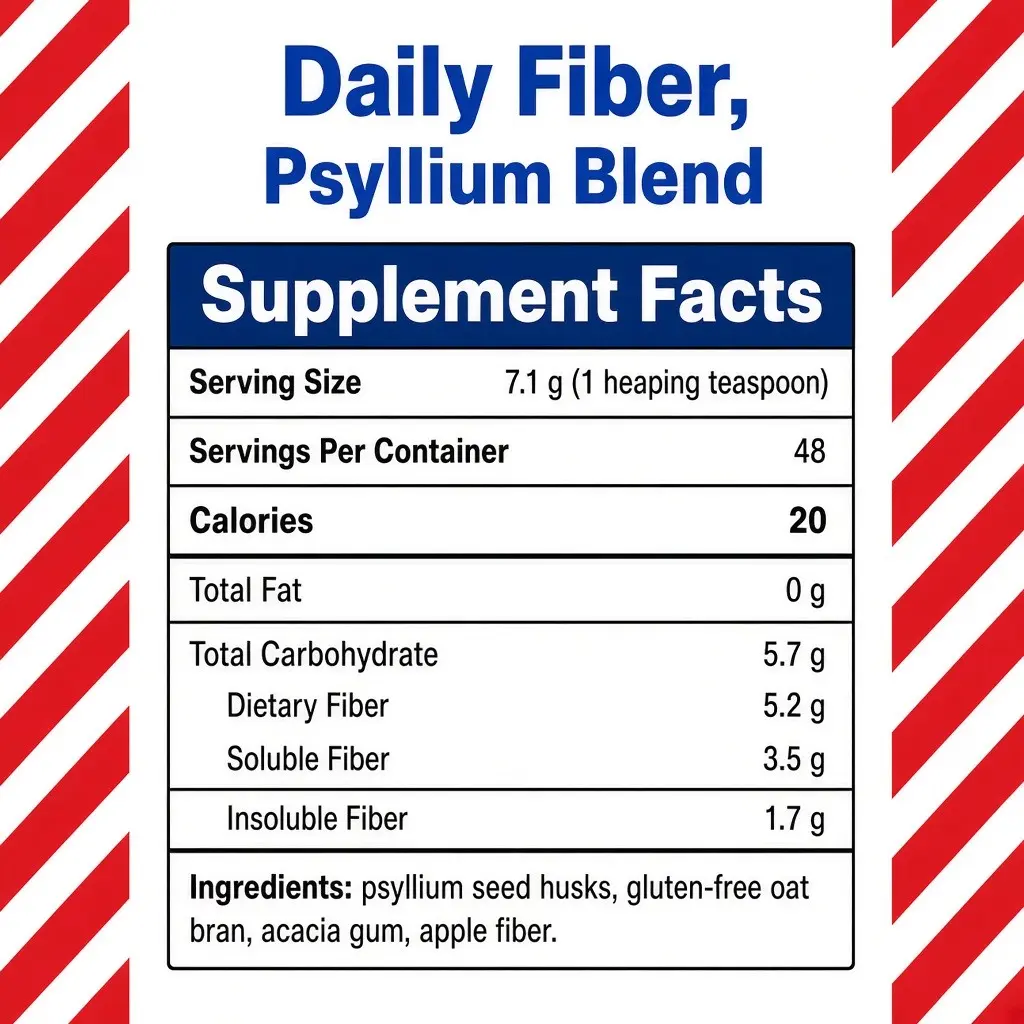
 Psyllium Drink Mix
Best for: A gel-forming psyllium powder, stirred into water and consumed immediately.
Specification: Plantago ovata husk or husk extract. The husk extract is soluble fiber ≥ 85%, 80–100 mesh, moisture ≤ 10%. Husk powder for drink mixes is specified by mesh size, swelling volume and soluble fiber content. Define soluble fiber grams, viscosity, dispersion, moisture and the water instruction. Sweetener and flavor change scoop weight.
Label reference: Readings from one commercial product family. Each line is its own serving or its own label statement.
- A one-teaspoon powder serving, about 5.8 g: 3 g dietary fiber, 2 g soluble fiber.
- A two-teaspoon column on a related powder label, about 11.6 g: 6 g dietary fiber, 5 g soluble fiber.
- A claim line for a powder serving in that family: about 2.4 g of soluble fiber from psyllium.
- Capsules in that family: about 1.8 g soluble fiber per serving, presented as about five capsules to one powder serving.
Compare a row only with its serving weight and its label line. Nearest-gram rounding on a panel can sit apart from the claim line for that family.
Considerations: Viscosity, bulk and the water instruction define the drinking experience. Clear dextrin or PHGG powders do not deliver this viscosity.
Typical format: Powder tub, pouch or single-serve pack. For regularity-related label wording, see fiber and regularity formulas.
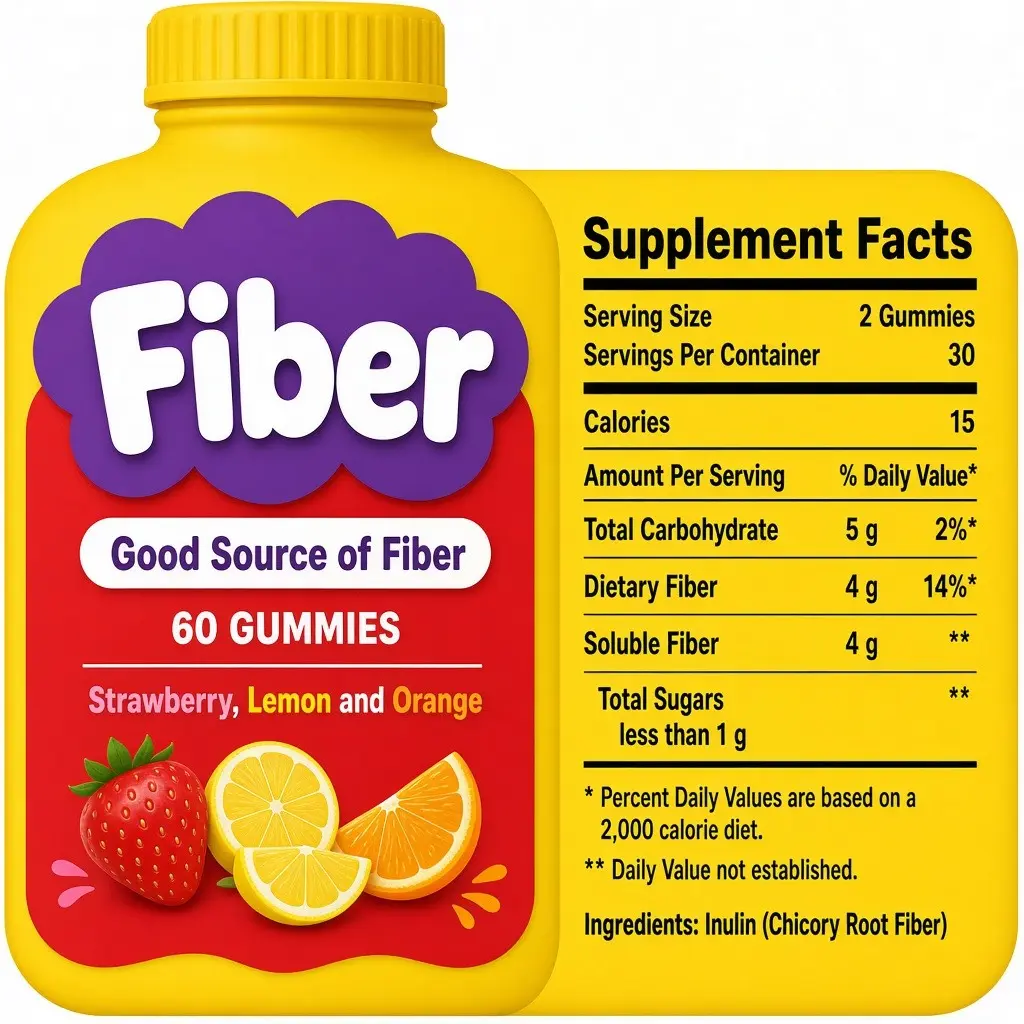
 Prebiotic Fiber Gummies
Best for: A serving counted in pieces, using chicory inulin or another low-viscosity soluble fiber that has passed a trial in the gummy mass.
Specification: Chicory root (Cichorium intybus). The KS grades are regular ≥ 85%, high purity ≥ 90–95%, ultra-high purity ≥ 98%, and an FOS-type grade at ≥ 55% FOS with the balance inulin. The FOS-type grade is short-chain material. Grades from other producers are compared by assay method and carbohydrate composition, not by grade name. If the lot is Jerusalem artichoke, it is named as such. Define piece count, piece weight, dietary fiber grams and added sugars. Pectin is used for vegan formulations; gelatin is an option otherwise.
Label reference: Two commercial gummy labels, read by piece count.
- Two pieces: 4 g inulin, 4 g dietary fiber, 4 g soluble fiber.
- Three pieces: chicory root 6 g, fructooligosaccharides (inulin) 4.5 g, dietary fiber 5 g.
Considerations: Inulin can partly hydrolyze under acid and heat, so the cook trial checks fiber retention, not only texture. A gel-forming psyllium serving is generally too bulky for a standard gummy piece. Green banana RS2 follows the processing limit in Green Banana Resistant Starch. If the formula includes live cultures, compatibility and stability are evaluated under synbiotic supplements. Children’s gummies need their own piece count, fiber grams and label review. “Prebiotic” wording is reviewed for the destination market.
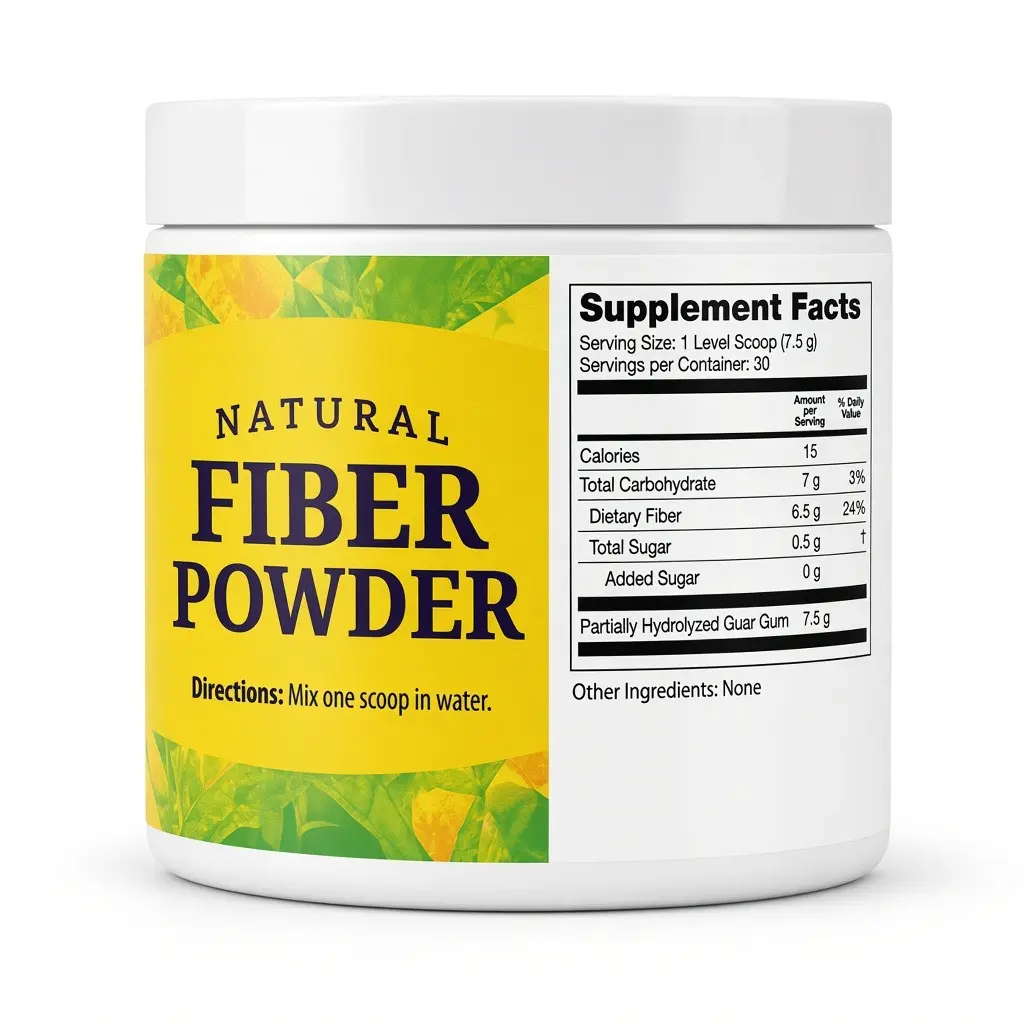
 Low-Viscosity PHGG Powder
Best for: A clear, low-taste daily powder that names partially hydrolyzed guar gum.
Specification: PHGG with the hydrolysis grade, dietary fiber or soluble fiber content, and method on that specification. Powder weight per serving depends on the fiber content of the selected grade. Intact guar gum is a high-viscosity thickener and a different specification.
Label reference: One commercial powder declares 6 g of dietary fiber in a 7 g scoop. Another product declares 3.7 g of soluble fiber in 5 g of ingredient. The two readings are separate products.
Considerations: PHGG typically gives a low-viscosity, mild-tasting solution. Viscosity and taste are confirmed on the selected grade.
Typical format: Multi-serve tub, or a stick pack sized to the fill weight.
 Green Banana Resistant Starch (Specialty)
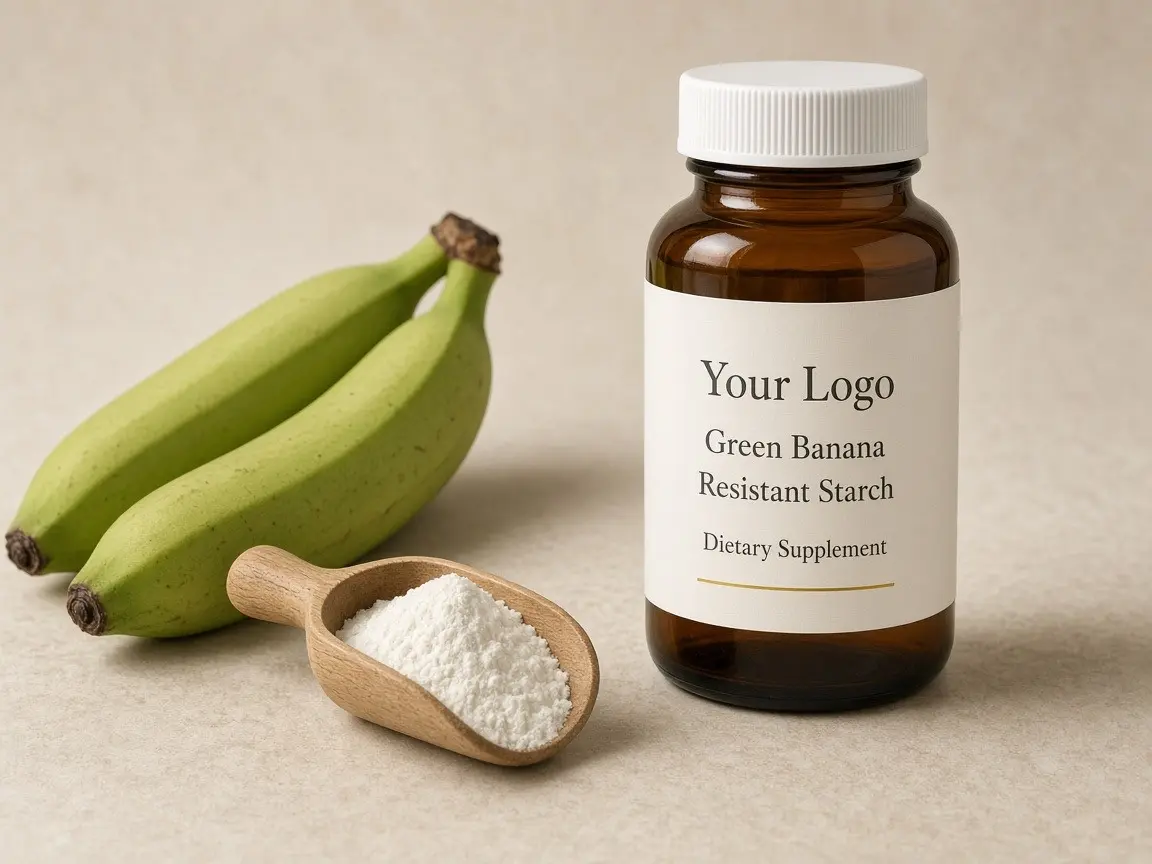
Best for: Green banana resistant starch type 2 (RS2), sold as a powder serving.
Specification: Green banana resistant starch type 2 (RS2), resistant starch ≥ 40%, by the assay named on that specification. Amylose (straight-chain) content is reported separately and does not set the resistant-starch percentage. Dried green banana flour and this isolated grade are checked separately before any gram is declared as dietary fiber. High-amylose maize starch on the US isolated-fiber list does not transfer to green banana.
Considerations: The ≥ 40% figure is the ingredient’s resistant-starch limit. Heat and moisture can gelatinize the starch and lower the resistant fraction, so retained resistant starch is checked against the agreed specification after processing. Gummies and ready-to-drink liquids are reviewed only if that retained fraction still meets the labeled target.
Typical format: Powder tub, pouch or stick pack.
Other Fiber Options For Finished Supplements
These can be assessed when the brief names the target fiber, source, content and format.
 Oat or barley beta-glucan
Define the source, beta-glucan content, assay and viscosity. A 10:1 oat extract is a different material from a specified beta-glucan grade. Claim conditions for the eligible whole-oat and barley sources are in Market-Specific Claim Conditions.
 Konjac glucomannan
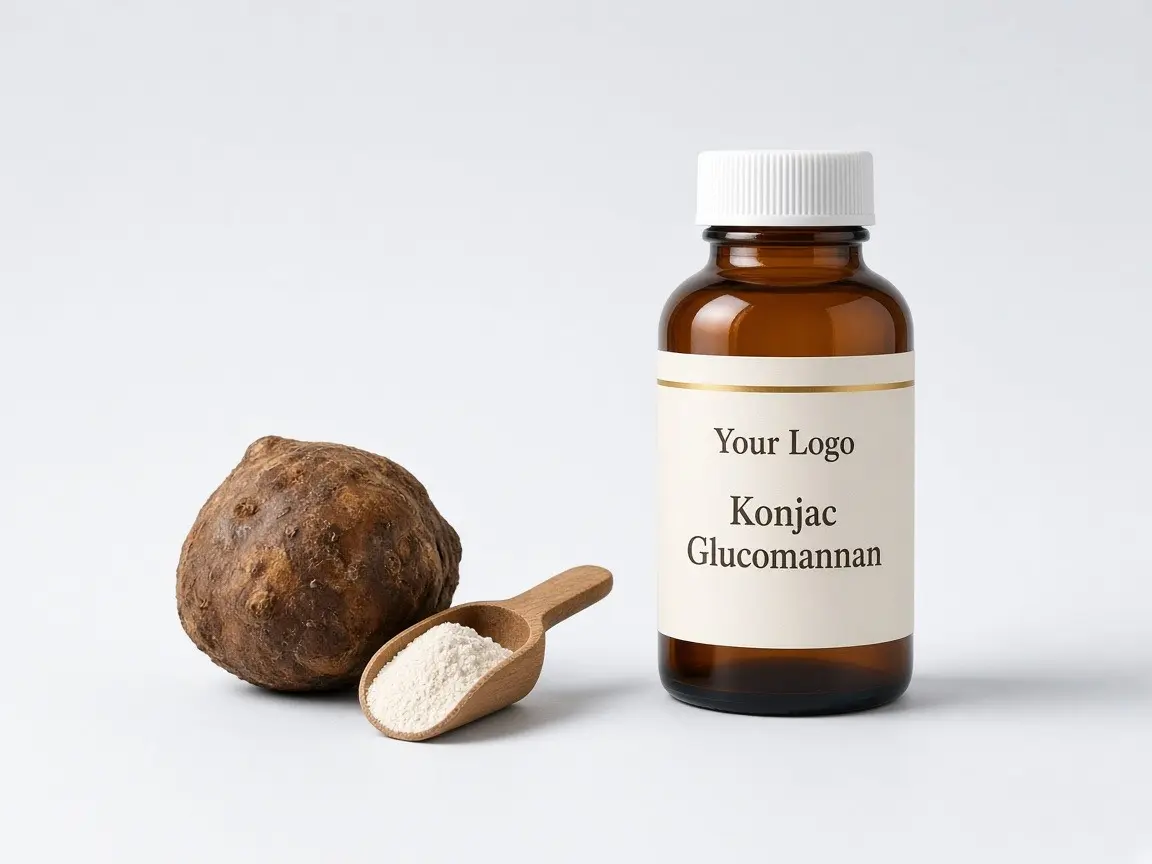
Konjac extract is Amorphophallus konjac tuber, glucomannan ≥ 60%, 80–200 mesh, moisture ≤ 10%. Quote extract weight, glucomannan grams and dietary fiber grams on separate lines. Konjac gels, so the water instruction is part of the label. A purified glucomannan above this grade is a different specification.
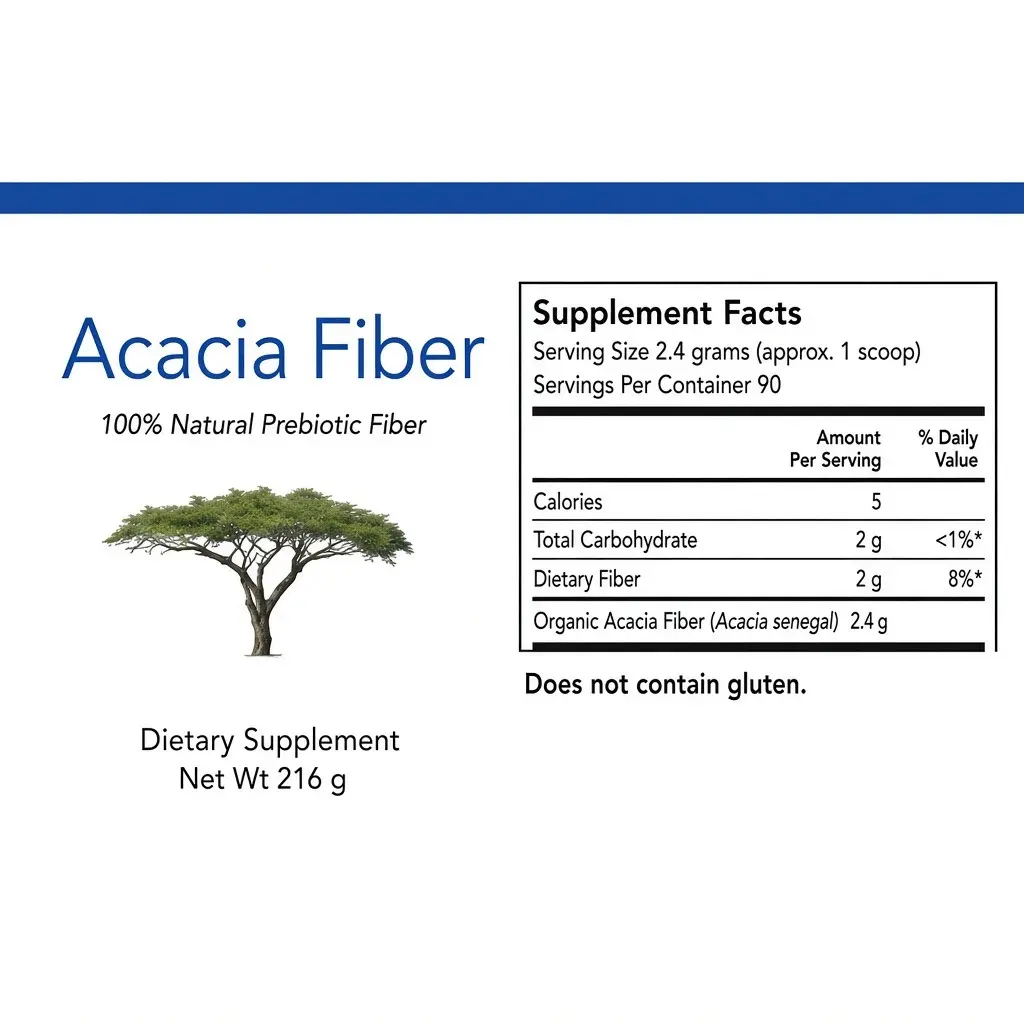
 Acacia fiber
Assessed for a low-viscosity soluble powder or a blend, on its own specification when PHGG or a dextrin is also under consideration. The quotation names source, fiber content, solubility, viscosity and moisture.
 Fruit-derived fibers
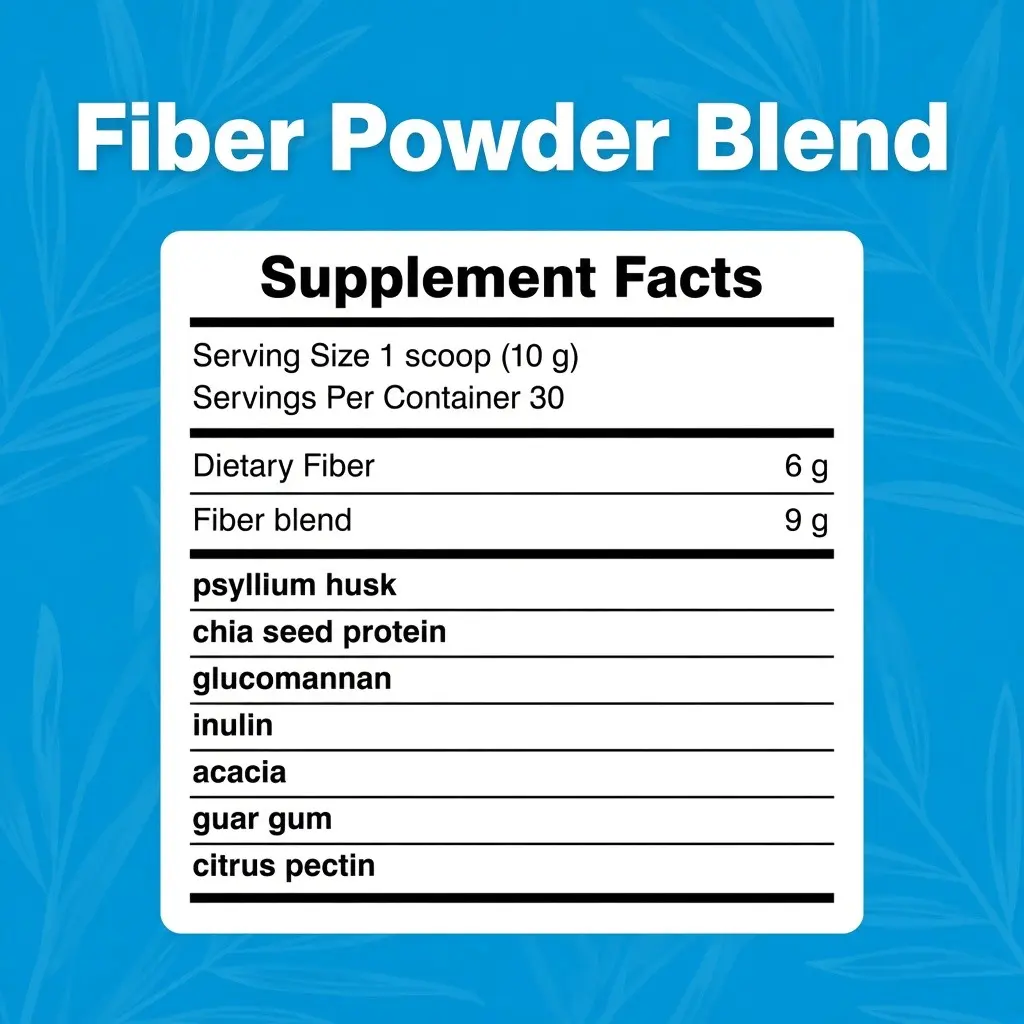
Apple fiber and citrus fiber can be assessed for a standalone powder or a multi-fiber blend. Apple fiber is not apple pectin, and citrus fiber is not citrus pectin. Neither is typically suited to gummies. A multi-fiber scoop names every fiber, and the quotation separates blend weight from fiber grams.
 Specialty beta-glucan extracts
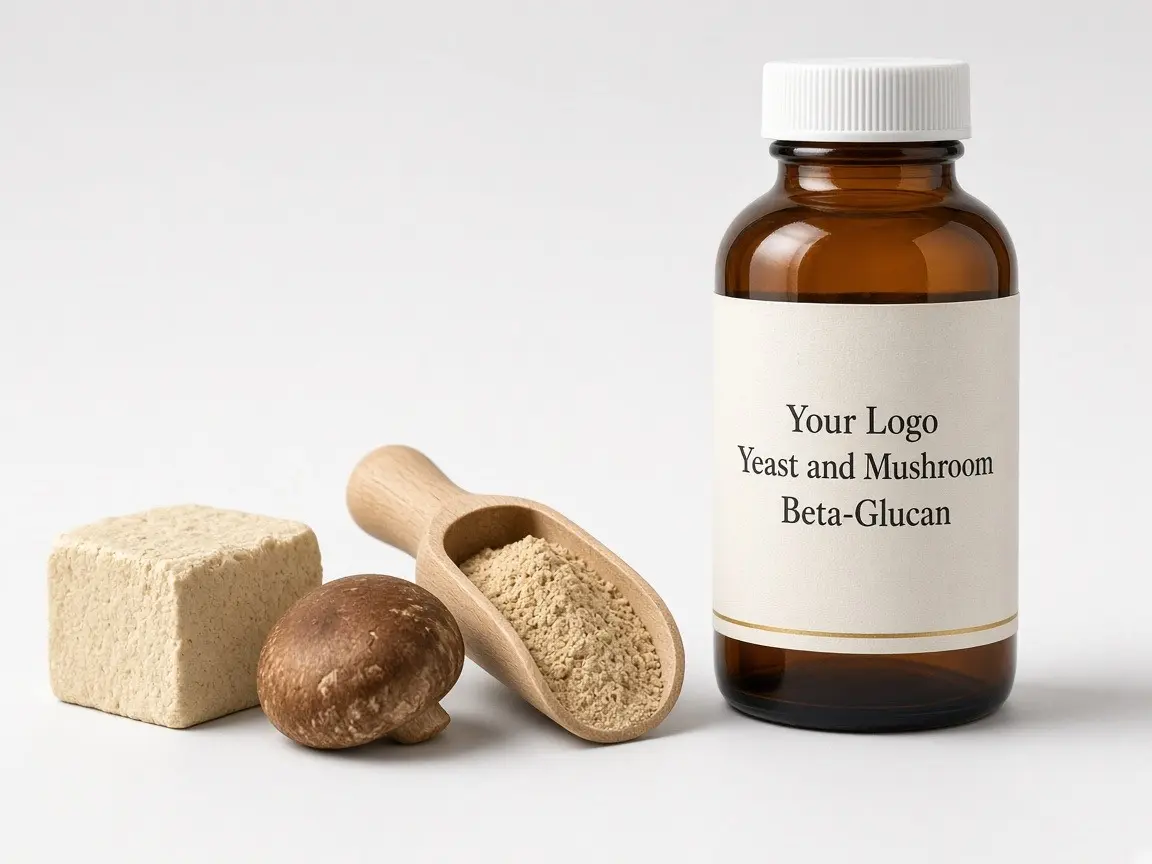
Yeast (Saccharomyces cerevisiae) and mushroom beta-glucan extracts are specified in milligrams, with an assay that separates beta-glucan from the alpha-glucan in starch. They are specified separately from oat or barley beta-glucan. Lion’s mane, cordyceps and other mushroom finished products keep those markers on their own specifications.
Choosing the Format: Powders, Stick Packs, Gummies or Capsules
Capsule count, piece weight and powder volume are assessed with the selected fiber. The gram target alone does not assign the format. See Serving Size and Format Feasibility.
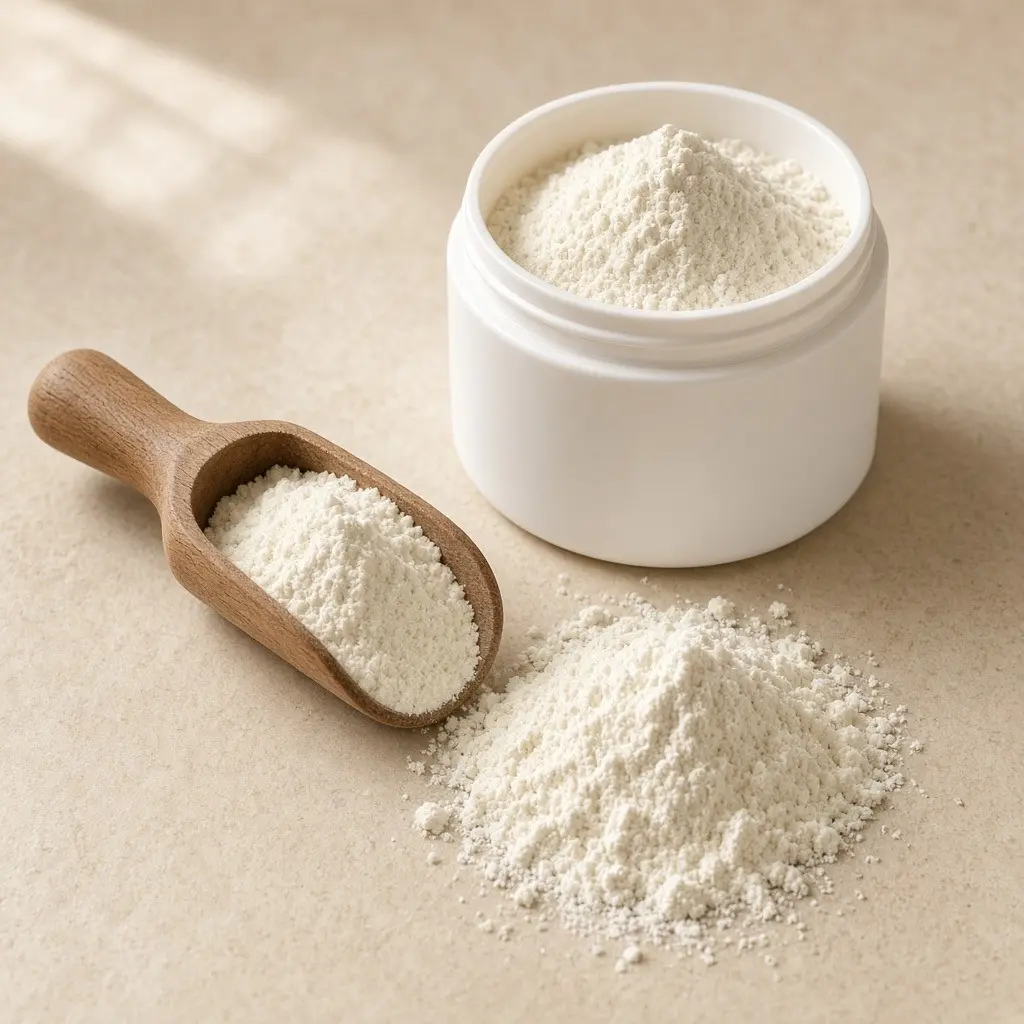 1. Powders
Best for: Dextrin, psyllium, PHGG and green banana RS2 when the serving is taken as a powder.
Key specifications: Bulk density, particle size, moisture and dispersion.
Manufacturing note: Hygroscopic fibers need a barrier pack. Powder quotations are based on the approved fiber blend, target fill weight, packaging requirements and testing scope. A similar tub size does not imply the same production cost.
 2. Stick Packs
Best for: One dose of a free-flowing powder, with the fiber grams already fixed.
Key specifications: Fill weight, then fiber grams, then film, seal and moisture barrier.
Manufacturing note: Psyllium’s low bulk density takes more volume per gram than a dense dextrin, and stick length follows that volume.
 3. Gummies
Best for: Inulin or another low-viscosity soluble fiber, after a trial on that mass.
Key specifications: Pieces per serving, fiber grams, gel system, sugar system, water activity and texture after storage.
Manufacturing note: Piece weight, fiber load and gel system are one specification. A fiber that fails the cook trial stays on a powder format.
 4. Capsules
Best for: A fiber serving that fits a practical capsule count, such as a lower-gram psyllium serving or a small specialty dose.
Key specifications: Fiber grams, powder density, capsule size and capsules per serving.
Manufacturing note: The label states the capsule count for that serving. A chewable tablet is quoted only after a check of tablet weight, hardness, taste and pieces per serving. Effervescent tablets, sustained-release tablets and ready-to-drink liquids are outside this format set.
The same gram target can land in different formats once density, water binding, gel strength and piece count are included. These rows are a first screen. The trial on the selected ingredient decides the format.
Target serving | First format screen | What the trial checks |
|---|---|---|
| Lower-gram serving | Capsules, gummies, powder or stick packs can be assessed | Capsule count, piece weight and the behavior of that fiber |
| Mid-gram serving | Powder or a stick pack is often the practical start. A gummy needs a cook trial | Fill weight, fiber load, gel system and texture |
| Higher-gram serving | Powder is the first format to assess | Volume, how the serving is taken, and pack size |
Commercial inulin labels in Prebiotic Fiber Gummies show how piece count carries a mid-gram soluble fiber. A gel-forming psyllium serving of the same grams is a different manufacturing job. US and EU wording for “good source,” “high,” “source of fibre” and “high fibre” is in Fiber Content Claims.
A project moves through the brief, a specification and feasibility review, a sample when the formula needs one, label review, and production.
Your situation | What to send | What the first review covers |
|---|---|---|
| New brand, concept stage | Product concept, target market, rough quantity | Fiber and format options, with the serving size and mouthfeel that follow |
| Existing brand, reformulating or adding a SKU | Current label or formula, target fiber grams, pack | Label targets, format feasibility and specification gaps |
| Retailer or private-label buyer | Reference label, pack, destination market, quantity | A quotation from the confirmed specification and order requirements |
| QA or regulatory team | Required tests, certificates, destination-market requirements | Documents, test scope and open compliance questions |
The sweetener system and the sugar level are part of the gummy specification. Powder specifications cover dispersion and moisture protection. Sugar-free wording is reviewed with the sweetener system and the destination market. The brief names that market, and the label is reviewed against its rules.
The ranges below are KS planning figures for finished supplements and schedule a first look. The quotation sets the confirmed minimum and calendar for each SKU, and formula, fill weight, packaging, testing, a new flavor and the production schedule can change both.
The quotation then separates tubs or pouches, sticks and bulk powder, because fill weight, film and batch weight change the confirmed minimum. Where a commercial window is still open, the table says the project is quoted, and no day count is added.
Format | Planning minimum | Sample | Commercial production |
|---|---|---|---|
| Multi-serve powder tub or pouch | Often from about 10,000 finished units | 7–15 days after the specification is confirmed; longer when the flavor is new | Quoted for the project |
| Stick packs | Often from about 10,000 units | 7–15 days after the specification is confirmed; longer when the flavor is new | Quoted for the project |
| Bulk powder | Quoted by kilogram | When a sample is made, 7–15 days after the specification is confirmed; longer when the flavor is new | Quoted for the project |
| Gummies | Quoted for the project | Set by the cook trial, the set and the assay | Quoted for the project |
| Capsules | About 3,000–5,000 finished units | 7–15 days after the specification is confirmed | About 30–45 days after sample approval |
| Chewable tablets, when quoted | About 5,000–10,000 finished units | 7–15 days after the specification is confirmed | About 30–45 days after sample approval |
A sample and a commercial batch are separate stages.
Documents for the project are the ingredient specification, the lot COA and an allergen statement for the lots used. Non-GMO documentation is included when it is available for that material. Shelf life is set from stability data on the finished format and pack.
Initial inquiries are typically answered within one business day. An NDA is available before a proprietary formula is opened.
Figures are group-wide. Capacity for a specific fiber format is confirmed by trial. Powder blending and stick-pack filling are assessed per project and are not given a daily rate in this table. Minimums and calendars for a SKU are in Planning Minimums and Timing.
Resource | Figure |
|---|---|
| Sites and lines | 5 manufacturing bases; 7 supplement production lines; 5 raw-material production lines; 260+ staff |
| Reported daily output | 5,000,000+ capsules; 2,000,000+ gummies |
| Raw-material capacity | 5,000+ tons a year, for ingredient processing |
Certifications include cGMP/GMP, ISO 9001, ISO 22000, HACCP, FSSC 22000, Halal and Kosher. Each applies to the legal entity, site and scope stated on its certificate. Halal and Kosher for a given fiber follow that certificate scope.
Ingredient weight, the fiber content of that ingredient, and the dietary fiber declared on the finished panel are three different numbers. The declared value follows the agreed method and records for that formula. A specification figure is not copied onto the label as a released result.
Specification field | What it establishes |
|---|---|
| Ingredient identity and source | Specific material, plant source and form |
| Fiber content and assay method | Ingredient specification and the testing basis |
| Target fiber per serving | Powder weight, piece or capsule count, and fiber grams per serving |
| Processing characteristics | Viscosity, solubility, heat stability, hygroscopicity |
| Labeling basis | Which declaration rule applies, and the records that support the grams |
| Finished-product release | Release specification and agreed tests for the SKU |
The specification defines what is purchased. The lot COA reports what that lot delivered. The release report confirms the finished SKU against its own specification. A certificate states the legal entity, site and scope it covers. Which declaration rule applies is set out under Fiber Content Claims and US Dietary Fiber Labeling.
This section covers nutrient-content claims for dietary fiber. Health-claim conditions for psyllium, oat and barley beta-glucan, native chicory inulin and glucomannan are in Market-Specific Claim Conditions. The destination market, the product category and the finished formula decide which set applies.
United States. 21 CFR 101.54 measures “good source,” “contains” and “provides” at 10 to 19 percent of the Daily Value per reference amount customarily consumed, and “high,” “rich in” and “excellent source” at 20 percent or more. The Daily Value for dietary fiber is 28 g, so those bands are about 2.8 g to 5.3 g and about 5.6 g or more on that reference amount. For a dietary supplement, 21 CFR 101.12 sets the reference amount as the maximum amount recommended on the label for consumption per eating occasion, or one unit when the label gives no recommendation. The declared grams still have to follow the dietary-fiber rules in US Dietary Fiber Labeling. If the food is not low in total fat, the label discloses total fat next to the fiber claim. The product category and the rest of 101.54 still have to fit before “high” is used.
European Union. Regulation (EC) No 1924/2006 sets “source of fibre” at 3 g of fibre per 100 g or 1.5 g per 100 kcal, and “high fibre” at 6 g per 100 g or 3 g per 100 kcal. The basis is per 100 g or per 100 kcal.
US Dietary Fiber Labeling
Isolated or synthetic non-digestible carbohydrates are assessed against the applicable FDA definition and guidance before any gram is declared. Being named below answers an identity question. The grams still come from the finished-product calculation in the specification table.
21 CFR 101.9(c)(6)(i) includes the following isolated or synthetic non-digestible carbohydrates in the dietary fiber calculation, because FDA has determined that they have physiological effects beneficial to human health: beta-glucan soluble fiber as described in 21 CFR 101.81, psyllium husk as described in that same section, cellulose, guar gum, pectin, locust bean gum, and hydroxypropyl methylcellulose.
FDA’s dietary fiber questions and answers also names carbohydrates the agency intends to propose adding to the definition. The guidance issued on June 14, 2018, The Declaration of Certain Isolated or Synthetic Non-Digestible Carbohydrates as Dietary Fiber on Nutrition and Supplement Facts Labels, is the enforcement-discretion notice for eight of them: mixed plant cell wall fibers, arabinoxylan, alginate, inulin and inulin-type fructans, high-amylose starch (resistant starch 2), galactooligosaccharides, polydextrose, and resistant maltodextrin/dextrin. Later notices added, among others, cross-linked phosphorylated RS4 in March 2019, glucomannan in January 2020 and acacia (gum arabic) in December 2021. Section 101.9(c)(6)(i) lists the seven carbohydrates named above. The additional names remain an intent to propose, with enforcement discretion while rulemaking is unfinished.
The same questions and answers describe mixed plant cell wall fibers, a broad category that includes apple fiber, as one of those intended additions. An apple-derived powder is checked against that identity. The category does not clear every apple ingredient. Green banana resistant starch is checked as green banana, rather than as high-amylose maize starch or resistant dextrin.
A wheat-derived ingredient does not, by itself, decide a gluten-free claim. Under 21 CFR 101.91, a food using the claim must meet the ingredient conditions in that section, and any unavoidable gluten must be below 20 ppm. Wheat remains a major allergen. When wheat is declared in the ingredient list or in a “Contains wheat” statement and the label also uses a gluten-free claim, 21 CFR 101.91(b)(3) requires the wheat declaration to carry the asterisk statement that the wheat has been processed to allow the food to meet FDA requirements for gluten-free foods. A food that uses both and omits that statement is misbranded. Eligibility for a given SKU still depends on processing history, cross-contact controls and the records for that finished product. FDA’s gluten-free labeling questions and answers summarize the rule.
These are health-claim conditions for the named fibers, including the required label statements. They are separate from the nutrient-content claims above.
- US soluble-fiber claim (21 CFR 101.81). For psyllium, the qualifying husk is psyllium seed husk at a purity of no less than 95 percent, with 3 percent or less protein, 4.5 percent or less light extraneous matter, and 0.5 percent or less heavy extraneous matter. Combined extraneous matter may not exceed 4.9 percent. The food contains at least 1.7 g of soluble fiber from that husk per reference amount customarily consumed. The daily level in the claim is 7 g or more of soluble fiber from psyllium seed husk. Soluble fiber for this claim is determined by the method incorporated in that section. The husk-extract specification of soluble fiber ≥ 85% does not, by itself, meet the 95 percent purity condition. The food that bears the claim, including a dietary supplement, has to meet the low-saturated-fat, low-cholesterol and low-fat conditions in that section. The low-fat condition has an exception when the fat comes from the eligible whole-oat sources. The same section sets separate conditions for beta-glucan soluble fiber from the whole-oat and barley sources named there, including 3 g or more per day. A 10:1 oat extract is not one of those sources.
- EU native chicory inulin claim (Regulation (EU) 2015/2314). The bowel-function claim may be used only for a food that provides a daily intake of at least 12 g of native chicory inulin. Native chicory inulin in that entry is a non-fractionated mixture of monosaccharides below 10 percent, disaccharides, inulin-type fructans, and inulin extracted from chicory, with a mean degree of polymerization of at least 9. The label has to tell the consumer that the effect is obtained with a daily intake of 12 g of chicory inulin. A 4 g gummy serving does not itself provide that daily intake. A high-purity grade does not establish the native-inulin definition. The claim is listed in the EU Register of nutrition and health claims.
- EU glucomannan claim (Regulation (EU) No 432/2012). The weight-loss claim may be used only for a food that contains 1 g of glucomannan per quantified portion. The consumer information states that the effect is obtained with 3 g of glucomannan a day, in three doses of 1 g, together with 1–2 glasses of water, before meals, in an energy-restricted diet. The claim also requires a choking warning for swallowing difficulty or too little fluid, and advice to take the product with water so it reaches the stomach. Those grams are glucomannan, not konjac-extract weight. The same register lists the conditions of use.
The brand owner is responsible for the final label and claim strategy.
Label directions and warnings to confirm for the destination market:
- Psyllium. A drink mix needs a water instruction. When the label uses the 21 CFR 101.81 psyllium claim and the husk is dry or incompletely hydrated, 21 CFR 101.17(f) also requires a notice on adequate fluid, choking if the product is eaten with too little liquid, and avoiding the product if swallowing is difficult.
- Glucomannan and konjac. Use the water amount, timing and choking warning in the EU claim above when that claim is requested. The water instruction is part of the label for a gel-forming konjac serving.
- Inulin and FOS. Gastrointestinal tolerance at the labeled serving, including whether the directions introduce the serving gradually.
Incoming-material checks and finished-product release criteria are defined in the approved project specification. Depending on the ingredient and product, the agreed scope may include identity, fiber content by the specified method, moisture, microbiology and heavy metals. The project specification identifies the required tests, methods, acceptance limits and release documents before production. Any external laboratory testing is confirmed by scope and quotation.
What is the MOQ for private-label fiber gummies?
Gummies are quoted for the project. Piece count, the cook trial, the assay and the pack set the minimum and the dates. Planning ranges for the other formats are in Planning Minimums and Timing.
How many grams of fiber can a gummy deliver?
The piece count and the fiber decide that. Commercial inulin readings are on Prebiotic Fiber Gummies. A gel-forming psyllium serving is generally too bulky for a standard piece.
Can psyllium be made into capsules or stick packs?
Yes, when the capsule count or the stick fill is part of the specification. A gel-forming drink is usually a powder. See Psyllium Drink Mix.
How do you test dietary fiber content?
The finished-product specification names the method and the limit. Incoming material is checked against the ingredient specification. Declared grams follow the destination market’s labeling rules. See Specification, Fiber Grams and Label Review.
What is the difference between straight-chain content and resistant starch?
Straight-chain content measures amylose, the linear fraction of the starch. Resistant starch measures starch that resists digestion in the small intestine. This grade is specified on resistant starch ≥ 40%, not on amylose. See Green Banana Resistant Starch.
How long does it take to develop and manufacture a fiber supplement?
The timeline depends on the fiber grade, the formula, the format, the packaging and the testing. A sample may be needed to confirm dispersion, viscosity, flavor or gummy texture before the specification is approved. Commercial production is scheduled after formula approval, packaging confirmation and agreement on the release requirements. Planning ranges are in Planning Minimums and Timing. The quotation states the sample and production windows for that project.
Request a Fiber Supplement Quote
Send any available reference label, existing formula or product concept. A closer first review includes:
- Target fiber. Ingredient, source and the specified fiber content, if known.
- Serving target. Dietary fiber grams per serving, and the serving size.
- Format and pack. Tub, pouch, stick pack, gummy or capsule, with pack size and piece count where they apply.
- Destination market. The market named in the brief.
- Order estimate. Finished retail units, stick count or bulk powder quantity.
- Quality requirements. Tests, certificates and release documents the project needs.
If some of these are still open, the first review names the gaps and the feasibility questions to settle before the quotation.
Request a fiber supplement quote.
Related
Gut Health Supplements · Digestive Enzyme Supplements · Gut Repair Supplements
Disclaimer
For wholesale and brand-manufacturing reference only. Not intended to diagnose, treat, cure or prevent any disease. Dietary supplements are not drugs, and no product is positioned as a treatment for any condition. Label readings are commercial references, not recommended intakes or stock formulas. Brand owners remain responsible for claim substantiation and for finished-label compliance in each destination market.
Written by KS Nutripharma Formulation Team | Reviewed by KS Nutripharma Director of R&D (PhD, Food Science, 19+ years nutraceutical development) | Technical review scope: fiber identity versus dietary fiber grams, psyllium husk versus extract, inulin grades, PHGG versus guar gum, green banana RS2 versus straight-chain content, and format feasibility | Updated October 2026 | R&D Center
Regulatory references: 21 CFR 101.9 · 21 CFR 101.12 · 21 CFR 101.54 · 21 CFR 101.81 · 21 CFR 101.91 · FDA dietary fiber questions and answers · Regulation (EC) No 1924/2006 · EU Register of nutrition and health claims. Regulatory references last checked: October 26, 2026.