








Gut Repair Supplement OEM/ODM Manufacturing Solutions
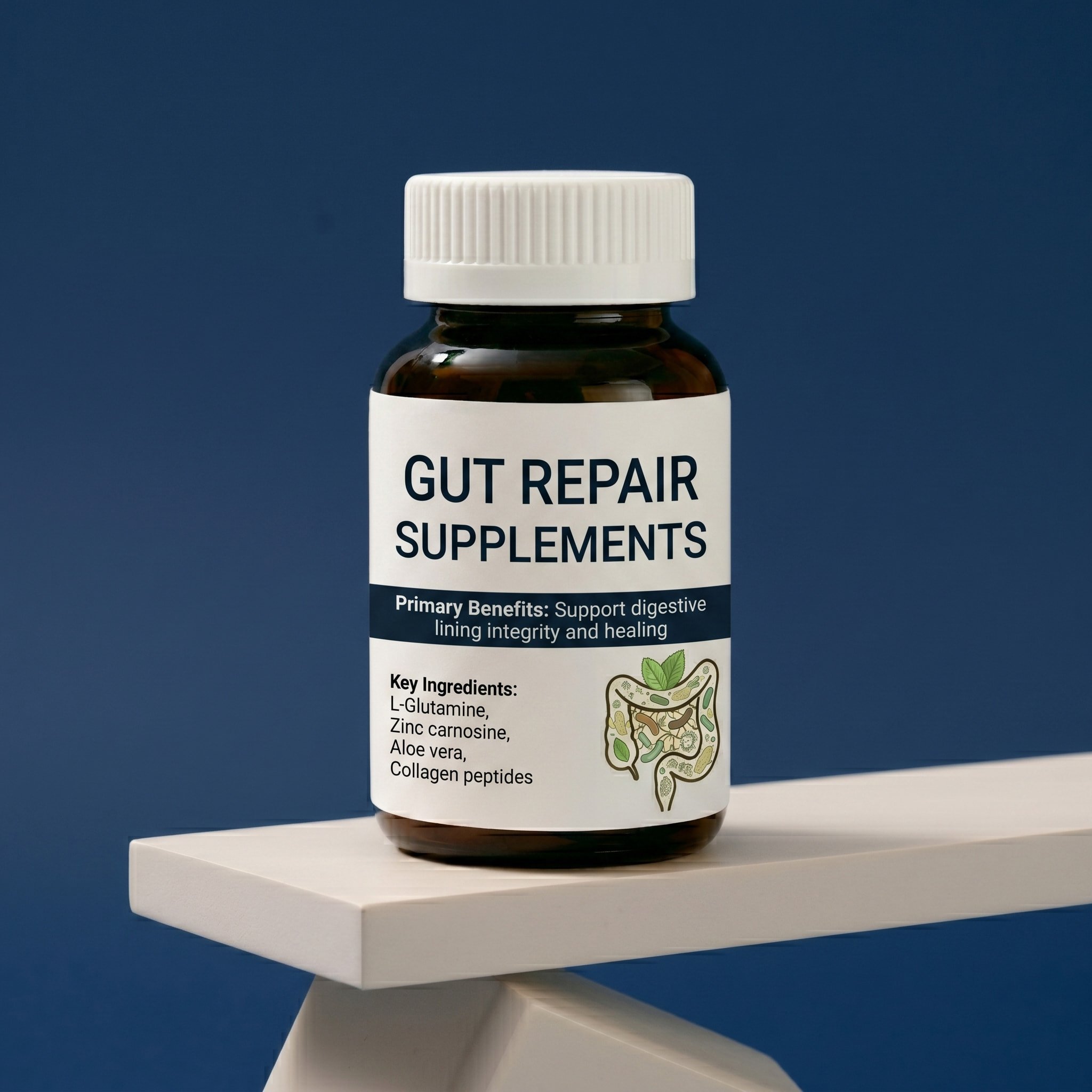
Looking for a gut repair supplement manufacturer for finished gut-lining and intestinal-barrier products—not a general digestive health catalog? KS Nutripharma develops these commercial OEM and private-label routes:
- Gut lining powders and sachets
- Glutamine + zinc carnosine formulas
- Botanical lining clusters (DGL, aloe, slippery elm, marshmallow)
- Lining plus fiber or selected probiotic strains
- Butyrate and tributyrin systems
- Capsules and two-part powder-plus-capsule kits
On this page, “gut repair” means commercial lining- and barrier-support supplement architectures. Typical finished products include glutamine-led powders, zinc-carnosine capsules, botanical lining formulas, microbiome bridge powders, butyrate systems, and two-part kits. Final claims belong to the brand owner for the destination market.
Formulation decisions follow dose space, active specification, dosage form, and finished-product release. The same label is not automatically the same manufacturing file in every format.
cGMP · ISO 9001 · ISO 22000 · HACCP · FSSC 22000 · Halal · Kosher · batch COA pathways as scoped
→ Manufacturing Capacity · Quality Control · Certifications
What to Specify Before You Compare Quotes
Have an existing label, BOM, or competitor formula? The specification lines below are what get checked before a quotation.
| Lock | What the quotation has to name |
|---|---|
| Dose space | Glutamine and fiber fill class. The consequence is under L-glutamine, then applied on F01 and F03 |
| Complex vs elemental zinc | Lock the declared basis. The rule is under Zinc Carnosine |
| Finished-product assay | The release list is under Finished-Product QC |
| Format | Powder, sachet, capsule, and two-part are separate routes |
Gut Repair Product Routes You Can Brief
Development-class fills for OEM quotation—not recommended intakes. The formulation team and R&D center match the brief to one route, then set glutamine fill, zinc-carnosine basis, and dosage form before a sample.
Brief | Route |
|---|---|
| Multi-gram glutamine powder | F01 |
| Lining + NAG | F02 |
| Capsule-first | F03 |
| Lining + fiber / cultures | F04 |
| Butyrate / tributyrin | F05 |
| Powder + capsule | F06 |
Core: L-glutamine + zinc-L-carnosine.
Optional lining botanicals: DGL, aloe, slippery elm, marshmallow.
Dose class: Glutamine 3–5 g-class; zinc-L-carnosine 50–75 mg-class, specified by complex weight. When botanicals are included, development bands often land near DGL 300–500 mg-class and aloe, slippery elm, and marshmallow 100–250 mg-class each.
Format: Powder can or stick.
Key specification: Free-form glutamine assay; each botanical, when used, by species, plant part, and extract definition.
Manufacturing constraint: Flavor, flow, and moisture. A botanical-led brief uses the optional module and can lower the glutamine fill. This fill class is not a capsule route; that file is F03 or F06.
Core: F01 core plus N-acetyl-D-glucosamine. Optional lining botanicals as on F01.
Dose class: Glutamine 3–4 g-class; zinc-L-carnosine 50–75 mg-class, specified by complex weight; NAG 500–1,000 mg-class.
Format: Powder.
Key specification: NAG identity, source route, and allergen declaration.
Manufacturing constraint: More specification lines and cost than F01. Source route affects allergen declaration and specification requirements.
Core: L-glutamine, zinc-L-carnosine, optional NAG, optional lining botanicals at capsule-compatible fills.
Dose class: Glutamine 1.5–2 g-class. Capsules per serving are a quote line.
Format: HPMC or gelatin capsule.
Key specification: Shell and fill weight. Zinc-L-carnosine specified by complex weight.
Manufacturing constraint: Capsule count becomes the commercial constraint when glutamine moves above the 1.5–2 g class. A 3–5 g-class target stays on F01 or moves to F06. Capsule feasibility is not label-equivalence.
Core: L-glutamine, PHGG and/or acacia, selected probiotic strains.
Dose class: Glutamine 1.5–2 g-class; PHGG ~2 g-class and/or acacia ~2–2.5 g-class.
Format: Flavored powder or sachet.
Key specification: Exact strain identity, including Saccharomyces boulardii or Bacillus coagulans when named; CFU at manufacture and at end of shelf life; moisture and barrier pack.
Manufacturing constraint: Aw, flavor, and culture stability share one file. Culture-led depth finishes on the probiotic path.
Core: L-glutamine, zinc-L-carnosine, butyrate salt or tributyrin.
Dose class: Glutamine 2–3 g-class; zinc-L-carnosine 50–75 mg-class, specified by complex weight.
Format: Capsule or powder, set by the butyrate system.
Key specification: Active basis, enteric delivery when used, odor control, finished assay.
Manufacturing constraint: Heavier delivery and sensory work than F01. Use when the brief requires this file.
Manufacturing principle: One commercial SKU does not necessarily mean one manufacturing route.
Core: Part A powder (glutamine, fiber, cultures, enzymes as specified). Part B capsule (zinc-L-carnosine, NAG, concentrated botanicals).
Dose class: Gram-level powder fills plus low-dose capsule actives.
Format: Powder plus HPMC capsule kit.
Key specification: Separate BOMs, specifications, release files, and pack configuration. Part B specifies zinc-L-carnosine by complex weight.
Manufacturing constraint: Gram-level powder actives and low-dose capsule actives are quoted as two files, not as a format swap.
Collagen, colostrum, and ordinary vitamin lines stay extensions.
Choose the Right Format: Powder, Capsules, Sachets or a Two-Part System
A format change is a new feasibility file. Dose class is already set on the route card.
Best for: F01, F02, and fiber loads on F04.
What to lock: Scoop weight, flavor, dispersion, moisture, finished glutamine assay.Best for: F03, and F05 when the butyrate system is a capsule.
What to lock: Capsules per serving, shell, fill weight.- Sachets / Stick Packs
Best for: Single-serve F01 or F04 powders, when the daily fill, flavor system, and barrier film can be matched.
What to lock: Dose uniformity, the same assay and Aw rules as the bulk powder, film and seal. A sachet and a stick pack are different quote lines. - Two-Part System
Best for: F06.
What to lock: Two COA sets, kit packaging, and directions. - Other Formats — Project-Scoped
Tablets and gummies only after a separate feasibility pass. A gut-repair gummy is not assumed to match a 3–5 g-class glutamine powder.
→ Gummies when the brief requires that path.
L-Glutamine — dose-space driver
Multi-gram glutamine is what decides whether the SKU is a powder, a sachet, or a capsule count. Lock free-form identity, assay, particle characteristics, target fill class, and finished-product assay.
3–5 g-class is the F01 powder route. 1.5–2 g-class is the F03 capsule route. Keeping the higher class and moving to capsules changes capsule count and the commercial SKU.
Zinc Carnosine — complex versus elemental
RFQ rule: Do not quote “75 mg zinc carnosine” until the file states whether 75 mg is zinc-L-carnosine complex weight or elemental zinc.
A zinc salt listed with L-carnosine is a different architecture. A branded grade (for example PepZin GI®) needs the authorized name. A generic complex is not an automatic substitute. Route cards specify zinc-L-carnosine by complex weight and use this rule.
N-Acetyl-D-Glucosamine (NAG)
Lock identity, source route, allergen status, and fill class. NAG extends F02. It does not replace glutamine or zinc carnosine.
Demulcent botanical cluster
Optional on F01 and F02. Lock the cluster when the brief includes it:
Botanical | Lock |
|---|---|
| DGL | Glycyrrhiza species, root, extract ratio, glycyrrhizin-removal definition |
| Aloe | Species, inner leaf or gel, decolorized status, polysaccharide % or ratio when claimed |
| Slippery elm | Bark, powder vs extract |
| Marshmallow | Root, powder vs extract |
Scoped only where they change the lining file. Culture-led, fiber-led, and enzyme-led specifications continue on Related pages.
- Fiber — PHGG, acacia, or resistant starch; gram load; low-FODMAP only when the brief gates it
- Probiotic — exact strain, CFU at manufacture, CFU at end of shelf life; detail is on F04
- Enzyme — activity units, named as a digestive-support module
- Butyrate / tributyrin — form, active basis, delivery, odor; detail is on F05
Incoming COA ≠ finished-product release. The quote states what is tested on the drum and what is tested on the finished powder, capsule, or kit.
Release focus | Why it matters |
|---|---|
| Glutamine assay | Confirms the finished label claim |
| Zinc / zinc-carnosine assay | Confirms the declared active basis |
| Moisture / water activity | Controls powder and culture stability |
| Sensory / odor | Matters for zinc-carnosine dry blends and butyrate systems |
| CFU at end of shelf life | Confirms the probiotic shelf-life target |
| Enteric integrity | Required when delivery depends on enteric performance |
| Microbiology and heavy metals | Scoped by product and destination market |
Packaging as a protection system: moisture and oxygen barrier, headspace, desiccant when needed, light protection when needed, and sachet seal integrity. Shelf life follows the finished formula and pack protocol.
Typical planning figures. The confirmed number follows formula, dosage form, pack, and testing scope. Sachet and stick pack are not one line item.
Typical figure | |
|---|---|
| Capsule MOQ | About 3,000–5,000 finished units per SKU |
| Finished powder MOQ | 3,000 finished powder units (tub, pouch, or jar) |
| Sachet MOQ | 5,000 |
| Stick-pack MOQ | 30,000 |
| Two-part kit | Quoted as two files |
| Sample | 7–15 days after the specification is locked |
| Commercial production | Often 30–45 days after formula, artwork, packaging, testing scope, and the production schedule are locked |
Project steps: send a brief, BOM, label, or COA → R&D feasibility and quote → sample → artwork and pack lock → commercial production and finished-product release.
Request a Gut Repair Formula Feasibility Review
Send a label, BOM, or target specification even if it is incomplete. Missing specification lines are listed before costing.
- Product route — F01–F06 or custom
- Target actives and target dose, if known
- Dosage form — powder, sachet, stick, capsule, tablet, or two-part
- Daily serving or capsule count
- Destination market and intended claim direction
- First-order or annual volume
- Existing label, BOM, or competitor reference — optional; note if live cultures are in scope
Request a Gut Repair Formula Feasibility Review
Related Digestive Manufacturing Pages
- Gut health supplements
- Synbiotic supplements
- Probiotic supplements
- Digestive enzyme supplements
- Powders and granules
Disclaimer
Wholesale / brand manufacturing and product-development reference only. Not intended to diagnose, treat, cure, or prevent any disease, including inflammatory bowel disease or any “leaky gut” diagnosis. Dietary supplements are not drugs. “Gut repair” on this page is a commercial formulation class for lining- and barrier-support products. Milligram examples are development-class fills for OEM discussion—not recommended intakes. Brand owners remain responsible for structure/function (or other) claim substantiation, notifications where required, advertising standards, and finished-label compliance in each destination market. Stability and shelf life follow the finished formulation and packaging system.