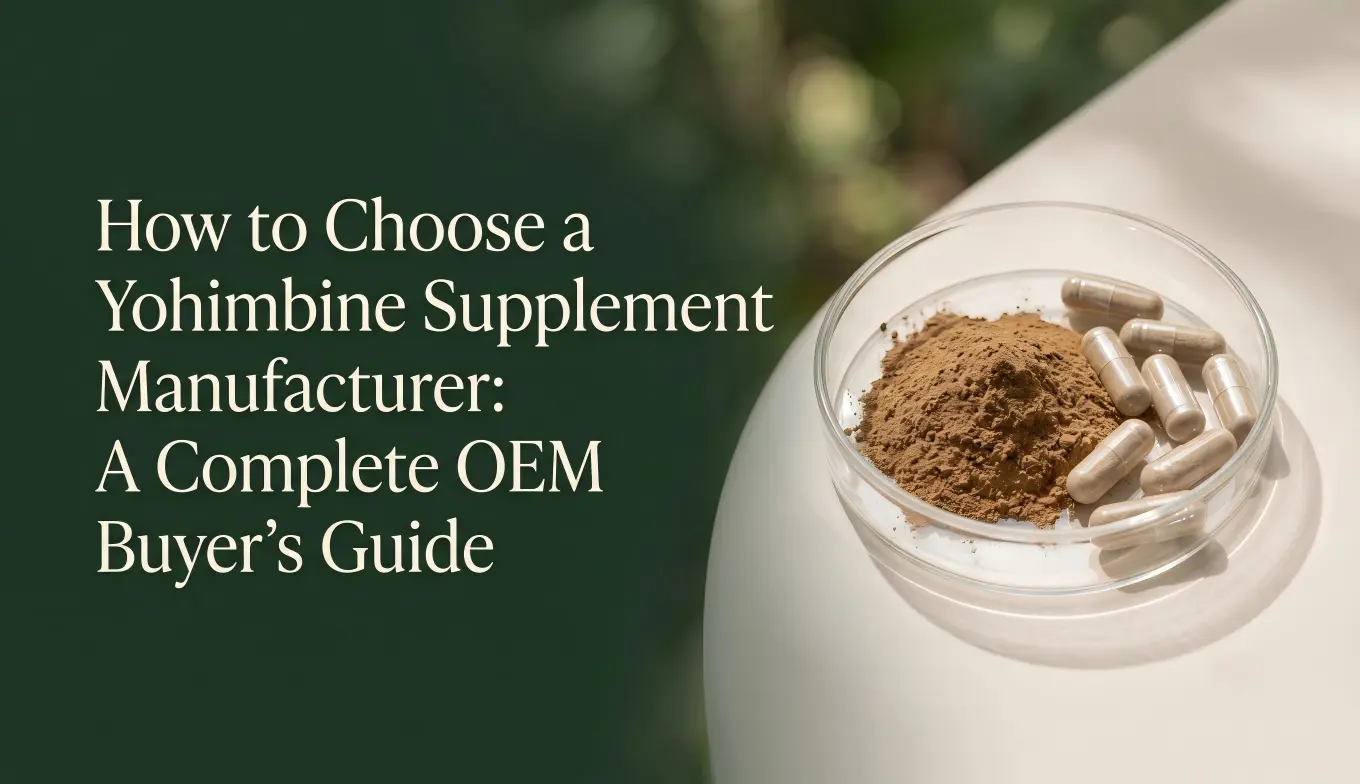
Supplier Evaluation Guide for Brand Owners, Procurement Managers & Private Label Teams
KS Nutripharma® | Science-Driven Nutraceutical Contract Manufacturer
Written by KS Nutripharma Formulation Team | Reviewed by KS Nutripharma R&D and Quality Team | Updated July 2026
Disclaimer: For procurement, manufacturing evaluation, and product-development guidance only. Not intended to diagnose, treat, cure, or prevent any disease. Brand owners remain responsible for finished-label compliance and market-entry legality with local counsel. Yohimbine / Yohimbe status varies by country. Citations below link to public government / scientific sources for verification; they are not legal advice and may be updated by the issuing authority.
Choosing a Yohimbine Manufacturer Is Not Only About Price
Selecting a Yohimbine supplement manufacturer is a commercial diligence exercise—not a consumer product review.
Professional buyers should evaluate:
- Ingredient authenticity
- Standardization level
- Quality control systems
- Manufacturing capability
- Regulatory readiness
- Supply chain reliability
This guide answers one procurement question:
How do I evaluate a Yohimbine supplement manufacturer before placing an OEM / ODM / private label order?
→ Manufacturing platform: Yohimbine HCl Supplement Manufacturer
Discuss Your Yohimbine Supplement Project
Quick Supplier Evaluation Checklist
Use this summary before deep diligence. Strong manufacturers usually show clear answers across all six areas.
Evaluation Area | What Good Manufacturers Provide |
|---|---|
| Ingredient Identity | Clear Yohimbine HCl or Yohimbe Extract specification—not vague “yohimbine” language |
| Testing | HPLC assay pathway + contaminant testing (microbial, heavy metals, residual solvents as applicable) |
| Manufacturing | GMP-controlled finished-goods production for your target format |
| Documentation | COA, TDS/spec sheet, SDS where needed, and lot-level traceability |
| Commercial | Realistic MOQ, lead time after formula & artwork lock, and reorder change control |
| Support | Formulation assistance, packaging options, and regulatory screening notes by destination |
Buyer shortcut: If a supplier cannot lock pathway + assay + documents before quoting finished goods, treat the quote as incomplete.
Why Choosing the Right Yohimbine Manufacturer Reduces Product Risk
Yohimbine is a highly specification-sensitive botanical-derived ingredient. Choosing the wrong partner increases product risk far more than it lowers unit cost.
A qualified manufacturer should help brands manage three risk zones:
1. Potency Consistency
Different suppliers may provide:
- Different purity/assay levels
- Different extraction or purification pathways
- Inconsistent active content between lots
Without identity and assay lock, Supplement Facts honesty and reorder reviews become fragile. Assay drift between lots is a common reorder failure mode.
2. Regulatory Risk
Markets differ regarding:
- Ingredient acceptance
- Labeling requirements
- Serving and warning expectations
- Whether Yohimbe / yohimbine pathways are allowed at all
Wrong material pathway selection—or missing market screening—can block launch even when the formula looks commercially ready.
3. Product Quality Risk
Weak suppliers may lack:
- Validated testing pathways
- Lot traceability
- Contaminant controls
- Change-control discipline on raw materials
- Complete COA packs tied to locked specs
MOQ surprises, missing documents, and undocumented material substitutions are procurement failures—not “production issues.”
Buyer takeaway: The cheapest unit quote is often the most expensive reorder.
Step 1: Confirm Material Pathway Before You Ask for Price
Understand Yohimbine Raw Material Types
Manufacturers may work with two different pathways:
Yohimbine HCl
- Purified alkaloid/hydrochloride pathway
- Standardized potency potential
- High dosing accuracy for finished SKUs
Yohimbe Extract
- Botanical bark extract
- Requires clearer standardization
- More complex quality evaluation
Why This Matters
Yohimbine products are not interchangeable. Yohimbine HCl and Yohimbe bark extract represent different ingredient pathways, requiring different specifications, labeling approaches, and quality documentation.
U.S. federal sources note that yohimbe bark contains the alkaloid yohimbine, that dietary-supplement yohimbine content can vary widely between products, and that OTC products containing yohimbine may not behave like prescription yohimbine medicines [1] [2]. Mixing pathways on paperwork—or treating bark extract as an “HCl equivalent”—creates identity, claim, and compliance risk before production even starts. Confirm which pathway appears on the locked specification before artwork freeze.
→ Comparison guide: Yohimbine HCl vs Yohimbe Extract
Questions to Ask Suppliers
- What is the botanical / material source?
- For bark pathways: is the material derived from Pausinystalia johimbe?
- Is the active compound identified and assayed?
- What extraction / purification pathway is used?
- Can you provide a sample COA tied to a locked specification?
- How do you prevent HCl vs bark-extract confusion on documents?
Step 2: Evaluate Standardization and Documentation
Look Beyond the Specification Sheet
A reliable supplier should be able to provide:
- Product specification / TDS
- COA
- HPLC / assay report pathway
- Microbial testing
- Heavy metal testing
- Residual solvents as applicable
- Traceability from incoming lot to finished release
Price without documents is not a real quote.
Why HPLC Testing Matters for Yohimbine
HPLC is commonly used to support:
- Identity
- Assay
- Active compound concentration vs locked acceptance criteria
Independent laboratory analysis of U.S. retail supplements labeled as containing yohimbe or yohimbine has reported large potency variation across brands, including products with little or no labeled active and products with pharmaceutical-quantity yohimbine [2] [3]. That is why assay lock and COA discipline matter before OEM pricing.
Commercial examples (method- and project-dependent):
- Yohimbine HCl programs often discuss high-assay grades (including ≥98% class materials)
- Yohimbe Extract programs need a defined yohimbine % and/or alkaloid profile—plus method clarity
Ask whether the assay method is written into the locked BOM and whether finished testing is available for hero formats.
→ Document literacy: How to Read a COA
Step 3: Ask the Right RFQ Questions Before Comparing Quotes
Before requesting price, lock the commercial brief so quotes are comparable.
Ask every shortlisted partner:
- Which material pathway will appear on the locked spec—Yohimbine HCl or Yohimbe Extract?
- What assay / acceptance criteria will govern incoming release?
- Which dosage form, serving architecture, and pack-out are assumed in the quote?
- What testing is included in the base quote vs billed as extras?
- What is MOQ and lead time after formula and artwork lock?
- Can you support NDA, sample/COA pathway, and video or document audit for qualified projects?
- Which destination markets have you already screened for this ingredient pathway?
Incomplete answers here usually produce incomplete—or non-comparable—pricing.
Step 4: Check GMP Systems and Factory Evaluation Discipline
Essential Certifications
Look for applicable systems such as:
- cGMP
- ISO 9001 / ISO 22000
- HACCP
- FSSC 22000
- Halal / Kosher pathways where required
- FDA facility registration posture where applicable
For U.S.-oriented dietary supplement manufacturing, buyers commonly benchmark against FDA 21 CFR Part 111, which requires manufacturers to establish and meet specifications for identity, purity, strength, and composition, and to control manufacturing, packaging, labeling, and holding operations [4]. Certifications help demonstrate controlled manufacturing environment, documented procedures, and quality consistency expectations.
Ask About Quality Control Workflow
Raw Material Inspection
        ↓
Identity Testing
        ↓
Assay / Spec Lock
        ↓
Production Control
        ↓
Finished Product Testing
        ↓
Batch Release + COA
Factory Diligence Questions
- Do you manufacture finished goods in the formats we need?
- How do you handle low-mg accuracy and blend uniformity for Yohimbine programs?
- Can you support private label, OEM, and ODM?
- Do you provide formulation assistance and claim-boundary notes?
- Can you support NDA, video audit, or QC review for qualified projects?
→ Quality Control · Certifications & Compliance
Step 5: Match Manufacturing Capability to Channel Reality
Available Dosage Forms
A finished-goods manufacturer for Yohimbine programs should typically support the formats brands actually sell:
Capsules
- Accurate serving control
- Clean labeling
- Common first launch for Amazon / DTC
Tablets
- Cost-efficient high-volume programs
- Retail / value channel fit
Powder blends / stick packs
- Pre-workout and convenience concepts
- Room for high-fill companions
Custom Formula Development
Evaluate whether the manufacturer provides:
- Formula concept / ODM design
- Ingredient compatibility review
- Serving architecture after market review
- Pilot / sample pathway
- Packaging and artwork checkpoints
→ Formulation depth: Yohimbine Formulation Considerations
MOQ, Lead Time and Production Flexibility
Factor | What Buyers Should Check |
|---|---|
| MOQ | Capsule / tablet / powder / stick starting volumes vs bulk-only quotes |
| Sample policy | Lab / pilot sample availability with COA pathway |
| Lead time | Timeline after formula and artwork lock |
| Packaging | Bottles, labels, stick packs, FBA / export packing |
| Batch size | Pilot to commercial scale under the same locked BOM |
| Reorder logic | Change control · retention samples · lot traceability |
Typical planning ranges (project-dependent):
- Capsules often from ~5,000 bottles · typically 4–6 weeks after formula & artwork lock
- Tablets often from ~5,000–10,000 bottles · typically 4–6 weeks
- Powders / sticks often 5–8 weeks depending on blend and pack scope
Step 6: Use a Yohimbine Supplier Scorecard
Use this as an RFQ scorecard. Request the download pack if your team needs a shared worksheet.
Raw Material
Manufacturing
OEM Capability
Commercial
Minimum Passing Criteria
A manufacturer should meet the following before shortlist approval:
Mandatory
- Ingredient identity confirmed (HCl vs bark extract)
- COA available and tied to locked specification
- GMP-controlled manufacturing system
- Lot-level traceability
Preferred
- Finished-product testing for hero formats
- Formulation / ODM support
- Export documentation experience
- Claim-boundary and market-screening notes
If a supplier fails any Mandatory item, do not advance to commercial negotiation on finished goods alone.
Request Supplier Comparison Worksheet
Yohimbine Manufacturer Evaluation Framework: Trader vs Ingredient Supplier vs OEM Factory
Not every “Yohimbine supplier” is suitable for brand launch. Match supplier type to your internal capability.
Supplier Type | Suitable For | Typical Strength | Risk If Misused |
|---|---|---|---|
| Raw Material Trader | Bulk ingredient buying when you already have manufacturing | Fast material quotes | Limited finished-product support, packaging, or claim screening |
| Extract / Ingredient Supplier | Ingredient sourcing and assay-defined materials | Spec and COA for raw input | No finished-dose manufacturing, labeling, or pack-out |
| OEM / ODM Manufacturer | Brand launch and private label programs | Formulation, production, packaging, documentation under one workflow | Best fit for most brand owners without in-house manufacturing |
Private Label vs OEM vs ODM Service Models
Service Model | Suitable For |
|---|---|
| Private Label | Faster market launch with adaptable concepts |
| OEM Formula | Your locked formula manufactured under your brand |
| ODM Development | Concept-to-commercial innovation with formulation support |
Many brand launches combine models: start with an ODM concept, then lock OEM reorders under the same BOM.
Regulatory Considerations When Manufacturing Yohimbine Supplements
Yohimbine / Yohimbe programs are YMYL-adjacent from a brand-risk perspective. Market acceptance depends on product positioning, ingredient status, dosage, labeling, and applicable regulations—not on a single universal “approved” status. Authoritative agencies have published safety, labeling, and market-restriction materials that procurement teams should review before RFQ [1] [5] [6].
United States Considerations
In the U.S., buyers typically need to evaluate:
- Dietary-supplement manufacturing and labeling frameworks, including 21 CFR Part 111 quality systems [4]
- Strong claim caution; avoid disease / ED-treatment language
- Ingredient pathway legality with counsel—especially for hydrochloride programs
- Whether warning statements, serving architecture, and Supplement Facts presentation align with counsel guidance
NCCIH notes that it is illegal in the United States to market an OTC product containing yohimbine as a treatment for erectile dysfunction without FDA approval [1]. Separately, FDA 21 CFR 310.528 classifies OTC drug products offered as aphrodisiacs—and lists yohimbine / yohimbine hydrochloride among ingredients historically used in such products—as not generally recognized as safe and effective for that OTC drug use [7]. NIH ODS also summarizes significant safety concerns reported for yohimbe / yohimbine in the weight-loss supplement context [8].
Do not treat a manufacturer quote as a legal clearance. Market acceptance depends on product positioning, ingredient status, dosage, labeling, and applicable regulations.
International Market Differences
Requirements differ materially by destination:
Market | Common Diligence Focus | Authoritative starting point |
|---|---|---|
| United States | Supplement pathway, labeling, claim boundaries, and counsel review of ingredient status | NCCIH Yohimbe · NIH ODS Weight Loss fact sheet |
| EU / UK | Yohimbe bark and its preparations are prohibited in foods under EU rules | Commission Regulation (EU) 2019/650 · EFSA 2013 opinion |
| Canada | Yohimbine is treated as a prescription-drug ingredient; unauthorized products are repeatedly targeted | Health Canada recall / advisory language |
| Australia | Yohimbine and related botanical names are called out in sport-supplement / scheduling guidance | TGA: Importing or supplying sport supplements |
EU detail: Commission Regulation (EU) 2019/650 amended Annex III to Regulation (EC) No 1925/2006 to prohibit “Yohimbe bark and its preparations originating from Yohimbe (Pausinystalia yohimbe (K. Schum) Pierre ex Beille)” in foods [6]. That decision followed EFSA’s 2013 scientific opinion concluding that chemical and toxicological characterization was inadequate to establish safety for food / food-supplement use [5].
Canada / Australia diligence note: Health Canada advisories state that yohimbine is a prescription drug and should be used only under healthcare supervision [9]. TGA sport-supplement guidance lists yohimbine among prescription-only / scheduled ingredients and notes botanical synonyms such as yohimbine bark extract, Corynanthe johimbe, and Pausinystalia johimbe [10]. DoD Operation Supplement Safety also summarizes international prohibition patterns for procurement awareness [11].
Screen destination before artwork, ads, or retailer onboarding.
Claims Compliance
A responsible manufacturer should help brands avoid non-compliant positioning.
Avoid
- Fat burner disease-style or exaggerated weight-loss claims
- Erectile dysfunction treatment claims
- Testosterone boosting / hormone drug claims
- Bark extract labeled as “HCl equivalent” without disclosure
Prefer
- Structure/function-compliant language reviewed for the destination market
- Accurate pathway naming on labels and sell sheets
- Claim boundaries documented before creative and Amazon copy freeze
For U.S. labeling, structure/function statements are addressed under 21 CFR 101.93; disease claims can push a product into drug regulation unless an authorized health claim applies [12]. NCCIH and NIH ODS materials also caution against assuming weight-loss or sexual-enhancement effectiveness from yohimbe supplements [1] [8].
What Determines Yohimbine Supplement Manufacturing Cost?
Procurement teams should compare cost drivers—not only unit price. Avoid relying on generic online quotes; final cost is project-specific.
Ingredients
- Yohimbine HCl purity / assay grade
- Botanical extract specification and standardization
- Incoming testing scope tied to the locked material
Dosage Form
- Capsule count and fill complexity
- Tablet compression requirements
- Powder blend / stick-pack architecture
Packaging
- Bottle, pouch, or stick format
- Label customization and multi-SKU artwork
- FBA / export packing requirements
Testing and Documentation
- Additional analytical requirements beyond base release
- Finished-product testing for hero SKUs
- Export document packs and retention-sample programs
Commercial Variables
- MOQ and reorder volume
- Pilot vs commercial scale
- Formulation / ODM development scope
Buyer note: The lowest quote often excludes assay lock, finished testing, or packaging realism. Compare total landed program cost under the same brief.
How to Prepare a Yohimbine OEM RFQ Brief
A strong kickoff brief makes quotes comparable and shortens feasibility review. Include the following before requesting OEM / private label pricing.
Project Basics
- Brand / company name and target launch window
- Destination markets (country-level)
- Sales channel (Amazon, DTC, retail, distributor, export)
Material & Formula
- Material pathway: Yohimbine HCl or Yohimbe Extract
- Target assay / acceptance criteria (if known)
- Serving architecture and daily use concept
- Companion ingredients (if stacking)
- Preferred dosage form: capsule / tablet / powder / stick
Packaging & Commercial
- Pack-out preference (bottle count, pouch, stick count)
- Labeling language / artwork readiness
- Estimated first order and reorder volume
- Sample / pilot needs
- Documentation pack requirements (COA, TDS, SDS, export docs)
Decision Support
- Any claim positioning already drafted (for compliance screening)
- Whether you need private label, OEM, or ODM support
- NDA requirement
→ Money page for manufacturing scope: Yohimbine HCl Supplement Manufacturer
Send Your Yohimbine OEM RFQ Brief
Why Choose KS Nutripharma as Your Yohimbine Supplement Manufacturing Partner
KS Nutripharma Manufacturing Overview
- Established experience in botanical and nutraceutical manufacturing
- Multi-format supplement production capability (capsules, tablets, powders, stick packs)
- Export-oriented quality documentation and project communication
- Private label / OEM / ODM pathways under locked specifications
Ingredient Expertise
- Botanical and standardized active pathways
- HCl vs Yohimbe extract specification discipline
- Formula concept support for sports, body-composition, and men’s wellness positioning
Quality System
- cGMP manufacturing posture
- HACCP · ISO · FSSC pathways
- Assay, metals, micro, and release documentation as scoped
Manufacturing Options
- Capsules · tablets · powder blends · stick packs
- Private label / OEM / ODM
- Packaging customization and export-oriented packing
Documentation Support
- COA
- Specification sheet
- Testing reports as scoped
- Manufacturing/export document packs
Discuss Your Yohimbine Supplement Project · Yohimbine HCl Supplement Manufacturer
Frequently Asked Questions
What should I look for in a Yohimbine supplement manufacturer?
Look for ingredient quality control, clear HCl vs bark-extract pathway language, GMP manufacturing, analytical testing capability, formulation support, documentation packs, and supply reliability.
How do I verify a Yohimbine supplier is legitimate?
Look for verifiable company registration, manufacturing certifications appropriate to finished goods, audit availability (document or video for qualified projects), and traceability documents tying COA lots to production release. Prefer partners who can explain pathway, assay method, and change control—not only unit price.
Should I buy Yohimbine HCl directly or use a finished OEM service?
It depends on internal capability. Buying Yohimbine HCl as a raw material can work if you already have formulation, manufacturing, packaging, and compliance resources. OEM / ODM is usually preferred when brands need formulation support, finished-dose production, packaging, documentation packs, and launch-ready private label execution under one workflow.
Does a Yohimbine manufacturer need HPLC testing?
HPLC is commonly used to verify active compound identity and potency. Ask how assay is locked for incoming material and whether finished testing is available for your hero format.
What certifications should a Yohimbine OEM manufacturer have?
Common systems include cGMP, HACCP, ISO 22000, FSSC 22000, and other applicable supplement / food quality pathways—plus market-specific options such as Halal or Kosher when required.
Can manufacturers produce private label Yohimbine capsules?
Yes. Many finished-goods manufacturers offer private label capsule production with customized packaging, labeling support, and documentation packs.
What MOQ is typical for Yohimbine supplements?
MOQ depends on dosage form, packaging, customization level, and whether you need pilot or commercial volume. Capsule programs often start around ~5,000 bottles—confirm per project.
Should I buy from a raw-material trader or a finished-goods manufacturer?
If you need branded bottles, capsules, powders, or sticks, you need finished-goods OEM / ODM capability—not extract trading alone. Traders can be useful for bulk ingredient programs only when manufacturing is already covered in-house or by another contract partner.
Reviewed by KS Nutripharma R&D and Quality Team
Expertise
- Botanical ingredient evaluation
- Supplement formulation
- GMP manufacturing
- Quality assurance and release documentation
This guide is maintained as a procurement and quality-education resource for brand owners evaluating Yohimbine OEM / private label partners.
Ready to Shortlist Your Yohimbine Manufacturing Partner?
Share your target market, material pathway, dose architecture, format, packaging, and volume. KS Nutripharma returns feasibility, MOQ, documentation scope, and next steps—from sample/COA to commercial production under locked specs.
Request OEM Quote · View Yohimbine HCl Manufacturer Page
KS Nutripharma manufactures for business clients only.
References
1.National Center for Complementary and Integrative Health (NCCIH), National Institutes of Health. Yohimbe: Usefulness and Safety. Updated May 2025. https://www.nccih.nih.gov/health/yohimbe
2. Cohen PA, Wang Y-H, Maller G, DeSouza R, Khan IA. Pharmaceutical quantities of yohimbine found in dietary supplements in the USA. Drug Testing and Analysis. 2016;8(3-4):357-369. https://doi.org/10.1002/dta.1849 | https://pubmed.ncbi.nlm.nih.gov/25847605/
3. Operation Supplement Safety (OPSS), U.S. Department of Defense. Yohimbe and Yohimbine in Dietary Supplement Products. Updated 25 March 2025. https://www.opss.org/article/yohimbe-and-yohimbine-dietary-supplement-products
4. U.S. Food and Drug Administration. 21 CFR Part 111 — Current Good Manufacturing Practice in Manufacturing, Packaging, Labeling, or Holding Operations for Dietary Supplements. https://www.law.cornell.edu/cfr/text/21/part-111 | Specifications (§111.70): https://www.law.cornell.edu/cfr/text/21/111.70
5. EFSA Panel on Food Additives and Nutrient Sources added to Food (ANS). Scientific Opinion on the evaluation of the safety in use of Yohimbe (Pausinystalia yohimbe (K. Schum.) Pierre ex Beille). EFSA Journal. 2013;11(7):3302. https://doi.org/10.2903/j.efsa.2013.3302 | https://efsa.onlinelibrary.wiley.com/doi/10.2903/j.efsa.2013.3302
6. European Commission. Commission Regulation (EU) 2019/650 of 24 April 2019 amending Annex III to Regulation (EC) No 1925/2006 as regards Yohimbe (Pausinystalia yohimbe (K. Schum) Pierre ex Beille). Official Journal of the European Union. L 110/21. https://eur-lex.europa.eu/eli/reg/2019/650/oj
7. U.S. Food and Drug Administration. 21 CFR § 310.528 — Drug products containing active ingredients offered over-the-counter (OTC) for use as an aphrodisiac (lists yohimbine and yohimbine hydrochloride among ingredients historically present in such products). https://www.law.cornell.edu/cfr/text/21/310.528 | https://www.accessdata.fda.gov/scripts/cdrh/cfdocs/cfcfr/cfrsearch.cfm?fr=310.528
8. Office of Dietary Supplements (ODS), National Institutes of Health. Dietary Supplements for Weight Loss — Health Professional Fact Sheet (Yohimbe section). https://ods.od.nih.gov/factsheets/WeightLoss-HealthProfessional/
9. Health Canada. Health Canada seized unauthorized sexual enhancement, weight loss and sleep aid products… (advisory stating yohimbine is a prescription drug). https://recalls-rappels.canada.ca/en/alert-recall/health-canada-seized-unauthorized-sexual-enhancement-weight-loss-and-sleep-aid
10. Therapeutic Goods Administration (TGA), Australian Government. Importing or supplying sport supplements (includes yohimbine and botanical synonyms such as Pausinystalia johimbe). https://www.tga.gov.au/resources/guidance/importing-or-supplying-sport-supplements
11. Operation Supplement Safety (OPSS), U.S. Department of Defense. Yohimbe and Yohimbine in Dietary Supplement Products — international restriction summary. https://www.opss.org/article/yohimbe-and-yohimbine-dietary-supplement-products
12. U.S. Food and Drug Administration. 21 CFR 101.93 — Certain types of statements for dietary supplements (structure/function vs disease claims). https://www.law.cornell.edu/cfr/text/21/101.93
13. National Center for Biotechnology Information. PubChem Compound Summary for CID 8969, Yohimbine. https://pubchem.ncbi.nlm.nih.gov/compound/Yohimbine
Note: Regulatory status can change. Always verify the current official page and obtain counsel review for each target market before labeling, advertising, or importation.
Related Resources
Topic Cluster
- Yohimbine HCl Supplement Manufacturer — Money page / manufacturing platform
- Yohimbine HCl vs Yohimbe Extract — Ingredient comparison
- Yohimbine Formulation Considerations — R&D / formulation guide
- How to Read a COA — Quality education