

Magnesium Citrate Supplement OEM, ODM & Private Label Service
KS Nutripharma is a magnesium citrate supplement manufacturer for OEM, ODM, and private-label programs. We manufacture finished magnesium citrate supplements — drink powders, tablets, and capsules — with the salt identity, hydration state, compound weight, elemental magnesium target, and batch specification defined before anything goes into production. If the salt is still open, the magnesium supplements category page maps citrate against the other magnesium salts.
Citrate is the salt best suited to drink-mix and regularity-positioned formulations. It also carries a procurement fork that no other magnesium salt has in the same form: the hydration state changes the elemental magnesium and the solubility in opposite directions. The grade that delivers the most magnesium per gram is generally the harder one to dissolve, so a buyer who optimizes the label number can end up with the powder that will not disperse in a glass.
Already have a formula? Send Your BOM — we review the citrate grade against your serving mass, flavor system, and elemental target.
Comparing two suppliers? Send two COAs — hydration state, assay basis, and elemental magnesium have to sit on the same footing before the prices mean anything.
Building a drink mix? Request Formula Support — we confirm dispersion and taste on the actual grade, not on the salt name.
cGMP | ISO 9001 | ISO 22000 | HACCP | FSSC 22000 | Halal | Kosher | In-house lab + SGS/Eurofins pathways | Batch COA
Typical first reply is within one business day on a complete brief. Project manager assigned. NDA available.
Magnesium Citrate Supplement Manufacturing at a Glance
What we manufacture | Drink powders and stick packs, tablets including effervescent, and capsules. Liquids on feasibility review |
| Identity | Magnesium citrate with the hydration state named — anhydrous trimagnesium dicitrate, the hydrated form, or a citric-acid-rich grade |
| What must be locked before a quote | Hydration state and grade, elemental magnesium target, serving mass, dosage form, flavor and sweetener direction, destination market |
| Key quantity | Elemental magnesium per serving, reported against the batch assay rather than calculated from the salt name |
| Drink-mix gate | Dispersion and taste confirmed on the actual grade. Solubility varies more between citrate grades than most buyers expect |
| Positioning | Drink-mix and regularity-positioned assortments; glycinate carries the evening occasion |
| Scope | Adult oral dietary supplements. No injections, no drug-path laxatives, no infant or pet SKUs |
| Documents | Incoming COA and finished-batch COA; SGS/Eurofins when the RFQ requires it |
Magnesium Citrate Formula Architectures
These are starting architectures adjusted from your brief, not fixed SKUs. Hydration state, grade, and elemental magnesium per serving are settled on every one of them; each card names what changes beyond that.
Companions come out of your brief with their own identity and assay — vitamin D3, B6 at higher inclusion, and D3 with K2, which is developed as its own formulation architecture rather than a variant of a citrate powder. Multi-salt blends that lead with citrate are quoted on our magnesium complex program, where the per-salt elemental breakdown is the whole exercise.
Use when: The product is a flavored magnesium drink or stick pack. The highest-volume citrate architecture and the one the salt is best suited to.
Specify: A dispersing grade confirmed by trial; serving mass; flavor, acid, and sweetener system; mouthfeel; anti-caking and moisture plan for sticks or tubs.
Trade-off: Not F05. A drink accepts a heavier scoop and therefore tolerates a lower elemental percentage in exchange for clean dispersion — the opposite of the grade logic a tablet wants. Deciding the format first, then the grade, avoids specifying a material that fails in the glass.
Default format: Powder or stick packs.
Use when: The brand wants a visible dissolve and a drink experience without a scoop. A real retail format for this salt.
Specify: Bicarbonate or carbonate source and the acid balance against the citrate’s own acidity; residual moisture limits at every stage; tooling and compression conditions; foil tube or individually wrapped packaging with desiccant.
Trade-off: Not F01. Effervescence is a controlled acid-base reaction, so the citrate becomes part of the reaction chemistry rather than just the mineral source, and moisture becomes the dominant failure mode. Ambient humidity that a stick pack survives will start the reaction here.
Default format: Effervescent tablets or granules.
Use when: The product is a hydration or electrolyte stick pairing magnesium with potassium and usually sodium.
Specify: Potassium salt and elemental potassium; sodium inclusion; osmolarity; total acid load across all sources; foil barrier strategy.
Trade-off: This is F01 with a second and third mineral competing for the same serving mass. A single-mineral drink can be flavored around the citrate; an electrolyte stick has osmolarity and a mineral load to satisfy first, and the taste system is built on what is left. Two or three minerals also mean two or three elemental lines to declare and assay.
Default format: Stick packs.
Use when: The panel pairs the mineral with vitamin B6 in a daily-wellness or regularity-positioned powder.
Specify: B6 form — pyridoxine hydrochloride or P5P; target dose; overage against the shelf-life claim; blend uniformity strategy.
Trade-off: Not F03. Potassium is a bulk mineral competing for serving mass; B6 is a milligram-scale addition inside a multi-gram powder, which makes uniform distribution and vitamin stability the controlling problems rather than osmolarity or taste.
Default format: Powder or stick packs.
Use when: The assortment needs a high-count bottle at a low cost per serving, and the consumer swallows rather than drinks.
Specify: The dense anhydrous grade with bulk and tapped density stated; particle-size distribution; disintegration target; coating; tablet weight and swallow size; tablets per serving.
Trade-off: Not F01. This is where the anhydrous grade earns its place: dispersion in water is irrelevant to a swallowed tablet, so the highest elemental percentage becomes a pure advantage and holds the tablet weight down. The same grade would be the wrong specification for the powder version of the same product.
Default format: Tablets.
Use when: The channel or the brand’s existing range requires capsules, and the drink occasion is not part of the concept.
Specify: Elemental magnesium per capsule and capsules per serving; HPMC vs gelatin; grade density against the shell size.
Trade-off: Not F05. A capsule gives serving precision that a scoop cannot, and it gives up the drink occasion that is usually the reason to pick citrate at all. Worth confirming the salt is still the right choice before the fill is engineered — for an evening capsule, glycinate is generally the better-matched material.
Default format: Hard capsules.
Use when: The brand wants a regularity-positioned daytime drink and an evening capsule sold as a pair or a subscription.
Specify: Each salt’s identity and elemental line separately; shared or distinct artwork; claim wording that keeps the two occasions apart. Glycinate is quoted from our magnesium bisglycinate program.
Trade-off: Not one unit. Combining a drink-mix mineral and an evening capsule mineral in a single product forces one format on both and leaves the consumer without a clear occasion. Two SKUs let each salt keep its own grade, format, and panel.
Default format: One powder plus one capsule.
Choose the Magnesium Citrate Format: Powder, Tablets, Capsules or Liquid
The architectures above settle the composition. These cards cover what the process does with it.
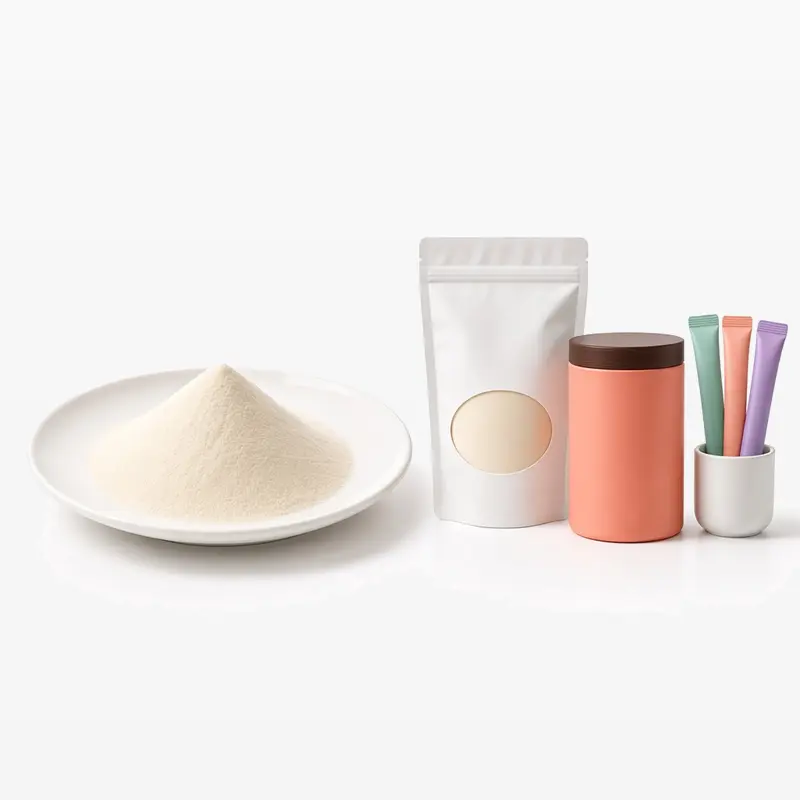
Best for: Single-mineral drinks, electrolyte sticks, and any concept where the serving is consumed in water.
Why: Dispersion, mouthfeel, and moisture control run this format. Blending and filling happen under controlled humidity, the pack is specified as a moisture barrier with a desiccant plan for tubs, and both dispersion and taste are confirmed at the target magnesium level rather than at a placeholder. Grittiness and sediment are the two complaints that kill repeat purchase, and both are set by the grade rather than by the flavor.
Default path: Powders and granules.
Best for: High-count bottles, cost-led SKUs, and effervescent products.
Why: Compressibility, tablet weight, hardness and friability, disintegration, and coating. A dense grade lets a single tablet carry a higher elemental line at a swallowable weight. Effervescent tablets are a separate discipline within the format: the acid-base reaction, low residual moisture at every stage, and barrier packaging matter more than compression force.
Default path: Tablets.

Best for: Capsule-only ranges and channels where a fixed swallowed serving is required.
Why: Fill weight against shell capacity. As a planning range, size 0 may take roughly 350–450 mg and size 00 roughly 500–650 mg of a powder blend; actual capacity follows the finished blend’s bulk and tapped density and is confirmed by trial. Because citrate’s elemental percentage moves with the grade, capsules per serving is an output of the qualified lot, not of the ingredient name — the arithmetic is worked through in how fill weight limits capsule count.
Default path: Hard capsules.

Best for: Ready-to-drink and dropper formats where a soluble grade and a stable finished pH can be established.
Why: A liquid declares magnesium per millilitre with both compound and elemental lines, and it adds preservation, pH stability, container compatibility, and shelf-life testing to the project. Gummies and softgels are not default citrate formats: the mineral load a gummy carries at a credible declared level is small and the citrate’s acidity interacts with the acidulant and the gel, while a softgel needs an oil phase that a dry citrate salt does not provide.
Default path: Quoted from the brief.
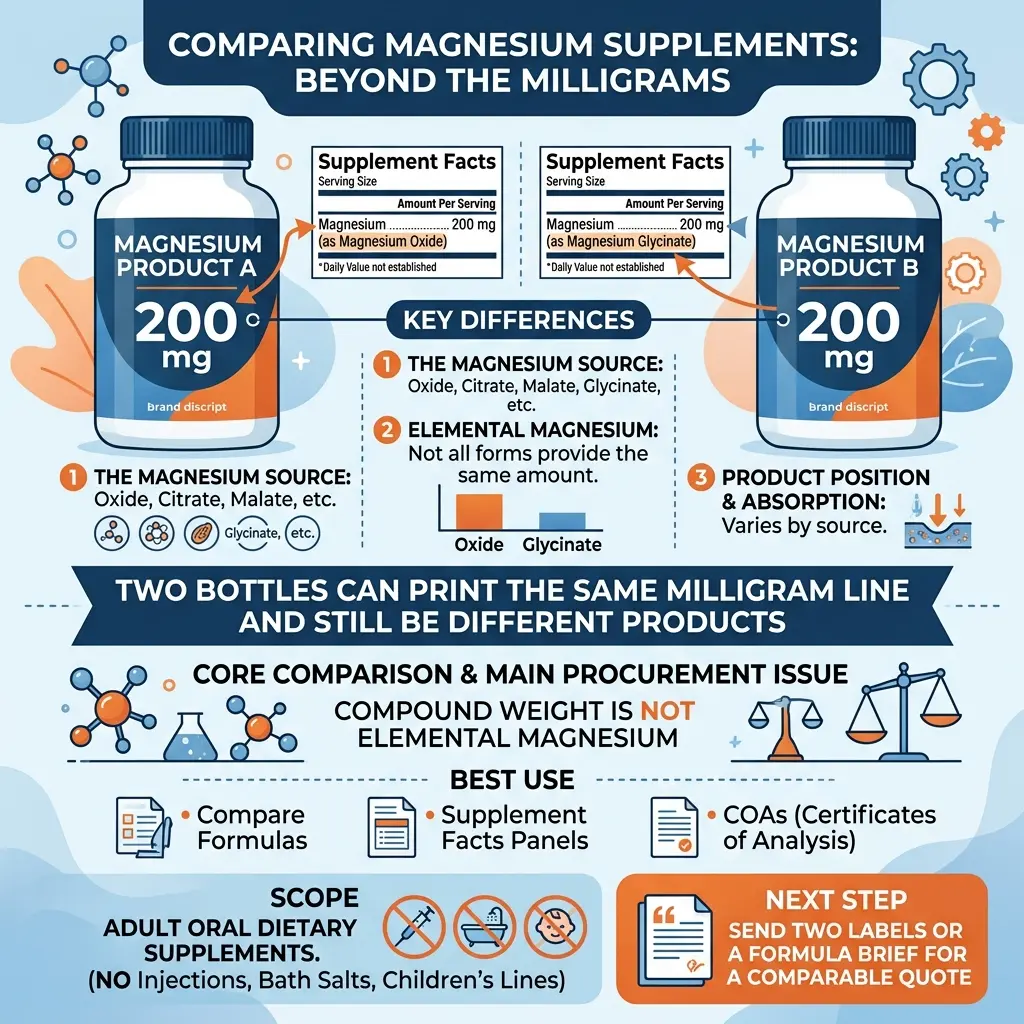
Every other decision on a citrate project follows from this one, and it is the reason two “magnesium citrate” quotes can describe materials that behave differently in the same formula.
Three grades, one ingredient name
Commercial magnesium citrate reaches you as anhydrous trimagnesium dicitrate, as the hydrated form of the same tribasic salt, or as a citric-acid-rich grade in which additional citric acid is present and less of the citrate is fully neutralized. All three are legitimately labeled magnesium citrate. They are not interchangeable in a formula.
What the hydration state does to the magnesium
Run the stoichiometry. Anhydrous trimagnesium dicitrate carries roughly 16% elemental magnesium; the nonahydrate carries roughly 12%, because about a quarter of the molecular weight is water. So a 1,000 mg citrate compound declaration resolves to something near 160 mg of magnesium on the anhydrous grade and near 120 mg on the hydrate — over 30% more magnesium from the same compound line. These are nominal calculated figures; the batch assay governs what you can declare.
What it does to the solubility — in the other direction
Here is the part that catches formulators. Solubility differs markedly across those grades, and the anhydrous tribasic form is generally the least soluble of the common ones, while hydrated and citric-acid-rich grades disperse far more readily. Optimizing for magnesium per gram therefore pushes you toward the grade that is hardest to get into solution, and optimizing for a clean-dispersing drink pushes you back toward a lower elemental percentage and a heavier scoop.
There is no universal right answer — there is a right answer per format. A tablet does not care whether the powder disperses in water, so a tablet program can take the dense anhydrous grade and benefit from it. A stick pack cares about nothing else. This single trade-off is why a citrate powder and a citrate tablet at the same elemental target are usually two formulas rather than one formula in two shells. Confirm it by dispersion trial on the actual lot rather than from the specification sheet.
Hydration state and assay basis are two different layers
The hydration state establishes the theoretical elemental contribution. What you can put on a label is the result of a defined assay against a defined specification. Keep the two apart in your paperwork: identity and hydration state establish which material arrived, and the assay basis establishes what it is worth in the formula. A quote that names one without the other is incomplete.
Acidity is a formulation input, not a flavor note
Citrate’s acidic profile is why it works in a beverage, and it also means the acid load is already partly spoken for before the flavor system is designed. The sweetener, the added acidulant, and any alkaline mineral sharing the blend all have to be balanced against the citrate rather than carried over from an existing formula.
Where the regulatory line sits
Regularity positioning is a recognised structure/function territory — FDA’s own illustration of an acceptable structure/function claim is that fiber maintains bowel regularity [2]. Such claims are not pre-approved: the marketer needs substantiation that the claim is truthful and not misleading, must notify FDA within 30 days of marketing, and must carry the disclaimer that FDA has not evaluated the claim and the product is not intended to diagnose, treat, cure, or prevent disease [2]. The line to respect is the drug line. Magnesium salts also exist as active ingredients in the over-the-counter laxative drug category, so a product marketed as a laxative or as a constipation treatment is being positioned as a drug, with a different classification and a different set of labeling obligations. We build the supplement path; the claim set and its substantiation stay with you and your local counsel.
Identity and hydration state
The specification names the salt, the hydration state, and where applicable the degree of neutralization — anhydrous trimagnesium dicitrate, the hydrated tribasic form, or a citric-acid-rich grade. Identity is confirmed on the incoming COA, and loss on drying establishes the hydration state and with it the fill volume the format has to carry.
Elemental magnesium and assay basis
Elemental magnesium sits on its own line, reported as the batch result with the method named, and the compound weight sits on a separate line. Which tests run on every lot and which are covered by supplier qualification follows the approved raw-material specification rather than a single fixed panel. An elemental figure alone is not something a plant can produce against, and what a magnesium specification has to carry beyond it applies to every salt in the range. Our general approach to reading supplier documentation is set out in how to read a COA.
Solubility, particle size, and density
Solubility or dispersion behavior, particle size or mesh, and bulk and tapped density belong on the specification, because each one closes off a format. This is the section that decides whether the material you bought can become the product you planned, and it is the section most often left as “magnesium citrate, food grade.”
Taste and acid load
The acid contribution of the grade is recorded alongside the flavor system, so a later grade change does not silently move the taste of an approved product. Citrate powders fail consumer acceptance on taste far more often than on assay.
Heavy metals and microbiology
Testing scope and COA fields follow the locked product specification, the destination market’s finished-product requirements, and the release criteria agreed at the start of the program — heavy metals including lead, arsenic, cadmium, and mercury, plus microbiology, identity, and assay as applicable. US retail programs frequently apply tighter lead thresholds than an ingredient specification does.
An incoming COA establishes what arrived at the door. It does not establish what a serving of the finished product delivers, and conflating the two is the most common documentation gap on magnesium projects.
Four stages close it. Raw-material qualification fixes identity, hydration state, batch elemental magnesium with its method, and the physical properties. Formula calculation converts the elemental target to compound weight, compound weight to serving mass or fill weight, and fill weight to scoop size, tablet weight, or capsules per serving. Dosage-form confirmation proves it on trial — dispersion and taste for a drink, compression and disintegration for a tablet, fill and flow for a capsule. Finished-product release then covers the finished specification, batch COA, finished-unit assay where the market or the retailer requires it, and packaging matched to the salt’s moisture sensitivity and the shipping lane. How finished-product magnesium is tested sets out the release side in more detail, and how magnesium stability changes shelf life covers the pack and storage decisions that follow a hygroscopic salt into a humid lane.
To get a quote that survives contact with production, send the target elemental magnesium per serving, the dosage form and serving architecture, the destination market, any flavor or packaging direction, and — for each supplier you are weighing — the specification with the hydration state named plus the batch COA with the elemental result and its method. Where a field is missing on one side, we will tell you which question to put back to that supplier instead of estimating around it.
Serving size follows the format and the qualified grade: a drink is a scoop or a stick, a tablet or capsule serving is one or two units. Both the elemental magnesium per serving and the number of units per serving are declared on the panel [3], and a quote is only usable when it states the elemental magnesium, the compound weight, the serving mass or fill weight, and the units per serving together — the general case is set out in why two magnesium labels are not comparable.
Digestive tolerance varies with the magnesium form, the serving size, the rest of the formulation, and the individual. It is a positioning and labeling consideration rather than a predictable outcome, and it should not be written as a guaranteed effect in either direction.
For US formulation review, NIH lists a tolerable upper intake level of 350 mg/day for magnesium from dietary supplements and medications for adults, which does not include magnesium naturally present in food [1]. That is a nutrition and regulatory reference used in safety review, not a formulation recommendation. Milligram and percentage figures on this page are development examples.
Should I specify anhydrous or hydrated magnesium citrate?
It follows the format, not a preference. Swallowed tablets and capsules generally favor the anhydrous grade, because its higher elemental percentage holds the unit weight down and dispersion in water is irrelevant. Drinks and sticks generally favor a hydrated or citric-acid-rich grade, accepting a heavier serving to get clean dispersion. Specify the one that matches the format and confirm it on trial.
Which citrate grade dissolves best in a drink mix?
Broadly, the hydrated and citric-acid-rich grades over the anhydrous tribasic form — but “broadly” is not a specification. Solubility, particle size, and the finished pH interact, so the grade is qualified by making the drink at the target magnesium level and judging dispersion, sediment, and mouthfeel in the actual water and the actual flavor system. A supplier’s solubility statement is a starting point for the trial, not a substitute for it.
Can you quote powder and tablet versions of the same elemental target?
Yes, and expect two specifications rather than one. The grade that suits a tablet is usually the wrong grade for the powder and vice versa, so the two versions differ in incoming material, serving mass, and often cost per serving even when the declared magnesium matches. Quoting them together is useful precisely because it shows that gap before packaging is committed.
Can you manufacture from our existing citrate BOM?
Yes. We work from an existing BOM or a formulation brief and review the salt identity and hydration state, the elemental magnesium target and its assay basis, serving size and fill weight, dosage-form feasibility, flavor and mixability requirements, and packaging against the destination market before quoting. Where the BOM specifies a grade that will not perform in the intended format, we flag it at review rather than at first production.
Is magnesium citrate a laxative?
Positioning matters more than the molecule here. Magnesium salts appear as active ingredients in the over-the-counter laxative drug category, so a product marketed as a laxative or as a constipation treatment is being positioned as a drug and takes on drug classification and labeling obligations. As a dietary supplement, the product stays inside the structure/function framework, with substantiation held by the marketer, FDA notification within 30 days of marketing, and the required disclaimer on the label [2].
What should the raw-material COA show?
Salt name with hydration state, identity confirmation and its method, batch elemental magnesium with the assay method named, loss on drying, particle size or mesh, bulk and tapped density, plus heavy metals and microbiology to the approved specification. For a drink program, a dispersion or solubility statement as well. A COA that reports only “magnesium citrate, conforms” has told you nothing you can formulate against.
How is elemental magnesium confirmed in the finished product?
Finished-batch testing measures total elemental magnesium in the unit, alongside the other release tests the specification requires. Where a market or a retailer expects it, finished-unit assay is written into the release specification from the start rather than added later, because the sampling plan and the acceptance criteria have to be agreed before the first production batch, not after a result arrives.
What is the MOQ, and how are samples handled?
Both depend on the dosage form, the packaging format, and how much custom work the formula needs, so they are confirmed against your brief rather than quoted as a single number. Samples and pilot runs follow specification lock, since a sample made from an unqualified grade tells you very little about the product you would actually receive. Send the brief and we will come back with quantities, sampling, and timing together.
Related
- Magnesium Bisglycinate Supplements Manufacturing
- Magnesium Malate Supplement Manufacturer
- Magnesium Complex Supplement Manufacturer
- Powders and Granules
- Tablets
- Hard Capsules
References
- NIH Office of Dietary Supplements. Magnesium — Health Professional Fact Sheet. https://ods.od.nih.gov/factsheets/Magnesium-HealthProfessional/
- US FDA. Structure/Function Claims. https://www.fda.gov/food/nutrition-food-labeling-and-critical-foods/structurefunction-claims
- 21 CFR 101.36 — Nutrition labeling of dietary supplements. https://www.ecfr.gov/current/title-21/chapter-I/subchapter-B/part-101/subpart-A/section-101.36
Disclaimer: Wholesale and brand-manufacturing reference only. Not intended to diagnose, treat, cure, or prevent any disease. Dietary supplements are not drugs. Magnesium citrate is a specified magnesium salt for finished-product OEM — not a treatment for constipation, insomnia, or any medical condition, and we do not manufacture drug-path laxative products. Milligram and percentage figures on this page are development and specification examples, not recommended intakes; nominal elemental percentages are calculated values that vary by grade, hydration state, and lot, and the batch COA governs. Positioning language referenced here is market convention, not claim substantiation. Brand owners remain responsible for finished-label compliance and claim substantiation with local counsel.