Written by: KS Nutripharma Formulation Team
Reviewed by: KS Nutripharma Director of R&D, PhD in Food Science
Technical scope: Magnesium glycinate during pregnancy — U.S. reference intakes versus the supplemental UL, finished-product identity, companion ingredients, and label review
Updated: September 2026
Magnesium glycinate during pregnancy is a magnesium supplement form that may appear in pregnancy-oriented products. Whether a pregnant person should use a particular product depends on total magnesium intake, the finished formulation, other ingredients, and individual medical circumstances — not on the salt name alone. See magnesium supplements for how glycinate sits beside other magnesium forms.
Two U.S. numbers are easy to confuse: the pregnancy Recommended Dietary Allowance (RDA), which includes magnesium from all sources, and the supplemental tolerable upper intake level (UL). They are not a single “pregnancy serving.”
A healthcare professional should review individual supplementation.
Why Do People Look for Magnesium During Pregnancy?
Magnesium is an essential mineral. U.S. RDAs for magnesium are higher during pregnancy than for non-pregnant women of the same age.[1] Some people look for magnesium supplements during pregnancy because a prenatal vitamin or the rest of the daily routine does not supply as much magnesium as they expected. Others see magnesium glycinate named on a pregnancy-oriented product and want to know what that form is.
Those searches do not mean every pregnant person needs an extra magnesium supplement, or that glycinate is required. Individual decisions belong with a healthcare professional who can see the full diet, the prenatal, other supplements, medicines, and medical history.
How Much Magnesium Do You Need During Pregnancy?
The useful distinction is pregnancy RDA ≠ supplemental UL.
U.S. RDAs for magnesium during pregnancy (all sources — food, beverages, supplements, and medications) are:[1]
Life stage | RDA (all sources) | UL from supplements and medications |
|---|---|---|
| Pregnancy, 14–18 years | 400 mg/day | 350 mg/day |
| Pregnancy, 19–30 years | 350 mg/day | 350 mg/day |
| Pregnancy, 31–50 years | 360 mg/day | 350 mg/day |
For pregnancy, the U.S. UL for magnesium from supplements and medications is 350 mg/day. This is different from the pregnancy RDA, which includes magnesium from all sources.[1] Dietary magnesium from food does not have a UL of that kind.
That is why a prenatal already listing magnesium, plus a separate magnesium glycinate product, plus magnesium in other supplements or medicines, has to be read as a total supplemental amount — not as three unrelated bottles. These figures are U.S. nutrition references. They are not a formula-setting instruction, not a global regulatory limit, and not a recommended intake for any individual product.
The magnesium amount from one supplement is only one part of total magnesium intake.
Is Magnesium Glycinate Safe During Pregnancy?
There is no yes-or-no answer that applies to every product and every pregnancy. Magnesium glycinate is a named magnesium source. Safety and suitability depend on more than the word “glycinate.”
What to weigh, with a healthcare professional:
- The finished product, not only the salt name — including elemental magnesium per serving, serving size, and capsule or powder count.
- Total supplemental magnesium, including the prenatal and any other magnesium-containing products.
- Other ingredients on the same panel — for example B6, folate, or iron — each with its own identity and amount.
- Individual circumstances — diet, medicines, medical conditions, and professional advice.
Glycinate is not a pregnancy-only salt, and it is not a treatment for pregnancy-related conditions. Gastrointestinal tolerance is a finished-product and individual question; see magnesium supplement side effects.
Is Magnesium Glycinate Different From Other Magnesium Forms During Pregnancy?
Other magnesium forms also appear in products that pregnant people may already be taking. None of the rows below is a ranking of which form is “best” during pregnancy.
Form | What to check |
|---|---|
| Magnesium glycinate / bisglycinate | Chelate identity, elemental magnesium, fully reacted vs buffered |
| Magnesium citrate | Elemental magnesium, finished-product tolerance, serving format |
| Magnesium oxide | High elemental magnesium percentage, formulation and tolerance considerations |
| Magnesium malate | Exact salt identity and elemental magnesium |
| Multi-magnesium formula | Contribution from each magnesium source |
A pregnancy-oriented magnesium supplement and a general adult magnesium supplement can use the same salt. The difference is usually the intended use, the rest of the formula, and the label — not a unique pregnancy mineral.
Does Magnesium Glycinate Mean the Same Thing as Bisglycinate?
In commercial specifications, “magnesium glycinate” and “magnesium bisglycinate” often refer to the same chelated form. The names still have to be confirmed on the supplier specification and the destination-market label. See magnesium bisglycinate supplements manufacturing.
The name on the front panel does not, by itself, prove how much elemental magnesium is in the serving, or whether the raw material is a fully reacted chelate or a buffered grade. Elemental magnesium is the comparison number on the panel; it is not the whole specification. See why elemental magnesium is not a manufacturing specification.
What About Buffered vs Fully Reacted Magnesium?
For a pregnancy-oriented formula, the raw-material identity should be confirmed rather than inferred from the name “magnesium glycinate.” Check whether the material is fully reacted or buffered, what magnesium source is actually present, and how the supplier identifies the material on its specification and COA. See buffered vs fully reacted magnesium.
A buffered grade that includes another magnesium source (often discussed as oxide) is a composition difference. It changes what is in the serving. It is not a pregnancy-specific safety ranking.
What Should You Check on the Label?
U.S. Supplement Facts labeling includes serving size, servings per container, the dietary ingredients, and the amount of each per serving.[2] For magnesium glycinate during pregnancy, those lines are the starting point — not a front-panel “for pregnancy” claim.
Check:
- Serving size and how many capsules, tablets, or scoops it is.
- Elemental magnesium per serving, separate from the compound weight.
- The magnesium source — glycinate, another salt, or more than one source.
- Other ingredients, including B6, folate, iron, or botanicals.
- Directions and any audience language.
- Destination market, which governs what the label may say.
The serving size should be reviewed together with the elemental magnesium per serving, the full ingredient panel, and the intended use of the finished product. Pregnancy reference values should not be treated as a formula-setting instruction by themselves.
If B6 is included, the exact form and amount should be reviewed as part of the complete pregnancy-oriented formula rather than treated as an interchangeable ingredient. Pyridoxine and P5P (pyridoxal-5-phosphate) are different ingredient forms and should be identified correctly in the formulation and on the label.
When Should a Pregnancy-Oriented Formula Be Reviewed?
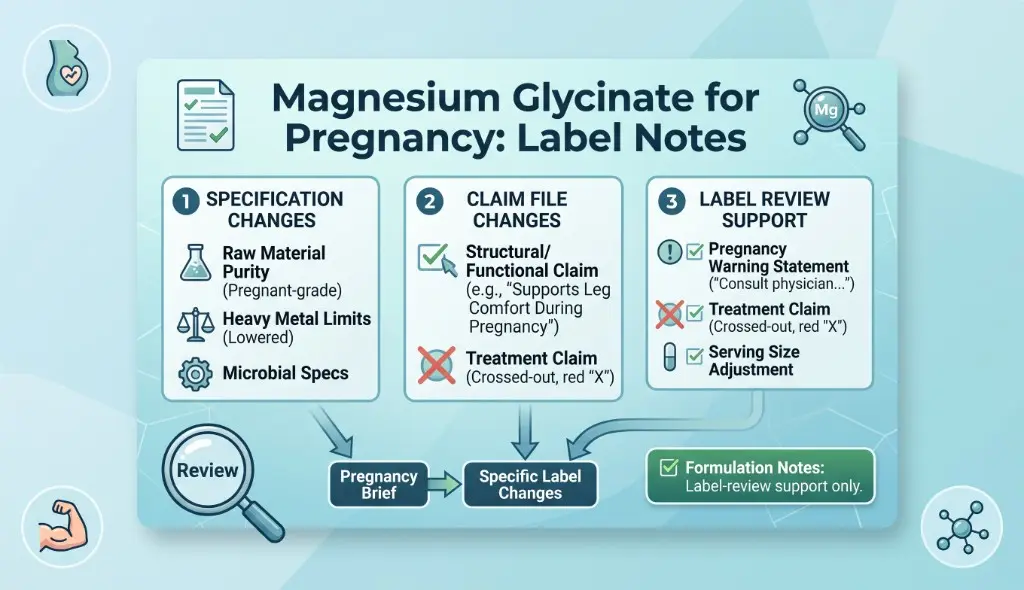
Pregnancy is not a standard adult magnesium capsule with a new audience line. A formula intended for pregnancy needs a separate review of the destination market, the proposed Supplement Facts, ingredient COAs, claim language, dosage form, and companion ingredients.
Developing a pregnancy-oriented magnesium product? Send the proposed formula, target market, and raw-material specifications for a formulation and label review. Send the formula brief when those files are ready.
Frequently Asked Questions
Is magnesium glycinate safe during pregnancy?
It depends on the product and the person. Magnesium glycinate is a magnesium source used in some pregnancy-oriented supplements. Whether it is appropriate depends on elemental magnesium per serving, total supplemental magnesium (including a prenatal), other ingredients, and individual medical circumstances. That decision belongs with a healthcare professional. This is not a statement that glycinate treats any pregnancy-related condition.
How much magnesium do pregnant women need?
U.S. RDAs during pregnancy are age-specific and count magnesium from all sources — for example 350 mg/day for ages 19–30 and 360 mg/day for ages 31–50.[1] Those values are nutrition references, not a serving printed on a magnesium glycinate bottle.
Is the 350 mg magnesium limit the same as the pregnancy RDA?
No. The 350 mg/day figure is the U.S. UL for magnesium from supplements and medications. The pregnancy RDA includes food. The two numbers have different jobs and should not be merged into one pregnancy dose.[1]
Can you take magnesium glycinate with a prenatal vitamin?
Only after the prenatal’s magnesium line — and any other magnesium-containing products — is counted with the glycinate serving. Many prenatals already include magnesium. Stacking without that check is how supplemental totals add up. Ask a healthcare professional before combining products.
Is magnesium glycinate different from magnesium citrate during pregnancy?
They are different magnesium sources. During pregnancy, the useful comparison is still identity, elemental magnesium, serving format, the rest of the formula, and professional advice — not a ranking of which salt is safer. Neither form is a pregnancy treatment.
What should a manufacturer specify for a pregnancy-oriented magnesium product?
The intended use and destination market, the proposed Supplement Facts (serving size, elemental magnesium, full ingredient list), claim language, dosage form, and supplier specifications and COAs — including whether a glycinate grade is fully reacted or buffered.
Related
- Magnesium Citrate Supplement Manufacturer
- Magnesium Malate Supplement Manufacturer
- Magnesium Supplement Side Effects
- Why Elemental Magnesium Is Not a Manufacturing Specification
- Magnesium Bisglycinate Supplements Manufacturing
- Buffered vs Fully Reacted Magnesium
Technical and Regulatory References
- NIH Office of Dietary Supplements. Dietary Supplements and Life Stages: Pregnancy — Health Professional Fact Sheet. https://ods.od.nih.gov/factsheets/Pregnancy-HealthProfessional/
- U.S. Food and Drug Administration. Questions and Answers on Dietary Supplements. https://www.fda.gov/food/information-consumers-using-dietary-supplements/questions-and-answers-dietary-supplements
Disclaimer: This article discusses adult dietary supplements and commercial formulation considerations. It does not prescribe a prenatal dose, diagnose or treat any pregnancy-related condition, or replace care from a qualified healthcare professional. Dietary supplements are not drugs. U.S. pregnancy RDAs and the 350 mg/day UL for magnesium from supplements and medications are nutrition references, not recommended intakes for an individual product. Brand owners remain responsible for finished-label compliance with local counsel and for pregnancy-specific labeling requirements in the destination market.