Professional Magnolia Bark Supplements Manufacturing
KS Nutripharma is a magnolia bark supplement manufacturer for OEM, ODM, and private-label programs. We develop finished magnolia bark dietary supplements—capsules, tablets, powders, and gummies—for sleep-support assortments and evening-relaxation SKUs, with locked Magnolia officinalis bark identity, a named honokiol and/or magnolol specification, and batch COA.
What we lock: species and plant part against the approved raw-material file; extract grade (powder, ratio, marked extract, or high-assay honokiol); HPLC marker and assay basis.
Already have a formula or COA? Send it. We check whether two quotes are the same bark, the same analyte, and the same milligram basis.
Request a Magnolia Bark Supplement Quote · Send Your Magnolia Bark Specification / COA
cGMP · ISO 9001 · ISO 22000 · HACCP · FSSC 22000 · Halal · Kosher · in-house lab + SGS/Eurofins pathways
About Us · Manufacturing Capacity · Certifications · Quality Control
Magnolia Bark Manufacturing at a Glance
Capability | Typical starting point |
|---|---|
| Botanical | Magnolia officinalis bark (variety per the approved specification) |
| Plant part | Magnolia bark / cortex. Specify stem or branch bark to the material file. Our default commercial grade is stem bark; branch-bark specs are quoted separately |
| Material | Bark powder / named-ratio extract / honokiol- and/or magnolol-specified extract / high-assay honokiol |
| Formats | Capsules / tablets / powder / gummies |
| Marker file | Honokiol and/or magnolol + HPLC |
| Documents | COA / specification / identity + scoped safety tests |
Tea, tincture, liquid, and topical are quoted as separate projects.
Choose Your Magnolia Bark Material For Your Final Supplements
Your brief | Recommended route | Key specification |
|---|---|---|
| Whole-bark botanical | Bark powder or named-ratio extract | Species + plant part + identity; DER + solvent if extract |
| Standardized magnolia extract | Honokiol- and/or magnolol-specified extract | Named analyte + HPLC + assay basis |
| Honokiol-forward / low-fill formula | High-assay extract or isolate | Honokiol % and milligrams; extract vs isolate named |
| Combination formula | Marked extract + companion | Each identity and assay; destination review |
A high-assay extract is not automatically an isolate; the material description should state which one is being quoted.
Bulk powder or extract on a filling program is a kilogram quote, not a bottle quote. Standardized botanical pathways: standard extracts.
Custom Magnolia Bark Supplement Formulation
Starting architectures—not frozen SKUs. R&D matches channel and destination, then locks bark grade and marker.
For an evening-relaxation or sleep-support formula, magnolia bark is typically one botanical component, not a sleep-aid drug. Common companions: L-theanine, lemon balm, passionflower, magnesium. Cortisol-adjacency with ashwagandha is a separate artwork.
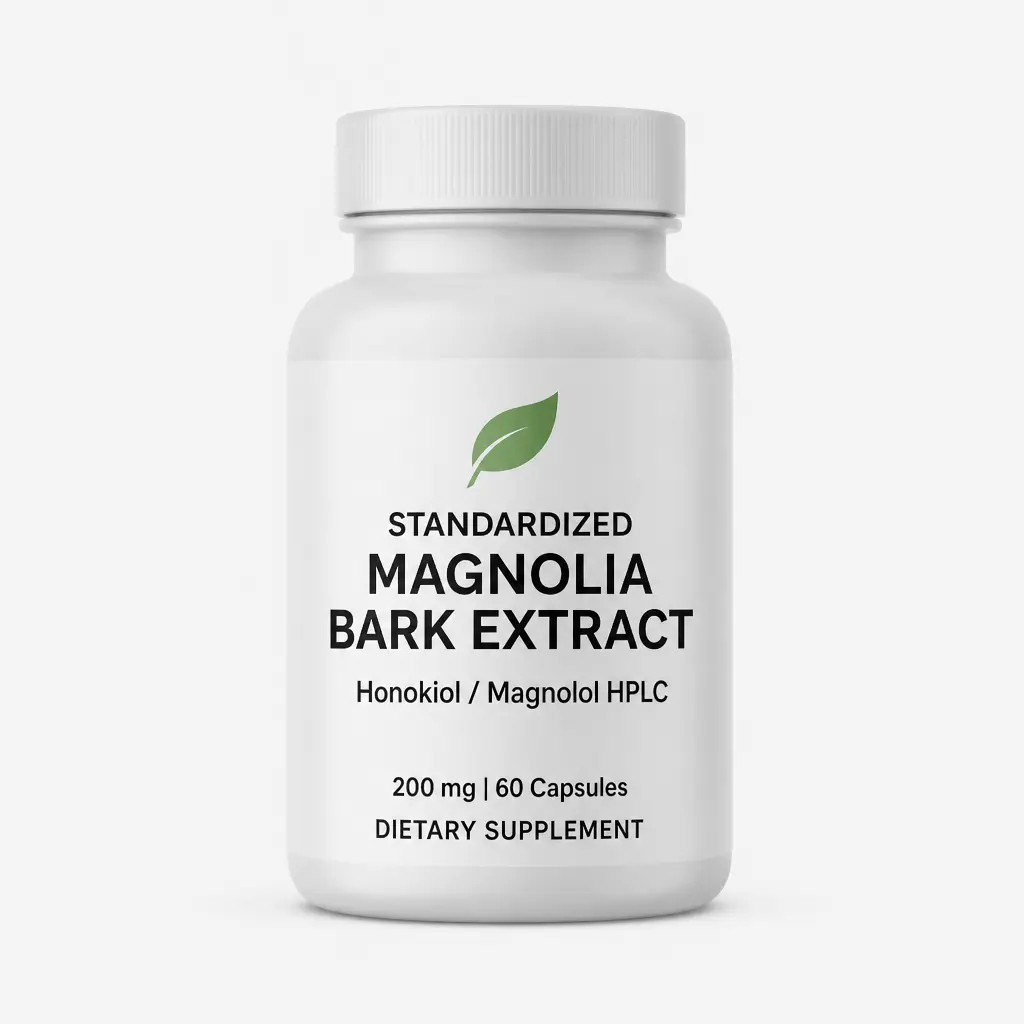
Use when: The panel prints magnolia bark extract with a named honokiol and/or magnolol marker. Default single-ingredient SKU.
Specify: Extract mg; analyte + HPLC; assay basis.
Trade-off: Extract-milligram identity vs a honokiol-milligram hero.
Default format: Hard capsule.
Manufacturing note: Name the analyte (honokiol, magnolol, or sum).
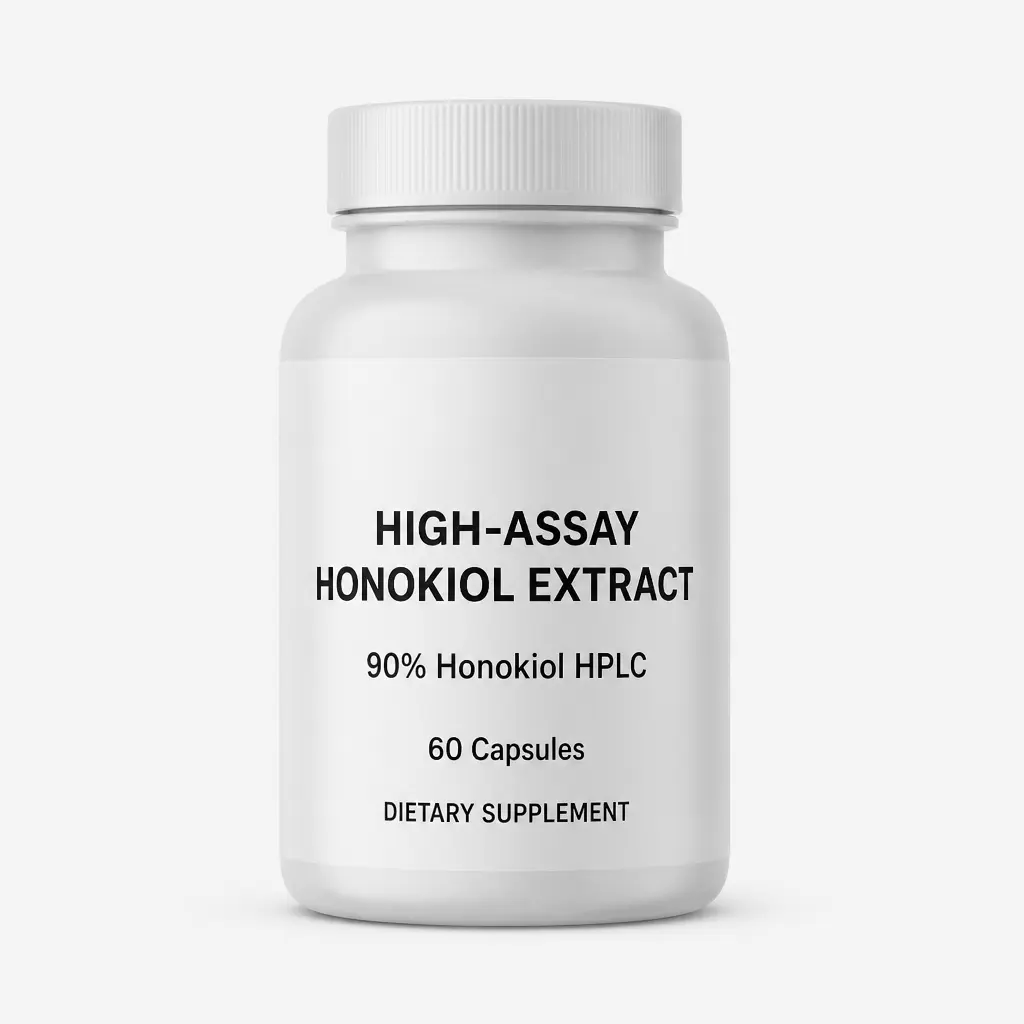
Use when: The panel heroes honokiol milligrams from a high-assay concentrate or named isolate.
Specify: Extract vs isolate; honokiol % + HPLC; mg as concentrate and as honokiol.
Trade-off: Compact fill and a higher kilogram vs standardized extract milligrams.
Default format: Hard capsule (usually a smaller size).
Manufacturing note: Do not relabel 200 mg × 2% as 40 mg × 90%.
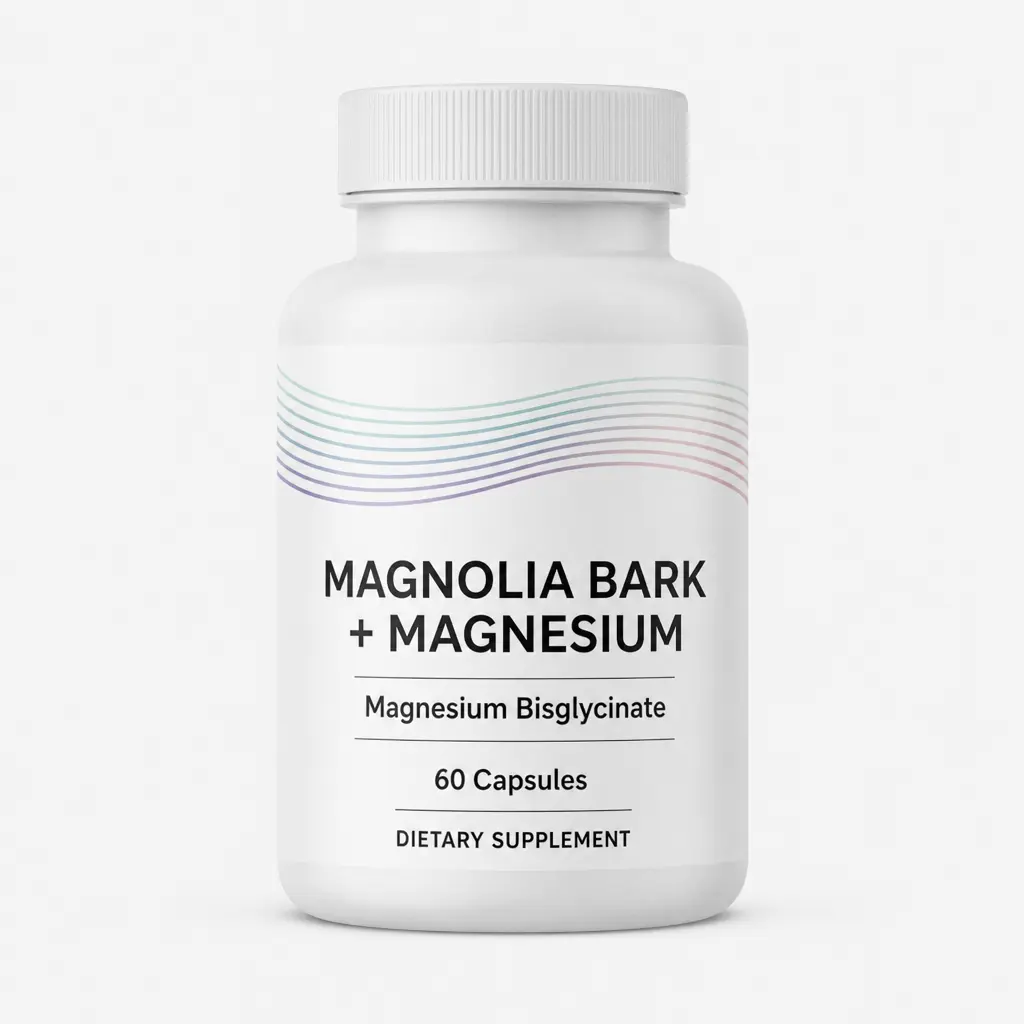
Use when: Mineral + botanical evening capsule. Magnesium → magnesium bisglycinate.
Specify: Salt + elemental mg; magnolia extract file; capsule count.
Trade-off: Familiar mineral stack vs a larger unit. Oxide is not the evening default.
Default format: Capsule or tablet.
Manufacturing note: 400 mg elemental magnesium plus 400 mg extract will not share a mini capsule or one gummy.
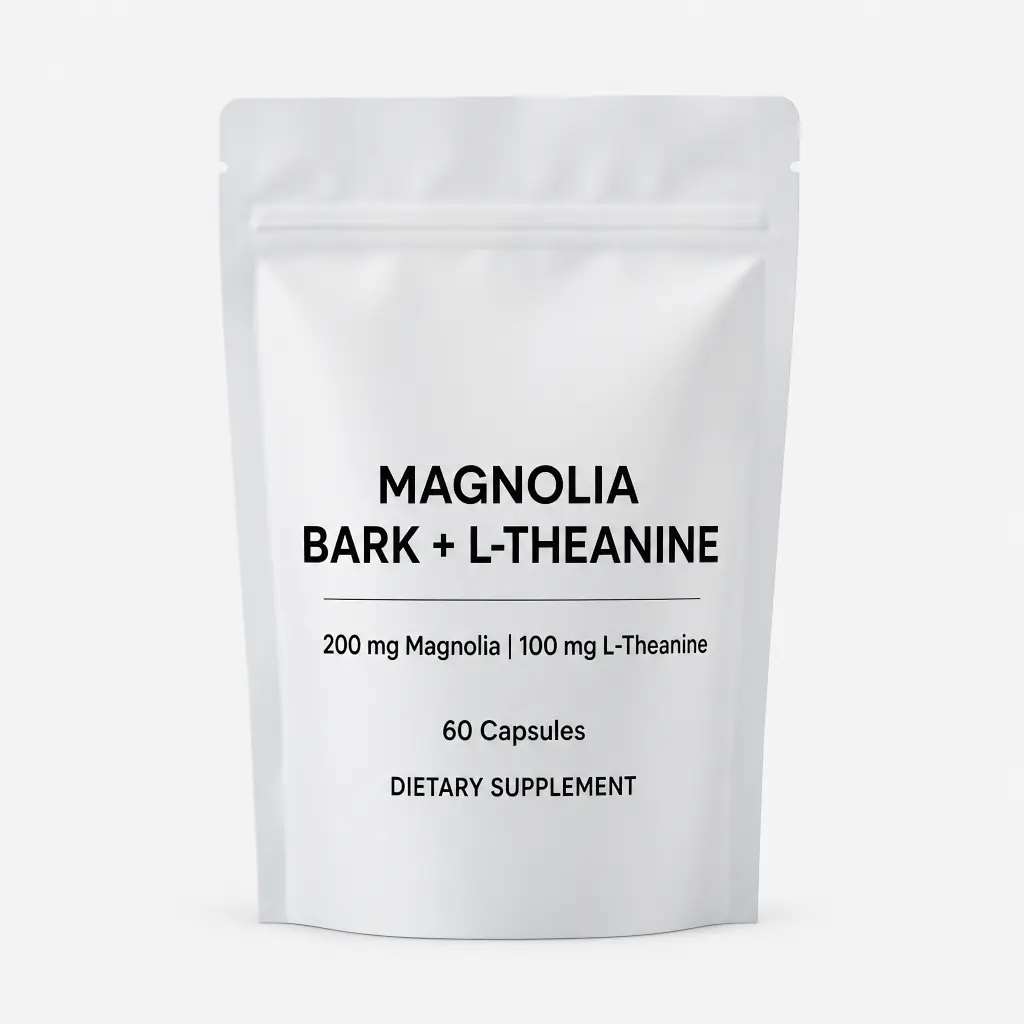
Use when: The panel names L-theanine as the second identity. GABA only if the destination allows it (GABA).
Specify: Theanine grade + mg; magnolia marker file.
Trade-off: Two assays. GABA is a third identity.
Default format: Hard capsule.
Manufacturing note: Low-dose theanine can segregate in a dark botanical blend.
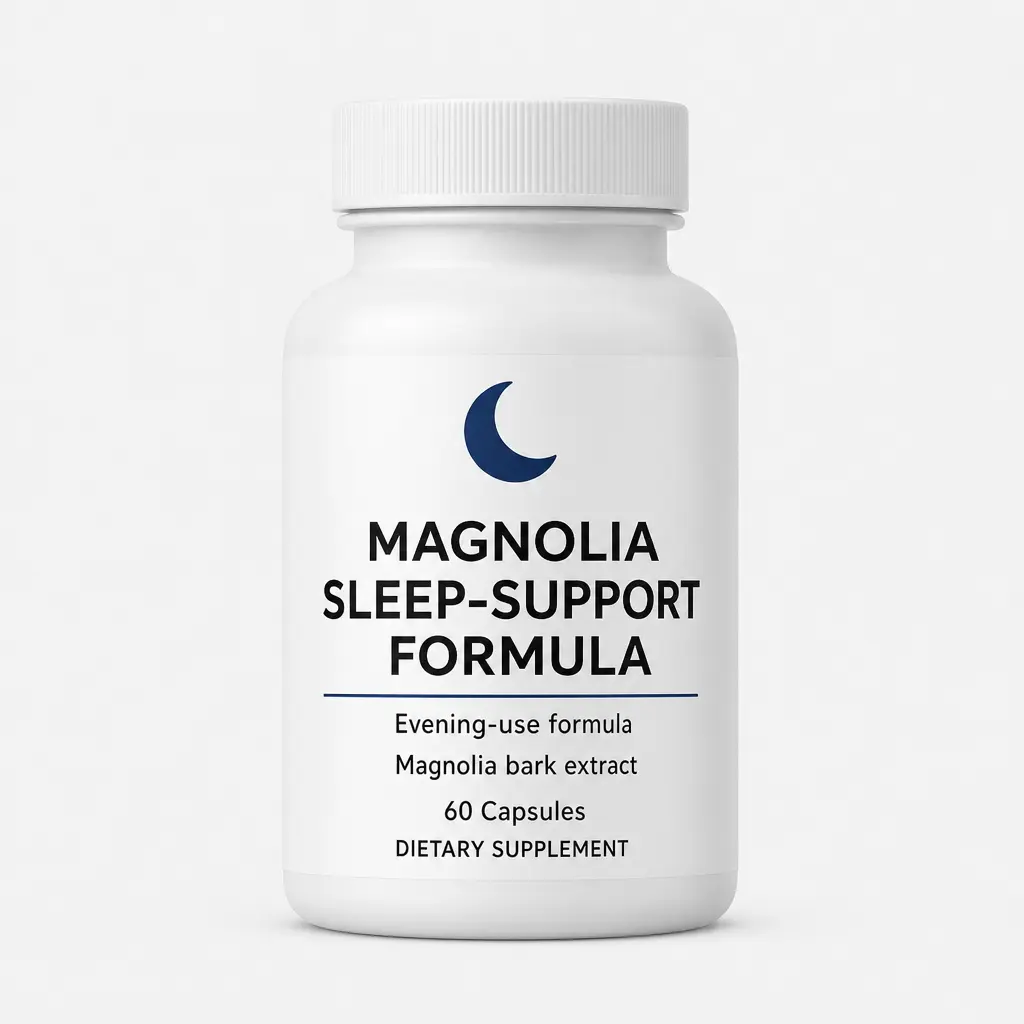
Use when: Evening relaxation / sleep-support assortment. Companions as named above; melatonin only if the destination allows it.
Specify: Standardized or high-assay magnolia as the botanical base. Positioning: evening-use formula.
Trade-off: Sleep-aisle placement vs a tighter combination review. Not cortisol-adjacency copy on the same bottle.
Default format: Hard capsule.
Manufacturing note: No treats-insomnia or sleep-aid drug copy.
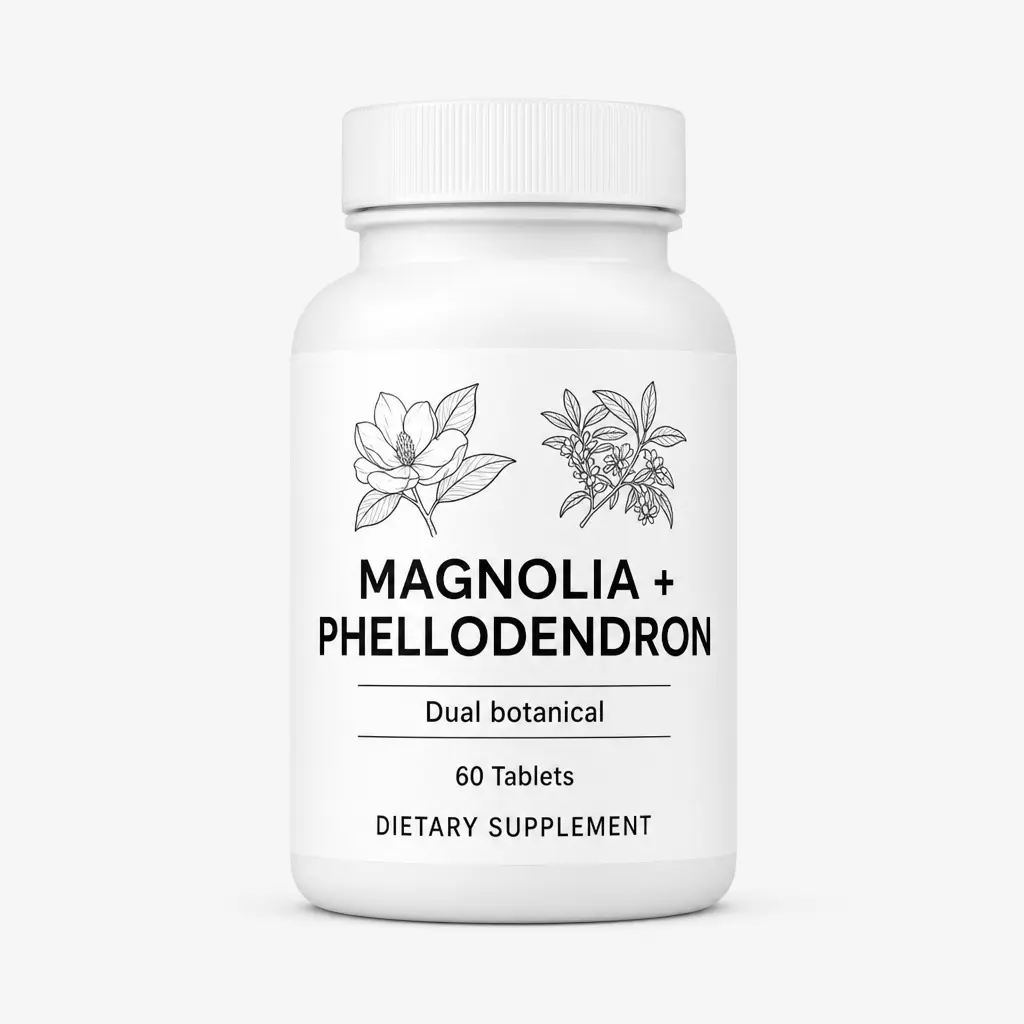
Use when: The BOM names Relora® or a generic magnolia + phellodendron dual. Category adjacency for cortisol-type briefs: cortisol support.
Specify: Trademark license or two generic identities; honokiol/magnolol on magnolia; phellodendron marker if labeled.
Trade-off: Dual-botanical recognition vs a trademark file. Not a honokiol % on single-herb bark.
Default format: Tablet or hard capsule.
Manufacturing note: No license = do not print Relora.
Choose the Magnolia Bark Format: Capsules, Tablets, Powder or Gummies
Hard capsules are a practical starting format for many private-label magnolia bark programs. Softgel only when an oil phase is on the BOM.
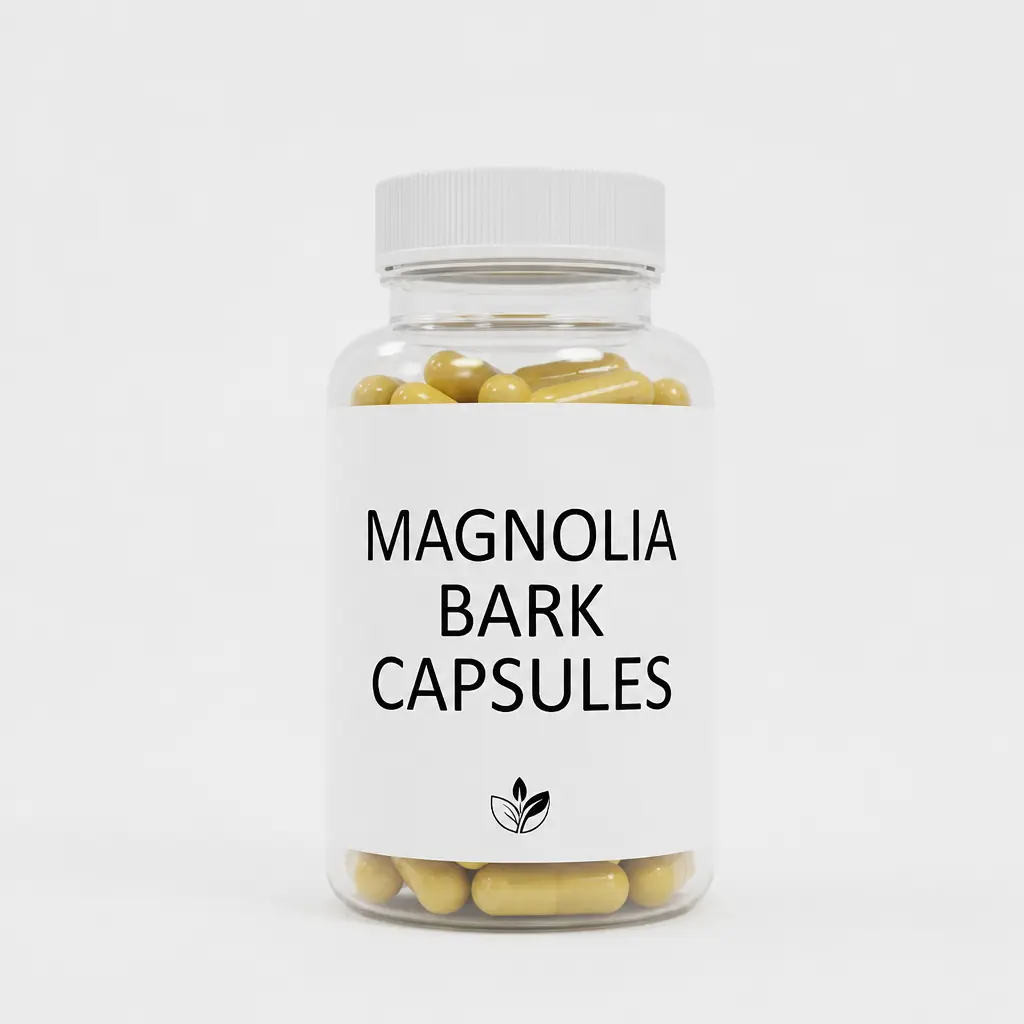
Best for: Most single-ingredient and combination dry formulas.
Why: Fast sample loop, shell isolates bitterness, companions share one unit.
Typical formula cards: Standardized extract, high-assay honokiol, theanine and sleep-support stacks.
What to lock: Gelatin vs HPMC; size 00 / 0 / 1; extract mg; marker file if claimed.
Manufacturing note: 200–400 mg marked extract often fits size 0 or 00. High-assay fills often fit a smaller capsule. Gram-scale bark powder needs size 00 × two pieces or a stick.
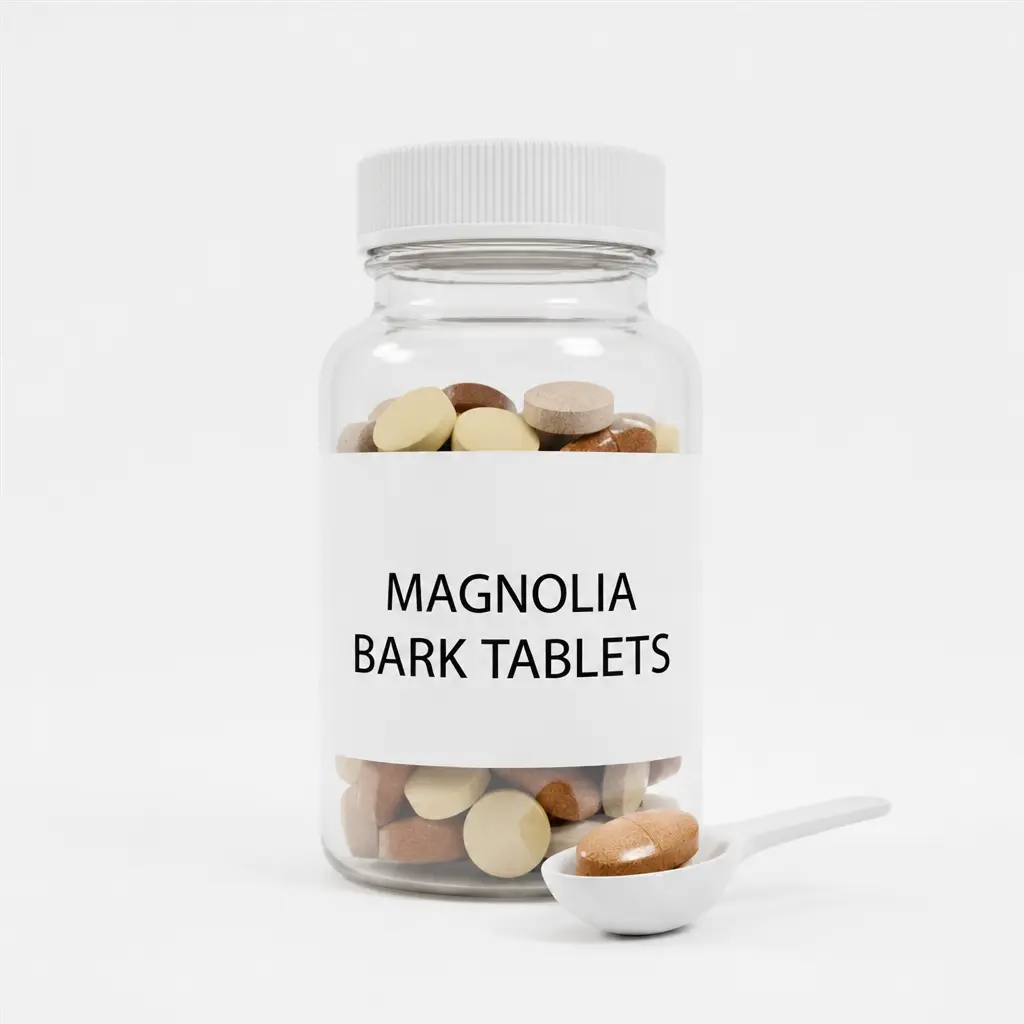
Best for: Phellodendron duals when the channel is tablet-led; magnesium stacks that will not fit one capsule.
Why: Compact bottles; coat can control dust.
Typical formula cards: Magnolia + phellodendron; magnolia + magnesium.
What to lock: Tablet weight; coat; disintegration; piece assay if a marker is claimed.
Manufacturing note: Brown, hygroscopic extract. Re-validate a capsule BOM before a tablet run.
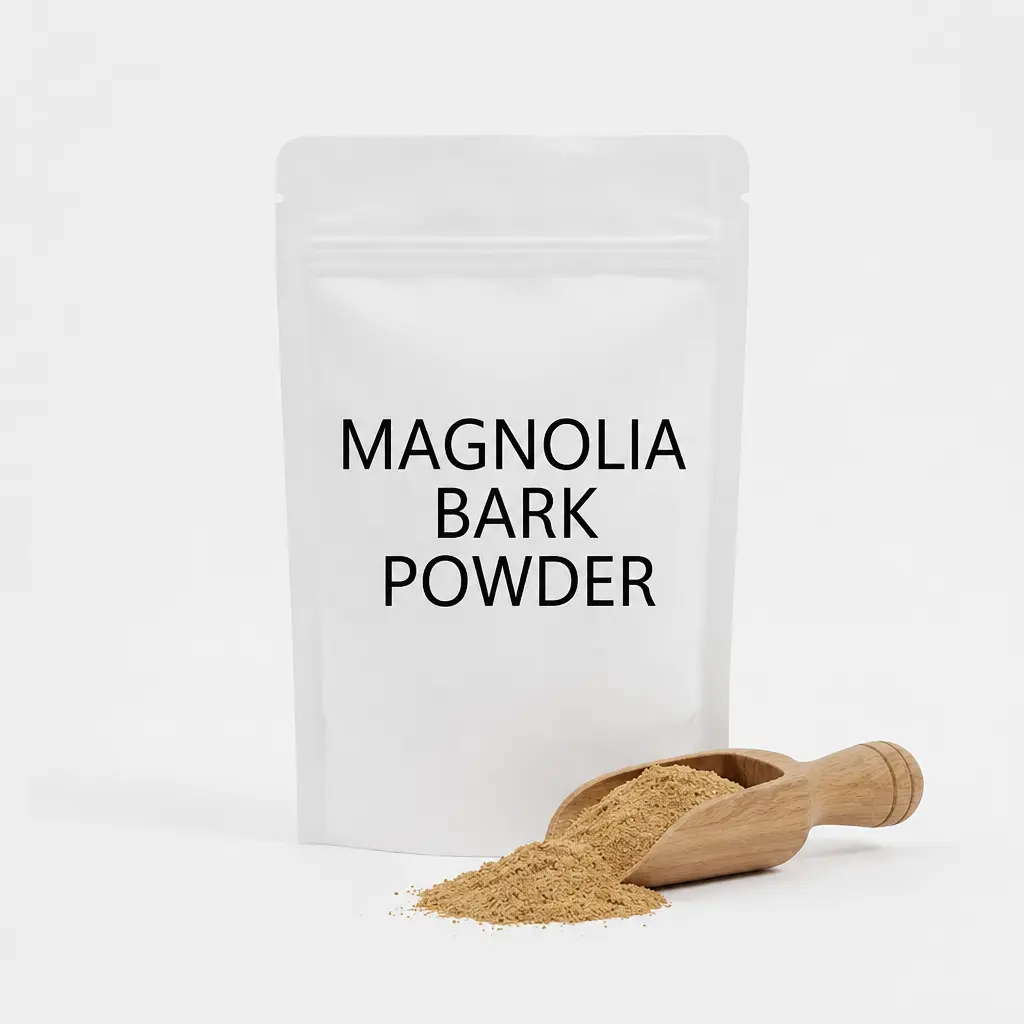
Best for: Whole-bark identity fills and bulk extract bags.
Why: Bag SKUs exist; flavored sticks are OEM after a flavor brief.
Typical formula cards: Bark powder / ratio extract.
What to lock: Bark powder vs extract in the name; mesh; g per serving.
Manufacturing note: Bark powder is not extract powder. Tea bags are a separate quote.
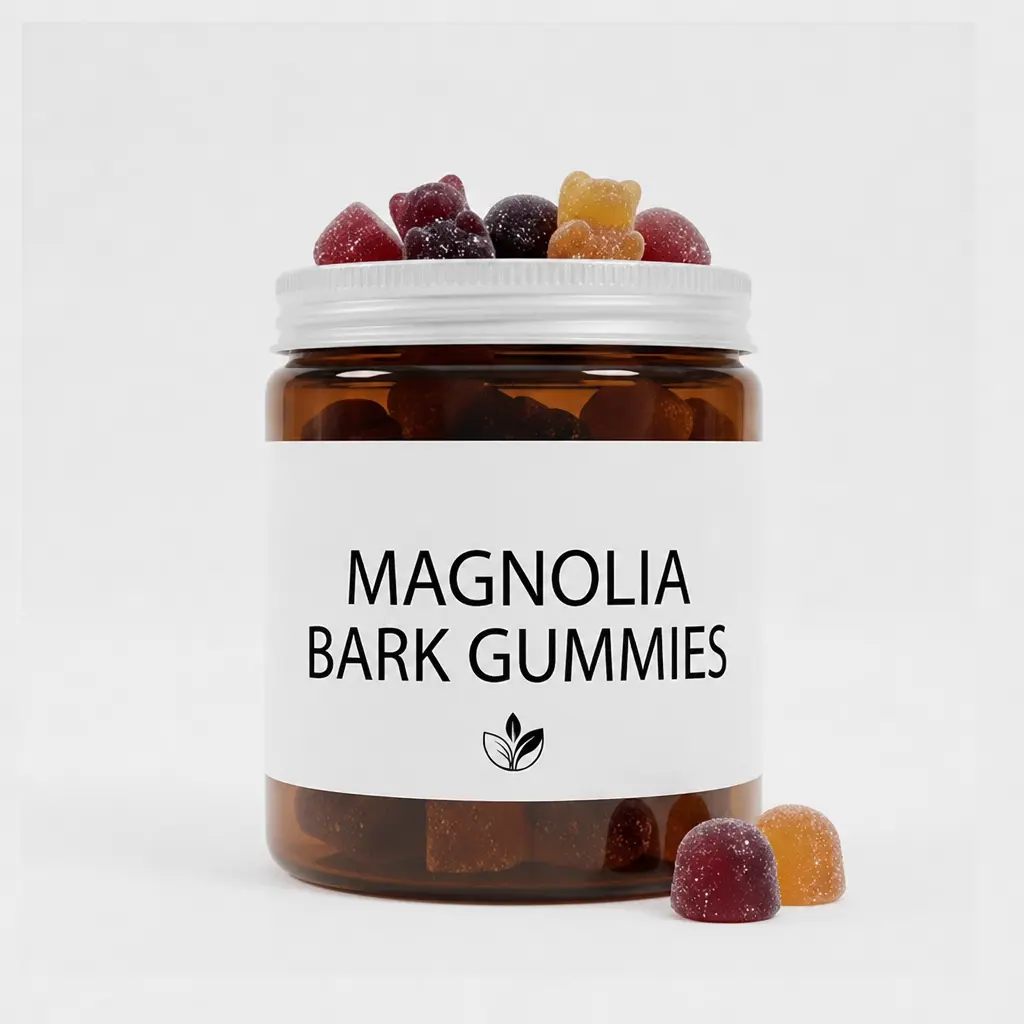
Best for: A supporting extract load in a sleep- or calm-stack.
Why: Flavor and piece assay are the project.
Typical formula cards: Standardized extract or theanine stack at reduced botanical load.
What to lock: Extract mg per piece; whether a marker is claimed; pectin vs gelatin.
Manufacturing note: Better suited to lower botanical loads. High-assay honokiol requires separate flavor, processing, and finished-unit assay feasibility review.
Magnolia bark is the botanical. Honokiol is one assayed compound in that bark; magnolol is the isomer usually run on the same HPLC. You are buying one of: bark identity, extract milligrams × a named %, or honokiol milligrams as the hero. Those are not the same purchase order.
Under the applicable pharmacopoeial monograph, European Pharmacopoeia defines Magnoliae officinalis cortex as dried stem and branch bark of M. officinalis and requires a minimum combined magnolol + honokiol of 2.0%, calculated with reference to the dried drug (reported for Ph. Eur. 8.1; the same combined floor is cited for Ph. Eur. 11).[1] The Chinese Pharmacopoeia has used the same combined 2.0% floor on dried houpo cortex (reported for the 2010 English edition).[2] Confirm the edition that applies to the destination market. That floor is a crude-drug quality criterion. It is not a commercial extract labeled “2% honokiol,” and it is not a finished-capsule guarantee. Other pharmacopoeial systems use different limits; do not treat 2.0% as a worldwide default grade.
Incoming assay ≠ finished-product assay. 2% honokiol ≠ 2% combined honokiol + magnolol. Write the PO as honokiol x% HPLC, magnolol x% HPLC, a named sum, or both peaks plus the sum.
| Standardized bark extract | High-assay honokiol extract | |
|---|---|---|
| Primary identity | Magnolia bark extract | Honokiol-forward extract (or isolate if specified) |
| Typical marker | Honokiol and/or magnolol | Honokiol |
| Assay | HPLC + reference standard | HPLC + reference standard |
| Manufacturing fit | Botanical formulas | Low-fill / honokiol-focused formulas |
| Fill weight | Higher (often 200–400 mg extract) | Lower concentrate fill |
| Cost | Lower kilogram | Higher kilogram |
| QC | Incoming; finished-unit when a milligram is declared | Tighter assay and pack review when a milligram is declared |
Illustration only—not an intake: 200 mg extract × 2% honokiol = 4 mg honokiol if the % is honokiol and finished assay agrees. 40 mg × 90% = 36 mg. Artwork, COA, and fill change together.
Commercial dietary-supplement labels and measured honokiol/magnolol can disagree; method, assay basis, and finished-unit testing are the specification, not a supplier’s unnamed “2%.”[3]
Extract weight × assay = theoretical marker amount. This calculation does not establish a recommended intake or a finished-product assay.
Not sure which specification matches your product? Send Your Magnolia Bark Specification / COA. Include the current COA, target honokiol or magnolol level, and serving size. We check whether the quoted material and assay basis match.
Generic literacy: How to Read a COA.
| COA item | Why it matters |
|---|---|
| Botanical identity | Confirms M. officinalis |
| Plant part | Stem vs branch (or root, if named) — prevents spec drift |
| Honokiol | Required when specifically declared |
| Magnolol | Relevant to combined-marker specifications |
| HPLC method | Makes the assay auditable |
| Reference standard | Supports peak identification |
| Assay basis | Dried bark vs dried extract vs as-is vs finished unit |
| DER / solvent | Defines extract identity; residual solvents when applicable |
| Heavy metals / microbiology | Botanical release |
Illustration only—not a released lot. Incoming extract: M. officinalis bark; honokiol 2.1% HPLC; magnolol 1.8%; sum 3.9%. That file does not prove 4.2 mg honokiol in a 200 mg finished capsule.
Send two COAs. We compare whether they are quoting the same species, plant part, analyte, and milligram basis.
Ask for | Why |
|---|---|
| Latin name + plant part on every lot | Houpo vs landscape bark vs M. obovata |
| Identity beyond color | HPLC peaks do not prove species |
| Origin when it will be claimed | A province on a brochure is not HPLC |
| Honokiol, magnolol, and the sum—multi-lot trend | Season and process move the ratio |
| Heavy-metal and residual-solvent trends | Bark tracks soil; extract tracks solvent |
Changing the extract supplier after approval restarts qualification. Two drums blended to “hit 2%” are not one approved SKU.
Path: Incoming identity (M. officinalis bark) → HPLC as specified → controlled blend → capsule, tablet, powder, or gummy fill → metal detection / pack inspection → finished tests as scoped → batch release.
When a milligram is declared on the finished label, scope finished-unit assay. Incoming drum % × fill weight is not that number.
Packaging and stability should be evaluated against the actual commercial pack and storage conditions, particularly when a finished product declares honokiol or magnolol. Dating should be based on the packaged SKU rather than an unpackaged blend. Storage can change measured honokiol/magnolol; do not assume a single degradation curve.[4]
Pack | When |
|---|---|
| HDPE or PET bottle + induction | Default capsules/tablets; desiccant when moisture leads |
| Blister | Pharmacy / travel / tighter moisture file |
| Stick or sachet | Flavored powder |
| Bulk drum | Filling program — still needs identity + HPLC |
Methods: quality control. Scale-up: manufacturing capacity.
Indicative commercial starting points — final MOQ and lead time depend on formula, dosage form, packaging, testing, and production schedule.
Item | Typical starting point |
|---|---|
| Capsules | About 3,000–5,000 units |
| Tablets | About 5,000–10,000 units |
| Stick packs | Often from about 10,000 units |
| Gummies | After feasibility |
| Bulk bark or extract on a finished-product project | Quoted by kg |
| Sample | 7–15 days after specification and material confirmation |
| Pilot | 15–25 days when required |
| Mass production | 30–45 days after formula, artwork, pack, and schedule |
Flavor work, dual HPLC, Relora-type trademark review, and finished honokiol assay add time before the sample clock starts.
OEM — you send a BOM. ODM — you send channel, format, and a milligram direction.
Qualitative manufacturing review, not a dosing or drug-interaction table.
| Review item | What brands should check |
|---|---|
| Formula interactions | Review the full combination, not magnolia alone |
| Sedation positioning | Especially with other evening ingredients (valerian, hops, melatonin) |
| Pregnancy / lactation | Destination-specific review; not a default SKU |
| Children | Separate formulation and regulatory assessment |
| Drug-like claims | Avoid disease-treatment positioning |
| Finished label | Destination-market counsel; we do not approve artwork as legal |
Gastrointestinal discomfort and next-day drowsiness are common warning-review items.
Regulatory note: U.S. structure/function claims are subject to 21 CFR 101.93 and applicable FDA requirements. Destination-market review is required before artwork approval; manufacturing documentation is not legal or regulatory clearance.
Why Brands Use KS Nutripharma
- Magnolia identity + HPLC specification on the same finished-unit file
- In-house formulation and analytical support
- Finished-product testing when a milligram is declared
- OEM / ODM / private-label packaging
- Documentation support for destination markets (not legal approval of the finished label)
81,000+ m² · 12 production lines · 260+ professionals · since 2007 · in-house lab + SGS/Eurofins pathways
An NDA is available before you send a BOM. A project manager is assigned when the specification is in review. Typical first technical reply: about one business day.
References
- European Pharmacopoeia, monograph Magnoliae officinalis cortex: dried stem and branch bark of Magnolia officinalis; magnolol + honokiol ≥2.0% on the dried drug (combined). Reported for Ph. Eur. 8.1 (Council of Europe, 2013) in Poivre & Duez (2017); the same 2.0% combined floor is cited for Ph. Eur. 11 in Siudem et al. (2025). Confirm the edition in force for the destination market.
- Chinese Pharmacopoeia Commission. Pharmacopoeia of the People’s Republic of China, Magnoliae Officinalis Cortex: honokiol + magnolol ≥2.0% with reference to the dried drug (2010 English edition, as reported by Poivre M, Duez P. J Zhejiang Univ Sci B. 2017. PMC5365644). Confirm the current destination-market edition before artwork.
- Siudem P, Wasiak A, Zielińska A, Kowalska V, Paradowska K. Using lignans from Magnolia officinalis bark in the assessment of the quality of dietary supplements—the application of ¹H NMR and HPLC-DAD. Int. J. Mol. Sci. 2025, 26(4), 1659. PMC11855702.
- Yan R, Yu S, Liu H, et al. Effects of storage time on magnolol and honokiol contents in bark of Magnolia officinalis. Zhongguo Zhong Yao Za Zhi. 2008. PubMed 19066046. Supports that storage can change measured constituents in crude bark; it does not by itself establish a light / moisture / oxygen degradation model for finished supplements. Dating follows the packaged SKU.
- ICH Q3C Residual Solvents.
- AHPA botanical identity guidance.
No EMA HMPC community monograph or USP dietary-supplement monograph is used as a default grade for houpo on this file.