
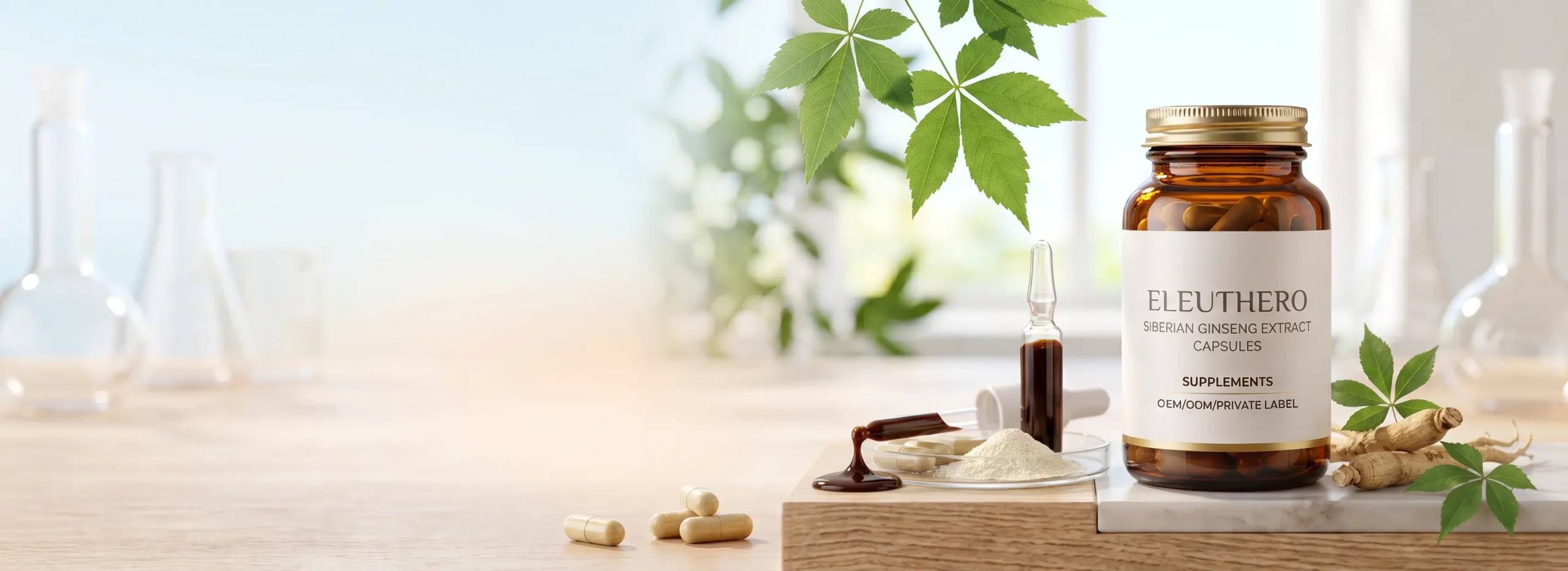
Professional Eleuthero Supplement Contract Manufacturer
KS Nutripharma is an eleuthero supplement manufacturer for OEM, ODM, and private-label programs. We develop finished eleuthero dietary supplements—capsules, tablets, and powders, as single-ingredient or combination formulas—for energy and adaptogen-adjacent assortments, with a finalized Eleutherococcus senticosus root grade (powder or eleutheroside-specified extract) and batch COA.
What is eleuthero? Eleutherococcus senticosus root, commonly specified to eleutherosides B and E. We manufacture it as capsules, tablets, powders, or combination formulas for dietary supplements.
What is 0.8% B+E? 0.8% B+E means the extract contains 0.8% combined eleutherosides B and E measured by HPLC. This specification is commonly used for commercial standardized eleuthero extracts.
Eleuthero vs Siberian ginseng? Same commercial root when the species is E. senticosus. Whether the destination label may print the alias is a naming field.
RFQs should specify whether the ingredient is root powder, ratio extract, or standardized B+E extract, because these require different pricing, testing, and release specifications. Name species, plant part, marker, method, and milligrams per serving before comparing quotes.
| If You have | Next step |
|---|---|
| Already have a formula | Send Your BOM |
| Already sourcing extract | Send the existing COA — we map species, marker, method, and milligram basis before quoting |
| No specification yet | Recommend extract grade |
| Format not decided | Ask the formulation team |
| Comparing two prices | Request a cost breakdown— we identify specification differences before quotation |
| US / EU export file | Request documentation review |
Every incoming lot is verified against the approved raw-material specification before production. Project requirements determine the incoming testing panel: botanical identity (E. senticosus root), eleutherosides B and E (or the named alternate assay), heavy metals, microbiology, and pesticides when the approved panel includes them.
cGMP | ISO 9001 | ISO 22000 | HACCP | FSSC 22000 | Halal | Kosher | In-house lab + SGS/Eurofins pathways | Batch COA
→ About Us | Manufacturing Capacity | Certifications | Quality Control
12 production lines · 81,000+ m² · 260+ professionals · since 2007 · 500+ brands · 60+ markets
Eleuthero Supplement Manufacturing at a Glance
| What we manufacture | Oral eleuthero root capsules, tablets, and powders. Softgel with an oil companion. Liquids and gummies after feasibility |
| Botanical | Eleutherococcus senticosus root. Alias: Siberian ginseng. |
| Extract type | Root powder · named ratio · standardized B+E extract — specify one |
| Markers | Eleutherosides B + E % + HPLC. Name total saponins on the PO only when that is the real assay. |
| Label name | Eleuthero vs Siberian ginseng — destination-market file |
| Frequently requested label | 200 / 300 / 400 mg extract per serving |
| B+E window | About 0.8%–2.0% B+E on many commercial extract COAs. |
| Formulation options | F01–F07 starting formulas, customized per brief |
| Scope | Oral dietary supplements |
| Documents | Batch COA; SGS/Eurofins when the RFQ requires it |
| MOQ / lead time | See MOQ, Samples and Lead Time Part. |
Choose the Eleuthero Format: Capsules, Tablets or Powder
Match milligrams, moisture, and serving size after the formulation option is chosen. Most B+E SKUs start as hard capsules.
Best for: F01, F03, F04, F05 — when an eleuthero capsule manufacturer path is the fastest start for a B+E extract.
Why: Extract fills in the low-hundreds of milligrams sit honestly in a hard capsule.
Typical formula cards: F01 · F03 · F04 · F05
What to finalize: Gelatin vs HPMC (vegan capsules are HPMC hard capsules); extract mg; B+E pair; count per day; second botanical if any.
Manufacturing note: Default unit for a dry standardized powder. HPMC is the vegetarian hard-capsule shell.
→ Hard Capsules
Best for: F01 or F02 pharmacy-compact or high-count bottles.
Why: Cost and line speed when compression and color are acceptable.
Typical formula cards: F01 · F02
What to finalize: Extract or root mg; excipients; film coat if dust or color is an issue; piece assay.
Manufacturing note: Tablet and capsule COAs are separate files.
→ Tablets
Best for: F02 sticks and premixes; gram-scale root powder.
Why: Root-powder servings are often larger than one capsule.
Typical formula cards: F02
What to finalize: Root powder vs extract powder in the name; g or mg per stick; flavor; moisture; assay per stick if a B+E number will appear.
Manufacturing note: Root powder and standardized extract require different Supplement Facts declarations. Softgel when an oil companion is on the BOM. Liquid and gummy programs need a dedicated pilot (taste, assay per mL or piece).
→ Powders and Granules
Custom Eleuthero Supplement Formulation for Private Label SKUs
Starting formulas for a finished eleuthero dietary supplement, customized per brief. Pick the closest card or send a BOM. KS formulation team and R&D center match channel and market, then finalize the root grade and eleutheroside fields against that BOM.
Use when: The label will print a standardized eleuthero root extract. Frequently requested talk is about 0.8%–2.0% eleutherosides B+E, HPLC. Default single-ingredient eleuthero supplement.
Specify: Extract mg per serving; B % + E % or B+E as a pair + method; whether that number is incoming only or finished as well; capsule vs tablet.
Main constraint: An incoming drum COA covers the extract; finished-unit potency is written separately. 0.8% is a frequently requested commercial window. Marker mapping: Purchasing Mistake.
Use when: The bottle will print root powder milligrams, or a named ratio extract, without a B+E percentage claim. Covers an eleuthero root supplement / botanical powder identity brief.
Specify: Plant part = root; powder vs ratio; mg as root or as extract; solvent if extract; whether any eleutheroside number will appear (if yes → F01).
Main constraint: Root powder and standardized extract use different dosage calculations because the active marker concentration differs. A 50:1 or 100:1 line needs a documented DER. Soft extract or paste is quoted when the BOM asks for it.
Use when: The panel names both adaptogens.
Specify: Eleuthero mg + the named eleutheroside assay; rhodiola species + rosavins / salidroside + methods; count per day.
Main constraint: Two assays. Quote a stress-line brief on stress-relief supplements. Salidroside and eleutheroside are separate methods.
Use when: The brand wants a dual-adaptogen capsule with ashwagandha as the second identity.
Specify: Withanolide method and mg; eleuthero milligrams + the named assay; gelatin vs HPMC.
Main constraint: Two species, two assays. Warning language follows destination-market review.
Use when: Both roots share one unit.
Specify: E. senticosus mg + the named assay; Panax species (ginseng vs quinquefolius) + ginsenoside % + method.
Main constraint: Quote a ginseng-led brief on the ginseng supplement manufacturer page. Label name: identity. A single blend weight does not identify the amount of each active.
Use when: The SKU sits in an energy assortment without caffeine as the primary active.
Specify: F01 or F02 grade; whether B vitamins or another named companion joins; stimulant yes/no.
Main constraint: Category brief → energy supplements. Adding caffeine as a named second active is a different specification from F06.
Use when: The brief names codonopsis or another client BOM (astragalus, schisandra, goji).
Specify: Each identity and assay; codonopsis species if used. If the brief is actually Panax, use F05.
Main constraint: Send the BOM.
Each still needs its own identity and assay. Quote them as a custom BOM (F07).
Companion | Typical brief | What to finalize |
|---|---|---|
| Vitamin B complex | Energy-line (F06) | Each B identity and mcg |
| Astragalus, schisandra, goji | Dual-herb China-market stacks | Species + plant part + named assay |
| Maca | Stamina-adjacent combo | Extract vs powder; macamide story if labeled |
| Cordyceps | Adaptogen blend | Fruiting body vs mycelium if labeled |
| L-theanine | Calm-focus without caffeine as the primary active | mg + count per day |
| CoQ10 | Custom lipid or dual SKU | Oil oxidation if softgel |
A single blend weight does not identify the amount of each active. Caffeine as a named second active: see FAQ.
Have a BOM? Send it · Still choosing? Get a Formula & Quote
Eleuthero and Siberian ginseng are the same commercial root when the species is Eleutherococcus senticosus. Panax ginseng (Asian / Korean / red ginseng) and American ginseng (P. quinquefolius) are different species with ginsenoside markers.
| Eleuthero | Panax ginseng | |
|---|---|---|
| Species | Eleutherococcus senticosus (syn. Acanthopanax senticosus) | Panax ginseng (or another named Panax) |
| Usual commercial plant part | Root | Root |
| Quality markers on most export POs | Eleutherosides B and E (HPLC) | Ginsenosides (named method) |
| Main compound class for that marker | Phenylpropanoid / lignan glycosides (B = syringin; E = syringaresinol diglucoside) | Triterpenoid saponins |
| Commercial naming | Eleuthero; Siberian ginseng as a market alias | Ginseng / Korean / red ginseng |
| Regulatory consideration | Some markets restrict printing “ginseng” on a non-Panax label | Destination ginseng identity and ginsenoside file |
When both roots share one capsule, specify each species and assay (F05). A ginseng-led brief belongs on the ginseng supplement manufacturer page.
Keep E. senticosus / eleuthero on the specification. Whether Siberian ginseng may appear on the destination label is a naming field.
A usable PO names species, root, markers + method, milligram basis, and the label name. How standardized botanical POs are written: standard extracts.
| Extract type | What the label can honestly say | Commercial use | Specification rule |
|---|---|---|---|
| Root powder (F02) | Eleuthero root powder, mg as root | Identity, economy, sticks | Root powder and standardized extract use different milligram declarations |
| Ratio extract (F02) | A named DER when the file documents a real ratio (talk often starts around 5:1) | Extract without a B+E % | Ratio claims should match the manufacturing specification |
| B+E extract (F01) | Eleutherosides B+E about 0.8%–2.0% + HPLC | Default commercial extract | 0.8% B+E is a marker specification on concentrated extract. Dried-root floor: Where 0.8% comes from |
Eleutheroside B is syringin. Eleutheroside E is the paired lignan marker. Public herbal monographs commonly discuss B and E together as the quality pair for E. senticosus root. About 0.8% to 2.0% B+E is a frequent commercial window on extracts. Two factories can print the same percentage and still have made different extracts until method and milligram basis match. References.
Some destination files name isofraxidin or flavonoids when the customer specification includes them. Soft extract or paste is quoted for bulk or liquid paths.
Root powder vs standardized extract: which should a brand choose?
| Decision | Root powder (F02) | B+E extract (F01) |
|---|---|---|
| Retail positioning | Whole-root / identity SKU | Numbered extract on Supplement Facts |
| Capsule size | Higher fill weight | Smaller serving at the same marker story |
| Ingredient cost | Usually lower per kg | Higher per kg; lower grams per bottle |
| Claim flexibility | Root milligrams; B+E % only when assayed | Marker % + method if the COA supports it |
| Manufacturing complexity | Dust, flow, larger sticks | Assay, overage, finished-unit testing |
When a brand usually stays with root powder (F02) — the panel will print root milligrams only; the capsule or stick already holds a gram-scale fill; finished-unit B+E assay is not in the budget yet.
When a brand usually chooses B+E extract (F01) — Supplement Facts will print a marker %; the hard capsule must stay small; two extract COAs need a comparable HPLC pair.
Where the 0.8 percent number comes from
USP-NF Eleuthero and Ph. Eur. Eleutherococcus root texts commonly specify a minimum sum of eleutherosides B and E on dried root — often discussed as 0.08%. The EMA HMPC assessment of Eleutherococcus senticosus radix cites that Ph. Eur. root floor. The WHO monograph Radix Eleutherococci treats B and E as characteristic markers. Those documents describe herbal-substance / herbal-medicine quality for dried root.
A commercial extract COA at ~0.8% B+E is a purchase specification on concentrated dry extract — about ten times the dried-root floor because the material is no longer whole root. A Chinese Pharmacopoeia syringin (B-only) line maps to a B+E pair only when the PO names both markers. EMA traditional-use wording is a herbal-medicine file; U.S. supplement panels follow structure/function rules.
Finalize before sampling: species = E. senticosus · root · powder vs ratio vs B+E extract · B+E % + HPLC (or the named alternate) · mg basis · eleuthero vs Siberian ginseng on the label · incoming vs finished assay · origin statement yes/no.
Many RFQs request “0.8% standardized” without defining eleutherosides B+E or total saponins.
Why the assays diverge
- Eleutherosides B and E are lignan / phenylpropanoid glycoside markers, typically quantified by HPLC against named reference standards.
- Total saponins quantify triterpenoid saponins and related glycosides by another method.
- Panax ginsenosides are saponins. Eleuthero’s default export marker pair is eleutherosides B and E.
- Two COAs can both print 0.8% and still fail qualification when one method is total saponins and the other is B+E HPLC.
We also see COAs that report only syringin (eleutheroside B) when the PO asked for combined B+E.
Lock three fields before anyone quotes: the analyte (B+E pair, or the saponin method), the named method, and whether the number applies to the incoming extract or the finished unit.
Representative RFQ wording.
| Grade (as written on many COAs) | Typical finished use | Why a brand picks it |
|---|---|---|
| Whole root powder | Identity / economy fills | Lowest ingredient cost; larger serving |
| ~5:1 extract | Herbal extract without a B+E % | Extract story without a marker claim |
| ~10:1 extract | Smaller fill when a real DER is on the file | Capsule volume when the DER is documented |
| ~0.8% B+E | Most common standardized private-label conversation | Marker on the panel at a familiar extract cost |
| ~1.2%–2.0% B+E | Tight capsule volume or a named higher pair | Same extract milligrams, more marker mg — higher extract cost |
Trade-off: Raising B+E at a fixed 300 mg extract increases calculated marker milligrams and can shrink capsule size. Rank quotations on marker, method, milligram basis, and finished assay.
What we see on briefs: U.S. private-label projects often start at 0.8% B+E in a hard capsule. EU-bound files often spend more time on whether Siberian ginseng may be printed. China-origin COAs sometimes list total saponins — map the method before treating the lot as equivalent (Purchasing Mistake).
Custom B+E targets are quoted when the customer specification names them.
Commercial E. senticosus root is discussed from Northeast China, the Russian Far East, and sometimes Korea. “Siberian” in the alias refers to the species’ historic range. Origin on the lot is confirmed when the label will state it.
Name origin on the PO when the label will state it. Lot-to-lot identity and the pesticide / metals panel matter more than a country name on the spec sheet. Wild vs cultivated is a sourcing note when origin is labeled.
High-level path for a dry extract used in capsules or tablets. Solvent, concentration, and the release assay follow the extract file.
Harvested root → clean → dry → mill → extract (water or hydroethanolic, as specified) → concentrate → dry → standardize to the named assay (B+E HPLC, or another method if that is the real file) → incoming QC → release to production.
Ratio (5:1, 10:1) describes a concentration story when a real DER is on the file. Residual solvents belong on the panel when an organic solvent is used. Hydroethanolic extraction is frequently used for dry extracts destined for capsules.
Need botanical identity or the lowest ingredient cost? → Root powder (F02).
Need a standardized number on the label? → B+E extract, most often ~0.8% (F01).
Need a smaller capsule? → Higher-assay B+E when the customer specification names it.
Need extract without a B+E percentage? → Named ratio (F02).
Need vegan? → HPMC hard capsule.
Need a finished-unit guarantee? → Incoming and finished assay, regardless of grade.
| Need | Usually choose |
|---|---|
| Lowest ingredient cost / whole-root identity | Root powder (F02) |
| Small capsule + marker on the panel | Standardized B+E extract (F01) |
| Named marker claim | Eleutherosides B+E + HPLC |
| China-market COA in hand | Confirm B+E vs total saponins — Purchasing Mistake |
| U.S. private-label conversation | Often ~0.8% B+E, hard capsule |
| Label may print “ginseng” | Destination-market file — see identity |
| Two quotes 40% apart | Compare the COAs before ranking price |
Freeze labeled milligrams and the basis (extract vs root) before comparing quotes.
Frequently requested labels for B+E-specified root extracts use 200, 300, or 400 mg extract per serving. Public research on named preparations is development context for those products; it does not transfer to a root-powder stick.
| Frequently requested label | Industry practice |
|---|---|
| ~200 mg extract | Lower commercial extract talk; some dual-root stacks use this band |
| ~300–400 mg extract | Common single-ingredient extract panel |
| B+E ~0.8%–2.0% | Marker window on the extract. Dried-root floor: Where 0.8% comes from |
| Root-powder grams | F02 identity fill; different milligram basis from 300 mg of a 0.8% extract |
How much eleutherosides are in a 300 mg extract?
Calculated marker milligrams apply when the B+E percentage is on the extract as filled and the HPLC method matches the COA. A finished-capsule guarantee requires a finished assay.
| Extract in the unit | Standardization | Calculated B+E in that fill |
|---|---|---|
| 300 mg | 0.8% B+E | 2.4 mg |
| 300 mg | 1.2% B+E | 3.6 mg |
| 400 mg | 0.8% B+E | 3.2 mg |
Label extract mg × (B+E %) equals marker mg when basis and method match. Combination formulas name every active in milligrams. Overage follows stability data.
A development checklist for root identity, extract type, methods, and finished COA.
Evaluation point | What to check |
|---|---|
| Identity | E. senticosus root |
| Alias | May Siberian ginseng appear on this destination label? |
| Extract type | Powder, ratio, or B+E extract, named on the PO |
| Markers | B+E + HPLC — or a named alternate assay |
| Finished assay | Drum COA vs the unit you will sell |
| Documents | Identity, potency, micro, metals, batch COA |
Align these fields on one sheet before you rank price. Send two supplier COAs with the RFQ — we map marker, method, and milligram basis against the intended label claim before quoting. For how to read a COA in general, see How to Read a COA.
| Item | Supplier A | Supplier B |
|---|---|---|
| Species (E. senticosus?) | ||
| Plant part (root?) | ||
| Extract type (powder / ratio / standardized) | ||
| Marker (B+E vs total saponins vs syringin only) | ||
| Method (HPLC + reference standards?) | ||
| Assay % and milligram basis | ||
| Incoming only vs finished-unit assay | ||
| Residual solvents | ||
| Heavy metals / micro / pesticides | ||
| Origin statement if the label will print it |
Two COAs that both print “0.8%” become comparable when marker and method match.
Why two eleuthero quotes can differ by ~40%
A cheaper quote that used root powder against a 0.8% extract RFQ is a different specification and a different price. Freight is quoted separately from the unit cost.
Cost driver | How it moves the number |
|---|---|
| Extract type | Root powder vs ratio vs B+E extract |
| Marker and assay | 0.8% vs 2.0% B+E; B+E vs total saponins vs syringin-only |
| Method | HPLC pair vs an unnamed “standardized” line |
| Finished assay | Incoming drum only vs the bottle you will sell |
| Testing panel | Metals, micro, pesticides, residual solvents as scoped |
| Capsule shell | Gelatin vs HPMC |
| Pack and count | Bottle vs blister vs stick; 30 / 60 / 90 / 120 |
| Origin | Named origin plus the pesticide / metals file that comes with it |
| Artwork name | Whether Siberian ginseng must be cleared for this market |
| Buyer request | Why it causes delays |
|---|---|
| Incomplete marker (“0.8% standardized”) | See Purchasing Mistake |
| “300 mg extract” | Root or extract milligram basis still open |
| “Extract” | Ratio, B+E-standardized, or soft extract still open |
| “Siberian ginseng extract” | Species and destination naming still open — see identity |
| “Same artwork worldwide” | Naming, claims, and warnings are market-dependent |
Example. The RFQ asked for 300 mg, 0.8%, hard capsule. The attached supplier sheet was 300 mg eleuthero root powder with no B+E method. That is root powder priced as a standardized extract. The quotation waited until the milligram basis and marker were rewritten.
Supplier switch mid-project: Changing the extract supplier requires a new qualification because solvent profile, density, particle size and finished potency may change.
A finished eleuthero SKU is usually sold as a botanical in an energy or stamina assortment, as a supporting ingredient on an F03 / F04 adaptogen BOM, or next to Panax as a second species (F05). Structure/function wording must follow destination-market regulations.
United States: dietary-supplement structure/function rules. European Union: authorized health-claim lists. EMA traditional-use wording on Eleutherococcus radix is a herbal-medicine file.
Market-dependent items
Can you use the same artwork worldwide? Usually no. Destination files differ on:
Product name (eleuthero vs Siberian ginseng) · Claims · Warning statements · Supplement Facts format · Language
Possible complaints include gastrointestinal discomfort. Occasional stimulation or blood-pressure sensitivity belongs on the warning set when the destination market requires it. Incidence varies by formulation and published evidence, so warning language is developed according to destination-market requirements.
Pregnancy or lactation is not a default SKU. Infant products are not manufactured here. F03–F05 each add a second botanical interaction review. Caffeine as a named second active is a different specification from F06.
Qualification path: Supplier qualification → raw-material COA review → identity confirmation → incoming QC → production release → finished-product testing → QA approval and batch COA.
Customer-supplied raw material follows the same path. Changing the extract supplier requires a new qualification because solvent profile, density, particle size and finished potency may change.
Results outside the agreed specification go on hold for investigation. The batch is released only after the deviation is closed under a documented QA procedure.
Processing losses, blend variability, and finished-product testing mean incoming vs finished potency should be named on the PO.
Example incoming QC panel
Project requirements determine the testing panel. Methods are agreed on the specification.
| Item | Method conversation |
|---|---|
| Identity | HPTLC (or DNA when the brief requires it) |
| Eleutherosides B+E | HPLC |
| Moisture / loss on drying | Agreed gravimetric method |
| Heavy metals | ICP-MS or equivalent, destination limits |
| Microbiology | Destination panel |
| Pesticides | Destination panel |
| Residual solvents | When an organic solvent is on the extract file |
| Bulk density | When fill weight depends on it |
Analytical methods on the finished file
Identity · HPTLC · HPLC (B+E or the named alternate) · loss on drying · bulk density · heavy metals · micro · residual solvents as agreed. In-house lab plus SGS/Eurofins when the RFQ requires a third-party report. Quality control.
| Challenge | Sample-plan focus |
|---|---|
| “Siberian ginseng 400 mg” only | Name species, root, and markers |
| B+E without HPLC method | Complete the PO |
| Total saponins sold as B+E | See Purchasing Mistake |
| Root powder quoted as 0.8% extract | F02 vs F01 |
| F05 two roots | Two species, two assays |
| Leaf or tea BOM | Separate product brief |
| Origin claim | When artwork will state it |
Typical manufacturing problems on the line:
Problem | What it affects | What to lock |
|---|---|---|
| Hygroscopic extract | Assay drift, caking, capsule tack | Moisture spec, induction, desiccant |
| Poor tablet hardness | Breakage, dust, failed piece assay | Compression file, excipients, in-process hardness |
| Blend segregation | Fill-weight and assay variation | Blend time, sampling plan, bulk density |
| Capsule weight deviation | Count vs label, uniformity | Target fill, density, in-process weight |
| Color or odor shift | Lot appearance, pack complaints | Appearance on the specification; re-assay if required |
| Dust | Weighing loss, operator handling | Containment, dust collection on mill / fill |
Eleutheroside content can move with moisture, heat, light, oxygen, and pack. Hygroscopic B+E powders usually need an induction seal and desiccant in the pack file — see moisture control.
Dating comes from formulation, pack, storage, and a stability study for that SKU. Sample lead time (7–15 days after spec lock) is a sample clock.
| Pack option | When it is in the conversation |
|---|---|
| HDPE or PET bottle + induction | Default for capsules and tablets |
| Desiccant | Moisture-sensitive B+E powder fills |
| Blister | Pharmacy-compact when the brief names it |
| Stick / sachet | F02 powder; barrier film as agreed |
| Bulk bag | kg on a finished-product project |
| Aluminum foil / nitrogen flush | When the stability file asks |
Softgels, when an oil companion is on the BOM, need a dry pack after encapsulation.
Supplement Facts must match E. senticosus, root, and milligram basis on the COA. If the panel prints B+E, the method has to point back to the specification. Whether Siberian ginseng may appear is a destination-market file (see Market-dependent items). Bottle counts are often 30, 60, 90, or 120.
Planning quantities. Final MOQ depends on formula, packaging, and production setup.
| Stage | Planning range |
|---|---|
| Sample | 7–15 days after the specification is approved |
| Pilot | 15–25 days |
| Mass production | 30–45 days after approval and scheduling |
| Stability | Set per pack and formula |
| Scope | Starting range |
|---|---|
| Capsules | ~3,000–5,000 units |
| Tablets | ~5,000–10,000 units |
| Powder / stick | Often from ~10,000 units |
| Softgels / liquid / gummies | Quoted after feasibility |
| Bulk on the finished project | Quoted by kg |
Dual-assay combos and a tight B+E finished assay add time before the sample clock. Bulk kg MOQ and finished-unit MOQ are separate.
Start Your Eleuthero Supplement Manufacturing Project
One specification from species and root through the finished extract — then the same team runs formulation, dosage form, pack, and batch release. F01–F07 are starting formulas, customized per brief. Private-label pack sits on that same file.
5 bases · 81,000+ m² · 12 production lines · 260+ professionals · since 2007 · 500+ brands · 60+ markets
| Your file today | Send |
|---|---|
| Locked BOM | Upload formula / BOM |
| Existing supplier COA | Compare COA-marker, method, and milligram basis against the label claim |
| Grade not chosen | Recommend extract grade |
| Format not chosen | Ask formulation team |
| Two quotes to rank | Request cost breakdown |
| US / EU documentation | Regulatory documentation review |
Name the market, pick F01–F07 or send a BOM, and tell us root powder vs B+E extract, milligrams, and capsules, tablets, or powder.
Request an Eleuthero Supplement Quote — Send Your Brief
01. RFQ — Market, formulation option or BOM, extract type, milligrams, format, pack, whether Siberian ginseng may be printed.
02. Feasibility — Markers, companions, fill.
03. Sample — Against the approved specification.
04. Approval — Assay, appearance, pack.
05. Artwork — Supplement Facts versus named lines and warnings.
06. Production — Commercial batch.
07. QA release — Incoming, in-process, finished, hold/release.
08. Shipment — Export documents and dispatch.
Example RFQ
Example fields. Attach the existing COA if you already have a supplier.
| Field | Example |
|---|---|
| Species | Eleutherococcus senticosus |
| Plant part | Root |
| Marker | Eleutherosides B+E (or total saponins, if that is the real file) |
| Assay / method | e.g. B+E 0.8% HPLC — incoming and/or finished |
| Dosage form | Capsule / tablet / powder |
| Serving size | mg as extract or as root — named |
| Target market | Country + may we print Siberian ginseng? |
| Existing COA | Attach if already sourcing |
Example project
Example for discussion only.
| Field | Example |
|---|---|
| Target market | United States dietary supplement |
| Specification | E. senticosus root extract, ~0.8% B+E, HPLC |
| Serving | 300 mg extract per capsule |
| Shell | HPMC |
| Pack | HDPE, induction, desiccant as agreed |
| Starting quantity | ~5,000 bottles (count on the brief) |
| Finished COA | Yes — identity, B+E as agreed, micro, metals |
Customer-supplied extract: qualification → pilot → finished assay → commercial production. The incoming COA is reviewed; the bottle still gets a finished-product COA.
Sources for the eleutheroside quality markers above. Destination-label review stays with the brand.
- European Medicines Agency, HMPC. Community herbal monograph on Eleutherococcus senticosus (Rupr. et Maxim.) Maxim., radix. EMA/HMPC/680618/2013. https://www.ema.europa.eu/en/documents/herbal-monograph/final-community-herbal-monograph-eleutherococcus-senticosus-rupr-et-maxim-maxim-radix_en.pdf
- European Medicines Agency, HMPC. Assessment report on Eleutherococcus senticosus (Rupr. et Maxim.) Maxim., radix. EMA/HMPC/680615/2013 (cites Ph. Eur. dried-root minimum sum of eleutherosides B and E, commonly 0.08%). https://www.ema.europa.eu/en/documents/herbal-report/final-assessment-report-eleutherococcus-senticosus-rupr-et-maxim-maxim-radix_en.pdf
- World Health Organization. Radix Eleutherococci. In: WHO Monographs on Selected Medicinal Plants. Vol. 2. Geneva: WHO; 2002. https://iris.who.int/bitstream/handle/10665/42052/9241545372.pdf
- United States Pharmacopeial Convention. Eleuthero (dietary-supplement monograph: dried rhizome with roots of E. senticosus; NLT 0.08% sum of eleutherosides B and E on the dried basis in published USP-NF text). Full method text is subscription.