
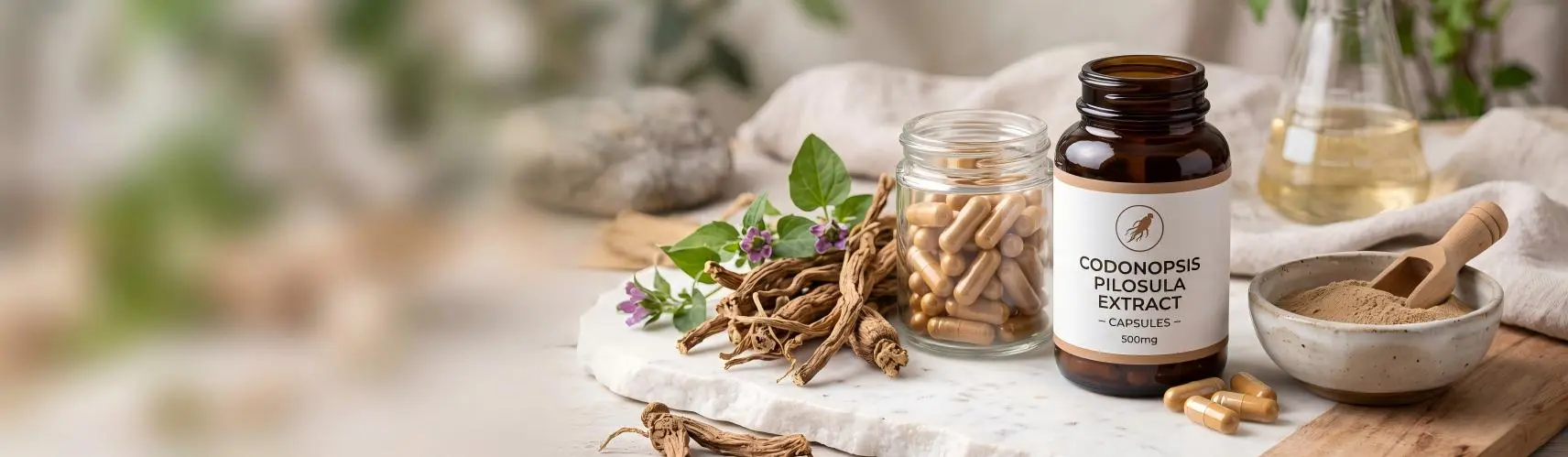
Codonopsis Supplement OEM/ODM Solutions
KS Nutripharma is a Codonopsis supplement manufacturer for OEM, ODM, and private-label programs. We source Dang Shen (Codonopsis pilosula) root and extract, then manufacture finished energy capsules, tablets, or powders — with batch COA release and private-label packaging.
Dang Shen root, Codonopsis root powder, and Codonopsis extract should not be treated as the same raw-material specification. We confirm species, plant part, extract ratio or marker, and assay method before quoting the finished SKU.
Already have a formula? Send Your BOM · Need a starting formula? Get a Formula & Quote · Comparing suppliers? Send Your COA
| What we need for a first quote | Typical project answer |
|---|---|
| Common name / botanical | Dang Shen = Codonopsis pilosula (Franch.) Nannf. Dried root. Confirm whether var. modesta or C. tangshen is permitted in the destination market |
| Plant part | Root |
| Working grades | Root powder (identity). Ratio extract 4:1 or 10:1. Polysaccharide-specified extract (10% polysaccharides is a common quote band, named assay method). Lobetyolin by HPLC when the brief names that marker. Final grade is project-dependent |
| Formula starting points | F01 extract · F02 root powder · F03 astragalus · F04 B-complex · F05 schisandra · F06 reishi · F07 eleuthero |
| Dosage forms | Typical starting format: capsules. Tablets when vitamins or minerals drive fill. Powder / stick as its own SKU. Gummies and liquids after feasibility |
| Target market | Country + food-supplement vs herbal-medicine classification + claim review |
| Documents | Batch COA · specification sheet · identity and safety tests as scoped · SGS / Eurofins when the RFQ requires it |
| MOQ / lead time | Capsules from ~3,000–5,000 units; samples 7–15 days; mass production 30–45 days — confirmed after formula, pack, and testing |
| Program | OEM / ODM / private-label finished SKUs. Bulk root powder or extract can be quoted on the same project |
cGMP | ISO 9001 | ISO 22000 | HACCP | FSSC 22000 | Halal | Kosher | In-house lab + third-party pathways (SGS / Eurofins) | Batch COA | Traceable release
-> About Us | Manufacturing Capacity | Certifications | Quality Control
12 production lines · 81,000+ m² · 260+ professionals
What you receive with a Codonopsis OEM project
- Matched C. pilosula root specification
- Starting BOM (F01–F07) or a custom formula built from your brief
- Dosage-form feasibility and sample
- Prototype COA
- Production quotation by SKU, including private-label pack
- Batch release documentation
- Packaging and export support
This page is manufacturing feasibility and documentation support — not legal approval of the finished label.
Choose the Codonopsis Format: Capsules, Tablets or Powder
Match load, flow, color, serving size, and unit cost after the starting BOM is chosen. We manufacture the same formula as a different SKU when the format changes. A capsule BOM is not reused as a gummy BOM.
Best for: F01, F03, F05, F06, F07 as a one-capsule SKU; F02 as a two-capsule SKU. Fastest sample path.
Why: Isolates color and odor; lower heat load; precise fill. Size 0 often holds F01 (500 mg extract); F02 root powder is the most likely two-capsule serving. We confirm against tap density, not a catalog milligram.
Typical formula cards: F01–F03, F05–F07. F04 when the B-complex still fits one shell.
Specify: Shell (HPMC / gelatin), fill weight, count, pack (HDPE / PET bottle or blister).
Manufacturing note: Extract SKUs usually fill one capsule. Do not copy F01 fill math onto F02.
→ Hard Capsules
Best for: F04 when the vitamin premix — or added minerals — will not fit one capsule; compact count programs.
Why: Higher pack density and a lower unit cost at volume when fill exceeds a practical capsule.
Typical formula cards: F04; custom mineral stacks.
Specify: Compression, hardness, friability, assay after press. Direct compression is evaluated first.
Manufacturing note: A capsule BOM is re-validated before a tablet run. Codonopsis color can speckle an uncoated tablet.
→ Tablets
Best for: Herbal drink mixes and F02-style identity powders. This is a different selling SKU, not a cheaper extract capsule.
Why: Flexible serving weight (often 2–5 g); matches Codonopsis powder search language.
Typical formula cards: F02; F06 after taste review.
Specify: Serving weight, taste (mild sweetness vs bitter companions), color, moisture-barrier film.
Manufacturing note: The consumer opens the pack every use, so barrier and shelf-life dating are part of the quote.
→ Powders & Granules
Heat, taste, color, water activity, and assay per piece. Do not list these formats to chase keywords if the brief is a standard botanical capsule. Extra sample time is quoted before artwork.
Custom Codonopsis Supplement Formulation for Private Label SKUs
These are starting BOMs we can sample and quote as finished private-label SKUs — not frozen catalog products, and not TCM prescription copies. Amounts below are manufacturing fills for sampling and quotation, not a recommended formula or daily dose. Extract grade, serving, count, and pack stay open.
Pick the closest card, or send a BOM. KS Nutripharma’s formulation team and R&D center match it to your channel and destination market, then set the Dang Shen root grade against that BOM. You receive a SKU-level cost, a sample plan, and a production quote.
Use case: For energy-supplement SKUs that need a concentrated Codonopsis / Dang Shen extract and a simple Supplement Facts panel. Fastest path from RFQ to sample.
Starting BOM (per capsule)
- Codonopsis pilosula root extract — 500 mg
- Grade: 10:1 ratio, or a polysaccharide-specified grade if the label will name polysaccharides (10% polysaccharides is a common quote band, named assay method)
- Excipients: flow aid / capsule fill as required
Typical starting format: Size 0 HPMC capsule · 1 capsule per serving · typical private-label pack 60 count.
Specify: Species, plant part (root), DER or marker and method, capsule count, shell (HPMC / gelatin).
Manufacturing note: Serving math is extract mg × assay. A 500 mg extract line is not “500 mg polysaccharide” unless that is the named analyte on the COA.
Use case: For labels that should show dried Dang Shen root rather than a concentrate. Covers Codonopsis root powder identity SKUs.
Starting BOM (per serving)
- C. pilosula milled root — 500 mg × 2 capsules (1,000 mg)
- Identity material; no guaranteed marker milligram unless extra testing is scoped
Typical starting format: Size 00 capsule, two-count serving. Stick pack (about 2 g) is a separate powder SKU, not a cheaper F01.
Specify: Species, plant part, particle size, capsule count vs serving weight.
Manufacturing note: Root powder takes more capsule volume than F01 extract. Color and mild sweetness vary by lot; we confirm bulk density before we set capsule size.
Use case: Two-root vitality SKU for immune support assortments. Each root is specified and assayed on its own.
Starting BOM (per capsule)
- C. pilosula root extract 10:1 — 300 mg
- Astragalus membranaceus root extract 10:1 — 300 mg
- Optional: name astragaloside IV or polysaccharide on the astragalus line if the label will state it
Typical starting format: Size 00 HPMC capsule · 1 capsule per serving · 60 count.
Specify: Both species, both plant parts (root), both extract types / markers, both methods.
Label note: Do not copy TCM “qi tonic” language onto a US structure/function panel. We manufacture the SKU; claim copy stays with your counsel.
Use case: Botanical plus daily energy nutrients — a nutrition companion on the same panel. Tablet if the premix and any minerals will not fit one capsule.
Starting BOM (per capsule)
- C. pilosula root extract 10:1 — 400 mg
- Thiamine (B1, thiamine HCl) — 25 mg
- Riboflavin (B2) — 10 mg
- Niacin (niacinamide) — 20 mg
- Vitamin B6 (pyridoxine HCl) — 10 mg
- Folate — 400 mcg DFE (folic acid or 5-MTHF as specified)
- Vitamin B12 — 50 mcg (methylcobalamin or cyanocobalamin)
- Pantothenic acid (calcium D-pantothenate) — 10 mg
Typical starting format: Size 0 or 00 capsule. Tablet after compression review if minerals join the BOM.
Specify: Each B form; folate salt vs 5-MTHF; whether minerals are in the same unit. Amounts are a sampling start and are confirmed against destination DV / NRV before sampling.
Manufacturing note: Low-dose vitamins need premix uniformity. B-vitamin assay is separate from the Codonopsis assay.
Use case: Two-botanical vitality SKU for brands that already specify schisandra lignans and want Dang Shen as the root.
Starting BOM (per capsule)
- C. pilosula root extract 10:1 — 400 mg
- Schisandra chinensis fruit extract — 200 mg (lignans / schisandrins by HPLC, method named)
Typical starting format: Size 0 HPMC capsule · 1 capsule per serving.
Specify: Schisandra identity, fruit (not leaf), lignan method — as a separate specification from Codonopsis.
Label note: No stress-drug or liver-treatment copy. We will not print disease language on a dietary-supplement label.
Use case: Root plus mushroom SKU for brands already running mushroom immune lines.
Starting BOM (per capsule)
- C. pilosula root extract 10:1 — 300 mg
- Ganoderma lucidum (reishi) fruiting-body extract — 250 mg
Typical starting format: Size 00 capsule. Powder blend after taste review.
Specify: Mushroom species, fruiting body vs mycelium, extract ratio. If the label states beta-glucans, that specification and method apply to the mushroom ingredient, not to Codonopsis.
Manufacturing note: Two identities, two assays. Reishi odor and color are managed in capsule; open powder needs a sensory plan.
Use case: Two-root vitality SKU when the brief wants a second adaptogen root without Panax on the panel.
Starting BOM (per capsule)
- C. pilosula root extract 10:1 — 300 mg
- Eleutherococcus senticosus (eleuthero) root extract — 200 mg (eleutherosides B+E, method named)
Typical starting format: Size 0 HPMC capsule. Raise fills only after bulk-density check; a two-capsule serving is quoted if Size 00 still overflows.
Specify: Eleuthero species, plant part, extract ratio, and eleutheroside assay method — separate from the Codonopsis line. If the brief wants Panax ginseng, that is a custom BOM, not this card.
Label note: Codonopsis and eleuthero should not be positioned or labeled as Panax ginseng or as a substitute for it. Do not use “poor man’s ginseng” as a claim.
Quoted after market review. Compatible in the blender is not a safety or efficacy claim. If F01–F07 is not the match, these are typical expansions we can quote on the same project.
| Ingredient | Why buyers add it | Key specification |
|---|---|---|
| Licorice root (Glycyrrhiza glabra) | Traditional multi-herb briefs | Glycyrrhizin limit; destination-market warning review |
| Ginger root (Zingiber officinale) | Vitality / herbal drink-mix briefs | Gingerols (HPLC); odor in open formats |
| Panax ginseng / P. quinquefolius | Buyers grouping Dang Shen with ginseng | Separate species and ginsenoside assay — not F07, and not C. pilosula |
| Rhodiola rosea | Energy / stamina stacks | Rosavins and salidroside (HPLC); own assay |
| Cordyceps (C. militaris) | Fungal vitality briefs | Fruiting-body identity; cordycepin / adenosine as specified (not a second F06 card) |
| Vitamin C + zinc | Short nutrition companion | Salt form and elemental zinc |
| Ashwagandha | Named by the buyer | Species and withanolides method |
We do not copy a TCM prescription (for example a four-herb “qi tonic” set) onto a dietary-supplement label without review.
For finished-product development, see our supplement contract manufacturing service.
Have a BOM? Send it · Want us to start from F01–F07? Get a Formula & Quote
Confirm classification and claim language before we set the root grade for sampling. English search interest in Dang Shen / C. pilosula is mostly herb identity. Finished “Codonopsis supplement” demand is still small — so the label has to be written as a dietary supplement, not as a TCM monograph.
| Market | Regulatory route | What to confirm before we sample |
|---|---|---|
| United States | Dietary supplement (DSHEA) | Structure/function vs disease. Vitality / energy language is not a fatigue-disease claim. Not an FDA-approved drug |
| EU / UK | Country-specific food vs herbal-medicine routes | Do not assume one EU answer. Traditional-use wording is market-specific; UK is reviewed separately |
| Australia / Canada | Complementary / NHP paths as applicable | Product-specific indications and listing |
| Other | Review required | Local classification, claims, notification |
| Starting BOM | Safer commercial framing (verify locally) | What delays artwork |
|---|---|---|
| F01 / F02 | Traditional root identity / daily vitality botanical | Treat, cure, qi deficiency, anemia |
| F03 | Herbal vitality / immune-assortment adjacency | Immune-disease or TCM prescription copy |
| F04 | Energy-nutrition formula | Stimulant-drug copy |
| F05 / F07 | Multi-botanical vitality set | “Replaces ginseng” |
| F06 | Root + functional-mushroom blend | Calling Codonopsis a mushroom |
Herb warnings and concurrent-medication language are destination-market items. We review them before formula finalization — not after you approve a sample you cannot label.
We source Dang Shen as part of the finished-supplement project. This page is not a bulk-root catalog. Dried root, root powder, and root extract are quoted to match the SKU you want manufactured.
Which material should we buy for your BOM?
| If the brief says… | Start with… |
|---|---|
| Traditional root identity; label shows dried Dang Shen | Root powder (F02) |
| Simple Codonopsis / Dang Shen extract capsule | Ratio extract, usually 10:1 (F01) |
| Label will state a polysaccharide number | Polysaccharide-specified extract |
| Label or spec names lobetyolin | Lobetyolin-standardized extract (HPLC) |
| Destination market needs a named solvent, dual marker, or organic | Custom specification |
→ Standardized extract pathways
Codonopsis Root
Dried Dang Shen root is the starting botanical. Buying “root” is not the same PO as buying a 10:1 extract. Whole or cut root may appear on traditional herbal briefs; for capsules we mill it (F02) or extract it (F01).
Codonopsis Root Powder
Milled root, identity only — no guaranteed marker milligram unless extra testing is scoped. Matches F02. Search language: Codonopsis root powder / Codonopsis powder.
Codonopsis Extract
Concentrated root described as a ratio (for example 4:1 or 10:1) or as a marker-standardized extract. A 10:1 ratio is the mass of crude root processed per unit of finished extract. It does not mean 10× lobetyolin or 10× polysaccharide.
Codonopsis pilosula Extract
The same manufacturing conversation as the extract above, with the species named on the PO. Write Codonopsis pilosula on the specification so the grade cannot drift to another Codonopsis.
| Material type | What you buy | Best fit | Key limitation |
|---|---|---|---|
| Dried root | Crude Dang Shen root | Traditional / cut-root briefs; then mill or extract | Direct encapsulation with no process step |
| Root powder | Milled root; identity | F02; powder blends | A quantified extract-marker claim without extra testing |
| Ratio extract | Concentrated root described as DER | Cost-sensitive F01 capsules | Treating 10:1 as 10× marker |
| Polysaccharide-specified extract | Released against named polysaccharide % | Briefs that will state a polysaccharide number | Drop-in for a lobetyolin HPLC specification |
| Lobetyolin-specified extract | Released against named lobetyolin (HPLC) | Briefs that want the polyacetylene marker | Assuming an aqueous polysaccharide grade matches this COA |
| Custom | Project solvent, DER, dual marker, organic | Named market requirements | Quoting “Codonopsis extract” with no species |
Identity we enforce on every PO
- Specify Codonopsis pilosula unless the destination-market monograph expressly allows var. modesta and/or C. tangshen. Those pharmacopoeial sources are related, not automatic substitutes.
- Codonopsis lanceolata and other Codonopsis materials are not this page’s Dang Shen.
- We do not quote unlabeled “Codonopsis extract” or “Campanulaceae root extract” as C. pilosula.
- Codonopsis is not Panax ginseng.
These fields change identity, serving math, color, how the powder runs on our lines, and what you can put on the label. Send them with the RFQ.
| Specification | Why it matters | What to put on the PO |
|---|---|---|
| Botanical identity | Other Codonopsis species are not this Dang Shen | Codonopsis pilosula (Franch.) Nannf. — plus whether var. modesta / C. tangshen is in scope |
| Plant part | Stem / leaf is not the herb | Root |
| Material type | Root, powder, and extract are different POs | Named type |
| DER / ratio | Ratio is not potency | Defined if used (for example 4:1 or 10:1) |
| Extraction solvent | Water systems often enrich polysaccharides; hydroalcohol profiles differ | Declared |
| Marker | Lobetyolin and polysaccharides are not interchangeable | Named analyte + minimum or as-is |
| Assay method | A number without a method is not comparable | HPLC for lobetyolin; named polysaccharide assay method on the specification and COA (do not mix phenol-sulfuric UV-Vis with HPLC) |
| Appearance / taste | Color and mild sweetness vary lot to lot | Specified |
| Moisture / particle size | Flow, fill-weight variation, caking | Matched to our filler or press |
| Carrier | Fill weight and labeling | Declared (none, maltodextrin, or project-specific) |
| SO₂ / sulfur fumigation | Common risk on some Chinese roots | Tested against the destination limit |
| Heavy metals / pesticides / micro / residual solvents | Market limits differ | Against destination-market requirements |
Serving math
Extract weight × assay = marker amount per serving.
Illustration only — not a dosage recommendation: 500 mg extract × 10% polysaccharide = 50 mg polysaccharide, if that is the named method on the COA. A lobetyolin HPLC specification uses a different equation. A 10:1 ratio extract is not the same math as a marker-standardized extract.
Final serving is confirmed from the selected grade, companion fill, capsule or tablet size, and target market — not from a consumer “take X mg daily” table.
Consistency comes from process control — incoming assay, filling, packaging, and shelf-life dating — not from copying a drum COA onto the finished product.
F03–F07 companions are checked for powder behavior: flow, hygroscopicity, bulk density, capsule fill, tablet compression, color, and marker retention. Glycyrrhizin, ginsenosides, and mushroom beta-glucans each keep their own assay. Water-extracted, polysaccharide-rich Codonopsis grades are often hygroscopic; humidity and pack are part of the sample plan.
| Manufacturing issue | What we check before you scale |
|---|---|
| Botanical identity | Species and plant-part verification; reject generic Codonopsis, non-root parts, and C. lanceolata |
| Raw-material variation | Incoming assay, appearance, and contaminant testing — including possible sulfur treatment |
| Powder flow / fill | Bulk density and fill-weight on F02 and bulky extracts; Size 0 vs 00 confirmed at sample |
| Hygroscopicity | Polysaccharide-rich extracts: process humidity and moisture-barrier pack |
| Tablet compression | Pilot press before a tablet MOQ (typical for F04) |
| Multi-ingredient formulas | Ingredient-specific assay; blend uniformity on F03–F07 |
| Micro / contaminants | Incoming and finished micro, metals, pesticides, residual solvents, SO₂ as scoped |
Humidity, barrier, and shelf-life dating: Moisture Control & Stability Engineering.
Packaging we quote with the SKU: HDPE / PET + induction seal as a common capsule/tablet start; blisters, pouches, sachets, cartons, and export cases as scoped; desiccant when moisture leads. Shelf life is set from formulation + pack + storage + stability data — not a catalog 24–36 months.
The commercial batch is released against the same approved specification used for the sample.
| Stage | What is checked |
|---|---|
| Incoming | Identity (C. pilosula root unless otherwise specified), appearance, named assay, micro, metals, pesticides, SO₂, residual solvents as scoped |
| In-process | Blend uniformity, capsule fill / tablet weight, hardness / friability where applicable, process moisture |
| Finished | Agreed spec, micro, pack inspection, batch records |
A usable COA has four blocks: Identity · Potency (analyte + method) · Safety · Physical.
Lab: in-house release; SGS / Eurofins when the RFQ requires it. Methods: Quality Control.
01 — RFQ
Market, F01–F07 or BOM, format, quantity, pack, target cost.
02 — Target market and spec review
Species, claims, Dang Shen grade.
03 — Formula development
Fill weight, compatibility, format feasibility.
04 — Sample
Prototype against the agreed specification.
05 — Pilot
Fill or compression, in-process checks.
06 — Stability / QC as scoped
07 — Production and packaging
Batch manufacture and private-label pack.
08 — Shipment
COA, batch records, export pack.
MOQ and lead time
| Stage | Typical |
|---|---|
| Sample | 7–15 days* after the specification is agreed |
| Pilot | 15–25 days* |
| Mass production | 30–45 days* |
| Scope | Typical start |
|---|---|
| Bulk extract on the project | Quoted by kg |
| Capsules | ~3,000–5,000 units |
| Tablets | ~5,000–10,000 units |
| Powder / stick — retail | Often from ~10,000 units |
| Gummies / liquids | Project-scoped |
Depends on formula, pack, testing, and schedule. Bulk kg MOQ is not a finished-unit MOQ.
Seven fields for a usable RFQ
- Destination market
- F01–F07 or BOM
- Format and pack
- Species / plant part / material type / marker + method
- Quantity and timeline
- Claim / label constraints
- Existing COA (if any)
Start Your Codonopsis Supplement Manufacturing Project
You do not need a finished Supplement Facts panel to start. Name the market, pick F01–F07 or send a BOM, and tell us capsules, tablets, or powder. If you already have a COA, send it — we check species, plant part, marker, and method before quoting.
Have a BOM? Send Your BOM
Want a starting formula sampled? Get a Formula & Quote
Comparing suppliers? Send Your COA
Related Resources
Dang Shen is the common name used here for Codonopsis root. On this page it means Codonopsis pilosula (Campanulaceae, root) unless the purchase order names another permitted species. It is not Panax ginseng.
Root powder is milled dried root (F02): identity material, no guaranteed marker milligram unless extra testing is scoped. Extract is concentrated root, quoted as a ratio (for example 10:1) or as a marker-standardized grade. A 10:1 ratio is not 10× polysaccharide or 10× lobetyolin. If you need a defined marker, name the analyte and method — polysaccharides and lobetyolin are different specifications. We source either as part of the finished SKU we manufacture.
Yes. Capsules are the default path for F01 and most two-botanical cards. Tablets after compression review — typical when F04 adds vitamins.
Split sourcing — extract trader, then a second factory for capsules — is where species drift, solvent mismatch, and fill problems show up. We source the root grade, formulate, encapsulate or press, pack, and release on one program, so the sample you approve is the grade that goes into the commercial batch.
- One specification from root identity through finished assay
- Starting BOMs (F01–F07) mapped to format and MOQ
- In-house + third-party test pathways
- Private-label pack without a second factory handoff
500+ brands · 60+ export markets · since 2007 · 5 bases