Ingredient Comparison & Formulation Decision Guide for Brand Owners and Procurement Teams
KS Nutripharma® | Science-Driven Nutraceutical Contract Manufacturer
Written by KS Nutripharma Formulation Team | Reviewed by KS Nutripharma R&D and Quality Team
Disclaimer: For ingredient education, procurement, and product-development guidance only. Not intended to diagnose, treat, cure, or prevent any disease. Final product claims and ingredient legality must comply with regulations in each target market. Yohimbine / Yohimbe status varies by country—confirm with local counsel before commercialization.
Should Brands Choose Purified Yohimbine HCl or Botanical Yohimbe Extract?
Yohimbine ingredients used in dietary supplements generally fall into two categories:
1. Yohimbine HCl
- Purified alkaloid compound
- High potency potential
- Precise dosing architecture
- Pharmaceutical-style specification pathway
2. Yohimbe Extract
- Botanical extract from Pausinystalia johimbe bark
- Contains multiple alkaloids
- Stronger natural / herbal positioning
- Requires clear standardization and supplier verification
Core takeaway for formulators:
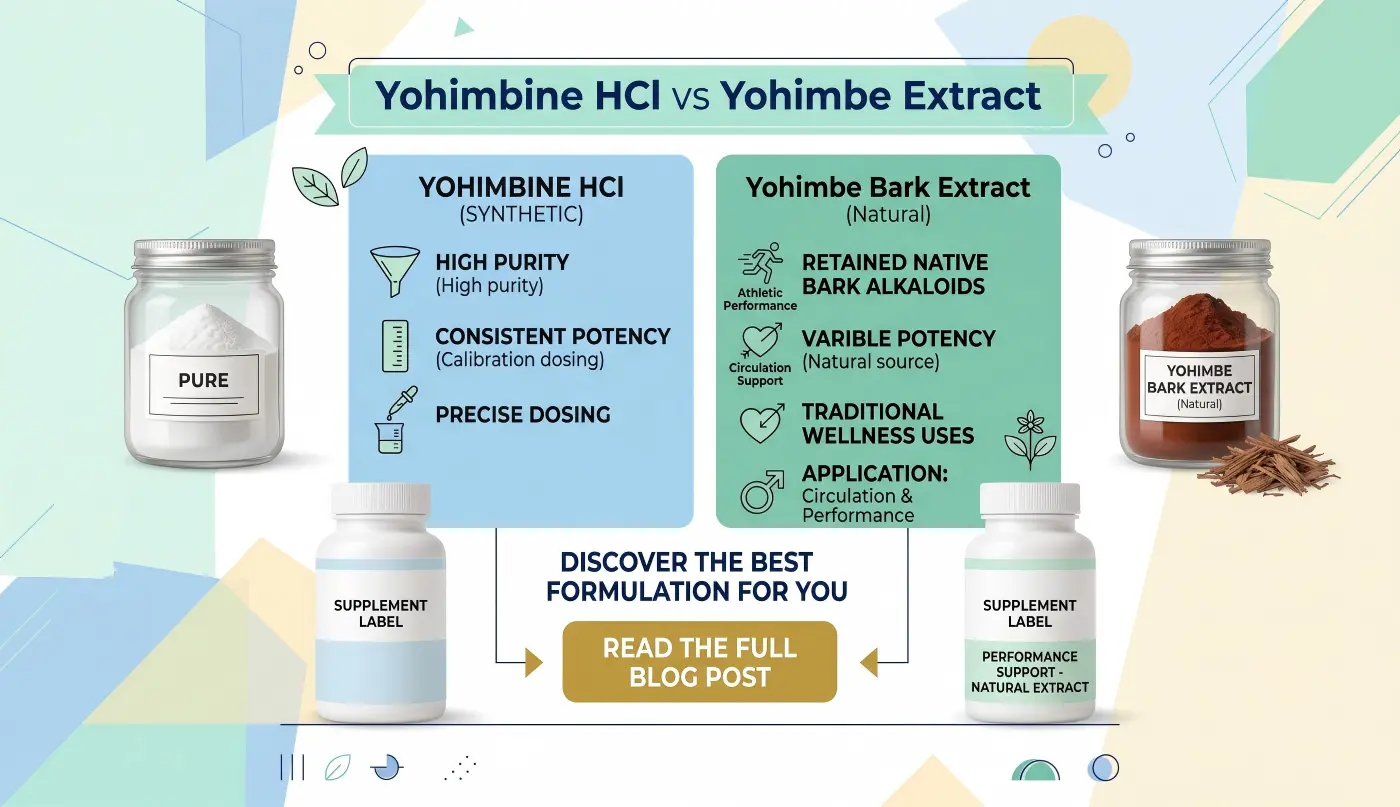
For brands prioritizing dose accuracy and formulation consistency, Yohimbine HCl is often preferred.
For brands seeking a botanical positioning, standardized Yohimbe Extract may support a different market approach—when destination rules allow.
→ Finished manufacturing: Yohimbine HCl Supplement Manufacturer
Request HCl vs Extract Spec Comparison
Quick Comparison: Yohimbine HCl vs Yohimbe Extract
Attribute | Yohimbine HCl | Yohimbe Extract |
|---|---|---|
| Source | Purified alkaloid | Botanical bark extract |
| Scientific / commercial name | Yohimbine hydrochloride | Pausinystalia johimbe bark extract |
| Ingredient type | Single compound focus | Multi-component extract |
| Marker compound | Yohimbine (as HCl) | Total alkaloids / yohimbine (method-dependent) |
| Standardization | Commonly high assay grades (e.g. ≥98% class) | Variable by supplier and method |
| Dose precision | High | Depends on locked specification |
| Formulation control | Easier for many finished SKUs | Requires stronger supplier verification |
| Natural / botanical positioning | Moderate | Stronger |
| Labeling complexity | Often lower when identity is clear | Higher if marker language is vague |
| Typical applications | Performance formulas · targeted products | Botanical / herbal supplement stories |
Procurement rule: Do not treat “Yohimbe extract %” as interchangeable with “Yohimbine HCl mg.” Compare identity + assay method + finished serving math + documentation.
What Is Yohimbine HCl?
Definition and Chemical Characteristics
Yohimbine HCl (Yohimbine Hydrochloride) is a purified salt form of yohimbine, an indole alkaloid originally associated with Yohimbe bark.
Technical snapshot for manufacturers
- Common commercial form: Yohimbine hydrochloride
- CAS (Yohimbine HCl): 65-19-0 (Yohimbine free base is often cited as 146-48-5—confirm which identity appears on your COA)
- Appearance: Typically white to off-white crystalline powder
- Commercial purity: High-assay grades are commonly discussed in the ≥98% class (project- and method-dependent)
For supplement manufacturers, Yohimbine HCl is valued for:
- Consistent potency potential
- Predictable serving architecture
- Clearer quality-control conversations
Advantages of Yohimbine HCl for Supplement Brands
1. Precise Active Dose Control
Suitable for:
- Capsules
- Tablets
- Powder blends / stick packs
When a brief requires a defined amount of yohimbine on the label, purified Yohimbine HCl usually supports cleaner serving math than a poorly defined bark extract.
2. Better Batch-to-Batch Consistency
Botanical materials can vary due to:
- Plant origin
- Harvesting conditions
- Extraction methods
- Alkaloid profile distribution
A purified, assay-locked HCl pathway reduces many of those variables for finished-goods reorders.
3. Easier Quality Documentation for Buyers
Procurement teams typically expect:
- COA
- HPLC / assay results
- Identity confirmation
- Heavy metals
- Microbial testing
- Residual solvents as scoped
→ Yohimbine HCl Supplement Manufacturer · How to Choose a Yohimbine Supplement Manufacturer
What Is Yohimbe Extract?
Botanical Source and Extraction
Yohimbe Extract is derived from Yohimbe bark (Pausinystalia johimbe).
It is a traditional botanical material that may contain:
- Yohimbine
- Corynanthine
- Other related indole alkaloids
That multi-compound matrix is why bark extract and Yohimbine HCl are not the same commercial ingredient.
Standardization of Yohimbe Extract
Not all Yohimbe Extracts are equivalent. Before artwork lock, ask what the specification actually means.
Specification style | What buyers should clarify |
|---|---|
| Extract ratio (e.g. 10:1) | Concentration narrative—not automatically equal to yohimbine % |
| Yohimbine % | Marker compound standardization—confirm assay method |
| Total alkaloids % | Broader botanical profile—define which alkaloids are included |
| Method (HPLC vs other) | Two COAs with “yohimbine” may not be analytically identical |
Buyer caution: Vague “Yohimbe extract” quotes without marker + method + contaminant scope create formulation and retailer risk.
Key Differences Between Yohimbine HCl and Yohimbe Extract
1. Purity and Active Compound Control
Yohimbine HCl: a single defined compound pathway focused on yohimbine as the hydrochloride salt.
Yohimbe Extract: a complex botanical matrix whose commercial value depends on how honestly the marker and method are locked.
2. Formulation Flexibility
Yohimbine HCl is often better for:
- Precise capsule / tablet formulas
- Combination products with crowded fill
- Assay-honest performance or sports-adjacent positioning
Yohimbe Extract is often better for:
- Herbal / botanical storytelling
- Traditional plant-extract merchandising
- Catalogs that lead with bark identity rather than HCl potency math
3. Quality Control Requirements
Supplier evaluation should cover:
- Botanical authentication (for bark pathways)
- Extraction solvent story (as applicable)
- Assay method and acceptance criteria
- Contaminant testing (metals · micro · pesticides / solvents as scoped)
- Change control between lots
Which One Should Supplement Brands Choose?
Choose Yohimbine HCl If You Need:
- Precise active dosage architecture
- Consistent potency for reorders
- Simplified formulation control
- Premium / performance positioning with clear assay disclosure
- Cleaner QC documentation conversations
Choose Yohimbe Extract If You Need:
- Botanical ingredient story
- Traditional herbal positioning
- Whole-bark extract concept
- Natural-supplement marketing angle (where market rules allow)
Practical sequence: Confirm destination legality → choose HCl or bark pathway → lock identity + assay method → confirm dosage-form feasibility → request COA / spec / sample → align OEM MOQ and docs before artwork lock.
Talk to Formulation About Pathway Selection
Regulatory and Safety Considerations for Yohimbine Supplements
Why Regulatory Review Matters
Yohimbine-containing supplements require careful review because rules differ sharply by market. This is a go / no-go gate—not a late artwork detail.
United States
- Follow applicable FDA dietary-supplement manufacturing and labeling frameworks
- Keep structure–function caution; avoid disease / ED-treatment claims without applicable drug pathways
- Synthetic yohimbine hydrochloride marketed as a dietary-supplement ingredient faces significant scrutiny—confirm pathway legality with counsel
- Lock identity, serving disclosure, and retailer documentation early
European Union / United Kingdom
- Yohimbe bark and related preparations are commonly restricted or banned in foods / food supplements in multiple frameworks
- Do not assume a U.S. sports formula can ship into EU/UK without a formal screen
Canada / Australia / Other Regions
- Many markets restrict or prohibit Yohimbe / yohimbine supplement pathways
- Treat each destination independently; Halal packing does not equal ingredient legality
→ Market notes also on our manufacturer page · Regulatory Compliance Guide
How Supplement Manufacturers Evaluate Yohimbine Ingredients
1. Verify Ingredient Identity
- Botanical identification for bark pathways
- HPLC / assay identity for HCl pathways
- Raw-material traceability and lot coding
2. Check Standardization Method
Ask:
- Is the active marker yohimbine (and as which salt/form)?
- Is purity/assay tested by HPLC?
- Is the method validated and written into the locked spec?
3. Review Manufacturing Documentation
Request:
- COA
- Specification sheet
- SDS / TDS as needed
- Stability support (project-scoped)
- GMP / quality-system evidence
→ Full procurement checklist: How to Choose a Yohimbine Supplement Manufacturer
Yohimbine Supplement OEM Manufacturing Considerations
Available Formats
- Capsules
- Tablets
- Powder blends
- Stick packs / sachets
- Custom formula concepts under locked BOM
Formulation Support
- Ingredient pathway selection (HCl vs bark)
- Serving architecture after market review
- Blend compatibility and format engineering
- Stability scoping as needed
Quality Control Process
Raw material intake
        ↓
Identity testing
        ↓
Assay / specification lock
        ↓
Production (capsule / tablet / powder / stick)
        ↓
Finished product testing
        ↓
COA release · shipment
→ Yohimbine HCl Supplement Manufacturer · Quality Control
Frequently Asked Questions
Is Yohimbine HCl the same as Yohimbe Extract?
No. Yohimbine HCl is a purified hydrochloride form of yohimbine. Yohimbe Extract is a botanical bark extract that may contain multiple alkaloids and requires separate specification discipline.
Which is more suitable for supplement manufacturing?
It depends on positioning. Yohimbine HCl usually offers higher dosing precision and reorder control. Standardized Yohimbe Extract supports botanical storytelling when market rules allow and specs are honest.
How is Yohimbine content tested?
Typically through analytical methods such as HPLC, locked to the approved specification and method on the COA.
Can Yohimbine HCl and Yohimbe Extract be combined in formulas?
Sometimes—only when regulatory requirements, formulation goals, label identity, and serving architecture all support it. Do not invent equivalence between pathways.
What documents should buyers request from suppliers?
- COA
- Specification sheet
- HPLC / assay report pathway
- Contaminant panels as required
- GMP / quality documentation
- Stability information (project-scoped)
Reviewed by KS Nutripharma R&D and Quality Team
Expertise areas
- Botanical extraction and standardized herbal ingredients
- Nutraceutical formulation
- OEM / ODM / private label supplement manufacturing
- Incoming and finished-goods quality systems
19+ years | 500+ brand projects | 60+ export markets | 81,000+ m² cGMP footprint
Develop Your Yohimbine Formula With the Right Material Pathway
Share your target market, preferred pathway (Yohimbine HCl vs Yohimbe bark extract), dosage form, companions, packaging, and volume. KS Nutripharma returns feasibility guidance, documentation scope, MOQ direction, and next steps—from sample/COA review to commercial OEM/ODM production.
Request Material Pathway + OEM Feasibility · Yohimbine HCl Supplement Manufacturer · Yohimbe Extract Supplier Pathway
KS Nutripharma manufactures for business clients only.