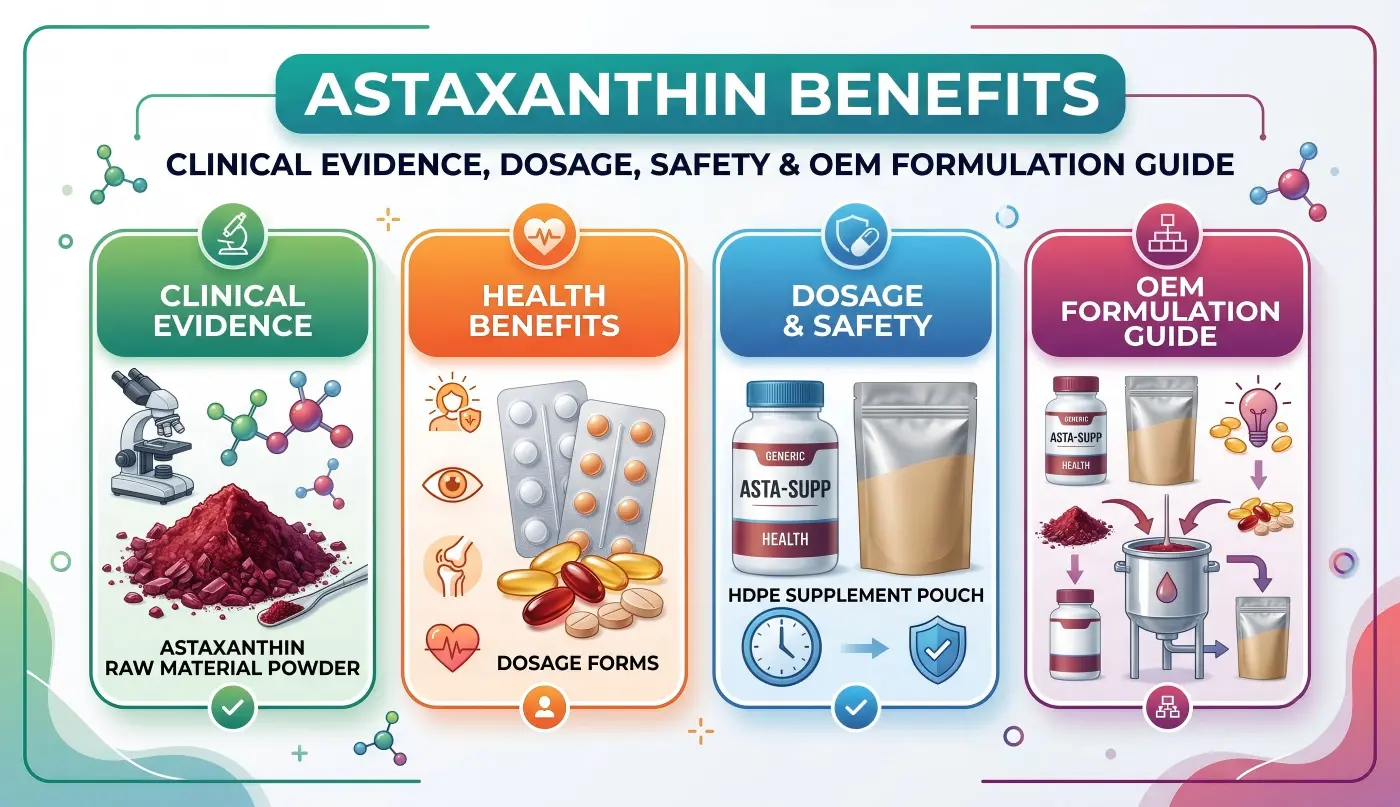
An evidence-based pillar guide for supplement brands developing natural astaxanthin products
Reviewed by: KSNutripharma R&D Team — Carotenoid Formulation & Nutraceutical R&D
Content type: Pillar content for OEM / ODM supplement manufacturing
Astaxanthin has moved from a niche carotenoid to a widely used ingredient in eye health, beauty-from-within, healthy aging, antioxidant, and sports nutrition products.
For supplement brands, the commercial value of astaxanthin supplements extends beyond consumer awareness. Natural astaxanthin is compatible with softgels, capsules, tablets, gummies, powders, and selected functional beverages when the appropriate ingredient format and stability system are used.
However, discussions about astaxanthin benefits often overstate laboratory findings or treat preliminary studies as definitive clinical proof. This guide examines what astaxanthin is, what current human research suggests, where evidence remains limited, and how brands can translate the science into responsible product development.
| Manufacturing Snapshot | KSNutripharma OEM / ODM Capability |
| OEM / ODM Available | Custom astaxanthin formulation, private label, and full contract manufacturing |
| MOQ | From 100,000 softgels or 200,000 gummies per SKU; pilot and scale-up runs supported |
| Lead Time | Typically 4–8 weeks after formula and packaging confirmation |
| Certifications | GMP, FSSC 22000, ISO 22000 and HACCP-certified facilities; Halal and Kosher options |
| Dosage Forms + Capacity | Softgels, capsules, tablets, gummies, powders and liquids — daily capacity up to 5,000,000 softgels or 3,000,000 gummies |
| Request a Quote | Send your target market, dosage form, serving level and estimated volume to the KSNutripharma team |
| Medical and regulatory notice: This article is for educational and product-development purposes only. It is not medical advice. Astaxanthin supplements are not intended to diagnose, treat, cure, or prevent disease. Product claims, formulations, and serving levels must be independently reviewed for the applicable target market before use. |
| Prepared and reviewed by the KSNutripharma R&D Team. Technical focus: carotenoid formulation, lipid oxidation control, and nutraceutical R&D. 19+ years of supplement manufacturing experience · 500+ custom formulas developed. Production in GMP- and FSSC 22000-certified facilities, with batch-level traceability and third-party testing support. (Certification numbers and audit reports are available on request for brand due diligence.) |
Table of Contents
- Key Takeaways
- What Is Astaxanthin? —
- What Is the Best Astaxanthin Source?
- What Does Astaxanthin Do?
- What Is Astaxanthin Good For?
- How Long Does Astaxanthin Take to Work?
- Astaxanthin Benefits for Men vs. Women
- Astaxanthin vs. Other Antioxidant Ingredients
- Natural vs. Synthetic Astaxanthin
- Why Two 6 mg Astaxanthin Products May Perform Differently
- Astaxanthin Dosage and Product Formats
- Formulation Considerations for Brands
- Astaxanthin Formulation Trends Observed by KSNutripharma
- Astaxanthin Safety and Side Effects
- Turning Astaxanthin Benefits Into a Responsible Product Brief
- Frequently Asked Questions
- Developing an Astaxanthin Supplement with KSNutripharma
- References and Authoritative Resources
Key Takeaways
- Astaxanthin is a lipid-soluble xanthophyll carotenoid found in microalgae and aquatic animals.
- Haematococcus pluvialismicroalgae is the principal source used for natural astaxanthin supplements.
- Human research has explored astaxanthin for skin appearance, visual comfort, exercise recovery, fatigue, and healthy-aging applications.
- The evidence is promising in several areas but varies considerably in quality, consistency, population, dose, and study duration. Most skin trials ran 6–12 weeks; eye-comfort studies typically ran 4–8 weeks.
- Astaxanthin should not be presented as a treatment for eye disease, skin disease, cardiovascular disease, cognitive decline, or inflammatory conditions.
- No astaxanthin health claim is currently authorized under the EU Nutrition and Health Claims Regulation; permitted wording in the United States is limited to substantiated structure/function claims with the required disclaimer.
- Ingredient source, dosage form, concentration, oxidation control, packaging, and finished-product testing can materially affect product quality — two products both labeled “6 mg” may perform very differently.
- Brands should distinguish scientific evidence from legally permitted label and advertising claims in each target market.
What Is Astaxanthin?
Astaxanthin is a naturally occurring red-orange carotenoid belonging to the xanthophyll family. It is produced by certain microalgae, yeasts, and bacteria and becomes part of the aquatic food chain when consumed by organisms such as krill, shrimp, trout, and salmon.
Unlike beta-carotene, astaxanthin is not generally considered a meaningful source of vitamin A activity in humans. Its commercial interest is primarily associated with its molecular structure, antioxidant behavior, lipid solubility, and use in premium wellness formulations.
The best-known natural commercial source is the freshwater microalga Haematococcus pluvialis. Under environmental stress, this microalga accumulates astaxanthin as a protective compound. It can then be cultivated, harvested, extracted, standardized, and processed into:
- Astaxanthin oil suspensions
- Astaxanthin oleoresin
- Standardized astaxanthin powder
- Microencapsulated water-dispersible powder
- Astaxanthin beadlets
Natural astaxanthin is commonly selected for human supplements because of its microalgae origin, established consumer recognition, and suitability for plant-based positioning. Brands should nevertheless verify the complete formula before making vegan claims, as capsule shells, carriers, processing aids, and other ingredients may be animal-derived.
What Is the Best Astaxanthin Source?
Commercial astaxanthin reaches the market from several sources, and they are not interchangeable in composition, positioning, or regulatory status. For supplement brands, the source decision shapes the claims, the price point, and the evidence that can be referenced.
| Source | Key Characteristics | Typical Commercial Use |
| Haematococcus pluvialis microalgae | Natural astaxanthin accumulated under environmental stress, predominantly in esterified form; the principal supplement-grade source | Premium human dietary supplements |
| Phaffia yeast (Xanthophyllomyces dendrorhous) | Naturally synthesizes astaxanthin at comparatively low concentrations | Limited supplement use; feed and fermentation research |
| Synthetic astaxanthin | Produced by chemical synthesis, with a different stereoisomer distribution | Aquaculture feed for salmonid pigmentation |
| Krill, shrimp, salmon, trout | Astaxanthin obtained through the aquatic food chain | Natural dietary source; minor co-constituent of krill oil |
For premium human supplements, Haematococcus pluvialis remains the reference source: it combines established consumer recognition, natural positioning, and the most developed human evidence base. Brands comparing suppliers should still confirm identity, stereoisomer profile, concentration, and contaminant controls rather than relying on the word “natural” alone.
What Does Astaxanthin Do?
Astaxanthin has a polar group at each end of its molecule and a nonpolar region through the center. This structure helps explain why it can interact with lipid environments, including cell membranes, in experimental models.
Laboratory and animal studies suggest that astaxanthin can participate in antioxidant and cell-signaling processes. These findings have encouraged research into several astaxanthin uses, including skin appearance, visual comfort, exercise recovery, and healthy-aging products.
Laboratory activity, however, does not automatically prove a meaningful benefit in humans. It also does not establish that one antioxidant is clinically “stronger” than another. Antioxidant-capacity comparisons frequently come from chemical assays or nonhuman models that cannot be directly converted into supplement claims.
A responsible assessment of astaxanthin health benefits should therefore prioritize:
- Systematic reviews and meta-analyses of human trials
- Randomized, placebo-controlled clinical trials
- Replication across different populations
- Clinically meaningful outcomes rather than laboratory markers alone
- Study doses and ingredient formats relevant to the finished product
- Independent research and transparent conflict-of-interest reporting
What Is Astaxanthin Good For?
Human studies have evaluated astaxanthin across several wellness categories. The evidence does not support describing it as a universal solution, but it can be a commercially relevant ingredient when the formulation and positioning reflect the available research. The table below summarizes the main application areas, the current level of human evidence, and typical formula concepts.
| Application Area | Human Evidence Level | What Human Studies Suggest | Typical Formula Concept |
| Skin moisture and elasticity | Moderate | Several RCTs report improved moisture, texture, or elasticity; wrinkle-depth findings are inconsistent | Astaxanthin + collagen peptides, vitamin C, or ceramides |
| Visual comfort (digital lifestyles) | Moderate | Combination studies report selected improvements in accommodative function and screen-related eye fatigue | Astaxanthin + lutein + zeaxanthin |
| Exercise recovery | Moderate | Meta-analyses report reductions in recovery biomarkers such as creatine kinase; no clear gains in VO2max or power output | Astaxanthin + CoQ10 or omega-3 |
| Healthy aging/antioxidant support | Emerging | Mechanistic and early human data; outcomes are mostly biomarkers rather than clinical endpoints | Astaxanthin + omega-3 or vitamin E |
| Cognitive wellness and fatigue | Limited | Marginally significant effects on cognitive accuracy; non-significant effects on reaction time | Astaxanthin + phosphatidylserine (PS) |
Evidence levels above are qualitative editorial judgments based on the quantity, consistency, and independence of human trials — not regulatory grades. Each application is examined in more detail below.
Skin Appearance and Beauty-From-Within Products
Skin health is one of the most established consumer applications for natural astaxanthin supplements.
A systematic review identified 11 clinical studies, including six randomized, double-blind, placebo-controlled trials. Several studies reported improvements in skin moisture, texture, elasticity, or appearance, generally at doses of 3–6 mg/day. However, the authors also noted important limitations: many trials were small, several involved healthy Japanese women, and commercial funding was common.[1]
A separate systematic review and meta-analysis reported statistically significant improvements in skin moisture and elasticity but did not find a significant reduction in wrinkle depth compared with placebo.[2]
These findings suggest that astaxanthin may be relevant to beauty-from-within concepts, but they do not justify guaranteed anti-aging, wrinkle-removal, UV-protection, skin-whitening, or disease-treatment claims.
Potential product concepts include:
- Astaxanthin with collagen peptides
- Astaxanthin with vitamin C
- Astaxanthin with ceramides
- Astaxanthin with hyaluronic acid
- Astaxanthin with glutathione
For B2B product development, the combination should be selected according to the target consumer, intended claims, serving format, sensory profile, stability requirements, and available substantiation — not simply the number of trending ingredients on the label.
Eye Wellness and Digital-Lifestyle Formulations
Astaxanthin is frequently used in eye health products, particularly formulas intended for screen-intensive lifestyles.
Clinical research has examined astaxanthin alone and in combination with lutein, zeaxanthin, and anthocyanins. One randomized, placebo-controlled trial found that a combination providing 6 mg astaxanthin, 10 mg lutein, and 2 mg zeaxanthin, taken daily for 8 weeks, significantly improved eye-hand coordination following visual display terminal (VDT) use, though smooth-pursuit eye movement did not improve as clearly.[3]
Another randomized, double-blind trial using a combination of anthocyanin, astaxanthin, and lutein over 6 weeks reported improvements in pupillary response and subjective focusing difficulty after VDT use.[4]
These are combination studies. Their results cannot be attributed to astaxanthin alone.
Astaxanthin may therefore complement lutein and zeaxanthin in digital eye wellness formulas, but it should not be marketed as a treatment for macular degeneration, cataracts, glaucoma, dry-eye disease, myopia, or other ocular conditions.
Brands developing multi-carotenoid products can review KSNutripharma’s eye health supplement manufacturing solutions for dosage-form and formulation options.
Exercise Recovery and Active-Lifestyle Products
Astaxanthin is also used in sports nutrition and active-aging formulations because strenuous exercise can increase metabolic and oxidative demands.
A 2026 systematic review and meta-analysis covering 24 randomized controlled trials found that astaxanthin supplementation was associated with reductions in certain exercise-recovery biomarkers, including creatine kinase (SMD = -0.45) and lactate dehydrogenase. The analysis did not find significant effects on malondialdehyde or interleukin-6, and did not find significant improvements in VO2max, time-trial performance, or maximal workload and power output.[5]
This distinction is important. Current evidence may be more relevant to recovery-oriented positioning than to claims of directly increasing endurance, strength, speed, or athletic performance.
A separate meta-analysis of 11 randomized trials (346 participants) reported that astaxanthin combined with regular training was associated with improved aerobic exercise efficiency and fat oxidation, but found only marginal or non-significant effects on several fatigue and cognitive outcomes. The authors called for larger, better-powered studies.[6]
Responsible positioning may include:
- Active-lifestyle nutrition
- Post-exercise recovery support
- Antioxidant support for physically active adults
- Healthy-aging formulas for active consumers
Brands should avoid promising faster recovery, reduced inflammation, enhanced athletic performance, or protection against exercise-related injury unless the exact wording is supported and permitted in the target market.
Antioxidant and Healthy-Aging Formulas
Astaxanthin is widely recognized as an antioxidant ingredient, but “antioxidant” should not be treated as a complete product claim.
Oxidative stress is a complex biological process, and the human body uses interconnected endogenous systems involving enzymes, signaling pathways, dietary nutrients, and metabolic regulation. A high result in an in-vitro antioxidant assay does not demonstrate that a supplement prevents aging or protects people from chronic disease.
For product development, astaxanthin can be combined with ingredients such as:
- Coenzyme Q10
- PQQ
- Resveratrol
- Vitamin E
- Omega-3 fatty acids
- Curcumin
- Glutathione
The combination should reflect a defined consumer need and compatible delivery system. For example, astaxanthin, CoQ10, vitamin E, and omega-3 oils may be technically appropriate for an oil-based softgel, while a complex containing water-soluble and lipid-soluble ingredients may require a different dosage form or multiple-product system.
KSNutripharma provides custom antioxidant supplement manufacturing for brands developing beauty, active-aging, cellular-wellness, and lifestyle formulations.
Cognitive Wellness and Fatigue
Astaxanthin is sometimes promoted for brain health, focus, memory, and fatigue. Current human evidence is not strong enough to support definitive conclusions in these areas.
A 2024 meta-analysis of 11 RCTs found that the effect of 8–12 weeks of astaxanthin supplementation on cognitive accuracy was only marginally significant (SMD = 0.12), while the effect on reaction time was not significant (SMD = -0.08). The fatigue analysis was based on just two studies and should be interpreted with caution.[6]
These findings do not support presenting astaxanthin as a treatment or preventive intervention for dementia, depression, neurological disease, chronic fatigue syndrome, or cognitive impairment.
For brands, cognitive or mental-performance positioning should be approached cautiously and supported by evidence for the complete formula, not merely by mechanistic claims about one ingredient.
How Long Does Astaxanthin Take to Work?
This is one of the most frequent consumer questions — and a frequent source of over-claiming. Human trials measure outcomes after defined supplementation periods, so realistic timelines should be drawn from actual study durations, not from marketing copy.
| Application | Typical Duration in Human Studies |
| Skin appearance (moisture, elasticity) | 6–12 weeks |
| Visual comfort and screen-related fatigue | 4–8 weeks |
| Exercise-recovery protocols | 2–8 weeks |
| Healthy-aging and antioxidant biomarkers | 8–12+ weeks |
The onset of observable effects may vary considerably according to baseline nutritional status, age, dosage, and product composition. Study timelines describe when outcomes were measured — they are not a promise that every consumer will notice a change within that window. Brands should avoid countdown-style claims such as “visible results in 14 days” unless the specific finished product has been clinically tested.
Astaxanthin Benefits for Men vs. Women
Search interest in sex-specific astaxanthin benefits has grown quickly. The scientific reality is simpler: most human trials were not designed to demonstrate different effects in men and women. The positioning below reflects consumer use cases and marketing segmentation, not sex-specific clinical findings — brands should not imply that the underlying biology differs between men and women.
- Beauty-from-within and skin hydration— several skin trials enrolled predominantly female participants, making this the most directly supported application for women-oriented brands.
- Healthy-aging and antioxidant support— astaxanthin fits multi-ingredient formulas built around collagen, ceramides, or hyaluronic acid.
- Visual comfort— relevant for screen-intensive professional lifestyles across genders.
- Active lifestyle and sports nutrition— recovery-oriented positioning aligned with the biomarker findings described above.
- Exercise recovery support— a defensible use case when claims stay within permitted wording.
- Visual fatigue— screen-intensive professions and gaming-adjacent categories.
- Healthy aging— antioxidant positioning in combination formulas with CoQ10 or omega-3.
Brands should avoid implying hormone-related, fertility, or sex-specific clinical effects that the literature does not establish. Gendered packaging and messaging are marketing choices — the underlying evidence base is largely shared.
Astaxanthin vs. Other Antioxidant Ingredients
Ingredient-versus-ingredient comparisons help brands position astaxanthin within a portfolio. One caution applies to all of them: antioxidant-capacity rankings from chemical assays should never be converted into consumer claims such as “hundreds of times stronger than vitamin C” — those figures do not translate into clinical outcomes.
| Ingredients | Primary Positioning | Notes for Formulators |
| Astaxanthin | Beauty + visual comfort + active aging | Lipid-soluble xanthophyll; unusually broad premium positioning across categories |
| Lutein | Eye health | Macular carotenoid with strong category recognition; complementary to, not interchangeable with, astaxanthin |
| Lycopene | Men’s health/general antioxidant | Frequently positioned in prostate-health concepts; oil-based delivery preferred |
| CoQ10 | Cellular energy | Lipid-soluble ubiquinone; technically compatible with astaxanthin in oil softgels |
| Resveratrol | Healthy aging | Polyphenol with stability and bioavailability considerations; a different mechanism story |
For site architecture, each comparison can become a supporting page — Astaxanthin vs. Lutein, Astaxanthin vs. CoQ10, and Astaxanthin vs. Lycopene — interlinked with this pillar guide to capture comparison-stage search intent and distribute topical authority. (Publish these as live pages before linking to them internally.)
Natural vs. Synthetic Astaxanthin
Natural and synthetic astaxanthin differ in source, composition, stereoisomer distribution, and market application.
Natural astaxanthin used in premium human supplements is commonly extracted from Haematococcus pluvialis. Synthetic astaxanthin is produced through chemical synthesis and is widely associated with aquaculture feed applications.
This does not mean every naturally sourced ingredient is automatically safe or that every synthetic ingredient is inherently unsafe. Safety depends on identity, purity, composition, dose, manufacturing controls, and intended use.
A qualified natural astaxanthin specification should address:
- Confirmed biological source
- Astaxanthin concentration
- Ester profile, where relevant
- Carrier oil or encapsulation matrix
- Extraction and processing information
- Residual-solvent limits
- Heavy-metal limits
- Microbiological specifications
- Pesticide testing where applicable
- Oxidation and stability controls
- Batch traceability
- Relevant certifications
Brands should also confirm whether the evidence supporting their desired positioning used a comparable source and formulation.
Why Two 6 mg Astaxanthin Products May Perform Differently
The label declaration is only the beginning. Two supplements that both declare 6 mg of astaxanthin can deliver materially different value to the consumer — and to the brand — because of decisions made long before the label was printed.
- Biological source. Microalgae-derived astaxanthin differs from synthetic material in ester profile and stereoisomer distribution, and study results from one source should not be freely transferred to another.
- Ester profile. Natural astaxanthin is predominantly esterified; the ester composition influences handling, analysis, and how the ingredient behaves inside a formula.
- Carrier oil and lipid matrix. The oil phase affects dissolution, oxidative protection, and absorption conditions. A well-designed carrier system is part of the active delivery, not a filler.
- Oxidation control. Astaxanthin is sensitive to oxygen, light, and heat. Exposure during storage, processing, or encapsulation can degrade the ingredient before it ever reaches a capsule.
- Microencapsulation quality. For powders, beadlets, and gummies, the encapsulation matrix determines dispersibility, protection, and release. Low-grade beadlets can fail disintegration testing or show color bleeding.
- Assay at end of shelf life. A responsible specification guarantees the declared content through the end of shelf life, supported by a justified manufacturing overage — not merely on the date of manufacture.
- Oxygen- and light-barrier selection — blister versus bottle, desiccant use, nitrogen flushing — is part of the formula’s real-world performance.
This is where an experienced OEM partner changes the outcome: specification review, stability engineering, and finished-product verification turn the same nominal dose into a reliably better product.
Astaxanthin Dosage and Product Formats
There is no universal astaxanthin dosage appropriate for every consumer, market, or formulation.
Human studies have used a range of serving levels, sources, durations, and ingredient combinations. Commercial supplements commonly provide approximately 4–12 mg per daily serving, but the presence of products at these levels does not establish an optimal dose.
The European Food Safety Authority evaluated an intake of 8 mg astaxanthin per day from supplements together with background dietary exposure and concluded that this combined exposure is safe for adults under the conditions assessed. The same opinion found that the acceptable daily intake (ADI) is reached by adolescents aged 14–18 and exceeded in younger children and infants — which is why the EU’s authorized novel food conditions of use restrict astaxanthin-rich oleoresin from H. pluvialis to the general population over 14 years of age, with lower maximum levels for younger age groups.[7][7a] As of this writing, no astaxanthin health claim is authorized in the EU Register of Nutrition and Health Claims, so EU-facing labeling should be limited to permitted nutrition/ingredient statements rather than health claims.[7b]
Serving-level decisions should consider:
- Target population
- Target country and regulatory category
- Ingredient source and specification
- Human evidence relevant to the intended positioning
- Single-ingredient or combination formula
- Daily serving size
- Dosage form
- Stability through the end of shelf life
- Label assay and manufacturing overage
- Use instructions and safety language
Because astaxanthin is lipid-soluble, oil suspensions are frequently used in softgels. Stabilized powders can be used in capsules and tablets, while microencapsulated powders or beadlets may be more appropriate for gummies, powders, and beverages.
The best format is not necessarily the one with the highest concentration. It is the format that delivers the intended serving consistently while maintaining acceptable stability, manufacturability, consumer experience, and cost.
Formulation Considerations for Brands
The right dosage form balances dose density, stability, consumer experience, and cost. The notes below summarize how the main formats compare for astaxanthin projects, based on our manufacturing experience.
Oil Softgels
- Advantages: the highest carotenoid stability, because the oil matrix limits oxygen exposure; premium positioning; natural compatibility with lipid-soluble partners such as CoQ10, vitamin E, and omega-3 oils.
- Challenges: oxidation control across the supply chain; fill viscosity and shell compatibility; leakage risk if the seal and gelatin system are not matched to the fill.
Capsules and Tablets
- Advantages: familiar, cost-efficient formats; vegetarian capsule options; suitability for standardized powders and beadlets.
- Challenges: compression pressure and heat in tableting can stress carotenoid beadlets; lower dose density than softgels; powders require validated stabilization systems.
Gummies
- Advantages: strong consumer appeal and taste-driven compliance; a differentiating format for beauty and lifestyle brands.
- Challenges: heat exposure during depositing; color fading across shelf life; lower loading capacity per piece; water activity and pH must be controlled to protect the carotenoid.
Powder Stick Packs and Functional Beverages
- Advantages: aligned with the functional-beverage and on-the-go trend; flexible serving sizes; easy combination with collagen, electrolytes, or vitamins.
- Challenges: water dispersibility requires microencapsulated or beadlet systems; sedimentation and ringing in liquids; flavor and color impact; light and oxygen exposure in transparent packaging.
KSNutripharma® supports astaxanthin projects across all of these formats — from ingredient sourcing and pilot batches through stability testing and packaging engineering — so the format decision can be made on evidence rather than assumption.
Astaxanthin Formulation Trends Observed by KSNutripharma
First-party insight from our project pipeline illustrates where brand demand is moving. Among astaxanthin-related customer inquiries received by our team between 2025 and 2026, application interest distributed as follows:
| Application Area | Share of Recent Inquiries |
| Beauty-from-within | 38% |
| Eye health | 26% |
| Healthy aging | 19% |
| Sports and recovery | 11% |
| Cognitive wellness | 6% |
Based on internal inquiry-volume tracking in KSNutripharma’s CRM between 2025 and 2026. Figures reflect the number of project inquiries received by our team, not market-wide sales or revenue data, and are not independently audited.
The pattern mirrors the evidence map above: beauty and eye wellness dominate because they combine consumer awareness with the most developed human data, while healthy-aging demand is rising on antioxidant and active-longevity positioning.
Astaxanthin Safety and Side Effects
A safety review covering 87 human studies reported no identified safety concerns with natural astaxanthin in the studies assessed, including 35 studies using at least 12 mg per day. The same review recommended that acceptable daily intake levels for natural astaxanthin be based only on studies using natural astaxanthin, since synthetic astaxanthin differs chemically and has been less studied in humans.[8] This review is a helpful reference point, but it does not replace official regional requirements or a product-specific safety assessment.
Potential safety considerations depend on the complete product. They may include:
- Individual sensitivity to astaxanthin or other formula ingredients
- Algae, seafood, fish, or carrier-oil allergens
- Pregnancy or breastfeeding
- Use by children
- Existing medical conditions
- Concurrent medications
- Use of multiple supplements containing the same ingredient
- Product contamination or adulteration
- Ingredient oxidation during storage
- Serving levels that exceed local requirements
Consumers who are pregnant, breastfeeding, taking medication, managing a medical condition, or considering supplements for children should consult a qualified healthcare professional before use.
Brands must establish safety for the intended conditions of use and include all relevant warnings. Passing raw-material testing does not eliminate the need to evaluate the finished formula.
Turning Astaxanthin Benefits Into a Responsible Product Brief
A marketable astaxanthin product begins with a defined product brief — not a list of broad health claims.
Define the consumer and use case. Determine whether the product is intended for beauty-from-within consumers, screen-intensive professionals, healthy-aging consumers, active adults, sports nutrition users, or general antioxidant wellness.
Select the evidence before the claims. Identify human evidence relevant to the ingredient source, dose, duration, population, and outcome. Then review whether the intended wording is permitted in the target market.
In the United States, FDA requires structure/function claims to be truthful, not misleading, and substantiated by the manufacturer. Such claims also require a 30-day post-marketing notification to FDA and the statutory disclaimer under 21 CFR §101.93. Disease claims are not permitted for dietary supplements without drug authorization.[9] In the EU, no astaxanthin health claim currently appears in the EU Register of Nutrition and Health Claims, so brands selling into the EU generally cannot use health-benefit wording for astaxanthin at all — only compliant nutrition/ingredient information.[7b] Clinical research does not automatically create an authorized marketing claim in any market.
Choose the appropriate delivery system. The formulation team should compare oil suspensions, standard powders, beadlets, and microencapsulated systems according to dose density, oxygen sensitivity, light sensitivity, heat exposure, water dispersibility, ingredient compatibility, color impact, taste and odor, packaging, and target shelf life.
Validate the finished product. Finished-product controls may include identity testing, astaxanthin assay, uniformity testing, heavy metals, microbiology, residual solvents, pesticide residues where appropriate, accelerated and real-time stability studies, packaging compatibility, and batch documentation and traceability.
For U.S. products containing a new dietary ingredient, manufacturers and distributors must determine whether a New Dietary Ingredient Notification (NDIN) is required. Under 21 U.S.C. §350b, an NDIN must provide a safety basis and generally must be submitted at least 75 days before the product is introduced into interstate commerce.[10]
KSNutripharma supports natural astaxanthin supplement manufacturing across softgels, capsules, tablets, gummies, powders, and liquid-format development.
Frequently Asked Questions
What are the main astaxanthin benefits?
Human research has explored astaxanthin for skin moisture and elasticity, visual comfort, exercise recovery, fatigue, and broader antioxidant applications. Evidence quality varies, and astaxanthin should not be presented as a treatment or prevention strategy for disease.
Does astaxanthin help skin?
Human trials report improvements in skin moisture, texture, and elasticity in some populations, typically over 6–12 weeks. Findings for wrinkle depth are inconsistent, and astaxanthin is not a substitute for sun protection or dermatological care.
What is astaxanthin made from?
Natural supplement-grade astaxanthin is commonly derived from Haematococcus pluvialis microalgae. Astaxanthin also occurs in aquatic foods such as salmon, trout, krill, and shrimp.
Is natural astaxanthin better than synthetic astaxanthin?
The two sources differ in manufacturing route and stereoisomer composition. Natural microalgae-derived astaxanthin is generally preferred for premium human supplement positioning, while synthetic astaxanthin is widely used in aquaculture. Suitability must be evaluated through identity, purity, safety, regulatory status, and intended use.
Is natural astaxanthin vegan?
Haematococcus pluvialis astaxanthin is derived from microalgae and is plant-based by origin. A finished supplement, however, is only vegan if every component — capsule shell, carrier oil, and processing aids — is verified accordingly. Softgel shells are commonly gelatin-based.
How much astaxanthin should a supplement contain?
There is no single serving level suitable for every product. Commercial products often provide 4–12 mg per serving, but formula decisions must reflect the target market, population, source, supporting evidence, dosage form, and regulatory requirements — including any market-specific maximum levels, such as the EU’s 8 mg/day limit for the general population over 14 years.
Can you take astaxanthin every day?
Human studies generally used daily supplementation over periods of weeks to months, and EFSA evaluated 8 mg per day from supplements as safe for adults under the conditions assessed. Consumers should follow product directions, and those who are pregnant, breastfeeding, managing a medical condition, or taking medication should consult a qualified healthcare professional.
Should astaxanthin be taken with food?
Astaxanthin is lipid-soluble, so it is commonly recommended with a meal that contains fat to support absorption conditions. Product-specific directions take precedence.
What is the best dosage form for astaxanthin?
Softgels are widely used because astaxanthin is lipid-soluble. Capsules and tablets may use standardized powders or beadlets, while gummies and beverages generally require protected or dispersible ingredient systems.
Is astaxanthin an anti-inflammatory?
Astaxanthin has been studied for its interaction with oxidative and inflammatory pathways, but it is not an approved anti-inflammatory drug, and supplement labeling must not claim to treat inflammation-related diseases. Positioning should stay within the structure/function language permitted in the target market.
What ingredients work well with astaxanthin?
Common, technically compatible partners include collagen peptides, vitamin C, ceramides, and hyaluronic acid for beauty products; lutein and zeaxanthin for eye wellness; and CoQ10, vitamin E, and omega-3 for healthy-aging formulas. Compatibility depends on the dosage form — lipid-soluble combinations suit oil softgels, while mixed systems may need microencapsulation.
Can astaxanthin be combined with lutein and zeaxanthin?
Yes. Astaxanthin is frequently combined with lutein and zeaxanthin in eye wellness products. The ingredients have different roles and should not be treated as interchangeable. Oil-phase compatibility and carotenoid stability require careful formulation.
Can astaxanthin be combined with collagen?
Yes. Astaxanthin can be combined with collagen, vitamin C, ceramides, or hyaluronic acid in beauty-from-within products. Finished-product feasibility depends on serving size, dosage form, sensory requirements, and stability.
Is astaxanthin safe?
Human studies generally report good tolerability under the conditions studied, but safety depends on dose, source, population, complete formula, and individual circumstances. Regional regulations and product-specific safety assessments still apply.
Developing an Astaxanthin Supplement with KSNutripharma®
Astaxanthin offers brands a flexible platform for beauty, eye wellness, antioxidant, healthy-aging, and active-lifestyle products. Commercial success depends on more than choosing a popular ingredient. Source qualification, dosage form, stability engineering, evidence review, compliant positioning, analytical testing, and packaging must work together.
KSNutripharma provides custom formulation, ingredient sourcing, pilot production, stability support, testing, packaging, private-label, and OEM/ODM manufacturing services — with minimum order quantities from 100,000 softgels or 200,000 gummies per SKU and typical lead times of 4–8 weeks.
Contact KSNutripharma about your astaxanthin supplement project and include your target market, desired dosage form, serving level, packaging, positioning, and estimated order volume.
| This article does not constitute medical, legal, or regulatory advice. Astaxanthin supplements are not intended to diagnose, treat, cure, or prevent disease. Brands must independently verify permitted claims, maximum levels, and safety requirements for each target market before commercialization. |
References and Authoritative Resources
- Ito N, Seki S, Ueda F. “Effects of Astaxanthin Supplementation on Skin Health: A Systematic Review of Clinical Studies.” National Library of Medicine, PubMed.https://pubmed.ncbi.nlm.nih.gov/32202443/
- Chang MX, Xiong F. “Systematic Review and Meta-Analysis on the Effects of Astaxanthin on Human Skin Ageing.” National Library of Medicine, PubMed.https://pubmed.ncbi.nlm.nih.gov/34578794/
- “Effects of Astaxanthin, Lutein, and Zeaxanthin on Eye-Hand Coordination and Smooth-Pursuit Eye Movement after Visual Display Terminal Operation in Healthy Subjects.” National Library of Medicine, PubMed.https://pubmed.ncbi.nlm.nih.gov/36986186/
- “Effects of Anthocyanin, Astaxanthin, and Lutein on Eye Functions: A Randomized, Double-Blind, Placebo-Controlled Study.” National Library of Medicine, PubMed.https://pubmed.ncbi.nlm.nih.gov/34376917/
- “The Effects of Astaxanthin Supplementation on Exercise Recovery Biomarkers and Exercise Performance: A Systematic Review and Meta-Analysis.” National Library of Medicine, PubMed.https://pubmed.ncbi.nlm.nih.gov/42197030/
- “Effects of Astaxanthin Supplementation on Fatigue, Motor Function and Cognition: A Meta-Analysis of Randomized Controlled Trials.” National Library of Medicine, PubMed.https://pubmed.ncbi.nlm.nih.gov/38243785/
- EFSA Panel on Nutrition, Novel Foods and Food Allergens (NDA). “Safety of Astaxanthin for Its Use as a Novel Food in Food Supplements.” EFSA Journal2020;18(2):e05993. (DOI: )https://www.efsa.europa.eu/en/efsajournal/pub/5993https://doi.org/10.2903/j.efsa.2020.5993
- 7a. Commission Implementing Regulation (EU) 2023/1581 amending the authorised conditions of use of astaxanthin-rich oleoresin from Haematococcus pluvialis algae. EUR-Lex. https://eur-lex.europa.eu/legal-content/EN/TXT/?uri=CELEX:32023R1581
- 7b. European Commission. “EU Register of Nutrition and Health Claims Made on Foods.” Food Safety, European Commission. https://food.ec.europa.eu/food-safety/labelling-and-nutrition/nutrition-and-health-claims/eu-register-health-claims_en
- Brendler T, Williamson EM. “Astaxanthin: How Much Is Too Much? A Safety Review.” National Library of Medicine, PubMed.https://pubmed.ncbi.nlm.nih.gov/31788888/
- U.S. Food and Drug Administration / Cornell Law School Legal Information Institute. “21 CFR §101.93 — Certain Types of Statements for Dietary Supplements.”https://www.law.cornell.edu/cfr/text/21/101.93
- U.S. Food and Drug Administration. “Dietary Supplements: New Dietary Ingredient Notification Procedures — Final Guidance.” (verify current URL in-browser before publication; FDA periodically reorganizes guidance-document paths)https://www.fda.gov/media/176512/download
- National Institutes of Health, Office of Dietary Supplements. Consumer and health-professional fact sheets on dietary supplements.https://ods.od.nih.gov/
- Council for Responsible Nutrition. Industry resources on supplement quality, safety, and labeling.https://www.crnusa.org/
- U.S. Pharmacopeia. Quality standards and resources for dietary supplements and herbal medicines.https://www.usp.org/dietary-supplements-herbal-medicines
All PubMed and regulatory citations above were verified against source content prior to publication. Reference 10 should receive a final manual URL check immediately before go-live, since government guidance-document paths are periodically restructured.