

Liposomal Apigenin OEM Manufacturer for Global Supplement Brands
KS Nutripharma® is developing commercially scalable liposomal apigenin supplements with an experienced OEM/ODM manufacturing partner. From phospholipid carrier selection and liposome engineering to GMP production and regulatory documentation, we support every stage of product commercialization.
| 19+ Years Nutraceutical Manufacturing | 81,000 m² GMP-Compliant Facility | 12 Production Lines |
| 500+ Brands Served Globally | 60+ Export Markets | 2 Dedicated R&D Centers |
| 5 M Capsules / Day | 2M Softgels / Day | 12M Tablets / Day |
| 2 M Gummies / Day | 7 International Certifications | 100% Batch Traceability |
Dedicated Liposome Production Infrastructure
- High-Pressure Homogenization Systems: Industrial-scale high-pressure homogenization systems optimized for liposome formation, particle size reduction, and batch-to-batch consistency.
- Liposomal Drying Technologies — Spray-dried and freeze-dried manufacturing options selected according to formulation characteristics, stability objectives, dosage form, and commercial positioning.
- Liposome Characterization — In-house characterization capabilities including particle size distribution, polydispersity index (PDI), encapsulation efficiency evaluation, and zeta potential analysis for formulation optimization and quality verification.
- Powder Redispersibility – Evaluation of powder redispersibility after reconstitution to support consistent product performance.
- Process Scale-Up Engineering – Process transfer from laboratory development to pilot production and full-scale commercial manufacturing while maintaining critical quality attributes.
- Dynamic Light Scattering (DLS)— In-house particle size analysis (target: 80–200 nm, PDI <0.30)
- HPLC Analytical Laboratory—Analytical laboratory supporting raw material identification, assay verification, encapsulation efficiency studies, stability evaluation, and finished product quality control.
- Phospholipid Carrier Development— Scientific selection and optimization of phospholipid carrier systems based on ingredient compatibility, phosphatidylcholine content, dosage form, and stability requirements.
- ICH-Compliant Stability Chambers— Stability studies designed according to ICH guidelines, including evaluation of particle size stability, encapsulation integrity, moisture control, and active ingredient retention throughout shelf life.
- Pilot Development & Process Validation— Pre-commercial validation batches (1–10 kg powder; 5,000–50,000 finished units), supports formulation optimization, engineering verification, process scale-up, and commercial readiness prior to full-scale manufacturing.
Liposomal Apigenin Manufacturing Options
Hard Capsules · Softgels · Stick Packs · Liquid Sachets · Bulk Powders · Functional Beverages · Oral Liquids
HDPE Bottles · Aluminum Laminate Pouches · Blister Packs (Alu-Alu) · Amber Glass · Nitrogen-Flushed Containers · Bulk Packaging
Supporting international brands across North America, Europe, Oceania, Southeast Asia and the Middle East.
US FDA (21 CFR Part 111) · EU Food Supplements (EC 1925/2006) · TGA Listing · HALAL · KOSHER
Market-Driven Liposomal Apigenin Formulation Concepts
Liposomal Apigenin can be formulated as a standalone ingredient or combined with complementary bioactives to create differentiated products targeting sleep support, healthy aging, cellular wellness, cognitive health, and antioxidant protection.
The following formulation concepts are based on current market offerings across major global retail channels and emerging trends in the nutraceutical industry. These examples are provided for product development inspiration and can be customized according to target markets, regulatory requirements, and brand positioning.
Market Positioning
Designed for brands targeting premium sleep support and relaxation products.
Typical Ingredient Combination
- Liposomal Apigenin
- L-Theanine
- Magnesium (Chelated Forms)
- Glycine
- GABA (Optional)
- Melatonin (Market Dependent)
Ideal For
- Sleep Support
- Relaxation
- Stress Management
- Nighttime Recovery
Market Positioning
One of the fastest-growing longevity-focused formulation concepts.
Typical Ingredient Combination
- Liposomal Apigenin
- NMN or NR
- TMG
- Quercetin
- Luteolin
Ideal For
- Healthy Aging
- Cellular Energy
- NAD+ Support
- Daily Wellness
Market Positioning
Developed for advanced healthy aging products targeting cellular maintenance.
Typical Ingredient Combination
- Liposomal Apigenin
- Fisetin
- Quercetin
- Green Tea Polyphenols
- Vitamin C
Ideal For
- Cellular Health
- Healthy Aging
- Antioxidant Support
Market Positioning
Designed for premium active aging and energy support supplements.
Typical Ingredient Combination
- Liposomal Apigenin
- Urolithin A
- Coenzyme Q10
- PQQ
- Alpha Lipoic Acid
Ideal For
- Mitochondrial Function
- Cellular Energy
- Healthy Aging
- Daily Vitality
Market Positioning
Suitable for cognitive performance and neurological wellness products.
Typical Ingredient Combination
- Liposomal Apigenin
- Citicoline (CDP-Choline)
- Lion’s Mane Mushroom Extract
- Bacopa Monnieri Extract
- Phosphatidylserine
Ideal For
- Memory Support
- Focus
- Cognitive Performance
- Brain Health
Market Positioning
Designed for comprehensive antioxidant protection and oxidative stress management.
Typical Ingredient Combination
- Liposomal Apigenin
- Liposomal Glutathione
- Vitamin C
- Alpha Lipoic Acid
- Selenium
Ideal For
- Antioxidant Support
- Cellular Protection
- Healthy Aging
- Immune Wellness
Market Positioning
Targeted for liver wellness, respiratory support, and antioxidant defense.
Typical Ingredient Combination
- Liposomal Apigenin
- Liposomal NAC
- Quercetin
- Vitamin C
- Bromelain
Ideal For
- Respiratory Health
- Liver Support
- Oxidative Stress
- Daily Immune Support
Market Positioning
Suitable for heart health and metabolic wellness product lines.
Typical Ingredient Combination
- Liposomal Apigenin
- Liposomal Coenzyme Q10
- Omega-3 Phospholipids
- Vitamin K2
- Vitamin D3
Ideal For
- Heart Health
- Cardiovascular Support
- Energy Metabolism
- Healthy Aging
Emerging Innovation Concepts
These next-generation combinations are attracting increasing interest from longevity-focused brands, although commercial availability remains limited. They represent promising opportunities for product differentiation and future product launches.
Available Manufacturing Formats
- Best for: Mass market, convenience, stackable regimens
- Fill: Spray-dried liposomal powder
- MOQ: 100,000 units
- Advantage: High-speed filling, cost-efficient production
- Best for: Premium positioning, lipid-compatible delivery
- Fill: Liquid liposomal suspension
- MOQ:100,000 units
- Advantage: Excellent phospholipid compatibility, consumer familiarity
- Best for:On-the-go, flavor-flexible, combination stacks
- Fill: Spray-dried liposomal powder
- MOQ: 50,000 units
- Advantage: Easy blending, portable, customizable flavor profiles
- Best for: Functional beverages, wellness shots, premium liquids
- Fill:Ready-to-drink liposomal liquid
- MOQ:50,000 units
- Advantage: Ready-to-drink format, immediate consumption
- Best for: Novel delivery, fast-dispensing, travel-friendly
- Fill: Liposomal liquid emulsion
- MOQ: 30,000 units
- Advantage: Unique positioning, high perceived innovation
- Best for:Lifestyle brands, wellness drink portfolios
- Fill:Bottled or canned liposomal beverage
- MOQ:10,000 L
- Advantage:Full beverage line capability, broad consumer appeal
Why Choose KS NutriPharma for Liposomal Apigenin Manufacturing?
Developing a successful liposomal apigenin supplement requires more than simply blending ingredients. Product performance depends on formulation expertise, phospholipid selection, encapsulation technology, manufacturing consistency, quality verification, and regulatory readiness.
At KS NutriPharma, we combine advanced liposomal engineering with scalable OEM/ODM manufacturing to help brands bring differentiated liposomal supplements to market with confidence.
Our formulation scientists develop phospholipid-based delivery systems designed to improve ingredient dispersion, stability, and product consistency while supporting scalable commercial production.
Our technical capabilities include:
- Phospholipid carrier system selection
- Phosphatidylcholine source optimization
- Encapsulation process development
- Particle size optimization
- Homogenization parameter optimization
- Spray drying process development
- Freeze-drying process development
- Powder redispersibility optimization
- Shelf-life stability optimization
- Scale-up manufacturing validation
Different products require different drying technologies depending on formulation goals, ingredient characteristics, storage requirements, and commercial positioning.
We support multiple liposomal powder manufacturing technologies, including:
Spray-Dried Liposomal Powders
Suitable for:
- Large-scale commercial production
- Excellent flowability
- Cost-efficient manufacturing
- Capsule and stick-pack applications
Freeze-Dried Liposomal Powders
Suitable for:
- Heat-sensitive ingredients
- Premium formulations
- Higher structural preservation
- Research and high-end applications
Our technical team assists customers in selecting the most appropriate drying technology based on product objectives and formulation requirements.
The performance of a liposomal formulation begins with selecting an appropriate phospholipid system.
Depending on the formulation strategy and product positioning, we evaluate factors such as:
- Phospholipid purity
- Phosphatidylcholine content
- Soy-derived phospholipids
- Sunflower-derived phospholipids
- Non-GMO raw materials
- Carrier compatibility
- Ingredient polarity
- Target dosage form
- Stability requirements
Carrier systems are selected to support formulation compatibility, manufacturing feasibility, and long-term product stability.
Quality assessment extends beyond conventional nutritional testing. Liposomal products require additional physicochemical characterization to evaluate formulation performance and manufacturing consistency.
Available characterization may include:
Particle Size Distribution
Zeta Potential
Moisture Content
Redispersibility
Appearance & Physical Stability
Our technical team assists customers with documentation required for international markets, including:
- Product Specifications
- COA
- TDS
- MSDS/SDS
- Allergen Statement
- Non-GMO Statement
- Regulatory Documentation
- Export Documentation
High-performance liposomal products begin with carefully selected raw materials.
Our sourcing standards focus on:
- High-purity active ingredients
- Premium phospholipid materials
- Non-GMO options
- Identity verification
- Heavy metal compliance
- Microbiological safety
- Residual solvent compliance
- Supplier qualification
- Batch traceability
Raw materials undergo qualification before entering production to help ensure manufacturing consistency and product quality.
Commercial-scale liposomal manufacturing requires consistent process control throughout production.
Critical manufacturing parameters are optimized and monitored, including:
- Mixing sequence
- Hydration conditions
- High-pressure homogenization
- Temperature control
- Spray drying parameters
- Freeze drying cycles
- Powder collection efficiency
- Batch reproducibility
- Scale-up consistency
End-to-End Product Development & Commercialization
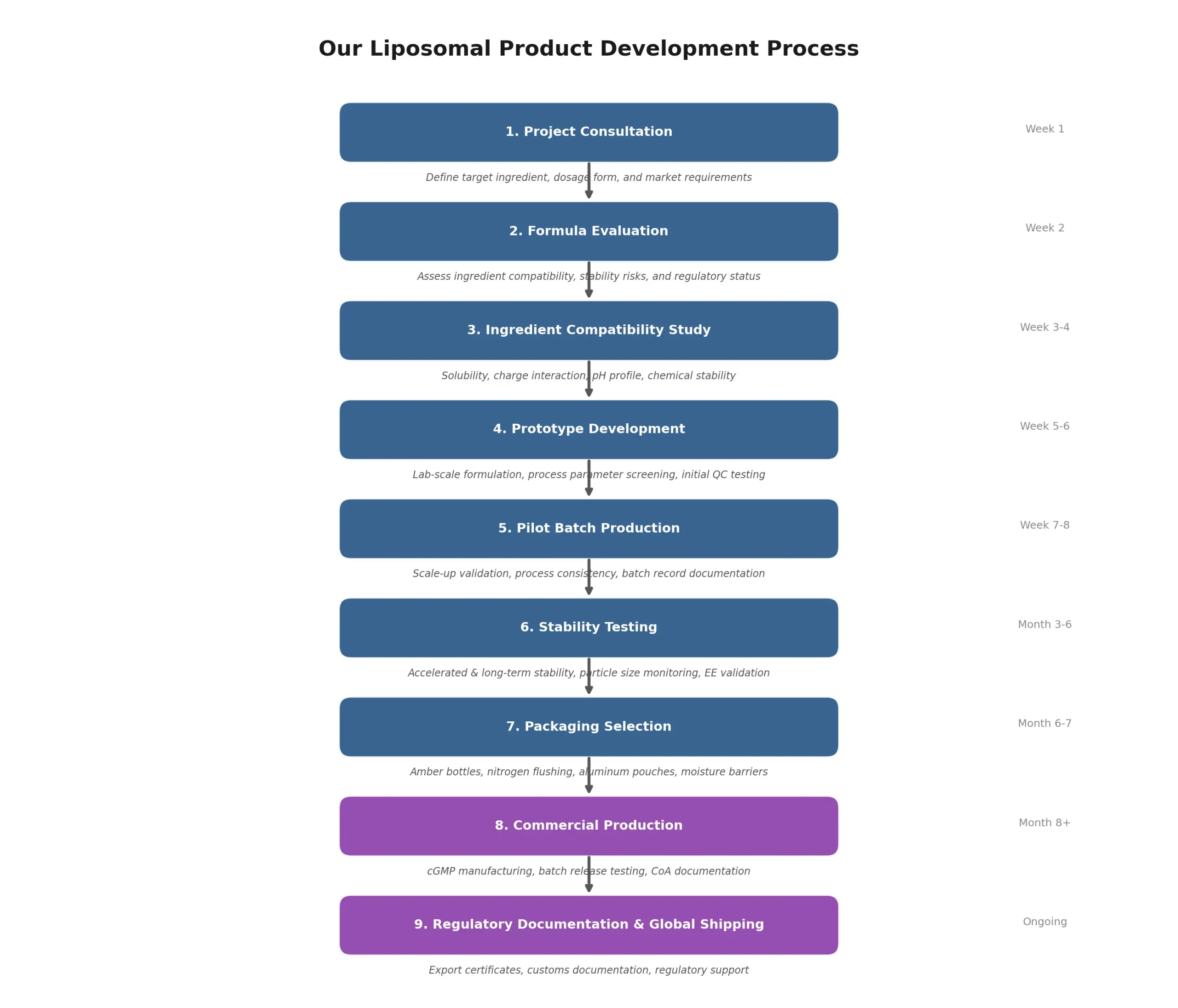
We manage the complete product lifecycle from concept to global shipment.
We begin by understanding your target market, customer positioning, dosage form, and regulatory objectives to develop a commercially viable formulation strategy.
Selection and qualification of phospholipids, active ingredients, functional excipients, and supporting materials with complete supplier documentation and traceability.
Evaluation of ingredient compatibility, solubility, stability, and carrier suitability prior to formulation development.
Optimization of:
- Phospholipid system
- Encapsulation process
- Particle size
- Physical stability
- Powder performance
Pilot-scale production for formulation verification, analytical testing, and preliminary stability studies.
Accelerated and real-time stability studies including liposome-specific quality attributes.
Validated process transfer from pilot to commercial production with batch consistency verification.
Selection of primary packaging, secondary packaging, moisture protection, and transportation solutions.
Preparation of technical documentation supporting global product registration and market compliance.
Commercial production, quality release, export documentation, customs support, and international logistics coordination.
| Stage | Timeline | Key Deliverables |
| 1. Inquiry | 1–3 days | Requirements document; initial feasibility assessment |
| 2. Formula & Quotation | 3–7 days | Custom formula proposal; pricing; regulatory pathway review |
| 3. Sample | 1–2 weeks | Physical sample with COA; organoleptic evaluation |
| 4. Pilot Batch | 2–3 weeks | 1–10 kg powder or 5,000–50,000 units; stability samples retained |
| 5. Scale-Up | 3–4 weeks | Process parameter lock; equivalence data; batch record validation |
| 6. Commercial Production | Per schedule | Full-scale manufacturing; in-process controls; finished product testing |
| 7. QC Release & Delivery | 1–2 weeks | Final COA; regulatory documentation; export logistics |
Commercial Production Overview
Formula Design → Pilot Batch → Scale-Up Validation → Commercial Production → QC Testing → Global Delivery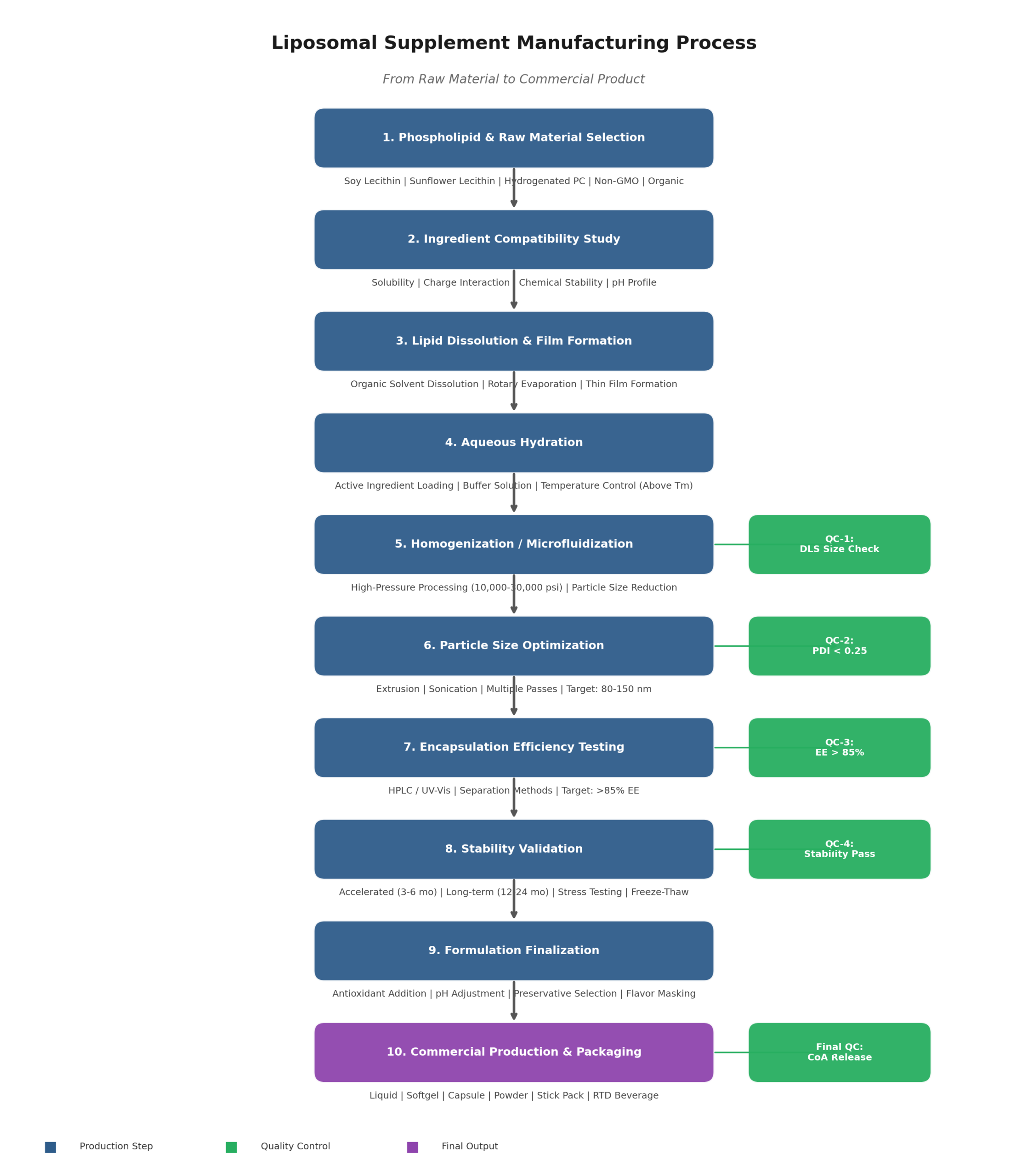
| Packaging Format | Barrier Properties | Best For | Shelf Life Support |
| Aluminum Laminate Pouches | Excellent moisture, oxygen, and light barrier | Stick packs; bulk powder; export shipments | 24–36 months |
| HDPE Bottles + Induction Seal | Good moisture barrier; moderate oxygen barrier | Standard retail; North American market | 18–24 months (with desiccant) |
| Blister Packs (Alu-Alu) | Excellent individual dose protection; zero moisture transmission | Pharmacy channel; clinical trials; premium positioning | 24–36 months |
| Amber Glass Bottles | Excellent light protection; good oxygen barrier (with proper seal) | Liquid formulations; premium positioning | 12–18 months (liquid) |
| Nitrogen-Flushed Containers | Displaced oxygen reduces oxidation risk | High-value formulations; extended shelf life targets | +6–12 months extension |
Packaging Components
- Desiccants:Silica gel canisters (1–3 g per bottle, depending on headspace volume) for powder products
- Oxygen Absorbers:Iron-based scavengers for oxygen-sensitive formulations
- Nitrogen Flushing:Applied during filling to reduce headspace oxygen to <3%
- Secondary Packaging:Cartons with UV varnish for light protection; tamper-evident seals
Storage Recommendations
| Product Form | Recommended Storage | Acceptable Range | Critical Warnings |
| Powder (spray-dried) | 15–25°C; <60% RH | 5–30°C; <75% RH | Protect from moisture and direct sunlight |
| Powder (freeze-dried) | 2–8°C preferred; 15–25°C acceptable | 2–30°C; <60% RH | Refrigeration extends shelf life; protect from moisture |
| Liquid suspension | 2–8°C | 2–25°C (short-term) | Shake well before use; do not freeze |
| Capsule / Softgel | 15–25°C; <60% RH | 5–30°C; <75% RH | Protect from heat and humidity |
Standard Batch Documentation
- Certificate of Analysis (COA)— Batch-specific test results for all specification parameters
- Product Specification— Complete quality specification with test methods and acceptance criteria
- Technical Data Sheet (TDS)— Product description, composition, physicochemical properties, handling guidelines
- Material Safety Data Sheet (MSDS)— Safety information, hazard classification, handling precautions, first aid
- Residual Solvent Report— GC-MS analysis confirming compliance with ICH Q3C limits
- Heavy Metal Report— ICP-MS data for Pb, Cd, As, Hg
- Microbiology Report— TAMC, TYMC, specified organism testing per USP <61>, <62>
- Stability Summary— Available stability data with storage conditions and retest period
Regulatory & Compliance Statements
- Allergen Statement— Free from major allergens; customizable per market requirements
- Non-GMO Statement— Available for non-GMO formulations
- BSE/TSE Statement— Free from bovine spongiform encephalopathy / transmissible spongiform encephalopathy risk materials
- Halal Certificate— Available upon request
- Kosher Certificate— Available upon request
- ISO 22000— Certified
- FSSC 22000— Certified
- cGMP Compliance— Per 21 CFR Part 111 (US) and applicable EU regulations
Liposomal apigenin incorporates apigenin into phospholipid vesicles to improve formulation performance and enable premium delivery formats.
Phospholipid Sources: Phosphatidylcholine (PC), sunflower lecithin (allergen-free, Non-GMO), soy lecithin, high-purity PC (≥95%), food-grade systems.
| Standard Apigenin | Liposomal Apigenin |
| Powder-only formats | Multiple dosage forms (capsule, softgel, liquid, RTD) |
| Commodity ingredient positioning | Proprietary delivery technology positioning |
| Limited formulation flexibility | Broad formulation compatibility |
| Lower perceived value | Premium market positioning |
| Basic packaging requirements | Advanced stability & packaging engineering |
Note: This comparison addresses manufacturing and market-positioning characteristics only. No bioavailability or efficacy claims are stated.
Ready to Develop Your Liposomal Apigenin Product?
Whether you are launching a new premium liposomal supplement or expanding your existing product portfolio, our formulation scientists and manufacturing team are ready to support every stage of development—from concept and pilot production to full-scale commercial manufacturing.
Let’s Build Your Next Liposomal Supplement Together
✔ Custom Formula Development
✔ OEM & Private Label Manufacturing
✔ Pilot Batch Production
✔ Regulatory Documentation
✔ Global Export Support
Request a Formula Consultation | Request Samples | Get an OEM Quotation