






Turnkey OEM, ODM & Private Label DHA Manufacturing
KS Nutripharma manufactures finished DHA supplements for OEM, ODM, and private label, including the oil-phase softgels on a brain health supplements line. The differentiation is which quoting risks are closed before a price is compared. Gross oil input does not equal active DHA yield. Required oil ≈ target DHA ÷ DHA concentration in the oil.
Risk closed before the quote | How it is closed |
|---|---|
| Oil weight priced as DHA | Costing runs from active DHA back to the oil fill |
| The same DHA percentage treated as the same oil | Source, assay basis, and molecular form are locked |
| The same DHA target moved into another dosage form | Softgel, liquid, and powder fills are recalculated |
| An incoming COA used as the finished unit | Release uses the finished-unit result |
DHA Supplement Manufacturing at a Glance
A quote starts from active DHA, the source, the molecular form, and the finished dosage form. Planning quantities below are confirmed after fill, shell, pack, and the testing plan are locked.
Item | Planning point |
|---|---|
| Sources | Fish body oil; high-DHA marine oil, including calamari when requested; algal oil |
| Molecular form | TG, rTG, or EE, named on the quote |
| Formats | Softgels, liquids, or powder |
| Release | The incoming oil COA and the finished-unit assay are separate results |
| Softgel and capsule MOQ | About 3,000–5,000 finished units, subject to fill, shell, and pack |
| Liquid or powder MOQ | Quoted with that dosage form |
| Sample | 7–15 days after the specification is agreed |
| Production | Often 30–45 days after formula, artwork, testing plan, and schedule are locked |
DHA Formula Options
Each card is the production path for one product requirement, so the quote is not a generic DHA oil. Milligram panels on the cards are commercial formulation benchmarks, not recommended intakes.
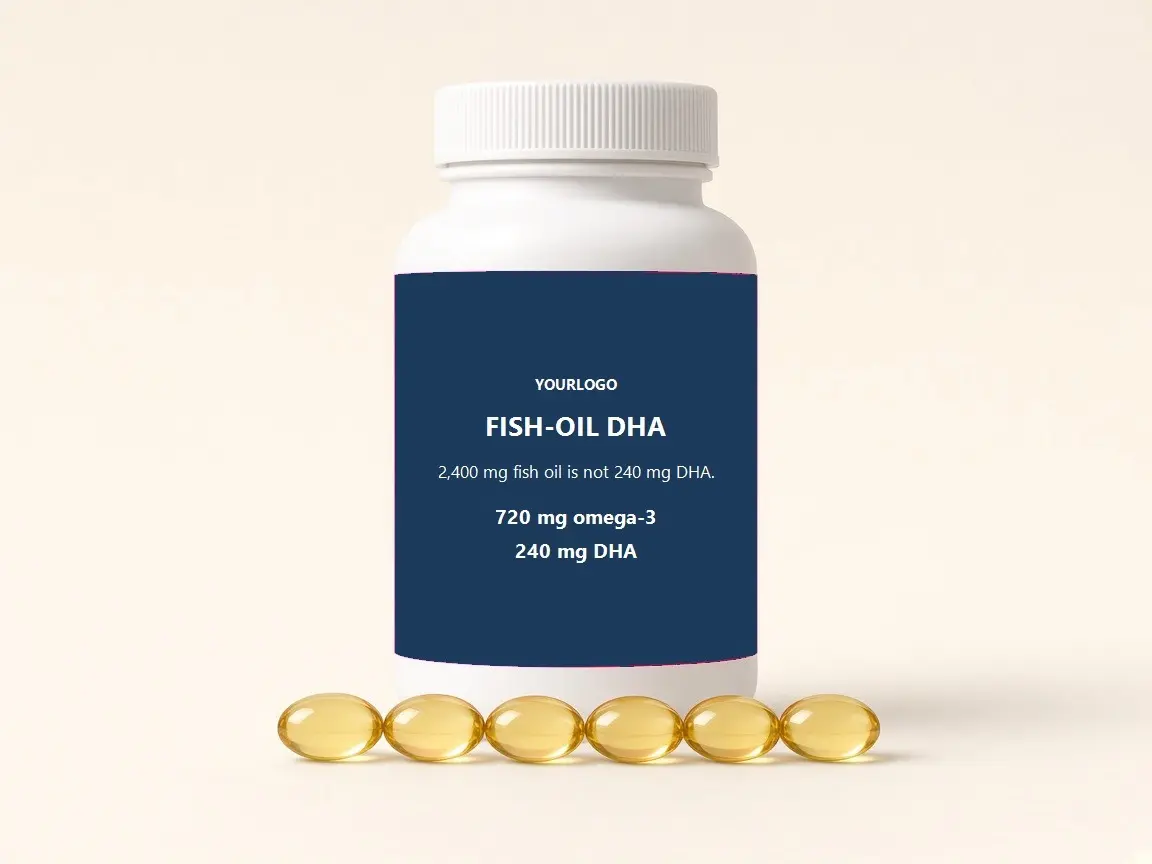
Fit: A conventional omega-3 product with both EPA and DHA on the panel.
Route: Fish body oil, a DHA target, and a softgel.
What changes the quote: DHA concentration, the EPA ratio, and fill weight. A standard two-softgel panel is typically labeled at 2,400 mg fish oil, 720 mg total omega-3, and 240 mg DHA.
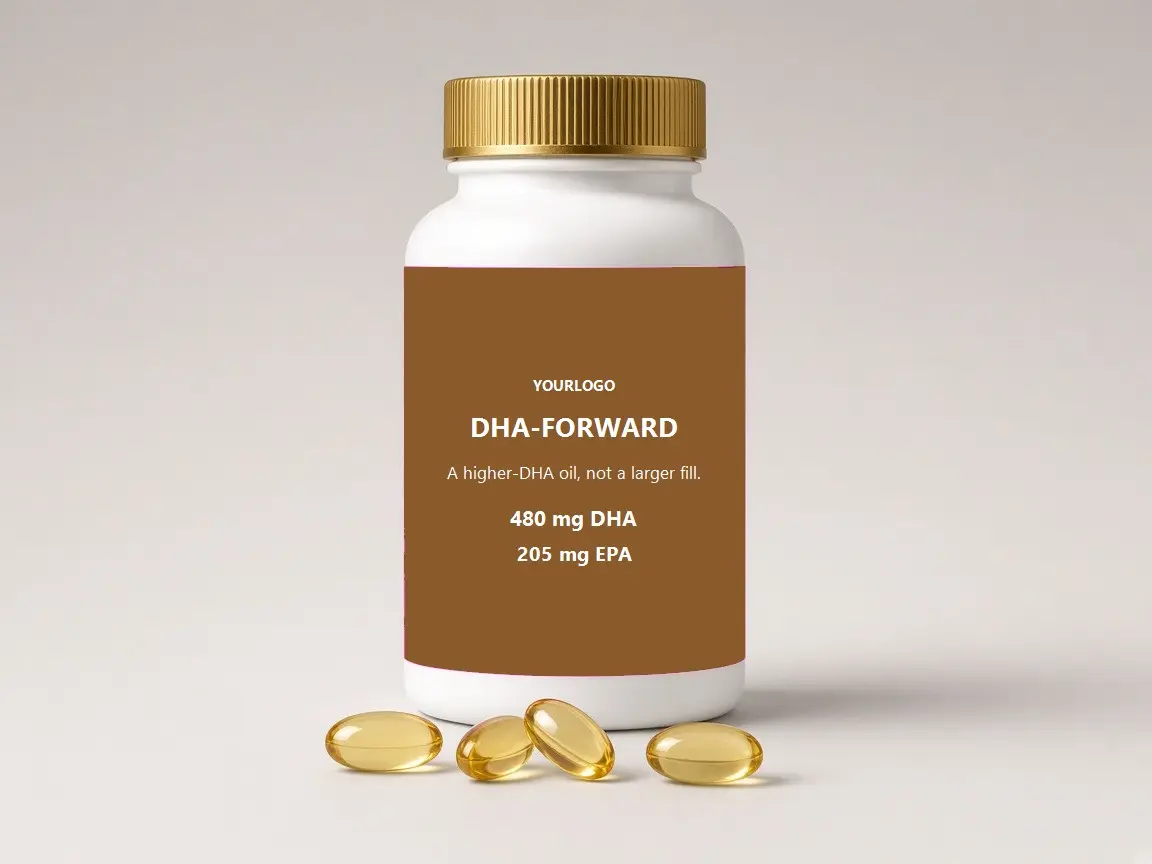
Fit: DHA is the primary active, with EPA still declared at a lower ratio.
Route: A higher-DHA fish oil or concentrate, rather than a larger fill of standard oil.
What changes the quote: Active DHA versus total oil. A two-softgel DHA-forward panel is typically labeled at 830 mg total omega-3, 480 mg DHA, and 205 mg EPA.
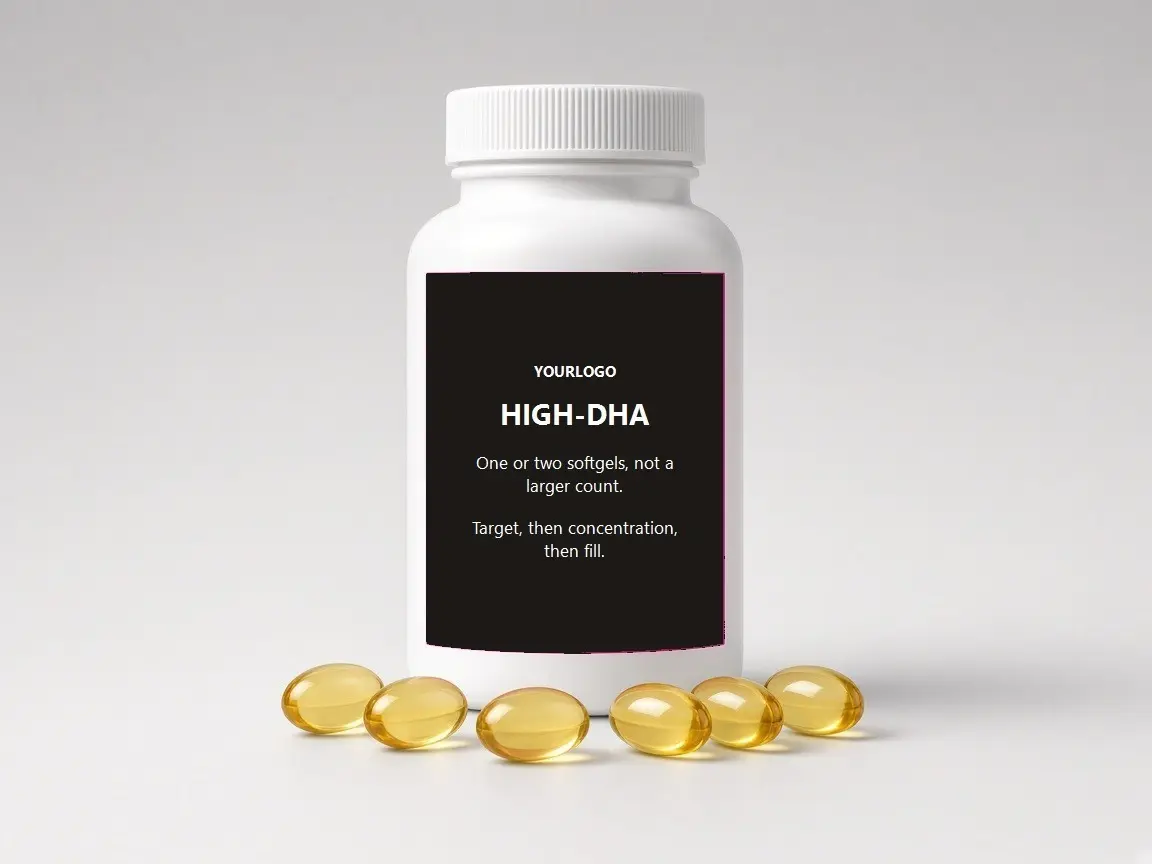
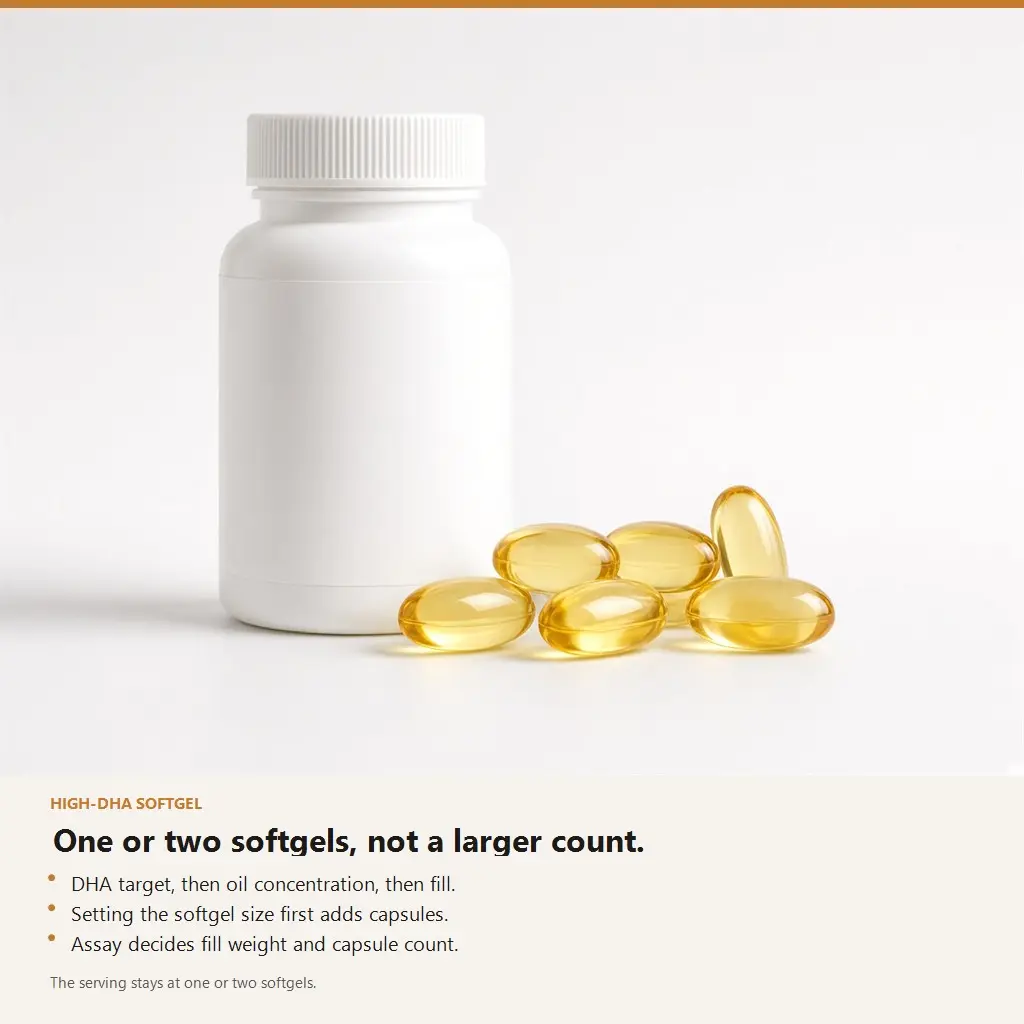
Fit: A high DHA serving that should stay at one or two softgels.
Route: DHA target, then oil concentration, then fill weight, then capsule count.
What changes the quote: Setting the softgel size before the assay forces extra capsules into the serving.
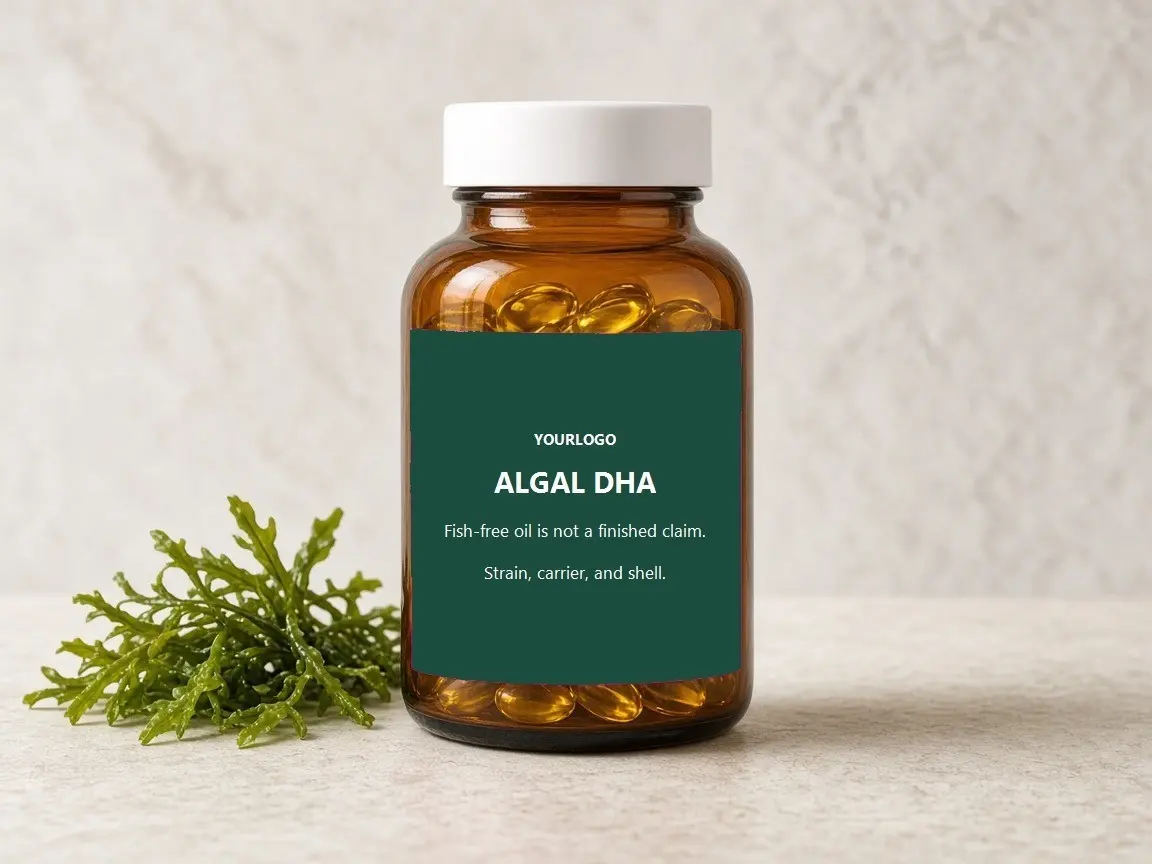
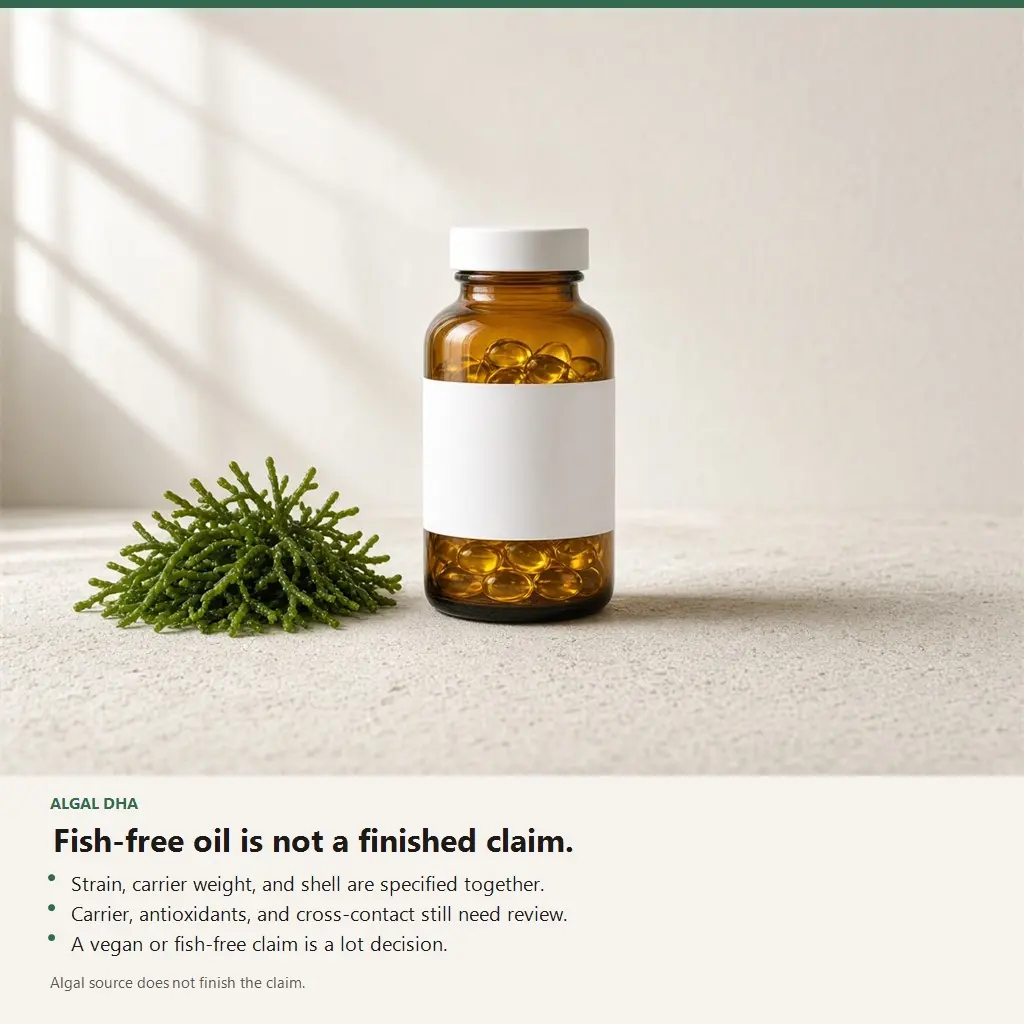
Fit: A fish-free product.
Route: Algal oil, a DHA concentration, a carrier oil, and a shell that fits the claim.
What changes the quote: Strain, whether EPA is declared, carrier weight, and allergen status across the full formula.
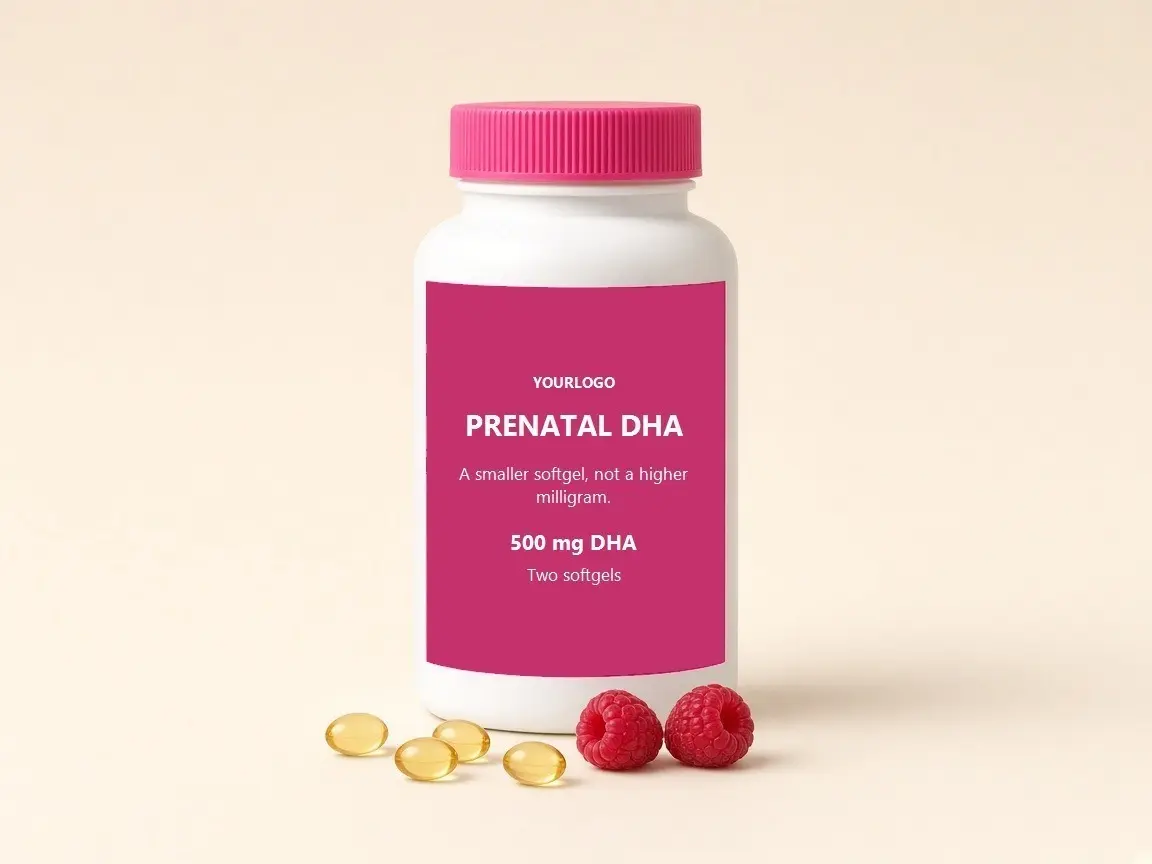
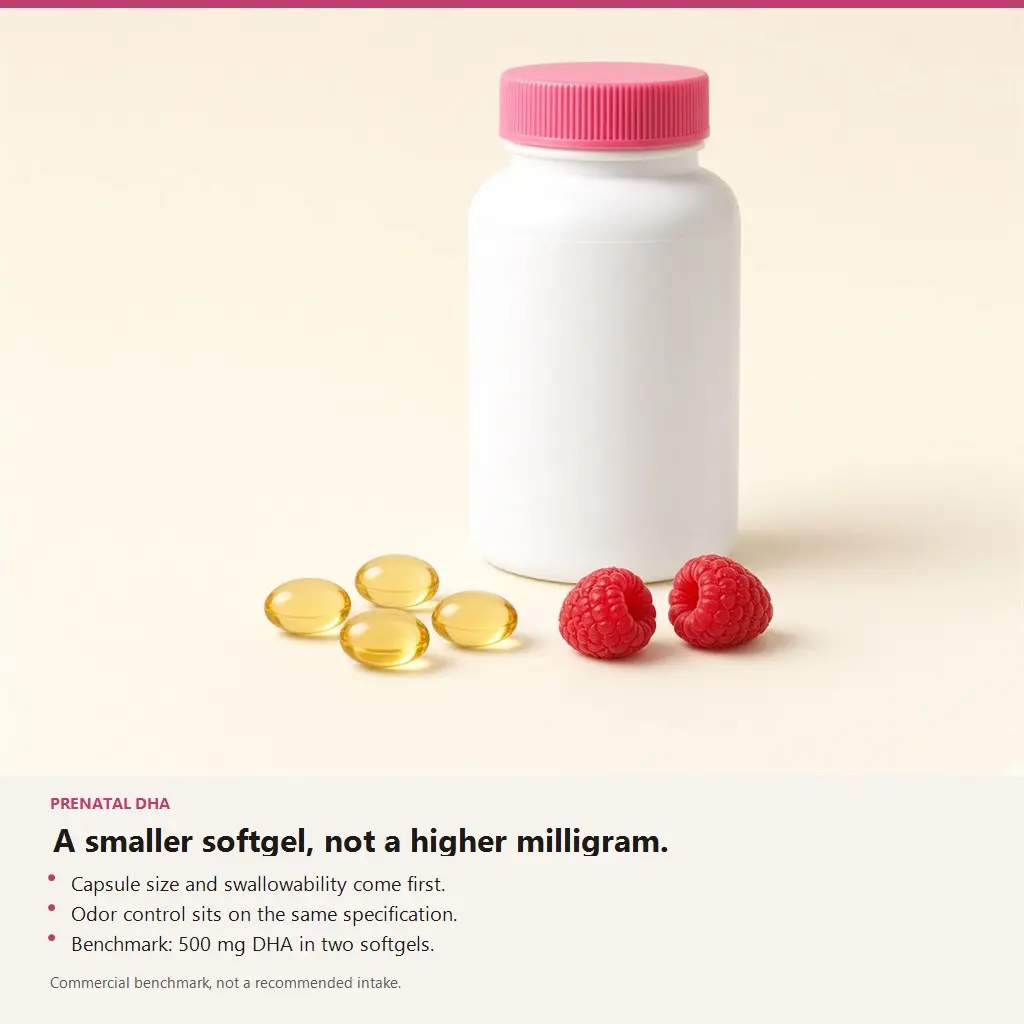
Fit: An adult prenatal softgel.
Route: DHA oil, alone or with EPA, in a smaller softgel. A choline row, when the formula includes one, stays on the choline supplement specification.
What changes the quote: Capsule size, swallowability, and odor outweigh maximum DHA per piece. One algal panel is typically labeled at 500 mg DHA and 500 mg total omega-3 in two softgels, carrier included.
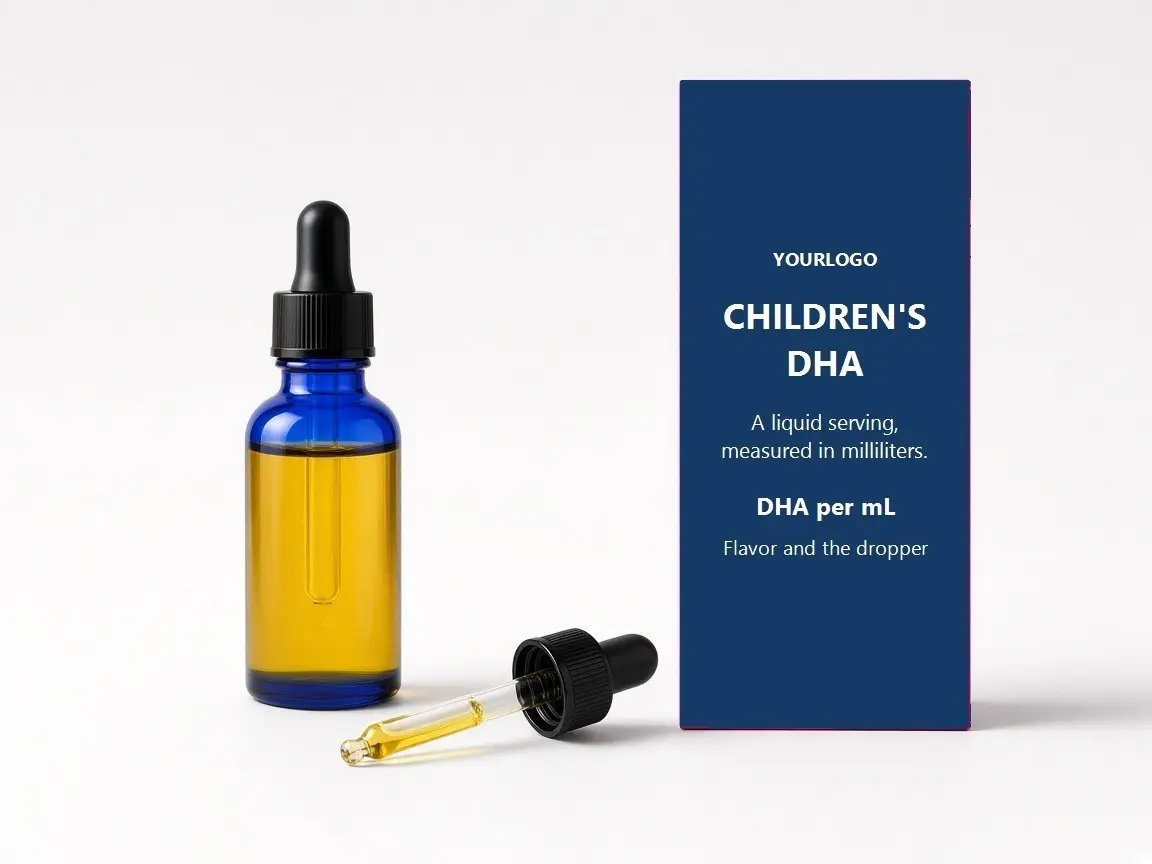
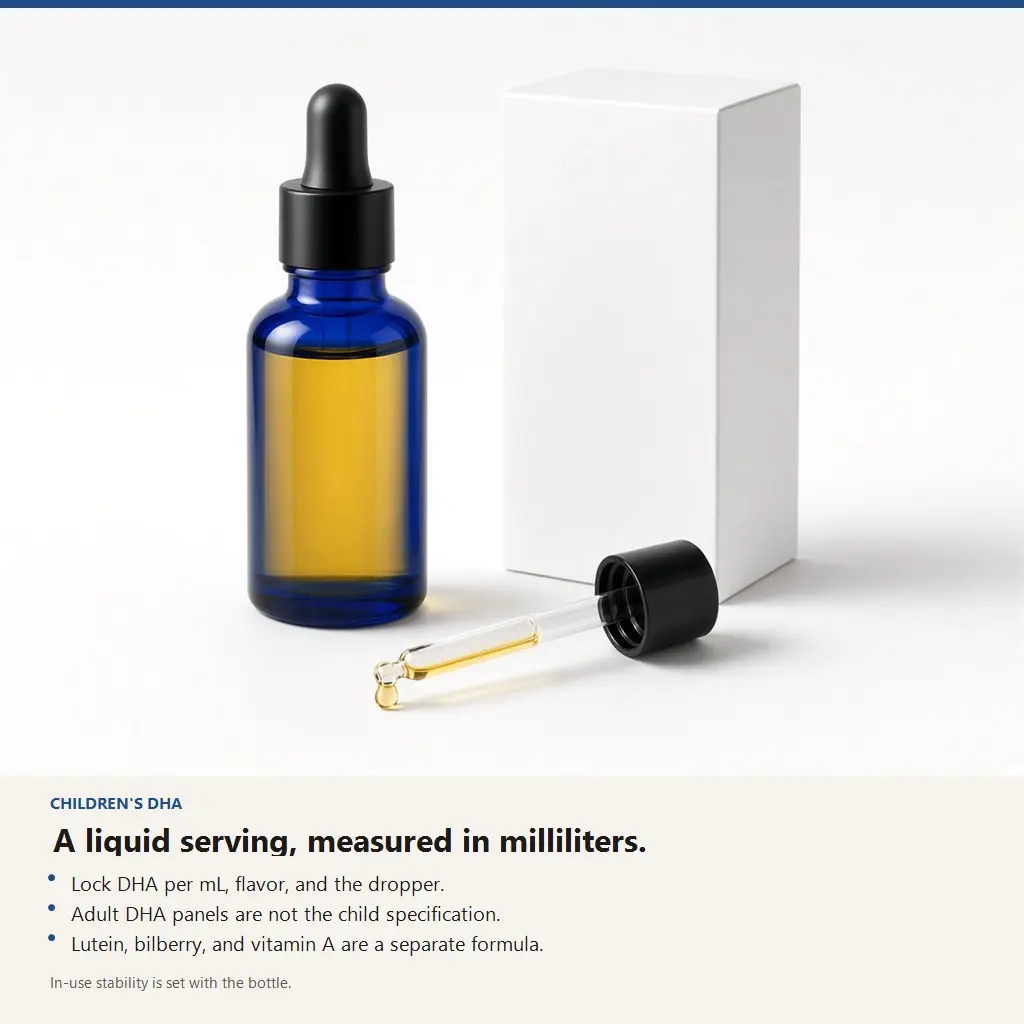
Fit: A child-age product, where the destination market permits that dosage form and claim.
Route: Age group, DHA per serving, flavor, and either a liquid or a small softgel.
What changes the quote: Dose, sensory profile, format, and serving size. Adult DHA panels are not the child specification. Vision-support actives (lutein, bilberry, vitamin A) are a separate eye health supplement formula.
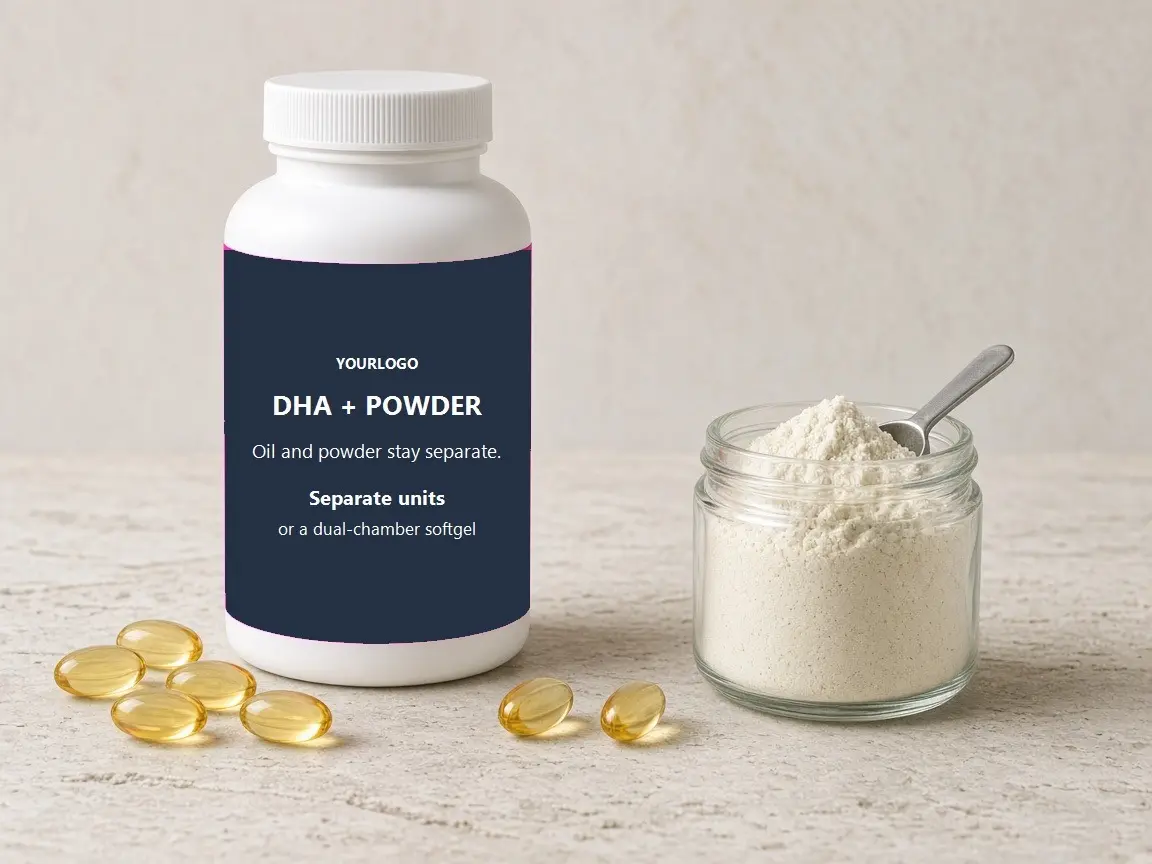
Fit: Phosphatidylserine or another dry powder shares the serving with DHA oil.
Route: The oil and the dry active are specified separately.
What changes the quote: The final configuration depends on whether they are packed as separate units or combined in a validated dual-chamber softgel.
Krill oil, cod liver oil, flax ALA, prescription omega-3, and infant-formula oil sit outside these routes.
Dosage-Form Feasibility: Softgels, Liquids or Powder
The risk is carrying a softgel DHA target into a liquid or a powder without recalculating the fill.
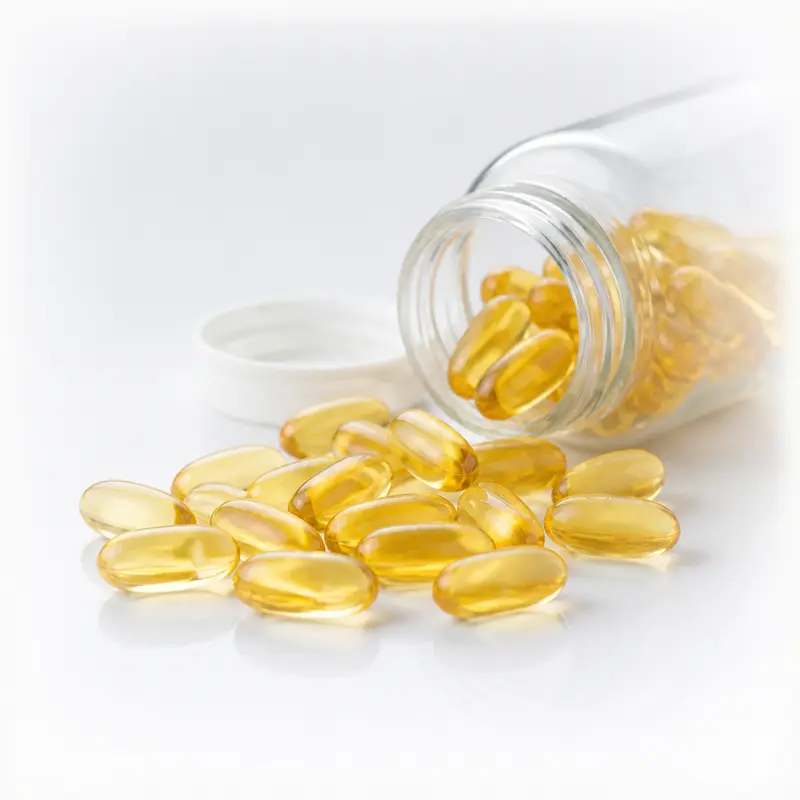
Best for: Fish oil, algal oil, and calamari oil.
Feasibility chain: DHA target → DHA concentration → required oil fill → softgel size and count.
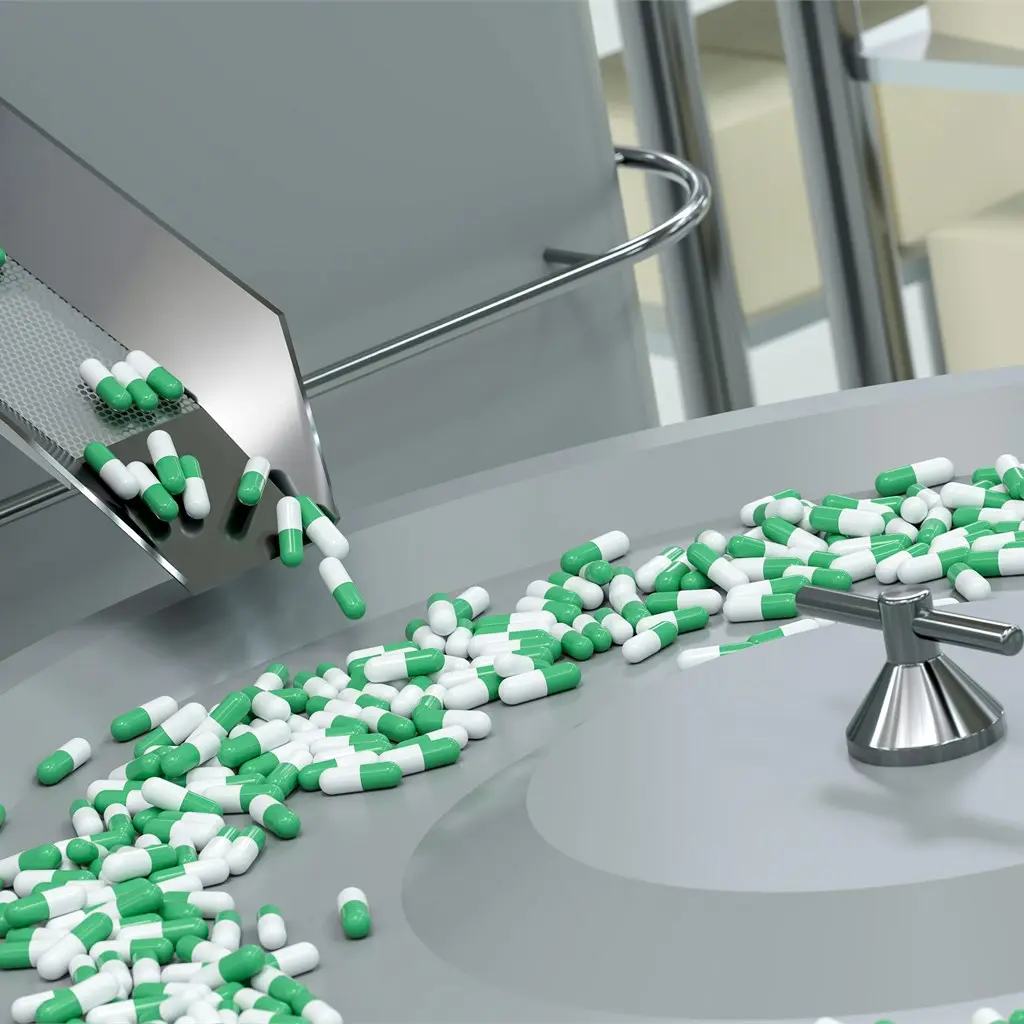
What to lock: Fish gelatin, or a plant shell of modified starch and carrageenan; fill weight; seal integrity. Oxygen exposure depends on the shell, packaging, headspace, antioxidants, and storage. Enteric or delayed-release requirements affect the capsule specification and the release profile. They are not assumed for every DHA softgel.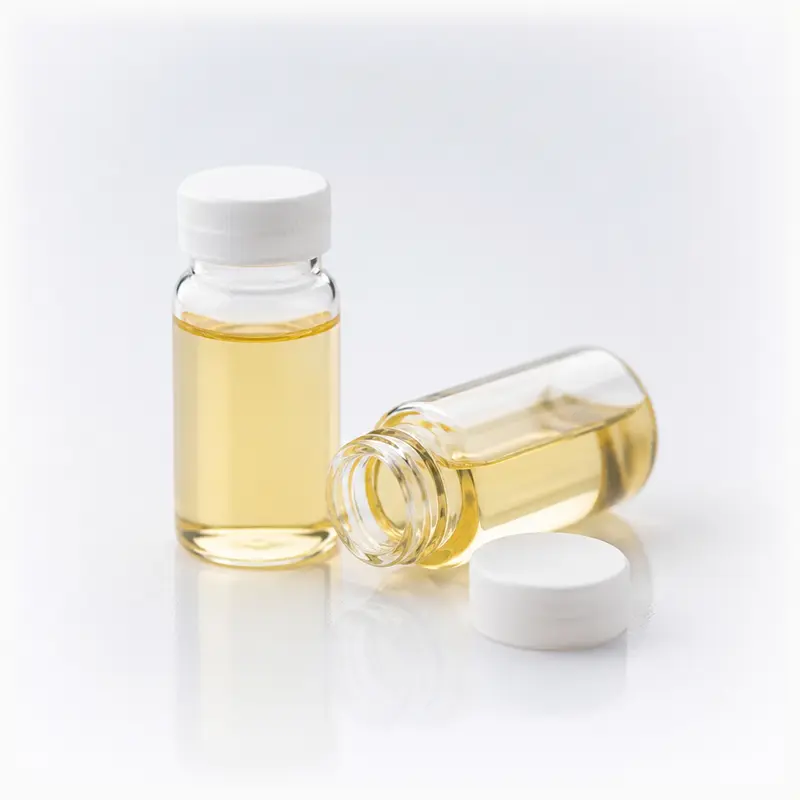
Best for: Pediatric and prenatal servings, and adult servings limited by swallowability.
Feasibility chain: DHA per milliliter → serving volume → flavor → emulsification → headspace → packaging → in-use stability.
What to lock: DHA per milliliter, serving volume, flavor, headspace, dispensing, and light-protective packaging such as amber glass or an opaque UV-blocking container.
Manufacturing note: A softgel specification is recalculated before it is filled as a liquid.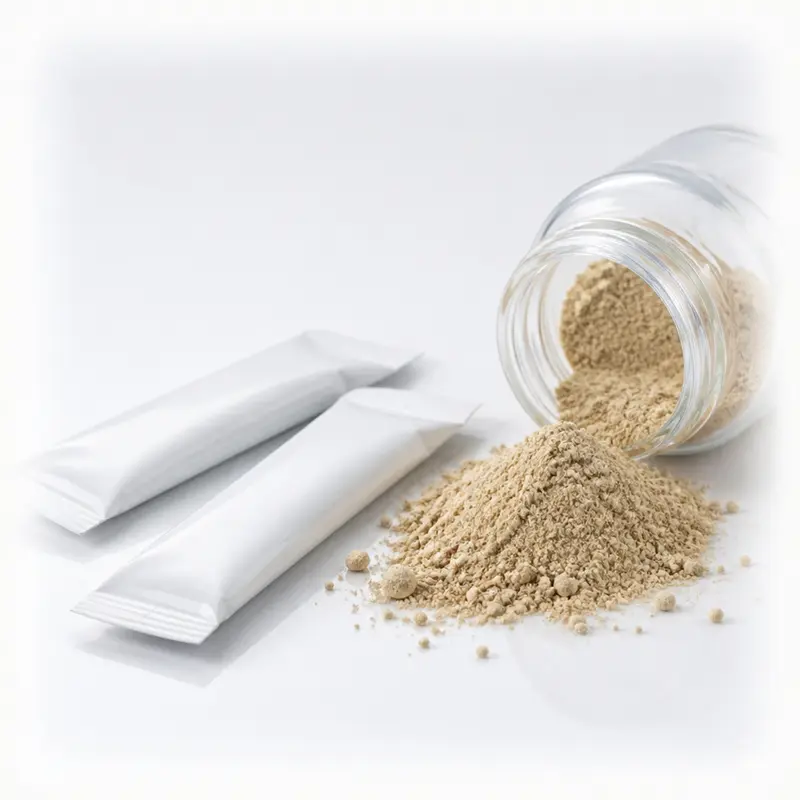
Best for: Sticks, drinks, and food fortification.
Feasibility chain: Microencapsulation → DHA concentration on the powder → wall material → surface oil → moisture → thermal exposure.
What to lock: Powder DHA percent, wall material, surface oil, moisture, and peroxide value after thermal exposure during downstream processing.
Manufacturing note: Microencapsulated powder and softgel oil are separate quotations. A gummy is reviewed only after dispersion, oxidation, flavor, texture, load, and shelf life are demonstrated.
The risk is treating two DHA percentages as the same raw material. For second-source projects, KS matches the replacement oil against the approved source, assay basis, molecular form, and finished-unit specification before substitution.
Fish oil
Fish body oil fits a conventional DHA-plus-EPA product and a set EPA:DHA ratio. The specification names species, tissue, origin, and whether the fish was wild or farmed. Anchovy, sardine, and pollock are the usual body oils. Tuna is used when the customer requests it. Liver oil is a separate specification from body oil. Cod liver oil also carries vitamins A and D.
“18/12” describes oil concentration, not the finished-unit DHA claim. It means approximately 18% EPA and 12% DHA by weight: about 180 mg EPA and 120 mg DHA per 1,000 mg of oil. It is a common description, not a universal grade. The finished-unit claim depends on the oil fill and the finished-product assay, not the trade shorthand alone.
High-DHA marine oil
This route fits a project that needs more DHA, less oil fill, and fewer or smaller softgels. The oil may be a fish concentrate or calamari (squid) oil specified upon customer request. Calamari is an alternative marine source, with DHA often the primary active and EPA still declared. A higher assay reduces fill weight and capsule size. For a quote comparison, compare DHA on the same assay basis and against the actual oil fill. The same percentage does not establish an equivalent raw-material cost when the source or the molecular form differs. Concentrate assays commonly start around 30% EPA/DHA and run higher.
Algal DHA
Algal oil fits a fish-free requirement. Schizochytrium sp. is a common commercial source and the default organism on our standard sourcing route. Crypthecodinium cohnii, and any other DHA-producing organism, is quoted when the customer requests it. Examples of commercial assay levels include 35%, 40%, 50%, and 60% DHA. High-oleic sunflower oil is a typical carrier: it changes potency and viscosity and counts in the fill. EPA is declared only when that strain produces it.
An algal source does not automatically support a vegan or fish-free claim on the finished unit. The carrier, antioxidants, flavors, shell, processing aids, cross-contact controls, and lot documents are part of that review.
Molecular Form
TG, rTG, and EE change the raw-material specification and the cost. The form is locked before supplier quotes are compared. Human studies have reported differences in EPA/DHA absorption among these forms, but the magnitude depends on formulation and study conditions. Krill oil is quoted separately on its phospholipid specification. A 500 mg softgel may declare about 30 mg DHA beside about 167 mg phospholipids, plus astaxanthin in micrograms.
Crude, refined, and winterized oils are not interchangeable. Each step changes what can be filled.
| State | Effect on the finished unit |
|---|---|
| Crude | Not a supplement fill. Degumming, neutralization, bleaching, and deodorization are required before encapsulation. Otherwise gums, free fatty acids, color, and odor carry into the softgel or the bottle. |
| Refined | The usual supplement fill: lower odor, color, and acidity. Deodorization does not set the peroxide value after filling, warehousing, and freight. |
| Winterized | Higher-melting fractions are removed so the oil stays clear and fluid in cold storage and cold filling. DHA potency does not rise with this step. |
A concentration step changes potency, fill weight, and cost. Molecular distillation is one route, not the only one. A typical ethyl-ester route uses esterification so the fatty acids can be separated, then molecular or short-path distillation and fractionation to raise EPA and DHA. Optional re-esterification converts that ethyl ester back to rTG. The finished oil is then EE or rTG, so the molecular form has to be named on the quote.
Claim | Required substantiation |
|---|---|
| Vegan | Algal DHA, a plant-based shell, and confirmation that the carrier, antioxidants, flavors, and other materials fit the claim. |
| Fish-free | Algal DHA, plus an allergen review of the full formula, the shell, and relevant cross-contact controls. |
| Sustainable source | A recognized certification, fishery documentation, or other substantiation that fits the claim and the market. A fermentation record alone does not establish the claim. |
Other claims, including non-GMO and traceability, require supporting lot documentation.
The risk is releasing a lot on the incoming oil COA. Oil-phase DHA for a brain health supplements line is released on the finished unit. Dry phosphatidylserine and ginkgo keep their own specifications.
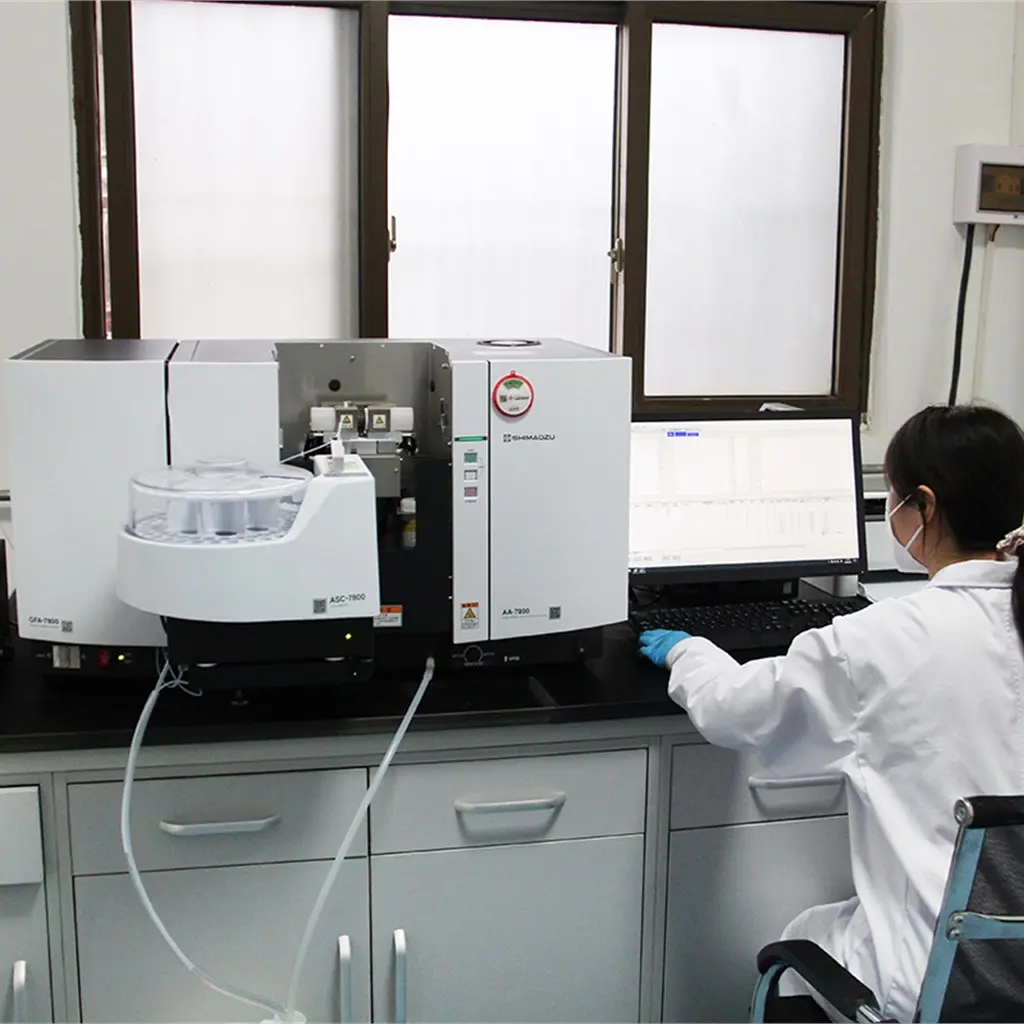
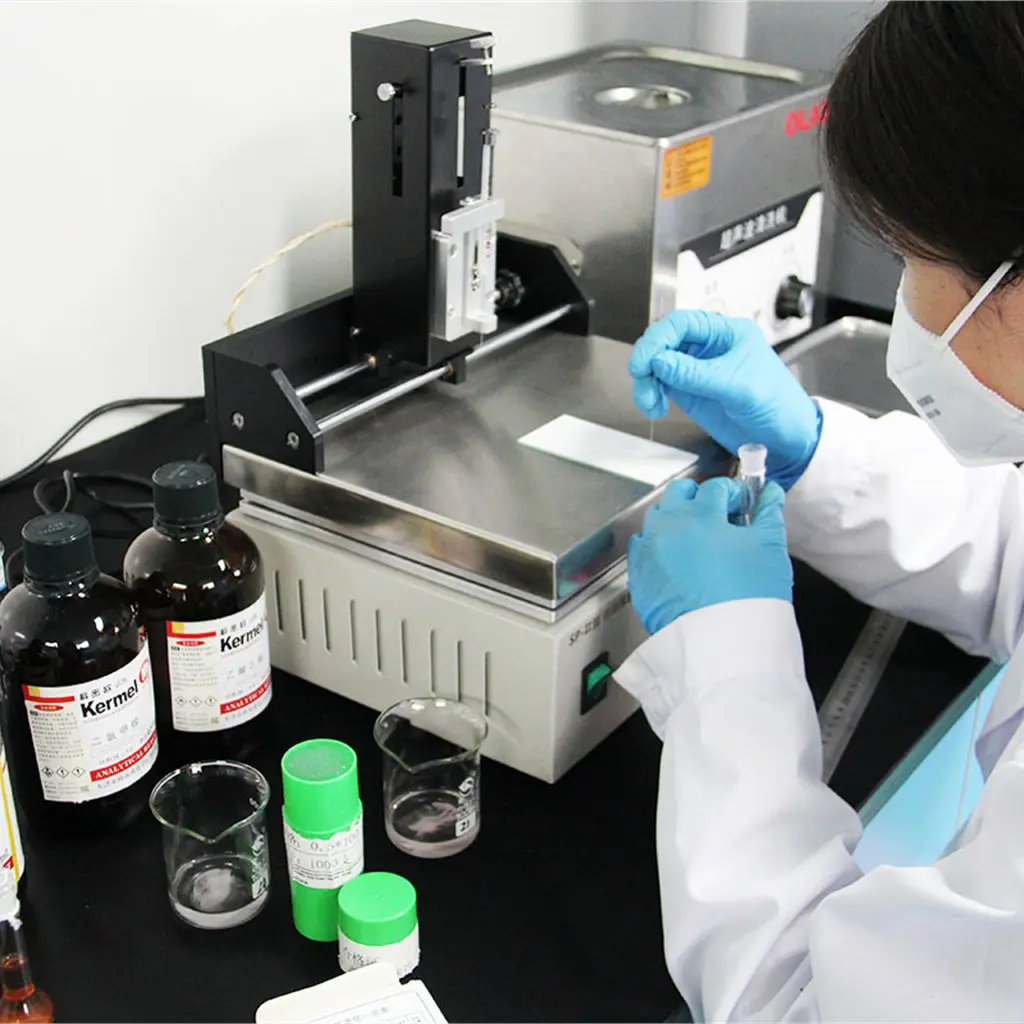
Raw-material qualification. Source, identity, DHA and EPA assay with the method, molecular form, oxidation, and contaminants. Fish oils add heavy metals, dioxins, and PCBs.
Manufacturing control. An approved oil moves into the dosage form already checked for feasibility. Oxidation and packaging follow that approved specification.
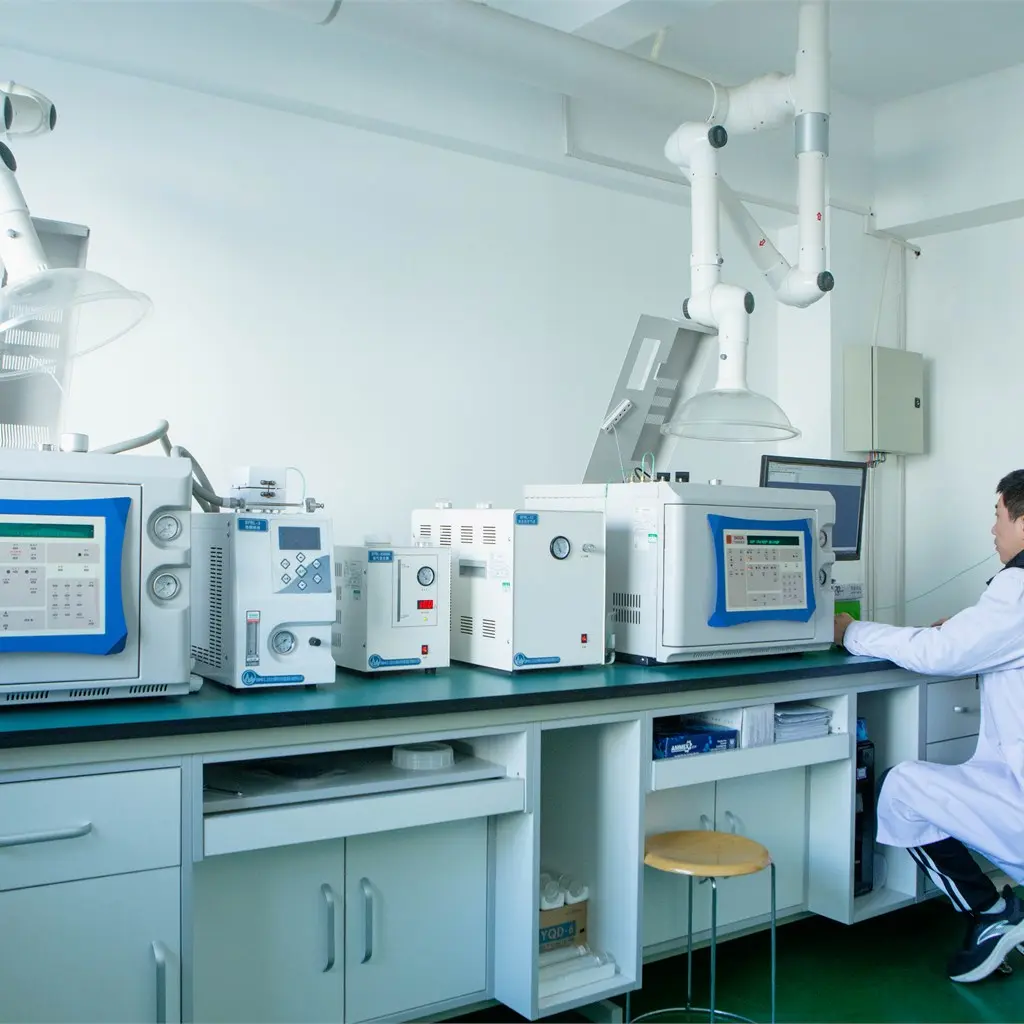
Finished-product release. An incoming COA qualifies the raw material. Finished-unit testing determines whether the manufactured product meets its approved specification: declared DHA, and EPA when the label declares it, plus fill weight, seal integrity, disintegration, oxidation where specified, and microbiology. See how to read a COA.
Oxidation benchmark. The GOED voluntary monograph specifies a peroxide value at or below 5 meq/kg, a p-anisidine value at or below 20, and TOTOX at or below 26 for in-scope omega-3 oils. These are voluntary industry specifications, not universal statutory limits, and they are not a standing factory guarantee. The p-anisidine method does not apply to flavored oils. Phospholipid oils need the method confirmed before TOTOX is used.
Manufacturing operates under cGMP requirements. Applicable site certifications include ISO 9001, ISO 22000, HACCP, FSSC 22000, Halal, and Kosher. IFOS, MSC, and Friend of the Sea appear only when that lot carries them. Prescription omega-3 drugs, infant-formula registration, feed-grade algal biomass, and disease-treatment products are outside this scope.
Compare | Must match |
|---|---|
| DHA content | mg DHA per serving, or a stated unit |
| DHA assay basis | The same basis and test method |
| Source | Fish, algal, or calamari |
| Molecular form | TG, rTG, or EE |
| Oil concentration | The same figure, or an explicit difference |
| Fill weight | Per capsule, or per serving for a liquid or powder |
| Finished-unit assay | Included, or explicitly absent |
| Oxidation specification | The same test basis, including whether the oil is flavored |
| Packaging | A comparable light and oxygen barrier |
| Quantity | Finished-product quantity, not a bulk-oil quantity |
A lower unit price is not an equivalent quote when DHA concentration, assay basis, molecular form, fill weight, or the finished-product specification differs. A named reference oil is checked on this table. It is not replaced by another DHA oil on the name alone.
The stage follows the brief. An open direction and a named oil are both workable starts. Each stage adds the lines the next quotation needs.
Stage | Starting point | What the project covers |
|---|---|---|
| Idea | A DHA product, no specification yet | Source direction, a DHA target, and softgel, liquid, or powder |
| Concept | A named DHA target and a serving count | Assay, fill weight, capsule or serving size, shell, and the cost drivers |
| Specification | An existing formula | Species or strain, DHA percent, molecular form, refining state, oxidation, contaminants, and the COA |
| Sample | An approved direction | Appearance, odor, flavor, fill weight, disintegration, and a preliminary stability check |
| Production | A locked specification | BOM, packaging, artwork, the batch, finished-unit tests, and the COA |
| Second source | A product already on sale | Match to the approved source, assay basis, molecular form, and finished-unit specification before substitution |
Is the shelf life of a bottled DHA oil the same after opening?
No. Sealed shelf life and in-use stability are different specifications. Once opened, oxygen exposure, temperature, headspace, and opening frequency can change the oil’s stability, so the in-use period has to be supported by the product and packaging specification.
Do triglyceride and ethyl ester percentages describe the same DHA?
No. DHA content and molecular form are separate specification fields. A COA has to identify the DHA assay basis and the oil’s molecular form before two suppliers can be compared.
What does a stability study add after the release peroxide value?
It shows whether peroxide value keeps rising under the labeled storage condition and the chosen pack, after the release sample has already passed.
How is a pediatric liquid dose defined?
The liquid is specified as DHA per milliliter, with the serving volume and the measuring device. The age group and the destination market are part of that specification.
What changes when algal oil replaces fish oil?
EPA may drop out, because many Schizochytrium oils are DHA-led, and strain replaces species. The carrier and the other excipients stay inside the claim review.
Start Your DHA Supplements Project
Send the target DHA per serving, the preferred source, the dosage form, the capsule or serving size, any EPA requirement, the destination market, and a current formula or BOM if you have one. If the specification is still open, a product direction is enough to start: everyday DHA, high DHA, prenatal, fish-free, a child-age serving, or a second source.
Send Formula Brief
Compare Two DHA COAs
Request Dosage-Form Feasibility
Related
Disclaimer: Manufacturing information for dietary-supplement brands. These products are not intended to diagnose, treat, cure, or prevent any disease. Milligram figures are standard commercial benchmark panels, not recommended intakes. Brand owners remain responsible for claims and label compliance in the destination market.
Written by KS Nutripharma Formulation Team | Reviewed by KS Nutripharma Director of R&D (PhD, Food Science | 19+ years nutraceutical development) | Technical review scope: source, active DHA per serving, molecular form, oxidation limits, and finished-unit release | Updated September 2026