
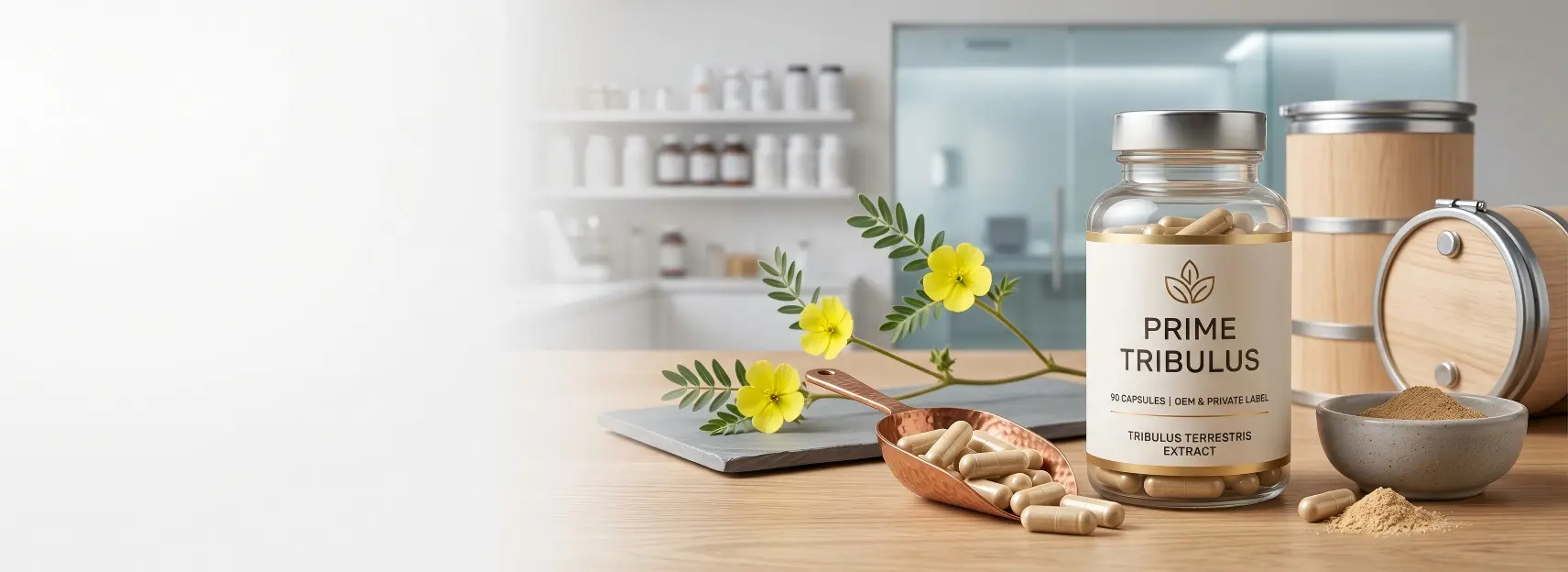
Develop Tribulus Supplements for Men's Wellness & Active Lifestyle Markets
Tribulus terrestris extract is widely used by supplement brands focused on men’s wellness, active lifestyle nutrition, botanical wellness, and daily vitality product categories. As brands look for standardized botanical ingredients with clear documentation and flexible finished formats, Tribulus remains a practical core or companion ingredient in commercial portfolios worldwide.
KS Nutripharma® provides OEM, ODM, and private label manufacturing solutions for Tribulus supplements, supporting brands from formulation development and ingredient selection through manufacturing, packaging, and global market supply.
5-Second Supplier Answers | Details |
|---|---|
| Who we are | KS Nutripharma® – nutraceutical contract manufacturer (founded 2007) |
| What we make | Finished Tribulus supplements under your brand + bulk extract pathways |
| Engagement models | Private label · Custom formulation (ODM) · Contract manufacturing (OEM) · Bulk supply |
| Facility | 81,000+ m² cGMP · 5 bases · 12 specialized lines · FDA-registered posture |
| Scale | 19+ years · 500+ brand projects · 60+ export markets |
| Line capacity | Capsules 5M+/day · tablets 12M+/day · gummies 2.5M+/day · powders 5,000+ tons/year |
| Typical capsule MOQ | From ~5,000 units/bottles (pilot options confirmed with quote) |
| Typical gummy MOQ | From ~5,000-10,000 units/bottles |
| Typical powder/stick MOQ | Powder blends from ~500 kg · sticks often from ~10,000 units |
| Typical bulk MOQ | From 25 kg; 1-5 kg pilots for qualified projects |
| Typical lead time | 4-8 weeks after formula & artwork lock (by format) |
| U.S. logistics | Los Angeles warehouse · New Jersey warehouse · LA office |
| Docs | Spec sheet · COA · identity · metals · micro · SDS · export packs |
Request Manufacturing Quote · Request Sample + COA · Get MOQ & Lead Time · Talk to Formulation Experts
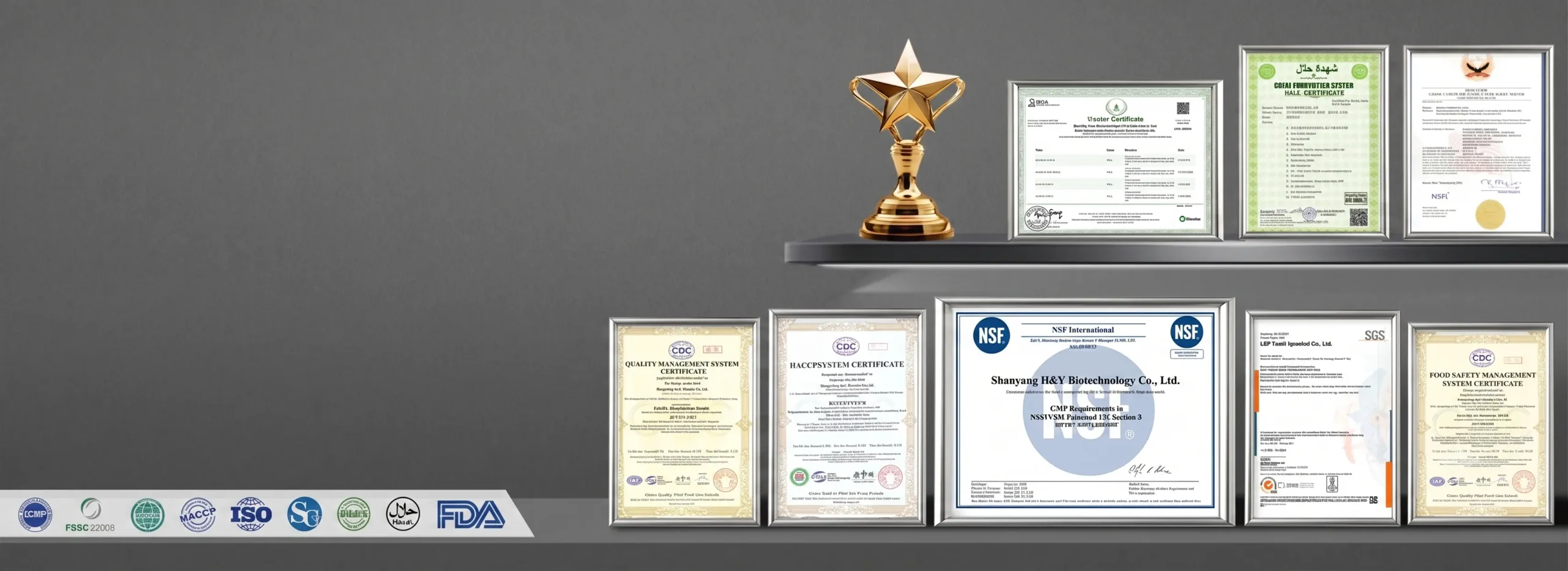
Trust Bar
cGMP · ISO 9001 · ISO 22000 · HACCP · FSSC 22000 · Third-party Tested (project-scoped) · Flexible MOQ · Documented Lead Times · Halal · Kosher · Non-GMO pathways
→ About Us · Manufacturing Capacity · Certifications · Quality Control
Tribulus Supplement Manufacturing Services at KS Nutripharma
Match the engagement model to how much formula ownership your brand already has.
Popular Tribulus Formula Concepts
Market-reference stacks for private label selection and custom formulation adaptation – not fixed recipes and not trademarked product names. Dose, grade, format, companions, and packaging can be adjusted after your brief.
Quick picker
Amazon / DTC capsule hero?     -> #1 / #2 / #3
Men's wellness daily stack?    -> #2 / #3 / #4
Sports / active lifestyle?     -> #5 / #6
Healthy aging premium?         -> #7 / #8
Taste-friendly launch?         -> #9 gummies · #10 sticks
Export / Halal convenience?    -> #11
Clean-label / practitioner? -> #12Positioning: Premium adult / healthy aging men’s wellness
Typical stack: Tribulus 300-500 mg · CoQ10 100 mg · Maca 200-300 mg · Magnesium 100-200 mg
Best formats: Capsules · softgel twin for CoQ10
Positioning: Premium botanical line with HPLC documentation depth
Typical stack: Tribulus with HPLC protodioscin lock (contract %) · optional single mineral cofactor
Best formats: Capsules
Positioning: High-compliance lifestyle gummy SKU
Typical stack (2 gummies): Tribulus dose engineered to sensory limits · optional Zinc / Vitamin D3
Best formats: Pectin or gelatin gummies
Positioning: Travel / subscription convenience
Typical stack: Tribulus project dose · optional Maca or electrolytes · RTM carrier / flavor
Best formats: 2-10 g foil sticks
Positioning: SEA & MENA convenience men’s wellness
Typical stack: Tribulus standardized extract · Halal-suitable carrier system · optional Maca / ginseng
Best formats: Powder sachets · premix sticks
Positioning: Clean-label / practitioner-channel minimalist formula
Typical stack: Disclosed Tribulus grade and method · minimal excipients · optional single mineral
Best formats: Capsules
Available Supplement Formats
We support multiple dosage forms to meet different market positioning and consumer preferences.
Available options:
- Bulk powders
- Stick packs
- Daily wellness sachets
- Halal-oriented premix pathways (project-scoped)
Advantages
- Room for sports companions that exceed capsule volume (creatine, citrulline, electrolytes)
- Strong fit for training-day rituals, travel packs, and convenience export channels
- Flexible serving math for tubs, sticks, and sachets
Trade-offs
- Mixability, flavor, and moisture barrier must be engineered early
- Daily single-ingredient compliance can be lower than capsules
- Stick / sachet barrier failure increases caking risk with hygroscopic Tribulus grades
Capacity / MOQ / lead time: 5,000+ tons powder/year · from ~500 kg powder or ~10,000 stick units · typically 4-7 weeks
Available options:
- Softgel twins for oil-soluble companions (e.g., CoQ10, Vitamin D3)
- Dual-SKU programs: Tribulus capsule hero + softgel companion
- Softgel-in-capsule pathways when one-unit convenience is required
Advantages
- Best home for oil-soluble companions that do not belong in a dry Tribulus powder fill
- Supports premium dual-SKU architecture beside a Tribulus solid-dose hero
- Clean consumer experience for lipid actives
Trade-offs
- Not the primary format for dry Tribulus extract / mineral powder matrices
- Higher MOQ and longer lead time than standard capsule launches
- Requires oil-system compatibility work separate from the botanical powder BOM
Capacity / MOQ / lead time: 2M+ softgels/day · from ~10,000 bottles · typically 5-7 weeks
Tribulus extracts are often hygroscopic, bitter, and hard to keep uniform from sample to commercial fill. The technologies below map common commercial failure points to KS process controls – not a second format-selection menu.
| Market/production bottleneck | What goes wrong without control | KS technology response |
|---|---|---|
| Capsule fill-weight drift | Hygroscopic powder sticks, clumps, or under/over-fills on high-speed lines | Humidity-controlled blending / encapsulation · real-time fill-weight monitoring · flow-aid and mesh adjustment |
| Tablet capping / weak hardness | High botanical load fails compression or films poorly | Direct compression or wet granulation pathways · binder / disintegrant tuning · hardness / friability / disintegration checks |
| Gummy assay loss + bad taste | Heat and water activity cut marker retention; bitterness kills reviews | Active-per-piece engineering · Aw / heat-overage control · pectin or gelatin masking systems · pilot assay retention checks |
| Powder / stick caking | Open moisture pickup ruins RTM mixability and stick appearance | Instantizing / dispersibility pathways · high-shear blend uniformity · high-barrier foil stick / sachet fill |
| Oil + powder cannot share one SKU | Brands are forced into two SKUs (capsule + softgel) or unstable dry mixes | Softgel-in-capsule · dual-SKU softgel companion programs for CoQ10 / D3 style oil systems |
| Incompatible actives in one blend | Minerals / botanicals interact, segregate, or fight moisture | Capsule-in-capsule · tablet-in-capsule · beadlets-in-capsule · biphasic / dual-chamber fills |
| Shelf lookalike problem | Commodity Tribulus capsules look interchangeable on Amazon / retail | Dual-color / dual-tone shells · advanced capsule architectures for premium private label differentiation |
Request Technology Feasibility Review · Request Advanced Capsule Feasibility
Three decisions are enough to start a workable manufacturing brief.
Question 1: What product category are you developing?
Men’s wellness · Sports nutrition · Botanical supplement · Premium documentation-led SKU
Question 2: What dosage form are you manufacturing?
Capsules · Tablets · Powders / sticks · Gummies
Question 3: What analytical specification do you require?
Total saponins (UV-Vis) · HPLC marker (e.g., protodioscin) · Custom specification
| Specification | Typical application |
|---|---|
| 20%-40% total saponins (UV-Vis) | General wellness / multi-ingredient formulas |
| 40%-60% total saponins (UV-Vis) | Sports / mid-premium single SKUs |
| Higher UV / custom locks | Compact fills or brand-specific potency targets |
| Protodioscin (HPLC) | Marker-controlled documentation briefs |
| Plant part lock | Fruit · aerial parts · whole plant (project-locked) |
Note: UV total saponins and HPLC protodioscin are different analytical stories and are not interchangeable on price alone. Higher assay % is not automatically better for every format.
Sample-to-commercial drift is the main Tribulus OEM risk. This section covers how KS locks transfer from approved sample to released bulk, then keeps supply and reorders under the same controls.
A. Consistency controls (sample to commercial release)
Before production
| Lock item | What is fixed before the first commercial run |
|---|---|
| BOM / raw material | Botanical (Tribulus terrestris), plant part, origin recorded per lot, extract solvent system (as scoped) |
| Assay target | Marker + method on the master spec (UV-Vis total saponins and/or HPLC protodioscin) with written acceptance range |
| Physical locks | Moisture (typically ≤5.0%), mesh / particle size, and bulk density when fill performance requires it |
| Pilot gate | New specs or source changes run a pilot (commonly ~10-20% of commercial scale) before bulk scheduling |
| Document revision | Artwork, COA/TDS/SDS language, and batch-record revision aligned to the same locked spec |
Pilot failures trigger re-pilot – not silent scale-up. Spec or solvent changes require a formal change notice.
During production
| Control point | Operational practice |
|---|---|
| Extraction / drying | Temperature, time, and solvent-to-material ratio logged; spray-dry outlet temperature treated as a critical control point |
| Sizing | Powder milled / sieved to the locked mesh band; sieve integrity checked and recorded |
| In-process checks | Concentration completeness checks before drying; fill-weight / blend uniformity checks on finished-dose lines |
| Batch record | Unique lot ID, inbound material codes, cleaning verification, and operator sign-off |
| OOS handling | Quarantine, CAPA investigation, and no release until disposition is closed |
Before shipment – release panel
| Test | Method / limit direction (project-locked) |
|---|---|
| Identity | HPTLC / TLC vs Tribulus terrestris reference |
| Assay | UV-Vis total saponins and/or HPLC protodioscin per locked method |
| Microbiology | Typical direction: TAMC ≤1,000 CFU/g · TYMC ≤100 CFU/g · E. coli / Salmonella absent as scoped |
| Heavy metals | Pb, Cd, As, Hg by ICP-MS vs USP/EP or client limits |
| Residual solvents | GC when hydro-ethanolic extraction is used; ICH Q3C / client limits |
| Pesticides | GC/LC-MS/MS multi-residue when required by market or brief |
COAs report numerical results against the locked specification revision. Two retain samples per lot are held for shelf life + additional retain period.
Sample-to-bulk rules
- Commercial lots use the same master specification as the approved sample unless both parties sign an amendment.
- Every commercial lot is released independently – a sample COA is not reused as a permanent pass.
- Multi-lot assay trends are reviewed; drift toward the lower control limit triggers raw-material review before the next reorder.
- Clients may request retain re-test or side-by-side comparison against the approved reference sample as scoped.
Analytical capability: In-house HPLC · UV-Vis · GC · ICP-MS · Third-party ISO 17025 labs as scoped
Systems: cGMP · ISO 9001 · ISO 22000 · HACCP · FSSC 22000 · Halal · Kosher · Non-GMO pathways
B. Supply reliability (what stays after consistency is locked)
Dual-path sourcing
- Primary Tribulus grade is locked on the BOM (plant part + marker + method + acceptance range).
- For active private label / OEM programs, a second qualified source or alternate lot pathway can be pre-approved.
- Any source change requires identity / assay re-qualification. Silent substitutions are not permitted.
Lot traceability
| Trace layer | What is recorded |
|---|---|
| Inbound botanical / extract lot | Supplier lot, receiving date, quarantine / release status, COA |
| Weighing & blend lot | Dispensed quantities, equipment ID, operator / batch record |
| Dosage-form lot | Encapsulation / tableting / gummy / powder lot number and in-process checks |
| Finished goods lot | Bottle / stick / carton lot, pack configuration, ship quantity |
| Retain samples | Physical retains held under controlled storage for investigation / reorder review |
U.S. staging & reorder continuity
- Approved commercial BOMs are frozen for reorder.
- U.S.-bound programs can stage finished goods through Los Angeles and New Jersey warehouse support for qualified North America shipments.
- Reorder POs reference the prior commercial lot / BOM revision.
What we will not do to “keep supply moving”
- Switch plant part or assay method without written customer approval
- Use a higher UV % quote as a substitute for an HPLC protodioscin lock
- Ship against an incomplete COA pack when release testing is still open
→ Quality Control · Certifications · Manufacturing Capacity
Request COA Example Pack · Request Supply & Traceability Brief
We do not claim zero risk. Responsible manufacturing requires a structured approach to identify, investigate, and resolve quality concerns while protecting brand reputation.
1. Intake & Assessment
Document:
- Batch / lot information
- Complaint scope
- Available evidence
- Product conditions
Purpose: Establish a clear understanding of the reported concern.
2. Containment
Where applicable:
- Review affected inventory
- Evaluate shipment status
- Define temporary control actions
Purpose: Prevent potential issues from expanding while investigation is ongoing.
3. Investigation
Review available records, including:
- COA and quality documents
- Retention sample testing (when applicable)
- Production and process records
Purpose: Identify whether the issue is related to material, process, packaging, or handling factors.
4. Root Cause Analysis
Evaluate potential sources:
- Raw material variation
- Manufacturing parameters
- Packaging conditions
- Storage or transportation factors
5. Corrective & Preventive Actions (CAPA)
Actions may include:
- Process improvement
- Additional verification testing
- Specification review
- Preventive measures for future batches
6. Close-Out & Continuous Improvement
Provide:
- Investigation conclusion
- Resolution documentation
- Prevention recommendations for future production
Commercial shipments can be supplied with the documentation packs commonly required for quality release, import clearance, and customer audits.
Document | What it supports |
|---|---|
| Certificate of Analysis (COA) | Lot-specific identity, assay, micro, metals, and other release results against the locked spec |
| Product Specification Sheet (TDS) | Master grade, plant part, physical locks, and acceptance criteria |
| Safety Data Sheet (SDS) | Handling and transport communication |
| Process flowchart | Manufacturing pathway overview for audits and registration files |
| Allergen / Non-GMO statements | Label and dossier support where applicable |
| Residual solvent & contaminant reports | GC / ICP-MS / related panels as scoped to the project |
| Certificate of Free Sale & export certificates | Available upon request for destination-market clearance |
Brand owners remain responsible for finished-label claims and market-entry legality. KS provides manufacturing feasibility and documentation support – not legal approval.
Collaboration workflow
1. Brief intake
   Private label / ODM / OEM formula / bulk extract scope
        ↓
2. Spec & BOM lock
   Plant part · marker + method · format · pack configuration
        ↓
3. Sample / pilot approval
   Evaluation sample or pilot batch against locked criteria
        ↓
4. Artwork & documentation alignment
   Label components and COA / TDS revision matched to the same BOM
        ↓
5. Commercial production & release
   In-process controls · finished testing · retain samples
        ↓
6. Shipment & reorder
   Export pack handover · next PO against the frozen BOM
Typical lead-time windows
| Project stage | Typical timing (confirm on quote) |
|---|---|
| Inquiry to technical response | Often within 1-2 business days for a complete brief |
| Sample / pilot preparation | After grade and formula lock; timing depends on material availability and format |
| Private label / existing-formula production | Approximately 4-8 weeks after formula & artwork lock |
| Custom formulation (ODM) | Approximately 6-10 weeks, including prototype / validation steps |
| New development with advanced formats | Subject to sensory, architecture, or stability validation before commercial booking |
| Reorder under frozen BOM | Usually shorter than first commercial runs when materials and artwork are unchanged |
Final lead times are confirmed after formula review, packaging selection, and order confirmation. Shelf-life planning is typically 24 months in original sealed packaging (project-scoped).
Discuss Your Tribulus Supplement Project
Whether you are developing a men’s wellness capsule, expanding an active lifestyle portfolio, or launching a private label Tribulus program, our formulation and manufacturing teams can assist with:
- Tribulus Formula Development
- Ingredient Selection & Synergistic Blending
- Dosage Form Optimization
- Advanced Capsule Architecture Feasibility
- MOQ Planning
- Packaging Solutions
- Regulatory Documentation Support
- Commercial Scale Manufacturing
Our team supports a wide range of Tribulus-based supplement formats, including capsules, tablets, powders, gummies, stick packs, and multi-ingredient men’s wellness formulations.
Contact KS Nutripharma to discuss your target market, product positioning, formulation objectives, and commercialization requirements.
Related Supplement Manufacturing Solutions
- Tongkat Ali Supplement Manufacturer
- Maca Extract Supplement Manufacturer
- Fenugreek Supplements Manufacturer
- Ashwagandha Supplements
- Men’s Health Supplement Contract Manufacturing
- Private Label Longevity / Wellness Pathways
KS Nutripharma® – Tribulus Terrestris Supplement Manufacturer | OEM, ODM & Private Label Partner
KS Nutripharma manufactures for business clients only.