
Ashwagandha Extract Manufacturer & Bulk Supplier for Dietary Supplements
At KSNutripharma®, we manufacture and supply premium Ashwagandha (Withania somnifera) extracts for dietary supplement brands, contract manufacturers, and ingredient distributors worldwide. From standardized botanical extracts to customized specifications, we help brands develop high-quality stress, sleep, cognitive wellness, and sports nutrition products with reliable raw material solutions.
Our vertically integrated manufacturing system combines standardized extraction, rigorous quality control, and scalable production to ensure consistent withanolide content, batch-to-batch stability, and global regulatory compliance. Whether you are launching a new supplement, upgrading an existing formula, or securing a long-term ingredient supply, we provide dependable manufacturing capabilities, flexible customization, and technical support throughout your product development process.
Rather than simply supplying botanical ingredients, KSNutripharma helps supplement brands reduce sourcing risks, improve formulation consistency, shorten development timelines, and build differentiated products that meet evolving consumer and regulatory expectations.
What Is Ashwagandha Extract?
Ashwagandha extract is a concentrated preparation derived from the root (and optionally leaf) of Withania somnifera (L.) Dunal, a perennial shrub in the Solanaceae family. The plant is native to the arid regions of India, the Middle East, and parts of Africa, and has been used for over 3,000 years in Ayurvedic traditional medicine as a Rasayana (rejuvenative tonic).
The name “Ashwagandha” comes from Sanskrit, combining “ashva” (horse) and “gandha” (smell), referring to the root’s horse-like odor and traditional association with strength. In Ayurvedic literature, it is also known as “Indian Ginseng” or “Winter Cherry” (English), and has been classified as a Medhyarasayana (mental rejuvenation herb).
Botanical Profile
- Botanical Name: Withania somnifera (L.) Dunal
- Family: Solanaceae (nightshade family)
- Common Names: Ashwagandha, Indian Ginseng, Winter Cherry, Asgandh
- Plant Part Used: Primarily root; leaf also used in some extracts
- Native Regions: India, Pakistan, Sri Lanka, Afghanistan, Middle East, North Africa
Active Compounds
The primary bioactive constituents of Ashwagandha extract are withanolides, a group of steroidal lactones that serve as the primary marker compounds for standardization. Key withanolides include withanolide A, withaferin A, withanone, and withanoside IV. Additional constituents include alkaloids (withanine, somniferine), saponins, flavonoids, and phenolic compounds.
According to the WHO Monographs on Selected Medicinal Plants (Volume 4, 2009), the root contains sitoindosides VII-X, withaferin A, and various withanolides responsible for the herb’s adaptogenic properties. The leaves contain triethylene glycol (TEG) and higher concentrations of withaferin A.
Popular Formulation Opportunities for Supplement Brands
Explore market-proven ingredient combinations for stress management, sleep support, sports nutrition, cognitive wellness, and women’s health product development.
Ashwagandha + L-Theanine
Calm Focus • Office Wellness • Productivity Support
Ashwagandha + Rhodiola Rosea
Adaptogen Blend • Stress Resilience • Daily Energy Balance
Ashwagandha + Vitamin D3
Mood Support • Immune Health • Everyday Wellness
Ashwagandha + Magnesium Glycinate
Deep Sleep • Muscle Relaxation • Evening Formula
Ashwagandha + GABA
Relaxation • Nighttime Recovery • Stress Relief
Ashwagandha + Apigenin + L-Theanine
Premium Sleep Formula • Neurocalm • Bedtime Support
Ashwagandha + Lion’s Mane Mushroom
Memory Support • Mental Clarity • Brain Health
Ashwagandha + Citicoline
Focus • Cognitive Performance • Professional Productivity
Ashwagandha + Bacopa Monnieri
Learning • Memory • Long-Term Cognitive Support
Ashwagandha + Creatine Monohydrate
Strength • Recovery • Performance Optimization
Ashwagandha + Electrolytes
Hydration • Exercise Recovery • Endurance Support
Ashwagandha + Beta-Alanine
Training Performance • Muscle Endurance • Active Lifestyle
Ashwagandha + Saffron Extract
Mood Balance • PMS Support • Emotional Wellness
Ashwagandha + Evening Primrose Oil
Hormonal Balance • Women’s Health • Daily Wellness
Ashwagandha + Coenzyme Q10
Cellular Energy • Healthy Aging • Heart Wellness
Ashwagandha + Curcumin
Healthy Inflammation Response • Joint Health • Active Aging
Compatible Dosage Forms
Traditional Ayurvedic preparations primarily use Ashwagandha root, which is considered the most valued part of the plant. Root extracts are rich in withanone, withaferin A, and sitoindosides. Leaf extracts, while containing similar withanolides, have a different phytochemical profile with higher concentrations of certain compounds. Many premium standardized extracts (such as KSM-66) use root-only material to align with traditional use, while full-spectrum products may combine both root and leaf (such as Sensoril).
Understanding the differences between raw Ashwagandha powder, simple extracts, and standardized extracts is critical for B2B buyers when selecting ingredients for dietary supplement formulations.
| Feature | Raw Powder | Simple Extract | Standardized Extract | Full-Spectrum |
| Withanolide Content | 0.1-0.5% | Variable | 2.5% / 5% / 10% | >5% |
| Consistency | Low | Moderate | High | High |
| HPLC Tested | No | Optional | Yes | Yes |
| Clinical Alignment | Low | Moderate | High | High |
| Price per kg | Lowest | Low-Mid | Mid-High | Premium |
| Best For | Tea/Powder blends | Basic supplements | Most formulations | Premium positioning |
Key Differences Explained
Raw Powder: The dried root is simply cleaned, dried, and ground into a fine powder. This form contains all natural constituents but has variable withanolide content (typically 0.1-0.5%). It is the most economical option but offers the least consistency for formulation.
Simple Extract: Produced by extracting the root with water, ethanol, or a combination, then concentrating. May be described by an extract ratio (e.g., 10:1, 20:1) indicating the concentration factor. Withanolide content varies by batch.
Standardized Extract: Analytically tested and standardized to contain a guaranteed minimum percentage of withanolides (typically 2.5%, 5%, or 10% by HPLC). This ensures batch-to-batch consistency and allows precise formulation.
Full-Spectrum Root Extract: A standardized extract that preserves the natural ratio of all constituents found in the original root, not just isolated withanolides. Products like KSM-66 fall into this category.
Standardized Ashwagandha Extract
Standardization is the process of ensuring that an extract contains a consistent, guaranteed minimum level of marker compounds (withanolides) in every batch. This is achieved through analytical testing using High-Performance Liquid Chromatography (HPLC).
Why Standardization Matters
For dietary supplement manufacturers, standardization provides: (1) batch-to-batch consistency in active compound levels; (2) accurate formulation and label claim verification; (3) alignment with clinical study dosages; (4) regulatory compliance support; and (5) quality differentiation in the marketplace.
Common Withanolide Specifications
| Specification | Withanolides 2.5% | Withanolides 5% | Withanolides 10% |
| Potency Level | Moderate | Standard | High |
| Typical Dosage | Higher quantity needed | Balanced | Lower quantity needed |
| Cost per kg | Lowest | Mid-range | Highest |
| Best Application | Daily wellness blends | Mainstream supplements | Premium/concentrated |
According to the U.S. Pharmacopeia (USP) and AOAC International, withanolide content should be determined by validated HPLC methods using USP reference standards (e.g., withanoside IV, CAS 362472-81-9). Buyers should always request Certificates of Analysis (COA) specifying the assay method.
Notable Standardized Extracts
- KSM-66: Full-spectrum root extract standardized to >5% withanolides (HPLC). GRAS-affirmed. 24+ published clinical studies.
- Sensoril: Root and leaf extract standardized to 10% withanolides. GRAS-affirmed. Multiple clinical trials.
- Generic Standardized Extracts: Available at 2.5%, 5%, and 10% withanolide levels.
As a dietary supplement contract manufacturer, we can formulate Ashwagandha extract into a wide range of delivery formats to meet your brand positioning and target consumer preferences.
| Form | Description | Advantages | MOQ |
| Capsules | Hard gelatin or HPMC vegetable caps | Convenient, precise dosing | 1,000 bottles |
| Tablets | Compressed tablets, coated or uncoated | Cost-effective, stable | 1,000 bottles |
| Gummies | Pectin or gelatin-based chewable | Consumer-friendly, palatable | 3,000 units |
| Softgels | Oil-filled gelatin soft capsules | Enhanced bioavailability | 3,000 units |
| Powder | Bulk powder in jars or pouches | Flexible dosing, versatile | 500 units |
| Liquid | Tincture or suspension in bottles | Fast absorption, customizable | 1,000 units |
| Stick Packs | Single-serve powder sachets | Portability, on-the-go | 5,000 units |
Recommended Serving Sizes by Form
- Capsules/Tablets: 300-600 mg of standardized root extract per serving (providing 15-30 mg withanolides at 5% standardization)
- Gummies: 100-150 mg per gummy (typically 2 gummies per serving)
- Softgels: 300-500 mg of oil-dispersed extract
- Powder: 500-1000 mg per serving in bulk powder or stick packs
- Liquid: 1-2 mL of liquid extract (typically providing equivalent active content)
The extraction method significantly influences the phytochemical profile, purity, and bioactivity of the final Ashwagandha extract. Our manufacturing partners employ validated extraction processes in GMP-certified facilities.
Water Extraction
The dried Ashwagandha root is extracted with purified water at controlled temperature and pressure. Water extraction is gentle and produces a clean extract without solvent residues. This method captures water-soluble constituents including certain withanolide glycosides and polysaccharides.
Hydroalcoholic Extraction
A mixture of water and food-grade ethanol (typically 30-70% ethanol) is used to extract both polar and moderately non-polar compounds. This is the most common method for producing standardized withanolide extracts, as ethanol effectively solubilizes the steroidal lactones. The extract is then concentrated and the solvent is removed under vacuum, with verification of solvent residue compliance.
Spray Drying
The liquid extract is atomized into a heated chamber, rapidly drying into a fine powder. Carrier materials such as maltodextrin may be added to improve flow properties and stability. Spray-dried extracts are ideal for powder formulations, capsules, and tablets.
Green Chemistry / SFE-CO2 (Supercritical Fluid Extraction)
Supercritical CO2 extraction uses carbon dioxide under high pressure and temperature as a solvent. This method produces a solvent-free extract and can selectively extract specific compound fractions. While less commonly used for Ashwagandha than hydroalcoholic methods, it is available for premium product lines requiring absolute solvent-free certification.
Quality Control at Every Step
- Raw material identification and authentication (macroscopic, microscopic, HPTLC/HPLC fingerprinting)
- Heavy metals testing (Pb, As, Cd, Hg) per USP <232>/<233>
- Microbiological testing (TPC, yeast/mold, E. coli, Salmonella)
- Pesticide residue screening per EC 396/2005 or USP <561>
- Solvent residue verification (for non-water extracts)
- Withanolide content verification by HPLC
Available Specifications
We offer Ashwagandha root extract in multiple specifications to meet diverse formulation needs, from entry-level wellness products to premium clinical-strength supplements.
| Parameter | Specification |
| Product Name | Ashwagandha Root Extract (Withania somnifera) |
| Withanolide Content | 2.5%, 5%, or 10% by HPLC |
| Extract Ratio | 10:1, 20:1 available |
| Plant Part | Root (leaf optional for full-spectrum) |
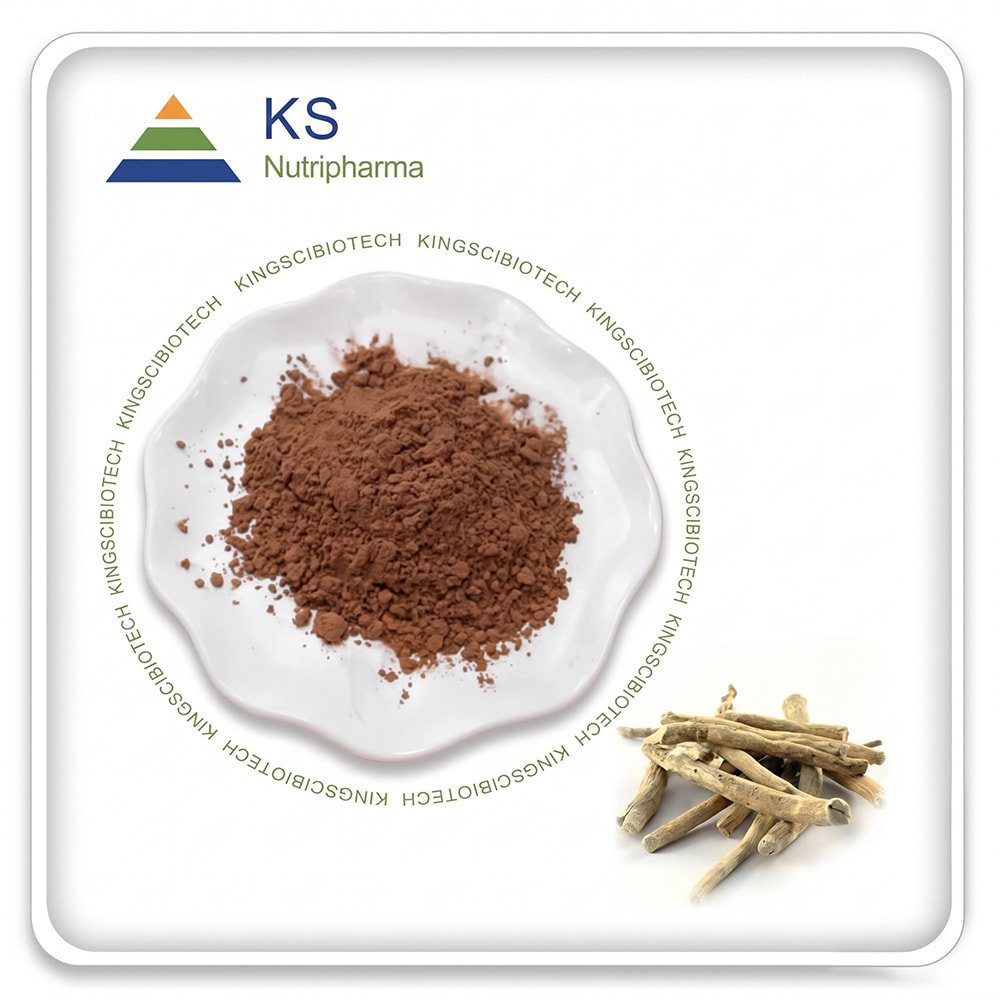
| Appearance | Brown to yellowish-brown fine powder |
| Solubility | Partially water-soluble; available as water-soluble grade |
| Mesh Size | 80-100 mesh (customizable) |
| Carrier | Maltodextrin or none (customizable) |
| Certifications | ISO, GMP, Organic, Halal, Kosher available |
| Heavy Metals | <10 ppm total; Pb <3 ppm; As <1 ppm; Cd <1 ppm; Hg <0.3 ppm |
| Microbiology | TPC <5000 CFU/g; Yeast/Mold <300 CFU/g; E. coli negative; Salmonella negative |
| Shelf Life | 24-36 months in sealed containers, stored cool and dry |
Analytical Methods
Withanolide content is quantified by High-Performance Liquid Chromatography (HPLC) with photodiode array (PDA) or UV detection at 227 nm, using reference standards (withanoside IV, withaferin A) for calibration. This method is validated per ICH Q2(R1) guidelines for specificity, linearity, accuracy, and precision.
Custom Specifications
Custom withanolide concentrations, extract ratios, particle sizes, and carrier materials are available upon request. Please contact our technical team for custom formulation support.
We provide end-to-end contract manufacturing services for dietary supplement brands looking to launch Ashwagandha-based products. Our GMP-certified facilities support the full product lifecycle from concept to finished goods.
Services Overview
- OEM (Original Equipment Manufacturing): Produce your formula to exact specifications using your brand packaging
- ODM (Original Design Manufacturing): Select from our library of proven formulations, customized with your branding
- Formula Development: Our R&D team develops custom formulations based on your target active content, delivery format, and positioning
- Packaging Design: In-house design team for labels, boxes, and marketing materials
- Regulatory Support: Label review, structure/function claim guidance, and compliance documentation
Manufacturing Capabilities
| Capability | Details |
| Dosage Forms | Capsules, tablets, softgels, gummies, powders, liquids, stick packs |
| Capsule Sizes | Size 00, 0, 1, 3, 4 (gelatin & HPMC vegetarian) |
| Tablet Options | Standard, enteric-coated, chewable, effervescent |
| Packaging | Bottles (PET/HDPE/glass), blister packs, pouches, boxes |
| Label Design | In-house graphic design & regulatory label review |
| Batch Size | Flexible from 1,000 to 500,000+ units |
| Storage | Climate-controlled warehousing & inventory management |
Quality Certifications
- GMP Certified (21 CFR Part 111 / NSF / WHO standards)
- ISO 9001:2015 Quality Management
- ISO 22000:2018 Food Safety Management
- HACCP Certified
- Halal & Kosher certified production lines
- Non-GMO Project Verified options available
- Third-party tested by independent laboratories
MOQ & Lead Time
- Minimum Order Quantity: 1,000 units per SKU (flexible for first orders)
- Sample Lead Time: 5-7 business days
- Production Lead Time: 4-6 weeks after sample approval
- Shipping: FOB, CIF, or DDP terms available
Documentation Provided
- Certificate of Analysis (COA) for every batch
- Certificate of Origin
- Material Safety Data Sheet (MSDS)
- Product Specification Sheet
- Flow Chart & Manufacturing Process Description
- Allergen & GMO Statements
- Heavy Metals & Microbiology Test Reports
According to the NIH National Center for Complementary and Integrative Health (NCCIH), Ashwagandha appears to be safe for short-term use (up to 12 weeks) in typical doses. Possible side effects may include drowsiness, stomach upset, diarrhea, and vomiting. Rare reports of liver injury have been documented. It should be avoided during pregnancy and breastfeeding. Individuals with thyroid disorders, autoimmune conditions, or those taking medications should consult a healthcare provider before use.
Build a comprehensive adaptogen or stress-support product line by combining Ashwagandha extract with these related botanical ingredients:
- Rhodiola Rosea Extract: Adaptogen traditionally used for fatigue and physical endurance support.
- Panax Ginseng Extract: One of the most studied adaptogenic herbs for energy and cognitive support.
- Maca Root Extract: Traditional Peruvian botanical for vitality and endurance.
- Reishi Mushroom Extract: Adaptogenic mushroom with immune-support properties.
- Lion’s Mane Extract: Medicinal mushroom studied for cognitive and nerve support.
- Cordyceps Extract: Traditional Tibetan and Chinese medicine for stamina and respiratory support.
- Holy Basil (Tulsi) Extract: Ayurvedic adaptogen for stress support and mood balance.
- L-Theanine: Amino acid from green tea for relaxation without drowsiness.
Our formulation team can recommend synergistic ingredient combinations and optimal ratios for your specific product concept.

- World Health Organization. Radix Withaniae. WHO Monographs on Selected Medicinal Plants, Volume 4. Geneva: WHO; 2009:373-391.
- Chandrasekhar K, Kapoor J, Anishetty S. A prospective, randomized double-blind, placebo-controlled study of safety and efficacy of a high-concentration full-spectrum extract of ashwagandha root in reducing stress and anxiety in adults. Indian J Psychol Med. 2012;34(3):255-262. PMID: 23439798
- Cheah KL, Norhayati MN, Husniati Yaacob L, Rahman RA. Effect of Ashwagandha (Withania somnifera) extract on sleep: A systematic review and meta-analysis. PLoS One. 2021;16(9):e0257843. PMID: 34582491
- Bonilla DA, Moreno Y, Gho C, Petro JL, Odriozola-Martinez A, Kreider RB. Effects of Ashwagandha (Withania somnifera) on Physical Performance: Systematic Review and Bayesian Meta-Analysis. J Funct Morphol Kinesiol. 2021;6(1):12. PMID: 33670194
- Wankhede S, Langade D, Joshi K, Sinha SR, Bhattacharyya S. Examining the effect of Withania somnifera supplementation on muscle strength and recovery: a randomized controlled trial. J Int Soc Sports Nutr. 2015;12:43. PMID: 26609282
- Lopresti AL, Smith SJ, Malvi H, Kodgule R. An investigation into the stress-relieving and pharmacological actions of an ashwagandha (Withania somnifera) extract. Medicine (Baltimore). 2019;98(37):e17186. PMID: 31517876
- Majeed M, Nagabhushanam K, Mundkur L. A standardized Ashwagandha root extract alleviates stress, anxiety, and improves quality of life in healthy adults by modulating stress hormones. Medicine (Baltimore). 2023;102(41):e35521. PMID: 37832082
- Arumugam S, et al. Effects of Ashwagandha Supplements on Cortisol, Stress, and Anxiety Levels in Adults: A Systematic Review and Meta-Analysis. Explore. 2024. PMID: 39348746
- U.S. Food and Drug Administration. GRAS Notice Inventory. Accessed 2025.
- NIH National Center for Complementary and Integrative Health. Ashwagandha. https://www.nccih.nih.gov/health/ashwagandha
- European Medicines Agency. Withaniae somniferae radix. HMPC Assessment Report. https://www.ema.europa.eu/en/medicines/herbal/withaniae-somniferae-radix
- Health Canada. Ashwagandha – Withania somnifera. Natural Health Products Ingredients Database. https://webprod.hc-sc.gc.ca/nhpid-bdipsn/atReq?atid=ashwagandha
- U.S. Pharmacopeia. Ashwagandha Root; Powdered Ashwagandha Root; Powdered Ashwagandha Root Extract. USP-NF.
- Indian Pharmacopoeia Commission. Withania somnifera. Indian Pharmacopoeia, 8th Edition. Ghaziabad, India; 2018.