
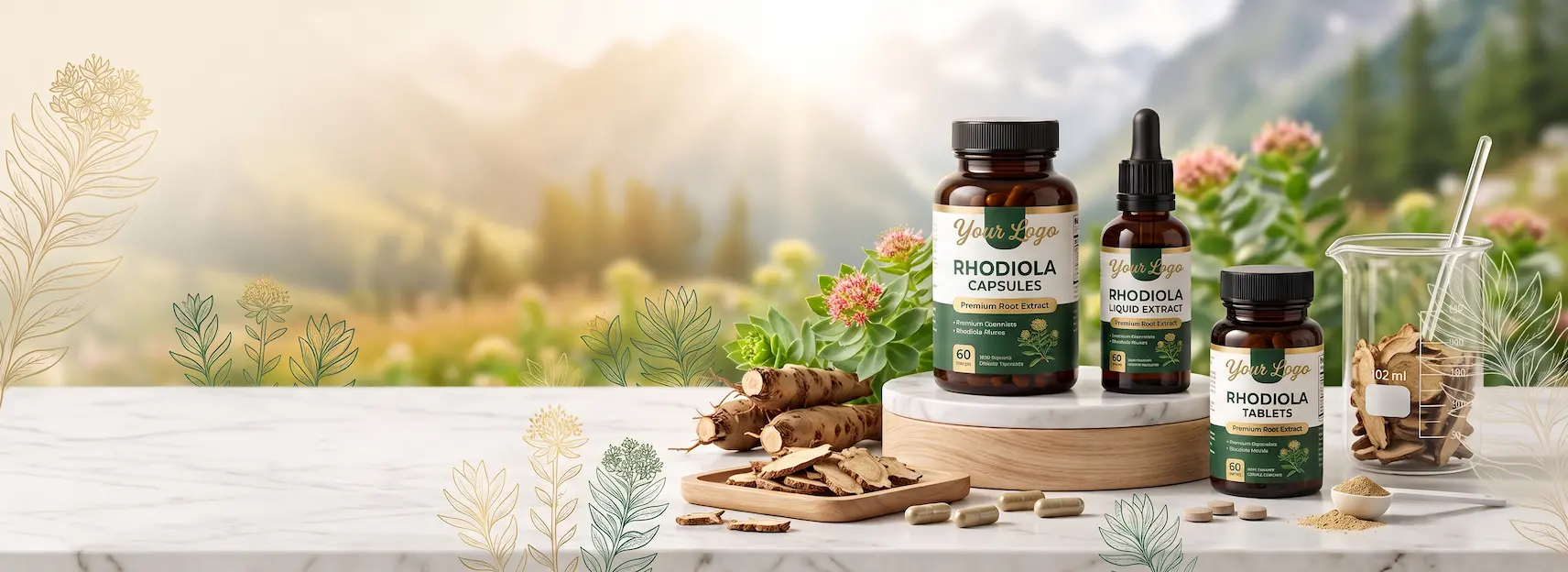
KS Nutripharma® is a rhodiola supplement manufacturer for OEM, ODM, and private-label programs. We manufacture finished rhodiola dietary supplements—capsules, tablets, powders, gummies, and liquids—for stress-relief assortments, with a locked Rhodiola rosea root grade (powder or a dual-marker extract), dosage form, testing panel, and batch COA.
Rhodiola rosea is golden root (some markets write arctic root or 红景天). The default plant part is root and rhizome. R. crenulata is a different species file. On this page, dual-marker specification means total rosavins plus salidroside, with the analytes, methods, and assay basis defined on the approved specification.
What we manufacture
- R. rosea root powder, named-ratio extract, and dual-marker extract grades we quote (3%/1% as the usual start; other pairs on request)
- Finished capsules, tablets, powders/sticks, gummies, and liquids
Dried Rhodiola rosea root
Dried R. rosea root. Color and a rose-like odor support botanical identity; the marker file still needs HPLC.
Who it is for
Brand owners who need a finished SKU under their label, and filling programs that need bulk rhodiola extract or root powder qualified into a line.
Why this factory
We lock species and the dual-marker file before anyone ranks price. Two supplier COAs are mapped before you pay for the wrong sample. Typical first reply is one business day. An NDA is available before you send a BOM. A project manager is assigned when the specification is in review.
Do not compare rhodiola price by “3%” alone. Compare species, total rosavins, salidroside, method, basis, and finished-unit assay.
Request a specification review · Compare two COAs · Get an OEM / private-label quote
cGMP · ISO 9001 · ISO 22000 · HACCP · FSSC 22000 · Halal · Kosher · in-house lab + SGS/Eurofins pathways
About Us · Manufacturing Capacity · Certifications · Quality Control
12 production lines · 81,000+ m² · 260+ professionals · since 2007 · 500+ brands · 60+ markets
Rhodiola Supplement Manufacturing at a Glance
Capability | Typical starting point |
|---|---|
| Botanical | Rhodiola rosea root / rhizome. R. crenulata is a different PO |
| Material | Root powder · named-ratio extract · dual-marker extract grades (see Available Specifications) |
| Marker file | Total rosavins + salidroside, HPLC. Unnamed “3% standardized” is not a spec |
| Formats | Capsules, tablets, powders, gummies, liquids. Softgel only when the BOM has an oil phase |
| Label timing | Many Western commercial labels position rhodiola for daytime use; final wording follows destination review |
| Taste | Bitter. Capsules hide it; sticks, gummies, and tinctures need a flavor plan |
| Documents | Batch COA · specification · identity + scoped safety tests |
| Capsule MOQ | From about 3,000–5,000 units |
| Samples | After specification and material confirmation |
| Scope | Human oral dietary supplements |
Fast-Start Rhodiola Formulas
These are practical formulation architectures for rhodiola supplement development—milligrams and marker fields stay customizable. KS formulation team and R&D center.
Named BOMs we quote from a client file: cordyceps (fruiting body vs mycelium if labeled), CoQ10, magnesium (evening-adjacent—same unit as rhodiola needs a timing architecture), phosphatidylserine. Ginseng-led duals quote on the ginseng page. Magnolia bark, if named, is a custom file. A six-herb kitchen-sink blend is not a default card. We do not reverse-engineer branded retail formulas.
Choose the Rhodiola Format: Capsules, Tablets, Powder, Gummies or Liquids
Bitterness can be a major factor in selecting the first SKU format. Dual-marker extract usually starts as a hard capsule. Gummies and tinctures already exist on retail shelves; they are not the first SKU for a compact dual-marker bottle.
An RFQ that says “rhodiola, 3% standardized, 500 mg” is not yet a material. Most failed samples on this botanical fail on species or on which analyte the percentage was. Price is the last field.
01 Species — R. rosea vs R. crenulata
A quotation line that says rhodiola and a COA that says Rhodiola crenulata are not the same drum. R. rosea is the species that supports a meaningful rosavins conversation. R. crenulata (大花红景天) is widely traded on salidroside; it typically carries little or no rosavin / rosarin / rosin. HPTLC (or the named identity method) belongs on the incoming file. Do not blend the two species into one “rhodiola mg.”
02 Plant Part — Root / rhizome
The default medicinal part on this page is root and rhizome. Aerial parts, leaf, or an unnamed “herb” line are a different PO. Lock plant part on the specification before you compare price.
03 Marker Pair — Total rosavins + salidroside
Rosavins are the phenylpropanoid glycosides rosavin, rosarin, and rosin—characteristic of R. rosea. Salidroside is a phenylethanoid glycoside found across Rhodiola species. They are different HPLC peaks. Rosavin (single peak) is not total rosavins.
On this page, dual-marker specification means total rosavins plus salidroside, with the analytes, methods, and assay basis defined on the approved specification. 3% on a dual-marker sheet means total rosavins (rosarin + rosavin + rosin), not a single rosavin peak. 1% means salidroside. Both are HPLC.
The dual-marker grades we quote are listed in Available Specifications below. Two drums with the same printed pair are still different materials until method, milligram basis, and incoming vs finished-unit assay match.
A COA that reports only salidroside—even at 3%—cannot be sampled as a dual-marker rosea capsule. If the panel will print both numbers, both analytes and both methods go on the PO.
04 Assay Basis — Incoming drum vs finished unit
Incoming COA ≠ finished-unit assay. Write whether the dual-marker numbers apply to the incoming extract or the finished unit. A finished-capsule guarantee needs a finished assay. Extract milligrams and root-powder milligrams are different bases.
05 Origin / Trademark
Altai, Siberia, “arctic,” Himalaya, or a Tibetan plateau story does not prove rosavins. Plateau / Tibet wording on open-market sheets often tracks R. crenulata. Name origin on the PO when the label will state it.
Trademarked extract names (including SHR-5®, Rhodiolife®, and Arctic Root®) are used only when the BOM specifically requires the branded ingredient and the applicable authorization or licensing documentation is available. A hydroethanolic dual-marker extract is not those brands.
Sourcing paperwork (bulk). Rhodiola spp. have been listed in CITES Appendix II since 23 February 2023, with annotation #2: all parts and derivatives except seeds, pollen, and finished products packaged and ready for retail trade. Bulk root, powder, and extract remain in scope. Destination-country implementation should be confirmed on the live shipment file.
China’s 2021 National Key Protected Wild Plants List includes R. rosea (and several other Rhodiola species) as Class II. Wild-origin lots may need additional Chinese documentation. A wild drum without a legal-origin file is not a cheaper rosea grade.
Rhodiola extract powder
Extract powder is often pink-brown to rose-brown. Color is not a rosavin assay.
Do not rank two “3%” prices until species, both analytes, method, and milligram basis match.
These are quoteable identity and dual-marker grades for finished-unit OEM and for bulk qualification into a KS filling line. They are not licensed branded extracts and not a website warehouse list. Each lot still locks R. rosea root / rhizome, both HPLC analytes where markers are printed, milligram basis, and whether the numbers apply to the incoming drum or the finished unit.
| Grade | Total rosavins | Salidroside | Form | Method | Best fit | Availability |
|---|---|---|---|---|---|---|
| Root powder | — | — | Native root powder | Identity (HPTLC or named method) | Whole-root capsules and powders | Quoteable identity grade |
| Named-ratio extract | — | — | Dry extract, documented DER | DER + identity | Extract story without a marker % | On request |
| Standard extract 3% / 1% | ≥3.0% | ≥1.0% | Dry extract | HPLC | Usual dual-marker starting SKU | Usual starting dual-marker grade |
| High-salidroside extract 3% / 2% | ≥3.0% | ≥2.0% | Dry extract | HPLC | Higher salidroside positioning | On request |
| High-rosavin extract 5% / 1% | ≥5.0% | ≥1.0% | Dry extract | HPLC | Compact / higher-rosavin formulas | On request |
| High-marker extract 5% / 2% | ≥5.0% | ≥2.0% | Dry extract | HPLC | High-potency / compact formulas | On request |
| Custom extract | Customer target | Customer target | Dry extract | HPLC | Named BOM / label architecture | On request |
How to read the pair. Total rosavins = rosarin + rosavin + rosin. Salidroside is a separate HPLC peak. A 3%/1% drum and a 5%/1% drum are different materials. Carriers used to hit a target % belong on the specification, the COA, and the finished ingredient list.
Root powder — what we lock. Botanical Rhodiola rosea L.; part = root and rhizome; form = powder; identity by HPTLC or the named botanical method. Particle size, moisture, ash, microbiology, metals, and pesticides are written on the approved specification and destination file—not copied from this page as a universal COA. Native root powder does not print a dual-marker % unless that lot is actually standardized. Typical bulk pack talk is 25 kg drum or a customer-qualified pack.
Trademarked extracts are a different PO from every row above.
Request a specification review — send the grade you want, or two COAs if you are comparing price.
Field-by-field reading follows the same method as How to Read a COA.
Field | Supplier A | Supplier B | Procurement reading |
|---|---|---|---|
| Species | R. rosea | R. crenulata | Not comparable |
| Plant part | Root / rhizome | Root / rhizome | Plant part matches; species does not |
| Total rosavins | 3%, HPLC | Not reported | B cannot support a rosavin claim |
| Salidroside | 1%, HPLC | 3%, HPLC | Different marker profile |
| Method | HPLC, named standards | HPLC | Method alone does not make specs equivalent |
| Finished-unit assay | Yes | Incoming drum only | Different QC commitment |
| Price/kg | $X | $Y | Do not rank yet |
Item | Root powder | Dual-marker extract | Named-ratio extract |
|---|---|---|---|
| Panel | Root mg | Root extract + dual-marker specification + HPLC | Named DER, no marker % |
| Cost | Lower per kg | Higher per kg; fewer grams per bottle | Between powder and marked extract when the DER is real |
| Capsule size | Often 500 mg–1 g root | Often 200–500 mg extract | Depends on documented ratio |
| Claims you can defend | Whole-root identity | Numbered extract only if both analytes, methods, and basis match | Ratio story only with a real DER |
| Stability | Moisture; bitter if opened | Hygroscopic; induction ± desiccant | Same moisture logic as other dry extracts |
| MOQ | Sticks often higher (film, flavor) | Capsule planning range | Capsule planning range |
| Typical retail | Identity, sticks | Pharmacy / DTC extract capsule | Herbal extract without a dual-marker print |
| When it fits | Root mg only | Marker pair on the label, or two COAs that must share both HPLC analytes | Extract story without a % |
R. crenulata is not a cheaper R. rosea. Isolated salidroside is not offered as a dietary-supplement SKU.
Request a specification review — missing species, analyte, method, and milligram-basis fields are listed before anyone quotes.
A usable PO names species, root / rhizome, extract type, the dual-marker specification, HPLC, milligram basis, and whether those numbers apply to the incoming extract or the finished unit. Moisture, metals, micro, and residual solvents (if the solvent is not water) sit on the same sheet.
How standardized botanical POs are written: standard extracts.
Marker field | Do not confuse with |
|---|---|
| Rosavin (single peak) | Total rosavins (rosavin + rosarin + rosin) |
| Total rosavins | Salidroside |
| Salidroside | Rosavins |
| Extract ratio (DER) | Marker percentage |
| Incoming drum assay | Finished-unit assay |
Write the analyte next to every percentage. A 5%/2% request is a different quote on the same R. rosea pair—not a second species and not a licensed branded extract. Carriers used to hit a target % (maltodextrin or another diluent) belong on the specification, the COA, and the finished ingredient list.
Incoming physical talk on many dry-extract sheets (illustration, not a catalog promise): pink-brown to rose-brown powder; often ≥95% through 80 mesh; loss on drying commonly discussed at ≤5%; ash ≤8%. None of those rows replace HPLC.
EU traditional-herbal medicine specifications may define rhodiola extracts by DER and extraction solvent. Those medicinal-product parameters should not be copied directly into a U.S. dietary-supplement specification.
Label milligrams and marker math for the panel—not a consumer serving recommendation.
Common extract panels: 200, 300, or 500 mg extract. Duals often drop rhodiola to 100–250 mg so the second identity fits one unit.
Illustration using standard extract 3% / 1% (total rosavins ≥3.0% / salidroside ≥1.0% on that extract, HPLC):
Extract in the unit | Calculated rosavins | Calculated salidroside |
|---|---|---|
| 200 mg | 6 mg | 2 mg |
| 300 mg | 9 mg | 3 mg |
| 500 mg | 15 mg | 5 mg |
That math holds only when both percentages are defined on the incoming extract as filled and the HPLC methods match. A finished-capsule guarantee needs a finished assay. Root-powder milligrams are a different basis: 500 mg root powder is not 500 mg of dual-marker extract. Do not back-calculate a dual-marker capsule from a root-powder serving.
Many Western commercial labels position rhodiola for daytime use; final timing language should follow the destination-market review. Evening use and “may affect sleep” belong on the warning set. If ashwagandha or magnesium shares the same unit, lock one timing line or split the SKU.
A kg quotation is not a bottle MOQ. Bulk is for brands that already fill, or for incoming qualification into a KS filling line. The finished unit still needs a finished COA. Customer-supplied drums follow the same qualification path.
Typical bulk talk: 25 kg HDPE drums, PE liner; smaller aluminum-foil packs for samples. Dating on the drum follows that lot’s stability file—do not copy a raw-material month count onto a gummy or tincture. CITES paperwork, when required, is a bulk-path field.
Get an OEM / private-label quote — name bulk kg vs finished units on the RFQ.
What the RFQ said | Rewrite to |
|---|---|
| 3% standardized | Name the grade (e.g. 3%/1%) as total rosavins + salidroside, HPLC + incoming vs finished |
| Rhodiola extract | R. rosea or R. crenulata |
| 500 mg | Extract mg or root-powder mg |
| Copy a branded retail formula | BOM / COA — we do not reverse-engineer branded SKUs |
| Trademarked extract as default | Licensed branded ingredient, or a non-branded dual-marker spec |
| Evening sleep rhodiola | Timing copy + warning review |
| Weight-loss rhodiola | This page does not develop that SKU |
| Same artwork worldwide | UK / AU / CA destination files |
Example. The RFQ asked for 500 mg dual-marker, hard capsule. The attached sheet was R. crenulata, salidroside 3%, rosavins not listed. That drum cannot be filled as a dual-marker rosea capsule. The quotation waited until species and both analytes were rewritten.
Changing the extract supplier after approval restarts qualification: solvent profile, bulk density, particle size, and finished potency can all move.
You do not need a finished Supplement Facts panel to start. Send:
Species and plant part · extract type and grade (root powder, named-ratio, or a dual-marker pair such as 3%/1%) · marker requirements and HPLC method if markers will be printed · milligram basis (extract vs root) · dosage form and fill weight · serving count and pack · destination market · quantity · whether you need incoming-only or finished-unit assay. Two supplier COAs if you are comparing price. An NDA can be signed first.
RFQ → lock species and the dual-marker file → sample → approval → artwork (timing line and warnings) → production → batch COA → shipment.
Sample 7–15 days after specification and material confirmation. Mass production 30–45 days after formula, artwork, pack, and schedule. Gummy or tincture pilots, licensed extract names, and bulk CITES paperwork add time before those clocks. Typical first reply is one business day.
Stress / adaptogen assortment is the default shelf for a dual-marker capsule. Energy-line SKUs follow the B-complex / energy card above. Cortisol wording, if used, is destination structure/function copy—not a cortisol-lowering drug and not a third money page.
We do not develop a weight-loss rhodiola SKU. We do not print antidepressant or disease claims. Isolated salidroside as an API path is out of scope.
Same artwork worldwide? Usually no. Product name (rhodiola / golden root / 红景天), claims, warnings, Supplement Facts format, and language are destination files. UK, Australia, and Canada each need their own review; they are not country landing pages.
Export programs we already run as dietary-supplement OEM (United States, Canada, Australia, EU destinations, Middle East) still close on the destination dossier—not on a single global carton.
This section supports finished-label review. It is not medical advice.
Complaints discussed on rhodiola files include gastrointestinal discomfort, restlessness or a stimulating feel, evening use affecting sleep, and headache. Incidence varies by formula and published evidence; warning language follows the destination market.
Potential interaction-related label language should be reviewed against the destination market, formulation, and available evidence before it is finalized. Pregnancy and lactation are not default SKUs. Infant and pet products are not manufactured here. Age-related restrictions depend on the destination market and product category.
Human oral dietary supplements only.
Release has to prove species, milligram basis (root vs extract), and the dual-marker file when the panel prints it. Powder color does not close those rows. Quality control.
Control | Typical rhodiola file |
|---|---|
| Incoming identity | HPTLC (or the named identity method) — rosea vs crenulata |
| Marker assay | Rosavins HPLC · salidroside HPLC |
| Physical | Moisture (hygroscopic powder) · bulk density when fill weight depends on it |
| Contaminants | Metals, micro, pesticides and residual solvents as scoped |
| Finished unit | Assay when the panel prints markers; piece or per-mL assay for gummies/liquids |
| Release | Hold if out of spec; batch COA after QA close |
| Retain / stability | Retained sample; dating follows that SKU’s stability file |
Third-party reports (SGS / Eurofins) when the RFQ asks. Heavy metals are controlled against the approved raw-material and finished-product specification and destination-market requirements. Customer-supplied drums follow the same qualification.
MOQ moves because the SKU moves—not because a website prints one number.
What changes the number | Why it moves on rhodiola |
|---|---|
| Format | Unflavored dual-marker capsules are simpler than a bitter stick or gummy |
| Bottle count | North American briefs often 120; many EU briefs 60–90. Count changes bottle, cap, and label yield |
| Flavor / film | Sticks and gummies carry a bitterness project |
| Dual HPLC + finished assay | Sample clock starts after the marker file is locked |
| Licensed extract name | Trademark grade is a different lead time from a non-branded dual-marker extract |
| Bulk vs units | Kg MOQ ≠ bottle MOQ; CITES on bulk is extra calendar |
Starting conversation ranges (planning, not a quote): capsules about 3,000–5,000 units; tablets about 5,000–10,000; powder / stick often from about 10,000. Gummies and liquids after feasibility. Bulk kg is a separate line.
Default bottle pack for dry extract: HDPE, induction seal, desiccant when moisture is in the file. Blister and stick film are quoted when named. No universal “36-month finished” claim.
What is a rhodiola supplement?
On this page it is a finished oral dietary supplement made from Rhodiola rosea root and rhizome—golden root; some markets write arctic root or 红景天. Structure/function wording follows the destination file. We manufacture capsules, tablets, powders, gummies, and liquids against a named grade and a batch COA.
Can I substitute R. crenulata for R. rosea?
No. Rosea supports a rosavins conversation. Crenulata trade is usually salidroside-only. A crenulata drum quoted as dual-marker rosea is rewritten before fill.
What does 3% rosavins / 1% salidroside mean?
The usual starting dual-marker grade we quote on dry R. rosea root extract: total rosavins ≥3.0% and salidroside ≥1.0%, HPLC. It is not a universal pharmacopeial standard and not a licensed branded extract. Other pairs (3%/2%, 5%/1%, 5%/2%) and custom HPLC targets are quoted on request. Lock method and incoming vs finished-unit assay to the approved COA.
What should I include in a rhodiola RFQ?
Species, plant part, extract type and grade, marker requirements, assay method, dosage form, fill weight, serving count, packaging, destination market, and quantity. Incoming vs finished-unit assay if markers will be printed. Two COAs if you are comparing price.
Can you supply bulk Rhodiola rosea extract?
Yes as a kilogram quote for filling programs, separate from bottle MOQ. Customer-supplied drums follow the same incoming qualification; finished units still need a finished COA. CITES paperwork, when required, is a bulk-path field.
Can rhodiola be made into gummies or tinctures?
Yes after a taste-and-assay pilot. Bitterness, cook heat (gummies), and assay per piece or per mL are the project. A root-mg gummy is not a 500 mg dual-marker capsule.
What is the MOQ, and how long does production take?
MOQ depends on dosage form, packaging, flavoring, and batch requirements. Current planning ranges are shown above. First reply typically one business day. Sample 7–15 days after spec and material confirmation. Mass production 30–45 days after formula, artwork, pack, and schedule.
Can I use my own raw material?
Yes after qualification against the approved specification. Finished-unit testing still applies.
Can you produce HPMC (vegan) capsules?
Yes. Vegan capsules are HPMC hard capsules on the same root grade, not HPMC softgels.
Can you copy another brand’s Rhodiola formula?
No. We do not reverse-engineer branded retail formulas. Send a BOM and COA. We lock specification from your file.
Lock a Launch-Ready Rhodiola Spec
Two “3%” extracts are different materials until species, both analytes, method, and milligram basis match. Send what you already have.
Request a specification review · Compare two COAs · Get an OEM / private-label quote
Related Product Pages
Category (similar positioning)
Ingredient money pages
- Ashwagandha Supplements
- L-Theanine Supplements
- Eleuthero Supplement Manufacturer
- Schisandra Supplement Manufacturer
- Saffron Supplement Manufacturer
- Ginseng Supplement Manufacturer
Specification support (live)
Disclaimer: Wholesale / brand manufacturing and product-development reference only. Not intended to diagnose, treat, cure, or prevent any disease. Dietary supplements are not drugs. Milligram, rosavin and salidroside figures on this page are development examples, not recommended intakes. Structure/function language, naming, and warning statements vary by country. Brand owners remain responsible for finished-label compliance with local counsel. KS Nutripharma provides manufacturing feasibility and documentation support — not legal approval. CITES, wild-plant, and destination-import rules are summarized for procurement planning; they are not customs or legal advice.
Written by KS Nutripharma Formulation Team | Reviewed by KS Nutripharma Director of R&D (PhD, Food Science | 19+ years nutraceutical development)
Technical review scope: R. rosea root identity, dual-marker specification, dosage-form feasibility, incoming vs finished-unit QC, and batch release | Updated September 2026