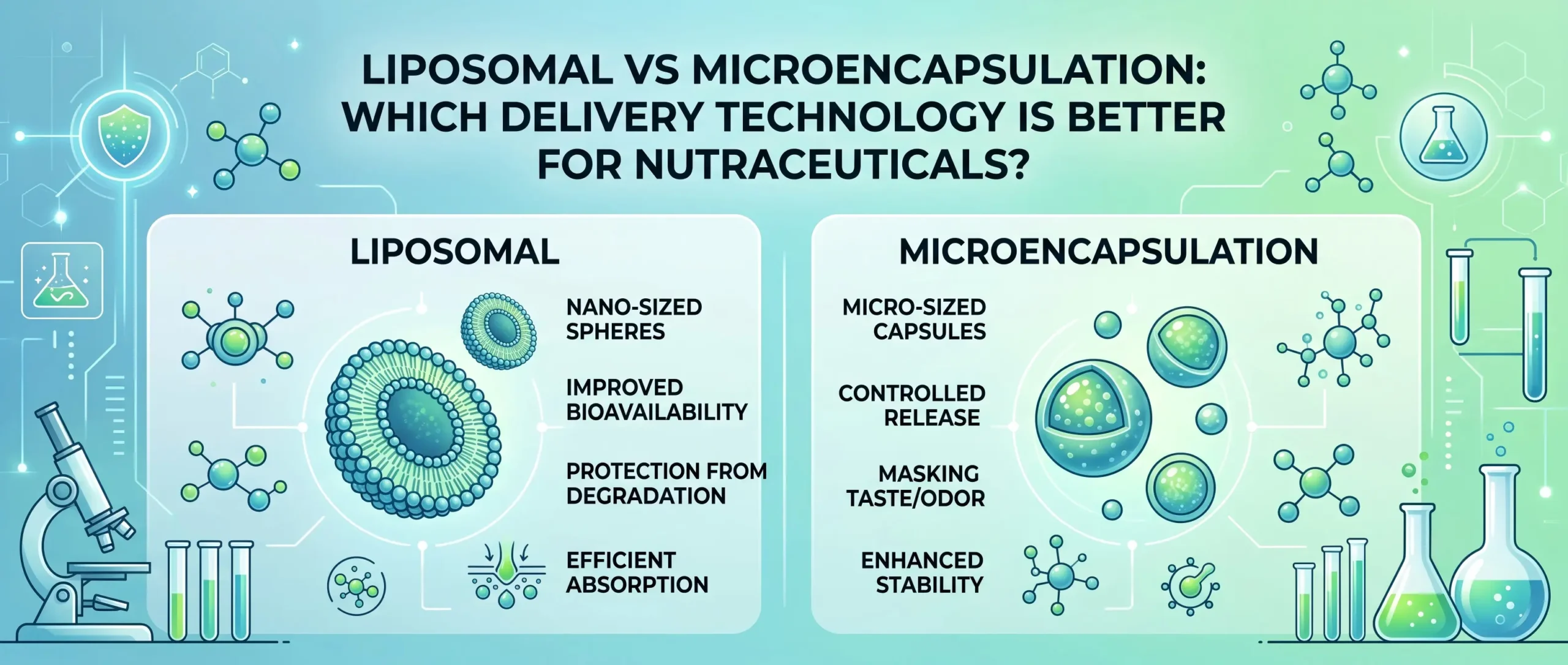
Liposomal vs. Microencapsulation: Which Delivery Technology Is Better for Nutraceuticals?
Choosing the Right Delivery Technology for Supplement Development
The nutraceutical industry is at an inflection point. As consumers demand higher efficacy and brands seek differentiation, advanced delivery systems have moved from niche innovation to strategic necessity. Yet for many B2B purchasers and product developers, the distinction between two leading technologies—liposomal and microencapsulation—remains unclear.
This guide provides a formulation-technology decision framework grounded in peer-reviewed clinical data and manufacturing science. Whether you are developing a premium anti-aging line, a sports nutrition powder, or a functional beverage, understanding these technologies is essential to making the right OEM investment.
Common formulation challenges that drive delivery system selection:
- Poor bioavailability: Many actives (e.g., glutathione, curcumin, CoQ10) exhibit inherently low absorption rates in standard powder or tablet forms.
- Oxidation sensitivity: Polyunsaturated fatty acids, vitamins, and botanical extracts degrade rapidly when exposed to oxygen, light, and heat.
- Moisture sensitivity: Hygroscopic ingredients lose potency and develop clumping issues during storage and processing.
- Taste masking: Bitter botanical extracts, fish oils, and certain amino acids create unacceptable sensory profiles for consumer-facing products.
- Controlled release: Some actives require targeted release in the small intestine rather than immediate gastric dissolution.
Liposomes and microencapsulation are frequently compared because both address these challenges—but they do so through fundamentally different mechanisms. The optimal choice depends on your ingredient’s physicochemical properties, dosage form, manufacturing requirements, and commercial objectives.
Core positioning of this guide: Liposomes and microencapsulation are complementary technologies rather than direct competitors. Liposomes primarily enhance nutrient delivery and bioavailability, while microencapsulation focuses on protecting ingredients, improving stability, masking taste, and enabling controlled release. The optimal choice depends on the ingredient’s physicochemical properties, dosage form, manufacturing requirements, and commercial objectives.
Section 1: What Is a Liposomal Delivery System?
Definition and Structural Foundation
A liposome is a spherical vesicle composed of one or more phospholipid bilayers, first discovered in the 1960s by Alec Bangham at the Babraham Institute, Cambridge. The structure mimics biological cell membranes, enabling liposomes to interact seamlessly with intestinal epithelial cells and facilitate cellular uptake via endocytosis.
Key structural characteristics:
- Phospholipid bilayer: The outer shell consists of amphiphilic phospholipids (typically phosphatidylcholine from sunflower or soy lecithin), with hydrophilic heads facing outward and hydrophobic tails oriented inward.
- Aqueous core: The interior compartment can encapsulate water-soluble (hydrophilic) actives, while the lipid bilayer itself can solubilize lipid-soluble (lipophilic) compounds.
- Particle size: Nutraceutical-grade liposomes typically range from 50 to 450 nm. Particle size below 100 nm is associated with enhanced cellular uptake and improved pharmacokinetic profiles.
- Encapsulation efficiency: High-quality liposomal formulations achieve encapsulation efficiencies of 60–70% for vitamin C and higher for lipid-soluble actives.
Mechanism of Enhanced Absorption
Liposomal delivery improves bioavailability through three primary mechanisms:
- Physical protection: The phospholipid bilayer shields encapsulated actives from gastric acid, enzymatic degradation, and premature oxidation in the gastrointestinal tract.
- Membrane fusion: Liposomes can fuse with enterocyte membranes, enabling direct delivery of actives into intestinal cells without reliance on passive diffusion or carrier-mediated transport.
- Lymphatic transport: A portion of liposomes is absorbed via the intestinal lymphatic system, bypassing hepatic first-pass metabolism and achieving higher systemic bioavailability.
Clinical Evidence: Liposomal Vitamin C
According to a randomized, double-blind, placebo-controlled crossover study published in Scientific Reports (2023), liposomal vitamin C (500 mg) demonstrated a 27% higher peak plasma concentration (Cmax) and 21% greater total exposure (AUC₀₋₂₄) compared to standard vitamin C in 27 healthy adults. Leukocyte vitamin C concentrations—a marker of tissue-level availability—were also 20% higher with the liposomal formulation. [https://pmc.ncbi.nlm.nih.gov/articles/PMC11519160/]
A more recent study published in ACS Nutritional Science (2026) using Metazome® liposomal technology reported even more dramatic results: liposomal vitamin C achieved 6.29-fold higher Cmax and 7.62-fold greater AUC₀₋₄₈ compared to conventional crystalline vitamin C. [https://pubs.acs.org/doi/10.1021/acsnutrsci.5c00002]
Clinical Evidence: Liposomal Glutathione
Glutathione—often called the “master antioxidant”—presents a classic bioavailability challenge. Oral glutathione is rapidly degraded by intestinal peptidases and exhibits poor membrane permeability.
A 2026 study published in the British Journal of Nutrition evaluated a novel liposomal glutathione formulation (LipoDuo™) against plain glutathione in both cellular and human models. Key findings included:
- Cellular uptake: 9-fold higher intracellular uptake than plain glutathione
- Plasma Cmax: Approximately 6× higher than plain glutathione (peaking at ~1,800 ng/mL)
- Bimodal absorption pattern: Sustained plasma levels >500 ng/mL at 24 hours
- Wound healing: 100% cell closure at 24 hours vs. 59.8% for plain glutathione
[https://pubmed.ncbi.nlm.nih.gov/41559937/]
Similar bioavailability improvements have also been reported for CoQ10 and curcumin. A 2024 randomized crossover study found liposomal CoQ10 achieved 31.3% higher Cmax and 22.6% greater AUC compared to standard CoQ10. Silica-coated flexible liposomes improved curcumin bioavailability by 7.76-fold compared to standard suspensions.
Section 2: What Is Microencapsulation?
Definition and Encapsulation Objectives
Microencapsulation is a mature, versatile technology that encloses active ingredients within a protective shell (wall material) to create micro-scale particles typically ranging from 1 to 1,000 μm in diameter. Unlike liposomes, which are self-assembled lipid vesicles, microcapsules are engineered composite structures designed primarily for protection, stability, and controlled release rather than absorption enhancement.
Primary encapsulation objectives:
- Physical protection: Shielding actives from oxygen, moisture, light, and heat during processing, storage, and distribution
- Taste and odor masking: Concealing bitter, astringent, or fishy flavors that would otherwise compromise consumer acceptance
- Controlled release: Engineering release profiles (immediate, sustained, or targeted) based on pH, temperature, or enzymatic triggers
- Process compatibility: Converting liquid or sensitive actives into free-flowing powders suitable for tableting, capsule filling, or powder blending
- Shelf-life extension: Reducing oxidative degradation and moisture-induced hydrolysis to extend product viability from months to years
Common Wall Materials
| Wall Material | Key Properties | Typical Applications |
| Maltodextrin | Low cost, good solubility, moderate oxygen barrier | Vitamins, flavors, botanical extracts |
| Gum Arabic | Excellent emulsification, film-forming, GRAS status | Essential oils, flavors, fat-soluble vitamins |
| Modified Starch (HI-CAP) | Superior oxygen barrier, good encapsulation efficiency | Omega-3 oils, carotenoids, vitamin A |
| HPMC | Thermal stability, inert, controlled release | Heat-sensitive actives, sustained-release tablets |
Manufacturing Overview
Spray drying is the dominant commercial method, involving atomization of a liquid feed into a hot gas chamber where rapid evaporation creates dry microcapsules. According to a 2025 review in Pharmaceutics, spray drying achieves encapsulation efficiencies of 88–98% for vitamin A, 93.48% for vitamin C, and 89.6% for vitamin E, depending on wall material selection. [https://pmc.ncbi.nlm.nih.gov/articles/PMC12300840/]
Fluidized bed coating suspends core particles in heated air while spraying coating solution—ideal for taste masking and controlled-release coatings.
Coacervation uses phase separation of polymers around an active core, achieving excellent encapsulation efficiency (>90%) but at higher cost than spray drying.
Section 3: Liposomal vs. Microencapsulation — Structural Differences
| Feature | Liposomal | Microencapsulation |
| Carrier structure | Phospholipid bilayer (self-assembled vesicle) | Polymer/carbohydrate/protein shell (engineered particle) |
| Primary mechanism | Membrane fusion and endocytosis | Physical barrier and controlled diffusion |
| Main objective | Enhance bioavailability and cellular uptake | Protect ingredients and enable controlled release |
| Water dispersion | Excellent (forms colloidal suspension) | Depends on wall material (soluble to insoluble) |
| Absorption enhancement | High (documented 20–700% improvement for specific actives) | Limited (primarily protects actives for normal absorption) |
| Controlled release | Moderate (depends on bilayer composition) | Excellent (design-dependent via wall material selection) |
| Taste masking | Moderate (lipid coating reduces bitterness partially) | Excellent (complete encapsulation isolates taste) |
| Oxidation protection | Excellent (phospholipid bilayer is oxygen barrier) | Excellent (carbohydrate/protein shell provides barrier) |
| Thermal stability | Moderate (phospholipids degrade >60°C) | High (many wall materials withstand >150°C) |
| Suitable for liquids | Excellent (forms stable aqueous dispersions) | Limited (requires reconstitution or suspension) |
| Suitable for powders | Good (requires spray-drying or freeze-drying) | Excellent (native output format) |
| Typical particle size | 50–450 nm | 1–1,000 μm |
| Encapsulation efficiency | 60–85% | 80–98% |
Key Insight for B2B Decision-Makers
The structural distinction is fundamental: liposomes are absorption-enhancing delivery vehicles, while microcapsules are protective containment systems. This does not make one superior to the other—it makes them complementary technologies suited to different formulation challenges.
Section 4: How They Improve Product Performance
Liposomal Technology — Core Performance Mechanisms
Improved Intestinal Uptake: Liposomes bypass the limitations of passive diffusion and carrier-mediated transport. For water-soluble actives like vitamin C, which relies on sodium-dependent vitamin C transporters (SVCTs) with saturable kinetics, liposomal encapsulation provides an alternative absorption pathway that is not subject to the same transport saturation limits. This explains why liposomal vitamin C achieves higher plasma concentrations even at moderate doses (500 mg) where standard vitamin C absorption would begin to plateau. [https://nutritionsource.hsph.harvard.edu/vitamin-c/]
Membrane Compatibility: The phospholipid composition of liposomes (e.g., phosphatidylcholine) is structurally identical to components of human cell membranes. This biocompatibility facilitates fusion with enterocyte membranes and reduces immunogenicity concerns.
Increased Ingredient Stability: While liposomes are not as thermally stable as microcapsules, the phospholipid bilayer provides effective protection against gastric acid degradation and enzymatic hydrolysis during intestinal transit. This is particularly valuable for peptides, proteins, and acid-sensitive actives that would otherwise be denatured in the stomach.
Microencapsulation — Core Performance Mechanisms
Stability Protection: Wall materials like maltodextrin and modified starch form a glassy matrix that physically separates hygroscopic actives from environmental moisture and oxygen. For omega-3 fatty acids and carotenoids, microencapsulation can extend shelf life from months to years. Research published in Comprehensive Reviews in Food Science and Food Safety (2017) established that microencapsulation is the primary industrial strategy for stabilizing omega-3 oils against lipid oxidation, with the choice of antioxidant and wall material directly determining oxidative stability outcomes. [https://pubmed.ncbi.nlm.nih.gov/33371591/]
Taste Masking: Complete encapsulation within a shell material effectively isolates bitter, astringent, or fishy compounds from taste receptors. This is why microencapsulation is the standard technology for omega-3 powders, caffeine, and botanical extracts in gummy and powder applications. Without microencapsulation, many high-value botanical extracts (e.g., berberine, andrographis) would be commercially unviable due to unacceptable taste profiles.
Controlled Release: By selecting wall materials with specific dissolution characteristics (e.g., enteric-coated HPMC for intestinal release, or pH-responsive alginate/chitosan systems), manufacturers can engineer precise release profiles that match therapeutic objectives. This enables sustained energy from caffeine over 4–6 hours, gradual release of vitamins throughout the day, or targeted delivery of probiotics to the colon.
Section 5: Best Ingredients for Each Technology
The following matrix is derived from clinical bioavailability data, physicochemical compatibility principles, and commercial manufacturing experience:
| Ingredient | Liposomal | Microencapsulation | Rationale |
| Glutathione | ★★★ | ★ | Liposomal achieves 6× higher plasma levels; microencapsulation alone cannot overcome poor membrane permeability |
| Vitamin C | ★★★ | ★ | Liposomal Cmax +27%, AUC +21% vs. standard; microencapsulation protects but does not enhance absorption |
| Curcumin | ★★★ | ★★ | Silica-coated liposomes achieve 7.76× bioavailability; microencapsulation improves solubility but absorption enhancement is limited |
| CoQ10 | ★★ | ★★ | Liposomal Cmax +31.3%, AUC +22.6%; microencapsulation with cyclodextrin or lipid carriers also improves absorption |
| Probiotics | ✗ | ★★★ | Liposomal structures cannot protect living cells; microencapsulation achieves 94–99% survival rates |
| Omega-3 (EPA/DHA) | ★ | ★★★ | Liposomes are unsuitable for bulk oil encapsulation; microencapsulation is the industry standard for oxidation protection |
| Caffeine | ✗ | ★★ | Microencapsulation enables controlled/sustained release and taste masking |
| Essential Oils | ★ | ★★★ | Microencapsulation (spray-drying with gum Arabic/maltodextrin) is cost-effective and scalable |
| Botanical Extracts | ★★ | ★★ | Liposomes for polyphenols with poor bioavailability; microencapsulation for heat-sensitive or bitter extracts |
| Vitamin D3 | ★ | ★★★ | Microencapsulation achieves 96.4% encapsulation efficiency with excellent stability |
| Vitamin B-Complex | ★ | ★★★ | Microencapsulation protects against moisture and heat; spray-dried B-vitamin microcapsules are the industry standard |
Four-Question Decision Framework
When evaluating an ingredient for delivery system selection, ask these four questions:
- What is the ingredient’s bioavailability in standard form?If <10% (e.g., glutathione, curcumin), liposomal technology should be strongly considered.
- Is the ingredient sensitive to oxidation, moisture, or heat?If yes, microencapsulation is essential regardless of bioavailability considerations.
- What is the target dosage form?Liquids and functional beverages favor liposomal dispersions; powders, tablets, and gummies favor microencapsulation.
- What is the price positioning?Premium positioning (>$40/bottle retail) can absorb liposomal cost premiums; mass-market products require microencapsulation economics.
Section 6: Stability and Shelf Life
| Stability Factor | Liposomal | Microencapsulation |
| Oxidation resistance | Excellent (phospholipid bilayer is natural antioxidant) | Excellent (carbohydrate/protein shell creates diffusion barrier) |
| Moisture resistance | Moderate (aqueous dispersions are high-moisture; powders require desiccant packaging) | Excellent (glassy carbohydrate matrices maintain stability at <60% RH) |
| Heat stability | Moderate (bilayer transitions at 40–60°C; unsuitable for high-temp processing) | High (wall materials withstand >150°C; compatible with extrusion, baking, UHT) |
| Liquid shelf life | 12–18 months (refrigerated 2–8°C) | N/A (native powder format) |
| Powder shelf life | 24–36 months (with cryoprotectants, ambient) | 24–36 months (standard, ambient) |
| Packaging | Amber glass, nitrogen flushing, oxygen absorbers | Standard HDPE/glass with standard desiccants |
Practical Implications for Supply Chain
For B2B purchasers planning global distribution, these stability differences have direct supply chain implications. Liposomal liquid products require cold-chain logistics for markets with extended transit times or high ambient temperatures, adding 15–25% to logistics costs. Microencapsulated powders ship under standard ambient conditions with no special handling requirements. This factor alone often determines technology selection for brands targeting emerging markets in Southeast Asia, the Middle East, or Latin America where ambient temperatures routinely exceed 35°C during transit and storage.
Section 7: Cost Comparison
| Cost Factor | Liposomal | Microencapsulation |
| Raw material cost | Higher (phospholipids: $15–30/kg; specialized lipids: $50–100+/kg) | Lower to moderate (maltodextrin: $2–5/kg; gum Arabic: $8–15/kg; modified starch: $5–12/kg) |
| Equipment investment | High (high-pressure homogenizer: $100K–$500K) | Moderate (spray dryer: $50K–$300K) |
| Manufacturing complexity | High (controlled environment, particle size monitoring, sterility) | Moderate (well-established protocols) |
| Production cost per kg | Higher (typically 3–5× standard powder cost) | Lower (typically 1.2–2× standard powder cost) |
| Scalability | Good (batch limited by homogenizer capacity) | Excellent (continuous industrial scale; 100–1,000+ kg/hour) |
| Quality control | Higher (particle size, zeta potential, encapsulation efficiency, lamellarity) | Standard (moisture content, particle size, encapsulation efficiency, flowability) |
Cost-Per-Effective-Dose Analysis
For B2B purchasers, the critical metric is not manufacturing cost per kilogram but cost per effective dose. A liposomal glutathione product at $80/kg with 6× bioavailability may deliver lower cost per effective unit than standard glutathione at $20/kg. Similarly, liposomal products command 30–100% retail price premiums, which can justify higher manufacturing costs for premium brands.
Example calculation for a 500 mg glutathione daily dose:
- Standard glutathione:$20/kg → 500 mg dose = $0.01 raw material cost; effective absorption ~5% → cost per effective dose = $0.20
- Liposomal glutathione:$80/kg → 500 mg dose = $0.04 raw material cost; effective absorption ~30% (6× improvement) → cost per effective dose = $0.13
In this scenario, liposomal glutathione actually delivers 35% lower cost per effective dose despite 4× higher raw material cost—a compelling argument for premium formulations where bioavailability is the primary value proposition.
Section 8: OEM Decision Framework
How to Choose the Appropriate Technology
Step 1: Ingredient Characterization
| Property | Liposomal Favored | Microencapsulation Favored |
| Molecular weight | <1,000 Da (small molecules) | Any (especially large molecules, live cells) |
| Solubility | Poor water solubility (curcumin, CoQ10) | Any (especially oils, volatile compounds) |
| Bioavailability | <10% in standard form | Not a primary concern |
| Thermal sensitivity | Moderate (can use freeze-drying) | High (spray drying at >150°C possible) |
| Oxidation sensitivity | Moderate | High |
| Taste/odor | Mild to moderate | Strong (bitter, fishy, astringent) |
Step 2: Dosage Form Selection
| Dosage Form | Preferred Technology | Rationale |
| Liquid supplement / functional beverage | Liposomal | Native aqueous dispersion; excellent clarity and stability |
| Hard capsule | Either | Liposomal liquids in soft-gels; microencapsulated powders in two-piece capsules |
| Tablet | Microencapsulation | Free-flowing powder required for compression |
| Gummy | Microencapsulation | Heat stability required (80–100°C); taste masking essential |
| Powder sachet | Either | Liposomal powders (freeze-dried) or microencapsulated powders |
| Effervescent | Microencapsulation | Liposomes incompatible with acidic effervescent matrices |
Step 3: Target Claims and Positioning
- “Enhanced bioavailability” / “Superior absorption”: Requires liposomal technology with clinical proof.
- “Extended release” / “Sustained energy”: Microencapsulation with controlled-release wall materials.
- “Clean taste”/ “No fishy aftertaste”: Microencapsulation is essential.
- “Oxidation-protected” / “Shelf-stable”: Either technology; microencapsulation is more cost-effective for long-term stability.
Step 4: Budget and Commercial Viability
- Budget < $5 per finished unit: Microencapsulation is the practical choice.
- Budget $5–$15 per finished unit: Either technology, depending on ingredient.
- Budget > $15 per finished unit: Liposomal technology can be justified for bioavailability-critical ingredients.
Regulatory Considerations by Market
| Market | Liposomal | Microencapsulation |
| USA (FDA) | GRAS-affirmed phospholipids; DSHEA/cGMP compliance | Standard food-grade materials; no special regulatory pathway |
| EU (EFSA) | Food supplement pathway; novel liposomal structures may trigger novel food assessment | Widely accepted; no special pathway for standard wall materials |
| Australia (TGA) | Stability data required demonstrating liposomal integrity | Standard listed medicine pathway |
| China (NHC) | Additional safety and efficacy documentation required | Widely accepted for health foods |
Section 9: Can Liposomal and Microencapsulation Be Combined?
The Dual Encapsulation Paradigm
One of the most promising developments in advanced delivery systems is the combination of liposomal and microencapsulation technologies into dual encapsulation (or hybrid encapsulation) systems. This approach leverages the bioavailability advantages of liposomes with the stability and handling benefits of microencapsulation.
Concept: Liposomal vesicles are dispersed within a spray-dried microcapsule matrix. The outer carbohydrate shell protects the liposomes from moisture and oxidation during storage; upon ingestion, the microcapsule dissolves in the GI tract, releasing intact liposomes for absorption.
Advantages:
- Enhanced shelf stability: The outer microcapsule wall protects liposomes from environmental stressors (moisture, oxygen, heat) that would otherwise degrade the phospholipid bilayer.
- Improved handling: Powder form enables standard manufacturing processes (blending, tableting, capsule filling) that are incompatible with liquid liposomal dispersions.
- Sustained release potential: The microcapsule wall can be engineered to dissolve at specific pH or after a defined time, creating a staged release profile.
- Premium positioning: Dual encapsulation supports “next-generation” marketing claims that justify premium pricing.
Applications:
- Liposomal glutathione powder: Combines the 6× bioavailability advantage of liposomal glutathione with the shelf stability and convenience of a powder format.
- Liposomal curcumin capsules: Protects liposomal curcumin from oxidation during storage while enabling hard-shell capsule filling.
- Functional beverage premixes: Dual-encapsulated liposomal vitamins can be blended into powder drink mixes that reconstitute into stable liposomal dispersions upon hydration.
Manufacturing Considerations:
Dual encapsulation requires expertise in both liposomal production and microencapsulation. Critical process parameters include liposome stability during spray-drying (requiring optimized cryoprotectant ratios), prevention of liposomal fusion during rehydration of powder products, and validation of liposomal integrity after microencapsulation. The manufacturing cost is approximately 20–40% higher than single-technology encapsulation, but this is often justified by the premium positioning and superior performance of the final product.
Section 10: Which Technology Is Right for Your Product?
| Product Goal | Recommended Technology | Rationale |
| Maximum bioavailability | Liposomal | Clinical data supports 20–700% absorption improvement for specific actives |
| Taste masking | Microencapsulation | Complete shell isolation of bitter/fishy compounds |
| Heat stability | Microencapsulation | Wall materials withstand >150°C processing |
| Liquid supplements | Liposomal | Native aqueous dispersion; no reconstitution needed |
| Premium anti-aging | Liposomal | Supports “enhanced absorption” claims; justifies premium pricing |
| Sports nutrition | Depends on ingredient | Liposomal for CoQ10/curcumin; microencapsulation for caffeine/amino acids |
| Functional beverages | Liposomal | Colloidal dispersion stability in aqueous matrices |
| Powder sachets | Either (formulation-dependent) | Liposomal powders (freeze-dried) or microencapsulated powders |
| Gummies | Usually Microencapsulation | Heat stability required; taste masking essential |
| High-value actives | Liposomal or Hybrid | Maximize therapeutic value of expensive ingredients |
| Mass-market vitamins | Microencapsulation | Cost-effective stability and protection |
| Probiotic products | Microencapsulation | Living cells require physical protection, not lipid vesicles |
| Omega-3 powders | Microencapsulation | Industry standard for oxidation protection and powder conversion |
| Controlled-release formulations | Microencapsulation | Wall material engineering enables precise release profiles |
Section 11: Why Choose KS NutriPharma for Advanced Delivery Systems
At KS NutriPharma, we do not advocate for one technology over another—we engineer the optimal delivery system for your specific ingredient, dosage form, and commercial objectives.
Our Core Capabilities:
- Liposomal Formulation Development:High-pressure homogenization (up to 1,500 bar) for 50–200 nm particle sizes; encapsulation efficiency optimization for glutathione, vitamin C, CoQ10, curcumin, and botanical extracts; spray-drying and freeze-drying for liposomal powder conversion.
- Microencapsulation Technologies:Industrial-scale spray drying (100+ kg/hour); fluidized bed coating for taste masking and controlled release; low-temperature extrusion for probiotic and heat-sensitive active protection.
- Dual Encapsulation (Hybrid Systems):Liposome-in-microcapsule development for premium powder applications; liposomal powder with resistant starch coating; multi-layer microcapsules with liposomal core.
- Stability Testing & Validation:Accelerated stability testing (40°C/75% RH, ICH guidelines); real-time stability monitoring; liposomal integrity validation (particle size, zeta potential, encapsulation efficiency over time); oxidative stability assessment.
- OEM Manufacturing:70,000 m² facility with 10 production lines; hard capsules, soft gels, tablets, gummies, powders, and liquids; ISO 9001, ISO 22000, HACCP, and GMP-certified operations.
- Regulatory Support:Certificates of Analysis (COA) for every batch; stability data packages; GRAS self-affirmation support; export documentation (FDA registration, EU health certificates, Halal/Kosher certification).
Frequently Asked Questions (FAQ)
Q1: Are liposomes better than microencapsulation?
A: Neither technology is universally “better.” Liposomes primarily enhance nutrient absorption and bioavailability, while microencapsulation focuses on ingredient protection, stability, taste masking, and controlled release. The optimal choice depends on your specific ingredient, target dosage form, and commercial objectives. For many premium applications, dual encapsulation (combining both technologies) delivers the best of both worlds.
Q2: Does microencapsulation improve bioavailability?
A: Microencapsulation can indirectly improve bioavailability by protecting actives from gastric degradation and enabling targeted intestinal release. However, it does not enhance absorption to the same degree as liposomal technology. Clinical studies show liposomal vitamin C achieves 21–27% higher plasma levels than standard vitamin C, while microencapsulated vitamin C primarily maintains potency rather than enhancing absorption.
Q3: Which technology is better for glutathione?
A: Liposomal technology is strongly preferred for glutathione. A 2026 clinical study demonstrated that liposomal glutathione achieved approximately 6× higher plasma concentrations than plain glutathione, with sustained levels >500 ng/mL at 24 hours. Microencapsulation alone cannot overcome glutathione’s poor membrane permeability and rapid enzymatic degradation.
Q4: Can both technologies be combined?
A: Yes. Dual encapsulation (liposome-in-microcapsule) is an emerging approach that combines the bioavailability benefits of liposomes with the stability and handling advantages of microencapsulation. For example, liposomal glutathione can be dispersed within a spray-dried microcapsule matrix, creating a powder product that maintains liposomal integrity during storage and releases intact liposomes upon ingestion.
Q5: Which technology is suitable for gummies?
A: Microencapsulation is the standard technology for gummy manufacturing. Gummy production involves heating to 80–100°C, which would destroy liposomal structures. Additionally, taste masking is critical for gummies (a consumer-facing, chewable format), and microencapsulation provides complete taste isolation.
Q6: How do I choose the right delivery system for OEM production?
A: Follow this four-step framework: (1) Characterize your ingredient’s bioavailability, solubility, and stability profile; (2) Define your target dosage form and consumer segment; (3) Determine your desired claims, regulatory requirements, and budget; (4) Evaluate both technologies against these criteria. A qualified OEM partner like KS NutriPharma can guide you through this analysis with ingredient-specific data and pilot-scale validation.
Q7: Is liposomal technology more expensive?
A: Yes, liposomal manufacturing is typically 3–5× more expensive than standard powder production. However, for bioavailability-critical ingredients (glutathione, curcumin, CoQ10), the cost per effective dose may be lower than standard formulations due to higher absorption efficiency. Liposomal products also command 30–100% retail price premiums, which can justify higher manufacturing costs for premium brands.
Q8: How do I verify that a product actually contains liposomes?
A: Legitimate liposomal products should provide: (1) Particle size data (typically 50–450 nm); (2) Encapsulation efficiency values; (3) Microscopic evidence (cryo-TEM or cryo-SEM images showing bilayer structures); (4) Zeta potential measurements; (5) Stability data demonstrating maintenance of liposomal integrity over shelf life. Be cautious of products claiming “liposomal” technology that provide no supporting analytical data—many products use simple emulsions or phospholipid mixtures without true liposomal structures.
Q9: Which delivery system is best for botanical extracts?
A: It depends on the specific extract. For polyphenol-rich extracts with poor bioavailability (e.g., curcumin, resveratrol, green tea catechins), liposomal technology is preferred. For bitter or heat-sensitive extracts (e.g., andrographis, berberine), microencapsulation provides taste masking and thermal protection. For volatile essential oil extracts, microencapsulation with gum Arabic or modified starch is the industry standard.
References
- PMC11519160 — Liposomal delivery enhances absorption of vitamin C into plasma and leukocytes: a double-blind, placebo-controlled, randomized trial. Scientific Reports, 2023. https://pmc.ncbi.nlm.nih.gov/articles/PMC11519160/
- ACS Nutritional Science — Development of Liposomal Vitamin C Stabilized by Gum Arabic Nanospheres Using Metazome Technology. ACS Nutritional Science, 2026. https://pubs.acs.org/doi/10.1021/acsnutrsci.5c00002
- PMID 41559937 — Liposomal glutathione outperforms plain glutathione in uptake, cell regeneration and systemic availability. British Journal of Nutrition, 2026. https://pubmed.ncbi.nlm.nih.gov/41559937/
- PMC12486408 — Impact of liposomal delivery on coenzyme Q10 absorption. Journal of Dietary Supplements, 2024. https://pmc.ncbi.nlm.nih.gov/articles/PMC12486408/
- PMC3918523 — Recent Developments in Delivery, Bioavailability, Absorption and Metabolism of Curcumin. Advances in Colloid and Interface Science, 2014. https://pmc.ncbi.nlm.nih.gov/articles/PMC3918523/
- PMC12300840 — Spray-Drying Microencapsulation of Natural Bioactives. Pharmaceutics, 2025. https://pmc.ncbi.nlm.nih.gov/articles/PMC12300840/
- Harvard T.H. Chan School of Public Health — Vitamin C. The Nutrition Source, 2025. https://nutritionsource.hsph.harvard.edu/vitamin-c/
- PMID 33371591 — The New Paradigm for Lipoid Oxidation and Insights to Microencapsulation of Omega-3 Fatty Acids. Comprehensive Reviews in Food Science and Food Safety, 2017. https://pubmed.ncbi.nlm.nih.gov/33371591/
Disclaimer: This article is intended for B2B professionals and product developers in the dietary supplement industry. The information provided is based on peer-reviewed research and industry standards as of the publication date. Specific formulation decisions should be validated through pilot-scale testing and regulatory consultation.