

Advanced Liposomal Vitamin C Delivery System for Next-Generation Nutraceutical Brands
Liposomal Vitamin C Supplements represent a high-efficiency delivery architecture for ascorbic acid, engineered to overcome the limitations of conventional vitamin C, including poor gastrointestinal absorption, rapid plasma clearance, and dose-dependent saturation effects.
By encapsulating Vitamin C within phospholipid bilayer vesicles, the liposomal system enables improved cellular uptake, sustained circulation time, and enhanced utilization efficiency—making it a preferred delivery format for premium immune support and beauty-from-within formulations.
For B2B nutraceutical brands, Liposomal Vitamin C is not just a nutrient upgrade but a formulation strategy upgrade, enabling premium positioning across immune health, antioxidant defense, skin radiance, and daily wellness categories.
KS Nutripharma® operates as an OEM/ODM contract manufacturer, specializing in liposomal delivery system development and private-label production. It is built around turnkey formulation services that support global brands from product concept and formulation design to scalable manufacturing and compliant packaging for commercial supplement launches.
| 19+ Years Nutraceutical Manufacturing | 81,000 m² GMP-Compliant Facility | 12 Production Lines |
| 500+ Brands Served Globally | 60+ Export Markets | 2 Dedicated R&D Centers |
| 5 M Capsules / Day | 2M Softgels / Day | 12M Tablets / Day |
| 2 M Gummies / Day | 7 International Certifications | 100% Batch Traceability |
Dedicated Liposome Production Infrastructure
- High-Pressure Homogenization Systems: Industrial-scale high-pressure homogenization systems optimized for liposome formation, particle size reduction, and batch-to-batch consistency.
- Liposomal Drying Technologies — Spray-dried and freeze-dried manufacturing options selected according to formulation characteristics, stability objectives, dosage form, and commercial positioning.
- Liposome Characterization — In-house characterization capabilities including particle size distribution, polydispersity index (PDI), encapsulation efficiency evaluation, and zeta potential analysis for formulation optimization and quality verification.
- Powder Redispersibility – Evaluation of powder redispersibility after reconstitution to support consistent product performance.
- Process Scale-Up Engineering – Process transfer from laboratory development to pilot production and full-scale commercial manufacturing while maintaining critical quality attributes.
- Dynamic Light Scattering (DLS)— In-house particle size analysis.
- HPLC Analytical Laboratory—Analytical laboratory supporting raw material identification, assay verification, encapsulation efficiency studies, stability evaluation, and finished product quality control.
- Phospholipid Carrier Development— Scientific selection and optimization of phospholipid carrier systems based on ingredient compatibility, phosphatidylcholine content, dosage form, and stability requirements.
- ICH-Compliant Stability Chambers— Stability studies designed according to ICH guidelines, including evaluation of particle size stability, encapsulation integrity, moisture control, and active ingredient retention throughout shelf life.
- Pilot Development & Process Validation— Pre-commercial validation batches (1–10 kg powder; 5,000–50,000 finished units), supports formulation optimization, engineering verification, process scale-up, and commercial readiness prior to full-scale manufacturing.
WHY CHOOSE LIPOSOMAL VITAMIN C FOR SUPPLEMENTS?
Core Value Positioning
- Enhanced bioavailability vs. standard ascorbic acid
- Reduced gastrointestinal irritation at higher dosages
- Improved cellular delivery through phospholipid encapsulation
- Flexible formulation integration (immune, skin, beauty, energy systems)
- Premium market positioning for functional nutrition brands
Primary Application Areas
- Immune system support formulations
- Beauty-from-within/skin radiance products
- Daily antioxidant defense supplements
- Premium wellness subscription products
- Multi-ingredient longevity and metabolic stacks
Established (Mature) Selling Formulations
The liposomal vitamin C category is no longer an emerging niche; it has entered a mainstream premium supplementation segment driven by absorption efficiency positioning and immune-health demand.
Global market estimates indicate that liposomal vitamin C reached approximately USD 1.2 billion in 2025, with projections exceeding USD 2.5 billion by 2034 (CAGR ~9.1%). Within the broader liposomal supplement category, vitamin C represents the dominant share, accounting for 60%+ of consumer preference, primarily due to immune and antioxidant positioning.
Across major retail ecosystems such as Amazon, iHerb, GNC, and Walmart, liposomal vitamin C consistently ranks as a top-tier immune supplement category.
Key demand drivers include:
- Post-pandemic immune resilience positioning remains structurally embedded in consumer behavior
- “Bioavailability awareness” is now mainstream, with consumers actively differentiating liposomal vs. standard ascorbic acid.
- Beauty-from-within positioning is accelerating category expansion beyond immune health
- Clean-label expectations (non-GMO lecithin, vegan capsules, third-party testing) are baseline requirements, not differentiators
- Subscription-based replenishment models are expanding rapidly in DTC and marketplace channels
High-Growth Formulation Trends (2026+)
Additional Synergistic Co-Ingredients (Formulation Opportunities)
For brands seeking differentiation beyond mainstream immune and beauty stacks, the following ingredient library provides a science-backed expansion toolkit. These actives are selected for their low-to-moderate market saturation, validated biological mechanisms, and high compatibility with liposomal delivery systems.
They are structured here as functional clusters rather than isolated ingredients, enabling more strategic formulation design.
Supporting brain function, metabolic regulation, and cellular signaling.
- Choline (CDP-Choline / Alpha-GPC) (250–500 mg)
Phospholipid synthesis and cognitive function. - Inositol (500–2,000 mg)
Metabolic and mood regulation support. - Beta-Glucan (Oat / Yeast) (250–500 mg)
Immune modulation and cholesterol support. - Colostrum / Lactoferrin (100–1,000 mg range)
Gut barrier integrity and immune system reinforcement.
Strategic value: Often used in gut-brain-immune axis formulations and functional wellness SKUs.
Available Dosage Forms & Commercial Manufacturing Strategy
Liposomal Vitamin C products are fundamentally format-driven businesses. The choice of dosage form directly determines target consumer segment, pricing architecture, and manufacturing complexity.
Core Engineering Parameters for Liposomal Systems
Liposomal performance is defined not by ingredient selection alone, but by structural engineering quality at the nanoscale level. These parameters directly determine bioavailability consistency, batch reproducibility, shelf stability, and retail performance—which are critical for commercial success in premium supplement markets.
For OEM buyers, these metrics represent the difference between a standard liposomal product and a clinically credible delivery system.
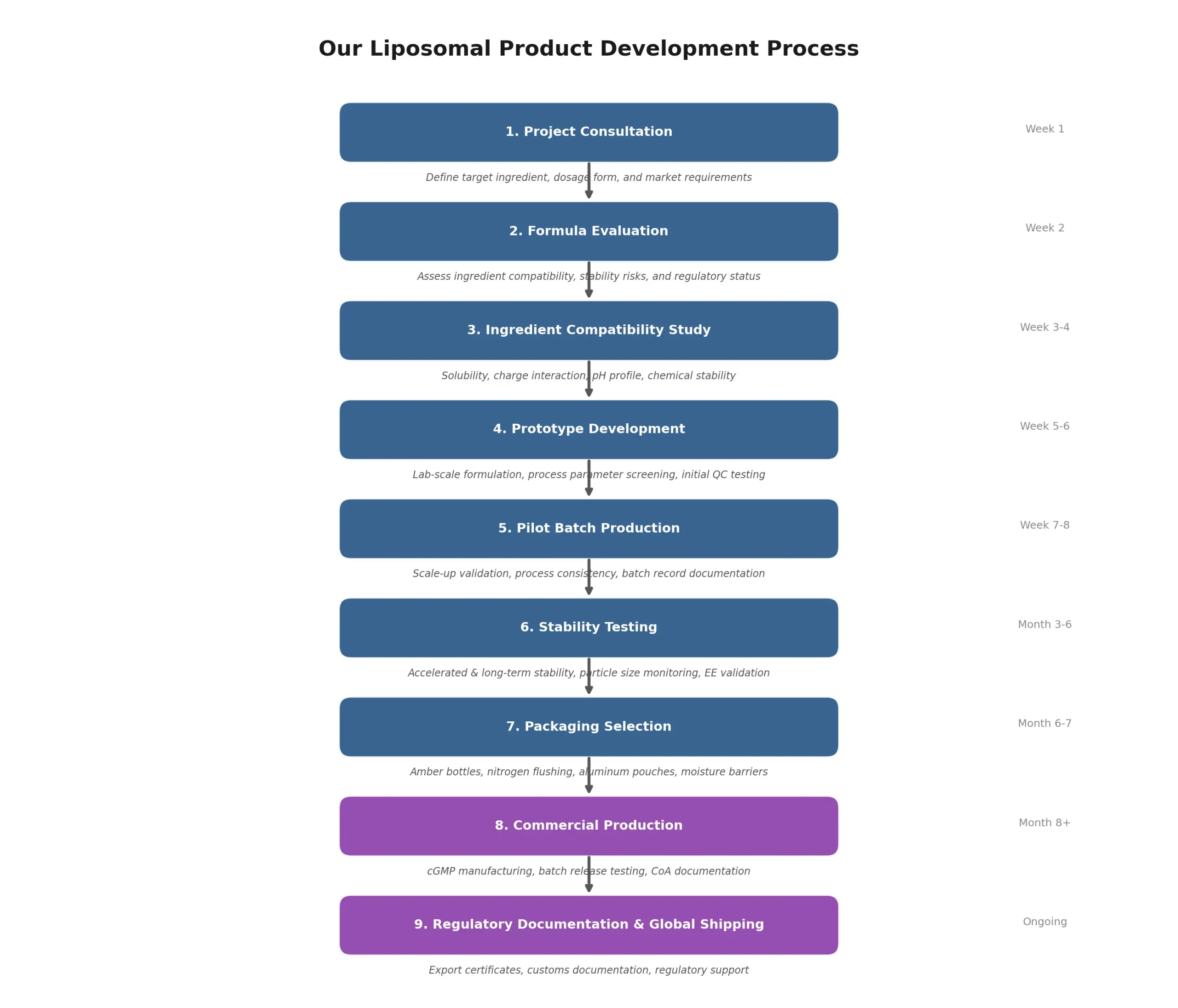
| Stage | Timeline | Key Deliverables |
| 1. Inquiry | 1–3 days | Requirements document; initial feasibility assessment |
| 2. Formula & Quotation | 3–7 days | Custom formula proposal; pricing; regulatory pathway review |
| 3. Sample | 1–2 weeks | Physical sample with COA; organoleptic evaluation |
| 4. Pilot Batch | 2–3 weeks | 1–10 kg powder or 5,000–50,000 units; stability samples retained |
| 5. Scale-Up | 3–4 weeks | Process parameter lock; equivalence data; batch record validation |
| 6. Commercial Production | Per schedule | Full-scale manufacturing; in-process controls; finished product testing |
| 7. QC Release & Delivery | 1–2 weeks | Final COA; regulatory documentation; export logistics |
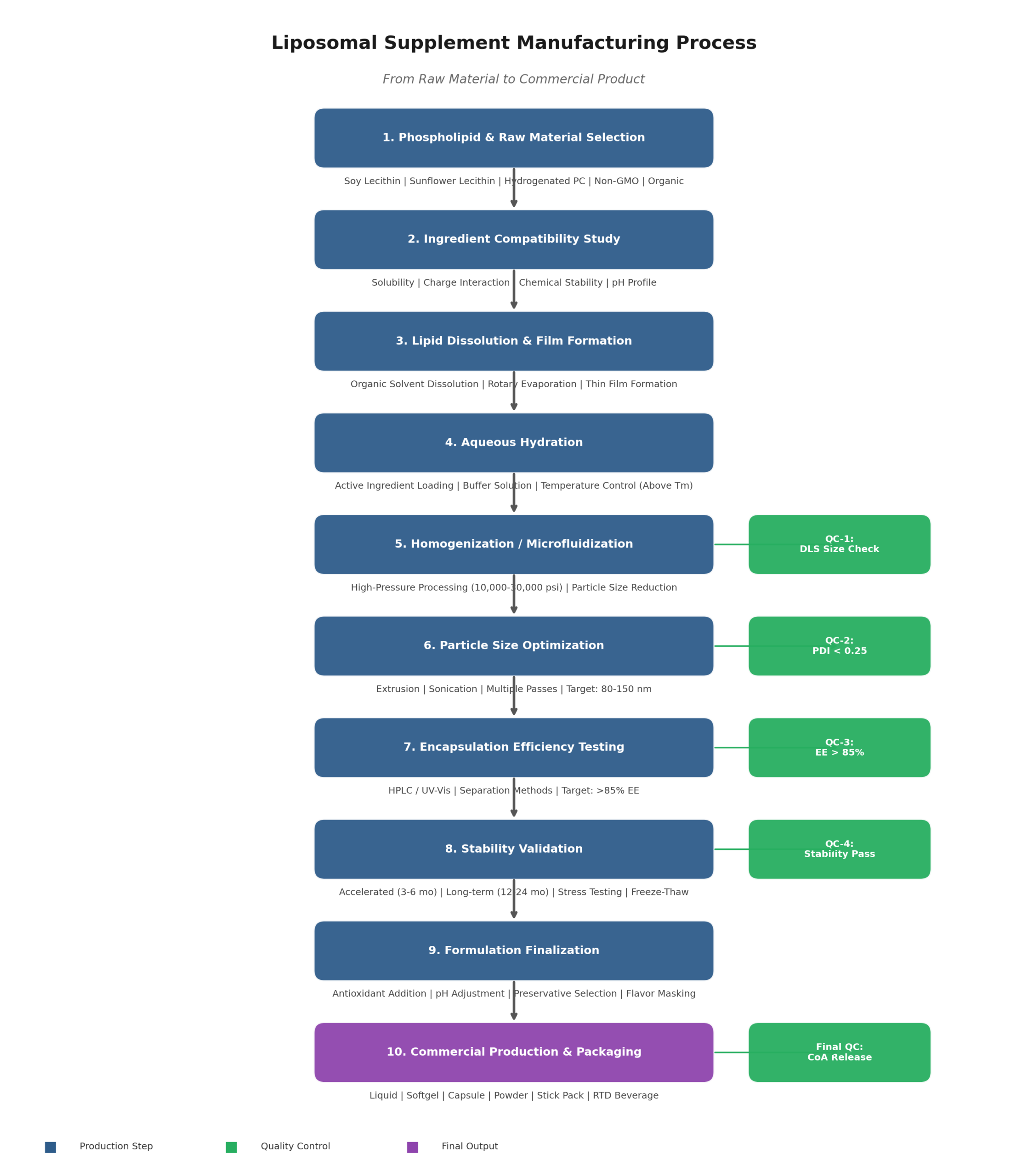
Commercial Production Overview
Formula Design → Pilot Batch → Scale-Up Validation → Commercial Production → QC Testing → Global Delivery
Standard Contract Manufacturing Benchmarks (US/EU OEM)
Manufacturing scale is directly tied to dosage form complexity:
- Capsules / Tablets: ~2,500 units minimum (6–8 weeks lead time)
- Softgels: ~8,500 units minimum (8–10 weeks)
- Gummies: ~2,500 units minimum (8–10 weeks)
- Powder systems: ~1,500 units minimum (6–8 weeks)
- Liquid systems: ~5,000 units minimum (8–10 weeks)
- Effervescents: ~2,500–5,000 units minimum
Startup & Low-MOQ Entry Pathways
For early-stage brands or market validation:
- Private label US shipment: ≤500 bottles (low-risk validation batch)
- Bulk liposomal powder (50–70% VC): 1 kg entry level
- High purity liposomal powder: ~1 kg premium grade input
- Japanese OEM systems: ~1,000+ capsules (premium beauty positioning)
- European liposomal powders: custom formulations with multi-active systems
Cost Structure Logic (Critical Procurement Insight)
Three core cost drivers determine product feasibility:
- MOQ leverage effect
- Low MOQ → 2–3× higher unit cost
- High MOQ → significant cost reduction but higher capital exposure
- Landed cost structure
- Typically 1.5–2× factory price after freight, customs, and brokerage
- Raw material complexity
- Liposomal systems cost 3–5× more than standard vitamin C due to phospholipid encapsulation requirements
For B2B brand owners, formulation and format decisions should follow a market-entry-to-scale logic model:
1) Market Entry Strategy (Lowest Risk)
- Immune stack formulation (Vitamin C + Zinc + Quercetin + Bioflavonoids)
- Hard capsule format
- Amazon / iHerb validated positioning
This represents the lowest failure-risk category entry point.
2) High-Growth Expansion Strategy
- Beauty-from-within systems (Vitamin C + Collagen + Hyaluronic Acid + Glutathione)
- Powder or effervescent formats
- DTC + influencer-driven distribution model
This is currently the fastest-growing commercial segment globally.
3) Market Expectation Shift (Critical Insight)
- Liposomal delivery is now baseline expectation, not premium differentiation
- Clean-label phospholipid sourcing (non-GMO sunflower lecithin) is mandatory
- Consumers actively evaluate CoA, particle size, and encapsulation transparency
4) Dose Positioning Strategy
- 500 mg → entry-level wellness positioning
- 1,000 mg → clinical-grade mainstream standard
- 1,500 mg+ → performance / biohacking segment
5) Format-to-Demographic Mapping
- Capsules → 45+ convenience-driven consumers
- Liquids / sachets → 25–45 lifestyle + travel users
- Powders → 25–40 beauty + fitness segment
- Gummies → families and entry-level users
6) Compliance & Risk Constraints
- FDA classification: dietary supplement (not drug)
- Only structure/function claims permitted:
- immune support
- antioxidant protection
- collagen synthesis support
- Disease claims are strictly non-compliant
7) Supply Chain Risk Considerations
Phospholipid sourcing (especially sunflower lecithin) is a critical supply chain dependency risk factor.
Recommended sourcing strategy:
- Diversify away from geopolitically unstable regions
- Prefer Argentina and European non-GMO lecithin supply chains
- Lock long-term contracts for stability assurance
| Packaging Format | Barrier Properties | Best For | Shelf Life Support |
| Aluminum Laminate Pouches | Excellent moisture, oxygen, and light barrier | Stick packs; bulk powder; export shipments | 24–36 months |
| HDPE Bottles + Induction Seal | Good moisture barrier; moderate oxygen barrier | Standard retail; North American market | 18–24 months (with desiccant) |
| Blister Packs (Alu-Alu) | Excellent individual dose protection; zero moisture transmission | Pharmacy channel; clinical trials; premium positioning | 24–36 months |
| Amber Glass Bottles | Excellent light protection; good oxygen barrier (with proper seal) | Liquid formulations; premium positioning | 12–18 months (liquid) |
| Nitrogen-Flushed Containers | Displaced oxygen reduces oxidation risk | High-value formulations; extended shelf life targets | +6–12 months extension |
Packaging Components
- Desiccants:Silica gel canisters (1–3 g per bottle, depending on headspace volume) for powder products
- Oxygen Absorbers:Iron-based scavengers for oxygen-sensitive formulations
- Nitrogen Flushing:Applied during filling to reduce headspace oxygen to <3%
- Secondary Packaging:Cartons with UV varnish for light protection; tamper-evident seals
Storage Recommendations
| Product Form | Recommended Storage | Acceptable Range | Critical Warnings |
| Powder (spray-dried) | 15–25°C; <60% RH | 5–30°C; <75% RH | Protect from moisture and direct sunlight |
| Powder (freeze-dried) | 2–8°C preferred; 15–25°C acceptable | 2–30°C; <60% RH | Refrigeration extends shelf life; protect from moisture |
| Liquid suspension | 2–8°C | 2–25°C (short-term) | Shake well before use; do not freeze |
| Capsule / Softgel | 15–25°C; <60% RH | 5–30°C; <75% RH | Protect from heat and humidity |
Standard Batch Documentation
- Certificate of Analysis (COA)— Batch-specific test results for all specification parameters
- Product Specification— Complete quality specification with test methods and acceptance criteria
- Technical Data Sheet (TDS)— Product description, composition, physicochemical properties, handling guidelines
- Material Safety Data Sheet (MSDS)— Safety information, hazard classification, handling precautions, first aid
- Residual Solvent Report— GC-MS analysis confirming compliance with ICH Q3C limits
- Heavy Metal Report— ICP-MS data for Pb, Cd, As, Hg
- Microbiology Report— TAMC, TYMC, specified organism testing per USP <61>, <62>
- Stability Summary— Available stability data with storage conditions and retest period
Regulatory & Compliance Statements
- Allergen Statement— Free from major allergens; customizable per market requirements
- Non-GMO Statement— Available for non-GMO formulations
- BSE/TSE Statement— Free from bovine spongiform encephalopathy / transmissible spongiform encephalopathy risk materials
- Halal Certificate— Available upon request
- Kosher Certificate— Available upon request
- ISO 22000— Certified
- FSSC 22000— Certified
- cGMP Compliance— Per 21 CFR Part 111 (US) and applicable EU regulations
Ready to Develop Your Liposomal Vitamin C Product with KS Nutripharma?
Whether you are launching a new premium liposomal supplement or expanding your existing product portfolio, our formulation scientists and manufacturing team are ready to support every stage of development—from concept and pilot production to full-scale commercial manufacturing.
Let’s Build Your Next Liposomal Supplement Together
✔ Custom Formula Development
✔ OEM & Private Label Manufacturing
✔ Pilot Batch Production
✔ Regulatory Documentation
✔ Global Export Support
Request a Formula Consultation | Request Samples | Get an OEM Quotation