

Engineering Liposomal NMN Formulations for Commercial Manufacturing
Liposomal NMN Supplements are advanced NAD+ precursor formulations designed to improve NMN stability, bioavailability, and delivery efficiency through phospholipid-based liposomal technology. For nutraceutical brands, they are no longer positioned as single-ingredient products, but as formulation platforms enabling combinations such as NMN with Resveratrol, CoQ10, or other longevity and energy-support compounds.
KS Nutripharma operates as an OEM/ODM contract manufacturer, focusing on liposomal delivery system development and private label production. It is built around turnkey formulation services, supporting global brands from product concept and formulation design to scalable manufacturing and compliant packaging for commercial supplement launches.
| 19+ Years Nutraceutical Manufacturing | 81,000 m² GMP-Compliant Facility | 12 Production Lines |
| 500+ Brands Served Globally | 60+ Export Markets | 2 Dedicated R&D Centers |
| 5 M Capsules / Day | 2M Softgels / Day | 12M Tablets / Day |
| 2 M Gummies / Day | 7 International Certifications | 100% Batch Traceability |
Dedicated Liposome Production Infrastructure
- High-Pressure Homogenization Systems: Industrial-scale high-pressure homogenization systems optimized for liposome formation, particle size reduction, and batch-to-batch consistency.
- Liposomal Drying Technologies — Spray-dried and freeze-dried manufacturing options selected according to formulation characteristics, stability objectives, dosage form, and commercial positioning.
- Liposome Characterization — In-house characterization capabilities including particle size distribution, polydispersity index (PDI), encapsulation efficiency evaluation, and zeta potential analysis for formulation optimization and quality verification.
- Powder Redispersibility – Evaluation of powder redispersibility after reconstitution to support consistent product performance.
- Process Scale-Up Engineering – Process transfer from laboratory development to pilot production and full-scale commercial manufacturing while maintaining critical quality attributes.
- Dynamic Light Scattering (DLS)— In-house particle size analysis.
- HPLC Analytical Laboratory—Analytical laboratory supporting raw material identification, assay verification, encapsulation efficiency studies, stability evaluation, and finished product quality control.
- Phospholipid Carrier Development— Scientific selection and optimization of phospholipid carrier systems based on ingredient compatibility, phosphatidylcholine content, dosage form, and stability requirements.
- ICH-Compliant Stability Chambers— Stability studies designed according to ICH guidelines, including evaluation of particle size stability, encapsulation integrity, moisture control, and active ingredient retention throughout shelf life.
- Pilot Development & Process Validation— Pre-commercial validation batches (1–10 kg powder; 5,000–50,000 finished units), supports formulation optimization, engineering verification, process scale-up, and commercial readiness prior to full-scale manufacturing.
Liposomal NMN Manufacturing Options
Hard Capsules · Softgels · Stick Packs · Liquid Sachets · Bulk Powders · Functional Beverages · Oral Liquids
HDPE Bottles · Aluminum Laminate Pouches · Blister Packs (Alu-Alu) · Amber Glass · Nitrogen-Flushed Containers · Bulk Packaging
Supporting international brands across North America, Europe, Oceania, Southeast Asia and the Middle East.
US FDA (21 CFR Part 111) · EU Food Supplements (EC 1925/2006) · TGA Listing · HALAL · KOSHER
WHY CHOOSE LIPOSOMAL NMN FOR SUPPLEMENTS?
→ Liposomal encapsulation protects NMN inside phospholipid bilayers, improving resistance to heat, moisture, and oxidation
→ Liposomal delivery enhances intestinal transport efficiency and improves absorption consistency across batches
→ Liposomal system enables stable integration with Resveratrol, CoQ10, PQQ and other NAD+ pathway actives
→ Liposomal delivery system enables brands to build a technology-driven positioning angle, helping define a distinct market identity beyond dosage competition and support premium differentiation in crowded retail channels
→ Delivery-system branding + improved perceived absorption technology supports higher consumer trust and premium positioning
→ Liposomal format supports multiple dosage forms (liquid, powder, beadlets) for flexible OEM product line expansion
Established (Mature) Selling Formulations
- NMN: 250–500mg
- Resveratrol: 50–100mg (trans-form preferred)
- Positioning: SIRT1 activation + NAD+ support synergy
- Market status: #1 best-selling NMN stack globally (Amazon-led demand)
- Key commercial logic: “longevity pathway dual activation”
- NMN: 250–500mg
- TMG: 50–500mg
- Positioning: methyl donor replenishment during NAD+ synthesis
- Commercial use: liquid and capsule formats in US/EU premium brands
- Key logic: prevents methyl depletion at high NMN dosage
- NMN + full B spectrum (B1–B12)
- Positioning: energy metabolism + cellular cofactor replenishment
- Strong fit: liquid “daily wellness” SKUs
- Use case: entry-level longevity consumers
- NMN: 250mg standard dose
- Carrier: sunflower phospholipids
- Positioning: minimalist, clinically transparent formulation
- Market demand: subscription-driven “baseline longevity product”
High-Growth Formulation Trends (2026+)
Positioning: NAD+ + senescence control + methylation + SIRT activation
Market behavior: strongest growth in “all-in-one longevity” segment
Positioning: mitochondrial biogenesis + ATP support system
Key insight: aligns with energy-performance consumer segment (40–60 male skew)
Positioning: autophagy + absorption enhancement
BioPerine increases absorption efficiency of polyphenols and alkaloids
Positioning: beauty-from-within NAD+ skin axis
Strong demand in Asia + US premium beauty beverage category
Positioning: stress modulation + cognitive longevity
Used in “calm energy” formulations for younger demographics
Positioning: Skin hydration + radiance + cellular vitality support
Market Logic: Combines NAD+ cellular energy pathway with structural skin support (collagen + HA), targeting aging + beauty dual demand
Additional Synergistic Co-Ingredients (Formulation Opportunities)
The following co-ingredients represent low-to-moderate saturation, science-backed actives that are widely used in advanced supplement positioning but still offer room for brand-level differentiation when structured correctly within NMN systems.
Ingredients in this group are primarily used to support cellular cleanup, mitochondrial renewal, and longevity pathways, making them highly compatible with NMN-based formulations targeting aging and biohacking consumers.
Fisetin: Senolytic compound associated with senescent cell clearance and cellular renewal (100–500mg; capsules or powder)
Urolithin A: Activates mitophagy and supports mitochondrial recycling (500–1000mg; capsules)
Pterostilbene: Methylated resveratrol analog supporting SIRT1-related longevity pathways (50–100mg; capsules)
Apigenin: CD38 inhibitory activity, supporting NAD+ preservation and metabolic efficiency (50mg; capsules)
Trigonelline: Alternative NAD+ precursor derived from coffee alkaloids, used in cellular energy positioning (50–170mg; capsules)
This category supports energy metabolism, glucose regulation, and mitochondrial oxidative balance, frequently used in performance-oriented NMN products.
Alpha-Lipoic Acid (R-ALA): Mitochondrial antioxidant that regenerates glutathione and supports metabolic resilience (100–300mg; capsules or powder)
Berberine: AMPK pathway activator widely used in metabolic health formulations (500mg; capsules or powder)
CoQ10 / Astaxanthin (functional pairing option): Supports mitochondrial electron transport and oxidative stress protection (dose varies; softgels preferred)
Taurine: Osmoregulation and cardiovascular energy support (500–2000mg; capsules or powder)
Sodium Bicarbonate: Performance buffering agent used in athletic endurance positioning (50–100mg; powder or capsules)
Designed for brands positioning NMN within cell protection, detox, and oxidative stress defense frameworks.
Glutathione (Reduced/Liposomal): Master antioxidant supporting detoxification pathways (250–500mg; liquid or capsules)
Sulforaphane (Glucoraphanin): Nrf2 pathway activator supporting endogenous antioxidant response (30–100mg; capsules)
L-Cysteine / NAC: Glutathione precursor supporting respiratory and detox pathways (200–600mg; capsules or powder)
Alpha-Lipoic Acid (dual function): Also positioned in mitochondrial antioxidant system (see above)
These ingredients support brain function, stress modulation, sleep quality, and neurotransmitter balance, often used in “daily performance” NMN products.
CDP-Choline (Citicoline): Phospholipid precursor supporting cognitive function and neuronal membrane integrity (250mg; capsules or powder)
Magnesium (Threonate / Bisglycinate): Supports NMDA receptor modulation, sleep quality, and neural relaxation (100–400mg; capsules or powder)
Niacinamide (NAM): NAD+ pathway intermediate with additional skin barrier support positioning (50–100mg; capsules or topical)
Nervonic Acid
A long-chain monounsaturated fatty acid essential for myelin sheath structure and neuronal membrane insulation. It is increasingly used in next-generation brain lipid formulations focused on long-term cognitive integrity and neurodevelopment support.
(50–200mg; capsules or lipid-based delivery systems)
Core Engineering Parameters for Liposomal Systems
Liposomal performance is defined not by ingredient selection alone, but by structural engineering quality at the nanoscale level. These parameters directly determine bioavailability consistency, batch reproducibility, shelf stability, and retail performance—which are critical for commercial success in premium supplement markets.
For OEM buyers, these metrics represent the difference between a standard liposomal product and a clinically credible delivery system.
Ensures uniform nanoscale dispersion across batches.
→ Directly influences absorption consistency and bioavailability predictability in end consumers.
Measures how effectively active ingredients are entrapped within phospholipid vesicles.
→ Higher EE% = higher functional payload delivery + improved cost efficiency per mg active.
Indicates electrostatic repulsion between particles.
→ Prevents aggregation, phase separation, and instability during storage.
Defines particle uniformity within the formulation.
→ Lower PDI = more consistent absorption behavior and improved product visual stability.
Evaluates resistance of phospholipids and actives to oxidative degradation.
→ Directly extends shelf life and preserves functional potency during distribution.
Measures structural recovery after spray-drying or freeze-drying processes.
→ Ensures liposomal integrity is preserved after conversion into powder formats.
Assesses structural resistance under thermal and mechanical stress.
→ Enables scalable industrial production without performance degradation.
High-purity phosphatidylcholine systems enhance membrane mimicry.
→ Improves cellular uptake efficiency and delivery performance.
Validates long-term degradation behavior under commercial storage conditions.
→ Critical for retail distribution, export compliance, and brand reputation protection.
Available Manufacturing Formats
Instead of offering a single delivery format, liposomal systems should be selected based on market positioning, consumer behavior, and product lifecycle strategy. Each format is engineered for a specific commercial use case.
MOQ: 100,000 units
Designed for scalable retail distribution and stable daily supplementation products.
Best for:
- Daily wellness and longevity SKUs
- Multi-ingredient NMN stacks
- Large-scale retail and Amazon distribution
Manufacturing base:
Spray-dried liposomal powder encapsulated into vegetarian or gelatin capsules
Commercial advantage:
- Highest scalability
- Strong supply chain compatibility
- Ideal for subscription-based business models
MOQ: 100,000 units
Designed for lipid-compatible actives and high-end anti-aging positioning.
Best for:
- Premium longevity products
- CoQ10, astaxanthin, fat-soluble actives
- High-margin brand positioning
Manufacturing base:
Oil-phase liposomal suspension system
Commercial advantage:
- Strong consumer trust perception
- Superior lipid absorption pathway compatibility
- Premium retail positioning
MOQ: 50,000 units
Designed for modern DTC, subscription, and lifestyle nutrition brands.
Best for:
- Beauty-from-within formulations
- NMN + collagen + functional blends
- Travel-friendly nutrition products
Manufacturing base:
Spray-dried liposomal powder with single-dose packaging
Commercial advantage:
- High formulation flexibility
- Excellent flavor customization potential
- Strong e-commerce conversion performance
MOQ: 50,000 units
Designed for high-end convenience-based supplementation.
Best for:
- Ready-to-drink longevity products
- NMN + B-complex + TMG liquids
- Premium daily wellness systems
Manufacturing base:
Stabilized liposomal liquid system
Commercial advantage:
- Zero-preparation consumption
- Premium user experience
- High perceived value per serving
MOQ: 25 KG
Designed for manufacturers, distributors, and brand builders requiring downstream flexibility.
Best for:
- Private label expansion
- Regional distribution networks
- Custom formulation development
Manufacturing base:
Spray-dried or freeze-dried liposomal powder systems
Commercial advantage:
- Maximum formulation flexibility
- Multiple downstream product applications
- Optimized cost structure at scale
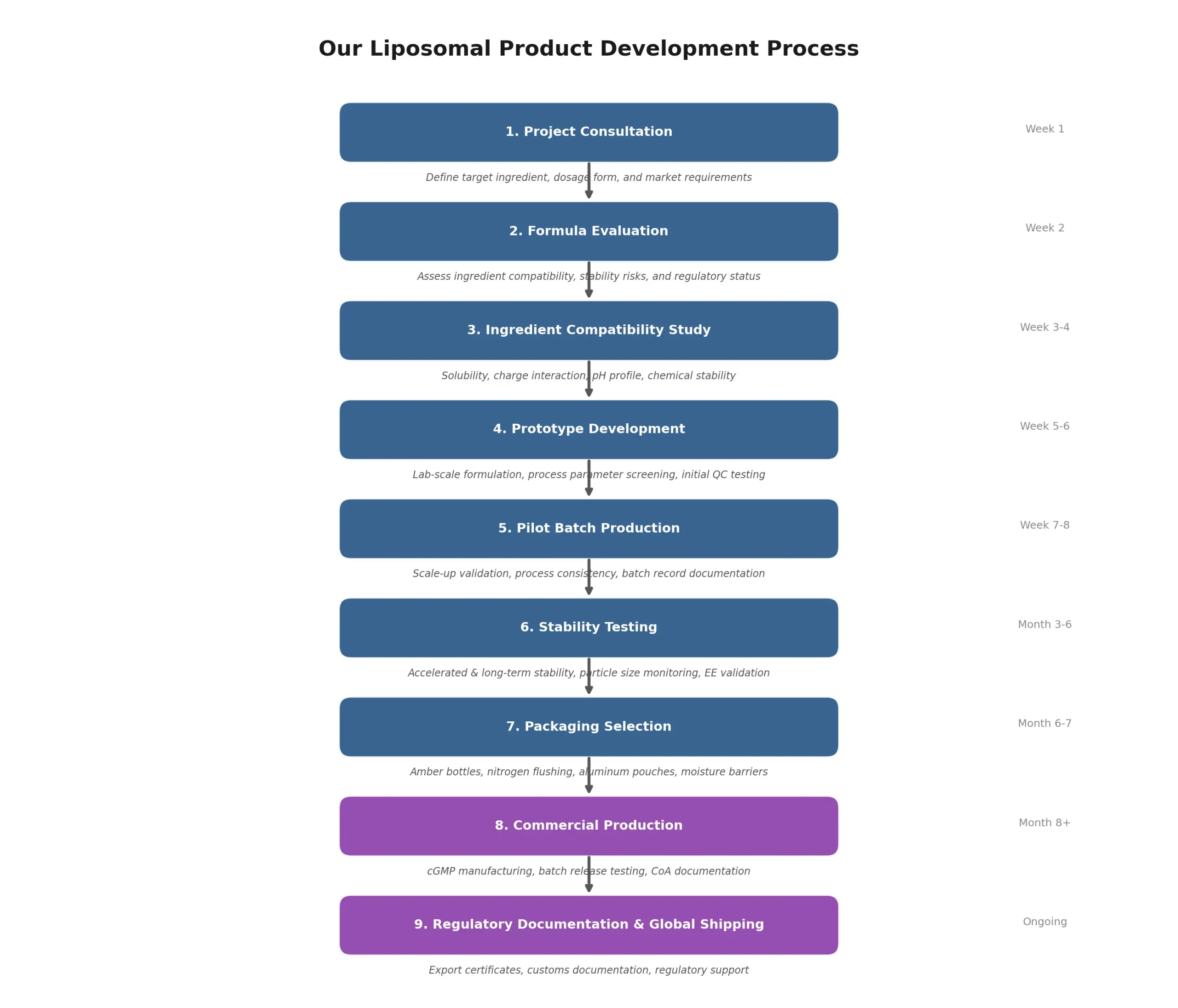
| Stage | Timeline | Key Deliverables |
| 1. Inquiry | 1–3 days | Requirements document; initial feasibility assessment |
| 2. Formula & Quotation | 3–7 days | Custom formula proposal; pricing; regulatory pathway review |
| 3. Sample | 1–2 weeks | Physical sample with COA; organoleptic evaluation |
| 4. Pilot Batch | 2–3 weeks | 1–10 kg powder or 5,000–50,000 units; stability samples retained |
| 5. Scale-Up | 3–4 weeks | Process parameter lock; equivalence data; batch record validation |
| 6. Commercial Production | Per schedule | Full-scale manufacturing; in-process controls; finished product testing |
| 7. QC Release & Delivery | 1–2 weeks | Final COA; regulatory documentation; export logistics |
Commercial Production Overview
Formula Design → Pilot Batch → Scale-Up Validation → Commercial Production → QC Testing → Global Delivery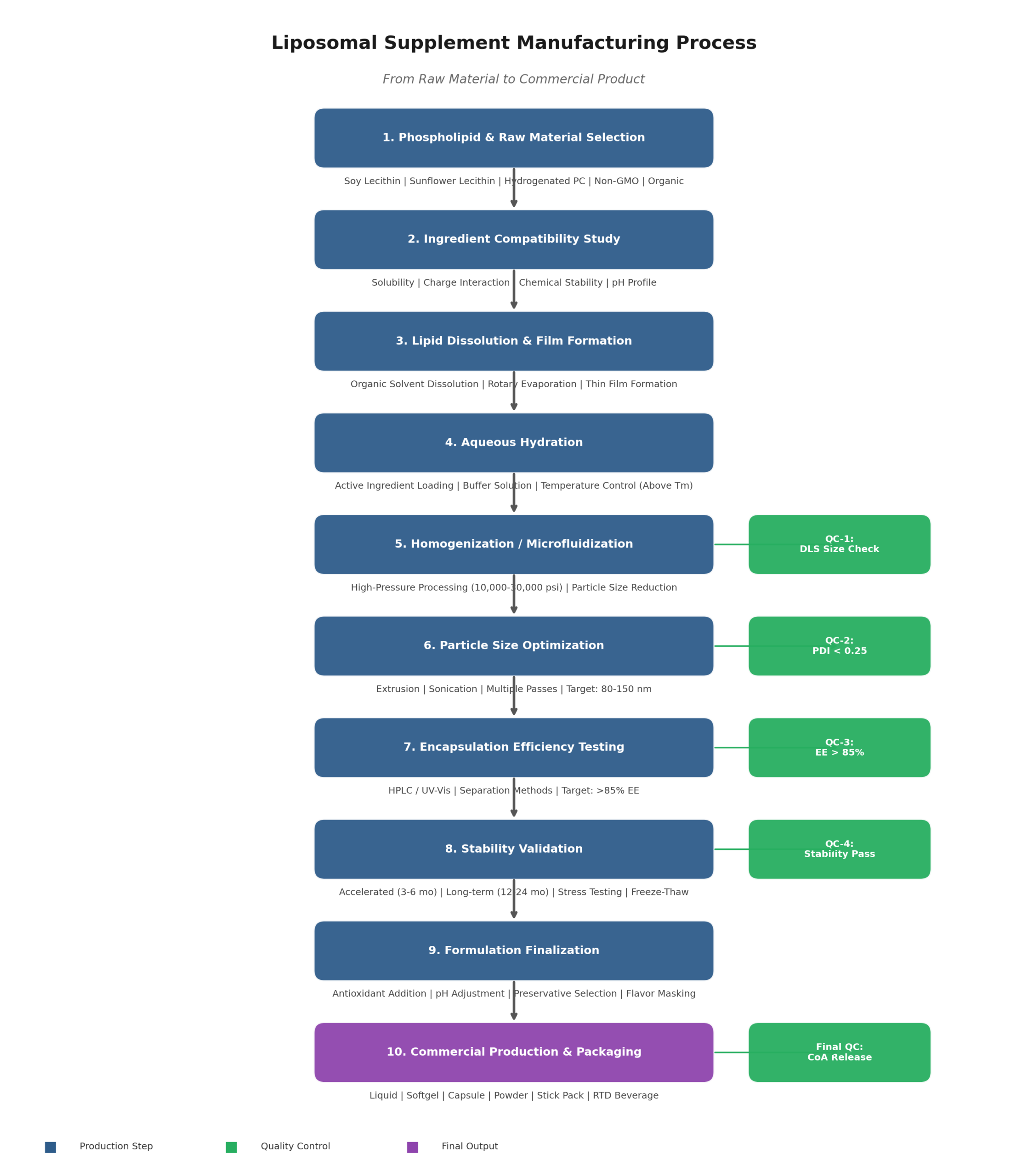
| Packaging Format | Barrier Properties | Best For | Shelf Life Support |
| Aluminum Laminate Pouches | Excellent moisture, oxygen, and light barrier | Stick packs; bulk powder; export shipments | 24–36 months |
| HDPE Bottles + Induction Seal | Good moisture barrier; moderate oxygen barrier | Standard retail; North American market | 18–24 months (with desiccant) |
| Blister Packs (Alu-Alu) | Excellent individual dose protection; zero moisture transmission | Pharmacy channel; clinical trials; premium positioning | 24–36 months |
| Amber Glass Bottles | Excellent light protection; good oxygen barrier (with proper seal) | Liquid formulations; premium positioning | 12–18 months (liquid) |
| Nitrogen-Flushed Containers | Displaced oxygen reduces oxidation risk | High-value formulations; extended shelf life targets | +6–12 months extension |
Packaging Components
- Desiccants:Silica gel canisters (1–3 g per bottle, depending on headspace volume) for powder products
- Oxygen Absorbers:Iron-based scavengers for oxygen-sensitive formulations
- Nitrogen Flushing:Applied during filling to reduce headspace oxygen to <3%
- Secondary Packaging:Cartons with UV varnish for light protection; tamper-evident seals
Storage Recommendations
| Product Form | Recommended Storage | Acceptable Range | Critical Warnings |
| Powder (spray-dried) | 15–25°C; <60% RH | 5–30°C; <75% RH | Protect from moisture and direct sunlight |
| Powder (freeze-dried) | 2–8°C preferred; 15–25°C acceptable | 2–30°C; <60% RH | Refrigeration extends shelf life; protect from moisture |
| Liquid suspension | 2–8°C | 2–25°C (short-term) | Shake well before use; do not freeze |
| Capsule / Softgel | 15–25°C; <60% RH | 5–30°C; <75% RH | Protect from heat and humidity |
Standard Batch Documentation
- Certificate of Analysis (COA)— Batch-specific test results for all specification parameters
- Product Specification— Complete quality specification with test methods and acceptance criteria
- Technical Data Sheet (TDS)— Product description, composition, physicochemical properties, handling guidelines
- Material Safety Data Sheet (MSDS)— Safety information, hazard classification, handling precautions, first aid
- Residual Solvent Report— GC-MS analysis confirming compliance with ICH Q3C limits
- Heavy Metal Report— ICP-MS data for Pb, Cd, As, Hg
- Microbiology Report— TAMC, TYMC, specified organism testing per USP <61>, <62>
- Stability Summary— Available stability data with storage conditions and retest period
Regulatory & Compliance Statements
- Allergen Statement— Free from major allergens; customizable per market requirements
- Non-GMO Statement— Available for non-GMO formulations
- BSE/TSE Statement— Free from bovine spongiform encephalopathy / transmissible spongiform encephalopathy risk materials
- Halal Certificate— Available upon request
- Kosher Certificate— Available upon request
- ISO 22000— Certified
- FSSC 22000— Certified
- cGMP Compliance— Per 21 CFR Part 111 (US) and applicable EU regulations
Ready to Develop Your Liposomal NMN Product with KS Nutripharma?
Whether you are launching a new premium liposomal supplement or expanding your existing product portfolio, our formulation scientists and manufacturing team are ready to support every stage of development—from concept and pilot production to full-scale commercial manufacturing.
Let’s Build Your Next Liposomal Supplement Together
✔ Custom Formula Development
✔ OEM & Private Label Manufacturing
✔ Pilot Batch Production
✔ Regulatory Documentation
✔ Global Export Support
Request a Formula Consultation | Request Samples | Get an OEM Quotation