
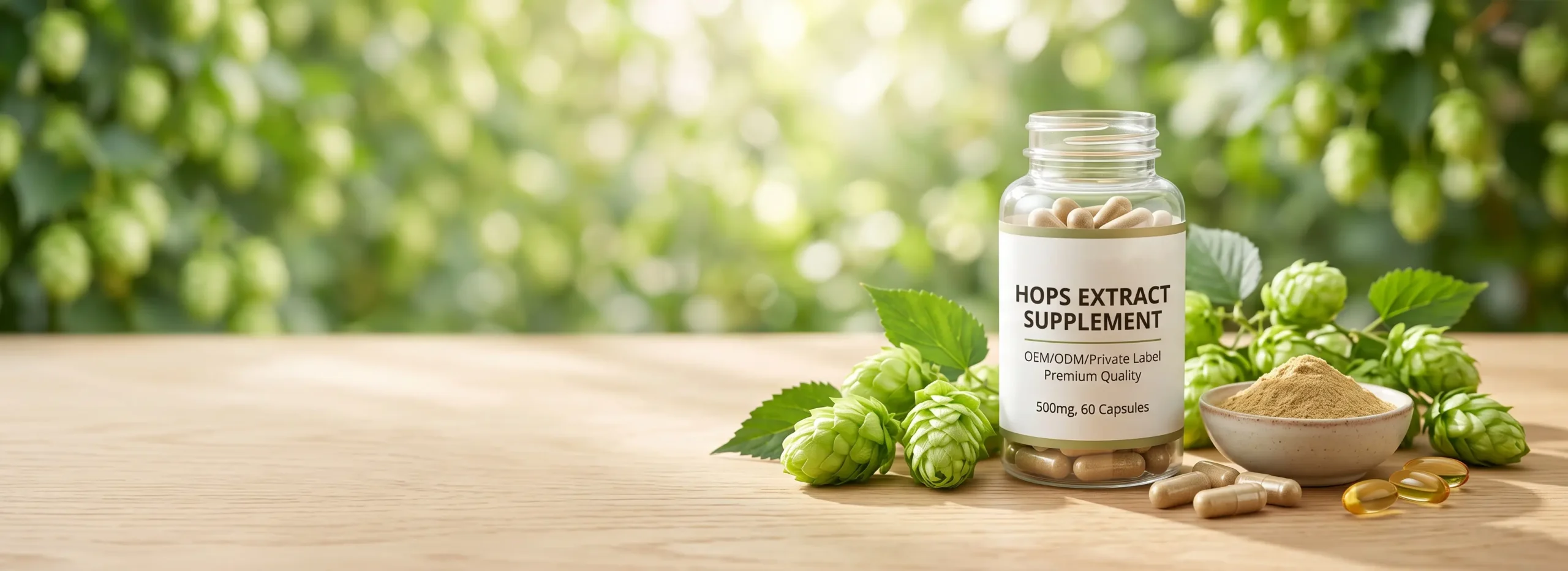
KS Nutripharma is a hops extract supplement manufacturer for OEM, ODM, and private-label programs. We develop finished hops extract dietary supplements—capsules, tablets, powders, and gummies, as cone-extract SKUs or valerian-pair evening formulas—for sleep-support assortments, with a locked Humulus lupulus female-cone / strobile grade, formula architecture, and batch COA.
Hops extract supplement and hop extract supplement are the same commercial product when the species is H. lupulus and the plant part is the female cone (strobile, hop flower). A ratio cone extract, a bitter-acid-specified cone extract, and milled cone powder are different PO lines. Other hop-industry files (xanthohumol-standardized, matured hop / MHE, brewing resins) are routed in the fork below — lock plant part, process story, analyte, method, and milligrams per serving before comparing quotes.
Already have a formula or COA? Send it. We confirm identity, extract definition, companions, format, and destination market before quotation.
Have an existing product? Send Your Formula or COA
Developing a new SKU? Get Formula Support
Ready to source? Request a Manufacturing Quote
cGMP · ISO 9001 · ISO 22000 · HACCP · FSSC 22000 · Halal · Kosher · in-house lab + SGS/Eurofins pathways · batch COA
About Us · Manufacturing Capacity · Certifications · Quality Control
Typical first reply is one business day on a complete brief. An NDA is available before you send a BOM. A project manager is assigned when the specification is in review.
Hops Extract Manufacturing at a Glance
What you confirm so the first quote is usable | Typical project answer |
|---|---|
| Which hops industry | Evening cone extract supplement. Xanthohumol mg, matured hop / MHE, or brewing CO₂ / iso-alpha → different file (see fork) |
| Botanical | Humulus lupulus L. Female cone / strobile / hop flower. Not leaf, brewing pellet, or malt as the named part |
| Material route | Cone powder / named-ratio extract / bitter-acid-specified extract — name one |
| Markers | DER or named bitter acids + method. “10% standardized” without the analyte is not a PO |
| Clock | Evening. Daytime hops as a hero is usually the wrong SKU |
| Architecture | S01 valerian pair (default commercial) / S02 solo cone / S03 + magnesium or theanine |
| Fill-weight talk | Combo talk often 60–120 mg hops extract; solo talk often 100–350 mg — development windows for capsule fill, not intake recommendations |
| Formats | Capsules first (bitterness enclosed). Tablets with a moisture-barrier coat. Powder / gummies after a bitterness review |
| Special files | 8-PN on pack, branded extracts, or hormone-adjacent positioning → separate specification |
| MOQ / lead time | Capsules about 3,000–5,000 units; tablets about 5,000–10,000; samples 7–15 days after spec lock; mass production 30–45 days after formula, artwork, pack, and schedule |
Which Hops Extract Are You Actually Buying?
The phrase hops extract is four industries sharing one English name. Quotes fail when those four files are priced as one. Identify the stream before you issue an RFQ.
Stay — Evening cone extract (this page)
You want this if: The label will say hops / Humulus lupulus cone, flower, or strobile extract for an evening sleep-adjacency SKU, often next to valerian. Searchers who meant hops extract for sleep land here.
What we lock: Plant part, solvent/DER or named bitter acids, serving mg, format, destination-market language.
What we do not lock by default: Xanthohumol milligrams, matured hop bitter-acid appetite grades, brewing IBU.
Leave — Matured hop extract / MHE
You want a different file if: The brief names matured hop extract, MHE, or appetite / weight-loss positioning built on matured bitter acids. That is a different process story, serving math, and claim-risk file.
Why we will not quote it here: Oxidized matured hop bitter acids are not evening cone extract and not a hidden grade of S01. Open a separate brief if that is the true ingredient class.
Bridge — Xanthohumol-standardized hops
You want the xanthohumol factory path if: The panel or A+ copy will print xanthohumol mg as the hero. That is a polyphenol SKU, not a valerian-pair sleep herb.
Go to: xanthohumol supplements. Cone extract and xanthohumol-standardized material are different purchase orders.
Leave — Brewing CO₂, iso-alpha, hop water, malt
You want a brewery supplier if: The brief is CO₂ hop extract, isomerized resins, hop extract for brewing, hop water, or hopped malt extract. Those materials are specified for beer or flavored beverages — often viscous resins calibrated by IBU — not for a free-flowing dietary-supplement capsule COA.
If you are still unsure, send the COA. Identity mistakes are cheaper to catch before sampling.
Evening Hops SKUs Brands Actually Launch
These are the architectures that show up on sleep shelves — starting points for private-label development, not frozen SKUs. Pick the closest card or send a BOM. KS formulation team and R&D center match the brief to channel and destination market, then lock the cone file against that BOM.
Use when: The brand is building a traditional botanical evening formula commonly formulated with hops and valerian. Hops is a named identity next to valerian — not a 15 mg dusting. Searchers who meant hops extract for sleep often start here. Category home: sleep-support.
Specify: Hops cone extract mg + DER or bitter-acid file; valerian root extract mg + its own marker file (valerenic acids if claimed); count per day; evening clock. Valerian manufacturer page — point-name only until live.
Trade-off: Fastest shelf recognition vs two assays, two aromas, and a next-day drowsiness label file. Vs S02: you keep valerian odor and a two-herb registration story. Proprietary combination names print only with a license.
Default format: Hard capsule.
Manufacturing note: Two botanicals, two assays. High-end talk (about 120 mg hops extract + 300 mg valerian extract) is often size 00 or a two-piece serving once flow aids are in — not a guaranteed single size 0. Structure/function only.
Use when: The panel must lead with hops / Humulus lupulus cone extract and the brand does not want valerian odor, valerian identity, or a two-herb registration story.
Specify: Extract mg in the solo window (see serving examples); plant part = cone; analyte + method; capsule vs tablet.
Trade-off: A clean single-herb label vs a thinner commercial and traditional-use story than the pair. Keep the hero as cone extract — do not re-label the same bottle as a xanthohumol polyphenol SKU or a matured-hop appetite SKU.
Default format: Hard capsule.
Manufacturing note: Incoming extract milligrams are not interchangeable with cone-powder milligrams.
Use when: The brief wants a melatonin-free evening capsule: cone extract plus a mineral or amino already on site. Pick one companion as the second identity: magnesium bisglycinate or L-theanine (point-name theanine if magnesium is the linked companion).
Specify: Hops cone file; elemental magnesium + salt or theanine grade + mg; capsule count (elemental Mg drives size).
Trade-off: A melatonin-free mineral/amino stack vs a larger unit than S01/S02. Oxide is not the evening default salt. Do not force 400 mg elemental magnesium plus a bitter high-load hops extract into one mini gummy. GABA, lemon balm, passionflower — point-name if the BOM lists them; no extra cards.
Default format: Hard capsule (often two pieces when elemental magnesium is high).
Manufacturing note: Fully reacted bisglycinate is bulky. Split count or a tablet before you shrink the shell. Two methods if both a botanical marker and a mineral/amino are labeled.
Choose the Hops Extract Format: Capsules, Tablets, Powder or Gummies
Hop cone extract is bitter and aromatic. Alpha and beta acids taste immediately on the palate; lupulin volatiles move through weak packs. That sensory file — not line speed — decides the first OEM unit.
Liquids, tinctures, teas, and hop oil are quoted after a dedicated feasibility file. Softgel only when an oil companion is on the BOM.
Best for: S01–S03 as the usual start — the hops extract capsule manufacturer path when bitterness, aroma, and companions share one dry unit.
Why: The shell keeps the shopper from tasting the BOM. Fastest sample loop. Lowest typical MOQ.
Typical formula cards: S01, S02, S03.
What to lock: HPMC vs gelatin; size 00 / 0 / 1; extract mg; whether valerian shares the fill; count.
Manufacturing note: Dark, aromatic, hygroscopic blends need flow aids. Dry cone extract is not a softgel fill unless an oil phase is on the BOM. Vegetarian softgel, if asked, is not an HPMC capsule rewritten as a softgel.
Best for: Pharmacy-compact S01/S02; coated tablets when a split capsule would leak odor; S03 when elemental magnesium will not fit one capsule.
Why: A moisture-barrier film manages surface bitterness and humidity. It is not delayed-release coating unless the BOM asks for delayed release.
Typical formula cards: S01, S02; S03 when count or mineral bulk forces a compressed unit.
What to lock: Tablet weight; coat type (barrier vs delayed-release — name one); valerian + hops fill; friability; disintegration as scoped to this coat.
Manufacturing note: A capsule BOM is re-validated before a tablet run. Mottling and weight variation are QC items on hygroscopic botanicals.
→ Tablets
Best for: Rare. Cone-powder identity SKUs, not flavored drink mixes as a default.
Why: Hop cone powder is aggressively bitter and fragrant in water. Masking often costs more than the herb.
Typical formula cards: Only when the brief insists on powder; usually steer back to capsules.
What to lock: Mesh; stick vs jar; whether any extract % will be claimed; flavor brief if a stick is on the RFQ.
Manufacturing note: Cone powder ≠ extract powder ≠ brewing pellet. A 10:1 dry extract milligram is not a cone-powder milligram.
Best for: Low-load S02 only after a sensory board. Not the default for S01 (two bitter botanicals) or S03 high-magnesium.
Why: Cook heat, moisture, and flavor systems fight both assay and lingering resinous bitterness.
Typical formula cards: Low-mg cone extract, if any (development talk often 25–50 mg extract per piece — fill and sensory check).
What to lock: mg extract per gummy; whether a marker will be printed; pectin vs gelatin; sugar system.
Manufacturing note: Finished-piece assay is mandatory if a marker is on the label. A capsule BOM is not a gummy BOM.
→ Gummies
A sleep-cone PO is not interchangeable with another “hops extract” kilogram until these fields are locked. Flower, cone, and strobile are the same plant part. The expensive miss on this botanical is pricing four industrial extracts as one.
Field to specify | Why it must be locked | Common miss |
|---|---|---|
| Humulus lupulus L. | Latin name is identity, not an IPA cultivar | Brewing trade name written as the supplement identity |
| Female cone / strobile / hop flower | Lupulin glands sit on the female inflorescence | Leaf, stem, brewing pellet, or malt as the named part |
| Route: powder / named-ratio extract / bitter-acid-specified extract | Three purchase orders | “Hops extract 150 mg” with no route |
| Analyte + method | Quotes are comparable only after this line exists | “10% standardized” with no compound named |
| Solvent / process story | Sleep hydro-ethanolic dry extract ≠ brewing CO₂ ≠ matured bitter acids | Mixing process stories on one RFQ |
| Incoming % vs finished mg | Bitter volatiles, humidity, and blending are not zero-loss | Drum COA copied onto the bottle |
Powder vs extract. Cone powder is identity, bulk, and a heavy aroma/bitterness load. A ratio extract needs a real DER and named solvent (ethanol/water is the usual sleep-cone pair). A bitter-acid-specified extract is a valid manufacturing conversation when the acids and the method are on the PO — release marker language, not a medical potency claim. Xanthohumol milligrams, matured bitter acids, or printed 8-PN micrograms belong on the matching file — not the default sleep-cone COA.
Standardized botanical pathways: standard extracts.
This section is serving architecture and capsule fill planning, not a recommended intake.
- S01 pair: Commercial/traditional combination talk often lands hops extract around 60–120 mg per serving, with valerian extract counted separately (often 150–300 mg in the same conversation). The numbers check capsule volume — not a licensed combination milligram to copy onto artwork.
- S02 solo: Shelf talk more often shows about 100–350 mg cone extract per serving. That is not the same fill story as 60 mg in a pair; the two files cannot be kg-price converted into each other.
- Cone powder: Fill is higher. Powder milligrams and extract milligrams are not comparable.
- Do not mix serving math from matured-hop appetite briefs, branded 8-PN microgram files, or brewing rates (g/hL).
- Gummies: Lock milligrams per piece before anyone prints a marker. High-load bitter botanicals are usually not one gummy.
- When to take: Evening serving is a label-timing review.
Hop cones naturally contain prenylflavonoids, including 8-prenylnaringenin (8-PN). On this plant, 8-PN is a label and channel file — not a default sleep-cone release field.
Sleep-grade cone extract is not an 8-PN SKU. A typical hydro-ethanolic evening extract (S01/S02) may carry baseline 8-PN; the default sleep COA should not print 8-PN micrograms unless the brief is the midlife line.
Men’s evening SKUs need artwork review — do not add testosterone copy. Midlife briefs that name a branded 8-PN ingredient or an explicit 8-PN milligram switch raw-material file and artwork; print brand names only with a verified license. Category adjacency: menopause supplements.
A usable sleep-cone brief names H. lupulus, uses female cone / flower / strobile consistently, locks DER or named bitter acids + method, splits incoming vs finished assay, states S01 / S02 / S03, matches bitterness to the format, and decides whether 8-PN appears on pack before artwork freezes.
Supplier comparison checklist: species · plant-part wording · powder vs ratio vs bitter acids · process story matches the panel · valerian second file if paired · finished assay · trademark licenses if branded extracts are named · batch COA.
What we receive | Why it is returned | What to send instead |
|---|---|---|
| Hops extract 10% standardized | No analyte; often misread as xanthohumol | Cone extract + DER or named bitter acids + method + incoming vs finished |
| Hops extract 150 mg only | Four industrial files can share that English | Evening cone vs xanthohumol vs MHE vs brewing — name one |
| Brewing CO₂ / IBU COA for a capsule SKU | Wrong process story | Dry, free-flowing cone extract suitable for capsule fill |
| Matured-hop / weight-loss brief on a sleep bottle | Different material and claim file | Separate brief; do not mix into S01 |
| Xanthohumol % as the sleep-SKU hero | Wrong owner page | Cone extract without a xanthohumol hero, or the xanthohumol finished-unit file |
| Branded 8-PN name on pack, no license | Trademark conflict | License or drop the brand name and 8-PN claim |
| 400 mg elemental Mg + two bitter botanicals in one mini gummy | Fill and sensory will not hold | Capsule, split count, tablet, or lower load |
| Hopped malt extract for a gluten-free botanical claim | Malt is not cone | Botanical cone extract as its own PO |
Public herbal files discuss Humulus lupulus female cones (strobiles) as a traditional evening herb, often combined with valerian in finished products. Commercial sleep extracts are typically specified by plant part and DER or named bitter-acid methods.
For U.S. dietary-supplement labeling, FDA structure/function claims under 21 CFR 101.93 describe effects on body structure or function; they are not disease claims and they are not FDA approval of the finished bottle.
Usually discussable after destination review: evening relaxation · sleep-support adjacency · calm before bedtime · traditional hop-cone evening herb.
Artwork that stalls the file: disease claims (including insomnia treatment), weight-loss drug copy, hormone therapy claims, or beer-equivalent dosing as a health claim.
Market-dependent items: valerian co-formula class (traditional herbal medicinal product vs food supplement in some EU files); melatonin or GABA on the same BOM; 8-PN printed on pack; pediatric gummies. Sleep SKUs, midlife 8-PN SKUs, and xanthohumol SKUs need separate artwork files.
The EMA HMPC monograph on Lupuli flos is a traditional herbal medicinal-product file in the EU. It is not a U.S. Supplement Facts template and not a default KS grade.
Brand owners still review finished warnings with local counsel. This is qualitative manufacturing review, not a dosing or drug-interaction table.
Issue | Manufacturing implication |
|---|---|
| Evening timing / drowsiness | Advise evening use on pack as scoped; review driving / machinery language |
| Other sedating ingredients or alcohol | Combination warning review with local counsel |
| Gastrointestinal discomfort / bitter reflux | Format and “with food” language are label items on high single loads or open powders |
| 8-PN / hormone-sensitive populations | Separate artwork file when midlife or hormone-adjacent copy is in scope; pregnancy and lactation are not default SKUs |
| Gluten | Cone extract is not hopped malt extract |
| Occupational hop allergy stories | Processing exposure is not the same as a finished-capsule allergy claim |
Infant, pet, and smoking-blend products are out of scope.
Hop resins are hygroscopic and aromatic. The path is:
Incoming identity (H. lupulus female cone) → named marker method (DER file or bitter-acid HPLC/UV as specified) → controlled blend → capsule, tablet, powder, or gummy fill → metal detection / pack inspection → finished tests as scoped → batch release.
HPLC (or a validated bitter-acid method) does not replace identity. Identity does not replace a printed milligram. Incoming drum COA is not the finished unit: volatiles and bitter fractions move with humidity, heat, and blending. If the panel prints a marker milligram, finished-unit assay is in scope.
Spent brewing hops are still H. lupulus. Chromatographic identity can confirm species; it does not by itself prove the lot was not a depleted kettle leftover. Bitter-acid or volatile assay is what catches exhausted material. DNA barcoding is used when the risk file asks — not as a default every-lot test.
Elemental impurities are evaluated against the applicable USP 〈2232〉 framework and project-specific permitted daily exposure requirements, using the labeled daily intake where applicable — not as a raw-material ppm line copied out of the chapter. Residual solvents are scoped when ethanol or another listed solvent was used (ICH Q3C). Microbiology follows the finished-unit specification.
Default sleep-cone SKUs are released on the approved cone extract specification, not on xanthohumol HPLC, unless the brief is the xanthohumol SKU. Methods: quality control.
Changing the extract supplier after approval restarts qualification.
Cone extract is sensitive to moisture, oxygen, and light. Pack is a stability decision.
Pack | When it fits this cone | Note |
|---|---|---|
| HDPE or PET bottle + induction seal | Default S01–S03 capsules and tablets | Desiccant when moisture leads |
| Amber glass | Pharmacy-positioned botanical lines | UV barrier for light-sensitive resins |
| Blister (Alu-Alu or PVC-Alu) | Humid export or travel | Per-piece protection; higher pack MOQ |
| Stick or sachet | Only after a bitterness/flavor brief | Moisture-barrier film; not the default |
Gummies need their own water-activity pack. Shelf life follows formulation, this container, storage, and stability data — this page does not print a fixed month range.
OEM. You send a BOM or a confirmed spec. We confirm material identity first, sample against that spec, then run commercial units.
ODM. You send channel, evening architecture (S01 / S02 / S03), format, and a milligram direction. We propose the cone file, sample, then scale.
| Stage | Typical |
|---|---|
| First technical reply | About one business day on a complete brief |
| Sample | 7–15 days after specification and material confirmation |
| Mass production | 30–45 days after formula, artwork, pack, and schedule |
| Scope | Typical start |
|---|---|
| Capsules | About 3,000–5,000 units |
| Tablets | About 5,000–10,000 units |
| Gummies / flavored powder | After feasibility and a sensory pilot |
Example RFQ. Humulus lupulus female-cone (strobile) extract; [ratio DER or named bitter-acid % + method]; [S01: hops + valerian mg or S02 solo mg or S03 + magnesium salt/elemental mg or theanine mg]; capsules 60 ct HPMC; destination [US/EU/…]; 8-PN on pack [no / yes + method + license status]; estimate [qty].
Send Your Existing Spec · Send Your BOM → Feasibility · Request Label / Regulatory Review
Ready to Manufacture Your Hops Extract Supplement?
Send your COA, BOM, Supplement Facts panel, or target specification. We confirm cone identity, extract definition, S01 / S02 / S03 architecture, format feasibility, and testing scope before quotation.
Have an existing product? Send Your Formula or COA
Developing a new SKU? Get Formula Support
Ready to source? Request a Manufacturing Quote
Typical first reply is one business day on a complete brief. An NDA is available before you send a specification.
References
Pharmacopoeial and regulatory sources below are identity, traditional-use, or assay context. They are not a U.S. Supplement Facts template and not a recommended intake.
- EMA HMPC, Lupuli flos (hop strobile) — EU traditional herbal medicinal-product monograph; not a dietary-supplement claim deck.
- FDA structure/function claim notifications (21 CFR 101.93).
- ICH Q3C Residual Solvents — scoped when ethanol or another listed solvent is on the extract file.
- USP 〈2232〉 Elemental Contaminants in Dietary Supplements — apply the chapter framework and project-specific PDE requirements; do not copy a raw-material ppm line as finished-serving release.
Related Product Pages
- Lemon Balm Supplement Manufacturer
- Passionflower Supplement Manufacturer
- Magnesium Bisglycinate Supplements Manufacturing
- L-Theanine Supplements
Disclaimer: Wholesale / brand manufacturing and product-development reference only. Not intended to diagnose, treat, cure, or prevent any disease. Dietary supplements are not drugs. Structure/function language varies by country. Brand owners remain responsible for finished-label compliance with local counsel. KS Nutripharma provides manufacturing feasibility and documentation support — not legal approval. Milligram figures are development examples, not recommended intakes. Branded ingredients appear on artwork only when the brand owner holds the required license.
Written by KS Nutripharma Formulation Team | Reviewed by KS Nutripharma Director of R&D (PhD, Food Science | 19+ years nutraceutical development) | Technical review scope: formulation feasibility, dosage-form selection, H. lupulus cone identity, specification, and QC release | Updated September 2026