A maca root supplement is a dietary supplement made from the root of Lepidium meyenii, a cruciferous plant grown in the high Andes of Peru. It is sold as powder, capsules, tablets, gummies and concentrated extracts, and it ranks among the most searched herbal supplements for energy, mood and sexual wellness. This guide explains what maca supplements are, how the main root colors and product forms differ, and how to judge quality before you buy or build a product.
What Is a Maca Root Supplement?
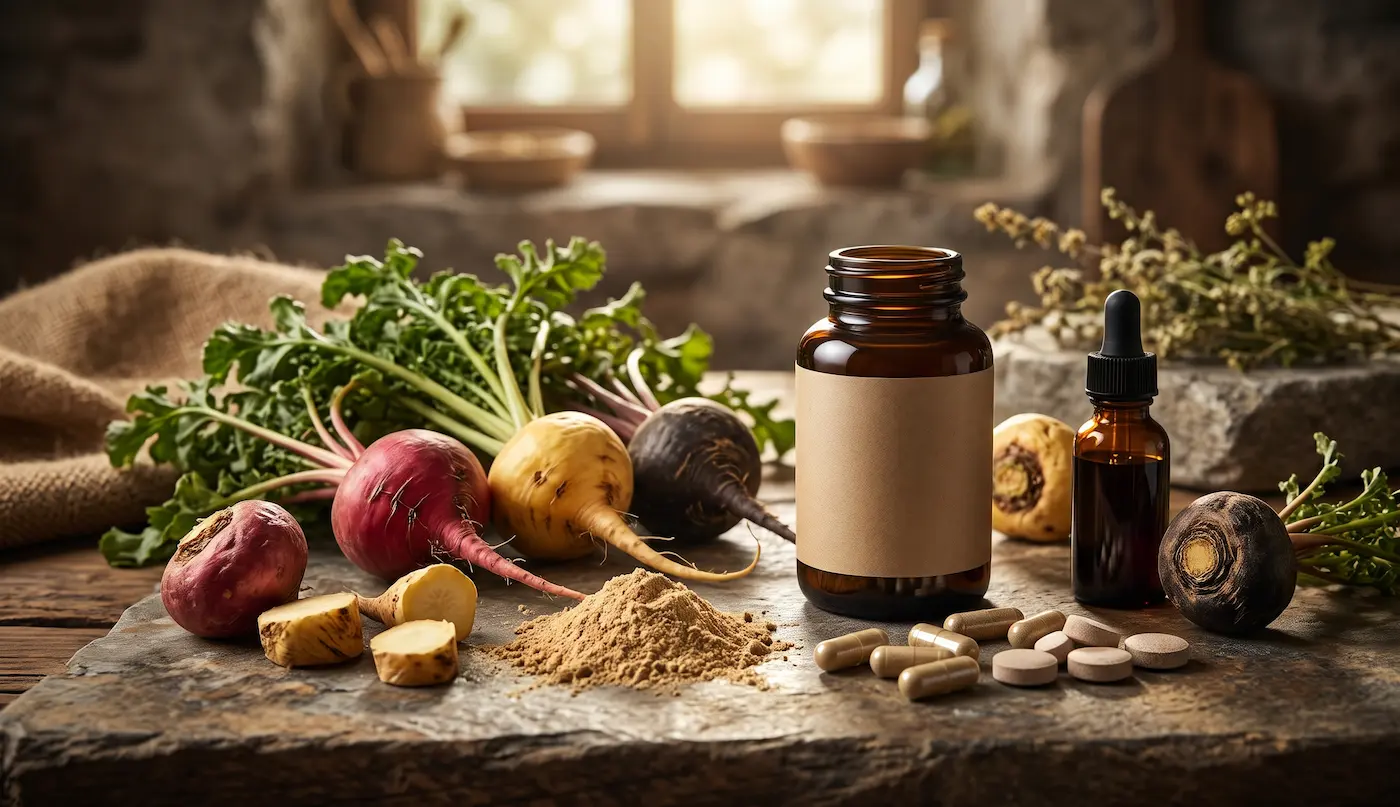
Maca (Lepidium meyenii Walp.) belongs to the same plant family as broccoli, kale and radish. It grows at roughly 3,500 to 4,500 meters in the Peruvian Andes, where its turnip-like root has been eaten as food for hundreds of years. Today most commercial maca is still cultivated in Peru, with smaller plantings elsewhere, including China.
A maca supplement takes that root and puts it in a form that is easy to take every day. The root itself supplies carbohydrates, protein, fiber and minerals, along with plant compounds such as glucosinolates and macamides. Researchers often use these compounds as markers when they compare one maca product with another.
Most maca root supplements fall into three groups:
- Raw maca powder: dried, milled root with the most natural profile and a strong earthy taste.
- Gelatinized maca powder: root that has been heated to break down starch, generally marketed as easier on digestion.
- Maca extract: a concentrated form that packs more root into each capsule or serving.
People commonly take maca for daily energy, mood, libido, hormonal balance and fertility support. The evidence behind each of those uses is uneven, which is why the next section looks at what research actually shows. In the United States, maca is sold as a dietary supplement, so it cannot be marketed as a treatment for any disease.
What Are Maca Supplements Good For?
Maca has promising but limited human evidence, mainly for sexual function and menopausal symptoms. Most trials are small, short and use different products, so reviewers call the results encouraging rather than conclusive.
Common use | What the research shows | Confidence |
|---|---|---|
| Sexual desire and function | A 2010 systematic review found four randomized trials with 131 people in total. Three showed benefits (for sexual desire, for sexual dysfunction in menopausal women, and for erectile function), while one found no effect in healthy cyclists. | Limited |
| Menopausal symptoms | A 2012 review found four randomized trials, all with favorable results on symptom scores. The authors said the trials were too few and too small for firm conclusions. | Limited |
| Mood and energy | A 2022 systematic review covered 57 studies, only 14 of them clinical. It reported effects on depression and memory, but also unclear study quality and a high risk of reporting bias. | Early |
| Semen quality and fertility | Some small trials report better sperm concentration or motility. Others find no difference. | Mixed |
Two points help set expectations. First, the sexual-function trials gave 1.5 to 3.5 grams of maca a day for 2 to 12 weeks, so benefits, if any, are not instant. Second, maca is not a hormone: in one trial of postmenopausal women, its effects on mood and sexual function were not explained by any estrogen or androgen content in the product.
For a deeper look at each use, see our upcoming guides on maca benefits, maca for men, maca for women, libido and fertility.
Maca Colors at a Glance
Maca roots come in three main colors, and each is sold as a different type of supplement. It is not yet clear whether the colors have different effects in people, although the 2022 systematic review above noted color-related differences in some studies and linked them to differences in plant compounds.
Type | How common | What to know |
|---|---|---|
| Yellow maca | The most widely grown color | Typically the most affordable |
| Black maca | Less common | Typically priced higher |
| Red maca | Less common | Typically priced higher |
| Mixed or multi-maca | Common in blends | A combination of all three colors in one product |
If a label names a color, check that the supplier can show it is real. A “black maca” claim means little without a batch document that confirms the root type. Our full comparison of black, red and yellow maca is coming soon.
Common Maca Supplement Forms
The best form is the one you will take consistently and that matches the dose you want. No form has been proven superior: the trials in the 2010 review used both dried and gelatinized maca.
Form | Best for | Watch out for |
|---|---|---|
| Raw maca powder | Smoothies, oatmeal and baking; the lowest cost per gram | Strong earthy taste; the starch can bother sensitive stomachs |
| Gelatinized maca powder | Daily drinks and people who find raw powder hard to digest | Still a bulky serving, often a teaspoon or more |
| Capsules and tablets | Convenience, travel and a fixed dose with no taste | A small capsule holds little powder, so check how many you need per day |
| Maca extract | A smaller serving or a stronger product | Extracts are concentrated, so compare the stated ratio and the root equivalent, not just the milligrams |
| Gummies and liquids | People who dislike pills and powders | Often contain less maca per serving, plus sugar or flavorings |
Extract labels can mislead if you compare only milligrams, because a concentrated extract represents more root than the same weight of plain powder. Our upcoming guide on maca powder, capsules and extract explains how to compare them.
How to Judge the Quality of a Maca Root Supplement
A good maca supplement tells you exactly what is in it and can prove it. In the United States, dietary supplements are not approved by the FDA before they are sold, and brands vary widely, so the label and the paperwork behind it matter.
Check | What good looks like | Red flag |
|---|---|---|
| Plant and part | Lepidium meyenii, root | Only “maca blend” or “maca complex” with no species or part |
| Amount per serving | Maca stated in mg, with the form (powder or extract) and ratio | A proprietary blend that hides the maca dose |
| Color and type | Yellow, black, red or mixed, clearly named | Color claims in marketing that do not appear on the label |
| Origin and organic status | Country of origin and a recognized organic certification if claimed | Vague wording such as “natural” or “Andean-style” |
| Contaminant testing | Heavy metals, microbes and pesticides tested, with results on request | No testing information at all |
| Independent verification | A seal from a third-party program such as USP or NSF | Seals that cannot be traced to a real program |
| Batch documents | A certificate of analysis (COA) tied to your lot number | A “COA” that is generic or undated |
| Manufacturing | Made in a facility that follows current good manufacturing practice (cGMP) | No facility information |
Contaminant testing deserves extra attention. Maca is a root crop, and root crops can take up metals from the soil where they grow. If you are unsure how to read a batch report, our guide on how to read a COA walks through the main sections.
Who Should Be Careful With Maca
Maca is generally well tolerated, and the most common side effect is an upset stomach. Long-term safety data are limited, so a few groups should speak with a doctor or pharmacist first:
- Pregnant or breastfeeding women: there is not enough reliable safety information.
- People with hormone-sensitive conditions: some maca compounds are described as phytoestrogens, so ask your doctor if you have a condition affected by estrogen.
- People with thyroid problems: maca is a cruciferous plant, and these plants contain compounds that can affect the thyroid in large amounts.
- Anyone taking regular medication or facing hormone blood tests: mention maca to your clinician.
Start with a small serving and add more gradually. Because products vary from brand to brand, a new brand may feel different from the one you used before. Our full guide to maca side effects and safety is coming soon.
Maca Supplement FAQ
What is a maca supplement?
A maca supplement is a product made from the root of Lepidium meyenii, sold as powder, capsules, tablets, gummies, liquids or concentrated extract.
What is maca root supplement good for?
People take it for energy, mood, libido, menopausal comfort and fertility support. Research is strongest, though still limited, for sexual function and menopausal symptoms.
Are maca dietary supplement, maca herbal supplement and maca root supplement the same thing?
They usually describe the same plant. The wording changes with the product: “dietary supplement” is the regulatory term, “herbal supplement” describes the plant source, and “root supplement” names the part used. Always check the label for the species, the form and the amount.
What is the difference between maca powder and maca extract?
Powder is the ground root. Extract is concentrated, so the same capsule size can represent much more root. Compare the stated ratio, not only the milligrams.
How long does maca take to work?
The trials in the 2010 review lasted from 2 to 12 weeks, so most studies looked for changes over weeks rather than days. Results differ from person to person, and some people notice nothing.
Can maca replace medical treatment?
No. Maca is a dietary supplement, not a treatment for any disease. Speak with a doctor about persistent symptoms such as low libido, menopausal symptoms or difficulty conceiving.
Building Your Own Maca Product?
If you are a brand owner rather than a shopper, the same choices in this guide (root color, form, extract ratio, organic status and testing) decide how your finished product performs. KS Nutripharma develops and manufactures custom maca supplements as capsules, tablets, powders, gummies and liquids, with batch documentation for every commercial lot. Send us a brief and our team will recommend a formula and format.
Sources
- Shin B-C, et al. Maca (L. meyenii) for improving sexual function: a systematic review. BMC Complementary and Alternative Medicine, 2010.
- Ernst E, et al. Maca (Lepidium meyenii) for treatment of menopausal symptoms: a systematic review. Maturitas, 2012.
- Bower-Cargill C, et al. A systematic review of the versatile effects of the Peruvian maca root on sexual dysfunction, menopausal symptoms and related conditions. Phytomedicine Plus, 2022.
- Brooks NA, et al. Beneficial effects of Lepidium meyenii (maca) on psychological symptoms and measures of sexual dysfunction in postmenopausal women are not related to estrogen or androgen content. Menopause, 2008. Summarized by the American Botanical Council.
- WebMD: Maca overview and side effects.