
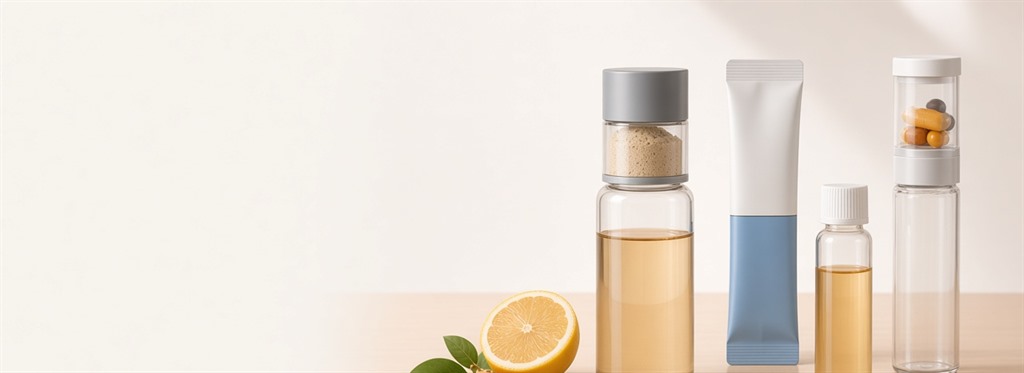
Dual-Chamber Oral Liquid OEM/ODM/Private Label Service
KS Nutripharma is a dual-chamber oral liquid manufacturer for OEM, ODM, and private-label supplement brands. We develop and manufacture dual-chamber oral liquid shots: a finished oral liquid unit with physically separated liquid and dry or concentrated components, activated before drinking, inside our liquid supplement capability.
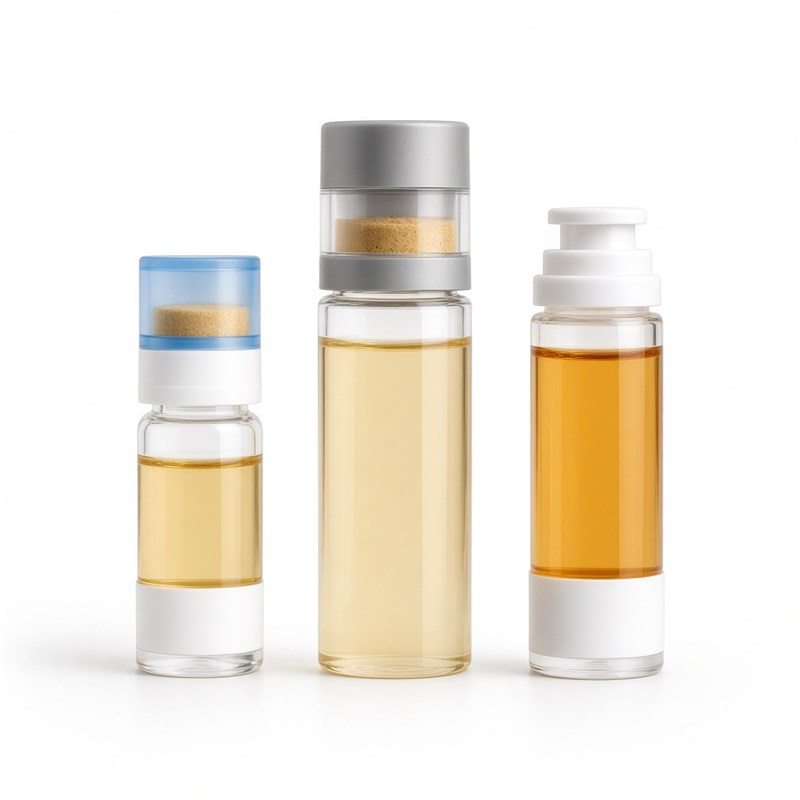
Top-cap, powder-in-cap, press-to-mix, twist-to-release, and dual-compartment vials are hardware routes for that same product. Dual-chamber is used when a dry or concentrated active must stay out of the liquid until activation. It is not premium packaging by default. It is controlled separation before use.
Before quotation, we review the chamber assignment, dry-fill load, liquid viscosity, activation behavior, container-closure integrity (CCI), post-mix appearance, active assay, pack sourcing, and destination-market label requirements. Request a Dual-Chamber Feasibility Review
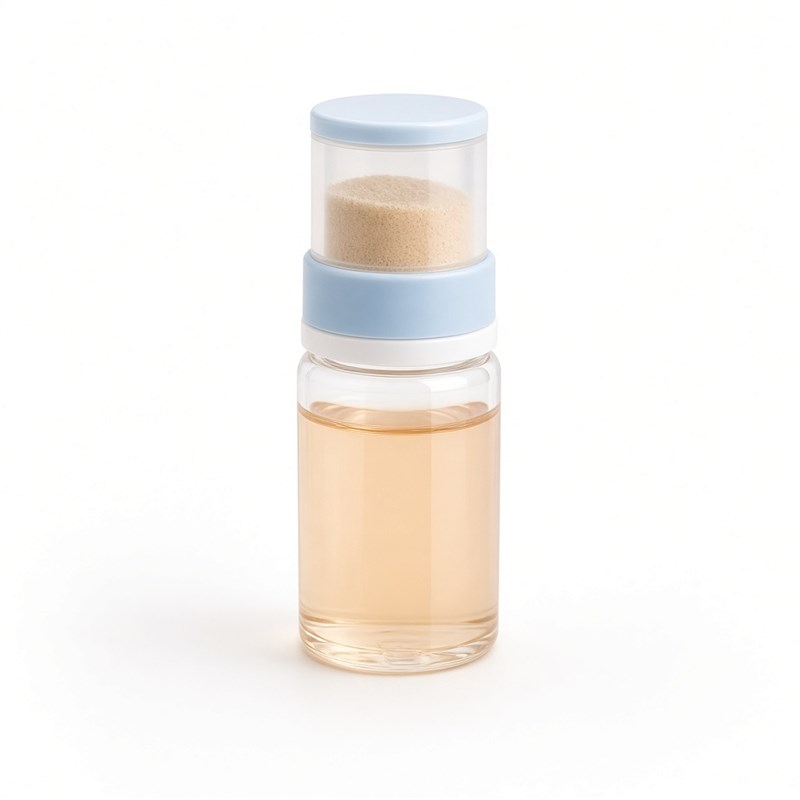
Commercial dual-chamber oral liquid example: dry component stored separately from the liquid base until activation
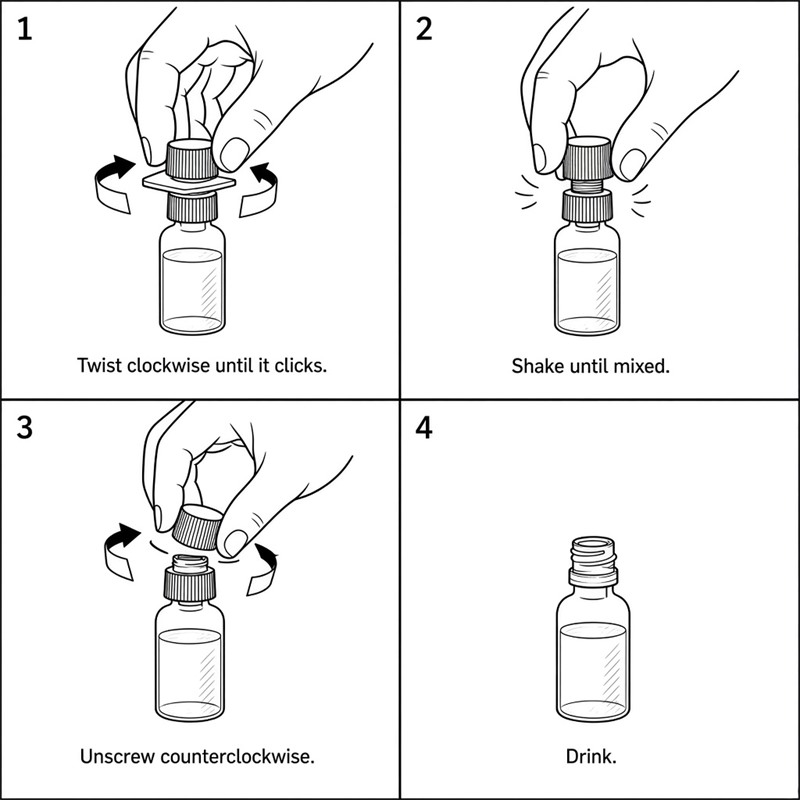
How the Dual-Chamber Vial Is Used
The pack is a small oral vial: dry active in the cap, liquid base in the bottle. Activation, mixing, opening, and the post-mix drink window belong on the instruction file.
Typical activation sequence: release, mix, shake, drink
| Step | Manufacturing meaning | What it must do |
|---|---|---|
| 1 Twist | The cap releases the dry chamber at the defined activation point | Powder must not leak in transit |
| 2 Mix | Shake until the dry load reaches the defined post-mix condition | The drink is uniform inside the labeled window |
| 3 Open | The closure opens after activation | The pack must stay sealed until the intended open |
| 4 Drink | The mixed shot is consumed inside the labeled window | Appearance, sediment, and assay are judged against this window |
When Should You Choose Dual-Chamber?
A dual-chamber oral liquid is justified when one part of the formula should not remain in the same liquid environment for the full shelf life. That risk may be moisture, oxygen, pH, light, ingredient interaction, color change, flavor drift, sedimentation, or assay loss. A moisture-sensitive powder, an oxidation-sensitive active, and a pH-sensitive ingredient do not need the same solution, so the first job is to identify the actual ingredient-environment conflict.
Project condition | Recommended route |
|---|---|
| Formula is stable as one liquid | Single-chamber oral liquid or RTD shot |
| One active is moisture-sensitive | Dry chamber may be justified if the cap protects it |
| Active has poor stability in the proposed liquid environment | Review dry storage, pH or form selection, oxygen/light protection, or another dosage form |
| Main problem is taste masking | Reformulation may help more than dual-chamber hardware |
| Main problem is oxidation | Formula, headspace, light barrier, and closure review come before pack choice |
| Powder load is too large for the cap | Different hardware, lower load, granulation change, or non-liquid format |
| Post-mix dispersion is poor | Dual-chamber does not solve it unless the drink window is realistic |
| Only reason is premium appearance | Usually not enough justification |
Dual-chamber solves a separation problem. It also adds component qualification, assembly, activation, and stability work. If the formula is already stable as one liquid, that extra complexity may not create enough product value. Use dual-chamber when the split changes the technical file. Stay with a normal oral liquid, syrup, drops, stick, capsule pair, or hard capsule route when the cleaner product already holds.
The table above is a route screen, not a finished specification. Fill weight, activation, CCI, residual powder, post-mix appearance, and assay are confirmed on the actual pack during sample, pilot, and release testing.
Dual-Chamber Specification Lock
The quote starts with a formula split: which ingredients stay in the liquid chamber and which stay dry or concentrated until activation. Without that split, the project is still a product idea, not a manufacturing file.
Lock the shot volume before pack selection. Different shot volumes can require different bottle geometry, headspace, fill accuracy, taste-masking strategy, and carton design.
The liquid chamber controls drinking volume, preservation, viscosity, flavor, and headspace. The dry chamber controls powder load, flow, moisture exposure, and release. Chamber ratio is a SKU specification, not a visual preference.
Powder load must fit the cap or dry chamber and still release after activation. Low-density powders, sticky granules, hygroscopic minerals, and dusty botanicals can fail even when the milligram target looks small.
The liquid base is usually an aqueous oral liquid, syrup-like base, or scoped suspension. Viscosity affects liquid fill accuracy, foaming, activation mixing, and final drinkability. pH affects active stability, preservation, and post-mix behavior. Softgel oil fills and liposomal liquids are separate routes.
Each active needs identity, grade, assay basis, and testing point. Some products require assay on the separated finished unit; others also need a post-mix check inside the drink window.
The risk must be named. A dry chamber helps only if the cap, liner, membrane, and pack protect the material from the exposure that matters.
Press-to-mix, twist-cap, overcap, top-cap, and powder-in-cap systems require different activation force, torque, membrane release, and consumer instructions.
Material choice affects moisture and oxygen barrier, light protection, closure fit, dimensional tolerance, and compatibility with the formula.
The label must say how the product is used after activation. The mixed shot is checked for appearance, sediment, flavor, pH, and assay against that intended window, not against full shelf life.
Claims, preservatives, sweeteners, caffeine warnings, and Supplement Facts or nutrition panels follow the market file. Brand owners remain responsible for finished-label compliance.
Dual-Chamber Formula Architectures
These are manufacturing starting points, not fixed KS formulations. The useful question is which ingredient must be separated, what condition creates the risk, and whether the hardware can handle the load.
Other product concepts can be reviewed when the formula, market, and claim file are defined. They are not fixed catalog SKUs on this page.
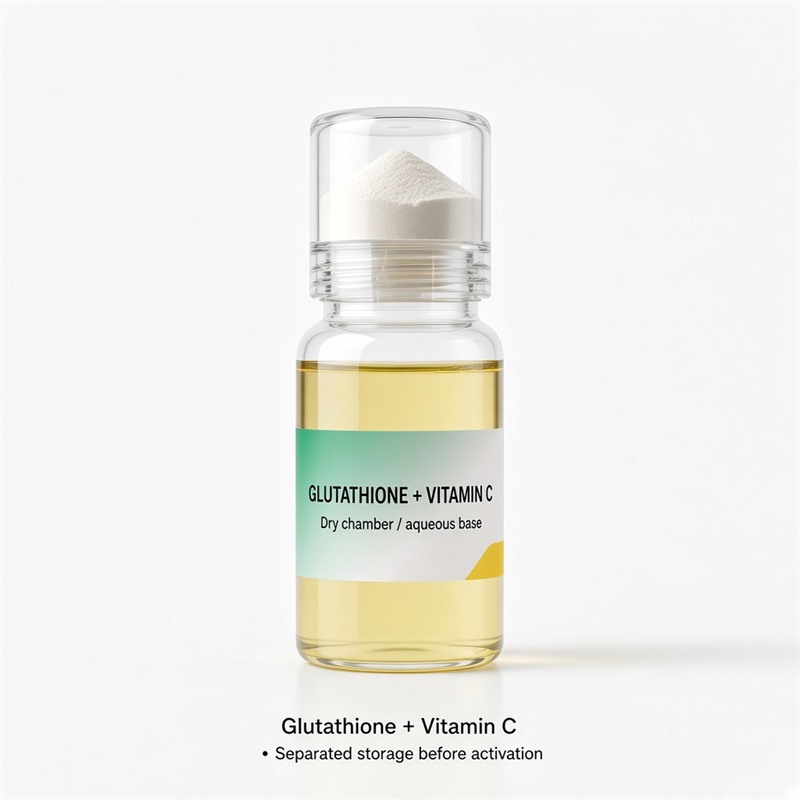
Reduced glutathione is one example of an active that may prompt a brand to evaluate separated storage, depending on the formulation and target shelf life. Specify reduced glutathione vs oxidized glutathione language, vitamin C form, oxygen and light exposure, GSH/GSSG testing if required, and the post-mix drink window. See our glutathione supplement manufacturing route when the better format is capsule, tablet, powder, softgel, or another non-liquid SKU.
Main constraint: GSH stability, claim discipline, and assay plan. Separation is a storage strategy; potency still needs finished-pack data.
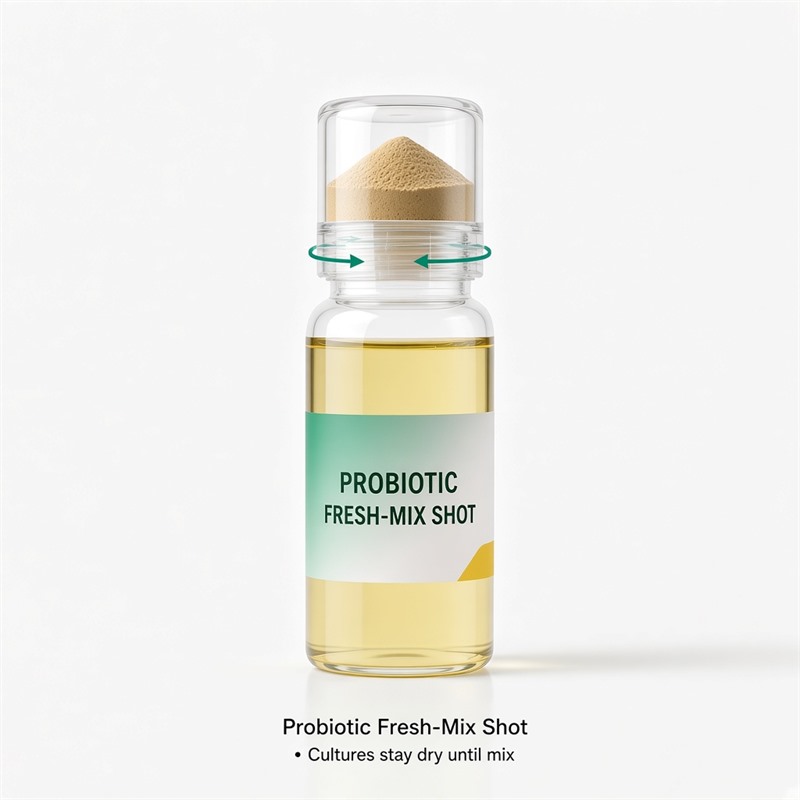
A probiotic fresh-mix shot can use the dry chamber to keep selected cultures or companion powders away from the liquid base until activation. Specify strain identity, CFU target and timing, dry-chamber moisture limit, liquid pH, water activity, storage condition, and release testing.
Main constraint: Hardware separation does not replace viability data. Ambient, chilled, and destination-specific probiotic files are different projects. Dual-chamber does not by itself make a culture ambient-stable.
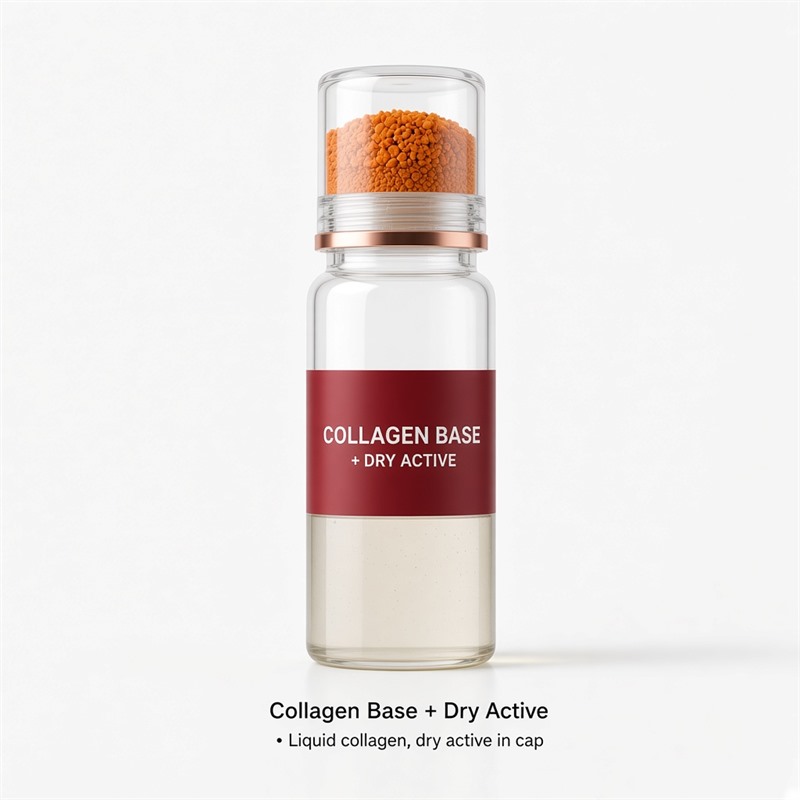
The liquid chamber can carry a collagen base while the dry chamber carries a vitamin, botanical, antioxidant, or flavor-sensitive active. See collagen supplement manufacturing for broader collagen format decisions.
Main constraint: Collagen liquids bring viscosity, flavor, preservation, and shake-uniformity work. Collagen alone does not automatically require dual-chamber packaging.
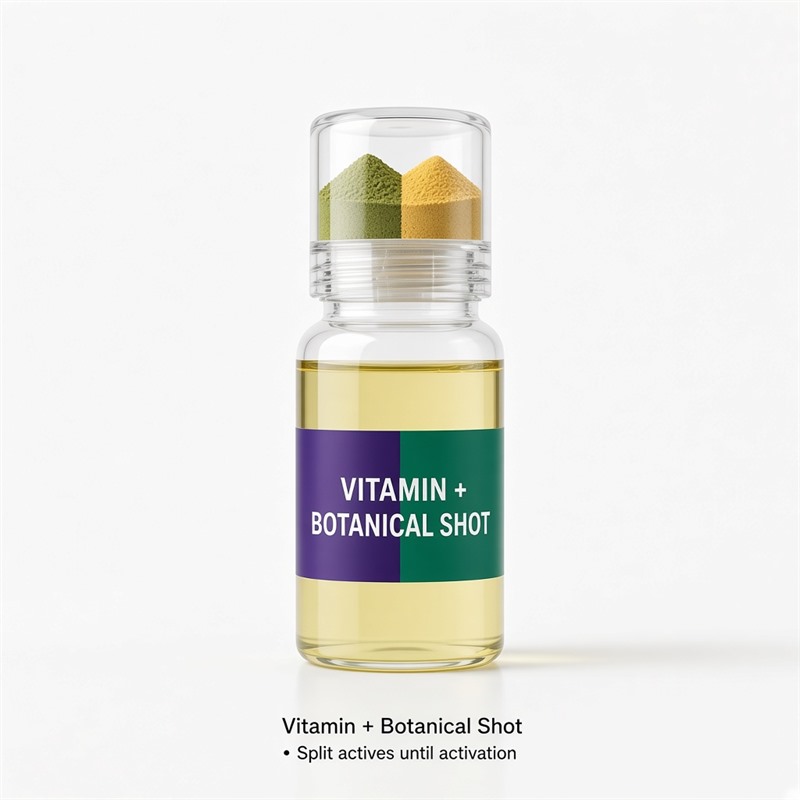
Vitamin C, B vitamins, minerals, and botanicals can create pH, color, flavor, or sediment conflicts in one liquid phase. Specify vitamin form, botanical marker and method, chamber assignment, before/after-mix pH target, light protection, and whether assay is required per finished unit.
Main constraint: The split may reduce storage contact, but browning, precipitation, or bitter notes can still appear after activation if the drink window is unrealistic.
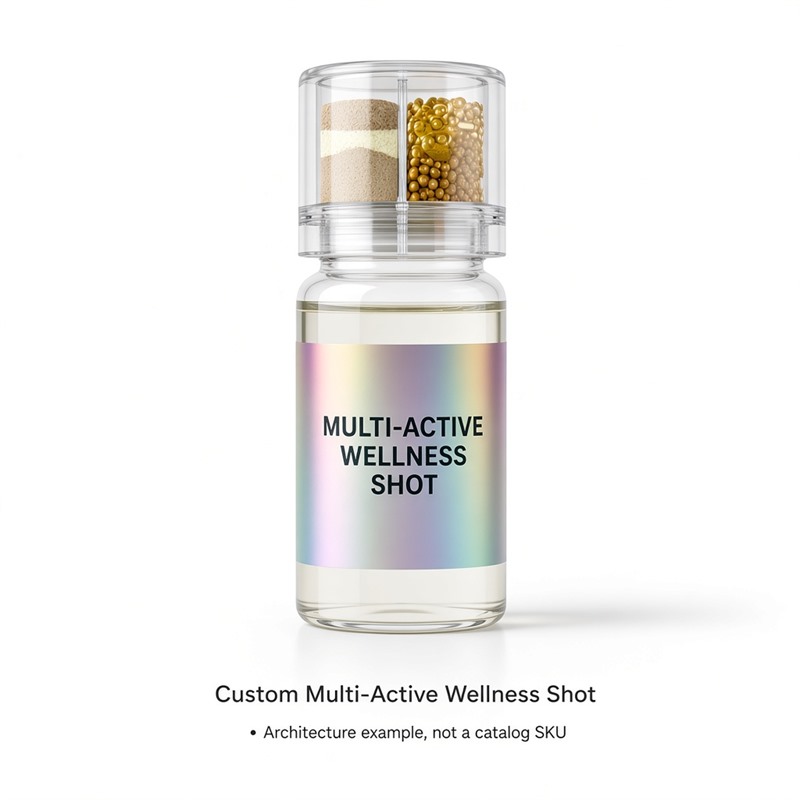
Multivitamin, D/K, antioxidant, hydration, energy, and other multi-active shots can use dual-chamber packaging when the formula contains a real separation reason. Broader antioxidant and energy programs can also be scoped through antioxidant supplement manufacturing or energy supplement manufacturing.
Main constraint: Do not put ten actives into the dry chamber just because the cap exists. Oil-soluble vitamins, minerals, stimulants, botanicals, flavors, and sweeteners need separate chamber, solubility, taste, and claim review.
Dual-Chamber Packaging Formats
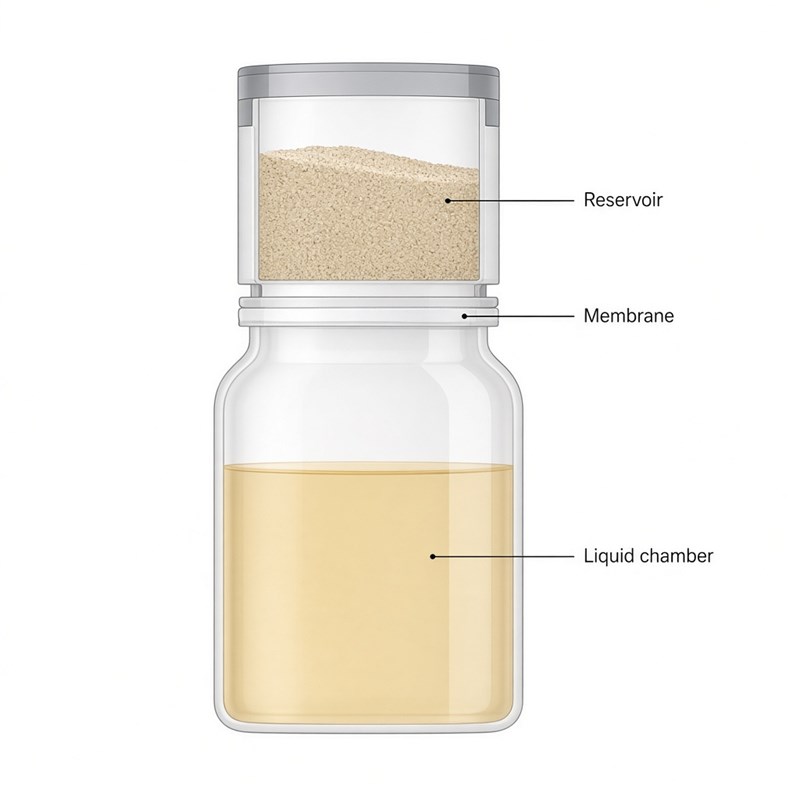
The hardware question is which pack can keep a dry reservoir separate from the liquid chamber until activation. Bottle, vial, top-cap, and overcap are hardware routes for the same finished oral liquid shot.
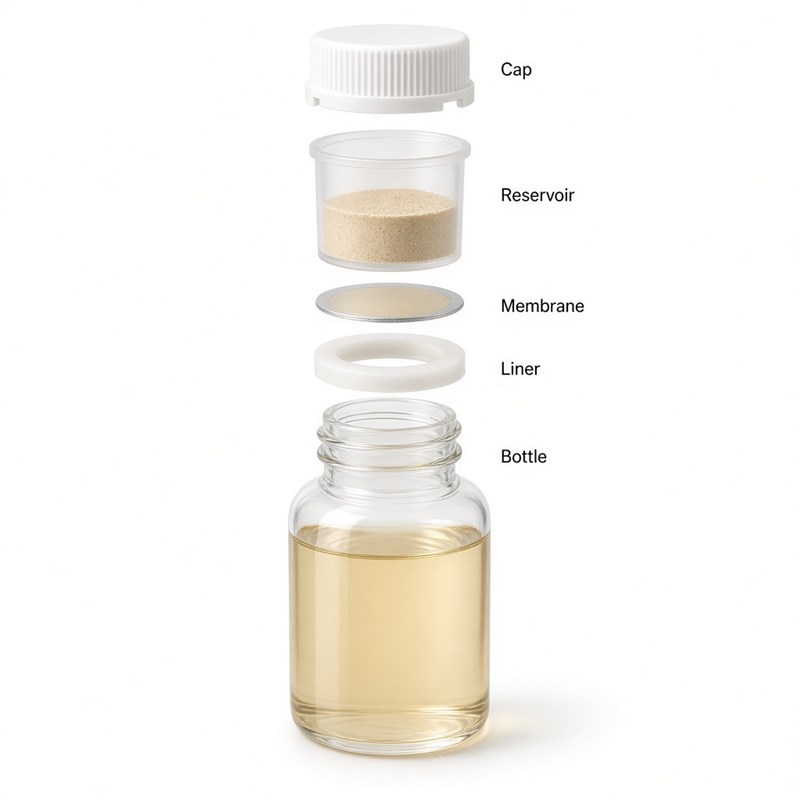
Cross-section of a dual-chamber vial: dry reservoir, membrane, liquid chamber, activation cap, and closure
For manufacturing, these visible features translate into dry-fill capacity, moisture protection, activation force, closure integrity, and release completeness.
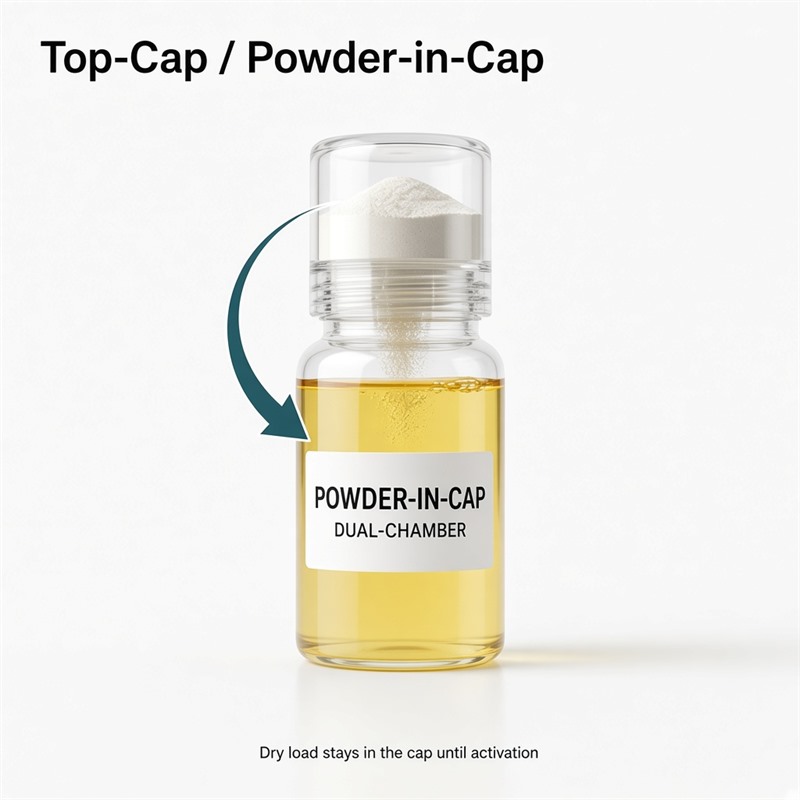 Top-Cap / Powder-in-Cap
A dry reservoir sits in the cap. Powder, granules, or small capsules stay there during storage. The liquid base stays in the bottle. Activation releases the dry load into the liquid; mixing and the drink window belong on the instruction file.
Use when: A named active should not sit in the liquid for the full shelf life.
What we check: Dry-chamber fill, moisture barrier, membrane or seal, activation force, torque, residual powder, mixed-shot appearance, and closure integrity.
Do not assume: Separation raises absorption. It changes the storage condition. Assay still needs finished-pack and post-mix data.
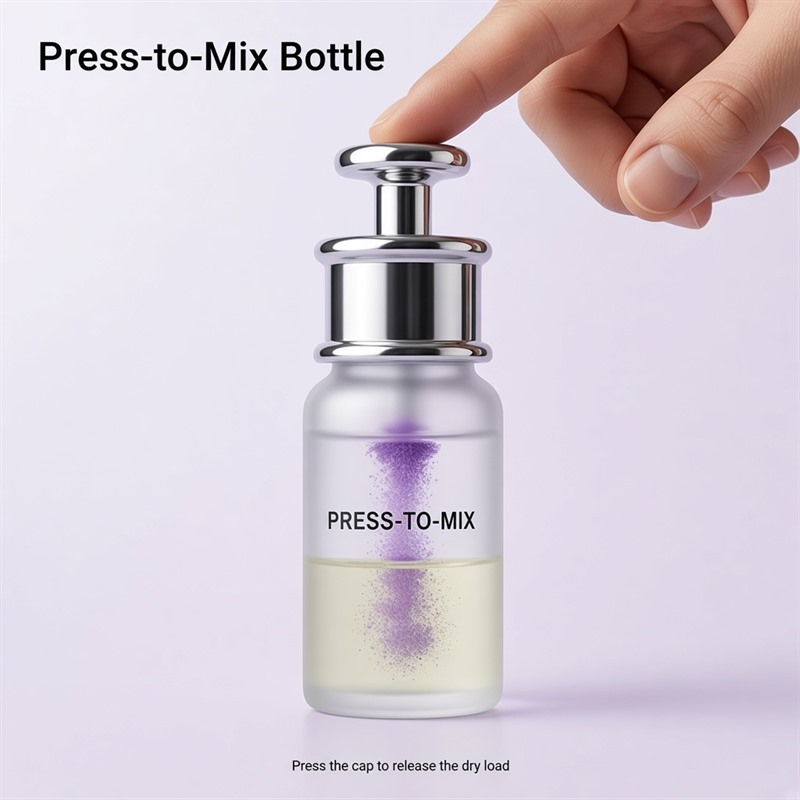 Press-to-Mix Bottle
Pressing the cap or plunger opens the dry chamber and releases the load into the liquid.
Use when: The brand wants a visible activation action and the dry load fits the overcap.
What we check: Activation force, membrane release, dry-load fit, premature opening in freight, and shake behavior.
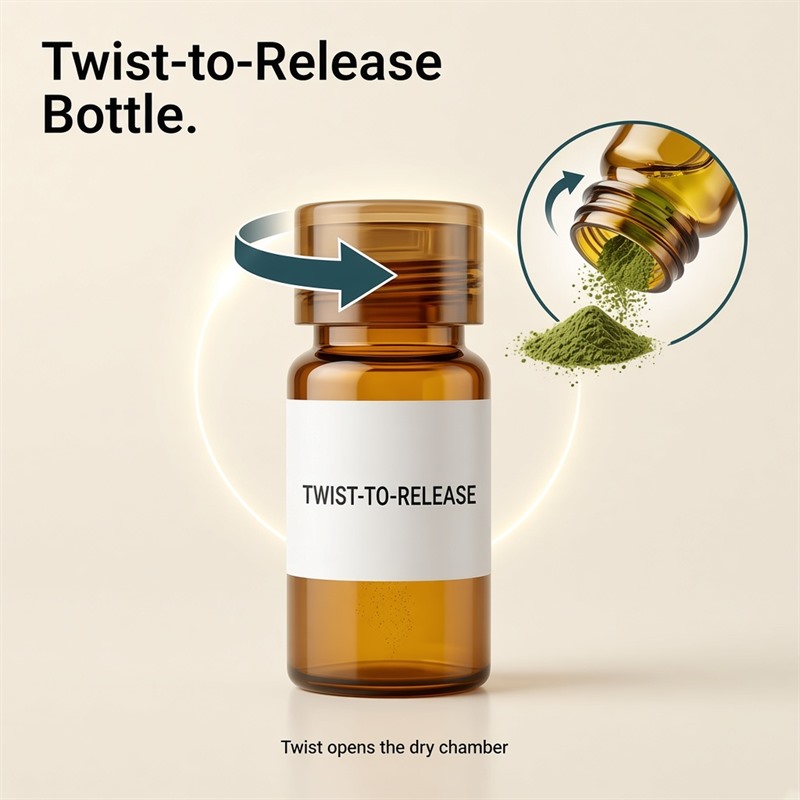 Twist-to-Release Bottle
Twisting opens the protective chamber so powder can drop into the liquid, then a reverse twist opens the bottle for drinking.
Use when: The brief follows a twist-mix-open-drink sequence on a small oral vial.
What we check: Torque, release completeness, cap seal, instruction clarity, and whether the pack stays sealed until the intended twist.
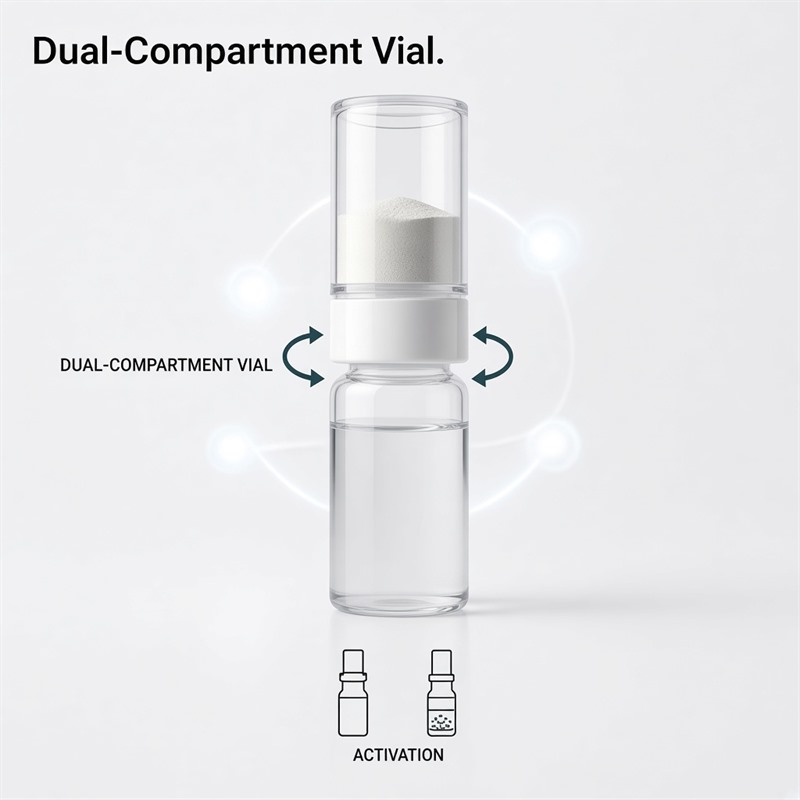 Dual-Compartment Vial
A compact oral vial with two physically separated compartments that connect at use.
Use when: The serving is a small daily shot and the chamber ratio can hold both the dry load and the drink volume.
What we check: Chamber ratio, component tolerance, liner, transport orientation, and fill sequence.
This is where many dual-chamber projects win or fail. The bottle can look ready for retail while the technical file is still unfinished.
Premature Activation
Failure: Powder releases during packing, freight, or consumer opening.
Likely cause: Weak membrane, poor cap tolerance, vibration, inversion, or incorrect torque.
What we check: Cap assembly, activation force, membrane strength, and transport orientation.
Incomplete Powder Release
Failure: Powder remains in the cap after activation.
Likely cause: Poor powder flow, static, moisture pickup, bridge formation, or cap geometry.
What we check: Powder density, granule size, flow behavior, residual powder, and shake instructions.
Moisture Ingress
Failure: Dry ingredient cakes, loses assay, or fails to release.
Likely cause: Cap liner, membrane, humidity exposure, hygroscopic excipient, or long component hold.
What we check: Dry-chamber moisture, barrier material, packaging sequence, and storage condition.
Fill-Weight or Fill-Volume Variation
Failure: The finished unit misses target fill weight or liquid volume.
Likely cause: Foaming, viscosity variation, dry-fill scatter, or component tolerance.
What we check: Fill volume, dry-fill weight, in-process controls, and finished-unit assay where required.
Poor Post-Mix Dispersion
Failure: Sediment, floating powder, gritty texture, or color streaking after activation.
Likely cause: Insoluble load, particle size, viscosity, insufficient headspace, or unrealistic shake instructions.
What we check: Mixed-shot appearance, redispersion, pH, viscosity, flavor, and drink-window behavior.
Closure or Transport Failure
Failure: Leakage, cap loosening, odor loss, oxygen ingress, or carton damage.
Likely cause: Liner incompatibility, torque drift, material interaction, temperature exposure, or poor secondary pack.
What we check: Closure fit, material compatibility, inversion or vibration checks, and carton pack-out.
Exploded dual-chamber components: cap, powder reservoir, membrane, liner, and bottle
Dual-chamber manufacturing requires both liquid-handling and dry-fill control. Specify how each chamber is filled, how it is sealed, how the cap or membrane is assembled, and how activation is checked before release.
Liquid-chamber review covers fill volume, viscosity, foam, pH, flavor, preservation, headspace, and compatibility with the bottle or liner. Dry-chamber review covers fill weight, powder flow, dust, granule size, static, moisture control, and whether the dry load releases completely after activation.
CCI is one part of the closure review. It is used to assess whether the closure system maintains its intended barrier against leakage and ingress. Activation force, torque, release behavior, and transport testing address other failure modes. Torque is also not only a closure parameter. It can decide whether the dry chamber releases completely without opening too easily during shipment or requiring excessive consumer force.
For customer-supplied bottles, caps, overcaps, or trademarked ingredients, qualification comes before production. We review component drawings or samples, material data, closure fit, activation behavior, and documentation. If the supplied component cannot meet the agreed specification, it should not move into commercial filling.
Dual-chamber projects require two separate stability questions.
Separated-pack stability asks whether the finished product remains within specification while the chambers stay separated in the commercial pack. Depending on the SKU, checks may include appearance, liquid pH, viscosity, dry-chamber moisture, active assay, microbiology, oxidation markers, CCI, leakage, and long-term or accelerated studies as scoped.
Post-mix evaluation asks whether the mixed product remains acceptable throughout the intended drink window. The mixed shot may be assessed for appearance, sediment, pH, flavor, viscosity, and active assay inside that window. The window belongs on the instruction and artwork file. It is a use instruction, not a second shelf-life claim.
Separation can reduce contact between selected liquid and dry components during storage. Dating still comes from the finished pack, fill/seal integrity, and the agreed test protocol. Overage is SKU-specific; it is not a fixed percentage copied from capsules or powders.
Quality documentation can include incoming release, in-process checks, finished-unit testing, traceability, and CoA as scoped. See our quality control approach for how specification, testing, and release documentation connect.
We develop and manufacture dual-chamber oral liquid projects for brands that already have a formula and for brands that need formulation support.
| Route | What the brand provides | What KS evaluates |
|---|---|---|
| OEM | Locked formula, target pack, market file | Manufacturability, chamber assignment, fill/seal, testing |
| ODM / custom formulation | Product concept, active direction, market | Formula split, liquid base, flavor, hardware, stability plan |
| Private label | Brand direction and pack preference | Suitable architecture, artwork space, carton pack-out, documentation |
| Customer-supplied pack | Bottle, cap, overcap, or drawing | Component qualification, CCI, activation, line handling |
| Customer-supplied ingredient | Ingredient COA and documentation | Identity, release testing, compatibility, claim and label limits |
The development path is: feasibility review -> formula split -> hardware selection -> lab-scale chamber trial -> sample or pilot -> activation and seal review -> stability protocol -> artwork and instructions -> commercial fill.
A lab-scale chamber trial tests chamber assignment and mixing behavior before a production decision. The trial can show whether the powder fits the cap, whether it releases, whether the mixed liquid is drinkable, and whether the intended testing plan is realistic.
Dual-chamber MOQ is usually component-driven rather than liquid-volume-driven. The bottle, cap, overcap, membrane, dry chamber, carton, and assembly setup often determine the commercial threshold more than the number of liters in the liquid base.
We do not publish a universal bottle MOQ for this format. A SKU-level MOQ depends on stock vs custom components, dry-chamber structure, fill setup, carton pack-out, customer-supplied component qualification, validation scope, and destination market. For a first quote, we can usually determine the commercial range once the hardware family, stock or custom status, and estimated order quantity are known. For a first quote request, state the expected order range, not only the shot volume.
| Driver | Why it affects MOQ or timing |
|---|---|
| Stock vs custom bottle/cap | Custom molds, imported parts, or special components add lead time and component minimums |
| Dry-chamber component | Powder reservoir, liner, membrane, and cap tolerance affect sourcing and assembly |
| Filling setup | Liquid fill plus dry fill requires more setup than a single-chamber shot |
| Carton pack-out | For example, 7-, 14-, or 30-unit cartons, depending on the SKU, need trays, inserts, artwork space, and packing labor |
| Qualification and validation | CCI, activation, stability, assay, and microbiology scope can extend the project |
Samples start after the formula split and usable hardware are aligned. First commercial production starts after formula, component, artwork, instruction, pilot, and testing files are locked. Reorders are faster when the same formula, component supplier, artwork, and release specification are retained.
Can a dual-chamber oral liquid replace a standard liquid shot?
Only when a named ingredient should not sit in the same liquid for the full shelf life. If a single-chamber shot already meets assay, taste, appearance, and microbiology targets, the extra component, assembly, and validation work usually is not justified.
What determines dual-chamber MOQ?
MOQ is usually set by the bottle, cap, dry-chamber component, carton, and fill setup, not by liquid volume alone. Stock components quote faster than custom molds or customer-supplied hardware that still needs qualification.
Can customer-supplied bottles and caps be qualified?
Yes, after we review samples, material data, dimensions or drawings, closure information, and supplier documentation. Qualification checks whether the component can be filled, sealed, activated, shipped, and released against the agreed specification.
How is post-mix stability evaluated?
Separated-pack dating and the post-mix drink window are different files. After activation, the mixed shot can be checked for appearance, sediment, pH, flavor, viscosity, and assay inside the intended use window. That window is an instruction, not a second shelf-life claim.
Does dual-chamber packaging improve absorption or bioavailability?
Not by itself. Dual-chamber packaging changes storage and activation conditions. Absorption depends on the ingredient, formulation, dosage form, and supporting evidence.
What to Send for a Dual-Chamber Quote
Send enough information for us to decide what should be separated, which pack can handle it, and what must be tested.
Please include destination market, full formula or ingredient direction, target dose per shot, target liquid volume, proposed dry-chamber ingredient, reason for separation, preferred hardware family, storage condition, estimated order size, carton pack-out (for example, 7, 14, or 30 units, depending on the SKU), and any bottle, cap, or overcap drawing or sample.
For customer-supplied components, include material information, dimensions, closure drawings if available, supplier details, and sample quantity for qualification. For customer-supplied ingredients, include COA, specification, allergen or solvent information, trademark authorization if relevant, and intended label language.
Primary CTA – Request Dual-Chamber Feasibility Review. Send your formula or ingredient direction, shot volume, separation reason, and preferred pack. If the chamber split is not yet locked, send the reason you think dual-chamber is needed. Request feasibility
Secondary CTA – Send bottle or cap details. Already selected a top-cap, overcap, twist-cap, or powder-in-cap reference? Send drawings or samples for qualification review. Send pack details
Related Manufacturing
- Glutathione Supplement Manufacturer
- Collagen Supplement Manufacturer
- Antioxidant Supplement Manufacturer
- Energy Supplement Manufacturer
- How to Read a CoA
Disclaimer
Wholesale / brand manufacturing and product-development reference only. Not intended to diagnose, treat, cure, or prevent any disease. Dietary supplements are not drugs. Dual-chamber packaging can help separate selected ingredients during storage and reduce potential interactions between incompatible liquid and dry components. It does not guarantee stability, potency, absorption, freshness, or a named shelf life. Final stability depends on formulation, packaging configuration, fill/seal integrity, and validated shelf-life testing. Activation, mixing, and the post-mix drink window are label and instruction files, not medical directions. Skin-radiance, antioxidant, energy, immune, probiotic, and beauty language are structure/function positioning after destination-market review; skin-bleaching, whitening-drug, injection, and disease-treatment pathways are out of scope. Brand owners remain responsible for finished-label compliance with local counsel. KS Nutripharma provides manufacturing feasibility and documentation support, not legal approval. Volumes, milligrams, and program pack counts are development examples, not recommended intakes.