
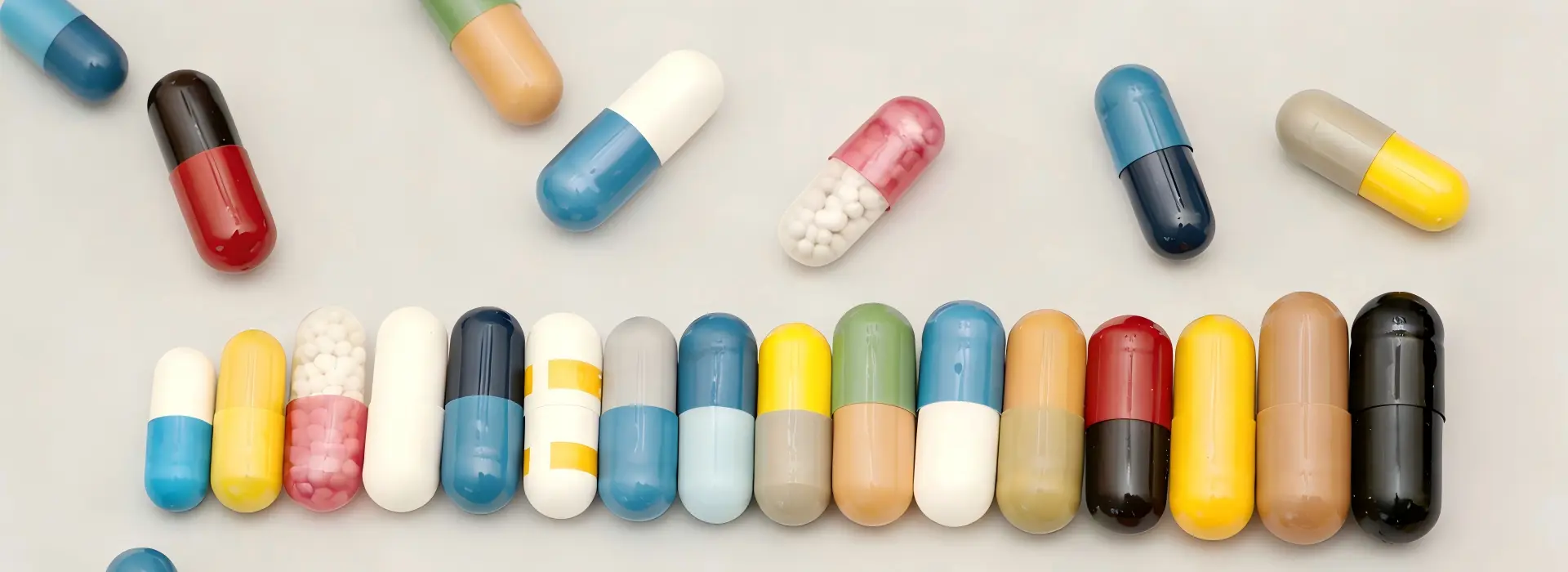
Introduction:
How to choose capsule size is primarily a volume decision, not a milligram rating. Start with the target fill weight of the finished blend, use measured or estimated density to calculate required volume, then compare that volume with candidate shell capacities. A hard capsule manufacturer should confirm final selection with a production-relevant fill trial, because packing, flow, moisture, shell grade, and machine setup can affect actual fill weight.
Quick answer: A 500 mg active dose does not automatically mean size 0 or size 00. The correct size depends on the total finished-blend volume and how that blend packs during encapsulation.
Capsule Size Chart: 000 to 5
Hard-capsule sizes run on an inverse scale: size 5 is the smallest common two-piece shell; 0, 00, and 000 are the larger cavities. Capsugel® Coni-Snap®, for example, is sold in sizes including 000, 00, 0, 1, 2, 3, 4, and 5 (plus elongated variants). [1] Nominal milliliter volumes come from empty-capsule drawings and filling tables. They are not milligram ratings.
Values widely cited for standard two-piece shells are about 1.37 mL (000), 0.91 mL (00), and 0.68 mL (0); some supplier charts list size 00 at 0.90 mL. Treat ~0.90–0.95 mL as a typical size-00 window, then lock the drawing for the grade you will buy. [2]
Gelatin and HPMC use the same size numbers. Confirm fill weight on the selected polymer and grade; see HPMC vs gelatin capsules.
| Size | Typical nominal volume | Approx. locked length | Relative volume vs size 0 | Typical development role |
|---|---|---|---|---|
| 000 | ~1.37 mL | ~26 mm | ~2.0× | Very high-volume formulas when one capsule is required |
| 00 | ~0.90–0.95 mL | ~23 mm | ~1.3–1.4× | High-fill formulas when density will not pack a size 0 |
| 0 | ~0.68 mL | ~21–22 mm | 1.0× | General-purpose starting point when blend volume allows |
| 1 | ~0.48–0.50 mL | ~19 mm | ~0.7× | Lower fill weight or a smaller physical capsule |
| 2 | ~0.36–0.37 mL | ~18 mm | ~0.5× | Low-fill formulas |
| 3–5 | ~0.13–0.30 mL | — | — | Low-dose fills; dosing precision matters more as the cavity shrinks |
These figures are screening values, not production capacities. Locked length and milliliters vary by supplier and grade. Size 000 also needs the correct change parts; not every encapsulator is set up for it.
How Capsule Fill Volume Is Estimated
Calculation gives a candidate size. A fill trial gives a production decision.
For an initial estimate
Required volume (mL) = target fill weight (g) ÷ estimated blend density (g/mL)
Equivalently: volume (mL) ≈ fill weight (mg) ÷ [density (g/mL) × 1000].
For production qualification
Actual fill capacity = the validated fill weight achieved under the selected machine and tooling
Bulk density is useful for an initial volume estimate. Tapped or compacted density can indicate how much additional mass may fit after powder consolidation. Actual machine fill depends on the powder’s behavior under the specific dosing system and tooling. Two blends with similar bulk density can still fill to different weights if they compress differently.
| Stage | Density that is useful | What it is for |
|---|---|---|
| Early estimate | Loose / poured bulk density of the finished blend | First volume screen and candidate sizes |
| Closer to filling | Tapped or compacted density | Whether the blend may achieve the target fill weight in a smaller shell |
| Decision | Trial fill on representative equipment | Production fill weight, variation, and whether the size holds |
Moisture and hygroscopicity can change both density and flow between lab and line. How bulk and tapped density are measured — and what they cannot guarantee — sits on powder flow and bulk density for capsule filling.
Illustrative calculations (not material specifications)
Densities below are worked examples. Measure the selected blend.
Example 1 — 500 mg at 1.0 g/mL
500 ÷ 1000 = 0.50 mL. Size 0 (~0.68 mL nominal) may have room, including some excipient volume, if packing on the filler agrees.
Example 2 — 500 mg at 0.60 g/mL
500 ÷ 600 = 0.83 mL. Size 00 (~0.90–0.95 mL) is the usual first candidate; size 0 is unlikely unless compression is unusually efficient.
Example 3 — 1,000 mg at 0.60 g/mL
1,000 ÷ 600 = 1.67 mL. That exceeds a typical size 000 cavity (~1.37 mL). The serving then needs more than one capsule, a denser formula, or another format — see high-dose capsule formulation.
A 500 mg active line is not the same as 500 mg of blend. Diluents, glidants, and lubricants add volume.
Size 00 vs Size 0
Size 00 is larger in length, diameter, and nominal internal volume than size 0. Using ~0.90–0.95 mL versus ~0.68 mL, size 00 provides about 32–40% more nominal volume. Exact ratio depends on the shell drawing.
There is no universal “size 00 holds X mg.” The same 00 cavity holds more mass of a dense mineral blend than of a low-density botanical blend.
Do not design to nominal capacity with zero margin. If the estimated blend volume is close to the nominal shell volume, move to a larger candidate size or confirm the smaller size through a fill trial rather than treating the nominal capacity as a guaranteed production fill.
How teams usually choose between them
- If estimated blend volume sits well under ~0.68 mL, with packing margin → size 0 is a candidate.
- If estimated volume sits near or above size 0 but under ~0.90 mL → size 00 is the usual next shell.
- If the brand will not use 00, the alternative is to increase the number of capsules per serving (two size 0 vs one size 00), not a hidden milligram rating.
Size 000 is larger still. It is an option for volume, not an automatic upgrade: change parts, line availability, and the intended serving format have to be acceptable. Splitting a serving across two 00 or 0 capsules is often the parallel path.
What Changes Fill Weight on the Line
Nominal shell volume is the ceiling. These variables move the weight you actually hit:
- Finished-blend bulk density — mass per poured volume; low density occupies more milliliters per milligram.
- Tamping / dosator packing — compression can raise effective density versus a loose beaker test.
- Compressibility and cohesion — two powders at the same bulk density can pack to different fill weights.
- Particle size and shape — fines, fibers, and wide distributions leave voids or flow poorly.
- Flow — incomplete bore fill shows up as weight variation; flow aids add volume.
- Moisture / hygroscopicity — can shift density, sticking, and bridging between specification and filling.
- Excipient load — the cavity has to hold actives and the functional set.
- Shell grade — same size number, slightly different internal volume or friction.
- Serving count — milligrams per capsule drop if the daily amount is split.
Fill-weight consistency matters as much as nominal capacity. A shell that can physically hold the target mass is not necessarily a good production choice if the blend cannot maintain acceptable weight variation at line speed. The question is not only “can 750 mg fit?” It is whether the line can repeatedly fill that mass within the agreed specification.
Larger Capsule vs More Capsules
When calculated volume will not fit the preferred shell:
- Move up a size (0 → 00 → 000) to keep one capsule per serving.
- Increase count (for example two size 0 or two size 00) to keep a smaller physical capsule.
That choice affects the product’s serving configuration. It also changes packaging: capsules per bottle, headspace, desiccant room, count configuration, and sometimes the bottle or blister that the line is set up to run. A 1,000 mg serving of a bulky blend is often two capsules, not one oversized shell.
A third option is to modify the formulation or process (densification, granulation, extract grade). That work belongs on the high-dose page, not in a size chart.
When Changing Capsule Size Is Not Enough
A bigger shell buys milliliters. It does not repair poor flow, a blend that will not pack, or a serving mass that still exceeds size 000 after a realistic density is applied.
If the problem is…
Too much volume
Larger shell, split serving, or densification / extract-grade change.
Poor flow
Particle work, excipient adjustment, or granulation — not a larger empty cavity by itself.
Poor packing
Formulation or granulation optimization so the powder consolidates on the selected dosing system.
Moisture-related sticking
Moisture control, material handling, and process adjustment; size change alone rarely fixes stick.
High dose
Serving split, a higher-density raw-material spec, granulation, or another dosage form — see the high-dose page rather than forcing one more size number.
If the constraint is bulk, sticking, or “1,000 mg in one capsule at all costs,” the next questions are formula and process.
How Capsule Size Is Typically Locked
Estimate → calculate → trial → validate
- Lock target fill weight per capsule and whether one capsule per serving is required.
- Review the quantitative formula and, if available, bulk/tapped density, moisture, and flow notes.
- Calculate theoretical blend volume.
- Pick candidate sizes (often 0 vs 00; 000 or two-count if volume is high).
- Run a laboratory or pilot fill on a representative setup.
- Check fill-weight consistency, capsule closure, and physical integrity.
- Confirm change parts for that size on the intended line.
- Freeze size, serving count, and packaging implications together.
A spreadsheet that “fits” is not a production specification.
What a Capsule Manufacturer Should Confirm
What to send
- Quantitative formula (actives and excipients)
- Target milligrams per capsule
- Preferred capsules per serving
- Gelatin or HPMC (or “recommend”)
- Target market and any existing shell size
- Bulk density, tapped density, particle size, moisture, or flow notes if you have them
What a qualified manufacturer should return
- Candidate capsule size(s)
- Estimated fill-weight range for that blend
- Required capsule count
- Whether a fill trial is required
- Tooling / change-parts compatibility
- Whether formula adjustment is needed
- Packaging implications of the size and count
A capsule-size quote based only on the active dose, without considering the total blend and fill behavior, is a preliminary estimate — not a production specification.
Have a formula but are not sure whether it is size 0, size 00, or two capsules?
Send the blend (or BOM), target fill weight, and serving constraint. KS Nutripharma can estimate volume and recommend a trial-fill path — then quote hard capsule manufacturing from that review.
Related Capsule Manufacturing Guides
– What Are Hard Capsules Made Of
– HPMC vs Gelatin Capsules
– How to Choose Capsule Size
– High-Dose Capsule Formulation
– Powder Flow and Bulk Density for Capsule Filling
– Capsule Filling Problems in Botanical Supplements
– Hard Capsule Manufacturing Process
– Capsule Weight Variation and Quality Control
– Advanced Hard Capsule Technologies
– How to Read a COA
Technical and Regulatory References
Empty-capsule manufacturer specifications (refs 1–2) support available sizes, typical nominal volumes, and dimensional language. They do not establish packing behavior, fill-weight variation, or production fill weight. Filling conclusions on this page follow process logic and trial fill, not a supplier marketing table. FDA (ref 3) is dietary-supplement regulatory context, not a technical basis for choosing size 0 vs 00.
- Capsugel. Coni-Snap® Capsules FAQ — sizes available (000, 00, 0, 1–5 and elongated variants). https://www.capsugel.com/knowledge-center/nutra/capsules/conisnap-frequently-asked-questions
- Capsugel / Lonza. Technical Reference File for Capsugel® empty hard capsules — composition, specifications, and dimensional information for empty-shell products. Confirm milliliter capacity and locked length against the drawing for the grade you will fill. https://www.capsugel.com/knowledge-center/capsules/2023-technical-reference-file
- U.S. Food and Drug Administration. Dietary supplements. https://www.fda.gov/food/dietary-supplements
Volume. Milligrams are mass. Density connects the two.
For a first estimate: volume (mL) ≈ fill weight (g) ÷ density (g/mL) of the blend. Compare with the shell’s nominal milliliters. Production capacity is the fill weight validated on the machine.
There is no fixed milligram capacity. As a screening example, at 1.0 g/mL a ~0.68 mL cavity corresponds to about 680 mg before production packing is considered. At 0.60 g/mL, the same nominal volume corresponds to about 408 mg. Actual fill weight depends on the blend and filling setup.
There is no fixed milligram capacity. Using a typical ~0.90–0.95 mL window, 1.0 g/mL screens to about 900–950 mg; 0.60 g/mL screens to about 540–570 mg. Confirm on a fill trial.
Loose bulk density is a first screen. Tapped or compacted density can show how much additional mass may fit after consolidation. Neither replaces a trial on the dosing system you will run.
Enough that two blends with similar poured density can fill differently. That is why size is not locked from a beaker number alone.
Yes. About 32–40% more nominal volume on typical 00 vs 0 drawings, with the exact ratio depending on the shell.
Size 000 is generally the largest standard two-piece hard-capsule size in the common 000–5 numbering system. Specialty elongated or non-standard shells may differ; confirm availability with the empty-capsule supplier.
Only if the blend volume fits the chosen shell. At moderate density, 1,000 mg often needs two capsules or size 000 — and 000 still has a volume limit.
When a single large capsule is not appropriate for the product brief because of capsule size, production constraints, or the intended serving format, but the serving mass still has to ship.
Sometimes, if the new cavity still holds the same blend at a stable fill weight. If the issue is flow or bulk, size change alone may not be enough.
Yes. Verify fill weight on the actual grade.
Yes. Size and count change bottle fill, headspace, and often pack configuration.
No. The manufacturer needs blend volume (density + total formula) and usually a fill trial before size is frozen.