
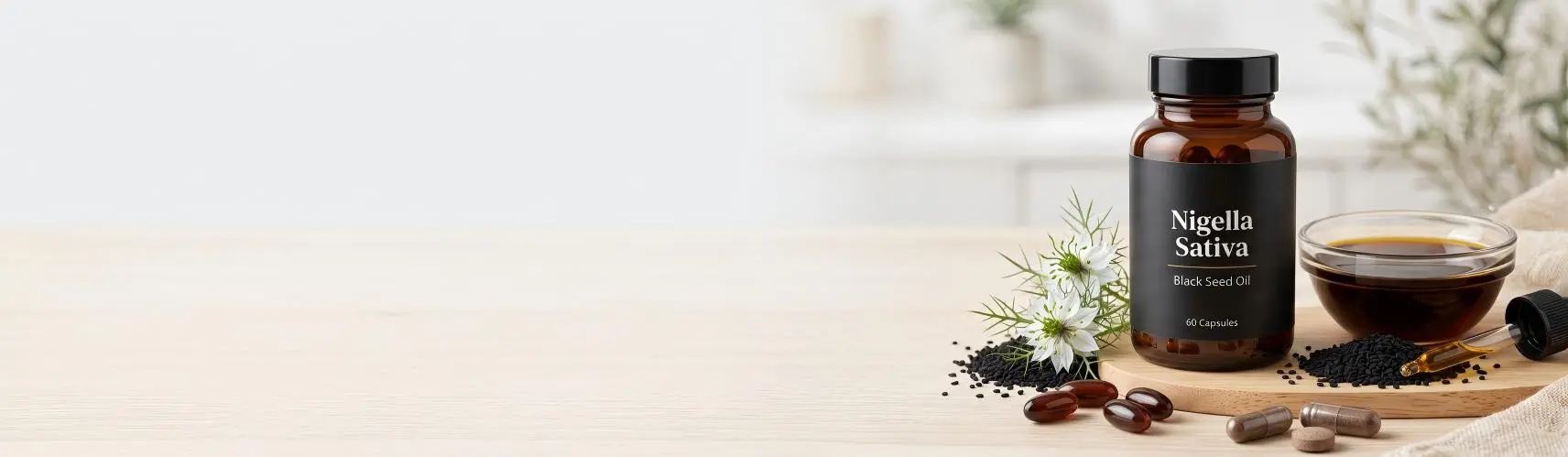
Black Seed Oil Capsules OEM/ODM Solution Partner
KS Nutripharma is a black seed oil capsules manufacturer for OEM, ODM, and private-label programs. We supplies finished Nigella sativa oil units as black seed oil softgels — custom fill weight, a TQ specification if the label will state it, and batch COA — as part of a black seed supplement manufacturer project.
The first decision is the oil grade and fill, not the bottle count. Name botanical identity, whether the oil is identity-grade or TQ-specified, fill weight, and shell before you compare quotes.
Have a CoA? Send it. We review species, seed, oil process, TQ method if named, and peroxide/acid value before quoting.
Request a Black Seed Oil Capsules Quote · Get a Spec Recommendation · Send Your CoA for Review
What to confirm so the first quote is usable | Typical project answer |
|---|---|
| Botanical | Nigella sativa L. seed oil. Not dry extract, not seed powder, not black ginger |
| Search term vs dosage form | “Black seed oil capsules” in trade search; softgel is the default oil fill |
| Oil type | Identity / cold-pressed oil · TQ-specified oil |
| Marker | TQ min / as-is / not specified + named method |
| Fill conversation | 500 mg / 750 mg / 1,000 mg oil per softgel — confirm against die and TQ math, not a catalog dose |
| Shell | Bovine gelatin (Halal/TSE file as scoped) or starch/carrageenan vegetarian system. Not HPMC |
| Pack | 60 / 90 / 120 / 180 count as a retail conversation; bottles or bulk undivided softgels |
| Documents | COA · specification · identity and safety tests as scoped |
| MOQ / lead time | Softgels typically from ~3,000–5,000 finished units (subject to fill, shell, and packaging); sample 7–15 days after the specification is agreed; mass production 30–45 days |
| Scope | OEM / ODM / private-label finished oil softgels. Bulk oil on the same finished-product project |
cGMP | ISO 9001 | ISO 22000 | HACCP | FSSC 22000 | Halal | Kosher | In-house lab + third-party pathways (SGS / Eurofins) | Batch COA | Traceable release
-> About Us | Manufacturing Capacity | Certifications | Quality Control
What you receive with an oil-capsule OEM project
- Matched N. sativa seed-oil specification
- Fill and die feasibility
- Sample based on the approved specification
- Prototype COA
- Production quotation by SKU
- Batch release documentation
- Packaging and export support
This page is manufacturing feasibility and documentation support — not legal approval of the finished label.
Black Seed Oil Capsules vs Softgels
In supplement trade, black seed oil capsules is the usual product-search term. Softgels are the dosage form used for a liquid N. sativa oil fill.
Buyers searching for capsules usually want a metered oral unit of seed oil — not a drum of oil, and not a dry-extract two-piece capsule. A two-piece hard shell is built for powder. Bulk oil in that shell is not the default: it needs a dedicated liquid-fill or adsorption review, and it is not how this page quotes a first SKU.
A softgel meters a fixed oil fill, limits oxygen and light compared with an open bottle, and contains odor. That is a process reason, not a repurchase statistic and not a promise of zero leaks. Vegetarian softgels use a starch/carrageenan (or named plant-gel) system — not HPMC.
How to Specify Black Seed Oil Capsules
Botanical identity → oil type → TQ (min / as-is / not specified) → fill weight → die and shell → oxidation pack → testing → count and label.
- Identity. Nigella sativa L., seed, expressed oil. Incoming identity should rule out other Nigella species and undeclared carrier oils.
- Oil grade. Identity cold-pressed oil or a TQ-specified / concentrated oil. Cold-pressed describes process. It is not automatically higher TQ.
- Per-unit math. Fill milligrams × assay = TQ milligrams per softgel — if the label will state TQ.
- Release. If TQ is labeled, use the same named method on incoming oil and on the finished unit. Confirm peroxide/acid value at fill in either case.
Artwork and disease-treatment copy from oil blogs delay a SKU you can actually label. Claim language stays with the brand owner and local counsel.
Black Seed Oil Specification for Softgel Fill
This section is the oil that goes into the softgel — not a bulk-oil catalog.
Confirm N. sativa seed. Whole-seed lots can be mixed with other Nigella species or look-alike seeds; oil can be diluted with cheaper vegetable oils. Name the species, then test the lot you will fill.
If the label will not state a TQ milligram: TQ may be as-is or not specified. Oxidation still has to be controlled.
If the label will state TQ: agree a minimum or range and a named method (HPLC is commonly discussed). USP-NF uses the title Black Cumin Seed Oil for a named N. sativa cold-pressed oil grade. That supports the naming, not a default TQ window for every drum on this page.
Serving math (illustration only, not a dosage recommendation):
1,000 mg oil × 2% TQ = 20 mg TQ per softgel
A 1,000 mg oil line is not 1,000 mg thymoquinone. Use oil milligrams, not shell weight.
At fill, also confirm: peroxide value, acid value, and fatty-acid profile where specified. Metals, micro, and residual solvents as the process and destination market require. How those oxidation numbers are held after fill is covered in leak control, shell drying, and oil oxidation below.
Black Seed Oil Capsules Formulation Options
These are oil-fill architectures for private-label softgels — not frozen SKUs.
Oil-plus-oil briefs (for example oregano oil) are quoted after market and dual-oxidation review. Compatible in the fill is not a safety or efficacy claim.
Request a Black Seed Oil Capsules Quote · Get a Spec Recommendation
Fit: Fastest oil SKU when the label shows seed oil, not a numbered TQ milligram.
Architecture: N. sativa seed oil ± antioxidant system as scoped. Softgel.
Specify: Process, peroxide/acid value, fill (500 mg / 1,000 mg as a starting conversation), shell.
Avoid: Copying a dry-extract claim onto this fill.
Fit: The Supplement Facts panel will state TQ math.
Architecture: Oil released against named TQ + method. Softgel.
Specify: TQ min or range, method, fill weight so serving math is honest.
Avoid: Treating a brochure percentage as cold-pressed as-is. 1%/2%/3%/5% are commercial label conversations, not a factory catalog. Lock oil milligrams × named method = TQ milligrams per softgel.
Fit: A second SKU beside a plain oil flagship (for example vitamin D3 oil or vitamin E).
Architecture: Compatible oil-phase fill, or a dual SKU (oil softgel + dry capsule).
Specify: Each assay file, oxidation stacking, destination-market claim file.
Avoid: Disease copy. Do not treat D3 or vitamin E as Black Seed TQ potency.
Fit: A blend SKU when the shopper already searches black seed and oregano oil.
Architecture: Dual oil-phase softgel, or two SKUs (plain oil + blend).
Specify: N. sativa TQ file; oregano carvacrol (or named marker) + method; dual PV/AV; fill mass per oil; destination-market claim file.
Avoid: Antibacterial, antiviral, parasite, or immune-boost copy. Do not treat oregano phenols as Black Seed TQ potency.
Black Seed Oil Softgel Specifications
Match fill, die, shell, count, and barrier pack after the oil grade is named.
Best for: Turning the oil spec into a unit the label can carry.
Why: Serving math is oil milligrams × assay, not shell weight.
Typical conversation: 500 mg, 750 mg, or 1,000 mg oil per softgel — confirm against die and TQ math, not a catalog dose.
What to lock: Fill weight, density, die.
Manufacturing note: These are fill conversations, not factory SKU sizes.
Best for: A metered oil fill and odor containment.
Why: Gelatin is the usual commercial shell; vegetarian is a different sealing and drying file.
Typical: Bovine gelatin with Halal/TSE documentation if required, or a starch/carrageenan vegetarian system.
What to lock: Gelatin source or plant-gel system, color, die.
Manufacturing note: Do not write HPMC here. HPMC is a two-piece hard-capsule shell.
→ Softgel Solutions
Best for: Private-label bottle programs.
Why: Count is a retail conversation, not a factory SKU list.
Typical conversation: 60 / 90 / 120 / 180 count; HDPE or amber as scoped; induction seal.
What to lock: Count, bottle resin, light/oxygen barrier, label.
Manufacturing note: Bulk undivided softgels are a different PO from retail-ready bottles.
Best for: Only if the brief forces a hard capsule after feasibility (adsorbed oil or liquid-filled hard capsule).
Why: Bulk oil is the wrong default fill for a two-piece dry shell.
What to lock: Feasibility first; then shell (this is where HPMC belongs).
Manufacturing note: If the real SKU is dry extract, that path is not this page.
→ Hard Capsules
A black seed oil softgel fails commercially when oil weeps at the seam, when fill weight is short because the die does not match oil density, or when peroxide value climbs in distribution even though the incoming drum looked acceptable. The one-piece shell is a barrier relative to an open bottle. It is not a claim of zero leaks or a complete oxygen lock.
Match rotary-die cavity volume to target fill mass and measured oil density so the ribbon closes on a full, centered fill rather than a trapped air pocket. Headspace inside the capsule is a leak and oxidation risk: underfill leaves oxygen against the oil; overfill stresses the seam while the ribbon is still plastic. During fill, nitrogen blanketing on the oil tank and, where scoped, inert headspace reduce dissolved and headspace oxygen before the weld sets. After encapsulation, inspect seam continuity and reject split, malformed, or leaking units before tumbling and drying. Light and heat during drying and packing still move peroxide value; that is why the pack conversation (amber vs HDPE, induction seal) belongs on the same RFQ as the die, not after artwork is frozen.
Odor is part of the same file. N. sativa oil is aromatic. A sound seam and a closed bottle contain it better than a two-piece powder capsule, but coating, flavor, or a gummy path will not rescue a leaking oil fill. If the brief needs a two-piece look, run feasibility first — do not assume banded liquid hard capsules behave like this default softgel.
Bovine gelatin remains the usual commercial shell for black seed oil: it forms a flexible ribbon, welds on a rotary die, and dries on a known curve. Halal, Kosher, and TSE documentation are project files, not automatic attributes of every gelatin lot. Vegetarian softgels on this page mean a starch/carrageenan (or other named plant-gel) system. HPMC is not a softgel ribbon. It is a two-piece hard-capsule polymer. Writing “HPMC vegetarian softgel” on an RFQ sends the project down the wrong tooling path.
Drying is where the two shells diverge. Gelatin ribbons lose water on a controlled tumble/tunnel curve until the shell is firm enough to pack without sticking or collapsing. Starch/carrageenan systems take a different moisture window and often a longer or re-validated drying cycle; rush-drying them to a gelatin schedule produces brittle seams, stickiness, or delayed leaks in the bottle. Disintegration also differs: gelatin softgels typically open in aqueous media on a familiar timeline; plant-gel shells can disintegrate more slowly or more variably depending on plasticizer, thickness, and residual moisture. If the destination market or the brand’s QC method names a disintegration or rupture test, name the shell before you lock artwork and serving count — a vegetarian switch is a new sample, not a drop-in gelatin BOM.
Cost and lead time follow that file. Vegetarian dies, ribbon formula, and extra drying occupancy are quoted as a different SKU from gelatin. Do not copy a gelatin 500 mg or 1,000 mg conversation onto a plant-gel shell without re-checking fill, die, and drying.
Peroxide value (PV) tracks primary oxidation (hydroperoxides). Acid value (AV) tracks free fatty acids from hydrolysis. N. sativa oil is rich in unsaturated fatty acids, so both numbers can move from drum to finished bottle if heat, oxygen, light, or residual moisture are left unmanaged. A high TQ percentage on the COA does not replace these gates. Identity cold-pressed oil and TQ-specified oil both need an oxidation file.
Set incoming PV and AV limits on the oil you will actually fill, not on a brochure lot. Re-check at fill if the oil has been held, warmed, or transferred. After encapsulation, PV can still rise in a poorly sealed bottle or in a clear pack under warehouse light; AV can rise if moisture reaches the fill. Antioxidant systems (for example mixed tocopherols) are scoped when the oil and the claim file allow them — they are not a license to skip barrier pack. Stability, where scoped, should include the same PV/AV methods used at incoming, on the finished softgel in the commercial pack, not only on bulk oil in a lab bottle.
Shelf life is not a copied 24-month default. Dating follows formulation, shell, pack, storage, and data. If the RFQ only states “black seed oil capsules, 1,000 mg,” ask for incoming PV/AV limits and whether finished-product oxidation will be reported on the COA. That is the difference between a quote you can repeat on the next lot and a one-drum sample that does not scale.
- RFQ — Capture destination market, oil type, TQ yes/no, fill conversation, shell (gelatin vs starch/carrageenan), bottle count, and volume in retail units so the first quote is a SKU, not a drum price.
- Oil spec review — Confirm N. sativa seed identity, declared process, TQ method if named, and incoming peroxide/acid value against the lot that will be filled.
- Die / fill / shell match — Match rotary tooling die to target fill mass and verified oil density so the ribbon closes without trapped headspace that later shows up as micro-leaks or short fill.
- Sample — Encapsulate against the approved specification, dry on the shell-specific curve (gelatin vs plant-gel), and issue a prototype COA on the same methods as commercial release.
- Pilot — Run fill-weight uniformity, seam and leak checks, and in-process weight at a scale that exposes drying and sorting issues before mass production.
- Stability / QC as scoped — Place the commercial pack on the agreed program and re-test named assay plus PV/AV where oxidation is on the file — not a drum TQ % copied onto the bottle.
- Production + packaging — Encapsulate, dry, sort, and pack into the locked bottle or bulk carton with induction or barrier as specified, keeping oil handling under the same oxygen/light/heat limits used at sample.
- Shipment — Release with COA, batch file, and export pack that match the sample grade the buyer approved.
One project, one chain: N. sativa oil sourcing → incoming oil QC (identity and oxidation) → fill → softgel → pack → shipment. You do not need to split oil trader, encapsulator, and packer.
OEM: You already have formula, fill, and pack files.
ODM: You have a concept and market; we help set oil grade → fill → die → pack.
Private label: Artwork, count, and bottle on an agreed oil specification.
| Stage | What is checked on this fill |
|---|---|
| Incoming | Identity (N. sativa seed oil), named TQ or oil profile if specified, peroxide/acid value, micro, metals as scoped |
| In-process | Fill weight, leak/seam checks |
| Finished | Agreed assay if labeled, pack integrity, batch file |
COA four blocks: Identity · Potency (analyte + method) · Safety · Physical (including oxidation parameters for oil). TQ on the COA must use the same named method as the agreed specification.
Lab: in-house; SGS/Eurofins when the RFQ requires it.
Documents available (by project scope, not an automatic full set): specification · COA · micro · heavy metals · allergen · Halal / Kosher · organic / Non-GMO / vegan where applicable · stability where scoped · packaging spec.
| Stage | Typical |
|---|---|
| Spec review | 1–3 working days on a complete brief |
| Sample | 7–15 days* after the specification is agreed |
| Pilot | 15–25 days* |
| Mass production | 30–45 days* |
Depends on formula, pack, testing, and schedule.
| Scope | Typical start |
|---|---|
| Softgels (this page) | Typically from ~3,000–5,000 finished units, subject to fill, shell, and packaging |
| Bulk undivided softgels | Quoted separately from retail-ready bottles |
| Bulk oil on the finished-product project | Quoted by kg |
Bulk kg MOQ ≠ finished-unit MOQ. Finished-unit MOQ is not a bottle MOQ.
Cost drivers: oil type · TQ specification · fill weight · shell · count and print · testing scope · destination-market documents. A higher TQ specification is not automatically a better commercial SKU.
Request a Black Seed Oil Capsules Quote
You do not need a finished Supplement Facts panel to start a black seed oil capsules OEM program. Name the oil and the fill, and we return a die match, a SKU-level quote, and a sample against a specification you can actually label.
Send destination market, oil type (identity or TQ-specified), TQ min / as-is / “recommend,” fill conversation, gelatin or starch/carrageenan shell, bottle count, order volume in retail units, and pack. If you already have an oil CoA, attach it — we check species, process, TQ method if named, and peroxide/acid value before quoting.
Ready to quote a fill? Request a Black Seed Oil Capsules Quote
Need the oil grade and TQ math set first? Get a Spec Recommendation
Comparing drums or current suppliers? Send Your CoA for Review
Related Resources
Use this before you lock a PO — so the CoA you send matches the oil you intend to fill.
- How to Read a COA — identity, named TQ method, and peroxide/acid value on the same file.
Are black seed oil and black cumin oil the same?
Usually yes when the specification names Nigella sativa seed. Confirm the Latin binomial — some spice lots sold as”black cumin” are a different plant. See Black Seed or Black Cumin.