
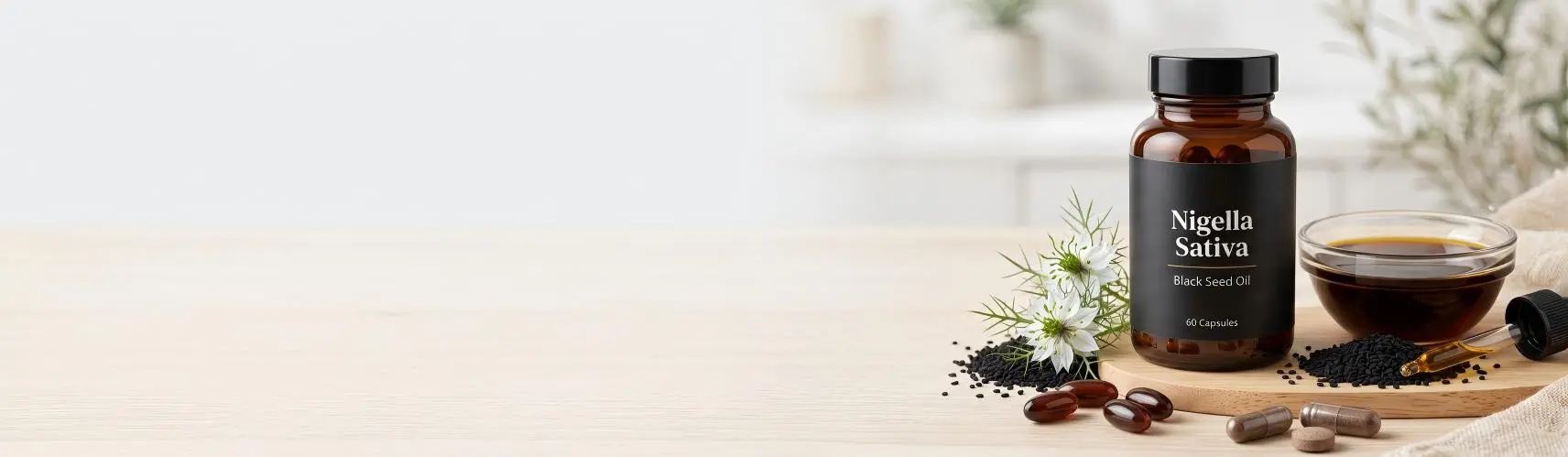
Black Seed Supplements OEM/ODM Solutions
KS Nutripharma is a black seed supplements manufacturer for OEM, ODM, and private-label programs. We manufacture finished immune support softgels, capsules, tablets, and powders from Nigella sativa (black seed / black cumin) oil, standardized extract, or seed powder — then carry the same specification through production and batch COA release.
Oil, extract, and seed powder are three different Black Seed materials. Start with which Nigella sativa material you need — not capsule count or TQ percentage. Black seed oil, a TQ-standardized extract, and milled seed powder are not the same PO line. Name the material type, whether the file will state thymoquinone, and the dosage form before you compare quotes.
Have a CoA? Send it. We review species, plant part (seed), material type, TQ method if named, and oil-quality parameters before quoting.
Request a Black Seed Quote · Get a Black Seed Spec Recommendation · Send Your CoA for Review
| What to confirm so the first quote is usable | Typical project answer |
|---|---|
| Botanical | Black Seed = Nigella sativa L. Seed. Not black ginger, not black sesame, not other Nigella species |
| Raw material | Expressed / cold-pressed oil · TQ-specified oil · seed powder · ratio extract · TQ-standardized extract |
| Key specification | Oil quality profile and/or thymoquinone (TQ) + named method. Extract ratio if used |
| Formula architectures | F01 oil softgel · F02 extract capsule · F03 seed powder · F04 turmeric · F05 ginger · F06 zinc / vitamin D · F07 short wellness stack |
| Formats | Softgels (oil; 500/1,000 mg fill conversation) / capsules / tablets / powder. Gummies after feasibility. Bottled oil = separate classification |
| Target market | Country + food-supplement classification + claim file + naming (Black Seed vs Black Cumin) |
| Documents | COA / specification / identity and safety tests as scoped |
| MOQ / lead time | Softgels and capsules typically from ~3,000–5,000 finished units (softgels subject to fill, shell, and packaging); samples 7–15 days after the specification is agreed; mass production 30–45 days — confirmed after formula, pack, and testing |
| Scope | OEM / ODM / private label / bulk oil or extract on the finished-product project |
OEM available: Custom formulation, private-label artwork, and white-label stock solutions.
cGMP | ISO 9001 | ISO 22000 | HACCP | FSSC 22000 | Halal | Kosher | In-house lab + third-party pathways (SGS / Eurofins) | Batch COA | Traceable release
-> About Us | Manufacturing Capacity | Certifications | Quality Control
What you receive with a Black Seed OEM project
- Matched N. sativa oil, extract, or seed-powder specification
- Formula and dosage-form feasibility review
- Sample based on the approved specification
- Prototype COA
- Production quotation by SKU
- Batch release documentation
- Packaging and export support
This page is manufacturing feasibility and documentation support — not legal approval of the finished label.
Custom Black Seed Supplement Formulation for Private Label SKUs
These are commercially established dietary-supplement architectures — not frozen SKUs and not traditional-remedy copies. Pick the closest card or send a BOM. KS formulation team and R&D center match it to channel and destination market, then set the N. sativa grade against that BOM. You receive a SKU-level cost, feasibility read, and sample plan — not pre-approved label claims.
Custom stacks (project-scoped): garlic; olive-oil blend; omega-3 dual SKU; vitamin C when F06 already covers zinc/D. Quoted after market review.
For finished-product development, see our supplement contract manufacturing service.
Request a Black Seed Quote · Get a Black Seed Spec Recommendation
Fit:Default oil flagship for immune support assortments — a metered seed-oil softgel, not a dry-extract capsule.
Format: Softgel (trade search: black seed oil capsules). Fill conversation 500 mg / 1,000 mg oil.
Specify: Process, TQ if labeled, peroxide/acid value, gelatin or starch/carrageenan (not HPMC).
Avoid: Copying F02/F03 powder claims onto this fill.→ Black Seed Oil Capsules Manufacturer
Commercial fit: Capsule brands that need a defined dry fill and a named TQ or extract-ratio specification.
Architecture: TQ-standardized or ratio N. sativa extract. Capsule default; tablet after compression review.
Best for: Simplest Supplement Facts on a dry SKU; quantified TQ math.
Not suitable for: Copying an oil softgel claim onto a dry extract line.
What to lock: DER or TQ % + method, carrier, capsule count.
Manufacturing note: Do not treat extract milligrams as thymoquinone milligrams.
Commercial fit: Cost-led identity SKUs that will show milled seed, not a concentrated extract or oil.
Architecture: Milled N. sativa seed. Capsule, often two-count per serving.
Best for: Labels that will not state a quantified TQ milligram.
Not suitable for: A numbered TQ claim without switching to F01 or F02.
What to lock: Particle size, capsule count vs serving weight, identity method.
Manufacturing note: Seed powder uses more capsule volume; odor and oil residue in the powder still need handling.
Fit: Two-botanical wellness SKU already sold in natural retail — assortment adjacency, not a joint-disease formula.
Format: Capsule first. Oil + curcuminoid in one softgel only after fill-system review.
Specify: Black Seed material type + curcuminoids % / HPLC as a separate spec.
Avoid: Inflammation-treatment or arthritis copy.
Fit: Botanical wellness / digestive health assortments, distinct from turmeric (F04).
Format: Capsule.
Specify: Ginger identity and gingerol method as a separate spec.
Avoid: GI-disease treatment copy.
Ginger Extract Supplement Manufacturer
Fit: Nutrition-led immune-adjacent stack when F01/F02 is too herb-only.
Format: Capsule or tablet when the mineral drives fill; D3 oil may split to a softgel.
Specify: Zinc salt (oxide vs glycinate changes tablet size), vitamin D form (D3 oil vs dry), Black Seed grade.
Avoid: Treating zinc/D as Black Seed TQ potency.
Fit: Short complementary stack at a mid price band — a second SKU next to F01/F02, not a duplicate of F06.
Format: Capsule.
Specify: Each companion identity, assay, and claim-risk file. Quote as a defined BOM.
Avoid: Unnamed “proprietary blend” with no assay plan.
Fit: Botanical oil blend when the brief already names black seed and oregano oil.
Format: Oil+oil softgel, or two SKUs (plain F01 + blend).
Specify: N. sativa TQ file; oregano carvacrol (or named phenol) + method; stacked peroxide/acid value.
Avoid: Antibacterial, antiviral, parasite, or immune-boost copy. Oregano phenols are not Black Seed TQ potency.
Choose the Black Seed Format: Softgels, Capsules, Tablets or Powder
Match load, odor, oxidation, serving size, and unit cost after the architecture is chosen.
Oil → softgel. Extract → capsule or tablet. Seed powder → identity / cost-led SKU. Do not reuse an oil BOM as a dry tablet, or a capsule BOM as a gummy.
Best for: F01; oil-based flagship; any brief that is actually black seed oil.
Why it is first here: Two-piece dry capsules are the wrong default for a bulk oil fill. Softgel isolates odor, meters a fixed oil fill, and limits oxygen/light exposure compared with an open bottled oil — a process reason, not a repurchase statistic.
Typical formula architectures: F01; F04/F06 only when the fill is oil or a reviewed suspension.
Typical fill conversation: 500 mg or 1,000 mg oil per softgel — confirm against shell size and TQ math, not a catalog dose.
What to lock: Oil grade, TQ if named, peroxide/acid value at fill, shell (gelatin source + Halal/TSE file if required, or starch/carrageenan vegetarian system — not HPMC), nitrogen/headspace as scoped, retail count.
Key manufacturing consideration: A dry F02 extract BOM is not poured into this shell. Vegetarian softgels are a different sealing/drying file from gelatin.
→ Softgel Solutions
Best for: F02, F03, F04 (dry), F05, F07.
Why: Isolates odor; precise dry fill; shortest sample loop for extract specs.
Typical formula architectures: F02–F05, F07. Extract fills are often discussed around 300–500 mg. F03 seed powder is the most likely two-capsule serving.
What to lock: Shell (HPMC/gelatin — this is where HPMC belongs), fill weight, pack. Confirm against bulk density, not a catalog dose.
Key manufacturing consideration: Liquid-filled hard capsules are an alternate oil path only after review — not the F01 default.
→ Hard Capsules
Best for: F06 mineral-vitamin stacks; cost-sensitive F02 SKUs; compact pharmacy bottles.
Why tablets are not the oil default: Black seed oil is a liquid. It is not a direct-compression fill. Tablets in this category are usually seed powder, dry extract, or a mineral stack — or an adsorbed / microencapsulated oil after a dedicated feasibility loop.
Typical formula architectures: F06 first; F02 when pack density leads.
What to lock: Compression, hardness, assay after press. Direct compression first for dry BOMs.
Key manufacturing consideration: A capsule BOM is re-validated before a tablet run. Characteristic odor may need coating as a scoped option.
→ Tablets
Best for: Seed-powder drink mixes and F03-style identity powders — a different SKU, not cheaper F01.
Why: Flexible serving weight. Oil is usually the wrong input for a stick.
Typical formula architectures: F03-style identity powders; custom drink-mix briefs.
What to lock: Taste/odor masking, color, moisture-barrier film, oil-in-powder leakage.
Key manufacturing consideration: Specify powder as its own SKU from the start.
→ Powders & Granules
Best for: Channel briefs that already require a gummy, after a dedicated feasibility loop.
Why they are not automatic: Strong taste, oil dispersion vs extract loading, depositing heat, water activity, assay per piece. An F01 softgel TQ claim often cannot be copied onto a small gummy piece.
Typical formula architectures: None by default.
What to lock: Active per piece, pectin vs gelatin, flavor system, extra sample time.
Key manufacturing consideration: If the piece cannot carry the agreed specification, the sample loop decides a split serving or a capsule/softgel path.
→ Gummies
Best for: Briefs that already specify a food-oil or cosmetic bottle (amber glass, dropper), after classification review.
Why it is not the default on this page: Taste, oxidation, dosing variability, and destination classification (dietary supplement vs food vs cosmetic/topical) are a different file from a metered softgel.
Typical formula architectures: None on this finished-supplement page.
What to lock: Market classification first, then pack barrier, dating, and whether this is even a KS finished-supplement SKU.
Key manufacturing consideration: Do not write that liquid oil “absorbs faster” or is for scalp/hair as a supplement claim.
After you pick the SKU architecture, confirm naming, classification, and claim language before you freeze the oil or extract grade.
Use one commercial name on the spec and the label file: Black Seed / Nigella sativa / Black Cumin / Kalonji. They can refer to the same seed when the specification names N. sativa. They are not automatic substitutes for other “black cumin” spices. Chinese 黑小茴香 is a naming trap (小茴香 usually means fennel). Do not use Black Ginger copy.
Safer commercial framing (verify locally): daily botanical supplement · oil identity SKU · immune-assortment adjacency · digestive-adjacent botanical set.
Artwork killers: lowers blood sugar · treats inflammation · prevents cancer · cures hypertension · “clinically proven to treat…”
| Market | Buyer should confirm |
|---|---|
| United States | Dietary supplement classification, structure/function claims, and notification requirements where applicable. Black seed is not an FDA-approved drug |
| EU / UK | Country-specific food / supplement / herbal classification and permitted claims. Do not assume one EU answer |
| Canada | NHP classification and product-specific requirements |
| Australia | Complementary medicine / food classification as applicable |
| Other markets | Local classification, claims, and import requirements. Cross-border retail of imported oil softgels is not a licence to copy their claims |
Do not carry disease-treatment claims from consumer oil content into F01 artwork. F02 needs a separate dry-extract specification; it is not a direct substitute for black seed oil. F03 does not support numbered TQ milligrams without a new spec. F04/F05 are not suitable for joint-disease or GI-treatment copy. F06 is not suitable for immune-disease claims. F07 needs a defined BOM, not an unnamed proprietary blend.
Traditional use, a published study, and a permitted finished-product claim are different files. A human safety study on a named TQ-rich oil grade (e.g. PMID 36518481) does not validate every oil, extract, or powder SKU. Clinical evidence does not automatically establish a permitted finished-product claim.
Pregnancy/lactation positioning, medication users, and high-dose TQ briefs need the brand owner’s regulatory review before sampling.
We source N. sativa as part of the finished-supplement project. This page covers finished-product development rather than standalone bulk-oil sales. The quote gap between oil, extract, and seed powder is usually different materials, not “someone overcharging.”
Decision chain: Market → Formula card → Format → Material type → TQ (min / as-is / not specified) → Cost.
| Material type | What you are buying | When it fits | What it will not support |
|---|---|---|---|
| Expressed / cold-pressed oil | Seed oil; identity + oil-quality file | F01 softgel | A dry-extract capsule fill; a TQ milligram claim without extra assay |
| TQ-specified oil | Oil released against named TQ | Active-led oil SKUs | Skipping peroxide/acid value because TQ % looks high |
| Seed powder | Milled seed; identity | F03; some powders | A numbered TQ claim without a different spec |
| Ratio extract | Concentrated seed described as DER | Cost-sensitive F02 | Treating 10:1 as 10× TQ |
| TQ-standardized extract | Dry extract released against named TQ | F02 quantified SKUs | Drop-in replacement for F01 oil |
| Custom | Solvent, DER, dual marker, organic | Named market file | Quoting “black seed” with no material type |
Black seed oil is the pressed lipid fill for F01. Specify process, identity, peroxide/acid value, and TQ only if the label will state it. Many oil SKUs are identity oils, not TQ-milligram oils. Cold-pressed describes process — not automatically higher TQ.
Black seed extract is the dry input for F02 capsules and tablets. Specify DER or TQ % + method, and the carrier. Extract ratio is not TQ potency. Standardized extract pathways: Standard Extracts.
Black seed powder is milled seed for F03. Serving mass is higher; residual oil still affects odor and stability. It is not a concentrate and not an oil.
Identity traps: Confirm Nigella sativa seed — N. damascena is not this file. Black ginger (Kaempferia parviflora) is a different plant. Black sesame is not black seed. “Black cumin” must be confirmed as N. sativa, not another cumin-class spice. 黑小茴香 is not a drop-in English spec name.
TQ percentage should not be treated as the only quality indicator. Identity oil, TQ-specified oil, extract, and seed powder are different specification files. Higher % is not automatically the better SKU.
| Decision | What to confirm |
|---|---|
| Material | Oil / extract / powder |
| TQ | Min / as-is / not specified |
| Assay | Named validated method (HPLC commonly discussed) |
| Finished serving | Raw-material mg × TQ % |
| Oil quality | Peroxide value / acid value |
| COA | Same grade + same method as the sample you will buy |
1% / 2% / 3% TQ are commonly discussed commercial label conversations for oil softgels (often next to a 500 mg or 1,000 mg fill). They are not a KS catalog default, and not “higher % is more effective.”
Label % is not cold-pressed as-is. If the brief wants 2% on a 1,000 mg oil fill, confirm whether that is a standardized / concentrated oil or an identity cold-pressed oil with as-is TQ. VOC (volatile oil content) is not the same analyte as TQ.
Serving math (illustration only, not a dosage recommendation):
Raw-material weight × assay = thymoquinone amount per serving.
1,000 mg oil × 2% TQ = 20 mg TQ
A 500 mg or 1,000 mg oil line is not 500/1,000 mg thymoquinone. Use oil milligrams, not capsule shell weight.
If the brief only says “Black Seed 2%,” confirm: oil or extract? TQ min or as-is? Named method? Raw-material spec or finished-product release?
Consistency is a process file, not a drum TQ % copied onto the bottle. F04–F07 companions are formulation-compatible in the blender or as dual SKUs — that is not a safety or efficacy claim.
| Challenge | What buyers should expect |
|---|---|
| Strong taste and odor | Shell choice, coating as scoped, pack; gummy flavor systems are a separate pilot |
| Oil oxidation | Freshness of oil, peroxide/acid value gates, oxygen/light/heat, antioxidant system where appropriate, barrier pack |
| TQ consistency | Crop, process, and method change the number; incoming spec + named assay — not one COA copied forward |
| Capsule fill weight | Seed powder and bulky extracts; bulk density and capsule size |
| Gummy compatibility | Taste, oil dispersion, piece loading, AW, assay per piece — often a split serving or a different format |
| Formula-to-label translation | TQ % on the drum → serving size → TQ mg → Supplement Facts. Oil ml vs mg must be declared the same way on spec and label |
Oil oxidation should be controlled during raw-material handling, fill, and storage where the SKU is an oil or an oil-containing fill. Dry extract SKUs still need odor and moisture control; they are not the same file as F01.
→ Moisture Control & Stability Engineering
Packaging & dating: Oil softgels use a barrier bottle or blister as scoped, with an induction seal. 60 / 90 / 120 / 180-count bottles are a common retail conversation — confirm count on the RFQ. Dry capsules/tablets commonly start with HDPE/PET + induction; desiccant when moisture leads. Shelf life comes from formulation + pack + storage + data.
| Stage | What is checked |
|---|---|
| Incoming | Identity (N. sativa seed), appearance, named TQ or oil profile, micro, metals, pesticides, residual solvents where applicable, peroxide/acid value for oils |
| In-process | Weight variation, blend uniformity, fill weight, moisture, hardness/disintegration for tablets, softgel fill/leak checks, gummy weight/texture as scoped |
| Finished | Identity, agreed assay, micro, metals as scoped, pack integrity, batch file |
COA four blocks: Identity · Potency (analyte + method) · Safety · Physical (and oxidation parameters for oil). TQ on the COA must use the same named method as the agreed specification — incoming, finished, or both, as the file states.
Lab: in-house; SGS/Eurofins when the RFQ requires it.
Documents available (by project scope, not an automatic full set): raw-material spec · finished-product spec · COA · micro · heavy metals · pesticides where applicable · allergen · Non-GMO where applicable · vegan where applicable · Halal · Kosher · organic documentation where applicable · stability where scoped · packaging spec.
- RFQ — market, F01–F07 or BOM, material type, TQ yes/no, format, quantity, pack
- Target market & spec review — naming, claims, oil vs extract vs powder, TQ method
- Formula development
- Sample
- Pilot — fill/compression/softgel leak, in-process
- Stability / QC as scoped
- Production + packaging
- Shipment — COA, batch records, export pack
MOQ and lead time
| Stage | Typical |
|---|---|
| Requirement review | 1–3 working days on a complete brief |
| Formula development | Project dependent |
| Sample | 7–15 days* after the specification is agreed |
| Pilot | 15–25 days* |
| Mass production | 30–45 days* |
Depends on formula, pack, testing, schedule.
| Scope | Typical start |
|---|---|
| Bulk oil / extract on project | Quoted by kg |
| Softgels | Typically from ~3,000–5,000 finished units, subject to fill, shell, and packaging |
| Capsules | Typically from ~3,000–5,000 finished units |
| Tablets | Typically from ~5,000–10,000 finished units |
| Powder / stick retail | Often from ~10,000 units |
| Gummies / liquids | Project-scoped |
Bulk kg MOQ ≠ finished-unit MOQ.
Packaging: bottles · jars · pouches · sachets · blisters where available · cartons · export cases. Standard vs custom artwork, Supplement Facts, batch/expiry, barcode, oil-pack compatibility.
Cost drivers: material type · TQ specification · dose per serving and serving count · dosage form · companion ingredients · bottle/pouch/print · testing scope · order quantity · destination-market documentation. Higher TQ specification does not automatically mean a better commercial product.
RFQ checklist
| Field | Include |
|---|---|
| 1. Target product | Finished SKU or bulk-on-project |
| 2. Material type | Oil / TQ oil / extract / seed powder / recommend |
| 3. TQ & method | Named % + method — or not specified; attach CoA |
| 4. Formula | F01–F07 or BOM |
| 5. Format | Softgels / capsules / tablets / powder / gummy (feasibility). Softgel: 500 or 1,000 mg fill conversation + gelatin vs starch/carrageenan shell |
| 6. Quantity | First PO in retail units + annual |
| 7. Market | Country + classification + channel + naming |
One project, one chain: N. sativa sourcing → incoming QC (including oil oxidation where relevant) → formula → sample → finished production → pack → shipment.
Buyers do not need to split the project into oil trader + extract vendor + formulator + filler + packer.
Capabilities: GMP · R&D · softgel / capsule / tablet / powder lines · QC lab · export docs · OEM/ODM/private label. Gummies line exists; black seed gummies still require feasibility confirmation.
Confirmed data: 5 production bases · 81,000+ m² · 2 R&D centers · 12 lines · 260+ professionals · since 2007 · 500+ brand projects · 60+ markets.
Start Your Black Seed Supplement Project
A vague “black seed capsules” request is not an RFQ — oil and extract quotes are different products. Send dosage form, material type, TQ specification or “recommend,” serving size, order quantity in retail units, and destination market. We will recommend a manufacturing path that matches a SKU you can label.
Request a Black Seed Quote
Get a Black Seed Spec Recommendation
Send Your CoA for Review
Related Resources
Oil is the pressed lipid fraction of N. sativa seed; extract is a dry concentrated or standardized preparation. They are different materials and different dosage-form paths — see Oil, Extract or Seed Powder above.
Yes, when the specification names Nigella sativa seed. “Black cumin” must be confirmed as N. sativa, not another spice. Black ginger and black sesame are different plants.
Yes, by project. Confirm oil or extract, TQ min or as-is, and a named method before sampling. TQ %, method, and acceptance criteria are set per SKU.
Yes. Oil-phase softgels are the default for F01 (typical fill conversation: 500 mg or 1,000 mg oil; bovine gelatin or starch/carrageenan vegetarian shell — not HPMC). Dry extract and seed powder go into hard capsules (HPMC or gelatin) or tablets.
Project-scoped. Oil dispersion, heat, water activity, and assay per piece require feasibility before quoting.
Yes. F04–F07 are established architectures. Each companion keeps its own spec and assay file.
We manufacture to spec and provide documentation. Brand owners confirm final label compliance with local regulatory counsel.
Target market, material type, TQ spec or “recommend,” formula/F-card, format, quantity in retail units, and packaging. Sample follows the approved spec.
Yes, when the specification names Nigella sativa seed. “Black cumin” must be confirmed as N. sativa, not another spice. Black ginger and black sesame are different plants. See Black Seed or Black Cumin.
No. Black seed is the seed. Black seed oil is the expressed lipid. Extract and milled powder are different PO lines. Oil flagships use a softgel, not a dry two-piece capsule.